1. Introduction
The exploitation of benthic resources by artisanal fishermen is an example of the use of common pool resources (CPR), which could generate individual interests that do not necessarily correspond to the group objectives such that, in different contexts, socially undesirable results (e.g., natural resource overuse or over-exploitation, lack of cooperation among agents) are expected (Taylor, Reference Taylor1987; Ostrom, Reference Ostrom1990, Reference Ostrom1993, Reference Ostrom, Hanna and Munasinghe1995; Ostrom and Gardner, Reference Ostrom and Gardner1993).
One potential solution to the CPR management problem, on which this work focuses, is for the people involved (in this case, artisanal fishermen) to make limited negotiation contracts in order to develop a cooperation strategy that they themselves will implement. In this CPR management plan, the agents involved have the right to use and exploit the resource, define the organization and its operational rules, and are responsible for resource management and exploitation within a determined geographic area (Taylor, Reference Taylor1987). The evident over-exploitation of benthic resources in Chile by the end of the 1980s was one of the consequences of the new international markets and the increasing export supply triggered by economic reforms in the country, leading to an uncontrolled escalation in the fishing effort (Bustamante and Castilla, Reference Bustamante and Castilla1987; Castilla, Reference Castilla1990; Bustos et al., Reference Bustos, González and Ponce1991).
At that time, artisanal fishing was not regulated. In 1989, an attempt was made to enact a Fishing Law and, in 1991, the approved Fishing Law incorporated a regulatory system based on the creation and allocation of territorial rights. Finally, at the end of 1995, the regulation of benthic resource management was enacted. The Benthic Resource Management and Exploitation Areas (BRMAs) were placed within the fishing administration system. Legally constituted artisanal fishing associations were assigned exclusive rights to use and exploit benthic resources in geographic sectors within five miles of the coast, only for artisanal fishing, or in inland and interior waters (SUBPESCA, 1995).Footnote 1
The BRMA regime was intended to promote the conservation and rational use of benthic resources as well as cooperation between artisanal fishing associations and the fishery administration. Therefore, this regime was expected to become a viable management system that would enhance artisanal economic activity by assigning natural shoals of benthic resources (SUBPESCA, 1995). Despite the increasing importance of this innovative fishing administration system, no previous work has systematically evaluated this critical aspect of either national or regional BRMA operations. This work contributes to the empirical study of the development of managed areas for benthic fisheries in Chile.
The BRMA system serves two main purposes in Chile: benthic resource conservation and improved economic conditions for local fishermen. However, the BRMAs’ economic performance is clearly uneven. Furthermore, some of the BRMA concessions have failed to manage the areas and others have even decided to return their concession to the regulatory authority. The reasons for these failures and for the inconsistent economic performance are not clear at all. These problems might be related to specific geographical and biological characteristics of the areas and/or problems within the fishing organizations.
In order to analyze the results of applying this regulatory regime, it is first necessary to evaluate the BRMA performance in relation to its objectives. This evaluation requires an indicator of the impact of the BRMA on the well-being of the coastal area and should consider both human and non-human elements of, for example, the coastal ecosystem. Ideally, this evaluation would compare the base line information, which was gathered prior to the use of managed areas, with that gathered after the implementation of the BRMA. However, on the whole, base line information is not available for such before (ex ante)−after (ex post) comparisons. Several authors suggest first evaluating the success of different management areas or their performance using the perception of key agents as a way to overcome this problem (Kamara et al., Reference Kamara, Koppen and Magingxa2001; Sumalde and Pedroso, Reference Sumalde and Pedroso2001; Pollnac et al., Reference Pollnac, Crawford and Sukmara2002). At the same time, the results of the management policy could also be analyzed by evaluating their direct impact on the economic performance of management sites; this is the approach followed in this paper. Specifically, we evaluated the impact of the management system on the economic performance by carrying out contemporaneous (spatial) comparisons of the BRMAs.
The objective of this paper is to study the economic performance of the BRMAs in central-southern Chile. The study considers 26 areas in operation between 2001 and 2003 that reported Chilean abalone (Concholepas concholepas) to be the main exploited benthic resource. We first calculated the economic performance indicator of the BRMAs studied and then we evaluated the role of economic, environmental–biological, institutional–organizational, and organizational leader characteristics as potential determinant factors for BRMA economic performance. We used per capita benefit as a measure of the individual economic performance of the BRMAs. The per capita benefit for each area and year considered was calculated, based on the information available for income per annual Chilean abalone harvest, annual harvest costs, and the number of members in the fishing organizations.
This work is organized in five sections. Section 2 describes the regulatory BRMA system and the management areas in the Bío-Bío Region, central-southern Chile. In section 3, after a brief review of the literature on evaluations of community-based natural resource management, we discuss the econometric specification used for this analysis. The results from our estimations are presented in section 4. Finally, in section 5, we offer conclusions arising from the analysis; policy implications are also discussed.
2. Regulatory system: Benthic Resources Management areas
2.1. General description
The BRMA management system in Chile gives local fishermen the responsibility for regulating and administering benthic resources, the fishing organization, conflict control, and planning. Moreover, all these aspects focus on complying with goals set by and for the fishermen themselves.
Local fishing organizations interested in establishing a coastal Managed Area must first apply for this designation through the Under-Secretary of Fisheries (Subsecretaría de Pesca, SUBPESCA). Once the physical area is declared to be a Managed Area, the organization must present to the National Fisheries Service (Servicio Nacional de Pesca, SERNAPESCA) a Base Situation Study of the Area and a Management and Exploitation Plan of the Area (MEPA) detailing the area's initial characteristics and the benthic resource extraction plan.Footnote 2 If these studies are acceptable, an Agreement of Use is approved by resolution, establishing a renewable four-year period of administration and benthic resource extraction. During this period, the fishing organization should issue monitoring reports of local performance, including: area monitoring, direct target species assessment, general aspects of the benthic community (including secondary species), catch information, catch quota, and the area's social-economical performance (price trend, per capita income, cost/benefit ratio, access, training, etc.). Although this information has been requested as of 2003, it has not necessarily been included in all the monitoring reports received thus far.
Once the Agreement of Use has been renewed at the end of the fourth year, the organization must pay an annual tax based on the surface of the Managed Area (34,700 Chilean pesos or US $745 per ha per year). We are aware that this tax has been recently reduced (9,300 Chilean pesos or US $1.8 per ha per year) and payment is currently being required after the second year since the Agreement of use has been approved.
Extraction must be specified in the MEPA or approved in the last monitoring report, which should indicate an extraction plan for the year (total allowable quota), specifying the estimated landed catch in tons. Authorization for extraction is granted by SERNAPESCA (the Chilean fisheries enforcement authority) and SUBPESCA; SERNAPESCA supervises harvesting during the days allotted for this activity. Thus, the organization itself, aided by the monitoring and enforcement agency, determines the total harvest amount and its schedule.
2.2. Managed areas in the Bío-Bío region, central-southern ChileFootnote 3
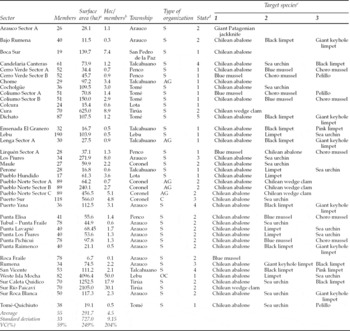
As of 2003, a total of 108 areas had been requested for BRMA in the Bío-Bío Region: 26 were rejected, 15 left pending, and 67 granted. Only 40 of the Managed Areas were operating (60 per cent of the total granted areas), 26 reported Chilean abalone among their target species, and only 20 reported extractions of that resource.Footnote 4
Appendix 1 gives the characteristics of the 40 areas that were operational as of 2003. On average, each Managed Area is administered by 55 members, with a standard deviation of 33 (60 per cent variation coefficient). The mean surface area is 292 ha, although a few very large (e.g. West Isla Mocha) and other very small (e.g. Roca Fraile) areas result in a very high variation coefficient (250 per cent). The average number of hectares per member is 4.5, with a standard deviation of 9.15 ha per member; this variation coefficient is also high (204 per cent), suggesting wide variability in the physical characteristics of the areas allocated to each organization.
In the Bío-Bío Region, 85 per cent of the operating areas are held by unions, 10 per cent by trade associations, and 5 per cent by community groups. Furthermore, half of the areas operating in the Bío-Bío Region are located in the townships of Penco, Lirquén, Talcahuano, San Vicente, and Coronel. The other half, in Arauco, Isla Santa Maríıa, Lebu, and Tirúa, are in the southern part of the region, which is less connected to urban areas.
The benthic resource Chilean abalone (Concholepas concholepas) is the target species for 65 per cent of the Managed Areas, followed by blue mussels (Aulacomya ater; 13 per cent), Chilean wedge clams or duckbill tagelus (Tagelus nombeii; 5 per cent), and giant Patagonian jack-knife mussels (Ensis macha; 2 per cent) (see Appendix 1).
3. Determinants of economic performance
3.1. Literature review and working hypothesis
The existing literature on the effects that a management system for natural resources has on the community performance includes studies of individual programmes and projects implemented under Community-Based Coastal Resource Management (CBCRM). These studies relied on the Independent Base Line Technique (Pomeroy and Carlos, Reference Pomeroy and Carlos1997; Pomeroy et al., Reference Pomeroy, Pollnac, Katon and Predo1997), a methodological tool that considers information gathered before (ex-ante) and after (ex-post) the implementation of a CBCRM programme and verifies changes in biological and social indicators and the perception of wealth in the community. Although this sort of analysis is ideal for identifying variations in the initial conditions stemming from the management system, its use is not feasible given the lack of reliable base line information for the studied areas.
Platteau and Abraham (Reference Platteau and Abraham2002) offer an evaluation of community management systems and their characteristics. These authors found that natural resource management by communities has been well accepted and implemented by many organizations. However, they also pointed out that community management is not possible if there are imperfections in the community, that is information problems (circulation of erroneous information), non-unanimous agreements (low community interaction and unclear decision-taking procedures), problems with participatory regulations, and the risk of discrimination (conflicts due to different ways of thinking or beliefs among members). In a related study, Ostrom and Gardner (Reference Ostrom and Gardner1993) evaluated the conditions that might contribute to the development of an irrigation community when important differences exist among its members. Their study explored the interactions between community leaders and members when taking decisions regarding the conservation of irrigation systems and examined empirical evidence from an irrigation study in Nepal.Footnote 5
Antinori and Rauser (Reference Antinori and Rausser2003) considered the physical characteristics of community-administered natural resources and community cooperation through a study aimed at verifying the effect that the type of communication channels used by a forestry resource management organization has on its performance indicators. The authors sampled 44 communities or groups of workers involved in wood production in Mexico. Ecological and cooperation indicators were used as dependant variables and their empirical relationships with the quality of the communication channels were analysed as independent variables (rate of meeting attendance and community participation in decision-taking processes). The authors found interaction between the community and forest advisor to be a meaningful predictor of compliance with forest usage and ecological rules. Meeting attendance explained respect for regulations, but not the ecological condition of the woods.
In a related study, Kamara et al. (Reference Kamara, Koppen and Magingxa2001) explained the economic performance and relative contribution of certain socio-economic factors to net incomes per hectare in irrigation communities, or ‘projects’, in the south of Africa, which are implemented by the government in different areas with community participation. The authors based their study on a conceptual model in which the physical-technical and socio-economic conditions of the organizations affect productivity and profitability both individually (for each farmer) and overall (for each project). Individually, productivity and profitability depended on the farmer's reliance on irrigation, agricultural knowledge, management skills, and disposition to cultivate; at the project level, the capacity to organize, observe regulations, and resolve internal conflicts determined productivity and profitability. The administrative and operational costs generated by the organization could be affected by the demand for water supply for other types of activities that may modify both water supply and quality. Productivity and profitability explained the level and distribution of net incomes individually and for the overall project (organization), the demand for labour, and environmental indicators such as soil and water quality, etc. The resulting incomes could improve the community's socioeconomic and technological conditions, thereby improving the project's sustainability and feasibility. Information on the dependent variable came from a total of 64 observations of family groups from four projects, which explains the high net income. This variable included: age, size of family group, farmer's schooling, activity income, other incomes, and a property deed. The authors found that the variation in the dependent variable (net income per hectare) could be explained mainly by the size of the family group and the percentage that the community activity contributed to its overall income.Footnote 6
A number of published works study BMRAs in Chile. Most of these studies associate biological and technical aspects with the operations of the managed areas (Castilla and Fernández, Reference Castilla and Fernández1998; Jeréz, Reference Jeréz, Alveal and Antezana2001). González (Reference González1996) provided an initial analysis of the management system, including its origins and a general description of its main aspects. Cereceda and Czischke (Reference Cereceda and Czischke2001) reported on case studies that examined success factors in two coves: El Quisco and Quintay. In addition to these, a study by the Fishery Research Fund prepared by the Ecology and Resource Management Group of the Universidad Católica del Norte analyzed the performance of BRMAs according to biological indicators (see the Final Report for FIP Project 2003−18, November 2005). A recent case study described organizational styles and operating rules in Benthic Resource Management and Exploitation Areas of the Bío-Bío Region (Palma and Chávez, Reference Palma and Chávez2006).Footnote 7
Considering the main purposes of the BRMA system in Chile and the evidence of the actual BRMA operations, which suggests heterogeneous outcomes in terms of economic performance, and based on the literature review about factors explaining community performance, we explored the hypothesis that economic, environmental–biological, and organizational factors and the characteristics of the organizational leader affect the economic performance of a Managed Area under an Agreement of Use in the Bío-Bío Region, central-southern Chile. Section 3.2 provides an empirical analysis of the economic performance determinants for a unique example of locally managed fishery resource systems. These determinants were created by the government within the context of a country with no previous experience in cooperative coastal fishery management.
3.2. Econometric model and data description
The factors that determine the economic performance of a Managed Area are studied herein. Economic performance was measured as the annual per capita profit that a fisherman belonging to a BRMA would earn from Chilean abalone. This variable was calculated, for each year and BRMA, as the difference between annual total incomes from Chilean abalone harvests, deducting the total costs observed and divided by the number of corresponding organizational members. The total incomes were obtained by multiplying the observed average annual price of Chilean abalone in each BRMA by the total annual harvest recorded. The costs included operational costs such as provisions, transportation, extraction materials, office supplies, follow-up consulting services, unforeseen expenses and other minor costs, fuel costs, and other costs associated with equipment and engine maintenance. Formally, the per capita net benefit for BRMA i in year t can be described as follows
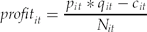
where profitit is the per capita net benefit (in thousands of Chilean pesos) in area i for year t; pit is the average price of Chilean abalone (in Chilean pesos/unit) in area i for year t; qit is the harvested amount of Chilean abalone (in units) in area i for year t; cit is the total annual harvest cost (in Chilean pesos) in area i for year t; and Nit is the number of organizational members in area i for year t.
An econometric model is used to estimate per capita benefits, taking the economic, environmental–biological, and institutional–organizational characteristics and those of the organizational leader to be its determinants. This is estimated with the following equation

where, as described before, profit represents the net per capita benefit obtained from the harvest of Chilean abalone exploited in area i for period t; p is the vector of the economic characteristics associated with Managed Area i for period t; z is a vector including Managed Area environmental–biological characteristics; k is a vector including Managed Area institutional–organizational characteristics; d is a vector including the characteristics of the organizational leader in area i for period t; the αs are the parameters to be estimated; and v is a random error term.
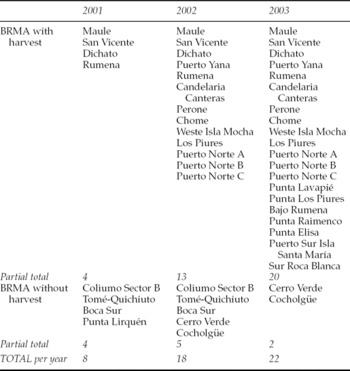
The analysis included BRMAs in the Bío-Bío Region that have an Agreement of Use and reported harvesting the target benthic resource Chilean abalone (Concholepas concholepas). Out of the 26 BRMAs (see table 1) considered, only 20 reported harvesting the target resource during the study period (2001–2003).Footnote 8 It should be noted that all areas were operational, with benthic resource extraction authorized right after the Agreement of Use was declared between the organization and the State. Consequently, the areas began their operation by selling their harvests and accruing several costs, some directly from exploitation and others related to monitoring reports. Nevertheless, in the period indicated, some BRMAs in the Bío-Bío Region generated incomes by harvesting species other than Chilean abalone, although their participation in the total income was not relevant.Footnote 9
BRMA under Agreement of Use in the Bío-Bío Region (2001–2003) according to harvest conditions
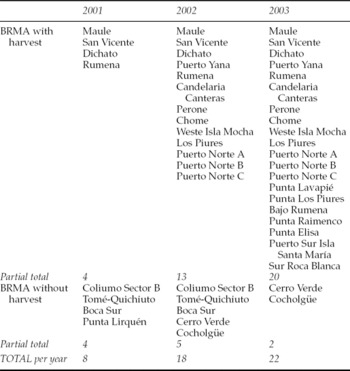
Source: Own elaboration based on information provided by SERNAPESCA and surveys of BRMA organizational leaders.
We gathered information from the BRMA follow-up reports and harvest and price records available from the National Fishing Service (SERNAPESCA). This information was complemented with structured surveys of the leaders of organizations administering the areas in the period considered. The BRMA economic performance analysis considered several characteristics as potential determinant factors. Consequently, the information collected was sorted into the four previously indicated categories:
1 Economic characteristics
Price of the main species (PRICEit): corresponds to the average price per unit of Chilean abalone in Chilean pesos observed in every area i in year t.
2 Environmental–biological characteristics
Hectares of the area (HASi): number of hectares included within the coastal area borders forming a polygon. This is defined when area i is requested and determined by a legal resolution.
Average size (SIZEit): average size in mm of the benthic resource available for harvesting in area i in year t.
Commercial size fraction (COMSIZEit): the percentage of specimens (Chilean abalone) in the total biomass that are equal to or larger than 100 mm in area i during year t.
Habitable polygon (bathylogical chart) (POLYGONi): the variable describing the surface inhabited by the benthic resources in area i. This is a continuous variable, expressed as surface in hectares.
Density of other species (DENSORit): density of other species present in area i during year t that are interrelated within the area. This is measured in individuals per square meter (ind/m2).
Density of the target species (DENSPit): individuals per square meter of the main species for extraction (ind/m2) in area i during year t.
Growth parameter (BETAi):Footnote 10 growth parameter relating an estimate of weight as a function of the length of the species in area i.
3 Institutional–organizational characteristics
Number of members (NMEMBERSit): number of fishermen registered in the organization of area i in year t.
Number of divers (NDIVERSit): number of divers belonging to the union administering area i in period t.
Type of organization: this indicates whether the organization is a labour union (UNION), trade union association (ASOCG), or other. This is a dichotomous variable, being 1 if the organization is a labour or trade union association and 0 in all other cases.
Gender (MENit): percentage of male members of the organization administering area i during period t.
Organizational fee value (FEEit): the value to be contributed by every fisherman belonging to the organization administering area i to facilitate its management. This is a continuous variable.
Rural–urban location (URBANi): location of the area in the region. This is a dichotomous variable, being 1 if the BRMA is located in an urban zone and 0 in all other cases.
4 Characteristics of the leader
Age (AGEit): age of the leader of area i in period t.
Education (EDUCAit): education level of the leader of area i in period t. This is a categorical variable on a scale of 1 to 5: incomplete elementary education (1), complete elementary education (2), incomplete secondary education (3), complete secondary education (4), higher training or other (5).
Experience in the activity (EXPFISHINGit): number of years that the leader of area i has worked in the fishing activity through period t.
Leadership experience (EXPLEADERit): number of years that the person has been the leader of the organization administering area i through period t.
Other economic activity (OTHERACTit): this indicates whether or not the leader of area i has another work activity during period t. This is a dichotomous variable, being 1 if the leader works in another place and 0 in all other cases.
Marital status (MARRIEDit): this indicates the marital status of the leader of the organization administering area i during period t. This is a dichotomous variable, being 1 if the leader is married and 0 in all other cases.
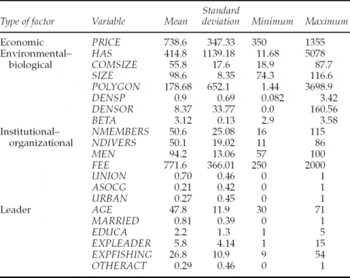
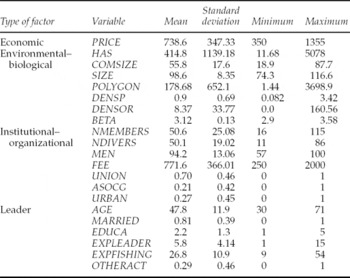
The exploration of data for all the areas that reported Chilean abalone harvests in the study period indicated near-zero values for some environmental–biological variables. These areas had practically no Chilean abalone despite the fact that it was declared to be the main resource for exploitation (see table 2). On average, the density of other resources (DENSOR) was greater than that of Chilean abalone. Some organizations had few members (16), whereas others were much larger (115); the average was 51 members per BRMA, most of which were men (MEN).
Descriptive statistics for determinant factors of BRMA economic performance in the Bío-Bío Region (2001–2003) for areas harvesting Chilean abalone
Source: Own elaboration based on information provided by SERNAPESCA and surveys of BRMA organizational leaders.
The average age of the organizational leaders was 47, with the youngest being 30 and the oldest 71. Most were married and had completed their elementary education. On average, the leaders had 27 years of experience in the local fishing sector and had led the Managed Area organization for 5.8 years.
4. Econometric results
4.1. Estimation by ordinary least squares with correction for selection bias
Since the information considered corresponded to operational areas that harvested Chilean abalone between 2001 and 2003, omitting any operational areas that did not harvest Chilean abalone in spite of available information on exogenous variables, the coefficients are probably biased. To correct for a possible selection bias, the Heckman (Reference Heckman1979) method was applied in two steps (Green, Reference Green1998). Because our empirical study was based on a small sample of a total of 46 observations made at 26 sites in central-southern Chile, these results must be taken with care.
First, a selection model was estimated considering the total number of observed operational Managed Areas (20 with and six without harvests), independently of their Chilean abalone harvest or lack thereof. In this first stage, a probit model was estimated for the BRMAs harvesting decision. The specification we used was given by

where P is the probability indicator, HARVESTit is a binary variable that takes a value equal to 1 if managed area i harvests Chilean abalone in period t, and 0 otherwise; and f(.) is the probability function. We considered two variables affecting the harvesting decision: DENSPit, the number of individuals per square meter of the target species (ind/m2) in area i for year t, and NDIVERSit, the number of divers that belong to the organization that manages area i during period t.Footnote 11 Equation (3) was estimated by the maximum likelihood method and the inverse Mills ratio was estimated for each BRMA.
In the second step, a linear model was estimated for per capita benefit of the BRMA in the Bío-Bío Region according to equation (2). The estimated variable in the first step (the inverse Mills ratio) was introduced into equation (2) in the second step. We denoted this variable as LAMBDA. The estimated coefficients were not efficient but were consistent.
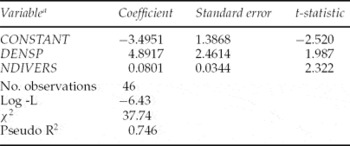
Table 3 shows the results for the estimation of the harvesting decision equation (probit model). The results showed that both coefficients had the expected positive sign (5 per cent error). The positive sign for the estimated parameter associated with the resource density variable (DENSP) suggested an increasing probability of Chilean abalone harvests in Managed Areas with higher resource densities. The sign of the parameter estimated for the variable number of divers (NDIVERS) indicated that the probability that a BRMA would harvest Chilean abalone increased with the number of members who are divers.
Probit model estimation results for harvest decision: BRMA with an Agreement of Use in the Bío-Bío Region (2001–2003)
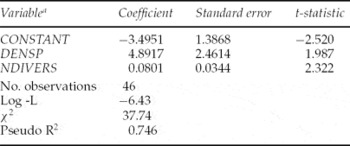
Notes: aDENSP: individual per square meter of Chilean abalone; NDIVERS: number of divers in the organization.
Source: Own elaboration based on econometric results.
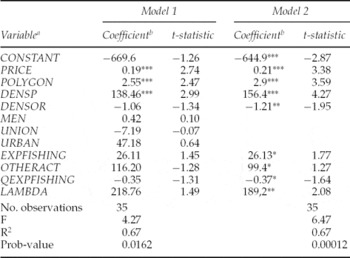
The model described in equation (2) was estimated by using ordinary least squares (OLS) and correcting for selection bias, including only those areas that harvested Chilean abalone from 2001 to 2003. Table 4 shows the result of preferred specification.Footnote 12 In that model, the variables that were highly correlated and the institutional–organizational characteristics that were not statistically significant were excluded. It was possible to obtain a simple specification.Footnote 13 The analysis of the simplest estimated model (model 2, table 4) had an R-square of 0.67. From a global perspective, the model was statistically significant (F = 6.47) and the additional variable (LAMBDA) for the predicted harvest decision was taken into consideration; this turned out to be positive and statistically significant. This indicated that the estimates made with the sample excluding the non-harvesting BRMA may have been biased. Moreover, a positive coefficient suggested a positive correlation between the errors of the regression equation and those of the selection.
Estimation results for per capita benefit, with selection bias correction: BRMA with an Agreement of Use and Harvest in the Bío-Bío Region (2001–2003)
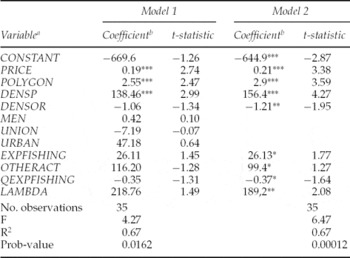
Notes: aPRICE: average price per unit of Chilean abalone; POLYGON: surface inhabited by Chilean abalone in area; DENSP: individual per square meter of Chilean abalone; DENSOR: density of other benthic resources; MEN: percentage of men members of the organization; UNION: type of organization; URBAN: location of area; EXPFISHING: number of years that leader work in fishing; OTHERACT: indicates whether the leader has another work activity; QEXPFISHING: is the square of EXPFISHING variable.
b *p < 0.10; **p< 0.05; ***p < 0.01.
Source: Own elaboration based on econometric results.
The results suggested that the economic variable (PRICE), environmental–biological factors (POLYGON, DENSP, DENSOR), and the characteristics of the BRMA's leader were relevant explanatory factors for the BRMA's economic performance.Footnote 14 The parameters associated with these variables were estimated at statistical levels of significance greater than 0.05 and 0.01.
It is interesting to note that the sign for the variable representing leader's experience in fishing activities (EXPFISHING) and its non-linear effect were as expected, suggesting that experience has a positive but decreasing effect on the BRMA's per capita benefit. We decided to include the OTHERACT variable in order to evaluate this frequent behaviour of leaders, considering that harvests only take place during three months of the year.
4.2. Elasticity and analysis by type of area
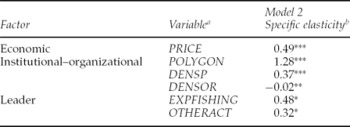
Considering the estimates of the selection model for the performance of a Managed Area of benthic resources harvesting Chilean abalone in the Bío-Bío Region, we decided to explore the effects of selected variables, determining economic performance by means of specific elasticity estimates. Table 5 shows that, according to our estimations, a 1 per cent variation in the selling price of Chilean abalone results in an increased per capita benefit of 0.49 per cent for the BRMA in the Bío-Bío Region. Although it is not surprising that the price of Chilean abalone affects profits, it is interesting given the amount of variation we found in prices among sites. The variation may be explained, in part, by the market structure and the specific form of negotiations involved. According to information gathered in a recent case study that analysed organizational and institutional characteristics of BRMAs, for each area, a commission represents the organization in negotiations with potential buyers. The commission is appointed by the member of the organization in a regular meeting. Usually, the commission includes two or three members, including the head of the organization. The commission is allowed to set and negotiate prices, volumes of transactions with potential buyers, and other related aspects. In a recent survey, fishermen belonging to BRMAs reported a low number of buyers and described a market structure that can be characterized as a bilateral monopoly. Apparently, observed prices result from the relative negotiating power on each side of the market (Palma and Chávez, Reference Palma and Chávez2006). Although the size of Chilean abalone also defines the price, with higher prices for heavier specimens, in some organizations, there is just one buyer who provides short-term loans before the onset of the harvest season as an advance on payment. Thus, the organization makes informal contracts with the buyer, thereby acquiring financial resources to fund their harvest operation costs; the organizational leaders perceive this situation as advantageous for the buyer at the moment of negotiating final prices (Palma and Chávez, Reference Palma and Chávez2006). Therefore, variations in observed prices among organizations could be due to characteristics of the Chilean abalone (size, weight) as well as the negotiation power, abilities, and position of each organization.
Effects of independent variables on the per capita benefit in managed areas (Bío-Bío Region, 2001–2003)
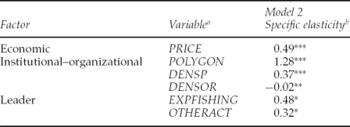
Notes: aPRICE: average price per unit of Chilean abalone; POLYGON: surface inhabited by Chilean abalone in the area; DENSP: individual per square meter of Chilean abalone; DENSOR: density of other benthic resources; EXPFISHING: number of years that leader work in fishing; OTHERACT: indicates whether the leader has another work activity.
b*p < 0.10; **p< 0.05; ***p < 0.01.
Source: Elaborated by the authors using the results of the econometric estimates.
Among the environmental–biological factors, the habitable area of Chilean abalone in the Managed Area (POLYGON) had the greatest effect on economic performance. With a 1 per cent increase in surface, the per capita benefit could be expected to increase by 1.28 per cent. A 1 per cent increase in Chilean abalone density (DENSP), on the other hand, would cause a 0.37 per cent rise in the per capita benefit. However, if the density of the other benthic resources in the Managed Area were to increase by 1 per cent, the per capita benefit would decrease by 0.02 per cent.
The characteristics of the leader also provided interesting results. A non-linear effect was found for the variable associated with the leader's expertise in the fishing activity (EXPFISHING). The elasticity of the per capita benefits with respect to expertise in the fishing activity, considering the average value of the leader's years of experience, suggested that a 1 per cent increment in years of fishing experience would cause per capita benefits to increase by 0.48 per cent.
5. Conclusions
The results from this paper indicated that the economic performance of BRMAs in the Bío-Bío region, central-southern Chile, was determined mainly by economic and environmental–biological factors. Our results showed that restricting the analysis to areas with harvests caused a selection bias; therefore, data were also incorporated for those areas that did not harvest during the studied period. Specifically, and related to the aforementioned factors, the following analysed variables were found to be determinant factors of economic performance: Chilean abalone price, habitable area, target resource density, and the density of other benthic resources in the area.
The determinant economic factor was the variable price of the species. Although not surprising, this result is particularly interesting if we consider the process of price determination of the main species under management. In fact, fishing organizations and especially their leaders directly negotiate prices with intermediaries. Since the number of intermediaries is reported to be low, the result of the negotiation process depends on the negotiating skills of the organizations. The price information that we have, which was used in the estimates, suggests heterogeneity in the selling prices of the studied organizations for each year. This may be determined by differences in the harvested resource (its size, for example), but may also be an indicator of the negotiating position of the organizations in relation to that of the middlemen involved. Because of the importance of price for determining the economic performance of the areas under study, it may be relevant to improve management and negotiating skills related to harvest sales. As a policy implication, this result showed that, along with granting concessions, the regulating authority could also support the system by providing specific training on management, marketing, and negotiation. Furthermore, improving the negotiation positions of the managed areas by, for example, providing short-term loans to help them fund harvesting operations could enhance economic performance and well-being in Chile's coastal communities.
Three environmental–biological factors (habitable surface for Chilean abalone, the density of this resource, the density of other resources) determined the economic performance of BRMAs in the Bío-Bío Region. This is important because the BRMAs define the main species to be exploited and, if the density and habitable surface are not suitable, other more appropriate species should be defined as the main target species. This would ensure economic benefits for the organizations. From another point of view, our results indicate that the economic performance of the BRMAs depends on the biological productivity of the assigned areas. This consideration is relevant when it comes to defining the location of the BRMA, not only for the fishing organizations but also for State agencies that take part in the process of assigning areas. The results for leader experience suggested that the time spent working in fishing as well as BRMA management increased per capita profit.
Our analyses indicate that the most relevant variables to observe when a BRMA has been territorially defined are the necessary design of a harvest programme and a BRMA development strategy. The government could encourage the organizations to select zones with proper habitable polygon characteristics and resource density. Moreover, it could suggest that fishermen in the organization participate in training programmes and perhaps define specific requirements for personal characteristics of fishermen that can be elected as leaders of the organizations.
Our empirical analyses can be extended in several directions. For example, our estimates consider that the price at which harvests are purchased from the fishing organizations in each period is exogenous. Further research should consider how the selling price of the resources harvested and managed by fishing organizations is structured. This work indicated that price is relevant and varies among different organizations. In addition, the estimates could be refined by explicitly considering a data base with a panel structure. This would perhaps require increasing the number of observations in the operational areas over time.
Finally, the monitoring and evaluation of the management regime based on territorial rights should continue. This is particularly important if we consider the coverage of this management along the coast of Chile, as well as the fact that one of the main objectives of the BRMA is to improve the economic conditions of local fishermen, their families, and communities.
Descriptive statistics for Benthic Resource Managed Areas operating in the Bío-Bío region (2001–2003)
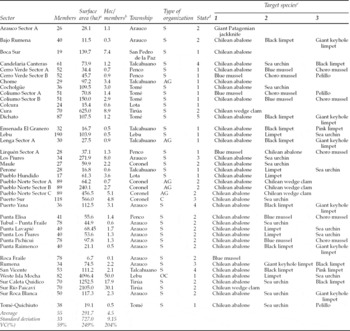
Notes a: surface area in hectares.
b: surface in hectares per partner.
c: type of organization: S = union; AG = trade association; C = co-operative; and OC = communitarian organization.
d: monitoring report given to SERNAPESCA per area, specifying the performance of the area and the catch plan for the following period.
e: target species inscribed in the area register, numbers (1,2,3) do not necessarily indicate priority.
Source: Own elaboration based on information provided by the National Fisheries Service (Servicio Nacional de Pesca, SERNAPESCA), 2003.