Party system instability consists of changes in the patterns of interaction between parties and the electorate (Pedersen Reference Pedersen1979, 4). Even so, the study of party system instability has by and large focused on change originating from shifts in voter preferences, as evinced by the prevalent use of the Pedersen index of electoral volatility (e.g., Mainwaring Reference Mainwaring1998; Korasteleva Reference Korasteleva2000; Mainwaring and Zoco Reference Mainwaring and Zoco2007; Lane Reference Lane2008; Robbins and Hunter Reference Robbins and Hunter2012). This is to the neglect of electoral changes in parties, including their ideology, structure and strategies. Party change is an important component of party system change not only because parties are the building blocks of party systems, but also because party change is a defining characteristic of most electoral landscapes (Maguire Reference Maguire1983; Bielasiak Reference Bielasiak2002; Mair, Muller and Plasser Reference Mair, Muller and Plasser2004; Tavits Reference Tavits2008a). Carl Friedrich observed (1968, 452): “Party development is more highly dynamic than any other sphere of political life; there is no final rest, no ultimate pattern… Rather, there is constant change in one direction or another, with never a return to that starting point.”
The nearly exclusive focus on voter volatility is compounded further by conceptual and empirical problems. Existing measures of voter volatility have often been used as akin to instability in parties and party systems, pace their original formulation as vote transfers between elections (e.g., Maguire Reference Maguire1983; Bielasiak Reference Bielasiak1997; Bielasiak Reference Bielasiak2002; Evans Reference Evans2002; Taagepera and Grofman Reference Taagepera and Grofman2003; Mainwaring and Zoco Reference Mainwaring and Zoco2007). Closely related is a well-recognized empirical limitation of such indicators—namely, their inability to incorporate electoral changes (Birch Reference Birch2001; Sikk Reference Sikk2005; Powell and Tucker Reference Powell and Tucker2014). The entry and exit of parties is an impediment to estimating voter volatility, forcing scholars to ignore changes and/or continuities in the evolution of parties (for an overview see Sikk Reference Sikk2005). Disregarding instability in political parties becomes especially problematic in some new democracies where such changes are endemic (Bielasiak Reference Bielasiak2002; Tavits Reference Tavits2008a, 2008b). Extending the use of voter volatility indicators to developing party systems proliferates conceptual stretching and obfuscates the nature of systemic instability.
This article develops an empirical indicator of instability in political parties based on six categories of electoral change in parties: the emergence of new parties, the disbanding of existing parties, the formation of party mergers, splinter parties, and party entry into and exit from joint lists. The complexity of such changes usually means that they are studied qualitatively and cannot be readily integrated in empirical models (e.g., Panebianco Reference Panebianco1988; Birch Reference Birch1998; Kreuzer and Pettai Reference Kreuzer and Pettai2003; Protsyk and Wilson Reference Protsyk and Wilson2003; Shabad and Slomczynski Reference Shabad and Slomczynski2004; Mainwaring and Torcal Reference Mainwaring and Torcal2006). Hence, in addition to the rich party-level data, I offer an aggregate indicator of party instability at the election level of analysis. I demonstrate the usefulness of the data by analyzing the consequences of party instability for voter familiarity with party positions. While the results attest to an overall negative effect, the rich party-level data uncover stark differences across types of party changes and between established and less-consolidated party systems. The indicators of party change and accompanying data (27 European democracies, 1987–2011) will make an important contribution to the field of comparative politics by facilitating further empirical research on the interplay between political elites and masses and on party and electoral systems more broadly.
Party system change: concept and existing indicators
Party system change is “the total set of changes in patterns of interaction and competition” at the levels of political parties and the electorate as well as between them (Pedersen Reference Pedersen1979, 4).Footnote 1 Change in party systems is thus effected by parties, the electorate, institutions and their interaction (Smith Reference Smith1989). Change stemming from the electorate has been the dominant approach in studying party system change, to the neglect of other aspects, including change in party structure (Mair Reference Mair1989).Footnote 2 In this section, I review existing indicators of party system change, discuss their limitations and recent modifications, and chart new paths for measuring electoral change in parties.
The most widely used measure of party system change is the Pedersen index of volatility (Pedersen Reference Pedersen1979). In its original formulation, the index was intended to account for party system instability attributable to individual vote transfers between elections, admittedly to the neglect of change at “the level of the party as an organization” (Pedersen Reference Pedersen1979, 4). However, many studies treat volatility as akin to instability in parties and party systems at large (e.g., Maguire Reference Maguire1983; Bielasiak Reference Bielasiak1997; Bielasiak Reference Bielasiak2002; Evans Reference Evans2002; Taagepera and Grofman Reference Taagepera and Grofman2003). Rarely is it recognized that the index conflates the roles of elites and masses in destabilizing party systems, or that this conflation impedes understanding the nature of party system change (for exceptions see Mair Reference Mair1997; Birch Reference Birch2001; Tavits Reference Tavits2008a; Powell and Tucker Reference Powell and Tucker2014). This is because the index is ill-suited to measure electoral changes in parties. Gaging volatility in multi-party systems with changing parties requires not only researching how parties emerge, disappear, merge and split, but also deciding how to deal with party change in estimating volatility (for a discussion see Powell and Tucker Reference Powell and Tucker2013). As Pedersen’s index was not developed to accommodate changes in parties, they are relegated to an “other” category, and researchers are forced either to ignore them (e.g., treat splinters as a continuation of pre-existing parties) or to disregard continuities between past and present parties (e.g., treat splinters as new parties) (for a discussion see Sikk Reference Sikk2005). The problem becomes all the more acute in developing democracies with frequent party change.
In recognizing the conceptual and empirical challenges presented by the volatility index, recent efforts have centered on isolating the portion of volatility attributable to party change (Birch Reference Birch2001; Sikk Reference Sikk2005; Rose and Mishler Reference Rose and Mishler2010; Powell and Tucker Reference Powell and Tucker2014). One approach has been to estimate separately the vote shares of existing and new parties (Birch Reference Birch2001; Sikk Reference Sikk2005; Tavits Reference Tavits2008b; Rose and Mishler Reference Rose and Mishler2010) while others have partitioned volatility ex post facto into its component parts (Powell and Tucker Reference Powell and Tucker2014). With both approaches, scholars aim to approximate the portions of change in election results because of electoral instability in parties (EIP) and because of vote transfers among stable parties, respectively. Importantly, these new measures record the effects of party change as reflected in election results rather than the sheer prevalence of instability in parties.Footnote 3
The literature has also produced several indicators of change in party organizations. Among them are party discipline, party personalism, the percentage of independent candidates, the extent of candidate party switching and the affiliation patterns of politicians (Panebianco Reference Panebianco1988; Dix Reference Dix1992; Birch Reference Birch1998; Kreuzer and Pettai Reference Kreuzer and Pettai2003; Protsyk and Wilson Reference Protsyk and Wilson2003; Shabad and Slomczynski Reference Shabad and Slomczynski2004; Mainwaring and Torcal Reference Mainwaring and Torcal2006). These measures have been partial in documenting only some aspects of change, and have been limited to a handful of cases, thus limiting replicability and cross-national comparability.
Finally, it is worth stressing the continuous interaction between the components of party systems. While the Pedersen index has often been criticized for confounding electoral shifts with changes in parties (Mair Reference Mair1997; Birch Reference Birch2001; Powell and Tucker Reference Powell and Tucker2014), the two sources of change are interdependent and it is therefore empirically difficult to tease them apart. On one hand, voter utility for a given party is dependent on the characteristics of all parties (Quinn, Martin and Whitford Reference Quinn, Martin and Whitford1999), including their stability. As I show in the empirical section, party instability influences voter familiarity with parties which can potentially affect vote choice. On the other hand, party changes are at least partially motivated by shifts, or expected shifts, in voter preferences. While it is difficult to separate the two sources of party system instability entirely, we can limit their conflation by discontinuing the reliance on the Pedersen index as an indicator of party or party system change and by excluding election results from estimates of party instability. The following section formally introduces the concept of EIP and proposes a set of empirical indicators to estimate it.
EIP: Concept and Measurement
EIP: Concept
The interaction of parties and their responses to electoral and institutional change are an important component of systemic instability (Smith Reference Smith1989). While multiple types of party change are conceivable (e.g., changes in party ideology, strategy or structure), this inquiry focuses on structural changes in parties that are consequential for electoral competition (Janda Reference Janda1980; Harmel and Janda Reference Harmel and Janda1994). Changes in party structure that are visible on the electoral ballot include the emergence of new parties, the disappearance of existing parties, party splinters and mergers, and/or the formation and disbanding of joint lists (Mair Reference Mair1997; Mainwaring Reference Mainwaring1998; Toole Reference Toole2000; Kreuzer and Pettai Reference Kreuzer and Pettai2003; Shabad and Slomczynski Reference Shabad and Slomczynski2004). Here I discuss the nature of party change, the unit of analysis in conceptualizing and measuring it, and its relationship to party system change.
In their nature, party changes are not incidental. Parties are conservative organizations unlikely to undertake changes to their structure as this requires building a coalition of support within the organization and overcoming resistance from party members (Harmel and Janda Reference Harmel and Janda1994). It is important to emphasize that while party changes are not incidental, they may be haphazard. Party changes are not necessarily incremental, gradual or leading to a certain outcome (e.g., party institutionalization) but potentially abrupt, discontinuous and chaotic (Panebianco Reference Panebianco1988; Harmel and Janda Reference Harmel and Janda1994). External factors, such as electoral rules, and/or internal dynamics, such as change of the dominant faction within the party, can act as catalysts for a process that culminates in party change (Harmel and Janda Reference Harmel and Janda1994; Sikk Reference Sikk2005; Tavits Reference Tavits2006; Tavits Reference Tavits2008b).
There are at least three possible units of analysis when studying party change: coalitions of individuals (e.g., Birch Reference Birch1998; Shabad and Slomczynski Reference Shabad and Slomczynski2004), coalitions of factions (e.g., Protsyk and Wilson Reference Protsyk and Wilson2003), and parties of a divisive nature (Laver Reference Laver1989). Using the third approach is optimal because it retains the party, rather than individuals or factions, as the fundamental unit of analysis; thus, it avoids tracing a potentially infinite number of changes among politicians, cross-cutting factions and/or sub-factions. Conceiving of the party as potentially divisive allows for conflict within parties over time instead of assuming that parties are static, unitary actors. By giving consideration to intra-party politics, we can trace changes in the structure of party organizations, such as party splits and fusions.
Finally, what does party change mean for party system instability? Mair (Reference Mair1989) was skeptical about the study of party change as an indicator of party system change because the former does not necessarily matter for the latter.Footnote 4 However, a similar argument may be made about the significance of voter fluctuations for party system change as the former does not necessarily indicate a party system transformation, such as an electoral realignment. Notwithstanding Mair’s observation, changes in parties have important implications for electoral competition. Some stability in party alternatives is necessary for citizens to receive voting cues from parties. Sniderman (Reference Sniderman2000, 81) observes, “Citizens can overcome informational shortfalls about politics, not because they (mysteriously) can simplify public choices effectively, but because these choices are systematically simplified for them.” As I show in the empirical section, parties have a central role in organizing electoral information for voters, and high party instability has negative consequences for voter familiarity with electoral alternatives.
Measuring EIP
I use six indicators to operationalize electoral changes in parties: the emergence of new parties, the disbanding of existing parties, splinter parties, party mergers, entrance in and exit from party joint lists (Mair Reference Mair1997; Toole Reference Toole2000; Kreuzer and Pettai Reference Kreuzer and Pettai2003; Shabad and Slomczynski Reference Shabad and Slomczynski2004).Footnote 5 I document such changes in each party organization between two subsequent elections (at times t−1 and t) at the party level of analysis. All parties with at least 5 percent of the vote in any lower-house parliamentary election form part of the data set.Footnote 6 The threshold excludes marginal, non-parliamentary parties that were not adequately covered in the press or secondary sources. Categories of party change are not exclusive. I discuss the coding of each variable below, with illustrative examples from the data set.Footnote 7
New party
A party is coded as new at election t if it had not competed in election t−1; the indicator is binary where a new party is coded 1 and existing parties are coded as 0. My goal was to code truly new party formations. Parties that originated from mergers, splits or joint lists of existing parties at t−1 are not coded as new party formations (Sikk Reference Sikk2005; Barnea and Rahat Reference Barnea and Rahat2011). For example, Democrats for Strong Bulgaria first competed independently in the 2005 election but is not coded as new because it originated in a 2004 splinter of the United Democratic Forces. In the Netherlands, Martin Batenburg founded the General Elderly Alliance, which gained six seats in the 1994 election. The party is coded new because it had no links to pre-existing organizations.
Disbanded party
If a party at t−1 did not appear for reelection at t, it is coded as disbanded (and assigned a value of 1; 0 otherwise). Similarly to the previous category, parties that appear for reelection at t as mergers, splinters or on joint lists are not considered disbanded. Parties that received a small percentage of the electoral vote at t−1 were most likely to disband. Examples include Slovenia is Ours, the Danish Democratic Center, the Liberal Party of Italy and the Belgian ROSSEM.
Splinter
If a party at t is a new formation that formed after its members split off from an existing party, it is coded as a splinter party (and assigned a value of 1; 0 otherwise). Defection of party members that did not result in a new party at t is not considered a splinter. For example, the Czech Freedom Union is a splinter from the Civic Democratic Party. Right of the Republic, a 2007 splinter of the Polish Law and Justice, is not coded as it did not meet the inclusion threshold.
Merged
If a party from t−1 officially merged with at least one other party at t, it is coded as merged (and assigned a value of 1; 0 otherwise). Each party that participated in a merger is coded separately. The defection of party members from one party to another is not considered a merger between two parties. For example, a four-party merger in Iceland resulted in the founding of the Social Democratic Alliance in 2000. The 1999 merger between the Irish Democratic Left and the Labour Party is not coded as only former party did not meet the 5 percent inclusion threshold.
Joint lists (two indicators: entry and exit)
Entry is coded 1 if a party at t−1 appears at t on an electoral ballot with at least one other party; exit is coded 1 if a party at t no longer appears on a joint list; 0 otherwise. A joint list comprises of two or more parties that compete on a single electoral ticket; the parties remain organizationally independent. For example, the joint list L’Ulivo, compromising of the Democrats on the Left, the European Republican Movement and the Daysy-Democracy, gained 31 percent of the vote in the 2006 Italian election. Parties that did not participate on joint lists or remained on the same joint lists are coded as 0, such as the long-term joint list, Democratic Unity Coalition, between the Portuguese Communist Party and The Greens. Each party that participated in a joint list is coded separately. Pre-electoral coalitions (in which parties agree to form a government after the election or coordinate opposition efforts) are not joint lists as the parties do not run on the same ticket; membership in pre-electoral or governing coalitions is not taken into account when coding joint lists.
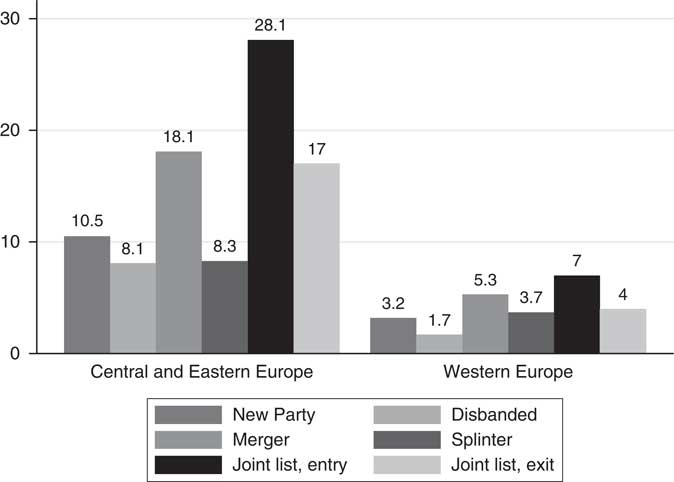
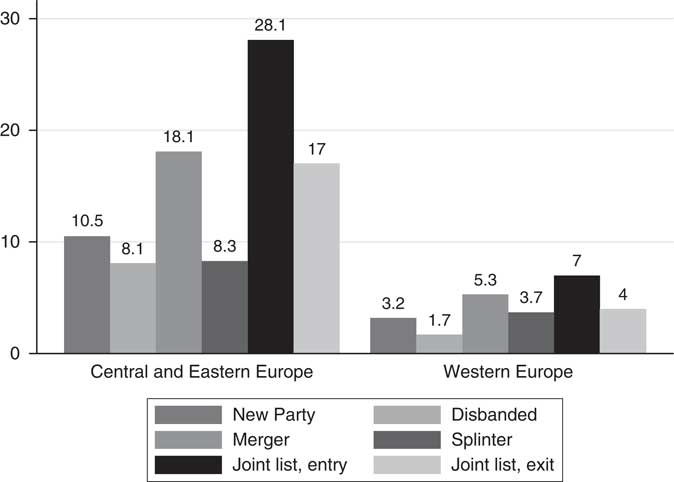
Based on the six indicators above, I have compiled a party-level data set of changes in parties from 27 European democracies: 17 West European (WE) and 10 Central and East European (CEE) democracies, 1987–2011 (148 elections).Footnote 8 The elections from CEE span the ten continuously democratic polities since 1989, and the data on WE matches this time period. Unlike existing indices of party change (e.g., Birch Reference Birch2001; Sikk Reference Sikk2005), the data set incorporates elections from both mature and developing democracies and thus allows for comparison and robustness checks across regions. This is especially important given evidence of the different patterns and nature of party system change across established and less-consolidated party systems (e.g., Bielasiak Reference Bielasiak2002; Tavits Reference Tavits2008a). Figure 1 attests to these differences. In both CEE and in WE, parties are most often destabilized by entry in and exit from joint lists and entry in mergers; in absolute terms, however, in WE such changes are much less frequent. In CEE on average 28 percent of parties per election enter into a joint list with another party and another 17 percent abandon the joint list by the following election. The formation of new parties and the disappearance of parties are the least common forms of party change in both regions.
Percent of parties changing in an average election, by type of instability
An Election-Level Index
To gain a sense of overall instability in parties between two elections, this article proposes an index of change in political parties at the election level of analysis. While the detailed data described above records the types of instability occurring in each party, the index aims to measure overall instability in parties between subsequent elections. For this purpose, the overall indicator records the number of new or modified party formations between elections t and t−1. I estimate an aggregate index of party change based on the six categories of change. EIP at election t (EIP t ) is a simple, additive index of the six categories of party change that occur between subsequent elections t−1 and t for all parties that pass the 5 percent threshold.Footnote 9
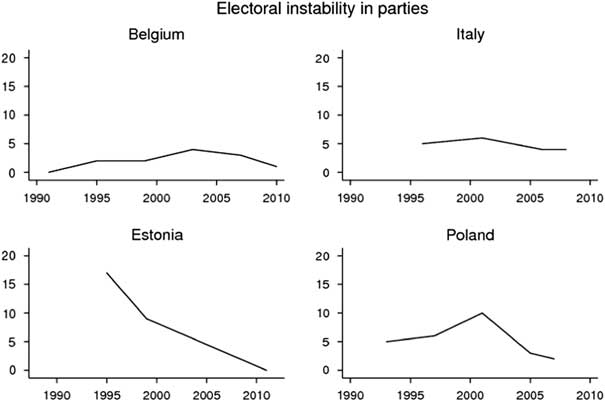
To illustrate the coding of EIP, I describe how EIP varied over time in four countries. I trace EIP levels in four cases: Belgium, Italy, Estonia and Poland (see Figure 2). The four countries experienced elections with some of the highest EIP scores in WE and CEE, respectively, though trends over time vary drastically across the four countries. Belgium is relatively stable, with an occasional peak in EIP. Estonia experienced extremely high instability in the early elections after independence, but exhibits a clear pattern of decline. In Poland and Italy, EIP varies substantially without a clear pattern.
Electoral instability in parties time series for Belgium, Italy, Estonia and Poland
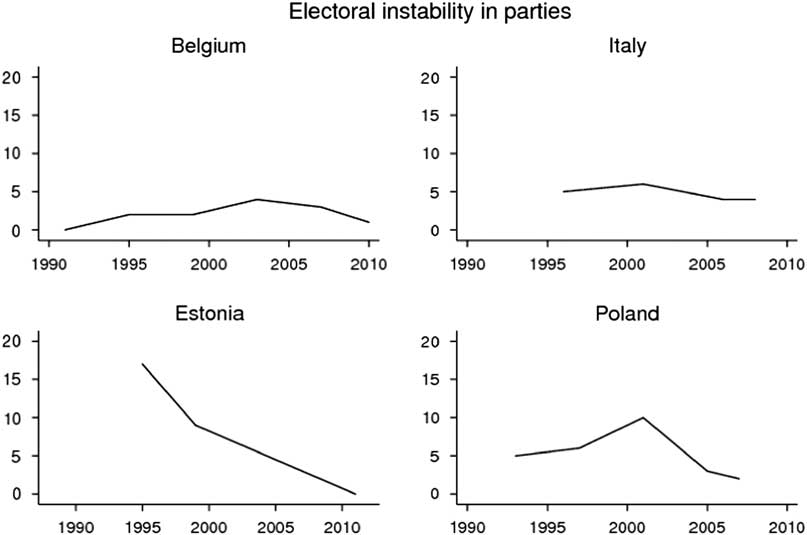
The first panel in Figure 2 shows EIP levels in Belgium. Instability in Belgium is relatively low, save for a peak in 2003 when the Belgian party system experienced a number of party changes. Between 1999 and 2003, the conservative People’s Union (VU) produced two splinter parties: Spirit (14.9 percent in 2003) and the New Flemish Alliance (3.1 percent); each of the VU splinters had abandoned the VU-iD21 joint list they ran on in 1999.Footnote 10 Spirit and the Flemish Socialist Party then ran on a joint list together (14.9 percent). The Liberal Reformation Party and the Francophone Democratic Front merged into the Reformist Movement (14.1 percent). The splinter that passed the 5 percent threshold, the new joint list, the disbanded joint lists and the new merger resulted in an EIP score of four for the 2003 election.
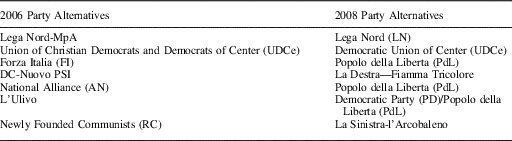
In WE, the party system most vulnerable to change is Italy, experiencing an average EIP score of 4.75 between 1994 and 2008. The time series for Italy begin in 1994 owing to the dramatic changes the party system underwent in the late 1980s and early 1990s (see Morlino Reference Morlino1996).Footnote 11 Instability in Italy is rarely driven by the emergence of new parties or by the disbanding of existing ones; rather, parties continuously fuse, split and drift in and of out of joint lists.Footnote 12 Observers of Italian elections can confirm that such instability is not trivial. Compare the list of party alternatives in the two most recent Italian elections in the data set (Table 1). While not a single party was either new or had disbanded between 2006 and 2008, the party alternatives look altogether different. Lega Nord had run on a joint list with the Movement for Autonomy in 2006 but ran separately in 2008. Union of Christian Democrats and Democrats of Center produced a splinter that contested the election on the Popolo della Liberta (PdL) joint list in 2008, along with Forza Italia, National Alliance and DC-Nuovo PSI (a 2006 joint list of Socialist and Christian Democrats). L’Ulivo produced a merger, Democratic Party, that ran independently, and a splinter, LD, that ran on the PdL list. Newly Founded Communists ran on a single ticket La Sinistra-l’Arcobaleno with the Green Federation and the Party of Italian Communists. Given how different party alternatives were in 2006 and 2008, many voters set on holding the incumbents accountable for the plummeting economy would have been hard-pressed even to identify them.
Electoral Alternatives in Italy: 2006 and 2008 Elections

The bottom-left panel traces electoral changes in Estonian parties. The early elections in Estonia were some of the most turbulent ones in all of Europe since 1990.Footnote 13 However, EIP steadily declined, falling to negligible levels in the most recent election. Between 2007 and 2011, EIP was zero: while the Estonian People’s Union and the Estonian United Left formed a new joint list, it did not meet the 5 percent inclusion threshold. Most CEE countries resemble the pattern of Estonia over time: while EIP was relatively high in the 1990s and early 2000s, in recent elections it has declined substantially.
The final panel traces EIP levels in Poland. The time series in Poland are interesting in that the early election do not register high party change, yet EIP climbs gradually in subsequent elections, peaking at ten in 2001.Footnote 14 While Polish voters initially faced a high number of parties (111 in 1991 and 35 in 1993), relatively few of those meeting the 5 percent threshold underwent electoral change. A decade later the picture was altogether different. Only one party that entered parliament in 2001, the Peasant Party, had not changed between 1997 and 2001. Law and Justice was a new party launched by the Kaczynski brothers in 2001.Footnote 15 The League of Polish Families, soon to merge with the Movement for Reconstruction of Poland, was a splinter of Solidarity.Footnote 16 The Civic Platform had its roots in the Freedom Union and is coded here as a splinter.Footnote 17 Samo-Obrana, a very marginal party before 2001, received 10.2 percent of the vote.Footnote 18 Finally, the party sweeping a plurality of votes was a newly formed joint list between the Democratic Left Alliance and the Union of Labor.Footnote 19 Following this turbulent election, EIP levels fell drastically in 2005 and again in 2007. Electoral instability in Polish parties was a fraction of 2001 levels in the most recent elections.Footnote 20
More generally, EIP is higher in the post-socialist democracies (on average, EIP is 4.57 and 0.61 in CEE and WE, respectively); however, levels of EIP in some WE elections (e.g., Belgium and Iceland) are nearly as high as the figures in some East European elections (e.g., Hungary and the Czech Republic). Average EIP scores for the time period are highest in the Baltic countries, Bulgaria and Poland, closely followed by Italy. See Table A.3 in Online Appendix for country profiles.
Robustness and Validity
Aggregating party changes across elections raises several measurement issues: whether or not different types of party changes (e.g., mergers, splinters, disbanded parties) ought to be weighted equally; further, if party changes ought to be treated equally across parties of different size or weighted by electoral strength; and finally, how party change should be treated across party systems of varying sizes. I discuss each of these issues in turn and test the robustness of the EIP index to the coding protocol.
The EIP index weighs the six types of party changes equally as we do not have any a priori knowledge of the relative importance of each category. While each type of party change alters the menu of electoral alternatives presented to voters, some categories of instability arguably involve more drastic change in parties than others. The appearance of a new, unfamiliar party may be more drastic than, say, the reappearance of a familiar party upon leaving a joint list. However, as evinced by the Italian case, changes in joint lists, mergers and splinters can completely transform electoral alternatives from election to election (see Table 1). Further, the relative importance of each category—for example, should a splinter be given one- or two-thirds the weight of a new party? —is an empirical question that depends in part on our research question. Researchers are hence encouraged to test the effects of each types of party change on outcomes of interest. The empirical application illustrates this approach below.
The second point that merits discussion is weighing party change by the electoral strength of parties. On one hand, treating change equally across parties may give undue weight to instability in small parties and thus overestimate the overall degree of instability between elections. On the other hand, the electoral strength of a party is not necessarily a good indicator of its importance in a party system; rather, the systemic role of a party determines the extent to which its appearance or disappearance affects electoral competition (see Mair Reference Mair1989). Furthermore, a weighted index would confound change in parties with voter preferences by capturing the electoral share of transformed parties rather than change in and of itself. To avoid these problems, while at the same time excluding marginal parties for which information was difficult to come by, the index adopts a 5 percent inclusion threshold.Footnote 21 This threshold is at or above the electoral thresholds of most countries included in the data set, thus only change in parliamentary parties is included. Change in small, marginal parties is excluded without relying on the electoral strength of each party.
Finally, levels of instability naturally and in part depend on the number of parties in a party system. EIP tends to be somewhat higher in party systems with more parties, though the relationship is far from deterministic.Footnote 22 Because EIP captures the entry and exit of parties from the system, it is interrelated with the total number of parties. As the two processes are not independent, standardizing EIP by the number of parties would generate inequalities between elections of varying levels and types of EIP, and thus measurement bias.Footnote 23 As the index is not standardized by party system size, researchers are encouraged to control for the number of parties in their analyses.
The index is robust to the coding decisions described above. Varying the inclusion threshold to 3 and 7 percent produced a measure highly correlated with the EIP index (ρ=0.97 and 0.95, respectively).Footnote 24 Furthermore, standardizing the index by the total number of parties at election t−1 or weighing party change by the vote share of each party or party list also produced a measure highly correlated with EIP (ρ=0.91 and 0.89, respectively). I also test how diffuse party change is in the system. The larger the value of EIP, the greater the percentage of parties changing between elections (ρ=0.76), suggesting that high EIP is generally not concentrated in a small cluster of parties.
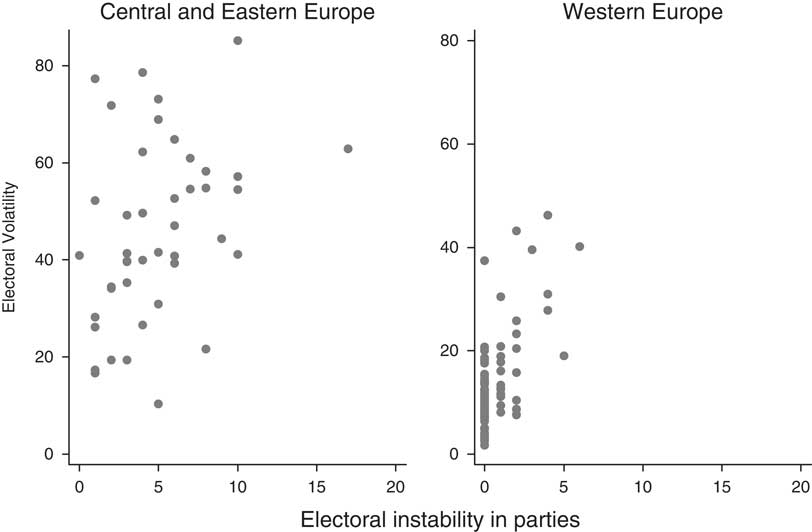
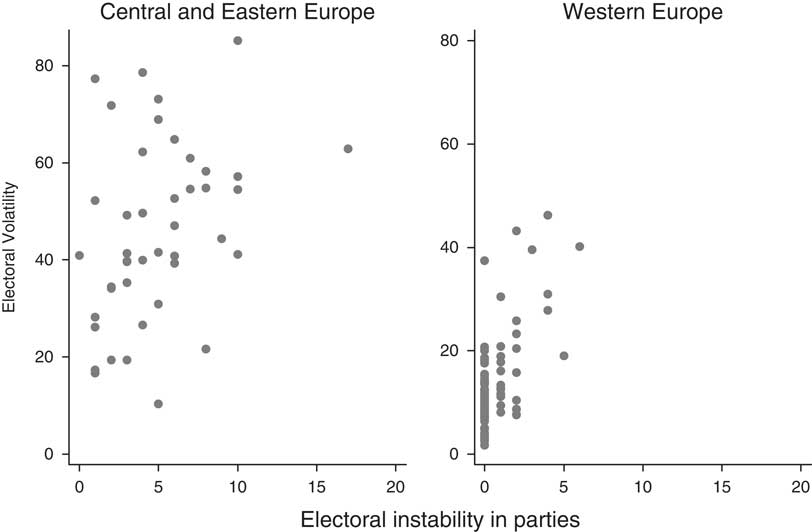
Finally, I examine the external validity of EIP by comparing it to related indices. First, Figure 3 plots the relationship between EIP and volatility in the new and mature European democracies, respectively.Footnote 25 Because party changes are reflected in volatility scores, the relationship is largely tautological. Although we cannot speak of the direction of causality between EIP and volatility, the general trends across the two regions largely conform to our prior expectations. While in the East, high party change and volatility go hand in hand, in WE vote swings among stable parties are the norm. In the latter, 95 percent of elections have an EIP score of five or less, while volatility in those same elections is on average 13, and as high as 43. These trends are as we might expect from the previous literature establishing that voters are the destabilizing force in WE electoral politics (Rose and Urwin Reference Rose and Urwin1970; Inglehart Reference Inglehart1977; Mair, Muller and Plasser Reference Mair, Muller and Plasser2004), while electoral swings in CEE are associated with change in parties (Tavits Reference Tavits2008a; Rose and Munro Reference Rose and Munro2009; Powell and Tucker Reference Powell and Tucker2014). Further strengthening the construct validity of the index is the strong correlation between EIP and Powell and Tucker’s Type A Volatility that captures the segment of volatility owing to party entry and exit (0.38 and 0.70 in CEE and WE, respectively) and the low correlation between EIP and Type B Volatility that reflects volatility among stable parties (0.1 and 0.01).
Scatter plots of electoral instability in parties and electoral volatility by region Source: Data on electoral volatility: Power and Tucker (2013).
Party Instability and Political Knowledge: An Application
In order to cast a meaningful ballot, citizens ought to be familiar with the ideological leanings of competing parties. However, as parties transform between elections, they breed electoral complexity, with potentially negative consequences for voters’ ability to take party cues and make informed decisions. Owing to the demands placed on their attention and cognition, citizens may be generally less capable of taking party cues and placing parties correctly on the left–right ideological spectrum. The rich data on party instability enable us to trace the effects of party change on political knowledge while the EIP index gives a sense of the overall impact of instability in a given election. We can thus evaluate if citizens are equally familiar with new and splinter parties, how the total number of party changes in a given election affects knowledge of party positions and how these relationships vary across new and developed democracies, respectively.
I complement the party instability data with survey data from 58 elections of 25 European countries, 1996–2011, by appending the three modules of the Comparative Study of Electoral Systems (CSES).Footnote 26 To estimate the dependent variable, knowledge of parties’ ideological leanings, I use survey questions available in the CSES. I calculate how much each respondent’s placement of each party on a 0–10 left–right ideological scale deviates from political experts’ placement of the corresponding parties on the same scale. Larger values indicate higher inaccuracy in respondents’ political knowledge; for ease of interpretation, I reverse the scale.
In the analyses I control for individual and contextual variables that condition the ability, motivation and opportunity to become politically informed (Delli Carpini and Keeter Reference Delli Carpini and Keeter1996; Gordon and Segura Reference Gordon and Segura1997; Berggren Reference Berggren2001; Grönlund and Milner Reference Grönlund and Milner2006; Fraile Reference Fraile2013). In addition to education, gender and age, I control for voters’ ideological distance from each party as voters may be more familiar with parties in their corner of the ideological spectrum. I control for the effective number of electoral parties because in party systems with a very high number of political parties information is more costly to individuals (Laakso and Taagepera Reference Laakso and Taagepera1979). The competitiveness of electoral systems has been found to motivate voters to stay politically informed; hence, I control for district magnitude and dummy variables for proportional and majoritarian electoral system rules (Gordon and Segura Reference Gordon and Segura1997). Furthermore, bicameral legislatures increase the complexity between vote choice and electoral outcomes and may thus create a disincentive for citizens to gather information (bicameral=1). The frequency of elections may increase the salience of party platforms, and hence the less time (in months) has elapsed since the previous national election, the more informed voters should be. High seat–vote disparity reduces voters’ incentives to become involved in the electoral process; it is estimated as the average vote–seat share deviation of the two largest parties in the polity (Lijphart 1984).Footnote 27
The dependent variable is the familiarity of each individual with each party in a given election, and hence each individual appears as many times in the data set as the number of parties she placed on the left–right scale. The data are stacked at the individual per party level and contains repeated observations on individual. I take account of the nested data structure by fitting fixed effects country and year regression models with robust standard errors clustered around individual.Footnote 28 Individual i’s knowledge of party j’s position may be expressed as follows: K ij =δ 0+δ 1New j +δ 2Merger j +δ 3Splinter j +δ 4Joint list entry j +δ 5Joint list exit j +δ 6EIP+γX ij +ε ij , where X ij is a vector of covariates and γ a vector of slopes for X ij .Footnote 29
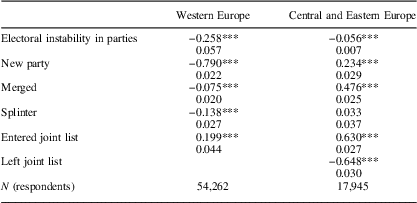
The results offer evidence of an overall negative effect of party instability on political knowledge (see Table 2). However, the impact of instability depends on its type and overall levels and varies starkly across new and developed democracies. While citizens tend to be less knowledgeable of party positions in elections with multiple party changes, the magnitude of the effect is four times larger in WE. Levels of EIP are comparatively low in WE, and yet voters in those democracies are more adversely affected by each instance of instability than are voters in the East. This result may well hint at a learning effect where citizens who experience frequent transformation of parties become accustomed to instability and adapt to such contexts more readily than do citizens who experience only occasional peaks in party change.Footnote 30
Citizen Knowledge of Party Positions

Note: the data are stacked at the individual per party level and contains repeated observations on individual. The total number of observations is 299,104 and 80,710 in Models 1 and 2, respectively. All models include fixed effects for country and year and robust clustered errors around individual. A total of 43 West European and 15 Central and East European elections are included in the analyses. In addition to the independent variables reported here, all models also control for age, age squared, gender, university education, effective number of electoral parties (log), district magnitude, months since previous election, seat–vote disparity, and binary variables for proportional and majoritarian representation and bicameral legislature. Please see Tables A.3 and A.4 in the Online Appendix for full model results.
*p<0.05, **p<0.01, ***p<0.001.
The party-level data also shed light on differences across established and developing democracies. In WE, nearly all categories of party change exert a negative effect, and the effect of newcomers is particularly adverse. In CEE, overall instability in elections also results in a loss of knowledge, though to a much smaller degree. On average voters tend to be more familiar with the positions of newcomers in CEE than with those of pre-existing parties. In CEE elections, genuinely new parties have been so successful that Sikk (Reference Sikk2012) has argued that “newness” is an electorally advantageous strategy. Because of sheer newness, in some cases parties receive additional press coverage, arguably leading voters to become familiar with their platforms and elect them into office. This is in stark contrast to the West where voters are on the whole less familiar with newcomers and tend to misplace them by nearly a point on the left–right ideology scale.
The analyses also reveal interesting differences across types of party changes. Namely, party entry into joint lists boosts voter ability to place parties correctly on the left–right in both established and developing democracies, and party entry into mergers has a substantial positive effect on knowledge in CEE. One possible explanation for this effect is that mergers and joint lists help consolidate and clarify pre-existing positions while simultaneously reducing the number of parties running (separately) in an election. Arguably, such was the case in the Czech Civic Democratic Party’s split from the Civic Forum, as the former advocated neoliberal economic reforms not endorsed by the latter (see Roberts Reference Roberts2010). New mergers and joint lists can potentially reduce the complexity of electoral information for voters.
As a final illustration of the usefulness of EIP data, I have refitted the models presented in Table 2 with the Pedersen index of electoral volatility (see Online Appendix). Much like EIP, electoral volatility appears to exert a negative effect on political knowledge; however, the direction of causality in this model specification is problematic. Political knowledge of party positions precedes temporally electoral volatility; therefore it is more plausible that low levels of political knowledge contribute to electoral volatility than vice versa. Voters who tend to know less about party positions are more likely to shift allegiances, thus contributing to volatility in elections. A similar issue may be raised in other studies where the Pedersen index is used to discern the effects of party system instability on voter behavior, including party identification and turnout (e.g., Bengtsson Reference Bengtsson2004; Mainwaring and Torcal Reference Mainwaring and Torcal2006; Rico Reference Rico2010; Robbins and Hunter Reference Robbins and Hunter2012). In contrast to the Pedersen index, the data on party instability presented here record party dynamics without relying on electoral shifts in voter preferences. Although party and voter shifts cannot be fully separated, the data on EIP goes a long way in ameliorating concerns about the endogeneity of voter preferences and party dynamics. As such it opens new venues for research on the interaction between party system change and voter preferences and behavior.
Conclusions
The study of party system instability has gained importance in recent years. The frequency of party changes in modern democracies has stimulated a number of recent articles and books exploring the dynamics of instability in party organizations (e.g., Mair, Muller and Plasser Reference Mair, Muller and Plasser2004; Sikk Reference Sikk2005; Tavits Reference Tavits2006; Tavits Reference Tavits2008a; Sikk Reference Sikk2012). To facilitate the study of party instability, the European Consortium of Political Research held a section titled “Party System Dynamics: New Tools for the Study of Party System Change and Party Transformation” for its 2013 meetings. This recent scholarship indicates that political scientists have identified an important phenomenon that has not yet been adequately measured.
This work in this field is driven by the recognition that currently used indicators often conflate the roles of political elites and masses in destabilizing party systems, or are partial and limited to a handful of cases, thus limiting cross-national comparability. In addition to supplying detailed, qualitative data on party transformations in 27 European democracies, this article proposes an indicator of electoral instability in parties that is comparable cross-nationally and that considerably reduces endogeneity between voter choice and party change. The election-level indicator is robust to the coding protocol adopted in this article and has good construct validity when compared with available related indicators.
As illustrated in an empirical application, one fruitful venue for future research that this data make possible is the interplay between voters and parties. Extant accounts of voter behavior are usually static, as parties are merely the recipients of voter evaluations under fixed institutional settings. The present article affords parties the agency to influence voter knowledge of party positions, and by extension voter choice. It thus conceives of elections in fairly realistic terms—as dynamic, give-and-take processes between voters and parties. The data on party instability will allow future research to disentangle further the effects of party change on how voters decide, thus closing an important theoretical gap in the interaction between political elites and voters. The data will also be useful in comparative research on party and electoral systems. Given the importance of party system stabilization for democratic consolidation, the index should enable researchers to study the incentive structures of elites in triggering instability.Footnote 31