





1. Introduction and main results
In the upper half-space  $\mathbb {R}^n_+$ (
 $n\geq 2$), we consider the time-decay properties of solutions to the Navier-Stokes initial value problem:
 \begin{equation} \left\{ \begin{array}{@{}lll} \partial_tu-\Delta u+(u\cdot\nabla)u+\nabla p=0 & \mbox{in} & \mathbb{R}^n_+{\times} (0, \infty),\\ \nabla\cdot u=0 & \mbox{in} & \mathbb{R}^n_+{\times} (0, \infty),\\ u(x, t)=0 & \mbox{on} & \partial\mathbb{R}^n_+{\times} (0, \infty),\\ u(x, 0)=a & \mbox{in} & \mathbb{R}^n_+,\end{array} \right. \end{equation}
where  $u=(u_1(x, t), u_2(x, t), \ldots , u_n(x, t))$ and
 $p=p(x, t)$ denote the unknown velocity vector and the pressure, respectively, while
 $a=a(x)$ is a prescribed initial velocity vector field. The kinematic viscosity is normalized to be one.
Given  $a\in L^2_\sigma ( \mathbb {R}^n_+)$, a vector function
 $u\in L^\infty (0, \infty ; L^2_\sigma ( \mathbb {R}^n_+))\cap L^2_{loc}([0, \infty ); H^1_0( \mathbb {R}^n_+))$ is called a weak solution of (1.1) if it satisfies (1.1) in the sense of the distribution. The weak solution
 $u$ of (1.1) is said to be a strong solution if
 $u\in L^\infty (0, \infty ; H^1_{0, \sigma }(\mathbb {R}^n_+))\cap L^2_{loc}([0, \infty ); H^2( \mathbb {R}^n_+))$.
The existence of global weak solutions for the Cauchy problem of the Navier-Stokes equations was given by Leray [Reference Leray18], and the uniqueness of these solutions is only known in space dimension two. Meanwhile it is also well known that smooth solutions are global in dimension two and for higher dimensions when the data are small in some critical spaces. Caffarelli, Kohn and Nirenberg [Reference Caffarelli, Kohn and Nirenberg6], Lin [Reference Lin13] showed that the one-dimensional Hausdorff measure is zero for the set of the possible space-time singular points, for the suitable weak solution to the 3D Navier-Stokes equations, which brings about a deeper understanding on the regularity theory and narrowed the gap between what we can get from the global existence theory and what we need for the uniqueness and regularity of global weak solutions.
Many interesting and important results have been achieved on decay properties of weak and strong solutions for the Navier-Stokes equations in the whole space (see, e.g., [Reference Bae and Choe1–Reference Brandolese and Vigneron4, Reference Kato17, Reference Schonbek19–Reference Schonbek22, Reference Wiegner26], and the references therein), and in the non-whole space, see [Reference Borchers and Miyakawa5, Reference Ukai23] for examples. Recently some  $L^1$-decay rates on the initial boundary value problem in exterior domains have been established in [Reference He and Miyakawa14, Reference He and Miyakawa15]. Compared to the exterior problem, the situation in the half-space becomes complicated due to the non-compactness of the boundary, and the unboundedness of weighted potentials. Even though there exist several results on the
 $L^1$-summability of solutions of problem (1.1) (see [Reference Han9] e.g.), the explicit physical background is still not characterized directly, and it is very necessary to give an explicit physical characterization on the
 $L^1$-decay completely. In this article, we consider the nonstationary Navier-Stokes equations in half-space, for which the associated total net force to the boundary may not vanish, and discuss in details the relation (including the weighted case) between
 $L^1$-summability and the total net force exerted by the fluid on the body.
Let  $(u, p)$ be the strong solution of (1.1) with the initial data
 $a\in L^2_\sigma (\mathbb {R}^n_+)$. The net force exerted by the fluid to
 $\partial \mathbb {R}^n_+$ at time
 $t$ is denoted as follows:
 \[ \mathcal{Z}(t)=\int_{\partial\mathbb{R}^n_+}(T[u, p]\cdot\nu)(y, t)d S_y,\quad t>0, \]
where  $T[u, p]=(T_{jk}[u, p])_{j, k=1}^n$ denotes the stress tensor associated to
 $(u, p)$,
 $T_{jk}[u,p]=\partial _ju_k+\partial _ku_j-\delta _{jk}p$,
 $\nu =(0,\ldots ,0,-1)=-e_n$ is the unit outward normal to
 $\partial \mathbb {R}^n_+$,
 $T[u, p]\cdot \nu =-(T_{n1}, T_{n2},\ldots ,T_{nn})$.
For the Stokes flow  $e^{-tA}u_0$ with the initial data
 $a\in L^1_\sigma (\mathbb {R}^n_+)$, we don't expect
 $\|e^{-tA}a\|_{L^1(\mathbb {R}^n_+)}\leq C\|a\|_{L^1(\mathbb {R}^n_+)}$, which holds in the whole space. In fact, Desch, Hieber and Pruss [Reference Desch, Hieber and Pruss7] found a counterexample: there exists a function
 $a\in L^1_\sigma (\mathbb {R}^n_+)$ such that the corresponding Stokes flow
 $e^{-tA}a\not \in L^1(\mathbb {R}^n_+)$ for each
 $t>0$. Generally speaking, it is natural to guess that the Navier-Stokes flow
 $u$ of (1.1) does not belong to
 $L^1(\mathbb {R}^n_+)$ for each
 $t>0$, because
 $e^{-tA}a$ is the linear part of
 $u$. The following theorem 1.1 validates this conjecture.
Theorem 1.1 Assume  $a\in L^1_\sigma (\mathbb {R}^n_+)\cap L^\infty (\mathbb {R}^n_+)$ (
 $n\geq 2$) satisfies
 $|x|^2a\in L^1(\mathbb {R}^n_+)$,
 $|x|a, (1+|x|)\nabla a\in L^2(\mathbb {R}^n_+)$. Then there exists a number
 $\eta >0$ such that if
 $\|a\|_{L^n(\mathbb {R}^n_+)}\leq \eta$ (smallness condition is unnecessary if
 $n=2$), problem (1.1) admits a unique strong solution
 $(u,p)$ satisfying for
 $0\leq \alpha <\frac {1}{2}$ and
 $t>1$
 \begin{equation} \big\|u({\cdot}, t)-V({\cdot}, t)\int_0^t\mathcal{Z}(\tau)d\tau\big\|_{L^1(\mathbb{R}^n_+)}\leq Ct^{-\frac{\alpha}{2}};\end{equation}
furthermore, for  $0\leq \beta <\frac {1}{4}$,
 $\beta <\alpha <\frac {1}{2}-\beta$
 \begin{equation} \big\||x|^\beta\big(u({\cdot}, t)-V({\cdot}, t)\int_0^t\mathcal{Z}(\tau)d\tau\big)\big\|_{L^1(\mathbb{R}^n_+)}\leq C t^{-\frac{\alpha-\beta}{2}}.\end{equation}
Here the matrix function  $V(x, t)=(V_{j,k}(x, t))^n_{j, k=1}$, and
 \[ V_{j,k}(x,t)=E_t(x)\delta_{j,k}+\int_0^\infty\partial_j\partial_kE_{t+\tau}(x)d\tau,\quad E_t(x)=(4\pi t)^{-\frac{n}{2}}e^{-\frac{|x|^2}{4t}}. \]
Remark (1) The constrained conditions on  $\alpha , \beta$:
 $0\leq \beta <\frac {1}{4}$,
 $\beta <\alpha <\frac {1}{2}-\beta$ arise from the following (2.12) and
 $({2.12}')$, and the technical proposition 2.1 with
 $r=1$, where the assumption
 $\alpha +\beta <1$ is required in establishing the weighted estimates.
(2) The total net force exerted by the fluid to  $\partial \mathbb {R}^n_+$ on the time interval
 $(0, t)$ is finite. That is,
 \[ \Bigg|\int_0^t\mathcal{Z}(\tau)d\tau\Bigg|\leq C,\quad\forall t>0, \]
where  $C$ is independent of
 $t$.
It is known that the strong solution  $(u, p)$ of (1.1) belongs to
 $C^\infty (\mathbb {R}^n_+\times (0, \infty ))$. Moreover, under the assumptions of theorem 1.1, by proposition 2.1 and lemma A.3, we find for each
 $t>0$
 \begin{align*} &|x|^\theta u({\cdot}, t)\in L^r(\mathbb{R}^n_+),\quad 1< r\leq\infty, \ 0\leq\theta<\min\left\{1,\ n\left(1-\frac{1}{r}\right)\right\};\\ &|x|^\theta \nabla^ku({\cdot}, t), \quad |x|^\theta \nabla p_1({\cdot}, t)\in L^r(\mathbb{R}^n_+), \ k=1,2,\ 1\leq r\leq\infty, \ 0\leq\theta<1; \end{align*}
and  $p=p_1+p_2$,
 $p_2|_{\partial \mathbb {R}^n_+}=0$, see (2.1), (2.2) below.
Let  $\mathcal {Z}=(\mathcal {Z}_1, \mathcal {Z}_2, \ldots , \mathcal {Z}_n)$. Then for
 $1\leq j\leq n$,
 $\tau >0$
 \begin{align*} \displaystyle\mathcal{Z}_j(\tau)&=\displaystyle-\int_{\partial\mathbb{R}^n_+}(T[u, p]\cdot\nu)_j(y, t)d S_y \\ &=\displaystyle-\int_{\partial\mathbb{R}^n_+}[\partial_ju_n+\partial_nu_j-\delta_{jn}p_1](y, \tau)d S_y\\ &=\displaystyle\int_{\mathbb{R}^n_+}[\partial_j\partial_nu_n+\partial_n\partial_nu_j-\delta_{jn}\partial_np_1](y, \tau)dy. \end{align*}
Whence using proposition 2.1 with  $\gamma =0, r=1$, and lemma A.3 yields for
 $t>0$
 \begin{align*} \displaystyle\Bigg|\int_0^t\mathcal{Z}(\tau)d\tau\Bigg|&\leq\displaystyle C\int_0^t\int_{\mathbb{R}^n_+}(|\nabla^2u|+|\nabla p_1|)(y, \tau)dyd\tau\\ &\leq\displaystyle C\int_0^t(\|u(\tau)\|^2_{L^2(\mathbb{R}^n_+)}+\|\nabla u(\tau)\|^2_{L^2(\mathbb{R}^n_+)}+\|\nabla^2 u(\tau)\|_{L^1(\mathbb{R}^n_+)})d\tau\\ &\leq\displaystyle C\int_0^t((1+\tau)^{{-}1-\frac{n}{2}}+(1+\tau)^{-\frac{3}{2}})d\tau\leq\displaystyle C. \end{align*}
(3) The matrix function  $V(x, t)\not \in L^1(\mathbb {R}^n_+)$ for each
 $t>0$.
The proof is similar to the case of the exterior problem studied by He and Miyakawa [Reference He and Miyakawa14, Reference He and Miyakawa15], we omit the proof's details here. It follows from the above theorem 1.1 that the strong solution  $u$ of (1.1) doesn't belong to
 $L^1(\mathbb {R}^n_+)$ at time
 $t$ provided that the total net force exerted by the fluid to the boundary in the time interval
 $(0, t)$ does not vanish, that is,
 $\int _0^t\mathcal {Z}(\tau )d\tau \neq 0$ for
 $t>0$. Meanwhile, it reveals that the total net force
 $\int _0^t\mathbb {}\mathcal {Z}(\tau ) d\tau$ plays a crucial role in determining the
 $L^1$-summability of the strong solution of (1.1).
To conclude this introduction, we explain some notations used in what follows: Let  $C^\infty _{0, \sigma }( \mathbb {R}^n_+)$ denote the set of all
 $C^\infty$ real vector-valued functions
 $\phi =(\phi _1, \phi _2,\ldots ,\phi _n)$ with compact support in
 $\mathbb {R}^n_+$, such that
 $\nabla \cdot \phi =0$ in
 $\mathbb {R}^n_+$.
 $L^r_\sigma (\mathbb {R}^n_+)$ (
 $1< r<\infty$) is the closure of
 $C^\infty _{0, \sigma }(\mathbb {R}^n_+)$ with respect to
 $\|\cdot \|_{L^r(\mathbb {R}^n_+)}$, where
 $L^r(\mathbb {R}^n_+)$ represents the usual Lebesgue space of vector-valued functions. By symbol
 $C$, we denote a generic constant whose value may change from line to line.
2. Proof of the main results
This section is devoted to the proof of theorem 1.1. To be more specific, we first introduce some notations and collect some known results as follows, which are necessary in the proofs of our main results. The following Helmholtz decomposition holds for  $1< r<\infty$ (see [Reference Borchers and Miyakawa5])
 \[ L^r(\mathbb{R}^n_+)=L^r_\sigma(\mathbb{R}^n_+)\oplus G(\mathbb{R}^n_+), \]
where
 \begin{align*} L^r_\sigma(\mathbb{R}^n_+)&=\{v\in L^r(\mathbb{R}^n_+); \ \nabla\cdot v=0,\ (v\cdot\nu)|_{\partial\mathbb{R}^n_+}=0\},\\ G(\mathbb{R}^n_+)&=\{v=\nabla p\in L^r(\mathbb{R}^n_+); \ p\in L^r_{loc}(\overline{\mathbb{R}^n_+})\}. \end{align*}
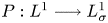
Let  $P:\,L^r(\mathbb {R}^n_+)\rightarrow L^r_\sigma (\mathbb {R}^n_+)$ (
 $1< r<\infty$) be the bounded projection, and
 $A=-P\Delta$ denotes the Stokes operator. Then
 $-A$ generates a bounded analytic semigroup
 $\{e^{-tA}\}_{t\geq 0}$ in
 $L^r_\sigma (\mathbb {R}^n_+)$.
Let  $a\in L^2_\sigma (\mathbb {R}^n_+)\cap L^n(\mathbb {R}^n_+)$
 $\,(n\geq 2)$. Then there exists a number
 $\eta >0$ such that if
 $\|a\|_{L^n(\mathbb {R}^n_+)}\leq \eta$ (smallness condition is unnecessary if
 $n=2$), problem (1.1) admits a unique strong solution
 $(u, p)$. Such small-data global existence of classical solution in the half-space is referred to theorem 3.2 in [Reference Fujigaki and Miyakawa8]. In dealing with the decay of solutions to problem (1.1) in
 $L^1(\mathbb {R}^n_+)$, the pressure term is subtle and troublesome, because we don't have enough useful information on the pressure near the boundary
 $\partial \mathbb {R}^n_+$. We have to search for some new ideas and effective methods to avoid such difficulties caused by the pressure function. Fortunately, we find that the pressure
 $p$ can be decomposed into the sum of two functions:
 $p_1, p_2$, and
 $p_1, p_2$ can be represented through the Gaussian kernel
 $E_t$ and the velocity field
 $u$. Then the extremely difficult estimate of the weighted gradient of
 $p$ can be turned into the manageable weighted case of
 $\nabla p_1$, see proposition 2.1, which plays a crucial role in the proof of the main result. Precisely, a direct calculation shows that the pressure
 $p$ can be decomposed into
 $p=p_1+p_2$, where
 \begin{align} p_1(x, t)&=\int_0^\infty\int_{\mathbb{R}^n_+}[E_s(x-y)+E_s(x-y^\ast)]\sum\limits_{i,j=1}^n\partial_i\partial_j(u_iu_j)(y, t)dyds, \end{align}
 \begin{align} p_2(x, t)&=\int_0^\infty\int_{\mathbb{R}^{n-1}}\partial_{x_n}E_s(x^\prime-y^\prime, x_n)\Delta u(y^\prime,0, t)dy^\prime ds \end{align}
satisfy respectively
 \[ -\Delta p_1=\sum\limits_{i,j=1}^n\partial_i\partial_j(u_iu_j)\text{ in }\mathbb{R}^n_+;\ \partial_\nu p_1=0\text{ on }\partial\mathbb{R}^n_+; \]
and
 \[ -\Delta p_2=0\text{ in }\mathbb{R}^n_+;\ \partial_\nu p_2=\Delta u(y^\prime,0, t),\quad p_2(x^\prime, 0)=0\text{ on }\partial\mathbb{R}^n_+. \]
Proposition 2.1 Let  $0\leq \gamma <1$. Then for
 $t>0$
 \[ \||\cdot|^\gamma\nabla p_1({\cdot}, t)\|_{L^r( \mathbb{R}^n_+)} \leq C\sum\limits_{k=0}^1\|(1+|\cdot|^\frac{\gamma}{2})\nabla^k u({\cdot}, t)\|^2_{L^{2r}( \mathbb{R}^n_+)},\quad 1\leq r\leq\infty. \]
Proof. Using (2.1) yields for  $0\leq \gamma <1$,
 $x=(x^\prime , x_n)\in \mathbb {R}^n_+$ and
 $t>0$
 \begin{align*}
\displaystyle |x|^\gamma|\nabla p_1(x,
t)|&\leq\displaystyle |x^\prime|^\gamma |\nabla p_1(x,
t)|+x_n^\gamma |\nabla p_1(x, t)|\\
&\leq\displaystyle\int_0^1\int_{\mathbb{R}^n_+}((|x^\prime-y^\prime|^\gamma+|y^\prime|^\gamma)|\nabla_x[E_s(x-y)+E_s(x-y^\ast)]|\\
&\quad +(x_n+y_n)^\gamma |\nabla_xE_s(x-y^\ast)|+(|x_n-y_n|^\gamma+y_n^\gamma)|\nabla_xE_s(x-y)|)|\\
&\quad \times \sum\limits_{i,j=1}^n\partial_i\partial_j(u_iu_j)(y,
t)|dyds
\displaystyle+\sum\limits_{i,j=1}^n\int_1^\infty\int_{\mathbb{R}^n_+} \\
&\quad \times ((|x^\prime-y^\prime|^\gamma+|y^\prime|^\gamma)|\nabla_x\partial_{y_i}\partial_{y_j}[E_s(x-y)+E_s(x-y^\ast)]|\\
&\quad +(x_n+y_n)^\gamma |\nabla_x\partial_{y_i}\partial_{y_j}E_s(x-y^\ast)|
+(|x_n-y_n|^\gamma+y_n^\gamma)|\nabla_x\partial_{y_i}\\
&\quad \times \partial_{y_j}E_s(x-y)|)|(u_iu_j)(y,
t)|dyds. \end{align*}
Together with the Young inequality, we conclude for  $0\leq \gamma <1$,
 $1\leq r\leq \infty$ and
 $t>0$
 \begin{align*} \displaystyle \||\cdot|^\gamma \nabla p_1({\cdot}, t)\|_{L^r( \mathbb{R}^n_+)} &\leq\displaystyle C\sum\limits_{i,j=1}^n\Bigg\{\int_0^1s^{\frac{\gamma}{2}-\frac{1}{2}}\|\partial_i\partial_j(u_iu_j)({\cdot}, t)\|_{L^r( \mathbb{R}^n_+)}\\ &\qquad\displaystyle+\int_0^1s^{-\frac{1}{2}}ds\|(|y^\prime|^\gamma+y_n^\gamma)\partial_i\partial_j(u_iu_j)({\cdot}, t)\|_{L^r( \mathbb{R}^n_+)}\\ &\qquad\displaystyle+\int_1^\infty s^{\frac{\gamma}{2}-\frac{3}{2}}\|(u_iu_j)({\cdot}, t)\|_{L^r( \mathbb{R}^n_+)}\\ &\qquad\displaystyle+\int_1^\infty s^{-\frac{3}{2}}ds\|(|y^\prime|^\gamma+y_n^\gamma)(u_iu_j)({\cdot}, t)\|_{L^r( \mathbb{R}^n_+)}\Bigg\}\\ &\leq\displaystyle C\sum\limits_{k=0}^1\|(1+|\cdot|^\frac{\gamma}{2})\nabla^k u({\cdot}, t)\|^2_{L^{2r}( \mathbb{R}^n_+)}.\end{align*}
□
Proof of theorem 1.1. Proof of theorem 1.1
Let  $(u, p)$ be the strong solution of problem (1.1) with the initial small datum
 $a\in L^2_\sigma (\mathbb {R}^n_+)$
 $\,(n\geq 2)$ (see theorem 3.2 in [Reference Fujigaki and Miyakawa8]). Then there holds (see [Reference He and Miyakawa14] for example)
 \begin{align} \displaystyle u(x, t) & =\displaystyle \int_{\mathbb{R}^n_+} E_t(x-y)a(y)dy+\int_0^t\int_{\partial \mathbb{R}^n_+}V(x-y, t-\tau)(T[u, p]\cdot \nu)(y, \tau)dS_yd\tau\notag\\ & \quad-\int_0^t\int_{\mathbb{R}^n_+} \nabla_x V(x-y, t-\tau):(u\otimes u)(y, \tau)dyd\tau, \end{align}
where the representations of  $E_t(x),\ V(x, t)=(V_{jk}(x, t))_{j, k=1, 2, \ldots , n}$ are given in theorem 1.1,
 $u\otimes u=(u_iu_j)_{n\times n}$ denotes the
 $n\times n$ matrix,
 $\nabla _x V:(u\otimes u)=\nabla _x (\sum_{j, k=1}V_{jk}u_ju_k)$. Moreover,
 \[ |\partial_x^m\partial_t^kV(x, t)|\leq C(|x|^2+t)^{-\frac{n+m}{2}-k},\quad\forall x\in\mathbb{R}^n,\ t>0; \ m, k=0,1, 2,\ldots. \]
and
 \[ \||\cdot|^\alpha\nabla^k E_t\|_{L^1( \mathbb{R}^n_+)}+\||\cdot|^\alpha\nabla^k V({\cdot}, t)\|_{L^1( \mathbb{R}^n_+)}\leq Ct^{\frac{\alpha}{2}-\frac{k}{2}}. \]
with  $0\leq \alpha < k$,
 $k=1,2,\ldots$.
Note that  $\int _{\mathbb {R}^n_+} a(y)dy=0$ due to
 $a\in L^1(\mathbb {R}^n_+)\cap L^2_\sigma (\mathbb {R}^n_+)$. Using the Young inequality, we get for
 $0\leq \beta <1$ and
 $t>0$
 \begin{align} & \big\||x|^\beta \int_{\mathbb{R}^n_+} E_t(x-y)a(y)dy\big\|_{L^1(\mathbb{R}^n_+)}\notag \\ & \quad=\displaystyle\big\||x|^\beta \int_{\mathbb{R}^n_+}(E_t(x-y)-E_t(x))a(y)dy\big\|_{L^1(\mathbb{R}^n_+)}\notag \\ & \quad=\displaystyle\big\||x|^\beta \sum\limits_{j=1}^n\int_0^1\int_{\mathbb{R}^n_+} \partial_{x_j}E_t(x-\theta y)({-}y_j)a(y)dyd\theta\big\|_{L^1(\mathbb{R}^n_+)}\notag \\ & \quad\leq\displaystyle C\||\cdot|^\beta \nabla E_t({\cdot})\|_{L^1(\mathbb{R}^n)}\int_{\mathbb{R}^n_+}|y||a(y)|dy+C\|\nabla E_t({\cdot})\|_{L^1(\mathbb{R}^n)}\int_{\mathbb{R}^n_+}|y|^{1+\beta}|a(y)|dy\notag \\ & \quad\leq\displaystyle C\left(t^{-\frac{1-\beta}{2}}+t^{-\frac{1}{2}}\right); \end{align}
and together with lemma A.3,
 \begin{equation}
\begin{aligned} & \big\||x|^\beta
\int_0^t\int_{\mathbb{R}^n_+} \nabla_x V(x-y,
t-\tau):(u\otimes u)(y,
\tau)dyd\tau\big\|_{L^1(\mathbb{R}^n_+)}\\ &
\quad\leq\displaystyle C\int_0^t\||\cdot|^\beta \nabla
V({\cdot}, t-\tau)\|_{L^1(\mathbb{R}^n)}\|u(\tau)\|^2_{L^2(
\mathbb{R}^n_+)}d\tau\\ &
\qquad\displaystyle+C\int_0^t\|\nabla V({\cdot},
t-\tau)\|_{L^1(\mathbb{R}^n)}\|u(\tau)\|_{L^2(
\mathbb{R}^n_+)} \||\cdot|^\beta u({\cdot}, \tau)\|_{L^2(
\mathbb{R}^n_+)}d\tau\\ & \quad\leq\displaystyle
Ct^{-\frac{1-\beta}{2}}\int_0^\frac{t}{2}(1+\tau)^{{-}1-\frac{n}{2}}d\tau
+Ct^{-\frac{1}{2}}\int_0^\frac{t}{2}(1+\tau)^{\frac{\beta}{2}-\frac{1}{2}-\frac{n}{2}}d\tau\\
&
\qquad\displaystyle+C\int_\frac{t}{2}^t\big((t-\tau)^{-\frac{1-\beta}{2}}(1+\tau)^{{-}1-\frac{n}{2}}
+(t-\tau)^{-\frac{1}{2}}(1+\tau)^{\frac{\beta}{2}-\frac{1}{2}-\frac{n}{2}}\big)d\tau\\
& \quad\leq\displaystyle
C\Bigg(t^{-\frac{1-\beta}{2}}+t^{-\frac{1}{2}}\Bigg).
\end{aligned}
\end{equation}
Observe that for any  $t>0$
 \begin{equation} \begin{aligned} & \displaystyle \int_0^t\int_{\partial \mathbb{R}^n_+}V(x-y, t-\tau)(T[u, p]\cdot\nu)(y, \tau)dS_yd\tau-V(x,t)\int_0^t\mathcal{Z}(\tau)d\tau\\ & =\displaystyle \int_0^t\int_{\partial \mathbb{R}^n_+}\big(V(x^\prime-y^\prime, x_n, t-\tau)-V(x^\prime, x_n, t-\tau)\big)(T[u, p]\cdot\nu)(y, \tau)dS_yd\tau\\ & \quad\displaystyle +\int_0^t\int_{\partial \mathbb{R}^n_+}\big(V(x^\prime, x_n, t-\tau)-V(x^\prime, x_n, t)\big)(T[u, p]\cdot\nu)(y, \tau)dS_yd\tau\\ & =\displaystyle I(x, t)+J(x, t). \end{aligned} \end{equation}
Observe that the pressure function  $p$ satisfies
 \[ -\Delta p=\sum\limits_{i,j=1}^n\partial_i\partial_j(u_iu_j)\text{ in }\mathbb{R}^n_+;\ \partial_\nu p=\nu\cdot\Delta u\text{ on }\partial\mathbb{R}^n_+. \]
Let  $I(x, t)=(I_1, I_2, \ldots , I_n)(x, t)$. Recall
 $p=p_1+p_2$, where
 $p_1, p_2$ are given in (2.1), (2.2) respectively. Using
 $p=p_1+p_2$ and
 $p_2(y^\prime , 0)=0$,
 $y^\prime \in \mathbb {R}^{n-1}$ yields for
 $x=(x^\prime , x_n)\in \mathbb {R}^n_+$,
 $t>0$
 \begin{align*}
I_\ell(x, t)&=\displaystyle
-\sum\limits_{k=1}^n\int_0^t\int_{\partial
\mathbb{R}^n_+}\big(V_{\ell k}(x^\prime-y^\prime, x_n,
t-\tau)\\
&\quad -V_{\ell k}(x^\prime, x_n, t-\tau)\big)
T_{kn}[u,p_1](y, \tau)dS_yd\tau\\ &=\displaystyle
-\sum\limits_{k=1}^n\int_0^t\int_{
\mathbb{R}^n_+}\big(V_{\ell k}(x^\prime-y^\prime, x_n,
t-\tau)-V_{\ell k}(x^\prime, x_n, t-\tau)\big)\\
&\quad\displaystyle\times
(\partial_{y_n}\partial_{y_n}u_k-\delta_{kn}\partial_{y_n}p_1)(y,
\tau)dyd\tau,\quad 1\leq\ell\leq n.
\end{align*}
Whence it holds for  $0<\alpha <1$
 \begin{equation} \begin{aligned} \displaystyle|I_\ell(x, t)| & \leq\displaystyle \sum\limits_{k=1}^n\int_0^1\int_0^t\int_{ \mathbb{R}^n_+}\big|V_{\ell k}(x^\prime-y^\prime, x_n, t-\tau)-V_{\ell k}(x^\prime, x_n, t-\tau)\big|^{1-\alpha}\\ & \quad\displaystyle\times\big|\partial_{x^\prime}V_{\ell k}(x^\prime-\theta y^\prime, x_n, t-\tau)\big|^\alpha|y^\prime|^\alpha|\partial_{y_n}\partial_{y_n}u_k-\delta_{kn}\partial_{y_n}p_1|(y, \tau)dyd\tau d\theta. \end{aligned} \end{equation}
Then for  $0\leq \beta <1$,
 $0<\alpha <1$
 \begin{equation} \begin{aligned} & \displaystyle\||x^\prime|^\beta I_\ell({\cdot}, t)\|_{L^1( \mathbb{R}^n_+)}\\ & \quad\leq\displaystyle \sum\limits_{k=1}^n\int_0^1\int_0^t\int_{ \mathbb{R}^n_+}\Bigg(\int_{ \mathbb{R}^n_+}|x^\prime|^\beta\big|V_{\ell k}(x^\prime-y^\prime, x_n, t-\tau)-V_{\ell k}(x^\prime, x_n, t-\tau)\big|^{1-\alpha}\\ & \qquad\times\big|\partial_{x^\prime}V_{\ell k}(x^\prime-\theta y^\prime, x_n, t-\tau)\big|^\alpha dx\Bigg)|y^\prime|^\alpha|\partial_{y_n}\partial_{y_n}u_k-\delta_{kn}\partial_{y_n}p_1|(y, \tau)dyd\tau d\theta; \end{aligned} \end{equation}
and
 \begin{equation*} \begin{aligned} & \displaystyle\|x_n^\beta I_\ell({\cdot}, t)\|_{L^1( \mathbb{R}^n_+)}\\ & \quad\leq\displaystyle \displaystyle\sum\limits_{k=1}^n\displaystyle\int_0^1\int_0^t\int_{ \mathbb{R}^n_+}\Bigg(\int_{ \mathbb{R}^n_+}x_n^\beta\big|V_{\ell k}(x^\prime-y^\prime, x_n, t-\tau)-V_{\ell k}(x^\prime, x_n, t-\tau)\big|^{1-\alpha}\\ & \qquad\displaystyle\times\big|\partial_{x^\prime}V_{\ell k}(x^\prime-\theta y^\prime, x_n, t-\tau)\big|^\alpha dx\Bigg)|y^\prime|^\alpha|\partial_{y_n}\partial_{y_n}u_k-\delta_{kn}\partial_{y_n}p_1|(y, \tau)dyd\tau d\theta. \end{aligned} \end{equation*}
In the next arguments, for the simplicity of computations, we first deal with the two parts inside of (2.8) and (2.8') separately. Namely,
 \begin{align*}
&\sum\limits_{k=1}^n\int_0^1\int_{ \mathbb{R}^n_+}\omega(x)
\big|V_{\ell k}(x^\prime-y^\prime, x_n, t-\tau)-V_{\ell
k}(x^\prime, x_n,
t-\tau)\big|^{1-\alpha}\\
&\quad \times \big|\partial_{x^\prime}V_{\ell
k}(x^\prime-\theta y^\prime, x_n, t-\tau)\big|^\alpha
dxd\theta, \end{align*}
where the weight function  $\omega (x)=|x^\prime |^\beta , x_n^\beta$.
Noting that for  $0\leq \beta <1$,
 $\beta <\alpha <1-\beta$, there holds for
 $t>\tau$
 \begin{align} & \displaystyle\sum\limits_{k=1}^n\int_0^1\int_{ \mathbb{R}^n_+}|x^\prime|^\beta \big|V_{\ell k}(x^\prime-y^\prime, x_n, t-\tau)-V_{\ell k}(x^\prime, x_n, t-\tau)\big|^{1-\alpha}\notag\\ & \qquad\times\big|\partial_{x^\prime}V_{\ell k}(x^\prime-\theta y^\prime, x_n, t-\tau)\big|^\alpha dxd\theta\notag\\ & \quad\leq\displaystyle C\int_0^1\int_{
\mathbb{R}^n_+}(|x^\prime-y^\prime|^\beta+|y^\prime|^\beta)
\big(|x^\prime-y^\prime|+x_n+
\sqrt{t-\tau}\big)^{{-}n(1-\alpha)}\notag\\ &
\qquad\displaystyle\times \big(|x^\prime-\theta
y^\prime|+x_n+ \sqrt{t-\tau}\big)^{-(n+1)\alpha}dxd\theta\notag\\
& \leq\displaystyle
C\int_0^1\int_{\mathbb{R}^{n-1}}(|x^\prime|^\beta+|y^\prime|^\beta)
\Bigg(\int_0^\infty\big(|x^\prime|+x_n+
\sqrt{t-\tau}\big)^{{-}n}dx_n\Bigg)^{1-\alpha}\notag\\ &
\qquad\displaystyle\times
\Bigg(\int_0^\infty\big(|x^\prime+(1-\theta)y^\prime|+x_n+
\sqrt{t-\tau}\big)^{{-}n-1}dx_n\Bigg)^\alpha dx^\prime
d\theta\notag\\ & \quad\leq\displaystyle
C\int_0^1\int_{\mathbb{R}^{n-1}}(|x^\prime|^\beta+|y^\prime|^\beta)
\big(|x^\prime|+\sqrt{t-\tau}\big)^{-(n-1)(1-\alpha)}\notag\\ &
\qquad\displaystyle\times
\big(|x^\prime+(1-\theta)y^\prime|+
\sqrt{t-\tau}\big)^{{-}n\alpha}dx^\prime d\theta\notag\\ &
\quad\leq \displaystyle
C(t-\tau)^{-\frac{\alpha-\beta}{2}}\int_0^1\int_{\mathbb{R}^{n-1}}\big(|\tilde{x}^\prime|+1\big)^{\beta-(n-1)(1-\alpha)}\notag\\
& \qquad\displaystyle\times
\big(|\tilde{x}^\prime+(1-\theta)\tilde{y}^\prime|+1\big)^{{-}n\alpha}d\tilde{x}^\prime
d\theta
+C(t-\tau)^{-\frac{\alpha-\beta}{2}}|\tilde{y}^\prime|^\beta\notag\\
& \qquad\displaystyle\times
\int_0^1\int_{\mathbb{R}^{n-1}}\big(|\tilde{x}^\prime|+1\big)^{-(n-1)(1-\alpha)}
\big(|\tilde{x}^\prime+(1-\theta)\tilde{y}^\prime|+1\big)^{{-}n\alpha}d\tilde{x}^\prime
d\theta\notag\\ & \quad\leq\displaystyle
C(t-\tau)^{-\frac{\alpha-\beta}{2}}\Bigg\{\int_0^1\Bigg(\int_{\mathbb{R}^{n-1}}\big(|\tilde{x}^\prime|+1\big)^{(\beta-(n-1)(1-\alpha))r}d\tilde{x}^\prime
\Bigg)^\frac{1}{r}\notag\\ & \qquad\displaystyle
+|\tilde{y}^\prime|^\beta\int_0^1\Bigg(\int_{\mathbb{R}^{n-1}}
\big(|\tilde{x}^\prime|+1\big)^{-(n-1)(1-\alpha)r}d\tilde{x}^\prime
\Bigg)^\frac{1}{r}\Bigg\}\notag\\ &
\qquad\displaystyle\times\Bigg(\int_{\mathbb{R}^{n-1}}\big(|\tilde{x}^\prime+(1-\theta)\tilde{y}^\prime|+\sqrt{t-\tau}\big)^{{-}n\alpha
q}d\tilde{x}^\prime\Bigg)^\frac{1}{q}d\theta\notag\\ & \quad\leq
\displaystyle
C(t-\tau)^{-\frac{\alpha-\beta}{2}}(1+|\tilde{y}^\prime|^\beta)\notag\\
& \quad=\displaystyle
C((t-\tau)^{-\frac{\alpha-\beta}{2}}+(t-\tau)^{-\frac{\alpha}{2}}|y^\prime|^\beta),\end{align}
where  $\tilde {y}^\prime =\frac {y^\prime }{\sqrt {t-\tau }}$,
 $1< r<\infty$ satisfies
 $\frac {1}{r}\in (1-\frac {n\alpha }{n-1}, 1-\alpha -\frac {\beta }{n-1})$,
 $\frac {1}{r}+\frac {1}{q}=1$. Such number
 $r$ exists due to
 $0\leq \beta <1$,
 $\beta <\alpha <1-\beta$.
 \begin{align}
&
\displaystyle\displaystyle\sum\limits_{k=1}^n\displaystyle\int_0^1\int_{
\mathbb{R}^n_+}x_n^\beta \big|V_{\ell k}(x^\prime-y^\prime,
x_n, t-\tau)-V_{\ell k}(x^\prime, x_n,
t-\tau)\big|^{1-\alpha}\notag\\ &
\qquad\displaystyle\times\big|\partial_{x^\prime}V_{\ell
k}(x^\prime-\theta y^\prime, x_n, t-\tau)\big|^\alpha
dxd\theta\notag\\ & \quad\leq\displaystyle
C\displaystyle\int_0^1\int_{\mathbb{R}^{n-1}}\Bigg(\int_0^\infty\big(|x^\prime|+x_n+
\sqrt{t-\tau}\big)^{{-}n}dx_n\Bigg)^{1-\alpha}\notag\\ &
\qquad\displaystyle\times
\Bigg(\int_0^\infty\big(|x^\prime-\theta
y^\prime|+x_n+\sqrt{t-\tau}\big)^{\frac{\beta}{\alpha}-n-1}dx_n\Bigg)^\alpha
dx^\prime d\theta\notag\\ & \quad\leq\displaystyle
C\int_0^1\int_{\mathbb{R}^{n-1}}\big(|x^\prime|+\sqrt{t-\tau}\big)^{-(n-1)(1-\alpha)}\big(|x^\prime-\theta
y^\prime|+ \sqrt{t-\tau}\big)^{\beta-n\alpha}dx^\prime
d\theta\notag\\ & \quad\leq\displaystyle
C(t-\tau)^{-\frac{\alpha-\beta}{2}}\int_0^1\int_{\mathbb{R}^{n-1}}\big(|\tilde{x}^\prime|+1\big)^{-(n-1)(1-\alpha)}\big(|\tilde{x}^\prime-\theta
\tilde{y}^\prime|+1\big)^{\beta-n\alpha}d\tilde{x}^\prime
d\theta\notag\\ & \quad\leq\displaystyle
C(t-\tau)^{-\frac{\alpha-\beta}{2}}\int_0^1\Bigg(\int_{\mathbb{R}^{n-1}}\big(|\tilde{x}^\prime|+1\big)^{-(n-1)(1-\alpha)r}d\tilde{x}^\prime
\Bigg)^\frac{1}{r}\notag\\ &
\qquad\displaystyle\times\Bigg(\int_{\mathbb{R}^{n-1}}\big(|\tilde{x}^\prime-\theta
\tilde{y}^\prime|+1\big)^{(\beta-n\alpha)
q}d\tilde{x}^\prime\Bigg)^\frac{1}{q}d\theta\notag\\ &
\quad\leq\displaystyle C(t-\tau)^{-\frac{\alpha-\beta}{2}},
\end{align}
where  $\tilde {y}^\prime =\frac {y^\prime }{\sqrt {t-\tau }}$,
 $1< r<\infty$ satisfies
 $\frac {1}{r}\in (1-\frac {n\alpha -\beta }{n-1}, 1-\alpha )$,
 $\frac {1}{r}+\frac {1}{q}=1$. Such number
 $r$ also exists due to
 $0\leq \beta <1$,
 $\beta <\alpha <1-\beta$.
Inserting (2.9), (2.9') into (2.8), (2.8') respectively, using proposition 2.1 and lemmas A.4 and A.5, we get for  $0\leq \beta <\frac {1}{4}$,
 $\beta <\alpha <\frac {1}{2}-\beta$ and
 $t>1$
 \begin{align} & \displaystyle \||x^\prime|^\beta I_\ell({\cdot}, t)\|_{L^1( \mathbb{R}^n_+)}\notag\\ & \quad\leq\displaystyle C\int_0^t(t-\tau)^{-\frac{\alpha-\beta}{2}}\big(\||y^\prime|^\alpha \nabla^2u({\cdot}, \tau)\|_{L^1( \mathbb{R}^n_+)}+\||y^\prime|^\alpha \partial_np_1({\cdot}, \tau)\|_{L^1( \mathbb{R}^n_+)}\big)d\tau\notag\\ & \qquad\displaystyle +C\int_0^t(t-\tau)^{-\frac{\alpha}{2}}\big(\||y^\prime|^{\alpha+\beta} \nabla^2u({\cdot}, \tau)\|_{L^1( \mathbb{R}^n_+)}+\||y^\prime|^{\alpha+\beta} \partial_np_1({\cdot}, \tau)\|_{L^1( \mathbb{R}^n_+)}\big)d\tau\notag\\ & \quad\leq\displaystyle C\int_0^t(t-\tau)^{-\frac{\alpha-\beta}{2}}\big(\||y^\prime|^\alpha \nabla^2u({\cdot}, \tau)\|_{L^1( \mathbb{R}^n_+)} +\|u({\cdot}, \tau)\|^2_{L^2( \mathbb{R}^n_+)}\notag\\ & \qquad\displaystyle+\|\nabla u({\cdot}, \tau)\|^2_{L^2( \mathbb{R}^n_+)}+\||y|^\frac{\alpha}{2}u({\cdot}, \tau)\|^2_{L^2( \mathbb{R}^n_+)} +\||y|^\frac{\alpha}{2}\nabla u({\cdot}, \tau)\|^2_{L^2( \mathbb{R}^n_+)}\big)d\tau\notag\\ & \qquad\displaystyle +C\int_0^t(t-\tau)^{-\frac{\alpha}{2}}\big(\||y^\prime|^{\alpha+\beta} \nabla^2u({\cdot}, \tau)\|_{L^1( \mathbb{R}^n_+)}+\|u({\cdot}, \tau)\|^2_{L^2( \mathbb{R}^n_+)}\notag\\ & \qquad+\|\nabla u({\cdot}, \tau)\|^2_{L^2( \mathbb{R}^n_+)}+\||y|^\frac{\alpha+\beta}{2}u({\cdot}, \tau)\|^2_{L^2( \mathbb{R}^n_+)} +\||y|^\frac{\alpha+\beta}{2}\nabla u({\cdot}, \tau)\|^2_{L^2( \mathbb{R}^n_+)}\big)d\tau\notag\\ & \quad\leq\displaystyle C\Bigg(\int_0^\frac{t}{2}+\int_\frac{t}{2}^t\Bigg)(t-\tau)^{-\frac{\alpha-\beta}{2}} (1+\tau)^{\frac{\alpha}{2}-\frac{\epsilon_1}{2}-1}d\tau,\quad\alpha<\epsilon_1<1-\alpha\notag\\ & \qquad\displaystyle +C\Bigg(\int_0^\frac{t}{2}+\int_\frac{t}{2}^t\Bigg)(t-\tau)^{-\frac{\alpha}{2}} (1+\tau)^{\frac{\alpha+\beta}{2}-\frac{\epsilon_2}{2}-1}d\tau,\quad\alpha+\beta<\epsilon_2<1-(\alpha+\beta)\notag\\ & \quad \leq\displaystyle Ct^{-\frac{\alpha-\beta}{2}},\qquad 1\leq\ell\leq n; \end{align}
and
 \begin{align} & \displaystyle \|x_n^\beta I_\ell({\cdot}, t)\|_{L^1( \mathbb{R}^n_+)}\notag\\ & \quad\leq\displaystyle C\displaystyle\int_0^t(t-\tau)^{-\frac{\alpha-\beta}{2}}\big(\||y^\prime|^\alpha \nabla^2u({\cdot}, \tau)\|_{L^1( \mathbb{R}^n_+)}+\||y^\prime|^\alpha \partial_np_1({\cdot}, \tau)\|_{L^1( \mathbb{R}^n_+)}\big)\notag\\ & \quad\leq\displaystyle C\int_0^t(t-\tau)^{-\frac{\alpha-\beta}{2}}\big(\||y^\prime|^\alpha \nabla^2u({\cdot}, \tau)\|_{L^1( \mathbb{R}^n_+)} +\|u({\cdot}, \tau)\|^2_{L^2( \mathbb{R}^n_+)}\notag\\ & \qquad\displaystyle+\|\nabla u({\cdot}, \tau)\|^2_{L^2( \mathbb{R}^n_+)}+\||y|^\frac{\alpha}{2}u({\cdot}, \tau)\|^2_{L^2( \mathbb{R}^n_+)} +\||y|^\frac{\alpha}{2}\nabla u({\cdot}, \tau)\|^2_{L^2( \mathbb{R}^n_+)}\big)d\tau\notag\\ & \quad\leq\displaystyle C\Bigg(\int_0^\frac{t}{2}+\int_\frac{t}{2}^t\Bigg)(t-\tau)^{-\frac{\alpha-\beta}{2}} \big((1+\tau)^{\frac{\alpha}{2}-\frac{\delta}{2}-1}+(1+\tau)^{\frac{\alpha}{2}-\frac{\delta}{2}-\frac{n}{2}}\big)d\tau\notag\\ & \quad\leq\displaystyle Ct^{-\frac{\alpha-\beta}{2}},\quad\alpha<\delta<1-\alpha,\ 1\leq\ell\leq n. \end{align}
Set  $J(x, t)=(J_1, J_2, \ldots , J_n)(x, t)$. Then it holds for
 $1\leq \ell \leq n$,
 $x=(x^\prime , x_n)\in \mathbb {R}^n_+$,
 $t>1$
 \begin{align} &
\displaystyle J_\ell(x, t)\notag\\ & \quad=\displaystyle
-\sum\limits_{k=1}^n\int_0^t\big(V_{\ell k}(x^\prime, x_n,
t-\tau)-V_{\ell k}(x^\prime, x_n, t)\big)\int_{\partial
\mathbb{R}^n_+}T_{kn}[u,p](y, \tau)dS_yd\tau\notag\\ &
\quad=\displaystyle-\sum\limits_{k=1}^n\int_0^t\big(V_{\ell
k}(x^\prime, x_n, t-\tau)-V_{\ell k}(x^\prime, x_n,
t)\big)\int_{\partial \mathbb{R}^n_+}
(\partial_{y_n}u_k-\delta_{kn}p_1)(y,
\tau)dS_yd\tau\notag\\ & \quad=\displaystyle
\sum\limits_{k=1}^n\int_0^t\int_0^1\tau\partial_t V_{\ell
k}(x^\prime, x_n, t-\theta\tau)d\theta\int_{
\mathbb{R}^n_+}(\partial_{y_n}\partial_{y_n}u_k-\delta_{kn}\partial_{y_n}p_1)(y,\tau)dyd\tau. \end{align}
where we used the fact:  $p=p_1+p_2=p_1$ on
 $\partial \mathbb {R}^n_+$.
Note that for  $0<\theta <1$,
 $t>\tau >0$
 \begin{equation} \begin{aligned} \displaystyle \sum\limits_{k=1}^n\int_{ \mathbb{R}^n_+}|x|^\beta\big|\partial_tV_{\ell k}(x^\prime, x_n, t-\theta\tau)|dx & \leq\displaystyle C\int_{ \mathbb{R}^n_+}(|x|+\sqrt{t-\theta\tau})^{\beta-n-2}dx\\ & \leq\displaystyle C\int_0^\infty(r+\sqrt{t-\theta\tau})^{\beta-3}dr\\ & \leq\displaystyle C(t-\theta\tau)^{{-}1+\frac{\beta}{2}},\quad\text{where}\quad 0\leq\beta<1. \end{aligned}\end{equation}
Combining (2.11) and (2.12), using proposition 2.1, lemmas A.4 and A.5, we obtain for  $0\leq \beta <1$,
 $0<\alpha <1$
 \begin{equation} \begin{aligned} & \displaystyle \||x|^\beta J_\ell({\cdot}, t)\|_{L^1( \mathbb{R}^n_+)}\\ & \quad\leq\displaystyle C\int_0^t\int_0^1\tau(t-\theta\tau)^{{-}1+\frac{\beta}{2}}d\theta(\|\nabla^2u({\cdot}, \tau)\|_{L^1( \mathbb{R}^n_+)}+\|u({\cdot}, \tau)\|^2_{L^2( \mathbb{R}^n_+)})\\ & \quad\leq \displaystyle C\int_0^t\Bigg(\int_0^1\tau(t-\theta\tau)^{{-}1+\frac{\beta}{2}}d\theta\Bigg)((1+\tau)^{{-}1-\frac{\alpha}{2}}+(1+\tau)^{-\frac{n}{2}-\alpha})d\tau\\ & \quad\leq \displaystyle Ct^{{-}1+\frac{\beta}{2}}\int_0^\frac{t}{2}(1+\tau)^{-\frac{\alpha}{2}}d\tau+C(1+t)^{{-}1-\frac{\alpha}{2}}\int_\frac{t}{2}^t\int_0^1\tau(t-\theta\tau)^{{-}1+\frac{\beta}{2}}d\theta d\tau. \end{aligned} \end{equation}
In the case of  $0<\beta <1$, we have for
 $t>0$
 \begin{equation} \begin{aligned} \displaystyle\int_\frac{t}{2}^t\int_0^1(t-\theta\tau)^{{-}1+\frac{\beta}{2}}\tau d\theta d\tau & =\displaystyle\int_\frac{t}{2}^t\Bigg(\int_0^1(t-\theta\tau)^{{-}1+\frac{\beta}{2}}d\theta\tau\Bigg) d\tau\\ & =\displaystyle \frac{2}{\beta}\int_\frac{t}{2}^t\big(t^\frac{\beta}{2}-(t-\tau)^\frac{\beta}{2}\big)d\tau\leq \frac{1}{\beta}t^{1+\frac{\beta}{2}}. \end{aligned} \end{equation}
In the case of  $\beta =0$, we infer for
 $t>0$
 \begin{equation} \begin{aligned} & \displaystyle\int_\frac{t}{2}^t\int_0^1(t-\theta\tau)^{{-}1}\tau d\theta d\tau =\displaystyle\int_\frac{t}{2}^t(\log_et-\log_e(t-\tau))d\tau =\displaystyle \frac{t}{2}\log_et-\int_\frac{t}{2}^t\log_e(t-\tau)d\tau\\ & \quad=\displaystyle \frac{t}{2}\log_et-\int_{-\infty}^{\log_e\frac{t}{2}}se^sds =\displaystyle \frac{t}{2}\log_et-\frac{t}{2}\log_e\frac{t}{2}+\frac{t}{2} =\displaystyle \frac{1}{2}(1+\log_e2)t, \end{aligned} \end{equation}
where  $e$ is the Euler's constant.
Inserting (2.14), (2.15) into (2.13), we conclude for  $0\leq \beta <1$,
 $\beta <\alpha <1$ and
 $t>1$
 \begin{equation} \||x|^\beta J_\ell({\cdot}, t)\|_{L^1( \mathbb{R}^n_+)}\leq Ct^{-\frac{\alpha-\beta}{2}}.\end{equation}
Inserting (2.10), (2.10') and (2.16) into (2.6), we obtain for  $0\leq \beta <\frac {1}{4}$,
 $\beta <\alpha <\frac {1}{2}-\beta$ and
 $t>1$
 \begin{align}
&\Bigg\||x|^\beta \Bigg(\int_0^t\int_{\partial
\mathbb{R}^n_+}V(x\,{-}\,y, t\,{-}\,\tau)(T[u, p]\,{\cdot}\,\nu)(y,
\tau)dS_yd\tau\,{-}\,V(x,t)\int_0^t\mathcal{Z}(\tau)d\tau\Bigg)\Bigg\|_{L^1(\mathbb{R}^n_+)}\notag\\
&\quad \leq
Ct^{-\frac{\alpha-\beta}{2}}.\end{align}
It follows from (2.3)–(2.5) and (2.17) that for  $0\leq \beta <\frac {1}{4}$,
 $\beta <\alpha <\frac {1}{2}-\beta$ and
 $t>1$
 \[ \big\||x|^\beta \big(u({\cdot}, t)-V(x,t)\int_0^t\mathcal{Z}(\tau)d\tau\big)\big\|_{L^1( \mathbb{R}^n_+)}\leq Ct^{-\frac{\alpha-\beta}{2}}.\]
Acknowledgments
The author expresses sincere thanks to the anonymous referee for her/his careful reading of this manuscript and many helpful comments and suggestions. This work was supported by the National Natural Science Foundation of China under Grant No. 11871457, the K. C. Wong Education Foundation, Chinese Academy of Sciences, Key Laboratory of Random Complex Structures and Data Science, Chinese Academy of Sciences (Grant No. 2008DP173182).
Appendix A.
In this section, we establish some weighted decay estimates for the Navier-Stokes flows, which are necessary in the proof of theorem 1.1.
Let  $g=\mathcal {N}f$ denote the solution of
 $-\Delta g=f$ in
 $\mathbb {R}^n_+$,
 $\partial _\nu g\,|_{\partial \mathbb {R}^n_+}=0.$ Then (see[Reference Han12])
 \begin{equation} \mathcal{N}f=\int_0^\infty F(\tau)fd\tau,\end{equation}
where the operator  $F(t)$ is defined by
 \[ [F(t)f](x)=\int_{\mathbb{R}^n_+}[E_t(x^\prime-y^\prime,\ x_n-y_n)+E_t(x^\prime-y^\prime, x_n+y_n)]f(y)dy, \]
and  $E_t(x)=(4\pi t)^{-\frac {n}{2}}e^{-\frac {|x|^2}{4t}}$.
Moreover,
 \begin{equation} P((u\cdot\nabla) u)=(u\cdot\nabla) u+\sum\limits_{i,j=1}^n\nabla\mathcal{N}\partial_i\partial_j(u_iu_j),\quad\forall\ u\in L^2_\sigma(\mathbb{R}^n_+)\cap H^1_0(\mathbb{R}^n_+).\end{equation}
We first recall the weighted  $L^q-L^r$ estimates for the Stokes flow (see [Reference Han11]):
Lemma A.1 Let  $a=(a_1, a_2,\ldots , a_n)$ satisfy
 $\nabla \cdot a=0$ in
 $\mathbb {R}^n_+\ (n\geq 2),$
 $a_n\,|_{\partial \mathbb {R}^n_+}=0$. Then for
 $i=1,2,3,$ and
 $t>0$
 \[ \|\omega_{\beta i}\nabla^k e^{{-}tA}a\|_{L^q(\mathbb{R}^n_+)}\leq Ct^{-\frac{k}{2}-\frac{\alpha-\beta}{2}-\frac{n}{2}(\frac{1}{r}-\frac{1}{q})}\|\omega_{\alpha i}a\|_{L^r(\mathbb{R}^n_+)},\quad k=0,1,2,\ldots, \]
provided that either  $1< r\leq q<\infty$ or
 $1\leq r< q<\infty$. Here
 $C=C(n, q, r, k, \alpha , \beta )$, and the weighted functions
 $\omega _{\gamma i}\;(\gamma =\alpha , \beta ,\; i=1,2,3)$ are defined as follows for
 $x=(x^\prime , x_n)\in \mathbb {R}^n_+$
 \[ \left\{
\begin{array}{@{}lll} \omega_{\gamma 1}(x)=|x|^\gamma, &
\gamma=\alpha, \beta, & -\dfrac{n}{q}<\beta\leq\alpha<
n\left(1-\dfrac{1}{r}\right);\\ \omega_{\gamma
2}(x)=|x^\prime|^\gamma, & \gamma=\alpha, \beta, &
-\dfrac{n-1}{q}<\beta\leq\alpha<(n-1)\left(1-\dfrac{1}{r}\right);\\
\omega_{\gamma 3}(x)=x_n^\gamma, & \gamma=\alpha, \beta, &
-\dfrac{1}{q}<\beta\leq\alpha<1-\dfrac{1}{r}. \end{array}
\right. \]
Lemma A.2 Let  $a=(a_1, a_2,\ldots , a_n)$ satisfy
 $\nabla \cdot a=0$ in
 $\mathbb {R}^n_+ (n\geq 2)$,
 $a_n\,|_{\partial \mathbb {R}^n_+}=0$. Assume
 $\,1\leq r< q\leq \infty$ or
 $1< r\leq q\leq \infty$. Then for
 $k\in \{0\}\cup \mathbb {N}$,
 $0\leq \alpha < k+1+n(\frac {1}{r}-\frac {1}{q})$ and
 $t>0$
 \begin{align*}
&\displaystyle\|x_n^\alpha\nabla^ke^{{-}tA}a\|_{L^q(\mathbb{R}^n_+)}\leq
C(t^{\frac{\alpha}{2}-\frac{k+1}{2}-\frac{n}{2}(\frac{1}{r}-\frac{1}{q})}\||y|a\|_{L^r(\mathbb{R}^n_+)}\\
&\quad +t^{-\frac{k+1}{2}-\frac{n}{2}(\frac{1}{r}-\frac{1}{q})}\|y_n^\alpha|y|a\|_{L^r(\mathbb{R}^n_+)});\\
&\displaystyle\||x^\prime|^\alpha\nabla^ke^{{-}tA}a\|_{L^q(\mathbb{R}^n_+)}\leq
C(t^{\frac{\alpha}{2}-\frac{k+1}{2}-\frac{n}{2}(\frac{1}{r}-\frac{1}{q})}\||y|a\|_{L^r(\mathbb{R}^n_+)} \\
&\quad +t^{-\frac{k+1}{2}-\frac{n}{2}(\frac{1}{r}-\frac{1}{q})}\||y^\prime|^\alpha
|y|a\|_{L^r(\mathbb{R}^n_+)}); \\ &\displaystyle\||x|^\alpha\nabla^ke^{{-}tA}a\|_{L^q(\mathbb{R}^n_+)}\leq
C(t^{\frac{\alpha}{2}-\frac{k+1}{2}-\frac{n}{2}(\frac{1}{r}-\frac{1}{q})}\||y|a\|_{L^r(\mathbb{R}^n_+)} \\
&\quad +t^{-\frac{k+1}{2}-\frac{n}{2}(\frac{1}{r}-\frac{1}{q})}\||y|^{\alpha+1}a\|_{L^r(\mathbb{R}^n_+)}).
\end{align*}
Remark Let  $a$,
 $k$,
 $\alpha$,
 $q, r$ be given in lemma A.2. Then the following slower decay than the third estimate in lemma A.2 has been shown in [Reference Han12] for
 $t>0$
 \[ \||x|^\alpha\nabla^ke^{{-}tA}a\|_{L^q(\mathbb{R}^n_+)}\leq C(t^{\frac{\alpha}{2}-\frac{k}{2}-\frac{n}{2}(\frac{1}{r}-\frac{1}{q})}\|a\|_{L^r(\mathbb{R}^n_+)} +t^{-\frac{k}{2}-\frac{n}{2}(\frac{1}{r}-\frac{1}{q})}\||y|^\alpha a\|_{L^r(\mathbb{R}^n_+)}). \]
Proof. Note that the Stokes flow with initial data  $a$ can be expressed by
 $e^{-tA}a$. Moreover,
 $e^{-tA}a$ can also be given as follows (see [Reference Solonnikov24, Reference Solonnikov25]):
 \begin{equation} [e^{{-}tA}a](x)=\int_{\mathbb{R}^n_+}\mathcal{M}(x,y,t)a(y)dy, \end{equation}
where  $\mathcal {M}=(M_{ij})_{i,j=1,2,\ldots ,n}$ is defined by
 \begin{equation}
\begin{aligned} \displaystyle M_{ij}(x,y,t) &
=\displaystyle\delta_{ij}(E_t(x-y)-E_t(x-y^*))\\ &
\quad \displaystyle+4(1-\delta_{jn})\frac{\partial}{\partial
x_j}\int_0^{x_n}\int_{\mathbb{R}^{n-1}}\frac{\partial
U(x-z)}{\partial x_i}E_t(z-y^*)dz\\ &
=\displaystyle\delta_{ij}E_t(x-y)+M_{ij}^*(x,y,t)\\ &
=\displaystyle\delta_{ij}(E_t(x-y)-E_t(x-y^*))+N_{ij}^*(x,y,t),
\end{aligned}
\end{equation}
 $y^*=(y_1,y_2,\ldots , -y_n)$,
 $E_t(x)=(4\pi t)^{-\frac {n}{2}}e^{-\frac {|x|^2}{4t}}$ is the Gauss kernel, and
 \[ U(z)={-}\frac{\Gamma(\frac{n}{2})}{2(n-2)\pi^\frac{n}{2}}\frac{1}{|z|^{n-2}} \text{ if }n\geq3;\ \frac{1}{2\pi}\log |z| \text{ if } n=2, \]
is the fundamental solution of the Laplace equation. Moreover, the following estimate for  $M_{ij}^*$,
 $N_{ij}^*$ in (A.4) holds for
 $t>0$
 \begin{equation} \begin{aligned} & \displaystyle |\partial_t^s\partial_x^{\vec{k}}\partial_y^{\vec{m}}M_{ij}^*(x,y,t)|+|\partial_t^s\partial_x^{\vec{k}}\partial_y^{\vec{m}}N_{ij}^*(x,y,t)|\\ & \quad\leq\displaystyle Ct^{{-}s-\frac{m_n}{2}}(t+x_n^2)^{-\frac{k_n}{2}}(|x-y^*|^2+t)^{-\frac{n+|{\vec{k}}^\prime|+|{\vec{m}}^\prime|}{2}}e^{-\frac{cy_n^2}{t}}, \end{aligned} \end{equation}
where  $s\in \{0\}\cup \mathbb {N}$,
 $\vec {\ell }=(\ell _1, \ell _2, \ldots , \ell _{n-1}, \ell _n)=(\vec {\ell }^\prime , \ell _n)$,
 $\vec {\ell }\in \{\vec {k}, \vec {m}\}$.
Note that  $\int _{\mathbb {R}^n_+}a(y)dy=0$. Whence for
 $t>0$
 \begin{align}
[e^{{-}tA}a](x)&=\int_{\mathbb{R}^n_+}[\mathcal{M}(x,y,t)-\mathcal{M}(x,0,t)]a(y)dy\notag\\
&=\int_0^1\int_{\mathbb{R}^n_+}y\cdot\nabla_{\theta
y}\mathcal{M}(x,\theta
y,t)a(y)dyd\theta.\end{align}
Let  $k=|\vec {k}|$,
 $\vec {k}=(\vec {k}^\prime , k_n)$, and
 $0\leq \alpha < k+1+n(\frac {1}{r}-\frac {1}{q}), \text { where }1\leq r< q\leq \infty \text { or }1< r\leq q<\infty .$
Using (A.3)–(A.6), we get for  $t>0$
 \begin{align*}
&\displaystyle\|x_n^\alpha\nabla^ke^{{-}tA}a\|_{L^q(\mathbb{R}^n_+)}\\
&\quad\leq\displaystyle\Bigg\|\int_0^1\int_{\mathbb{R}^n_+}|x_n-y_n|^\alpha|\nabla^k_x\nabla_x
E_t(x-\theta
y)||y||a(y)|dyd\theta\Bigg\|_{L^q(\mathbb{R}^n_+)}\\
&\qquad\displaystyle+\Bigg\|\int_0^1\int_{\mathbb{R}^n_+}|\nabla^k_x\nabla_xE_t(x-\theta
y)|y_n^\alpha |y||a(y)|dyd\theta\Bigg\|_{L^q(\mathbb{R}^n_+)}\\
&\qquad\displaystyle+C\Bigg\|\int_0^1\int_{\mathbb{R}^n_+}(t+x_n^2)^{-\frac{k_n+1_n-\alpha}{2}}(x_n+\theta
y_n)^\alpha\\
&\qquad \times (|x-\theta
y^*|^2+t)^{-\frac{n+|\vec{k}^\prime|+|\vec{1}^\prime|}{2}}|y||a(y)|dyd\theta\Bigg\|_{L^q(\mathbb{R}^n_+)}\\
&\quad\leq\displaystyle\|x_n^\alpha\nabla^k\nabla
E_t\|_{L^{(1+\frac{1}{q}-\frac{1}{r})^{{-}1}}(\mathbb{R}^n_+)}\||y|a\|_{L^r(\mathbb{R}^n_+)} \\
&\qquad +\|\nabla^k\nabla
E_t\|_{L^{(1+\frac{1}{q}-\frac{1}{r})^{{-}1}}(\mathbb{R}^n_+)}\|y_n^\alpha|y|
a\|_{L^r(\mathbb{R}^n_+)}\\
&\qquad\displaystyle+\|(t+x_n^2)^{-\frac{k_n+1_n-\alpha}{2}}
(|x^\prime|^2+x_n^2+t)^{-\frac{n+|\vec{k}^\prime|+{+}|\vec{1}^\prime|}{2}}\|_{L^{(1+\frac{1}{q}-\frac{1}{r})^{{-}1}}(\mathbb{R}^n_+)}\||y|a\|_{L^r(\mathbb{R}^n_+)}\\
&\quad\leq\displaystyle
C(t^{\frac{\alpha}{2}-\frac{k+1}{2}-\frac{n}{2}(\frac{1}{r}-\frac{1}{q})}\||y|a\|_{L^r(\mathbb{R}^n_+)}
+t^{-\frac{k+1}{2}-\frac{n}{2}(\frac{1}{r}-\frac{1}{q})}\|y_n^\alpha|y|
a\|_{L^r(\mathbb{R}^n_+)}); \end{align*}
and
 \begin{align*}
&\||x^\prime|^\alpha\nabla^ke^{{-}tA}a\|_{L^q(\mathbb{R}^n_+)}\\
&\quad\leq\displaystyle\Bigg\|\int_0^1\int_{\mathbb{R}^n_+}|x^\prime-\theta
y^\prime|^\alpha|\nabla^k_x \nabla_x
E_t(x-y)||y||a(y)|dyd\theta\Bigg\|_{L^q(\mathbb{R}^n_+)}\\
&\qquad\displaystyle+\Bigg\|\int_0^1\int_{\mathbb{R}^n_+}|\nabla^k_x\nabla_x
E_t(x-\theta y)||y^\prime|^\alpha
|y||a(y)|dyd\theta\Bigg\|_{L^q(\mathbb{R}^n_+)}\\
&\qquad\displaystyle+C\Bigg\|\int_0^1\int_{\mathbb{R}^n_+}(t+x_n^2)^{-\frac{k_n+1_n}{2}}|x^\prime-\theta
y^\prime|^\alpha\\
&\qquad \times (|x-\theta
y^*|^2+t)^{-\frac{n+|\vec{k}^\prime|+|\vec{1}^\prime|}{2}}
|y||a(y)|dyd\theta\Bigg\|_{L^q(\mathbb{R}^n_+)}\\
&\qquad\displaystyle+C\Bigg\|\int_0^1\int_{\mathbb{R}^n_+}(t+x_n^2)^{-\frac{k_n+1_n}{2}}(|x-\theta
y^*|^2+t)^{-\frac{n+|\vec{k}^\prime|+|\vec{1}^\prime|}{2}} \\
&\qquad \times \vphantom{\int_0^1}|y^\prime|^\alpha|y||a(y)|dyd\theta\Bigg\|_{L^q(\mathbb{R}^n_+)}\\
&\quad\leq \displaystyle\||x^\prime|^\alpha\nabla^k \nabla
E_t\|_{L^{(1+\frac{1}{q}-\frac{1}{r})^{{-}1}}(\mathbb{R}^n_+)}\||y|a\|_{L^r(\mathbb{R}^n_+)} \\
&\qquad +\|\nabla^k \nabla
E_t\|_{L^{(1+\frac{1}{q}-\frac{1}{r})^{{-}1}}(\mathbb{R}^n_+)}\||y^\prime|^\alpha
|y|a\|_{L^r(\mathbb{R}^n_+)}\\
&\qquad\displaystyle+\|(t+x_n^2)^{-\frac{k_n+1_n}{2}}|x^\prime|^\alpha
(|x^\prime|^2+x_n^2+t)^{-\frac{n+|\vec{k}^\prime|+|\vec{1}^\prime|}{2}}\|_{L^{(1+\frac{1}{q}-\frac{1}{r})^{{-}1}}(\mathbb{R}^n_+)}\||y|a\|_{L^r(\mathbb{R}^n_+)}\\
&\qquad\displaystyle+\|(t+x_n^2)^{-\frac{k_n+1_n}{2}}
(|x^\prime|^2+x_n^2+t)^{-\frac{n+|\vec{k}^\prime|+|\vec{1}^\prime|}{2}}\|_{L^{(1+\frac{1}{q}-\frac{1}{r})^{{-}1}}(\mathbb{R}^n_+)}\||y^\prime|^\alpha
|y| a\|_{L^r(\mathbb{R}^n_+)}\\ &\quad\leq\displaystyle
C(t^{\frac{\alpha}{2}-\frac{k+1}{2}-\frac{n}{2}(\frac{1}{r}-\frac{1}{q})}\||y|a\|_{L^r(\mathbb{R}^n_+)}
+t^{-\frac{k+1}{2}-\frac{n}{2}(\frac{1}{r}-\frac{1}{q})}\||y^\prime|^\alpha|y|
a\|_{L^r(\mathbb{R}^n_+)}). \end{align*}
From the above arguments, we complete the proof of lemma A.2.
Lemma A.3 ([Reference Fujigaki and Miyakawa8, Reference Han10, Reference Han12])
Assume  $a\in L^1_\sigma (\mathbb {R}^n_+)\cap L^\infty (\mathbb {R}^n_+)$,
 $|x|a\in L^1(\mathbb {R}^n_+)\cap L^2(\mathbb {R}^n_+)$,
 $(1+|x|)\nabla a\in L^2(\mathbb {R}^n_+)$
 $\,(n\geq 2)$. Let
 $u$ be the strong solution of (1.1) with the initial data
 $a$. Then for
 $t>1$
 \begin{align*}
&\displaystyle\|u(t)\|_{L^r(\mathbb{R}^n_+)}\leq
Ct^{-\frac{1}{2}-\frac{n}{2}(1-\frac{1}{r})},\;\;1<
r\leq\infty;\\ &\displaystyle\|\nabla^\ell
u(t)\|_{L^r(\mathbb{R}^n_+)}\leq
Ct^{-\frac{\ell+1}{2}-\frac{n}{2}(1-\frac{1}{r})},\;\;\ell=1,2,\;\;1\leq
r\leq\infty;\\ &\||x|^\beta
u(t)\|_{L^r(\mathbb{R}^n_+)}\leq
Ct^{-\frac{k}{2}-\frac{n}{2}(1-\frac{1}{r})+\frac{\beta}{2}},\;\;1<
r\leq\infty, \;\;0<\beta<\min\left\{1,\, n\left(1-\frac{1}{r}\right)\right\};\\
&\displaystyle\||x|^\beta
\nabla^ku(t)\|_{L^r(\mathbb{R}^n_+)}\leq
Ct^{-\frac{k}{2}-\frac{n}{2}(1-\frac{1}{r})+\frac{\beta}{2}},
\;\;k=1,2,\;\;1\leq r\leq\infty, \;\;0<\beta<1.
\end{align*}
Lemma A.4 Assume  $a\in L^1_\sigma (\mathbb {R}^n_+)\cap L^\infty (\mathbb {R}^n_+)$ (
 $n\geq 2$) satisfies
 $|x|^2a\in L^1(\mathbb {R}^n_+)$,
 $|x|a, (1+|x|)\nabla a\in L^2(\mathbb {R}^n_+)$. Let
 $u$ be the strong solution of (1.1) with the initial data
 $a$. Then for
 $k=0,1$ and
 $t>1$
 \[ \||x|^\beta \nabla^ku(t)\|_{L^r(\mathbb{R}^n_+)}\leq Ct^{-\frac{k}{2}-\frac{\alpha}{2}-\frac{n}{2}(1-\frac{1}{r})+\frac{\beta}{2}}, \]
where  $1< r\leq \infty$ and
 $0<\beta <\min \{1,\ n(1-\frac {1}{r})\}$ if
 $k=0$;
 $1\leq r\leq \infty ,$
 $0<\beta <1$ if
 $k=1;$
 $\alpha >0,$
 $\alpha +\beta <1$.
Proof. Let  $1< r\leq \infty$ and
 $0<\beta <\min \{1,\, n(1-\frac {1}{r})\}$ if
 $k=0$;
 $1\leq r\leq \infty$,
 $0<\beta <1$ if
 $k=1$;
 $\alpha >0$,
 $\alpha +\beta <1$,
 $n\geq 2$.
Using lemma A.2 yields for  $t>0$
 \begin{align}
\||x|^\beta \nabla^ke^{{-}tA}a\|_{L^r(\mathbb{R}^n_+)}&\leq
C(t^{\frac{\beta}{2}-\frac{k+1}{2}-\frac{n}{2}(1-\frac{1}{r})}\||y|a\|_{L^1(\mathbb{R}^n_+)} \notag\\
&\quad +t^{-\frac{k+1}{2}-\frac{n}{2}(1-\frac{1}{r})}\||y|^{1+\beta}a\|_{L^1(\mathbb{R}^n_+)}).
\end{align}
For simplicity of writing, we set  $Q(u)=P((u\cdot \nabla ) u)$. The following estimate is from lemma 3.1 in [Reference Han10]: Let
 $0\leq \gamma <1$,
 $1\leq r\leq \infty$. Then there holds for
 $v\in C^\infty _{0,\sigma }(\mathbb {R}^n_+)$
 \begin{align}
\||x|^\gamma Q(v)\|_{L^r(\mathbb{R}^n_+)} &\leq
C\big(\|(1+|x|^\gamma)
v\|_{L^{2r}(\mathbb{R}^n_+)})\|v\|_{L^{2r}(\mathbb{R}^n_+)} \notag\\
&\quad +\|(1+|x|^\gamma) \nabla
v\|_{L^{2r}(\mathbb{R}^n_+)})\|\nabla
v\|_{L^{2r}(\mathbb{R}^n_+)}\big).
\end{align}
Observe that for  $s>0$
 \[
\int_{\mathbb{R}^n_+}Q(u)(y,s)dy=0, \text{ due to }
\nabla\cdot Q(u)=\nabla\cdot [P(u\cdot\nabla u)]=0.
\]
Using (A.5), (A.8) and lemma A.3 yields for  $t>1$
 \begin{align}
&\displaystyle\big\||x|^\beta\int_0^\frac{t}{2}\int_{\mathbb{R}^n_+}\nabla_x^k\mathcal{M}(x,y,t-s)Q(u)(y,s)dyds\big\|_{L^r(\mathbb{R}^n_+)}\notag\\
&\quad=\displaystyle\big\||x|^\beta\int_0^\frac{t}{2}\int_{\mathbb{R}^n_+}[\nabla_x^k\mathcal{M}(x,y,t-s)-\nabla_x^k\mathcal{M}(x,0,t-s)]Q(u)(y,s)dyds\big\|_{L^r(\mathbb{R}^n_+)}\notag\\
&\quad\leq\displaystyle\Bigg(
\int_0^\frac{t}{2}\int_{\mathbb{R}^n_+}
\big\||x|^\beta[|\nabla_x^k\mathcal{M}(x,y,t-s)|\notag\\
&\qquad +|\nabla_x^k\mathcal{M}(x,0,t-s)|]\|_{L^r(\mathbb{R}^n_+)}|y|^\alpha||Q(u)(y,s)|dyds\Bigg)^{1-\alpha}\notag\\
&\qquad\displaystyle\times\Bigg(\int_0^1\int_0^\frac{t}{2}\int_{\mathbb{R}^n_+}\||x|^\beta\nabla_{\theta
y}\nabla_x^k\mathcal{M}(x,\theta
y,t)\|_{L^r(\mathbb{R}^n_+)}|y|^\alpha|Q(u)(y,s)|dydsd\theta\Bigg)^\alpha\notag\\
&\quad\leq\displaystyle
C\Bigg(\int_0^\frac{t}{2}\int_{\mathbb{R}^n_+}
\big(\||x-y|^\beta\nabla_x^k
E(x,y,t-s)\|_{L^r(\mathbb{R}^n_+)}+\|\nabla_x^kE(x,y,t-s)\|_{L^r(\mathbb{R}^n_+)}|y|^\beta\notag\\
&\qquad\displaystyle+\||x|^\beta\nabla_x^kE(x,0,t-s)\|_{L^r(\mathbb{R}^n_+)}+\|(x_n+y_n)^\beta\nabla_x^k\mathcal{M}^\ast(x,y,t-s)\|_{L^r(\mathbb{R}^n_+)}\notag\\
&\qquad\displaystyle+\||x^\prime-y^\prime|^\beta\nabla_x^k\mathcal{M}^\ast(x,y,t-s)\|_{L^r(\mathbb{R}^n_+)}
+\|\nabla_x^k\mathcal{M}^\ast(x,y,t-s)\|_{L^r(\mathbb{R}^n_+)}|y^\prime|^\beta\notag\\
&\qquad\displaystyle+\||x|^\beta\nabla_x^k\mathcal{M}^\ast(x,0,t-s)\|_{L^r(\mathbb{R}^n_+)}\big)
|y|^\alpha|Q(u)(y,s)|dyds\Bigg)^{1-\alpha}\notag\\
&\qquad\displaystyle\times\Bigg(\int_0^1\int_0^\frac{t}{2}\int_{\mathbb{R}^n_+}\big(\||x-\theta
y|^\beta\nabla_x^k\nabla_{\theta y}E(x,\theta
y,t-s)\|_{L^r(\mathbb{R}^n_+)}\notag\\
&\qquad\displaystyle+\|\nabla_x^k\nabla_{\theta
y}E(x,\theta
y,t-s)\|_{L^r(\mathbb{R}^n_+)}|y|^\beta\notag\\
&\qquad +\|(x_n+\theta
y_n)^\beta\nabla_x^k\nabla_{\theta
y}\mathcal{M}^\ast(x,\theta
y,t-s)\|_{L^r(\mathbb{R}^n_+)}\notag\\
&\qquad\displaystyle+\||x^\prime-\theta
y^\prime|^\beta\nabla_x^k\nabla_{\theta
y}\mathcal{M}^\ast(x,\theta
y,t-s)\|_{L^r(\mathbb{R}^n_+)}\notag\\
&\qquad\displaystyle+\|\nabla_x^k\nabla_{\theta
y}\mathcal{M}^\ast(x,\theta
y,t-s)\|_{L^r(\mathbb{R}^n_+)}|y^\prime|^\beta\big)|y|^\alpha|Q(u)(y,s)|dydsd\theta\Bigg)^\alpha\notag\\
& \quad \leq\displaystyle
C\Bigg(\int_0^\frac{t}{2}\int_{\mathbb{R}^n_+}
\big((t-s)^{\frac{\beta}{2}-\frac{k}{2}-\frac{n}{2}(1-\frac{1}{r})}+(t-s)^{-\frac{k}{2}-\frac{n}{2}(1-\frac{1}{r})}|y|^\beta\big)\notag\\
&\qquad \times|y|^\alpha|Q(u)(y,s)|dyds\Bigg)^{1-\alpha}\notag\\
&
\qquad\displaystyle\times\Bigg(\int_0^\frac{t}{2}\int_{\mathbb{R}^n_+}
\big((t-s)^{\frac{\beta}{2}-\frac{k+1}{2}-\frac{n}{2}(1-\frac{1}{r})}\notag\\
&\qquad +(t-s)^{-\frac{k+1}{2}-\frac{n}{2}(1-\frac{1}{r})}|y|^\beta\big)|y|^\alpha|Q(u)(y,s)|dyds\Bigg)^\alpha\notag\\
& \quad \leq \displaystyle
C\Bigg(t^{\frac{\beta}{2}-\frac{k}{2}-\frac{n}{2}(1-\frac{1}{r})}\int_0^\frac{t}{2}(1+s)^{\frac{\alpha}{2}-\frac{1}{2}-\frac{n}{2}}ds \notag\\
&\qquad +t^{-\frac{k}{2}-\frac{n}{2}(1-\frac{1}{r})}\int_0^\frac{t}{2}(1+s)^{\frac{\alpha+\beta}{2}-\frac{1}{2}-\frac{n}{2}}ds\Bigg)^{1-\alpha}\notag\\
&
\qquad\displaystyle\times\Bigg(t^{\frac{\beta}{2}-\frac{k+1}{2}-\frac{n}{2}(1-\frac{1}{r})}\int_0^\frac{t}{2}(1+s)^{\frac{\alpha}{2}-\frac{1}{2}-\frac{n}{2}}ds \notag\\
&\qquad +t^{-\frac{k+1}{2}-\frac{n}{2}(1-\frac{1}{r})}\int_0^\frac{t}{2}(1+s)^{\frac{\alpha+\beta}{2}-\frac{1}{2}-\frac{n}{2}}ds\Bigg)^\alpha\notag\\
& \quad \leq\displaystyle
Ct^{\frac{\beta}{2}-\frac{\alpha}{2}-\frac{k}{2}-\frac{n}{2}(1-\frac{1}{r})}; \end{align}
 \begin{align} &
\displaystyle\big\||x|^\beta\int_\frac{t}{2}^t\int_{\mathbb{R}^n_+}\nabla_x^k\mathcal{M}(x,y,t-s)Q(u)(y,s)dyds\big\|_{L^r(\mathbb{R}^n_+)}\notag\\
& \quad\leq \displaystyle
C\big\||x|^\beta\int_\frac{t}{2}^t\int_{\mathbb{R}^n_+}|\nabla_x^k\mathcal{M}(x,y,t-s)||Q(u)(y,s)|dyds\big\|_{L^r(\mathbb{R}^n_+)}\notag\\
& \quad\leq\displaystyle
C\int_\frac{t}{2}^t\sup\limits_{y\in\mathbb{R}^n_+}\||x-y|^\beta
\nabla_x^kE_{t-s}(x-y)\|_{L^1(\mathbb{R}^n_+)}
\|Q(u)(s)\|_{L^r(\mathbb{R}^n_+)}ds\notag\\ &
\qquad\displaystyle+C\int_\frac{t}{2}^t\sup\limits_{y\in\mathbb{R}^n_+}\|\nabla_x^kE_{t-s}(x-y)\|_{L^1(\mathbb{R}^n_{+,x})}\|||y|^\beta
Q(u)(s)\|_{L^r(\mathbb{R}^n_+)}ds\notag\\ &
\qquad\displaystyle+C\int_\frac{t}{2}^t\sup\limits_{y\in\mathbb{R}^n_+}\|(x_n+y_n)^\beta\nabla_x^k\mathcal{M}^\ast(x,y,t-s)\|_{L^1(\mathbb{R}^n_+)}
\|Q(u)(s)\|_{L^r(\mathbb{R}^n_+)}ds\notag\\ &
\qquad\displaystyle+C\int_\frac{t}{2}^t\sup\limits_{y\in\mathbb{R}^n_+}\||x^\prime-y^\prime|^\beta\nabla_x^k\mathcal{M}^\ast(x,y,t-s)\|_{L^1(\mathbb{R}^n_+)}
\|Q(u)(s)\|_{L^r(\mathbb{R}^n_+)}ds\notag\\ &
\qquad\displaystyle+C\int_\frac{t}{2}^t\sup\limits_{y\in\mathbb{R}^n_+}\|\nabla_x^k\mathcal{M}^\ast(x,y,t-s)\|_{L^1(\mathbb{R}^n_+)}
\||y^\prime|^\beta Q(u)(s)\|_{L^r(\mathbb{R}^n_+)}ds\notag\\ &
\quad\leq\displaystyle
C\int_\frac{t}{2}^t\big((t-s)^{-\frac{k}{2}+\frac{\beta}{2}}\|Q(u)(s)\|_{L^r(\mathbb{R}^n_+)}+(t-s)^{-\frac{k}{2}}\|||y|^\beta
Q(u)(s)\|_{L^r(\mathbb{R}^n_+)}\big)ds\notag\\ & \quad\leq
\displaystyle
C\int_\frac{t}{2}^t\big((t-s)^{-\frac{k}{2}+\frac{\beta}{2}}s^{{-}1-n(1-\frac{1}{2r})}
+(t-s)^{-\frac{k}{2}}s^{-\frac{1}{2}-\frac{n}{2}-\frac{n}{2}(1-\frac{1}{r})+\frac{\beta}{2}}\big)ds\notag\\
& \quad\leq\displaystyle
Ct^{\frac{\beta}{2}-\frac{k}{2}-\frac{n-1}{2}-\frac{n}{2}(1-\frac{1}{r})}. \end{align}
From (A.7), (A.9) and (A.10), we conclude that for  $t>1$
 \[ \||x|^\beta \nabla^k u(t)\|_{L^r(\mathbb{R}^n_+)}\leq Ct^{\frac{\beta}{2}-\frac{\alpha}{2}-\frac{k}{2}-\frac{n}{2}(1-\frac{1}{r})}.\]
□
Lemma A.5 Under the assumptions on  $a$ as in lemma A.4. Let
 $u$ be the strong solution of (1.1) with the initial data
 $a$. Then for
 $0<\beta <1$,
 $0<\alpha <1-\beta$ and
 $t>1$
 \[ \||x|^\beta\nabla^2u(t)\|_{L^r(\mathbb{R}^n_+)}\leq Ct^{\frac{\beta}{2}-\frac{\alpha}{2}-1-\frac{n}{2}(1-\frac{1}{r})},\quad 1\leq r\leq\infty. \]
Proof. Let  $1\leq r\leq \infty$. Using lemma A.2 yields for
 $t>0$
 \begin{equation} \||x|^\beta \nabla^2e^{{-}tA}a\|_{L^r(\mathbb{R}^n_+)}\leq C(t^{\frac{\beta}{2}-\frac{3}{2}-\frac{n}{2}(1-\frac{1}{r})}+t^{-\frac{3}{2}-\frac{n}{2}(1-\frac{1}{r})}).\end{equation}
In the next arguments, we still denote  $P((u\cdot \nabla )u)$ by
 $Q(u)$.
Let  $1\leq k,j\leq n$ (
 $n\geq 2$),
 $0<\beta <1$ and
 $1\leq r\leq \infty$. By (A.5), (A.8) and lemma A.3, one has for
 $t>1$
 \begin{align}
&
\displaystyle\Bigg\||x|^\beta\int_0^\frac{t}{2}\int_{\mathbb{R}^n_+}\partial_{x_k}\partial_{x_j}\mathcal{M}(x,y,t-s)Q(u)(y,s)dyds\Bigg\|_{L^r(\mathbb{R}^n_+)}\notag\\
&
\quad=\displaystyle\Bigg\||x|^\beta\int_0^\frac{t}{2}\int_{\mathbb{R}^n_+}
[\partial_{x_k}\partial_{x_j}\mathcal{M}(x,y,t-s)\notag\\
&\qquad -\partial_{x_k}\partial_{x_j}\mathcal{M}(x,0,t-s)]Q(u)(y,s)dyds\Bigg\|_{L^r(\mathbb{R}^n_+)}\notag\\
& \quad\leq\displaystyle\Bigg(
\int_0^\frac{t}{2}\int_{\mathbb{R}^n_+}\big\||x|^\beta[|\partial_{x_k}\partial_{x_j}\mathcal{M}(x,y,t-s)|
+|\partial_{x_k}\partial_{x_j}\mathcal{M}(x,0,t-s)|]\|_{L^r(\mathbb{R}^n_+)}\notag\\
&
\qquad\displaystyle\times|y|^\alpha|Q(u)(y,s)|dyds\Bigg)^{1-\alpha}\notag\\
&
\qquad\displaystyle\times\Bigg(\int_0^1\int_0^\frac{t}{2}\int_{\mathbb{R}^n_+}\||x|^\beta\nabla_{\theta
y}\partial_{x_k}\partial_{x_j}\mathcal{M}(x,\theta
y,t)\|_{L^r(\mathbb{R}^n_+)}|y|^\alpha|Q(u)(y,s)|dydsd\theta\Bigg)^\alpha\notag\\
& \quad\leq\displaystyle
C\Bigg(t^{\frac{\beta}{2}-1-\frac{n}{2}(1-\frac{1}{r})}\int_0^\frac{t}{2}\||y|^\alpha
Q(u)(s)\|_{L^1(\mathbb{R}^n_+)}ds\notag\\ &
\qquad\displaystyle+t^{{-}1-\frac{n}{2}(1-\frac{1}{r})}\int_0^\frac{t}{2}\||y|^{\alpha+\beta}Q(u)(s)\|_{L^1(\mathbb{R}^n_+)}ds\Bigg)^{1-\alpha}\notag\\
&
\qquad\displaystyle\times\Bigg(t^{\frac{\beta}{2}-\frac{3}{2}-\frac{n}{2}(1-\frac{1}{r})}\int_0^\frac{t}{2}\||y|^\alpha
Q(u)(s)\|_{L^1(\mathbb{R}^n_+)}ds\notag\\ &
\qquad\displaystyle+t^{-\frac{3}{2}-\frac{n}{2}(1-\frac{1}{r})}\int_0^\frac{t}{2}\||y|^{\alpha+\beta}Q(u)(s)\|_{L^1(\mathbb{R}^n_+)}ds\Bigg)^\alpha\notag\\
& \quad\leq\displaystyle
C\Bigg(t^{\frac{\beta}{2}-1-\frac{n}{2}(1-\frac{1}{r})}\int_0^\frac{t}{2}(1+s)^{\frac{\alpha}{2}-\frac{1}{2}-\frac{n}{2}}ds \notag\\
&\qquad +t^{{-}1-\frac{n}{2}(1-\frac{1}{r})}\int_0^\frac{t}{2}(1+s)^{\frac{\alpha+\beta}{2}-\frac{1}{2}-\frac{n}{2}}ds\Bigg)^{1-\alpha}\notag\\
&
\qquad\displaystyle\times\Bigg(t^{\frac{\beta}{2}-\frac{3}{2}-\frac{n}{2}(1-\frac{1}{r})}\int_0^\frac{t}{2}(1+s)^{\frac{\alpha}{2}-\frac{1}{2}-\frac{n}{2}}ds \notag\\
&\qquad +t^{-\frac{3}{2}-\frac{n}{2}(1-\frac{1}{r})}\int_0^\frac{t}{2}(1+s)^{\frac{\alpha+\beta}{2}-\frac{1}{2}-\frac{n}{2}}ds\Bigg)^\alpha\notag\\
& \quad\leq \displaystyle
Ct^{\frac{\beta}{2}-\frac{\alpha}{2}-1-\frac{n}{2}(1-\frac{1}{r})},\;\;\;0<\alpha<1-\beta. \end{align}
Note that  $Q(u)|_{\partial \mathbb {R}^n_+}=0$. Then for
 $0< s< t$ and
 $x=(x^\prime , x_n)\in \mathbb {R}^n_+$,
 \[ \int_{\mathbb{R}^n_+}\partial_{x_n}E_{t-s}(x-y)Q(u)(y,s)dy =\displaystyle \int_{\mathbb{R}^n_+}E_{t-s}(x-y)\partial_nQ(u)(y,s)dy, \]
which yields for  $1\leq k\leq n$ and
 $0< s< t$
 \begin{equation} \int_{\mathbb{R}^n_+}\partial_{x_k}\partial_{x_n}E_{t-s}(x-y)Q(u)(y,s)dy=\int_{\mathbb{R}^n_+}\partial_{x_k}E_{t-s}(x-y)\partial_nQ(u)(y,s)dy. \end{equation}
Let  $1\leq k\leq n$,
 $1\leq r\leq \infty$ and
 $0<\beta <1$,
 $0<\alpha <1-\beta$. Using (A.8), (A.13) and lemma A.2 yields for
 $t>0$
 \begin{align}
&\displaystyle\Bigg\||x|^\beta\int_\frac{t}{2}^t\int_{\mathbb{R}^n_+}\partial_{x_n}\partial_{x_n}\mathcal{M}(x,y,t-s)Q(u)(y,s)dyds\Bigg\|_{L^r(\mathbb{R}^n_+)}\nonumber\\
&\quad\leq\displaystyle
C\int_\frac{t}{2}^t\sup\limits_{y\in\mathbb{R}^n_+}\||x-y|^\beta
\partial_{x_n}E_{t-s}(x-y)\|_{L^1(\mathbb{R}^n_{+})}\|\partial_nQ(u)(s)\|_{L^r(\mathbb{R}^n_+)}ds\nonumber\\
&\qquad\displaystyle+C\int_\frac{t}{2}^t\sup\limits_{y\in\mathbb{R}^n_+}\|\partial_{x_n}E_{t-s}(x-y)\|_{L^1(\mathbb{R}^n_{+})}\||y|^\beta
\partial_nQ(u)(s)\|_{L^r(\mathbb{R}^n_+)}ds\nonumber\\
&\qquad\displaystyle+C\int_\frac{t}{2}^t\sup\limits_{y\in\mathbb{R}^n_+}\|x_n^\beta
\partial_{x_n}\partial_{x_n}\mathcal{M}^\ast(x,y,t-s)\|_{L^1(\mathbb{R}^n_{+})}
\|Q(u)(s)\|_{L^r(\mathbb{R}^n_+)}ds\nonumber\\
&\qquad\displaystyle+C\int_\frac{t}{2}^t\sup\limits_{y\in\mathbb{R}^n_+}\||x^\prime-y^\prime|^\beta
\partial_{x_n}\partial_{x_n}\mathcal{M}^\ast(x,y,t-s)\|_{L^1(\mathbb{R}^n_{+})}
\|Q(u)(s)\|_{L^r(\mathbb{R}^n_+)}ds\nonumber\\
&\qquad\displaystyle+C\int_\frac{t}{2}^t\sup\limits_{y\in\mathbb{R}^n_+}\|(x_n+y_n)^{2\epsilon}
\partial_{x_n}\partial_{x_n}\mathcal{M}^\ast(x,y,t-s)\|_{L^1(\mathbb{R}^n_{+})} \notag\\
&\qquad \times \|y_n^{{-}2\epsilon}|y^\prime|^\beta
Q(u)(s)\|_{L^r(\mathbb{R}^n_+)}ds\nonumber\\
& \quad\leq\displaystyle
C\int_\frac{t}{2}^t\Big((t-s)^{-\frac{1}{2}+\frac{\beta}{2}}\|\partial_nQ(u)(s)\|_{L^r(\mathbb{R}^n_+)}+(t-s)^{-\frac{1}{2}}\||y|^\beta
\partial_nQ(u)(s)\|_{L^r(\mathbb{R}^n_+)}\Big)ds\notag\\ &
\qquad\displaystyle+C\int_\frac{t}{2}^t\Big((t-s)^{{-}1+\frac{\beta}{2}}\|Q(u)(s)\|_{L^r(\mathbb{R}^n_+)}\notag\\
&\qquad +(t-s)^{{-}1+\epsilon}\|y_n^{{-}2\epsilon}|y^\prime|^\beta
Q(u)(s)\|_{L^r(\mathbb{R}^n_+)}\Big)ds\notag\\ &
\quad\leq\displaystyle
C\int_\frac{t}{2}^t\big((t-s)^{-\frac{1}{2}+\frac{\beta}{2}}+(t-s)^{{-}1+\frac{\beta}{2}}\big)\|u(s)\|^2_{L^{2r}(\mathbb{R}^n_+)}ds\notag\\
&
\qquad\displaystyle+C\int_\frac{t}{2}^t\big((t-s)^{{-}1+\epsilon}+(t-s)^{-\frac{1}{2}}\big)\||y|^\beta
u(s)\|_{L^{2r}(\mathbb{R}^n_+)}\|u(s)\|_{L^{2r}(\mathbb{R}^n_+)}ds\notag\\
&
\qquad\displaystyle+C\int_\frac{t}{2}^t(t-s)^{-\frac{1}{2}}\|\nabla
u(s)\|_{L^\infty(\mathbb{R}^n_+)}\||y|^\beta\nabla^2u(s)\|_{L^r(\mathbb{R}^n_+)}ds\notag\\
& \quad\leq\displaystyle
C\int_\frac{t}{2}^t\Bigg((t-s)^{-\frac{1}{2}+\frac{\beta}{2}}
s^{{-}1-n(1-\frac{1}{2r})}+(t-s)^{-\frac{1}{2}}s^{-\frac{1}{2}-\frac{\alpha}{2}-n(1-\frac{1}{2r})+\frac{\beta}{2}}\Bigg)ds\notag\\
&
\qquad\displaystyle+C\int_\frac{t}{2}^t\Bigg((t-s)^{{-}1+\frac{\beta}{2}}s^{{-}1-n(1-\frac{1}{2r})}
+(t-s)^{{-}1+\epsilon}s^{-\frac{1}{2}-\frac{\alpha}{2}-n(1-\frac{1}{2r})+\frac{\beta}{2}}\Bigg)ds\notag\\
&
\qquad\displaystyle+Cf(t)\int_\frac{t}{2}^t(t-s)^{-\frac{1}{2}}s^{{-}1-\frac{n}{2}+\frac{\beta}{2}-1-\frac{n}{2}(1-\frac{1}{r})-\frac{\alpha}{2}}ds\notag\\
& \quad\leq\displaystyle
Ct^{-\frac{n}{2}-\frac{n}{2}(1-\frac{1}{r})+\frac{\beta}{2}-\frac{\alpha}{2}}+Ct^{-\frac{n}{2}+\frac{\beta}{2}-\frac{3}{2}-\frac{n}{2}(1-\frac{1}{r})-\frac{\alpha}{2}}f(t), \end{align}
where  $\epsilon \in (0, \frac {1}{2})$,
 $f(t)=\sup \limits _{0< s\leq t}[s^{1+\frac {n}{2}(1-\frac {1}{r})+\frac {\alpha }{2}-\frac {\beta }{2}}\||y|^\beta \nabla ^2u(s)\|_{L^r(\mathbb {R}^n_+)}]$. Here we used the estimate (see lemma 3.1 in [Reference Han12]): Let
 $\theta , \alpha \in (0,1)$,
 $n\geq 2$ and
 $1\leq q\leq \infty$. Then for any
 $u\in C^\infty _{0,\sigma }(\mathbb {R}^n_+)$
 \begin{align*}
&\left\|\sum\limits_{i,j=1}^nx_n^{-\theta}|x^\prime|^\alpha\nabla\mathcal{N}\partial_i\partial_j(u_iu_j)\right\|_{L^q(\mathbb{R}^n_+)}\\
&\quad\leq\displaystyle
C\big(\|(1+|y^\prime|^\alpha)u\|_{L^{2q}(\mathbb{R}^n_+)}\|u\|_{L^{2q}(\mathbb{R}^n_+)}\|(1+|y^\prime|^\alpha)\nabla
u\|_{L^{2q}(\mathbb{R}^n_+)}\|\nabla
u\|_{L^{2q}(\mathbb{R}^n_+)}\big).
\end{align*}
Observe that for  $x, y\in \mathbb {R}^n_+$ and
 $t>0$
 \[ \partial_{x_k}\mathcal{M}(x,y,t)={-}\partial_{y_k}\mathcal{M}(x,y,t),\quad 1\leq k\leq n-1. \]
Consequently, we have for  $1\leq \ell \leq n$,
 $1\leq k\leq n-1$ and
 $t>0$
 \begin{align}
&\int_\frac{t}{2}^t\int_{\mathbb{R}^n_+}\partial_{x_k}\partial_{x_\ell}\mathcal{M}(x,y,t-s)Q(u)(y,s)dyds \notag\\
&\quad =\int_\frac{t}{2}^t\int_{\mathbb{R}^n_+}\partial_{x_\ell}\mathcal{M}(x,y,t-s)\partial_{y_k}Q(u)(y,s)dyds.
\end{align}
Following the proof of (A.14), and using (A.15), we get for  $1\leq k\leq n-1$,
 $1\leq \ell \leq n$ and
 $t>1$
 \begin{align}
&\displaystyle\Bigg\||x|^\beta\int_\frac{t}{2}^t\int_{\mathbb{R}^n_+}\partial_{x_k}\partial_{x_\ell}\mathcal{M}(x,y,t-s)Q(u)(y,s)dyds\Bigg\|_{L^r(\mathbb{R}^n_+)}\nonumber\\
&\quad\leq\displaystyle C\int_\frac{t}{2}^t\big(\||x|^\beta
\partial_{x_\ell}G_{t-s}\|_{L^1(\mathbb{R}^n_{+})}\|\partial_kQ(u)(s)\|_{L^r(\mathbb{R}^n_+)}\nonumber\\
&\qquad\displaystyle+\|\partial_{x_\ell}G_{t-s}\|_{L^1(\mathbb{R}^n_{+})}\||y|^\beta
\partial_kQ(u)(s)\|_{L^r(\mathbb{R}^n_+)}\big)ds\nonumber\\
&\qquad\displaystyle+C\int_\frac{t}{2}^t\sup\limits_{y\in\mathbb{R}^n_+}\|(|x^\prime-y^\prime|^\beta+x_n^\beta)
\partial_{x_\ell}\mathcal{M}^\ast(x,y,t-s)\|_{L^1(\mathbb{R}^n_{+})}
\|\partial_kQ(u)(s)\|_{L^r(\mathbb{R}^n_+)}ds\nonumber\\
&\qquad\displaystyle+C\int_\frac{t}{2}^t\sup\limits_{y\in\mathbb{R}^n_+}\|
\partial_{x_\ell}\mathcal{M}^\ast(x,y,t-s)\|_{L^1(\mathbb{R}^n_{+})}
\||y^\prime|^\beta
\partial_kQ(u)(s)\|_{L^r(\mathbb{R}^n_+)}ds\nonumber\\
&\begin{aligned} & \quad\leq\displaystyle
C\int_\frac{t}{2}^t\Big((t-s)^{-\frac{1}{2}+\frac{\beta}{2}}\|\partial_kQ(u)(s)\|_{L^r(\mathbb{R}^n_+)}+(t-s)^{-\frac{1}{2}}\||y|^\beta
\partial_kQ(u)(s)\|_{L^r(\mathbb{R}^n_+)}\Big)ds\\ &
\quad\leq\displaystyle
C\int_\frac{t}{2}^t(t-s)^{-\frac{1}{2}+\frac{\beta}{2}}\big(\|u(s)\|^2_{L^{2r}(\mathbb{R}^n_+)}+\|\nabla^2
u(s)\|^2_{L^{2r}(\mathbb{R}^n_+)}\big)ds\\ &
\qquad\displaystyle+C\int_\frac{t}{2}^t(t-s)^{-\frac{1}{2}}(\||y|^\beta
u(s)\|_{L^{2r}(\mathbb{R}^n_+)}\|u(s)\|_{L^{2r}(\mathbb{R}^n_+)}\\
& \qquad\displaystyle+\|\nabla
u(s)\|_{L^\infty(\mathbb{R}^n_+)}\||y|^\beta\nabla^2u(s)\|_{L^r(\mathbb{R}^n_+)})ds\\
& \quad\leq\displaystyle
C\int_\frac{t}{2}^t(t-s)^{-\frac{1}{2}+\frac{\beta}{2}}
s^{{-}1-n(1-\frac{1}{2r})}ds+C\int_\frac{t}{2}^t(t-s)^{-\frac{1}{2}}s^{-\frac{1}{2}-n(1-\frac{1}{2r})+\frac{\beta}{2}-\frac{\alpha}{2}}ds\\
&
\qquad\displaystyle+Cf(t)\int_\frac{t}{2}^t(t-s)^{-\frac{1}{2}}s^{{-}1-\frac{n}{2}+\frac{\beta}{2}-1-\frac{n}{2}(1-\frac{1}{r})-\frac{\alpha}{2}}ds\\
& \quad\leq\displaystyle
Ct^{-\frac{n}{2}-\frac{n}{2}(1-\frac{1}{r})+\frac{\beta}{2}-\frac{\alpha}{2}}+Ct^{-\frac{n}{2}+\frac{\beta}{2}-\frac{3}{2}-\frac{n}{2}(1-\frac{1}{r})-\frac{\alpha}{2}}f(t),
\end{aligned}
\end{align}
where the definition of  $f(t)$ is given in the proof of (A.14).
It follows from (A.11), (A.12), (A.14) and (A.16) that for any  $t>1$
 \[ \||y|^\beta\nabla^2u(t)\|_{L^r(\mathbb{R}^n_+)}\leq Ct^{-\frac{n}{2}+\frac{\beta}{2}-\frac{3}{2}-\frac{n}{2}(1-\frac{1}{r})-\frac{\alpha}{2}}f(t) +Ct^{{-}1-\frac{n}{2}(1-\frac{1}{r})+\frac{\beta}{2}-\frac{\alpha}{2}}. \]
and then
 \[ t^{1+\frac{n}{2}(1-\frac{1}{r})+\frac{\alpha}{2}-\frac{\beta}{2}}\||y|^\beta\nabla^2u(t)\|_{L^r(\mathbb{R}^n_+)} \leq C_0t^{-\frac{n+1}{2}}f(t)+C. \]
Whence there exists  $t_0\geq 1$ satisfying
 $C_0t_0^{-\frac {n+1}{2}}\leq \frac {1}{2}$, such that for any
 $t>t_0$
 \[ f(t)\leq \frac{1}{2}f(t)+C, \text{ then } f(t)\leq 2C, \]
which implies for  $t>t_0$
 \[ \||y|^\beta\nabla^2u(t)\|_{L^r(\mathbb{R}^n_+)}\leq Ct^{{-}1-\frac{n}{2}(1-\frac{1}{r})+\frac{\beta}{2}-\frac{\alpha}{2}}.\]
□



