Introduction
Watermelon is an important specialty crop in the southeastern United States. Watermelon production encompassed 44,131 ha in 2014, producing 1,624 million kg ha–1 in the United States (NASS 2015). The leading producers by state in 2014 were Texas (9,510 hectares; 269 million kg ha–1), Florida (8,498 hectares; 220 million kg ha–1), and Georgia (7,689 hectares; 246 million kg ha–1). Alabama had 1,093 hectares in watermelon production in 2014 and produced 24 million kg ha–1.
According to the Southern Weed Science Society, the most common weeds in cucurbits are: crabgrass (Digitaria spp.), morningglory (Ipomoea spp.), pigweed (Amaranth spp.), nutsedge (Cyperus spp.), and sicklepod (Van Wychen Reference Van Wychen2016). Common weed management and agronomic practices in watermelon production, such as intensive cultivation or tillage with use of raised beds and polyethylene mulch, which facilitate soil-applied herbicide use for weed control, reduce soil quality due to erosion and loss of soil organic matter (SOM), soil structure, and soil biota (Franzluebbers et al. Reference Franzluebbers, Langdale and Schomberg1999, Lamont Reference Lamont1993, Mitchell et al. Reference Mitchell, Southard, Madden, Klonsky, Baker, DeMoura, Horwath, Munk, Wroble, Hembree and Wallender2008). With increasing public attention on food quality and safety, producers are seeking lower synthetic inputs in sustainable systems that meet consumer demands.
Watermelon, being a creeping vine, is a relatively noncompetitive crop, and can be easily shaded out by faster vertically growing weeds. Buker et al. (Reference Buker, Stall, Olson and Schilling2003) found that watermelon plants are very poor competitors with yellow nutsedge. Their research showed that 12 yellow nutsedge plants m–2 could reduce yield in transplanted watermelon by 40%. Monks and Schultheis (Reference Monks and Schultheis1998) found that marketable yield of watermelon was decreased by 5,582 kg ha-1 for every week that large crabgrass remained in watermelon compared to weed free. Monks and Schultheis (Reference Monks and Schultheis1998) also determined that transplanted watermelon must remain free of large crabgrass from zero to 6 wk to maximize yield. Weeds can be controlled between rows with herbicides, cultivation, or mowing until watermelons produce runners that vine across the inter-row area (Monday et al. Reference Monday, Lawrence, Foshee, Wehtje and Gilliam2015). However, similar to all crops, producers are more likely to successfully control weeds if they employ a number of different integrated weed control strategies (Monday et al. Reference Monday, Lawrence, Foshee, Wehtje and Gilliam2015).
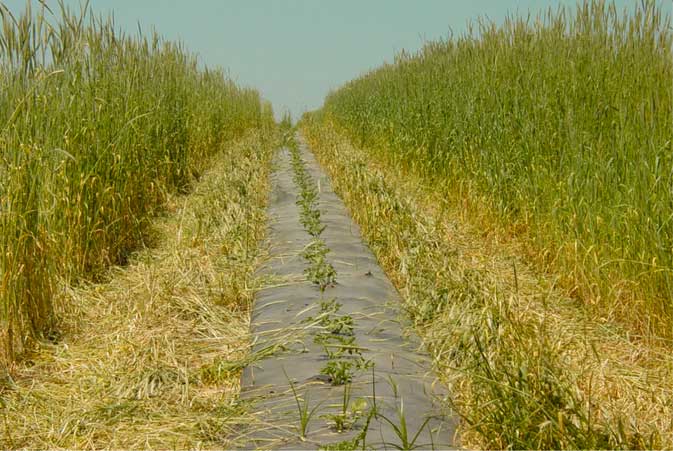
Conservation tillage, by reducing soil disturbance, improves soil quality by increasing organic matter and preserving soil structure (Balkcom et al. Reference Balkcom, Arriaga and Van Santen2013). Conservation tillage has become common in many row crops due to the effective cover crop management practices and popularity of genetically modified crops tolerant to effective POST herbicides that diminish the need for cultivation. However, specialty-crop weed control includes many challenges including few labeled herbicides compared to larger acreage crops such as corn, soybean, or cotton. In addition, relatively few conservation-oriented management recommendations are available for watermelon production (Abdul-Baki et al. Reference Abdul-Baki, Teasdale, Korcak, Chitwood and Huettel1996; Madden et al Reference Madden, Mitchell, Lanini, Cahn, Herrero, Park, Temple and Van Horn2004). Thus, conservation system adoption in watermelon has been slow, although progressive producers have improvised integrated systems (Figure 1).
Polyethylene/cereal rye cover crop mulch integrated system pioneered by Bob Rollins, watermelon producer, near Rebecca, Turner County, GA. The rye on either side of the polyethylene has been rolled and sprayed with glyphosate to terminate growth. The standing nonterminated rye offers protection from blowing sand damage to young transplants.

Cover crops reduce erosion by lowering the impact of rainfall on soil and reducing surface runoff (Zuazo and Pleguezuelo Reference Zuazo and Pleguezuelo2008). Cover crops are rarely used in watermelon production because of the lack of developed conservation management practices mentioned above, as well as the dominance and effectiveness of polyethylene for weed control. Polyethylene mulch has been successful combined with intensive tillage to maintain a clean, residue- and weed-free bed. Previous research showing that conservation tillage may result in unpredictable tomato yields has decreased adoption of conservation systems (Masiunas et al. Reference Masiunas, Weston and Weller1995). Keshavarzpour et al. (2008) evaluated watermelon yield following different tillage treatments and found that conventional tillage resulted in higher yield compared to reduced tillage, minimum tillage, and no tillage. However, none of the tillage methods evaluated in that study used a cover crop. Madden et al. (Reference Madden, Mitchell, Lanini, Cahn, Herrero, Park, Temple and Van Horn2004) demonstrated that in vegetable production, timely termination and adept use of a cover crop can provide weed control in conservation tillage.
Integration of cover crops in watermelon systems may provide enhanced weed management as a result of their weed-suppressive characteristics. In this study, herbicides integrated with different types of tillage and mulch systems were evaluated to determine impact on weed control, watermelon yield, and net returns.
Material and Methods
Field Site Description and Experimental Approach
The 3-yr experiment was established in fall 2013 at the Alabama Agricultural Experiment Station’s (AAES) E.V. Smith Research Center located in central Alabama (32.4417° N, 85.8974° W). The soil at the experimental site was a Pacolet loamy sand (siliceous, semiactive, thermic Typic Hapudult). The soil had a pH of 6 and 0.5% to 1.0% organic matter. The experimental design was a strip block design, with agronomic systems serving as strips, each containing a factorial arrangement of herbicide treatment. The experiment had three repetitions of each treatment.
The experiment contained four agronomic systems. The first system, conventional plus polyethylene (CV+P), is the industry standard, with polyethylene mulch installed on a 7.6-cm raised bed following conventional tillage including moldboard plow, disk harrow, field cultivation, and rototilling. The second system, conservation plus cover crop (CS+CC), was a conservation tillage with a non-bedded cereal rye (var. Wrens Abruzzi) cover crop without polyethylene. The third system, conventional tillage without polyethylene (CV), was non-bedded conventional tillage with soil prepared the same as the standard system, except with no polyethylene or bed installed. The fourth system, conservation plus cover crop plus polyethylene (CS+CC+P), was conservation tillage with polyethylene integrated into a cereal rye cover crop. Minimal 2.5-cm bedding occurred in this fourth system, with little soil movement because of cereal rye residue.
In both CS+CC and CS+CC+P systems, cereal rye was drilled at 101 kg ha–1 in the fall and managed for maximum biomass. In the spring prior to termination, cover crop biomass samples were collected by clipping all aboveground plant parts close to the soil surface from one randomly selected 0.25-m2 section in each plot. Plant material was dried at 60 C for 72 h and weighed. In the CS system, rye was terminated with glyphosate applied at 1.12 kg ae ha–1 and rolled/crimped 2 wk before transplanting watermelon (Ashford and Reeves Reference Ashford and Reeves2003). In the CS+CC+P system, the polyethylene mulch was installed utilizing a one-row Rain-Flo® model 2550 plastic mulch layer (Rain-Flo Irrigation Inc. East Earl, PA) in early spring following a subsoiling shank pass (performed to negate confounding compacted-soil effects) to avoid residue interference with bedding and polyethylene installation. In this system the cereal rye beside the polyethylene was sprayed with glyphosate applied at 1.12 kg ae ha–1 and left standing. The CV and CV+P plots were prepared as described above 1 wk prior to transplanting, and in the CV+P system, polyethylene was installed.
Herbicide applications were as follow: (1) halosulfuron (26.3 g ai ha–1; Sandea®, Gowan The GoTo C., Yuma, AZ) applied PRE; (2) halosulfuron (26.3 g ai ha–1) applied POST; (3) halosulfuron applied sequentially at 26.3 g ai ha–1 PRE and POST; and (4) a nontreated control. PRE treatments were applied 1 wk before the watermelon planting date. POST treatments were applied 4 wk after transplanting. A nonionic surfactant (Induce® nonionic low foam wetter/spreader adjuvant containing 90% nonionic surfactant (alkylarylopolyoxyalkane ether and isopropanol), free fatty acids, and 10% water; Helena Chemical Co., Memphis, TN) at 0.25% (vol/vol) was included in all POST herbicide treatments. Clethodim (140.1 g ai ha–1; Select®, Valent, Walnut Creek, CA) plus crop oil concentrate (Agri-dex®, 83% paraffin base petroleum oil and 17% surfactant blend; Helena Chemical Co., Memphis, TN) at 1% (vol/vol) was applied twice to all plots following transplanting, except the nontreated plots in each system, to suppress exceptional weedy grass emergence. All herbicides were applied utilizing a compressed CO2 backpack sprayer delivering 140 L ha–1 at 147 kPa. No hand weeding was done to augment weed control.
“Crimson Sweet” watermelon seedlings were transplanted May 14, 2014, May 1, 2015, and May 5, 2016. Watermelon in CV, CV+P, and CV+CC+P plots were transplanted by hand following a rolling dibble. Watermelon seedlings in CS plots were transplanted utilizing a modified RJ No-till transplanter (RJ Equipment, Blenhiem, Ontario, Canada); modifications included a flouted coulter followed by a subsoiler shank installed to penetrate the heavy residue and disrupt a naturally occurring compacted-soil layer found at both experimental sites at a depth of 30 to 40 cm (Kornecki et al. Reference Kornecki and Arriaga2011). In addition, two driving wheels were utilized (one wheel on each side of the watermelon row) instead of the original single wheel at the center of the row, to improve stability and eliminate drive wheel re-compaction of the soil opening created by the shank. All plants were irrigated at planting. Drip irrigation was then immediately installed on all plots, with irrigation applied four times a day for 15 min until harvest. Fertilizer was applied throughout the season using soluble fertilizer through the drip irrigation. Irrigation, fertilizer, insecticide, and fungicide were applied as recommended by the Alabama Cooperative Extension System (Mitchell and Huluka Reference Mitchell and Huluka2012). Plots were 5.49 m long and 2.13 m wide, with a 61-cm alley between each plot. Watermelon seedlings were transplanted with a spacing of 91 cm between plants.
Data Collection
Weed observations were recorded to determine the control of identified weeds in each plot. Visual weed control ratings, based on biomass reduction as compared to the nontreated control, were estimated on a scale of 0 (no injury to population) to 100 (complete death of all plants or no plants present) (Frans et al. Reference Frans, Talbert, Marx and Crowley1986). Early observations were recorded 2 wk after POST applications (6 wk after transplanting), and late observations were recorded immediately prior to harvest. Marketable watermelons were harvested on July 23, 2014, July 16, 2015, and July 13, 2016, and weighed.
Statistical Analysis
Weed control data from the control (CV nontreated) was not included in the analysis to stabilize variance, because visually estimated weed control ratings were zeros. To recognize structure in the treatment arrangement, analysis of variance was conducted using the general linear models procedure in SAS (SAS Institute Inc., Cary, NC), to evaluate the effect of the agronomic systems (four levels) and herbicide application (four levels) on weed control and crop yield. Year, agronomic system, herbicide application, and their interactions were considered fixed effects, whereas block was considered a random effect. Main effects and interactions were tested by the appropriate mean square associated with the random variable (McIntosh Reference McIntosh1983). Mean separations were performed using Fisher’s protected LSD test at P=0.05. Nontransformed data for visual evaluations were presented, because transformation did not affect data interpretation.
Economic Analysis
Partial budget analysis was used to empirically evaluate the impact of changes in production and herbicide application on net returns (Lu et al., Reference Lu, Duthie, Roberts, Taylor and Edelson2003; Walters Reference Walters2009). For a given production and herbicide application in a given year, net returns (nr) were calculated using the following equation:
 $$nr{\equals}\left( {P{\asterisk}Y} \right){\minus}VTC{\minus}YVC,$$
where P was the market price (US$ kg–1), Y was the yield (kg ha–1), VTC was variable treatment costs (US$ ha–1), and YVC was yield varying costs (US$ ha–1). The market price (0.28 US$ kg–1) used in the analysis was the 5-yr (2011 to 2015) average fresh-market price received by producers in Alabama for watermelons (USDA, 2017). Variable treatment costs consisted of polyethylene mulch, including installation and removal; cover crop establishment and termination; tillage where applicable; and herbicide product and application. Yield varying costs included costs for harvest, hauling, and packing; bins, pallets, and lids; and packing shed operations (0.154 US$ kg–1; Coolong and Boyhan Reference Coolong and Boyhan2017). All other variable costs were assumed constant across treatments and years. Fixed costs, such as land rent, depreciation, and overhead, were not included in the analysis as they may differ substantially between operations.
Results and Discussion
Cover Crop Biomass
At time of termination in 2014, rye biomass in CS+CC and CS+CC+P systems was 4,500 kg ha–1 (Standard Error (SE)2014=0.147). In 2015, rye biomass was 5,900 kg ha–1, whereas in 2016 rye biomass was 3,200 kg ha–1 (SE2015=0.136 and SE2016=0.154).
Watermelon Weed Control
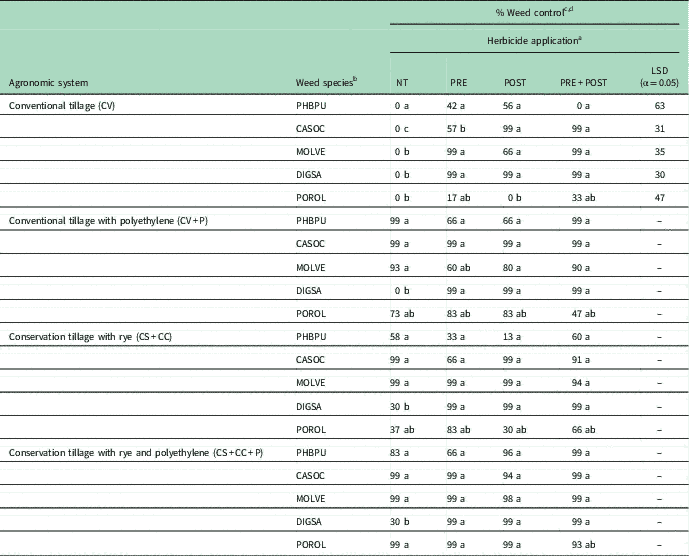
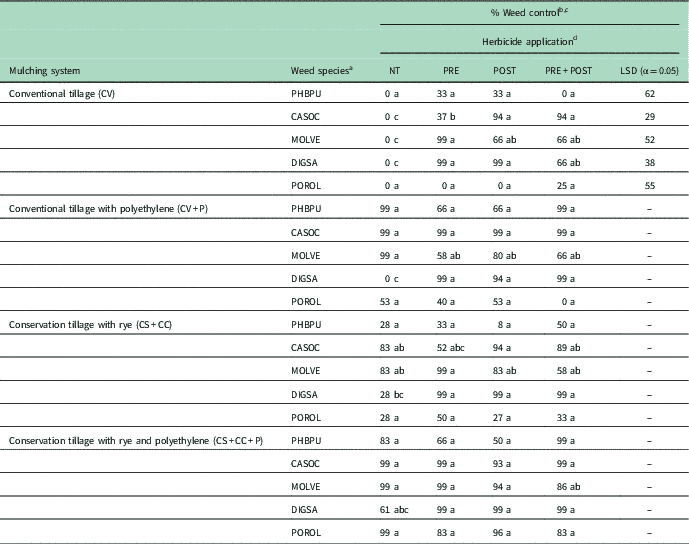
In 2014, weed control ratings recorded the treatment effects on carpetweed, coffee senna, common purslane, large crabgrass, and tall morningglory. Overall, CS+CC+P provided the highest weed control in nontreated plots compared to other systems, at early and late timings of weed control ratings (Tables 1 and 2). Polyethylene or the cereal rye cover crop effectively controlled tall morningglory, coffee senna, and carpetweed early season in nontreated plots, whereas the integration of the two was effective at controlling common purslane. Morningglory and purslane control was insufficient late season regardless of production system and herbicide application. In the late weed control interaction between herbicide and mulching systems in 2014, coffee senna had significantly less control in the CV or CV+P systems utilizing only PRE or POST herbicide applications compared to CS+CC or CS+CC+P. In addition, late season, crabgrass overtook all nontreated plots regardless of production systems (Table 2). Sequential herbicide applications never increased control compared to either a PRE or POST application alone early or late season. The most effective weed control early and late season was attained when cereal rye and polyethylene were integrated with herbicide applied either PRE or POST.
Early weed control following different mulching systems and herbicide application in watermelon, 2014.

a Nontreated (NT) plots had no herbicides applied, halosulfuron (26.3 g ai ha–1) was applied PRE, halosulfuron (26.3 g ai ha–1) was applied POST, or both PRE and POST applied. Clethodim (140.1 g ai ha–1) was applied twice to all plots, except NT in each system following transplanting, to suppress exceptional weedy grass emergence.
b Abbreviations: PHBPU, tall morningglory; CASOC, coffee senna, MOLVE, carpetweed; DIGSA, large crabgrass; POROL, purslane.
c Means with the same letter within a row are not significantly different.
d PROC GLIMMIX was used in SAS for all statistical analysis.
Late weed control of different mulching systems and herbicide application in watermelon, 2014.

a Abbreviations: PHBPU, tall morningglory; CASOC, coffee senna, MOLVE, carpetweed; DIGSA, large crabgrass; POROL, purslane.
b Means with the same letter within a row are not significantly different.
c PROC GLIMMIX was used in SAS for all statistical analysis.
d Nontreated (NT) plots had no herbicides applied, halosulfuron (26.3 g ai ha–1) was applied PRE, halosulfuron (26.3 g ai ha–1) was applied POST, or both PRE and POST applied. Clethodim (140.1 g ai ha–1) was applied twice to all plots, except NT in each system following transplanting, to suppress exceptional weedy grass emergence.
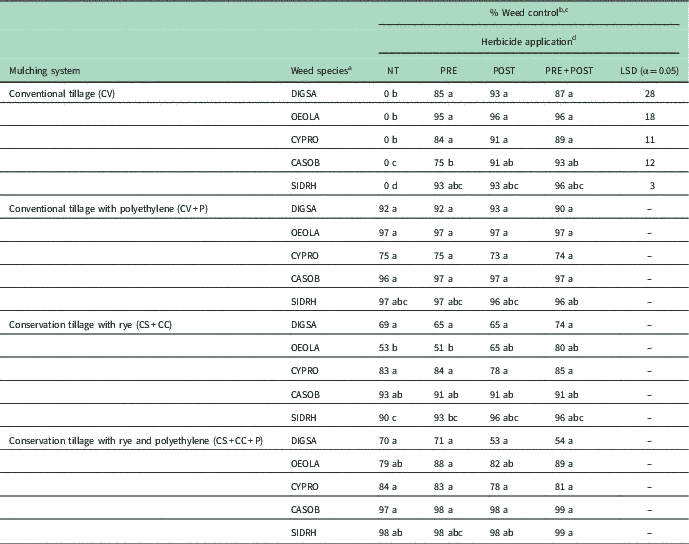
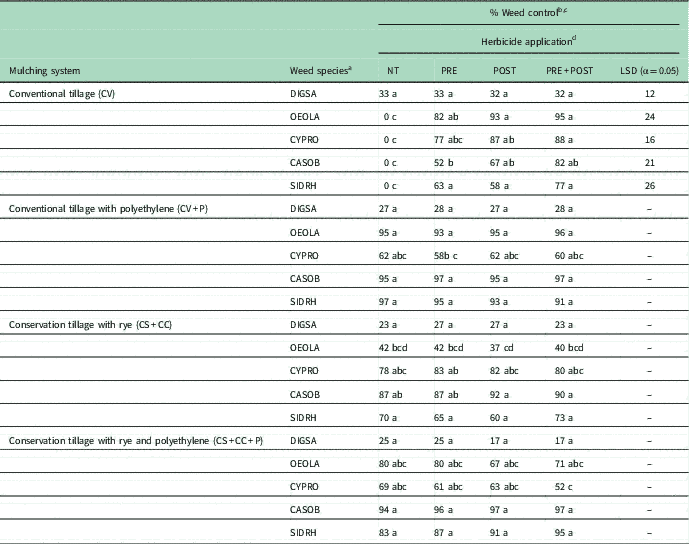
In 2015 and 2016, weed control ratings were recorded for arrowleaf sida, cutleaf eveningprimrose, large crabgrass, purple nutsedge (Cyperus rotundus L.), and sicklepod. Year interactions were not significant for weed control, thus data were combined for analysis. Similar to 2014, the production system was the main factor driving weed control. Polyethylene effectively controlled cutleaf eveningprimrose, sicklepod, and arrowleaf sida early season in nontreated plots. For early crabgrass control early season, CV and CV+P systems provided increased weed control compared to CS+CC or CS+CC+P systems, across herbicide treatments. Conversely, there was less sicklepod control following the CV systems, when polyethylene was not used. In addition, cutleaf eveningprimrose had significantly less control in both CS+CC and CS+CC+P systems, with nontreated and one herbicide application resulting in 53% (PRE only) and 51% (POST only) control (Table 3). Late purple nutsedge control in both CS+CC and CS+CC+P systems was significantly less than conventional tillage regardless of herbicide application (Table 4). Similar to 2014, sequential herbicide applications never increased control compared to either a PRE or POST application alone early or late season. Unlike 2014, the most effective weed control early season was attained using the industry standard conventional tillage with polyethylene, with herbicide applied either PRE or POST.
Early weed control of different mulching systems and herbicide application in watermelon, 2015 and 2016.

a Abbreviations: DIGSA, large crabgrass; OEOLA, cutleaf evening primrose; CYPRO, purple nutsedge; CASOB, sicklepod; SIDRH, arrowleaf sida.
b Means with the same letter within a row are not significantly different.
c PROC GLIMMIX was used in SAS for all statistical analysis.
d Nontreated (NT) plots had no herbicides applied, halosulfuron (26.3 g ai ha–1) was applied PRE, halosulfuron (26.3 g ai ha–1) was applied POST, or both PRE and POST applied. Clethodim (140.1 g ai ha–1) was applied twice to all plots, except NT in each system following transplanting, to suppress exceptional weedy grass emergence.
Late weed control of different mulching systems and herbicide application in watermelon, 2015 and 2016.

a Abbreviations: DIGSA, large crabgrass; OEOLA, cutleaf evening primrose; CYPRO, purple nutsedge; CASOB, sicklepod; SIDRH, arrowleaf sida.
b Means with the same letter within a row are not significantly different.
c PROC GLIMMIX was used in SAS for all statistical analysis.
d Nontreated (NT) plots had no herbicides applied, halosulfuron (26.3 g ai ha–1) was applied PRE, halosulfuron (26.3 g ai ha–1) was applied POST, or both PRE and POST applied. Clethodim (140.1 g ai ha–1) was applied twice to all plots, except NT in each system following transplanting, to suppress exceptional weedy grass emergence.
Watermelon Yield
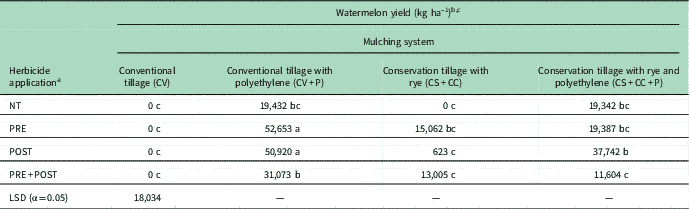
Year interactions were significant for yield; therefore, data were not combined for analysis. This interaction was attributed mainly to a total crop loss in the CV system and the nontreated CS+CC plots in 2014. This loss was due to extreme weed competition resulting from extremely high precipitation that probably quickly dissipated the PRE herbicide application activity and encouraged continuous seedbank germination. The CV+P plots with a PRE herbicide application produced the highest watermelon yield at 52,653 kg ha–1 (Table 5).
Watermelon yield following different mulching and herbicide application, 2014.

a Nontreated (NT) plots had no herbicides applied, halosulfuron (26.3 g ai ha–1) was applied PRE, halosulfuron (26.3 g ai ha–1) was applied POST, or both PRE and POST applied. Clethodim (140.1 g ai ha–1) was applied twice to all plots, except NT in each system following transplanting, to suppress exceptional weedy grass emergence.
b Means with the same letter are not significantly different.
c PROC GLIMMIX was used in SAS for all statistical analysis.
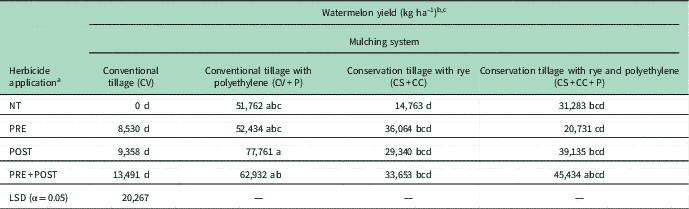
In 2015, the CV system yield was significantly lower than the CV+P, which were the highest yielding––again highlighting the advantage polyethylene provides in watermelon. The CV+P plus a POST herbicide application was the highest watermelon yield treatment and significantly different from all other mulching systems at 77,761 kg ha–1 (Table 6).
Watermelon yield following different mulching and herbicide application, 2015.

a Nontreated (NT) plots had no herbicides applied, halosulfuron (26.3 g ai ha–1) was applied PRE, halosulfuron (26.3 g ai ha–1) was applied POST, or both PRE and POST applied. Clethodim (140.1 g ai ha–1) was applied twice to all plots, except NT in each system following transplanting, to suppress exceptional weedy grass emergence.
b Means with the same letter are not significantly different.
c PROC GLIMMIX was used in SAS for all statistical analysis.
Similar results were observed by Teasdale and Abdul Baki (Reference Teasdale and Abdul Baki1997), where polyethylene outperformed conservation plots without polyethylene. However, the CV+CC treatment was similar to the CV+CC+P treatment, again highlighting the yield variability within conservation plots.
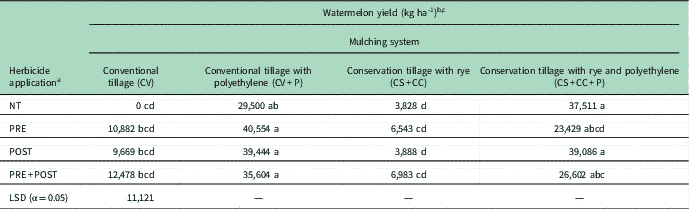
As in 2015, watermelon yields in 2016 followed similar trends and were highest when polyethylene was present, regardless of tillage or herbicide application. CV+P with PRE applied alone had the highest yield at 40,554 kg ha-1 (Table 7). Notably, yield in some CS+CC+P systems were not unlike CV+P treatments.
Watermelon yield following different mulching and herbicide application, 2016.

a Nontreated (NT) plots had no herbicides applied, halosulfuron (26.3 g ai ha–1) was applied PRE, halosulfuron (26.3 g ai ha–1) was applied POST, or both PRE and POST applied. Clethodim (140.1 g ai ha–1) was applied twice to all plots, except NT in each system following transplanting, to suppress exceptional weedy grass emergence.
b Means with the same letter are not significantly different.
c PROC GLIMMIX was used in SAS for all statistical analysis.
Economic Analysis
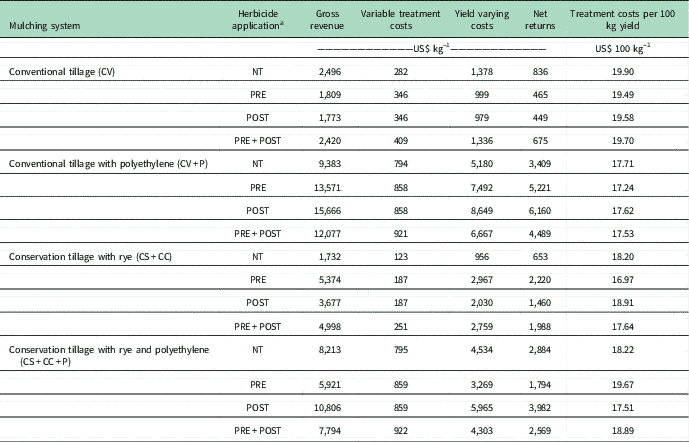
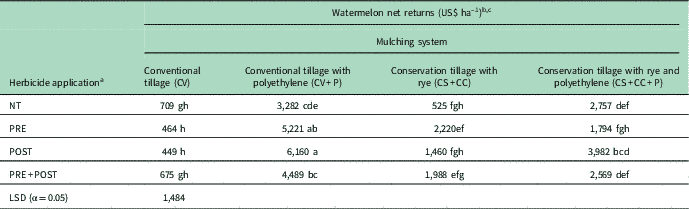
Although total treatment costs (variable treatment costs and yield varying costs) were highest for CV+P with POST herbicide only, increased watermelon yields under polyethylene improved gross and net returns as compared to the other systems (Table 8, Table 9). Applying PRE herbicide alone, or both PRE and POST under polyethylene, reduced net returns by 18% and 37%, respectively, as compared to POST only. Net returns for CS+CC with POST application only were 55% lower than for CS or CV with POST only; however, there are additional benefits, such as erosion control over the winter, that were not accounted for in the analysis. CS or CV with POST only was not statistically different from polyethylene without herbicides, with PRE only, or with both PRE and POST (Table 9). Although total treatment costs were lower, CV across all herbicide application and CS without herbicides produced net returns statistically lower than polyethylene regardless of herbicide application. Utilizing a CS system with PRE only resulted in the lowest total treatment costs per 100 kg of watermelon yield; however, the low costs did not offset the lower revenues.
Net returns by mulching and herbicide application, averaged across experimental years.

a Nontreated (NT) plots had no herbicides applied, halosulfuron (26.3 g ai ha–1) was applied PRE, halosulfuron (26.3 g ai ha–1) was applied POST, or both PRE and POST applied. Clethodim (140.1 g ai ha–1) was applied twice to all plots, except NT in each system following transplanting, to suppress exceptional weedy grass emergence.
Net returns of watermelon production from different mulching and herbicide application averaged over experimental years.

a Nontreated (NT) plots had no herbicides applied, halosulfuron (26.3 g ai ha–1) was applied PRE, halosulfuron (26.3 g ai ha–1) was applied POST, or both PRE and POST applied.
b Means with the same letter are not significantly different.
c PROC GLIMMIX was used in SAS for all statistical analysis.
This research indicates that using polyethylene produced the highest watermelon yields and net returns. In 2016, there was no significant difference between the CV+P and CS+CC+P treatments, showing that CS+CC+P could be an alternative system for watermelon production that yields well and also protects the environment. In the herbicide applications, there was no significant difference between treatments, again indicating that mulching system is the most important factor in increasing yield between herbicide and mulching system. The polyethylene systems had the greatest yield and net returns, neither of which were consistently increased by including a PRE and POST application.
Single PRE and POST herbicide application resulted in similar levels of weed control. Control was not increased in most comparisons with an additional herbicide application. Polyethylene integrated with rye was an effective weed control practice in most situations except for nutsedge, which was able to penetrate the polyethylene. Previous research has shown that watermelon grown utilizing conventional tillage produced higher yields than watermelon grown using conservation tillage (Keshavarzpour and Rashidi Reference Keshavarzpour and Rashidi2008). One explanation for this difference may be that watermelon has deep fibrous roots that thrive in a friable bed created by intensive tillage. However, the transplanter used in this study was equipped with a single subsoiler shank to alleviate potential compaction problems. Moreover, root zone soil structure differences were probably present in this experiment as a result of the different tillage implements utilized in each system. Past research showing that using polyethylene will greatly increase watermelon yield, attributed to both increased weed control and soil heating (Soltani et al. Reference Soltani, Anderson and Hamson1995), is supported by the results of our research.
Our weed control results demonstrate that using conservation tillage with a cereal rye cover crop integrated with polyethylene has potential as evaluated; however, watermelon yield and net returns reveal disadvantages in utilizing conservation tillage watermelon production. Polyethylene integrated with cereal rye in this experiment resulted in minimal beds, which could lead to restricted root zone and drainage issues depending on field conditions. Previous research has shown that cereal rye as a cover crop may preserve the structure of raised beds used in vegetable production (Roberts et al. Reference Roberts, Duthie, Edelson, Cartwright, Shrefler and Roe1999). Thus, future research might evaluate conventional raised beds created in the fall, with row middles then seeded with a winter cover crop. Subsequently, polyethylene could be installed in the spring, with cover crop biomass terminated in the row middles before transplanting.
Acknowledgments
Mention of a trade name, proprietary product, or specific equipment does not constitute a guarantee or warranty by the USDA and does not imply endorsement of a product to the exclusion of others that may be suitable. No conflicts of interest have been declared. This research received no specific grant from any funding agency, commercial, or not-for-profit sectors.