So the Old strode in disguised as the New, but it brought the New with it in its triumphal procession and presented it as the Old (Brecht [Reference Brecht, Willett and Manheim1939] 1987)
This article takes as its focus a newly established institution—South Africa's Constitutional Court—and explores some of the ways in which this institution makes claims to “being new” in a broader sense of offering a new way of doing things or representing change. Within South Africa's transition to democracy in the 1990s, many institutions of government were retained and repurposed: the Constitutional Court was a very important exception to this. Prior to 1994, South Africa had not had a Constitutional Court with the power of judicial review, nor a Constitution that enshrined both political and socioeconomic rights for its citizens. In 1994 the Constitutional Court was a “new” institution in the South African context, but it was also at the center of a broader claim to be building a “new” democratic, nonracial, and nonsexist South Africa in the wake of apartheid and colonialism. Indeed, the Court in its role as protector and promoter of the Constitution was also an institution at the vanguard of the fuller transformation of South African governance and society envisaged by that Constitution.
An important element in this broadly conceived transformation was gender equality and an improved representation of women within politics. As Shireen Hassim has noted, women came to occupy a “peculiar status” during South Africa's transition to democracy as the “proving ground” or “marker” of the extent to which the postapartheid agreement was viewed as “inclusive, participatory and permeable to socially excluded groupings” (2006, 162). The Constitution ensured that the courts could be considered one of those “proving grounds” of inclusivity when it stipulated in Section 174(2) that the judiciary should reflect broadly the racial and gender composition of South African society. This article follows on from Hassim's observations of the transition period and traces the story of women's “peculiar status” since 1994 in relation to the Constitutional Court and the South African judiciary, exploring the ways in which intersecting performances of race and gender might be read as signs of institutional newness, or “being new.”
Here “being new” is understood as an institutional attribute, which has to be constructed and claimed and can be disputed. This renders “old” and “new” unstable political claims, entangled with performance, bodies, and power, as in Bertolt Brecht's poem “Parade of the Old New” quoted above. This approach to institutional newness has been formulated in the context of recent theorizing about “new” institutions by new institutionalists contained within work on institutional origins and design. From within this literature various concepts have been suggested that try to capture the complexity of old, new, borrowing, remembering, and forgetting of rules and norms that go into the process of establishing an institution, including “bricolage,” “matrix,” and “nested newness” (Leach and Lowndes Reference Leach and Lowndes2007; Lowndes Reference Lowndes2005; MacKay Reference MacKay2009; North Reference North1990). I want to add to this emergent theorizing by foregrounding the politics of claiming or judging an institution to be new or old. In particular, in this article I aim to explore the ways in which gendered and raced bodies can become entangled with a politics of institutional newness.
In developing this approach to the politics of institutional newness, I draw from a number of disciplines and theoretical perspectives. The impulse to critique political claims of newness is inherited from a well-developed feminist and critical race scholarship that analyzes “new” institutional forms or legal state solutions to inequality and alerts us to “the old” lurking within and that explores the way in which existing power hierarchies and unequal structures are reinscribed through processes of institutional change and reform that ostensibly aim to tackle them.Footnote 1 An important concept within this literature is that of “backlash” or countermobilization, used to describe the reaction of those in power, or supportive of the status quo, to a given social or political change (see Kenney Reference Kenney2013, 136). As Sally J. Kenney notes, the importance of this concept lies in its assumption of newness; despite the fact that a backlash might be based upon historical patterns of inequality or oppression it is, in fact, a new manifestation. The political reform or social inclusion “has unleashed a new force that is distinct” from “plain old” sexism or racism (Kenney Reference Kenney2013, 136). I want to suggest here that to follow the mutations of sexism or racism in a “new” institution, we need to watch closely how the politics of newness unfolds and how bodies are entangled with these politics.
The focus upon bodies is inspired by Sara Ahmed's work on diversity policies within UK higher education institutions, in which she urges us to take note of the “work” that certain bodies are asked to do for certain institutions at certain times, paying particular attention to the experiences of those who have been historically excluded from said institutions, such as women or people of color (Ahmed Reference Ahmed2012). Ahmed notes that processes of institutional inclusion, or being “folded in” to an institution, are not without consequences for those who are included. As she puts it, historically excluded bodies “are not then simply or only included by an act of inclusion. In being ‘folded in,’ another story unfolds” (Ahmed Reference Ahmed2012, 164). In laying claim to newness, an institution opens up contestation over just what is “old” and what is “new.” Judgements might fall, or claims rest, upon a particular set of rules, a norm of behavior, or on bodies. When institutional claims about newness are being made through bodies, then gender, race, sexuality, and class—as ways of reading bodies—become simultaneously ways of reading institutional change and continuity. To notice that bodies and institutions are coconstitutive is an insight that underpins the study of gender and builds upon a view of institutions as “living scripts” that are constituted by everyday embodied performances of rules and norms (Puwar Reference Puwar2010, 298).
In exploring these questions through a court, the arguments here also draw upon an emergent scholarship on gender and judging and, in particular, the work of Sally J. Kenney. Kenney has urged those studying gender and judging to move “beyond” the question of whether women judges decide cases differently than men (Reference Kenney2008, 88). She argues that women need to be represented in the ranks of the judiciary, not because they necessarily bring a special “feminine” perspective, but because their inclusion normalizes women's power and authority. Kenney's approach helps shift our focus from searching for women's difference to tracing the specific dynamics of inclusion. When studying the incorporation of women into judiciaries from which they have been historically excluded, Kenney warns us to expect to see differences in “how each individual woman ‘does’ gender” and calls for us to see gender “one judge at a time” (Reference Kenney2008, 101; Reference Kenney2013, 45).
Particularly important for this article is Kenney's work on the first woman judge to be appointed to the UK Supreme Court. Kenney has tracked the way in which the absence of women from higher judicial office in the UK was brought onto the policy agenda in 2003 by a “critical community” that included feminists, inside and outside the legal professions, who linked the absence of women to discussions of the need to modernize the judiciary. In this context she shows how Justice Hale's appointment as the first woman Supreme Court judge was used to lay claim to the newly established Court's modernity. She also reveals the limitations of the strategy adopted by the critical community to “instrumentally” link their calls for more women judges to the broader agenda of modernization: the linkage was “enough to break the barrier of a woman first” but did not “generate a deeper commitment to gender equality” (Kenney Reference Kenney2013, 107). In this article I argue that in South Africa the range of agendas that lie behind the establishment of the Constitutional Court and the drive for diversity in the judiciary has resulted in a complex entanglement of race and gender with an institutional politics of newness.
The article begins by outlining the Constitutional Court's position within the South African legal system and sketches a brief overview of the competing agendas motivating a diversification of the judiciary in South Africa and the institutional mechanisms established to affect it. It then explores appointments to the Constitutional Court since 1994 through a historical narrative that pays attention to the ways in which historically excluded bodies, women and black men, have been included into this new institution within the judiciary.
THE “NEW” SOUTH AFRICA AND THE CONSTITUTIONAL COURT
The establishment of the South African Constitutional Court occurred within the context of the political transition from apartheid minority rule to postapartheid democracy and was an example of, and a contributor to, a globalized expansion of judicial power or “judicialization” of politics at the end of the twentieth century (Malleson Reference Malleson, Malleson and Russell2006, 3). As in other places that have seen an expansion of judicial power, the South African transition was accompanied by a renewed focus on the demographics of the judiciary and processes of judicial appointment (Malleson Reference Malleson, Malleson and Russell2006, 3). The push for a more diverse judiciary in South Africa was intertwined with the establishment of the new Constitutional Court, and the impetus for both was shaped by a number of overlapping and contesting agendas: a need for a renewal of judicial legitimacy and authority; an urge to protect hard-won rights and freedoms; and a wish to create and sustain the independence of the judiciary from executive power.
As Heinz Klug has put it, the South African transition to democracy was shaped by a strong “urge for legal continuity” that came from elements within both the antiapartheid liberation organizations and the former ruling white minority (Klug Reference Klug2010, 15).Footnote 2 As such, the transition from minority rule to democracy required a transformation of the law from that which had upheld and legitimized apartheid to that which underpinned a new legal order enshrining equality. Under the 1993 Interim Constitution, and then the 1996 final Constitution, South Africa moved from a system built around parliamentary sovereignty to one with a supreme written Constitution. However, the existing personnel and institutions of South Africa's apartheid-era legal system were largely retained. This included a judiciary that was widely perceived to have done more to underpin and uphold apartheid through law than act as a bulwark against that system's worst injustices. As a result, it lacked legitimacy and the moral authority to challenge the new democratic government, and many also doubted apartheid-era judges' commitment to the new equality enshrined in the Constitution. This was a predicament often expressed in bodily terms; after 1994, “the judiciary could not consist of ninety-seven percent white male judges and expect legitimacy” (Cowan Reference Cowan2006, 299).
The decision to establish a new Constitutional Court with new judges who had jurisdiction over constitutional matters was a response to the urge to protect the Bill of Rights and was an immediate means of side-stepping the lack of trust in the existing judiciary and its lack of legitimacy. A Constitutional commitment to transform the composition of the judiciary was the more long-term solution to its embodied lack of legitimacy. However, the establishment of a new appointments process run by a Judicial Services Commission (JSC), which ultimately strengthened the claim that the post-1994 judiciary would be “new” was also in part a response to a third agenda: to build up the structural independence of the judiciary as a check on the power of future executives.
Apartheid-era judicial appointments were regarded as secretive, politicized, and in the gift of the executive branch of government (Wesson and Du Plessis Reference Wesson and Du Plessis2009, 3). During multiparty talks in 1993 that drafted the Interim Constitution, an initial agreement between the ruling National Party (NP) and the foremost antiapartheid liberation organization, the African National Congress (ANC), would have continued to concentrate the power of appointing judges in the executive.Footnote 3 This was vociferously objected to by the liberal Democratic Party, sections of the liberal media, and some university law faculties. A “last-minute” compromise created a Judicial Services Commission (JSC) including representatives from Parliament and the legal professions with a significant role in making judicial appointments (Spitz and Chaskalson Reference Spitz and Chaskalson2000, 206). Once established, the JSC was quickly incorporated into the Constitutional Court's institutional claims to newness (see Mandela's speech at the Court's inauguration discussed below). In general terms, the JSC has been viewed by the ruling ANC as a vehicle for transforming the judiciary (Malleson Reference Malleson1999, 39). However, it is important to remember its origins, as Spitz and Chaskalson have described it, as the Democratic Party's “most notable prize” during the negotiations process (Reference Spitz and Chaskalson2000, 198). Since 1994, the JSC has thus also been viewed within liberal critiques of the ANC's political dominance as a means of maintaining judicial independence. Both views have become entangled with debates over bodies.
The 1996 Constitution stipulates two things about the judiciary. Firstly, Section 174(1) requires appointed candidates to be “appropriately qualified” and “fit and proper.” Secondly, Section 174(2) of the Constitution requires that the judiciary “reflect broadly the racial and gender composition of South Africa.” The JSC has a slightly different role to play in the appointment of judges dependent on the court to which the appointment is being made. It is “consulted” when the president is appointing the heads of South Africa's top two courts, the Constitutional Court and Supreme Court of Appeal.Footnote 4 It makes recommendations in the case of other appointments to the Constitutional Court, where the final decision rests with the president. It appoints directly, in the case of all other courts in South Africa. The JSC also has a role in the continuing training and education of judicial officers and the handling of complaints against judges.
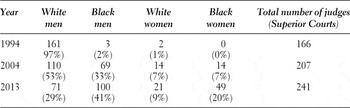
Table 1 provides a statistical summary of the transformation of the South African judiciary since 1994, in descriptive race and gender terms. The figures reveal that there has been a slower gender as opposed to racial transformation of the judiciary, which has become a focus of public debate again more recently (for discussion of the reasons behind the slower pace, see Andrews Reference Andrews2006; Cowan Reference Cowan2006). However, beyond revealing the pace of transformation, this statistical picture does not tell us the ways in which previously excluded racial and gender groups have been incorporated into this historically white and masculine institution.
A statistical picture of the transformation of the South African Judiciary (Superior Courts)

Note: Compiled by author. Statistics for 1994 drawn from Wesson and Du Plessis Reference Wesson and Du Plessis2009; for 2004, see AfriMap 2005; for 2013, see Nel Reference Nel2013. Percentages rounded to nearest whole number.
A NOTE ON METHODOLOGY
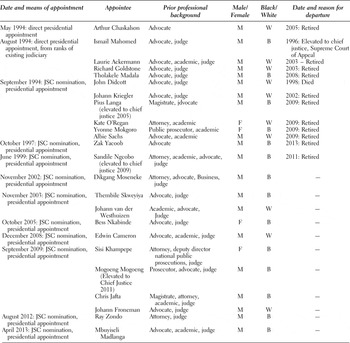
What is presented below is a historical narrative of the appointments to the Constitutional Court since 1994, reconstructed through media reports of the process. It is not simply a descriptive account and as such cannot hope to cover all 24 appointments made during this period in the same depth. The appointments made over the last two decades are summarized in Table 2, showing the dates at which judges have joined and left the Constitutional Court bench, the route by which they were appointed and, in broad terms, their professional background prior to joining the Court, and their gender and race.Footnote 5 In constructing the historical narrative that follows, I have collected and analyzed articles from South Africa's major English-language newspapers that reported and commented upon Constitutional Court appointments since 1994.Footnote 6 Through a textual analysis of these articles I have traced the ways in which the contested process of transformation and the Constitutional Court's newness has been read and articulated through gendered and raced bodies at particular moments. By tracing recurring patterns of discourse and noticing when and where race and gender appear in the debates over judicial appointments, what becomes apparent is that the relationship between bodies, politics, and institutions has not been straightforward or stable. Some bodies have been more “emotionally resonant” than others at specific moments, acting as conductors or amplifiers for debate (Kenney Reference Kenney2013, 57). Gendered and raced bodies have figured differently in institutional claims to newness. I argue here that in the Court's first 20 years, while individual black male judges have been read as embodying the new judiciary, women's importance (black and white) has most often lain in their continued absence.
Summary of appointments to the Constitutional Court, 1994–2013

Note: For much more detail on prior professional background, see the professional biographies for all judges current and former, provided on the Constitutional Court website (www.constitutionalcourt.org.za).
APPOINTMENTS TO THE CONSTITUTIONAL COURT SINCE 1994
In general terms the South African debates over transformation resemble those that have greeted attempts to diversify the judiciary in other countries. Perceived contradictions between the public and private, or formal and informal, aspects of the judicial appointments process—what a broader literature on judicial appointments refers to as the “gap between theory and practice”—have continued to provide moments for contesting transformation (Malleson Reference Malleson, Malleson and Russell2006, 5). Many elements of “backlash” against judicial diversification that Kenney identifies are visible in the press discourse on Constitutional Court appointments, including the powerful narrative that “representativeness and diversity are the enemies of merit” and that the appointment of women and black men is a sign of “the abandonment of merit and the primacy of special interest politics” (Kenney Reference Kenney2013, 139).
In South Africa, the emergence of this narrative has played out around the two constitutional provisions that the judiciary be “appropriately qualified” and “broadly representative.” In the JSC's first two decades of appointments, critics have often framed the two provisions as contradictory, or as existing in a hierarchy, with those who suggest that “appropriately qualified” should always trump the call for diversity (for example, Kreigler quoted in Du Plessis Reference Du Plessis2013b), pitted against others who have wished to see the relationship reversed and the concept of merit rewritten to value a diversity of perspectives (for example, Davies Reference Davies2010; Mokgoro Reference Mokgoro2010). A merit versus diversity dichotomy has continually resurfaced within public debates over appointments, most recently in 2013 when Chief Justice Mogoeng commented that “merit does count, but it is not all about merit. Transformation is just as important” (quoted in Du Plessis Reference Du Plessis2013b).
However, it has been argued that South Africa is a context in which the rewriting of merit to value diversity has gone further than most (see Mogadime Reference Mogadime2005) and in which the constitutional provisions “move beyond” calls for diversity within the judiciary, “pursuing representivity instead” (Du Bois Reference Du Bois, Malleson and Russell2006, 282). In post-1994 South Africa, the argument that the judiciary must be “diverse” in composition has been won. The Constitutional Court has argued that it is appropriate for judges to bring their life experiences to the act of adjudication, providing “a powerful rationale for judicial diversity” (Wesson and Du Plessis Reference Wesson and Du Plessis2009, 48). Yet the powerful narrative of merit versus diversity has surfaced around the pace of change and the “balance” of differences. The meaning of transformation has also been contested—with an increasing number of critical observers now pushing for more attention to be paid to the values of judicial candidates amid the “troubling racial disharmony” of public debate over judicial appointments (Cowen Reference Cowen2010, 9).
Within this there is a complex story to tell about the ways in which women and black men have been incorporated into the judiciary and been entangled with the politics of the Constitutional Court's newness. In press discourses on judicial appointments there are a number of patterns that can be observed. A dominant set of voices, made up of legal journalists writing in the English-language press and their sources from within the legal professions, legal professional bodies, and politicians, have routinely associated white bodies with the old, with continuity and legal tradition, with ability and merit, with being independent-minded and descriptions such as “reserved” or “aloof.” In contrast, black bodies have been read as a sign of the new, of change, as representative, as a sign of inclusion, as charming or open, but potentially politically pliant. These dichotomies have not been stable or consistently applied with the same attributes sometimes being read positively, sometimes negatively, and it can be seen that gender has often been disruptive of such judgements. None of this is to suggest that judicial values can, or should be, “read-off” bodies in this manner, but rather to note the way in which bodies have become entangled in discussions of values.
I argue in what follows that a turning point can be identified around 2008–2009 when what had been a strong emphasis on black male judges as a sign of the new in the first 15 years of transformation was disrupted by a shift toward women judges as a sign of a further, but as yet unrealized, “real” transformation. At around the same time as this discursive leap, the discourse on transformation of the judiciary also began to broaden out, and a wider range of civil society groups and those supportive of faster and more through-going judicial transformation focused on values began to join public debates over appointments more forcefully. In the conclusion, I offer some reflections on this apparent shift and its possible implications for those leading the call for more women judges in South Africa.
1994: Birth of a New Court
In 1994 the first 11 judges of the newly established Constitutional Court were appointed in three stages. In the first, a president of the Court, Arthur Chaskalson, was appointed directly by President Nelson Mandela in May 1994. The appointment of Chaskalson, a prominent human rights lawyer, as head of the Constitutional Court (initially president and later chief justice) signaled that while the South African legal tradition and judiciary was being challenged by the new court, the roots of this challenge came from within: from the lawyers and academics who had developed an oppositional tradition of law through human rights litigation against apartheid. Indeed, Roux has suggested that the Constitutional Court bench ultimately represented a “triumph of the oppositional tradition [of law] over its discredited opponent” (Roux Reference Roux2013, 220). In 1994, the media tied this recent oppositional tradition of law to what they framed as “known” white men. The repeated links between a human rights tradition of law and certain white men made at this time strengthened a recurring slippage between whiteness and “independence of mind.”
In the second stage of constituting the first Constitutional Court bench in August 1994, four judges were appointed, who had to be drawn from the ranks of the existing judiciary. In the commentary on these four appointments within prominent English-language newspapers such as the Sunday Times and the weekly Mail & Guardian, a dominant narrative pitted “known” white male candidates against “unknown” and undifferentiated black candidates. The decision not to appoint the “known” white men was framed as an act of “exclusion.” Two individuals in particular were named. Judge John Didcott was described as a man who had “practically invented pro-human rights judicial activism in this country” and was deemed to be a “natural choice” (Cowling Reference Cowling1994a; Rickard Reference Rickard1994). Similarly, Judge Pierre Olivier was seen as “an obvious choice” (Rickard Reference Rickard1994). It was suggested that these individuals had not been appointed “because the authorities felt that they could not risk too many strongly independent voices” (Rickard Reference Rickard1994). A professor of law at Wits University was quoted in the Mail & Guardian as commenting that Didcott was “male, white and independent-minded and that's three strokes against him” (Cowling Reference Cowling1994a).
Of those appointed were Richard Goldstone, Ismail Mahomed, Laurie Ackermann, and Tholakele Madala. Goldstone and Madala were the most “controversial.” Goldstone was considered to be controversial because he would be absent for the first two years of the Court's life, having just taken up a post as the chief prosecutor for the United Nations at the International Criminal Tribunal for the former Yugoslavia, and not, it was noted “because anybody questioned his suitability for the post” (Rickard Reference Rickard1994). In contrast, Madala, the first black African man to be appointed to the Court was described anonymously to the Sunday Times legal correspondent Carmel Rickard as “a legal non-entity” and an example of “tokenism,” whose appointment “over” Didcott and Olivier was “unacceptable” (1994). Madala's own human rights record as an advocate and as a law student involved in founding a legal aid clinic was not reported by Rickard, a point made angrily at the time by the then publicity secretary of the Black Lawyers Association, Dumisa Ntsebeza (Ntsebeza Reference Ntsebeza2004).
In the third stage of appointments, in September of 1994, a further six Constitutional Court judges were appointed by Mandela from a short list of ten presented by the JSC. The JSC selected 25 candidates for interview from a wider pool of candidates than had been previously considered. Alongside senior advocates, attorneys and legal academics could also be nominated for the first time. Reports of the JSC interviews contrasted an image of “an old-style judge” as “traditionally white-haired, formal” and “reticent with any non-legal opinions” with the “frank,” “open,” and “relaxed” new candidates on show (Cowling Reference Cowling1994b). The openness of the interview process itself was central to the institutional claims about the Court's newness.Footnote 7
However, when the final bench was announced, the assessments were not unanimously complimentary. Mandela, together with Chaskalson, selected from the short list John Didcott, Johann Kriegler, Pius Langa, Kate O'Regan, Yvonne Mokgoro, and Albie Sachs. In response, the liberal opposition Democratic Party's spokesperson for justice, Douglas Gibson, said that “South Africa has a less than glittering constitutional bench ... a historical opportunity to appoint the very best has been missed” (“Constitutional Judges Named” 1994). The former governing National Party was reportedly “disappointed” at the composition of the court (Breier Reference Breier1994). Overall, the reaction to the new Court was “surprisingly muted,” with one commentator suggesting that “it seems likely that the minority parties, like most of the public ... believe that the court will be a purely technical legal body” and therefore were not overly interested in the new judges (Friedman quoted in West Reference West1994).
The inauguration of the new judges was, however, a moment with multiple emotional resonances. President Nelson Mandela articulated the Court's various claims to be new and in doing so, highlighted just how important that “newness” was to the foundations of the postapartheid state:
You are a new court in every way. The process whereby you were selected was new. When we look at you, we see for the first time the many dimensions of our rich and varied country. We see a multiplicity of backgrounds and life experiences. Your tasks are new. Your powers are new. We hope that, without abandoning the many sterling virtues of legal tradition, you will find a new way of expressing the great truths of your calling (Mandela Reference Mandela1995).
The first bench of the Constitutional Court was majority white and male, but an overall composition that included black and women judges was vital for the Court's legitimacy, articulated by Mandela as resting “for the first time” on “the many dimensions of our rich and varied country.” Ahmed has noted that for an institution, visible “[racial] diversity can conceal whiteness by providing an organisation with colour,” but it can also “expose whiteness by demonstrating the necessity of this act of provision” (Ahmed Reference Ahmed2012, 33). This tension was downplayed in the South African media at the inauguration of the Constitutional Court by a focus upon judges' choice of language when swearing their oaths of office, a story that amplified the voices and presence of the black judges.
Most media reports of the event focused upon two signs of newness: the judges' newly designed dark green robes, which emphasised the appearance of change while drawing attention away from the actual bodies wearing the robes; and their choice of language in swearing their oaths of office. The Sowetan, an English language newspaper with a predominantly black readership reported the ceremony under the headline “Diversity in Oaths.” The reporter foregrounded the presence of black judges and read the combination of language and bodies as signs of historic change: “Probably for the first time in the country's history and except for Mr. Justice Ismail Mohamed, who spoke English, the three black judges took their oath in Xhosa, Zulu and Tswana” (Ngudle Reference Ngudle1995). Reflecting on the inauguration in 2011, Yvonne Mokgoro recalled being taken by surprise at the response of the public to this act, saying “I did it without realising there's history in the making” (Mokgoro Reference Mokgoro2011, 6). Mokgoro (Reference Mokgoro2011, 6) recalled “people started calling me and telling me how that was history making. For the first time a judge spoke in her African ... own African language.” Mokgoro also remembered with emotion the Sowetan's coverage as including a large picture of herself swearing her oath with the caption, “the Lady is a Judge.” Other newspapers (for example, Cape Times, Star, Business Day) also all reported the languages used in the ceremony in a list as English, Afrikans, Zulu, Xhosa, and Tswana, which emphasized a plurality of voices, with African languages outnumbering white languages in a way in which bodies did not.
1995–2008: How to Count Transformation?
During the first 15 years of postapartheid democracy, a steady trickle of appointments was made to the Constitutional Court at the same time as the broader profile of South Africa's judiciary was reshaped by the JSC (see Table 1). There was a subtly different way in which men and women's bodies were entangled with the claims and contestation of newness in the Court's early years. Early black male appointees were celebrated as signs of newness and transformation. For example, Justice Ismail Mahomed, promoted from deputy president of the Constitutional Court to head of the Supreme Court and chief justice of South Africa in 1996 was hailed as able to “symbolise the judiciary's commitment to applying the values of the new constitution” (Fine Reference Fine1996; Rickard Reference Rickard1996). The contrast was an embodied one in reports of the JSC interviews, which noted Mahomed's “bonhomie” and “passion” against his opponent's “reserved and more traditional figure” (Carter Reference Carter1996).
In the reporting of appointments to the Constitutional Court male judges were also often differentiated as individuals to a much greater extent than the only other woman to be appointed during the first 15 years, Bess Nkabinde. For example, the reporting of Zak Yacoob appointed in 1997 stands out for the emphasis on his individuality. In a profile of Yacoob, published in Business Day, shortly before he took up his post on the Constitutional Court, the new judge was quoted as stating,
The uniqueness which I have to add to the Constitutional Court is a combination of my experience which arises out of my disability, my involvement in the struggle for democracy and my involvement in a commercial and legal practice as a blind person. I do not think you will find another such person in this country (Lamberti Reference Lamberti1998).
Yacoob laid claim to an embodied contribution that was utterly unique. In this way he did not claim to be representative of a particular constituency but instead suggested that the Constitutional Court was home to a special set of perspectives on South Africa, his now included. In direct contrast, Bess Nkabinde's appointment in 2005 was reported simply as, the “third female judge for the Constitutional Court”—an act of arithmetic that reduced her and her fellow women judges, Yvonne Mokgoro and Kate O'Regan, simply to female bodies, countable and undifferentiated (“Third Female Judge for Top SA Court” 2006).
However, in instances that the contest for appointment was seen as being between black and white men, “unknown” blackness continued to be pitted against renowned whiteness. In 1999, it was reported that the appointment of Edwin Cameron, a white man, to the Constitutional Court had been “blocked” by the then deputy president, Thabo Mbeki, in favor of the strongest black candidate Sandile Ngcobo (Steinberg Reference Steinberg1999a). In the media's framing of Cameron's appointment as “blocked,” like the earlier “exclusion,” prominent legal journalists suggested that the trajectories of these white male bodies was natural, and was being interrupted. Media descriptions of the two candidates contrasted Cameron as “one of the finest jurists of his generation,” “unmatched” and capable of “progressive and creative jurisprudence” with appraisals of Ngcobo ranging from “able” and “solid,” with an appointment that was “by no means a scandal” to “this entirely unknown entity” (Steinberg Reference Steinberg1999a; Reference Steinberg1999b). Such assessments perpetuated a merit versus diversity dichotomy. The reported comments from within the legal system were anonymous, giving the impression they were “institutional speech acts” despite their unofficial nature (Ahmed Reference Ahmed2012, 143).
Ahmed suggests that we should pay attention to “what does and doesn't come up in accounts of institutional life” (2012, 49). As the inclusion of women and black men into the South African judiciary has unfolded, so, too, have clear limits on the public discussion of ongoing racism and sexism within the judiciary as experiences of a backlash against transformation. Racism and sexism have circulated in informal spaces by often anonymous rumor and allegation. In February of 2005, a storm of criticism erupted when a “secret” report was leaked to the press—written by the (then acting) judge president of the Western Cape High Court and the first black African man appointed to that division in 1995, Judge John Hlophe—which detailed racism he had experienced in his 10 years on the bench. While some of Hlophe's colleagues preferred that the allegations “be left to the judiciary to sort out,” away from the glare of publicity (van der Merwe et al. Reference Van der Merwe, Rickard, Govender, Benjamin and Davids2005), Hlophe himself was also ridiculed and some of his allegations belittled: “[W]hy does Hlophe care about this backstairs gossip?” asked one journalist (Gordin Reference Gordin2005). Many of the dynamics of the way in which racism is heard as potentially injurious to an institution, which Ahmed has documented, are visible here: how a critique of racism becomes controversy, is heard as accusation, and the way in which the accusation and the accuser become the problem (Ahmed Reference Ahmed2012, 148–56). The furor prompted Chief Justice Chaskalson to ask the heads of all thirteen divisions of the High Court to submit reports on racism and sexism, a process that resulted in recommendations including a committee to hear complaints of racism and sexism and a diversity training program for judges.
In the immediate aftermath of the Hlophe report, during JSC interviews in April of 2005, women judges told the Commission about their experiences of being treated as “invisible” and ignored by male colleagues (Rickard Reference Rickard2005a). Later the same year, the same legal journalist, Carmel Rickard, also reported on sexism, this time that which was evident in the JSC's own questioning of women judicial candidates (Rickard Reference Rickard2005b). In this first decade, women lawyers' and judges' experiences of sexism within the legal profession and during the appointments process, when it was reported, was framed as the result of “a clubby old boy network of the past” (Russell Reference Russell1995). As Rickard (Reference Rickard2005b) put it, women judges' experiences “show[ed] how little has changed over the past 12 years” and that there was “repeated evidence of just how much gender-related prejudice still flourishes” [emphasis added]. The invisibility of women was read as a sign of the old. Ahmed has also written about the implications of the description of racism within institutions as “old-fashioned”—“as if it lingers only in so far as institutions are not expressing what is in fashion” (2012, 48). In Rickard's critique of sexism, it was “still,” inert, unchanged, and old. This framing of sexism as a remnant of an old order displaced criticism of a backlash and instead suggested transformation was incomplete or had been unduly focused upon race.
2009–2014: End of an Era
The most important single year for Constitutional Court appointments was 2009, when four vacancies arose at one time following the end of Judges Sachs, O'Regan, and Mokgoro and Chief Justice Langa's 15-year tenures. The departure of the last judges appointed by Mandela was described as “the end of an era” and with the less than glowing reactions to their initial appointments forgotten, the first 15 years of the Court were seen as “a golden age” (“Historic Era” 2009). This nostalgia for the recent past was linked to the idea that the Court was under threat, or in decline, and that the JSC's decision making had “become” politicized, an indication that the “newness” of both institutions was tarnished. This set of criticisms was deepened by the appointments process in 2009, which saw three short-listed candidates for the Constitutional Court vacancies withdraw their nominations, reported in Business Day (“Historic Era” 2009) as “an apparent unprecedented show of no confidence in the JSC.” This lack of confidence was attributed to the JSC's decision three weeks earlier not to hold a formal inquiry into a dispute between the Constitutional Court judges and Judge John Hlophe, making headlines this time due to an accusation that he had attempted to influence a judgement in favor of the then president of the ANC, Jacob Zuma (Rabkin Reference Rabkin2009a). In September 2009 the remaining 22 candidates were interviewed, of which four were women.
To make matters worse for the JSC, Judge Hlophe was one of the candidates for the Constitutional Court, nominated by a campaign group, Justice for Hlophe Alliance. The JSC's claim to openness was damaged when Hlophe's interview had to be interrupted and the room cleared to enable the JSC to settle disagreements among its members as to what questions could be asked about his past controversies. These included the 2005 leaked report on racism, his recent dispute with the Constitutional Court judges over his apparent attempt to influence them, and also older charges brought against him that he had ignored a conflict of interest (Rabkin Reference Rabkin2009b). All of which led one observer to describe the JSC interviews as “a tragicomic farce,” “political,” “obsessed,” and “haunted” by the “so-called race question” (McKaiser Reference McKaiser2009).
However, a broader range of voices from civil society as well as from within the legal community in 2009 called for attention to be paid to candidates' values. Voices were raised from within civil society questioning Hlophe's case law record and suggesting that he had “contempt for gay men, lesbians and HIV positive South Africans” (Achmat Reference Achmat2009). The strong association between black men and “newness” that had been evident in the newspaper articles that had greeted Hlophe's appointment in 1995 announcing him as a “fresh new start for the judiciary” (“John Hlophe: Breaking the Mould” 1995) was disturbed by the suggestion that he was a judge with views seen as “closer to those of an apartheid magistrate” than the Constitution (Achmat Reference Achmat2009). Interestingly, the politics of the old/new were visible again in the description used to discredit Hlophe: “apartheid era.” Meanwhile debates over the appointment of women judges to the Constitutional Court continued to be less high profile. It was reported in 2009 that “most agree Zuma should appoint at least two women” (“Historic Era” 2009). In the event, he appointed one: Sisi Khampepe. Khampepe's appointment was framed again in terms of presence/absence in the media with reports that her appointment was “disappointing,” since the number of women on the bench had fallen from three back to two (Rabkin Reference Rabkin2009c).
If 2009 was the single most important year for Constitutional Court appointments, 2011 was perhaps the most controversial of all and marked a decisive break in the pattern of press discourses on appointments. After a botched attempt to extend Chief Justice Ngcobo's tenure as head of the judiciary, President Zuma's nomination of Judge Mogoeng Mogoeng for the position of Chief Justice on August 16 then prompted a huge outpouring of complaints and further questioning of the role of the JSC.Footnote 8 Initially the reaction came from opposition party leaders, many of whom expressed “surprise” at the choice of Mogoeng, only appointed to the Constitutional Court in 2009, instead of Moseneke, who had been on the bench since 2002, seeing the president's nominee as inexperienced in comparison (Keet Reference Keet2011).
In 2011 legal organizations wrote to the JSC objecting to Mogoeng's nomination but so too did trade unions; public interest law organizations; feminist, lesbian, and gay activists; and HIV activist organizations. In total there were 21 sets of comments on Mogoeng's nomination sent to the JSC (Marcus and Brickhill Reference Marcus and Brickhill2012). The objections raised were largely based on judgements written by Judge Mogoeng, which led many to doubt his commitment to gender and sexual equality enshrined in the Bill of Rights, as well as concerns over his career as a state advocate in the former homeland of Bophutswana between 1986 and 1990, where he was accused of “actively” pushing for the application of the death penalty (Kendal Reference Kendal2011).
Sisonke Msimang, executive director of the Open Society Initiative for Southern Africa argued that the issue was not necessarily that Mogoeng held conservative views but that where a judge's individual opinions were in conflict with constitutional values, the Constitution should take precedence. Msimang suggested that Mogoeng's case law demonstrated that “he hasn't been able to separate out his personal views when making judgments” (Kendal Reference Kendal2011). The Congress of South African Trade Unions (COSATU) explicitly critiqued reading bodies-as-values in its submission to the JSC by concluding. “Mogoeng proves the correctness of the theory that says ‘black is not equal to transformation.’ Ultimately, we need a new beginning with a transformed judiciary that is sensitive, accessible and accountable” (Marcus and Brickhill Reference Marcus and Brickhill2012; emphasis added). Within public debate, Mogoeng's appointment thus saw the complete severing of the assumed link between black male bodies and newness.
Mogoeng's JSC interview was a high-profile event, lasting an unprecedented two days, and made for a compelling personal drama with the overlooked deputy chief justice acting as chair of the JSC. Described by one commentator as “momentous” (Calland Reference Calland2013), it was broadcast live on national radio, and unusually, in full on pay-per-view television and in part on national television. However, despite the wide-ranging and thorough interview, the JSC appeared to adhere to a narrow interpretation of its role as passing judgement only on whether the nominee minimally met the constitutional criteria of “appropriately qualified” and “fit and proper.” So, while the appointment process was highly visible, so too was the criticism that the decision to appoint Mogoeng had already been made by the president, and his public interview would have no influence on the process. The elevation of Mogoeng to chief justice in 2011 received a huge amount of attention and galvanized a wide range of actors into pushing for greater attention to be paid to prospective judges' records of jurisprudence. In the aftermath of this debate, the lack of women judges was raised as a further critique of the JSC and transformation, and the suggestion was made that the appointment of women judges would be a sign of “real” transformation (see, for example, De Vos Reference De Vos2013).
The simultaneous criticism of the role of the JSC and audible calls for more women judges continued in 2012. It was suggested that by interviewing the minimum number of candidates for a Constitutional Court vacancy that year, the JSC was limiting its role “to the point of extinguishing it” (“Concerns Raised over Con Court Four” 2012). The JSC was widely seen as simply rubber-stamping the appointment of Judge Ray Zondo, reportedly the new chief justice's favored candidate. Alongside these criticisms was a contribution to the Mail & Guardian by Kelley Moult and Yonin Hoffman-Wanderer of the Gender, Health and Justice (GHJ) Research Unit at the University of Cape Town, which argued that more women judges would break down patterns of sexism within South African legal culture, normalize women judges, advance women within the legal profession more generally, as well as make a potential impact on judgements (Moutt and Hoffman-Wanderer Reference Moult and Hoffman-Wanderer2012). Judge Mandisa Maya was the one woman candidate on the short list for the Constitutional Court in 2012, and the Sonke Gender Justice Network and the GHJ Research Unit wrote to President Zuma to lobby for her appointment (“Concerns Raised over Con Court Four” 2012). However, despite this increased mobilization in support of a woman judge when Judge Zondo was subsequently appointed, only a “whimper” of protest at the passing over of Judge Maya was heard in public. This was in direct contrast to a flurry of media interest and criticism that greeted the JSC's concurrent decision to turn down a white man, Advocate Jeremy Gauntlett, for a post on the Western Cape High Court (Hassim Reference Hassim2012).
Ultimately, it was not a JSC or presidential decision passed on an individual woman candidate but the total absence of women candidates for the 2013 Constitutional Court vacancy that began to garner headlines. The contrasting media interest in Gauntlett's bid to join the judiciary also continued when several prominent figures nominated him for the Constitutional Court vacancy. The media concern for the fate of white male candidates was fed by the leaking of an internal JSC report in which one commissioner had concluded that the JSC's interpretation of transformation was such that white male candidates would only be considered in exceptional circumstances and that the JSC should “at the very least come clean and say so…so that white male candidates are not put through the charade of an interview before being rejected” (Tolsi Reference Tolsi2013a).
However, ignoring this latest “race row,” the outgoing Judge Yacoob instead chose to comment on the all-male shortlist of nominees to replace him—suggesting that President Zuma should reject the list and ask for another that included women (Du Plessis Reference Du Plessis2013a). Yacoob explained the absence of women as a result of Zuma's not taking the appointment of women “seriously enough” (Du Plessis Reference Du Plessis2013a). Other former Constitutional Court judges also joined in the public debate, with Kate O'Reagan using a speech at the Commonwealth Law Conference in Cape Town to express her “dismay” at the “less significant” gender transformation of the Constitutional Court bench (Davies Reference Davies2013). The Mail & Guardian's Serjeant at the Bar columnist similarly suggested that the absence of women candidates was a direct result of a perception that “the president is reluctant to appoint more women to the court” (2013).
In October 2013 the JSC appeared to respond directly to the public criticism of the all-male Constitutional Court appointments list. Chief Justice Mogoeng was praised for asking questions about the gender transformation of the judiciary during JSC interviews for various posts, which included an all-woman short list for a vacancy on the Western Cape High Court (Tolsi Reference Tolsi2013b). In 2013 these women candidates were read as signs of a renewed focus for the transformation agenda. Then, in May of 2014 the chief justice “pre-empted” calls for the immanent vacancy on the Constitutional Court to be filled by a woman judge by stating publically that this was his personal preference (Rabkin Reference Rabkin2014). This appears to mark a small success for those lobbying for more women judges in South Africa and a reinsertion of gender into the transformation agenda. The chief justice's seizing of the initiative may be an indication of the usefulness of women as a sign of the new for his own personal reputation, given the public criticism of his gender credentials in 2011 as well as the need to burnish the institutional reputation of the Constitutional Court and the JSC.
CONCLUSIONS
The emergence of public demands for more women judges in South Africa, which has been growing louder since 2009, has focused on Constitutional Court appointments—most recently evident in Chief Justice Mogoeng's expressed wish for another woman judge on the Constitutional Court in 2014—and, as such, is revealing the ongoing importance of the Constitutional Court as symbolic of a wider judicial and legal transformation in South Africa. This has been a claim made on behalf of the Court and by the institution itself, as then Chief Justice Pius Langa put it in an interview: “[W]e are, in a sense, playing a leading role in showing how South Africa should be and what the structures of justice, in particular, should be” (quoted in Broun Reference Broun2000, 194). As a site for ongoing claims to newness, the South African Constitutional Court offers a chance to explore the politics of newness and the ways in which institutional claims to be old or new are entangled with bodies and particularly with performances of race and gender. Paying attention to the politics of newness leads us to be skeptical when institutional newness is announced by the inclusion of bodies. However, the efforts to untangle the politics of newness should not be understood as simply unmasking “the new” as “just another version of the old” (Streeck and Thelen Reference Streeck and Thelen2005, 1). In fact, the intention is rather just the opposite: to trace the ways in which even that which appears to be old, is in fact new. This is the impulse that lies behind delineating the precise forms that “backlash” to social or political change takes. It may be as Ahmed puts it, that “solutions to problems are the problems given new forms” (2012, 143).
In South Africa, forms of backlash against judicial diversity have become intertwined with progressive critiques of the transformation of the judiciary, in complex ways. Race as the prime signifier of “change” in the Court's early years has become deeply embroiled with questions over the independence of judges and disquiet at the superficiality of a transformation agenda that might simply be “replacing old guard (white) patriarchs with new order (black and white) patriarchs” (De Vos Reference De Vos2013). Within this, an oft-repeated association between white male candidates and “independence” builds upon powerful discourses of whiteness as uniquely without social location. The emergence of calls for more women judges has, in some cases, been interlinked with this framing, placing women as “outside” of the politicization of race. For example, Richard Calland attributed the following motives to one woman judge, who he claimed had initially agreed to be nominated for the Constitutional Court in 2012 but later withdrew:
She no longer trusted the JSC process as it had become too politicised. She thought it was a foregone conclusion that Justice Zondo would be appointed; besides, she did not really want to serve a court led by Chief Justice Mogoeng (Calland Reference Calland2013).
The “peculiar status” of women as a sign of the new that was evident to Hassim (Reference Hassim2006, 162) during the transition has, it seems, resurfaced in the public discourse over the transformation of the judiciary twenty years later, prompted by the total absence of women from the Constitutional Court short list in 2012. It may be that as anxiety over the rate of progress toward the future envisioned by the 1996 Constitution writers has intensified, women judges have again become a useful and visible sign of the new. The question remains as to how far this utility can be pushed to open up a deeper commitment to transforming South African legal culture.