Introduction
Synanthedon myopaeformis (Borkausen), the apple clearwing moth (Alford Reference Alford2007), sometimes called the small red-belted clearwing (Ateyyat and Al–Antary Reference Ateyyat and Al-Antary2006), is native and common across Europe (Spatenka et al. Reference Spatenka, Gorbunov, Lastuvka, Tosevski, Arita and Naumann.1999). The distribution of S. myopaeformis extends as far north as Scandinavia and as far south to Egypt (Abd Elkader and Zaklama Reference Abd and Zaklama1971), with an eastern distribution into Turkey, western Russia (Zhang Reference Zhang1994), the Ural Mountains (Spatenka et al. Reference Spatenka, Gorbunov, Lastuvka, Tosevski, Arita and Naumann.1999), and Jordan (Ateyyat and Al–Antary Reference Ateyyat and Al-Antary2006). In 2005, the Centre for Plant Quarantine Pests at the Canadian Food Inspection Agency, confirmed the identification of several adult specimens of S. myopaeformis reared from larvae collected from symptomatic apple trees growing in an organic apple (Malus domestica (Borkhausen) (Rosaceae)) orchard in Cawston, British Columbia (BC), Canada (http://www.inspection.gc.ca). This was the first record of S. myopaeformis in the New World (Judd and Philip Reference Judd and Philip2006).
In 2006, examination of apple trees and collections of larvae from dozens of orchards in Cawston revealed that 97% of all apple orchards surveyed, half of which were certified organic, had some level of infestation with S. myopaeformis (G.J.R. Judd, unpublished data). Most organic apple producers in Cawston are currently attempting to control this invasive pest by applying several trunk applications of Entrust (spinosad) annually. This is a costly control program that risks the development of resistance because spinosad is the only active ingredient available to organic producers under an emergency-use permit.
The sex pheromone of S. myopaeformis has not been identified analytically but has been inferred from catches in traps baited with sex attractants for related species (El–Sayed Reference El-Sayed2009). In field trapping experiments, synthetic (3Z,13Z)-octadecadienyl acetate ((3Z,13Z)-18:OAc), a chemical first identified in pheromone glands of the North American peachtree borer, Synanthedon exitiosa (Say) (Tumlinson et al. Reference Tumlinson, Yonce, Doolittle, Heath, Gentry and Mitchell1974), was determined to be a sex attractant for S. myopaeformis in Belgium (Voerman et al. Reference Voerman, Minks, Van Wetswinker and Tumlinson1978) and Hungary (Szöcs et al. Reference Szöcs, Tóth, Sziráki and Schwarz1989). (3Z,13Z)-18:OAc is a common sex attractant for many sesiid species (El–Sayed Reference El-Sayed2009), including the large red-belted clearwing moth, Synanthedon culiciformis (L.), which was first suspected of infesting apple trees in Cawston. This suspicion proved false, and although S. culiciformis is a Holarctic species found in BC it has never been reported on apple or other species of Malus Mill. in North America (Eichlin and Duckworth Reference Eichlin and Duckworth1988) and rarely on Malus in Europe (Massee Reference Massee1954).
Preliminary studies in BC confirmed that commercial peach tree borer pheromone lures (Contech, Delta, BC) attracted S. myopaeformis, but it was thought that development of a more specific pheromone lure may increase the sensitivity of detection surveys and management of this invasive pest in North America. We undertook this study to identify the sex pheromone of S. myopaeformis in anticipation of the need for a more species-specific monitoring tool and the development of organically acceptable control tactics such as mass-trapping or mating disruption as alternatives to insecticides.
Methods and materials
Insects
In spring 2006, apple clearwing moth larvae were collected from infested apple trees near Cawston, BC (49°10.8′N, 119°46.2′W, elevation 401 m) and placed individually in 25 mL Solo cups on an agar-based pinto bean diet (Shorey and Hale Reference Shorey and Hale1965). Larvae were held at 23°C under a 16L:8D photoregime until pupation. Pupae were removed from diet and sexed using the presence of three (males) or four (females) rows of spines located on the fused terminal abdominal segment as in Synanthedon scitula (Harris) (Leskey and Bergh Reference Leskey and Bergh2003). Pupae were shipped on ice via courier to Simon Fraser University for identification of candidate pheromones in pheromone glands.
In summer 2010, apple clearwing moth pupae were collected from infested apple trees in Cawston and transported to Simon Fraser University, where emergent adults were used to collect effluvia from calling virgin female moths. These volatile collections were used to confirm and validate the identification of candidate pheromone components found in pheromone glands and to ensure that there were no missing candidates.
Pheromone gland extraction and analysis
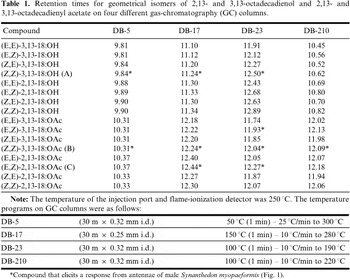
The abdominal tips of 1- to 2-day-old female S. myopaeformis with intact pheromone glands were removed with fine forceps and solvent-extracted for 15 min using approximately 20 μL HPLC-grade hexane (EMD Chemicals, Gibbstown, New Jersey) per gland. Aliquots of solvent containing one female equivalent of pheromone-gland extract were analyzed by coupled gas chromatographic − electroantennographic detection (GC-EAD) (Arn et al. Reference Arn, Städler and Rauscher1975; Gries et al. Reference Gries, Khaskin, Gries, Bennett, King and Morewood2002) employing a Hewlett Packard 5890A gas chromatograph equipped with one of four GC columns (Table 1). Helium was used as a carrier gas (flow rate 35 cm·s−1) for the gas chromatograph, with temperature programs as reported in Table 1.

* Compound that elicits a response from antennae of male Synanthedon myopaeformis (Fig. 1).
Female effluvia collection and analysis
For 7 consecutive days, 1- to 2-day-old virgin female S. myopaeformis were held in a vertically positioned cylindrical Pyrex glass chamber (10 cm i.d. × 6 cm length) provisioned with a water-soaked cotton wick. The chamber contained 2–13 females at any time and dead females were removed immediately. Control chambers contained the same water source but no females. A water aspirator drew humidified, charcoal-filtered air at a rate of 1.0–1.5 L·min−1 through the chambers and an attached glass column (14 cm length × 1.3 cm o.d.) filled with 150 mg Porapak Q (50–80 mesh, Waters Associates Inc., Milford, Massachusetts) that trapped volatiles. A total of 1056 female hour equivalents (FHE) of pheromone emission (1 FHE is the amount of pheromone emitted by 1 female during 1 h) were captured on Porapak Q. Trapped volatiles were eluted from Porapak Q with 2 mL redistilled pentane. The eluted material was concentrated under a stream of nitrogen such that 2 μL aliquots contained 40 FHE of pheromone emission, which was then analyzed by GC-EAD on a DB-5 column (30 m length × 0.32 mm i.d.) using a temperature program of 100°C for 1 min and a 20°C·min−1 increase to 300°C.
Pheromone identification
Compounds in gland extracts or female effluvia that elicited antennal responses were identified by comparing their respective retention times on four GC columns (DB-5, DB-17, DB-23, and DB-210) against the retention times of authentic standards (Table 1). The standards (Pherobank, Wageningen, the Netherlands) consisted of 16 synthetic compounds, representing the four geometrical isomers (EE, EZ, ZE, ZZ) for each of the four compounds: (i) 2,13-octadecadienyl acetate, (ii) 3,13-octadecadienyl acetate, (iii) 2,13-octadecadienol, and (iv) 3,13-octadecadienol.
Compounds in extracts or effluvia that elicited antennal responses, and their corresponding synthetic standards, were also subjected to GC−mass spectrometry employing a Saturn 2000 Ion Trap gas chromatograph − mass spectrometer (Varian instrument) fitted with a DB-5 column.
Field trapping experiments
Field trapping experiments were conducted in a 1.3 ha organic orchard containing a mixed planting of 3.5 m high Spartan, McIntosh, and Delicious apple trees with a 3.6 m × 4.7 m tree × row spacing, in Cawston, BC. This orchard has been organic for 30 years (Judd et al. Reference Judd, Gardiner and Thomson1997) and received no pesticide treatments during this study. Each trapping experiment was conducted for 5–7 d during July 2006. In 2006, emergence of adult S. myopaeformis observed on caged trees in an adjacent orchard began on 20 June, peaked on 13 July, and ended on 3 August (G.J.R. Judd, unpublished data). Field experiments employed a randomized complete block design with 10 replicates each. Small white Delta traps coated internally on three sides with Tanglefoot (The Tanglefoot Company, Grand Rapids, Michigan, Pennsylvania) were suspended from trees 1.5 m above ground using a 10 m spacing between traps within a linear array (block) and 20 m between blocks of traps. Each trap was baited with a grey halobutyl rubber septum (West Pharmaceutical Services, Lionville, Pennsylvania) impregnated with candidate pheromone components dissolved in 100μL HPLC-grade hexane. Every day the numbers of S. myopaeformis captured were recorded and treatment positions within blocks were re-randomized but lures were not replaced.
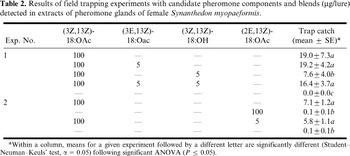
Our field experiments were directed by the knowledge that (3Z,13Z)-18:OAc is a proven attractant for S. myopaeformis, and our objective to quickly determine whether any newly identified antennally active compounds might improve the known attraction of (3Z,13Z)-18:OAc for this invasive pest. Experiment 1 (12–19 July 2006) consisted of five treatments: (1) 100 μg (3Z,13Z)-18:OAc, (2) 100 μg (3Z,13Z)-18:OAc plus 5 μg (3E,13Z)-18:OAc, (3) 100 μg (3Z,13Z)-18:OAc plus 5 μg (3Z,13Z)-octadecadienol ((3Z,13Z)-18:OH), (4) 100 μg (3Z,13Z)-18:OAc plus 5 μg (3E,13Z)-18:OAc plus 5 μg (3Z,13Z)-18:OH, and (5) unbaited solvent control. Experiment 2 (26–30 July 2006) consisted of four treatments: (1) 100 μg (3Z,13Z)-18:OAc, (2) 100 μg (2E,13Z)-octadecadienyl acetate ((2E,13Z)-2,13–18:OAc), (3) 100 μg (3Z,13Z)-18:OAc plus 5 μg (2E,13Z)-18:OAc, and (4) unbaited solvent control.
Statistical analyses
Trap-catch data were subjected to a two-way randomized block analysis of variance (ANOVA) and mean catches for each treatment were separated using the Student–Newman–Keuls' multiple comparison procedure with the experiment-wise error rate set at ∞ = 0.05 (Zar Reference Zar1984). All analyses were performed using SigmaStat (Systat Software Inc. 2003).
Results and discussion
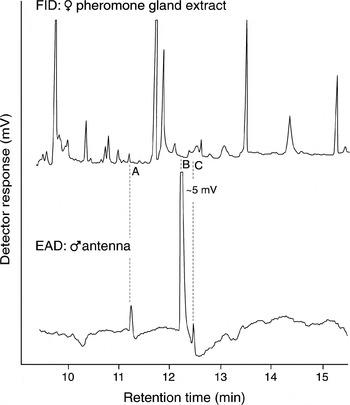
Four components elicited responses from male antennae in GC-EAD analyses of pheromone-gland extracts from female S. myopaeformis, but only three components elicited consistent responses (A, B, and C in Fig. 1). Based on attractants previously reported (Voerman et al. Reference Voerman, Minks, Van Wetswinker and Tumlinson1978; Szöcs et al. Reference Szöcs, Tóth, Sziráki and Schwarz1989), the most antennally stimulatory component, B, was hypothesized to be (3Z,13Z)-18:OAc. Its retention time with corresponding antennal response on four GC columns (Table 1), and its mass spectrum in a concentrated pheromone-gland extract, matched those of an authentic standard, thus confirming the structural assignment. Components A and C were below the detection threshold of the mass spectrometer, but their retention times on the four GC columns (Table 1) matched those of authentic (3Z,13Z)-18:OH (A in Figure 1) and (2E,13Z)-18:OAc (C in Figure 1). Moreover, synthetic (3Z,13Z)-18:OAc, (3Z,13Z)-18:OH, and (2E,13Z)-18:OAc elicited strong responses from male antennae, further supporting structural assignments of all three components. A fourth component, (3E,13Z)-18:OAc, elicited inconsistent antennal response and only revealed itself on the DB-23 column (Table 1).

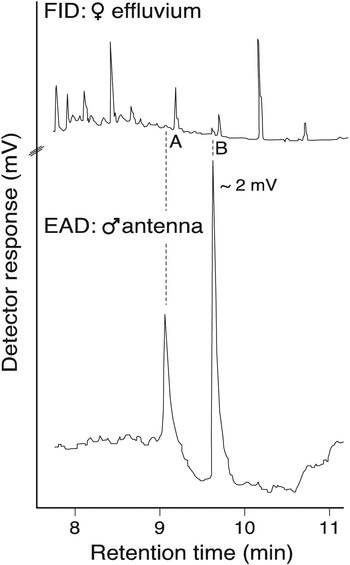
Although three compounds elicited consistent antennal responses (Fig. 1), only (3Z,13Z)-18:OH (A) and (3Z,13Z)-18:OAc (B) were detected using GC-EAD analysis of the effluvia from calling females (Fig. 2). It is not uncommon for solvents to extract a greater quantity and variety of materials from pheromone glands than are normally detected in the effluvium; nevertheless, both approaches often lead to the same conclusions. GC-EAD examination of the female effluvium analytically confirms the presence of (3Z,13Z)-18:OAc as a naturally released pheromone component for this species.

In experiment 1, (3Z,13Z)-18:OAc, as a single component, was as attractive as a binary combination of (3Z,13Z)-18:OAc and (3E,13Z)-18:OAc, and significantly more attractive than a binary blend of (3Z,13Z)-18:OAc with its corresponding alcohol (Table 2). On its own (3Z,13Z)-18:OAc was also as attractive as the ternary blend of (3Z,13Z)-18:OAc, (3E,13Z)-18:OAc, and (3Z,13Z)-18:OH (Table 2). Inexplicably the inhibitory action of the alcohol was less apparent in the ternary blend. Results of experiment 1, and those of Voerman et al. Reference Voerman, Minks, Van Wetswinker and Tumlinson(1978) demonstrating that binary blends containing 20% or more (3E,13Z)-18:OAc were less attractive than (3Z,13Z)-18:OAc alone, suggested that further testing of this binary combination was unwarranted. Likewise, the clear antagonistic action of as little as 5% (3Z,13Z)-18:OH to the attraction of (3Z,13Z)-18:OAc, ruled out the need for further testing of this binary combination as a means of improving attraction to (3Z,13Z)-18:OAc.

* Within a column, means for a given experiment followed by a different letter are significantly different (Student–Neuman–Keuls' test, ∞ = 0.05) following significant ANOVA (P ≤ 0.05).
In experiment 2, traps baited with a binary blend of (3Z,13Z)-18:OAc and (2E,13Z)-18:OAc were no more attractive than (3Z,13Z)-18:OAc alone (Table 2), and traps baited with (2E,13Z)-18:OAc caught no more moths than unbaited control traps. These findings also argued against the need for further testing of blends with this compound.
Results from our chemical analyses and trapping experiments indicate that (3Z,13Z)-18:OAc is the major, and perhaps the only, pheromone component in this introduced population of S. myopaeformis. Single component pheromones are unusual in Lepidoptera and the presence of (3Z,13Z)-18:OH in the female effluvium does suggest at least a minor role for it in the pheromone communication of this species. This alcohol is a common sex attractant for many sesiid species but often acts as a major pheromone component in those genera where it is present (El–Sayed Reference El-Sayed2009). This isomer of the alcohol is rare among studied species of Synanthedon Hübner and rarer still among European Synanthedon spp.
If this alcohol has a part to play in the pheromone communication of S. myopaeformis, then that role may not be revealed by trapping studies. For example, in codling moth, Cydia pomonella (L.) (Lepidoptera: Tortricidae), some female-produced compounds that were inhibitory were shown to improve fine-scale searching behaviour when tested at appropriately low concentrations in a flight tunnel, but they never increased trap catches in the field (Witzgall et al. Reference Witzgall, Bengtsson, Rauscher, Liblikas, Bäckman and Coracini2001). More detailed behavioural studies may be required to fully understand the pheromone system in S. myopaeformis, but would not necessarily address our objective to improve attraction of (3Z,13Z)-18:OAc for trapping surveys.
We conclude that populations of S. myopaeformis in BC, and other parts of Canada or North America, can be monitored effectively with (3Z,13Z)-18:OAc. Our findings indicate that commercially available (3Z,13Z)-18:OAc (e.g., Pherobank), which commonly has an isomeric purity >94%, should be adequate for detection surveys. Neither the E,E- nor Z,E-isomer impurities elicit antennal responses, and the antennally active E,Z-isomer (Table 1) has no behavioural activity alone (Voerman et al. Reference Voerman, Minks, Van Wetswinker and Tumlinson1978) or when it makes up 5% of a blend with (3Z,13Z)-18:OAc (Table 2). These results help to explain why a commercial mixture containing 94.5% (3Z,13Z)-18:OAc and 0.9%, 2.3%, and 2.3% of the EE-, ZE-, and EZ- isomers, respectively, was attractive to S. myopaeformis (Voerman et al. Reference Voerman, Minks, Van Wetswinker and Tumlinson1978).
Within the Okanagan−Similkameen Valley system, traps baited with (3Z,13Z)-18:OAc will catch several Synanthedon spp. (V.M. Aurelian, unpublished data). In most cases these species are easily identified and distinguishable from S. myopaeformis, but the presence of S. culiciformis could present a problem. As their respective common names imply, the small and large red-belted clearwing moths, S. myopaeformis and S. culiciformis, can be distinguished on the basis of size, but this is an unreliable character. The presence or absence of bands on the abdomen, colour of the ventral side of the labial palpus, and structure of the genitalia, such as the male valvae, can be used to distinguish species (Spatenka et al. Reference Spatenka, Gorbunov, Lastuvka, Tosevski, Arita and Naumann.1999), but care needs to be taken, as these characters can be difficult to discern in moths caught in sticky traps.
Use of (3Z,13Z)-18:OAc as a tool for detecting S. myopaeformis may not present a problem in Europe because that species is somewhat chronologically isolated from S. culiciformis and both appear to be host- or habitat-specific (Spatenka et al. Reference Spatenka, Gorbunov, Lastuvka, Tosevski, Arita and Naumann.1999). Within Canada, however, little is known about the seasonal flight phenology or localized distributions of S. culiciformis and it is not known whether cross-species attraction will be a problem for detection surveys. Pheromone lures that may be more selective for these two species will require an analysis of the pheromone system in S. culiciformis.
We recommend use of (3Z,13Z)-18:OAc as a single component to develop behavioural control tactics such as attract-and-kill, mass-trapping, or mating disruption for S. myopaeformis. These tactics may provide apple producers in BC with a means of organically managing this invasive species or eradicating it from localized areas (Trematerra Reference Trematerra1993; El–Sayed et al. Reference El-Sayed, Suckling, Wearing and Byers2006, Reference El-Sayed, Suckling, Byers, Jang and Wearing2009).
Acknowledgements
We thank Mark Gardiner and Larisa Aurelian for their technical assistance with field experiments, Ron Schneider and Andrea Turner for allowing us to conduct experiments in their orchard, and Robert Birtch for graphical illustrations. This research was funded, in part, by a British Columbia Plant Health Fund Grant from the British Columbia Ministry of Agriculture and Lands to G.J.R.J., and by a Natural Sciences and Engineering Research Council of Canada -Industrial Research Chair to G.G., with Contech Enterprises Inc., S.C. Johnson Canada, and Global Forest Science (GF-18-2007-226; GF-18-2007-227) as industrial sponsors.