Rural gardens in developed and developing countries are widely recognized as repositories of edible or medicinal plant diversity, or agrobiodiversity (Nazarea, Reference Nazarea1998, Reference Nazarea2005; Aguilar-Støen et al., Reference Aguilar-Støen, Moe and Camargo-Ricalde2009; Galluzzi et al., Reference Galluzzi, Eyzaguirre and Negri2010). A similar role has been hypothesized for their urban counterparts in developed countries based on limited species inventories of home and community gardens (Airiess and Clawson, Reference Airriess and Clawson1994; Corlett et al., Reference Corlett, Dean and Grivetti2003; Clarke and Jenerette, Reference Clarke and Jenerette2015; Taylor and Lovell, Reference Taylor and Lovell2015; Taylor et al., Reference Taylor, Lovell, Wortman and Chan2017) and genetic analysis of plant populations in urban gardens (Heraty and Ellstrand, Reference Heraty and Ellstrand2016). In the USA, the urban gardens of immigrants and transnational migrants in particular may harbor cultivated edible plant diversity with origins in developing countries. Gardeners acquire some of this diversity in the USA. They also bring plants, seeds and other propagules with them on their initial or subsequent journeys of migration or recruit friends and family to send them seeds from abroad. Gardeners may import some species because they wish to experiment with a familiar crop in a new environment. They may import others because they are integral to ethnic or familial foodways but unavailable or of limited availability in the USA. Traditional foodways have been found to strongly influence the agrobiodiversity of Chinese- and Mexican-origin households' gardens in Chicago (Taylor and Lovell, Reference Taylor and Lovell2015; Taylor et al., Reference Taylor, Lovell, Wortman and Chan2017). Gardeners further may prize imported species, which may contribute little to household food budgets, because of the material and symbolic connection they create to the gardener's place of origin. Immigrants may take extraordinary measures to maintain these plants in their gardens. They may overwinter tropical species on windowsills or repeatedly import the seeds of annual plants that fail to reproduce in a new locale, such as photoperiod-sensitive tropical maize (Zea mays subsp. mays) in Chicago (Taylor et al., Reference Taylor, Lovell, Wortman and Chan2017). Immigrants' gardens and the plants that they bring with them from their homeland may help to ease their transition to a new place and way of life (Head et al., Reference Head, Muir and Hampel2004).
However, evidence for the role of urban home food gardens in conserving agrobiodiversity is only slowly accumulating because of a paucity of studies on urban agriculture and biodiversity (Clucas et al., Reference Clucas, Parker and Feldpausch-Parker2018). Published species lists for urban agricultural sites in the USA indicate that, at least at the species level, the agrobiodiversity found in these gardens is not novel but consists of widely grown, culturally important plant species that are also available through the horticultural trade. There have been no previous reports of unrecorded cultivated species collected from these gardens.
This report documents the collection of one such species, Jaltomata darcyana Mione, from a home garden in Chicago. J. darcyana is a recently named species first collected on the Pacific Coast of Costa Rica (Mione and Yacher, Reference Mione, Yacher, Keating, Hollowell and Croat2005). No herbarium specimen seen to date or other source mentions cultivation of this plant, though human consumption of the mature fruit in Mexico has been reported (J. Amith, personal communication). No collections of the plant have been recorded previously in the USA.
In 2018, one of us (J. T.) returned to a home garden in the Little Village neighborhood of Chicago, IL (41°50′N, 87°42′W), to further document a food plant that had been provisionally identified as J. darcyana based on photographs from an earlier garden visit. Little Village is part of South Lawndale, one of Chicago's 77 community areas. South Lawndale's population is predominately of Mexican origin (80%). J. T. first visited the garden in 2014 with a bilingual research assistant as part of a larger study of the home food gardens of ethnic and migrant households in Chicago (Taylor et al., Reference Taylor, Lovell, Wortman and Chan2017). As part of that study, all cultivated garden plants were inventoried and identified to the species level, when possible, and gardeners were interviewed about the uses and origins of food plants. All study procedures and instruments were approved by the University of Illinois Urbana-Champaign's Institutional Review Board. Written informed consent was obtained from all gardener-participants prior to data collection.
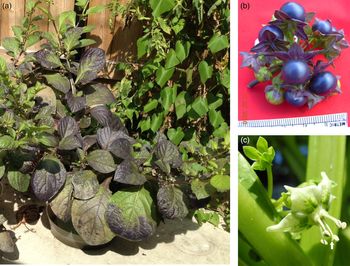
The gardener and her husband maintain a large, diverse garden across the backyards of two adjacent multifamily residential buildings and a contiguous vacant lot. In 2014, a plant that the gardener referred to as ‘pichueca' was observed growing in black plastic pots on concrete patios in the backyards of both buildings (Fig. 1a). The gardener, who was in her mid-40s in 2014, reported that she had brought seeds of the plant to Chicago when she was 20 from her native Michoacán, Mexico, where her family had also cultivated the plant, and had grown it in her garden ever since. She reported eating the fruit raw, in hand—which she did during the interview—and freezing the fruit for consumption during the winter. She informed us that she does not cook the fruit (Fig. 1b) but does eat it with salt and pepper. We later determined that the plant was most likely J. darcyana based on vegetative morphology but, lacking pictures of the flowers, were unable to confirm its identity. During the 2018 visit, J. T. photographed the flowering plants—which were growing in black plastic pots sunk into the ground in the backyard garden of one of the dwellings—and collected fruit.
Jaltomata darcyana: (a) in a home garden in Chicago, IL; (b) ripe (black) and unripe (green) fruits (smallest units are mm) and (c) flower with curved style orienting the stigma (at white arrow) to the side. Photos by J. T. (a) and T. M. (b, c).

There are about 70 species in the genus Jaltomata, distributed from Arizona, USA to Bolivia, with one species growing on the Galápagos Islands and another growing on the Greater Antilles (Mione et al., Reference Mione, Leiva González and Yacher2015). The fruits of most Jaltomata species are collected from wild plants and eaten by humans uncooked (Mione, unpublished data based on 15 collecting trips in Latin America). Jaltomata is most closely related to Solanum (potato, tomato) (Särkinen et al., Reference Särkinen, Bohs, Olmstead and Knapp2013) with two of the more notable differences being that flowers of Jaltomata produce nectar and have longitudinal anther dehiscence, while flowers of Solanum do not produce nectar and have anthers with terminal pores. Only Jaltomata procumbens (Cav.) J. L. Gentry grows naturally (wild) in the United States, in Arizona (Mione, Reference Mionein press). Seeds of J. procumbens are available commercially through the horticultural trade.
This is the first documentation of the cultivation of J. darcyana. This species has a curved style orienting the stigma to the side (Fig. 1c). In contrast, J. procumbens has a straight style. It is more commonly encountered in the field and is consequently more frequently collected than J. darcyana. In Mexico, J. procumbens is typically found in disturbed habitats, including as a weed in agricultural fields where it is deliberately not removed so that its fruits can be consumed (Davis and Bye, Reference Davis and Bye1982; Williams, Reference Williams1985; Mione, fieldwork in Mexico). J. darcyana is the only species of the black/purple fruited lineage of Jaltomata (Mione, Reference Mione1992; Miller et al., Reference Miller, Mione, Phan and Olmstead2011; Wu et al., Reference Wu, Kostyun, Hahn and Moyle2018) that lacks a day of protogyny. The two species are self-compatible, autogamous, and have similar fruits.
As mentioned above, this study documents use of the local name ‘pichueca’ where J. darcyana was collected in Chicago. Earlier records of local names of the species are: ‘yoloxóchitl’ (J. D. Amith et al., 1858, herbarium of T. M.), ‘cachumba’ (G. B. Hinton 8056, GH), and ‘pacheca’ or ‘pitzecua’ (L. Robles 600, WIS), all from the Pacific side of southern Mexico. Collection of this species from a Chicago garden, far from its known geographic distribution on the Pacific side of Central America and southern Mexico, suggests that urban gardens may harbor previously unrecorded agrobiodiversity. Consequently, we strongly recommend that the biodiversity of these gardens in the USA and elsewhere be documented by ecologists and botanists and their findings reported.
Urban garden diversity could contribute to efforts around the world to evaluate different plant species as potential new crops (e.g., by the Institute for the Preservation and Improvement of Valencian Agro-diversity (COMAV), Universitat Politècnica de València, Valencia, Spain, among others). Our reporting of J. darcyana as a cultivated plant, a first reporting, hopefully brings it to the attention of researchers who evaluate plant species as potential new crops. The development of new crops is of utmost importance because we now rely on surprisingly few species for most of our food, and more food species could potentially contribute to food stability. As mentioned above, Jaltomata is most closely related to the tomato/potato genus, and thus Jaltomata species are wild relatives of some of the most economically important plant species. The preservation of wild crop relatives is of paramount importance for safeguarding global food security (IUCN, 2019).
Author ORCIDs
John Taylor, https://orcid.org/0000-0002-0689-9032
Thomas Mione, https://orcid.org/0000-0002-2944-7557
Acknowledgements
The authors would like to thank the anonymous gardener for sharing her garden and knowledge with us, Adriana Rodriguez for her assistance in interviewing the gardener and the two anonymous reviewers of the manuscript.