





1. Introduction
Over the last five centuries or so, English has come to increasingly rely on the BE Ving-construction to mark progressive aspect, as in the Present-day English (PDE) examples from the British National Corpus (BNC; Davies 2004) in (1).
-
(1)
-
(a) Things appear to be improving. (BNC)
-
(b) ‘I actually got a job, then another, and within two years I was working every day.’ (BNC)
-
As a marker of progressive aspect BE Ving construes a process as ongoing, by profiling its interior stage – and thereby deprofiling its beginning and end points (Langacker Reference Langacker1991). Based on this core function, however, it also associates with a cluster of closely related meanings (Declerck Reference Declerck1991; Huddleston & Pullum et al. Reference Huddleston and Pullum2002). For example, it can emphasize duration and imply incompleteness, as in (1a), or denote a temporary habit, as in (1b). The development of BE Ving has received extensive attention in the historical literature (e.g. Strang Reference Strang and John1982; Denison Reference Denison and Romaine1998; Smitterberg Reference Smitterberg2005; Hundt Reference Hundt2004a, Reference Hundt, Lindquist and Mairb; Kranich Reference Kranich2010; Killie Reference Killie2014; Petré Reference Petré2016, Reference Petré2017). Even so, an important aspect remains largely unaddressed: what was there before BE Ving became the dominant marker of progressive aspect? Did speakers of English use to rely on alternative strategies to express progressive meaning, or did they simply refrain from expressing progressive meaning altogether?
While not offering detailed answers to these questions, the literature does give a number of important pointers. It is clear that BE Ving has to some extent come to replace simple forms, which supported progressive interpretations in earlier stages of the language (Denison Reference Denison and Romaine1998: 143; Fischer et al. Reference Fischer, De Smet and van der Wurff2017: 125–6). For example, the Early Modern English (EModE) simple form weepe in (2) favours a progressive reading, and would most likely be expressed as a BE Ving form in PDE.
-
(2) All this is comfort, wherefore weepe I then? (1623, W. Shakespeare, Romeo and Juliet)
In this light, the use of the simple form in EModE may have been very similar to the use of simple forms in Present-day Dutch and German, which have never developed the near-obligatory marking of progressive aspect that characterizes PDE. Much as in EModE but in contrast to PDE, Dutch and German simple forms readily support progressive interpretations. This is easily seen in translation contexts, as in (3) (from EUROPARL (Koehn 2005)).
(3)
(a)
International rail travel within Europe is growing in importance as an environmentally-sound alternative to air travel. (EUROPARL-English)
(b)
Het
internationale
treinverkeer
binnen
Europa
wordt
steeds
the
international
train-traffic
within
Europe
becomes
ever
belangrijker
als
milieuvriendelijk
alternatief
voor
luchtverkeer.
more-important
as
environment-friendly
alternative
for
air-traffic
(EUROPARL-Dutch)
(c)
Der
internationale
Eisenbahnverkehr
in
Europa
gewinnt
als
the
international
railway-traffic
in
Europe
wins
as
umweltfreundliche
Alternative
zum
Flugverkehr
an
Bedeutung.
environment-friendly
alternative
to
flight-traffic
in
significance
(EUROPARL-German)
All of this implies that there would have been variation and competition between simple forms and BE Ving. However, the relation between the two patterns cannot be characterized solely in terms of interchangeability and replacement. Not all simple forms could alternate with BE Ving, and those that can may not always invite progressive interpretations. The main complicating factor is that simple forms come with a wide range of possible interpretations. For example, simple forms may favour a habitual interpretation, as in (4a), or a perfective one, as in (4b) (for detailed discussion, see Kayenbergh & De Smet Reference Kayenbergh and De Smetin prep.).
-
(4)
-
(a) Apparently, he drinks two pints of milk and, as soon as he feels drowsy, he drinks two pints of orange juice. (BNC)
-
(b) she drank her milk and began to prattle on about her visit to the dentist. (BNC)
-
So, if BE Ving replaced simple forms, did it replace only simple forms with progressive interpretations, or did it encroach on simple forms with non-progressive interpretations as well? In the former case, the rise of BE Ving amounts to a shift in how explicitly progressive meaning is coded. In the latter, it also amounts to a shift in which meanings are being commonly expressed in the language. The rise of BE Ving, then, would mark a shift in how speakers of English preferentially construe events.
The last option is, in fact, hardly far-fetched if we allow that the rise of BE Ving may not have been an isolated development in the history of English. Recent work on the topic has argued that the rise of BE Ving is part of a more sweeping reorganization of the typological profile of English from a bounded to an unbounded language (Los Reference Los, Meurman-Solin, López-Couso and Los2012; De Smet & Vancayzeele Reference De Smet and Vancayzeele2015; Fanego Reference Fanego2024). As a parameter of linguistic typology, the bounded/unbounded distinction relates to how speakers process and convey information about events (see Carroll et al. Reference Carroll, von Stutterheim, Nuese, Pechmann and Habel2004; Athanasopoulos & Bylund Reference Athanasopoulos and Bylund2013; Flecken et al. Reference Flecken, Gerwien, Carroll and von Stutterheim2014). Speakers of bounded languages will combine a preference for perfective event construal with a tendency towards more strictly sequential narrative organization. Speakers of unbounded languages will (among other things) be more inclined to rely on progressive event construal, which helps them organize events into larger clusters linked by foreground/background relations and approximate simultaneity (see Carroll et al. Reference Carroll, von Stutterheim, Nuese, Pechmann and Habel2004). Thus, as a progressive marker, English BE Ving leaves the beginning and endpoint of an event unprofiled, which makes it ideally suited to describe the backgrounded scene against which another more prominent and narratively consequential event unfolds in approximate simultaneity, as in (5).
-
(5) I was unpacking the car when the phone went. (BNC)
The rise of BE Ving, then, may itself have responded to – as well as consolidated – a more fundamental shift in the preferred patterns of event construal in English (Petré Reference Petré2010; Los Reference Los, Meurman-Solin, López-Couso and Los2012). If so, the same functional pressures that promoted BE Ving may have encouraged speakers of English to experiment with a variety of strategies to express progressive aspect. Supporting this is the observation that, in addition to BE Ving, English did effectively develop a range of grammatical patterns thought to contribute to its unbounded profile (De Smet & Vancayzeele Reference De Smet and Vancayzeele2015; Van de Pol & Petré Reference Pol and Petré2015; De Smet Reference De Smet, Seoane, Acuña-Fariña and Palacios-Martínez2018; Fanego Reference Fanego2024), and lost grammatical patterns strongly associated with its earlier bounded profile (Petré Reference Petré2010). For example, just like BE Ving in (5) above, the premodifying participle driving in (6) serves to background an event and construe it as ongoing at the time of the foregrounded event set out (De Smet & Vancayzeele Reference De Smet and Vancayzeele2015).
-
(6) Their cheeks were blanched and drawn as the party set out in the driving rain, armed with ropes and fresh lanterns. (BNC)
BE Ving may have been only one of several options speakers of English embraced as the language shifted to an unbounded profile.
In sum, there is good reason to think that the rise of BE Ving interacted with the grammar of English in complex and evolving ways. BE Ving is likely to have replaced progressive uses of simple forms, even though the two constructions merely overlap in functional range. At the same time, there may have been other strategies that were being exploited to express progressive meaning, use of which was partly superseded by BE Ving as it grammaticalized into the default marker of progressive aspect. It is this diachronically shifting landscape that the present article sets out to chart in greater detail.
This is done here by exploiting a corpus of successive English translations of the same source text, Cervantes’ Don Quijote. The sequence of translations can be thought of as a natural experiment, offering a rare opportunity to compare linguistic choices across time, while keeping communicative intent maximally constant. As a result, the corpus gives a rich onomasiological window on how translators conveyed approximately the same meaning at different points in time. Wherever BE Ving is selected by one translator, the corpus can tell us which (if any) alternative options were chosen by earlier and later translators. This way, we can piece together a picture of the full range of competing strategies implicated in the rise of BE Ving.
In what follows, section 2 describes the corpus and the procedures we used to collect our data from it. To be able to exploit the data fully we first had to describe and classify the various strategies for expressing (or for refraining from expressing) progressive meaning that we encountered. Our classification distinguishes five macro-strategies, based on whether progressive meaning is being expressed and what means are used to do so. The five strategies are documented in section 3. Next, section 4 offers a quantitative analysis to show how different strategies are dominant at different times in the corpus. Section 5 interprets the relevance of the findings to our understanding of the history of progressive marking in English. The main conclusions are summarized in section 6.
2. Data
For the present study use was made of the Don Quixote Corpus, henceforth DQC (see De Smet Reference De Smet, Seoane, Acuña-Fariña and Palacios-Martínez2018). The DQC consists of eight successive English translations of Cervantes’ Don Quijote, published in the Spanish original from 1605 to 1615. The English translations cover the period from 1612 to 2003, roughly corresponding to the Early Modern, Late Modern and Present-day English periods. The corpus contains about 3.4 million words in total, with individual translations averaging around 425,000 words in length. The authors and years of each translation are provided in table 1 below. The oldest data in the corpus represents the period where the shift towards an unbounded profile in English is thought to have already set in but to be still in its early stages (see e.g. Petré Reference Petré2010).
English translations in the DQC

Table 1. Long description
The table is organized into two columns titled Translator and Translation year. The rows are as follows.
* Thomas Shelton, 1612–20.
* Charles Jervas, 1742.
* Tobias Smollett, 1755.
* John Ormsby, 1885.
* Samuel Putnam, 1949.
* J. M. Cohen, 1950.
* John Rutherford, 1999.
* Edith Grossman, 2003.
Of course, the DQC offers a one-sided and biased window on the history of English. Translations have known downsides as historical evidence, as they are inevitably influenced by source language patterns. Moreover, the DQC in particular contains the textual output of only eight individual language users, writing in a single highly specific text genre. However, the corpus was not chosen to offer maximally representative coverage of BE Ving in the history of English – something the preceding literature has already done to the highest standards – but to explore the relation between BE Ving and any alternative coding strategies. To this purpose it should be well-suited.
The DQC has been benchmarked against contemporary fiction prose from the Corpus of Late Modern English Texts (CLMET, 1710–1920) and the British National Corpus (BNC, mostly early 1990s) by Poniewierska (Reference Poniewierska2021). Reassuringly, for BE Ving the comparison reveals that the DQC largely follows the expected trend. As shown in figure 1 (based on Poniewierska Reference Poniewierska2021: 20), the frequency of BE Ving in the DQC increases dramatically, much as it does in non-translated fiction over a similar period. Note that the more recent translations behave somewhat more conservatively than the older ones, lagging behind the general trend. This is a pattern seen in other changes in the corpus as well and it is probably not coincidental. The later translations generally tend to be more conservative in style and grammar. This may in part be explained by changing attitudes towards the original, whose status as a literary masterpiece has only grown, resulting in more formal language use. In part, it may also reflect translators’ attempt to convey to their English audiences the feel of a variety of Spanish they themselves increasingly perceive as conservative and even archaic. Still, the difference in the use of BE Ving between the oldest and youngest translations is considerable. The corpus therefore provides ample basis to work out what strategies especially the earlier translators were relying on wherever later translators chose BE Ving.
The frequency of BE Ving (pmw) in the DQC as compared to the fiction components of CLMET and BNC (based on Poniewierska Reference Poniewierska2021: 20)Footnote 1

Figure 1 Long description
The horizontal x-axis represents Year from 1600 to 2000. The vertical y-axis represents Frequency from 0 to 4000.
CLMET and BNC data is represented by green dots connected by a solid green line. This trend shows a consistent linear increase starting at approximately 600 in 1750, rising to 1600 in 1820, 2700 in 1880, and peaking near 4000 by 2000.
DQC data is represented by individual dark blue dots. The data points are scattered as follows.
* One point near 250 in 1620.
* Two points around 1750, one at 500 and one at 1300.
* One point near 2400 in 1880.
* Three points between 1950 and 2000, ranging in frequency from 2300 to 3500.
* One final point near 2600 at the year 2000.
While both datasets show an upward trend over time, the CLMET and BNC line maintains a higher and more consistent rate of growth compared to the more varied distribution of the DQC points.
In the context of translation data, it is important to consider what grammatical forms in the Spanish original would have been likely to provoke the use of BE Ving, or other expressions of progressive meaning, in English. Spanish itself is said to have started shifting to an unbounded typological profile from the fifteenth century onwards (see Molenaers Reference Molenaers2023), which positions the seventeenth-century text under study on the unbounded end of the continuum. Cervantes’ Don Quijote frequently construes events as overlapping and ongoing. Progressive aspect or related meanings, such as durativity or ongoingness, are expressed in the Spanish original through a number of strategies, which in the English translations are commonly rendered as BE Ving.
In (7a), Spanish uses a grammaticalized progressive ESTAR Vndo (literally BE Ving). Other progressive periphrases found in the data include ANDAR Vndo (literally WALK Ving) and IR Vndo (literally GO Ving) (see e.g. Espunya i Prat Reference Espunya i Prat1996; Torres Cacoullos Reference Torres Cacoullos2001), though these are arguably less grammaticalized than ESTAR Vndo (see e.g. Quesada Reference Quesada1995; Ocampo & Ocampo Reference Ocampo and Ocampo2020). Progressive(-like) meaning can also be expressed inflectionally. In the past time sphere, the pretérito imperfecto inherently expresses imperfectiveness and incompletion, as in (8a) (see Batchelor & San José Reference Batchelor and San José2010: 136 for Present-day Spanish). For the present time sphere, contrary to what is found in Present-day English, the difference between the simple and progressive forms in Spanish ‘is not so clear-cut’ (Butt & Benjamin Reference Butt and Benjamin1994: 209); in other words, they ‘are sometimes virtually interchangeable’ (ibid. 231; see also Batchelor & San José Reference Batchelor and San José2010: 113; and see Torres Cacoullos Reference Torres Cacoullos2012 for a diachronic perspective). The progressive periphrasis is only said to be ‘more appropriate’ or even ‘obligatory’ when there is emphasis on the duration of an event or on its being ‘in progress at the time’ (Butt & Benjamin Reference Butt and Benjamin1994: 232). In the original Don Quijote, too, many simple present forms favour a progressive reading in context, as in (9a). Finally, the lexical periphrasis ESTAR + AdjP in (10a), though more stative than dynamic, still conveys meanings of duration and imperfectivity, and often depicts a backgrounded situation. All these strategies can be thought of as imposing or promoting imperfective or progressive(-like) readings.
(7)
(a)
Rocinante,
que
estaba
paciendo
en
tanto que
ellos
comían.
(1605–15, DQC)
who
was
grazing
while
they
ate
(b)
Rozinante, who was feeding whilest they did eate. (1612–20, DQC)
(8)
(a)
don Quijote […] vio que
por
el
camino
por
donde
ellos
iban
venía un carro
by
the
path
by
which
they
went
lleno de banderas reales (1605–15, DQC)
(b)
Don Quixote […] saw a cart decorated with the King’s colours coming along the road by which they were travelling. (1950, DQC)
(9)
(a)
¡Mire, pecador de mí, que
me
destruye
y
echa a perder
toda
mi
me
you-destroy
and
you-spoil
all
my
hacienda! (1605–15, DQC)
farm!
(b)
Sinner that I am, you are destroying and ruining everything I own! (2003, DQC)
(10)
(a)
estaba
en
piernas
y
desgreñada
(1605–15, DQC)
she-was
in
legs
and
dishevelled
(b)
she was barelegged and her hair was hanging down (1949, DQC)
In what follows, instances of BE Ving in the English translations in the DQC that correspond to patterns such as those in (7)–(10) are regarded as congruent, meaning that the English translator uses BE Ving to express an aspectual meaning similar to that conveyed by the corresponding strategy in Spanish. The progressive meaning in the original may be semantically coded or (in the case of the Spanish simple present) pragmatic.Footnote 2 Either way, these cases have special status in that the original prompts the translators to express progressive meaning.
Needless to say, some instances of BE Ving in the DQC are incongruent in that they do not directly match a Spanish form with similar progressive(-like) meaning. This does not mean the choice for BE Ving in these contexts is unmotivated or a translation error. Sometimes, these cases reflect the complexity of translation. For example, in (11) the Spanish ha llegado would literally translate as has arrived. However, in PDE, a more idiomatic verb in the context of a voice is ring. By opting for the more idiomatic verb, the translator also changes the lexical aspect from an achievement (arrive) to an activity (ring). It is plausible that this, in turn, triggered the choice of progressive aspect through BE Ving, as opposed to the perfective aspect in the pretérito perfecto of the Spanish original. In other cases, they reflect underspecification in the source language. In (12), the nominalization vuestro engaño (lit. ‘your deception’) in the source text is aspectually neutral. The translator in (12b) interprets it as denoting a current, ongoing situation, while the translator in (12c) interprets it as belonging to the past time sphere.
(11)
(a)
¿Qué
voz
es
esta
que
ha
llegado
a
mis
oídos? (1605–15, DQC)
what
voice
is
this
that
has
arrived
to
my
ears
(b)
Whose voice is ringing in my ears? (1999, DQC)
(12)
(a)
Eso me basta a mí -respondió don Quijote-
para
que
crea
vuestro
for
that
I-believe
your
engaño
(1605–15, DQC)
deception
(b)
“All of which,” said Don Quixote, “is sufficient to convince me that you are laboring under a misapprehension […]” (1949, DQC)
(c)
“That is enough,” responded Don Quixote, “for me to believe you were deceived […]” (2003, DQC)
The discussion below is largely based on congruent tokens, because those are the contexts where all translators are prompted by the source text to express progressive meaning. The incongruent tokens are nevertheless interesting as well, because they point to contexts where progressive meaning can but need not be expressed, shedding some light on the more impromptu decisions by individual translators. We will therefore also draw occasional evidence from those contexts.
In querying the DQC, we proceeded in two steps. First, we identified what we will here call targets. Targets are any matches returned by a regular corpus query in any single translation. Next, for any given target match, we also looked up all the passages corresponding to it in the other translations. These corresponding passages we will refer to as equivalents. Given the structure of the corpus, in principle any target comes with seven equivalents. From this point onwards, the examples from the corpus given below are arranged in the following way: a-lines correspond to the Spanish source text, b-lines to the target instance returned by our query for BE Ving, and any following lines (c and beyond) give equivalents.
For this study, the English translations in the DQC were initially queried at a 4 percent sampling rate for instances of the auxiliary BE followed by a word ending in -ing, allowing for at most one intervening word. This generated a random sample of targets to serve as a starting point for further data collection later on. First, however, the sample of targets had to be manually cleaned up. After removal of noise (e.g. was nothing, is a catching and incurable disease) and doubles,Footnote 3 335 BE Ving targets remained. The data set was filtered down further to keep the focus squarely on the expression of progressive aspect. This was done by removing (i) all target instances where BE Ving combined with additional marking of tense, aspect, modality or voice (e.g. had been listening, would be showing, was being borne along); and (ii) all target instances with clear habitual or future meaning, as in (13) and (14), as well as any instances of the emergent future marker BE going to. As a result, the remaining BE Ving targets are all present or past progressives. Because tense is a known factor in the rise of BE Ving (Petré Reference Petré2016), these target tokens and their equivalents have been coded for present or past time sphere accordingly. Following this first major round of data cleaning and annotation, the final dataset contains 230 congruent BE Ving targets and 43 incongruent targets. The distribution of the targets in our sample is shown in figure 2, revealing the expected rise of BE Ving over time, and echoing figure 1 above. This means that target instances in the sample predominantly come from the more recent translations.
Congruent and incongruent BE Ving targets per translation in the sample from the DQC

(13)
(a)
topé en el camino a esta buena dueña, y el diablo,
que
todo
lo
añasca
who
all
it
confounds
y
todo
lo
cuece
, hizo que yogásemos juntos (1605–15, DQC)
and
all
it
cooks
(b)
I met this good woman on the way, and the devil, who is always cooking up trouble, made us lie down together (2003, DQC)
(14)
(a)
“¿Vaste,
cristiano,
vaste?” Yo la respondí: “Señora, sí, pero no
you-go-refl
Christian
you-go-refl
en ninguna manera sin ti […]” (1605–15, DQC)
(b)
“Are you going away, Christian, are you going away?” “Yes, lady,” I replied, “but on no account without you. […]” (1950, DQC)
For each of the target tokens the corresponding equivalents were identified. For the congruent targets, the total should in principle amount to 1,610 equivalents (i.e. 7 × 230), but in some cases, no parallel passage could be found. Sometimes translators omit a clause, as in (15c), or reformulate it to the point where no correspondence can be established, as in (16c). The eventual data set consists of 230 congruent targets and their 1,541 equivalents. For the incongruent targets, another 240 equivalents were identified.Footnote
4
(15)
(a)
y
en
lo
demás
del
buen
suceso
que
espero, lo dejaré a Dios […]
in
the
rest
of-the
good
success
that
I-hope
(1605–15, DQC)
(b)
And for the rest of the happy result I am looking forward to, I trust to God […] (1885, DQC)
(c)
As for the rest, I trust in God […] (1949, DQC)
(16)
(a)
[…]a lo cual este niño dijo: “Señor,
no
me
azota
sino
porque
le pido
no
me
he-flogs
but
because
him I-ask
mi
salario.” (1605–15, DQC)
my
salary
(b)
Upon which the boy said: “Sir, the only reason he’s flogging me is because I asked for my wages.” (1999, DQC)
(c)
The boy protested he had done nothing but asked his wages. (1755, DQC)
It is this data set that underlies the following analysis and discussion. The target instances can be regarded as the entry points to translation contexts where the Spanish original encourages (congruent targets) or at least might not have ruled out (incongruent targets) the expression of progressive meaning, and where the use of BE Ving is certain to be a viable grammatical option, at least at one point in the history of English. The equivalents represent a range of choices made by other speakers in the same translation context. In what follows, the equivalents are of special interest, as they shed light on any alternative strategies translators could resort to wherever BE Ving was, had been or would later become possible.
3. Major translation strategies
The variation in translation strategies as revealed in the DQC data is considerable. To come to grips with it, we developed a classification of the data into major translation strategies that reflect how translators decided to handle progressive(-like) meaning in the original. The strategies differ in whether or not progressive meaning is being conveyed, and whether aspectual meaning is semantically coded into the translated message or left to be pragmatically inferred from context. Where aspectual meaning is semantically coded, we can further distinguish translator choices by the formal means that are being used to do so. This gives the following classification into five major strategies.
3.1. Coding by BE Ving
Many equivalent contexts simply have BE Ving, just like the target, as in example (17). The productivity of BE Ving increased with time, for example with the introduction of formal passives (Hundt Reference Hundt, Lindquist and Mair2004b; Fischer et al. Reference Fischer, De Smet and van der Wurff2017) and the loving-it progressive (Anderwald Reference Anderwald2017; Martínez-Vázquez Reference Martínez-Vázquez2018), but even in EModE the progressive could be used with a very broad range of verbs, and without obvious additional semantic overlays other than the construction’s basic aspectual meaning. In using BE Ving, therefore, translators opt for the most grammaticalized tool at their disposal for the expression of progressive meaning.
(17)
(a)
Notó bien don Quijote
la
atención
con
que
el
caminante
le
miraba
the
attention
with
which
the
walker
him looked
(1605–15, DQC)
(b)
Don Quixote noticed how attentively the traveler was looking at him (2003, DQC)
(c)
Don Quixote noticed the care with which the traveller was examining him (1999, DQC)
3.2. Coding by other means
Next to BE Ving, translators resort to a wide array of alternative patterns, all of which have in common that they semantically code progressive(-like) meaning, but for one reason or another lack the nearly unrestricted employability characteristic of BE Ving. The situation is a typical manifestation of ‘layering’ – that is, ‘the prominent fact that very often more than one technique is available in a language to serve similar or even identical functions’ (Hopper Reference Hopper, Traugott and Heine1991: 23). The various coding strategies other than BE Ving that are found in our sample can be loosely divided into two subgroups. The first group is the most prominent and consists of a range of patterns that straddle the boundary between lexical and grammatical. These patterns are all less grammaticalized than BE Ving, in that they impose more selectional restrictions on the lexical verbs they can combine with, or have additional semantic overlays, on top of the aspectual meaning being expressed. Nonetheless, they are or were potential sources for the grammaticalization of a progressive marker, as they formally instantiate the kind of subject-control structure that is a common starting point for auxiliarization in English, and semantically echo the various lexical sources for progressives reported in the grammaticalization literature.
Consider the Posture Verb Construction in (18c). The pattern is a cross-linguistic source for progressive markers (Kuteva et al. Reference Kuteva, Heine, Hong, Long, Narrog and Rhee2019; for its history in English see e.g. Visser Reference Visser1973; Lemmens Reference Lemmens2005 for Dutch; and Breed et al. Reference Breed, Brisard and Verhoeven2017 for Afrikaans) but it does not show advanced grammaticalization in English. Stood observing in (18c) continues to denote an activity performed in a standing posture.Footnote
5 The posture semantics overlay the expression of progressive aspect with additional lexical meaning, and thereby intrinsically limit the range of verbs that can enter the pattern.
(18)
(a)
estaba
don Quijote
mirando
cómo […]
entraban
hasta
doce labradores
was
don Quixote
looking
how
entered
up-to
twelve labourers
(1605–15, DQC)
(b)
Don Quixote was watching the entrance […] of some twelve peasants (1885, DQC)
(c)
Don Quixote stood observing, how […] entered a dozen countrymen (1742, DQC)
In a similar vein, there are several periphrases that highlight ongoing engagement such as BE employed in Ving, or BE engaged in Ving, as in (19), or patterns that metaphorically extend a containment relation to the expression of progressive aspect, like BE in the middle/midst/process/act of Ving. As regards the latter, Van Rompaey (Reference Van Rompaey2014) argues that they construe situations ‘as unbounded and durative’ like BE Ving (2014: 188) but recognizes that an important difference between BE Ving and the alternative less grammaticalized options ‘lies in the expanded non-aspectual uses of the former’ (Van Rompaey Reference Van Rompaey2014: 207). Again, structures that combine a locative marker with a nominalization are a recurrent source of progressive markers across languages (see e.g. Comrie Reference Comrie1976: 98–9; Bybee et al. Reference Bybee, Perkins and Pagliuca1994: 128–30; Kuteva et al. Reference Kuteva, Heine, Hong, Long, Narrog and Rhee2019). Yet other patterns involve combinations with CONTINUE Ving or KEEP Ving as in (20c), with the main verb highlighting sustained activity. Further, there is what Fanego (Reference Fanego2024) calls the Expeditionary GO Construction, illustrated in (20d). This pattern consists of ‘the motion verb go followed by an -ing form coding a durative, atelic activity which … is performed away from the deictic centre represented by the Speaker and/or Subject’ (2024: 14).
(19)
(a)
en tanto que estas razones iba diciendo,
iba
asimesmo
enalbardando
el
he-went
also
saddling
the
asno (1605–15, DQC)
donkey
(b)
Even as he said this he was adjusting the packsaddle (1949, DQC)
(c)
While he uttered this apostrophe, he was employed in putting the pack-saddle on his ass (1755, DQC)
(20)
(a)
Sancho
andaba
mirando
por
la
Dolorida, por ver qué rostro tenía sin las barbas
Sancho
walked
looking
for
the
Dolorous
(1605–15, DQC)
(b)
Sancho was looking everywhere for the Dolorous Duenna to find out what her face was like without a beard (1999, DQC)
(c)
Sancho kept looking about for the Distressed One, to see what her face was like without the beard (1885, DQC)
(d)
Sancho went looking about for the afflicted matron, to see if her beard was quite gone (1755, DQC)
A subtle variation on the Expeditionary GO Construction is the COME/GO Ving Progressive, which semantically ‘codes an event of motion that takes place over a period of time and is simultaneous with another event’ (Fanego Reference Fanego2024: 12), as illustrated in (21c).
(21)
(a)
Y ¿qué dirán mis insulanos cuando sepan que
su
gobernador
se
anda
their
governor
refl
walks
paseando
por
los
vientos?
(1605–15, DQC)
walking
by
the
winds
(b)
And what will my Islanders say, when they heare their Governour is hovering in the winde? (1612–20, DQC)
(c)
And what will my islesmen say when they learn that their governor goes roaming down the winds? (1950, DQC)
Note that, as the examples suggest, both the Expeditionary GO Construction and the COME/GO Ving Progressive may have been selected on the model of the Spanish source structure ANDAR Vndo, which they closely approximate both lexically and structurally. The fact remains, however, that both patterns have been attested in English outside translation contexts (Fanego Reference Fanego2024) and are a source of progressive markers cross-linguistically (Kuteva et al. Reference Kuteva, Heine, Hong, Long, Narrog and Rhee2019).
The second group of patterns are less restrained or wholly unrestrained in terms of productivity, but require a more drastic reconfiguring of clausal structure, or only approximate progressive meaning. For this reason, they constitute less likely sources of a grammaticalized auxiliary-like progressive marker. One recurrent strategy is the use of supplementive and absolute participials, as in (22c) and (23c) respectively. The latter have been linked to the shift of English towards unbounded language use by van de Pol & Petré, who argue that they ‘emphasiz[e] the co-presence or overlap of multiple events rather than their separation in time’ (Reference Pol and Petré2015: 222) – a characterization that can be easily applied to the former as well. As argued by De Smet & Heyvaert (Reference De Smet and Heyvaert2011), not all present participles in these constructions come with progressive meaning, but progressive interpretations are common and follow predictably from the interplay between syntactic structure and verbal semantics. We also found three attestations of a premodifying present participle in the data, as for instance given in (24). In (24), staring is situation-oriented and hence ‘present[s] a verbal process as (approximately) simultaneous to the main clause situation’ (De Smet & Vancayzeele Reference De Smet and Vancayzeele2015: 142). Again, the aspectual interpretation is progressive.
(22)
(a)
Jugando
está
a
las
tablas
don
Gaiferos,
que
ya
de Melisendra
está
olvidado.
playing
is
at
the
tables
don
Gaiferos
(1605–15, DQC)
(b)
Don Gaiferos is playing at backgammon, his lady Melisendra is forgotten. (2003, DQC)
(c)
Now Gayferos, at tables playing, Of Melisendra thinks no more. (1755, DQC)
(23)
(a)
diéronse priesa a alcanzarlos,
que,
como
iban
de espacio, con facilidad lo
because
they-went
slowly
hicieron. (1605–15, DQC)
(b)
they hurried to reach them, and since they were climbing slowly, this was an easy matter. (2003, DQC)
(c)
They hasted to overtake them, which they easilie might doe, the others going but softly. (1612–20, DQC)
(24)
(a)
A esta sazón, ya se había puesto don Quijote de hinojos junto a Sancho, y
miraba
con
ojos
desencajados
y
vista
turbada
a la que
Sancho
he-looked
with
eyes
dislocated
and
vision
troubled
llamaba reina y señora (1605–15, DQC)
(b)
By this time Don Quixote was down on his knees beside Sancho. His eyes were fairly starting from their sockets and there was a deeply troubled look in them as he stared up at the one whom Sancho had called queen and lady (1949, DQC)
(c)
By this time, Don Quixote having placed himself on his knees, by Sancho, gazed with staring eyes, and troubled vision, upon the object which the squire called queen and princess (1755, DQC)
Similarly, there is the Perception Verb Construction, with see, hear or feel followed by an -ing-clause, as in (25c). The construction imposes progressive meaning on the dependent verb (Huddleston & Pullum et al. Reference Huddleston and Pullum2002: 1236–7). Though not strictly a perception verb, a similar structure is found with find, as in (26c). Because these are not subject-control structures, grammaticalization of the higher verb into an aspectual marker is far less likely (see e.g. De Smet Reference De Smet and Beal2025) – and, indeed, we know of no cases in other languages.
(25)
(a)
los del bajel se vieron perdidos,
hicieron
vel
a
en tanto que
la
galera
they-made
sail
while
the
galley
volvía
(1605–15, DQC)
returned
(b)
those in the brigantine saw that they had escaped and set sail as the galley was turning (2003, DQC)
(c)
they in the Vessell saw themselves gone, and began to set sail, and to fly afresh as they saw the Gally comming on them (1612–20, DQC)
(26)
(a)
se fueron hacia la parte
donde
aún
estaba
hablando
y
porfiando
con
where
still
he-was
talking
and
arguing
with
su
criado. (1605–15, DQC)
his
servant
(b)
they walked over to where he was still talking and arguing with his servant. (1999, DQC)
(c)
they went to the spot where he was, and found him still protesting to his servant. (1950, DQC)
Further, progressive meaning can be imposed by forming adverbials that consist of a nominalization introduced by a locative preposition, as in (27). This again exploits the containment metaphor already discussed above, but without some recurrent and semantically light higher verb the pattern would be unlikely to grammaticalize as an aspectual marker in English. As a translation strategy, this pattern once more requires more radical clausal reconfiguration.
(27)
(a)
volvíame
a
mi
aldea, topé en el camino a esta buena dueña (1605–15, DQC)
I-returned-refl
to
my
village
(b)
I was returning home, and by the way I lighted upon this good dame (1742, DQC)
(c)
and so, in my return, I lighted on this honest damsel in the road (1755, DQC)
Finally, some structures are merely stativizing. In other words, the dynamicity of a proper progressive is lost, while its lack of profiled temporal boundaries is retained. These structures exploit the stative meaning of verbs such as BE or HAVE or the time-stability and simultaneity associated with adjective phrases (see De Smet & Heyvaert Reference De Smet and Heyvaert2011). Periphrases with BE or HAVE complemented by an NP or PP are illustrated in (28c) and (29c) respectively. A similar effect is realized by the existential construction in (30c).
(28)
(a)
no pareció sino que
la
voz
de
la
Trifaldi
me
sonaba
en
los oídos.
the
voice
of
the
Trifaldi
me
sounded
in
the ears
(1605–15, DQC)
(b)
it seemed as if the voice of Countess Trifaldi were sounding in my ears. (2003, DQC)
(c)
it sounded exactly as if it was Trifaldi’s voice I had in my ears. (1999, DQC)
(29)
(a)
nadie
nos
fuerza
a que sigamos éste (1605–15, DQC)
nobody
us
forces
(b)
nobody’s forcing us to continue on this one (2003, DQC)
(c)
we are under no obligation to continue in this (1742, DQC)
(30)
(a)
Todo esto escuchaba Sancho, no con poco dolor de su ánima, viendo que se le desparecían e iban en humo las esperanzas de su ditado […] y su
amo
and
his
master
se
estaba
durmiendo
a sueño suelto (1605–15, DQC)
refl
was
sleeping
like a baby (lit. at loose sleep)
(b)
To all this Sancho listened with no little sorrow at heart to see how his hopes of dignity were fading away and vanishing in smoke […] while his master was sleeping tranquilly (1885, DQC)
(c)
To all this Sancho listened in no small distress of mind, seeing that his hopes of a title were disappearing and going up in smoke […] while there was his master sound asleep (1950, DQC)
3.3. Reliance on pragmatic inference
Progressive(-like) meaning is not always semantically coded through an overt form. The equivalents to BE Ving targets in the DQC may feature simple forms of the verb, which are semantically neutral, but as a result pragmatically highly versatile in their aspectual interpretation. Given the right grammatical context, simple forms will be given a progressive reading. This is especially likely in contexts that involve temporal relations of containment or coextension between profiled events and/or between durative events and the punctual time of speaking. The effect of such containment relations is that the event boundaries of the containing event are deemphasized. Kayenbergh & De Smet (Reference Kayenbergh and De Smetin prep.) therefore describe this type of context as ‘boundary suppressing’ and argue that the contextual suppression of event boundaries is what encourages progressive readings in these simple forms. While there are other contextual features that can trigger a progressive reading, boundary-suppressing contexts are by far the most common triggers and their pragmatic effect is reliable. For the purposes of our analysis, then, only the simple forms in boundary-suppressing contexts as defined here have been treated as favouring a progressive reading.
For instance, in (31c), talked does not convey progressive meaning by itself, but from the pragmatic and grammatical context (the verbs framed by talked, the as-framing clause) a progressive reading is plausible. This is because the temporal frame of the process denoted by talked contains the process denoted by began to reade. The event boundaries of talked are deemphasized as a result, and a progressive reading becomes likely. Similarly, in (32c), the simple present passeth punctually profiles the time of speaking while denoting a durative situation, which likewise results in the suppression of event boundaries and therefore encourages a progressive interpretation. As a final example, simple passive forms are regarded as simple forms and can similarly encourage progressive readings in context, as in (33c), where was followed frames see.
(31)
(a)
Mientras
los
dos
esto
decían, había tomado Cardenio la novela y comenzado
while
the
two
this
said
a leer en ella (1605–15, DQC)
(b)
While they two were thus talking, Cardenio had taken up the novel, and began to read it (1742, DQC)
(c)
And as they two talked, Cardenio taking the booke, began to reade a little of it (1612–20, DQC)
(32)
(a)
¿Sabéis
lo
que
pasa
en
el
lugar, compañeros? (1605–15, DQC)
you-know
that
which
passes
in
the
place
(b)
“Do you know what is going on in the village, comrades?” (1885, DQC)
(c)
Companions, doe not you know what passeth in the Village? (1612–20, DQC)
(33)
(a)
él, sin mirar
si
le
seguía
su
escudero, se alongó un buen trecho.
if
him
followed
his
squire
(1605–15, DQC)
(b)
he continued for a good way without looking back to see if his squire was following. (1999, DQC)
(c)
[He] was a good way off, before he looked behind to see if he was followed by his squire. (1755, DQC)
Note that contexts favouring a progressive reading do not as a rule exclude alternative readings. For example, perfective readings for talked in (31c) and passeth in (32c) are conceivable – for talked imagine a bound time frame, for passeth imagine a reading of pass as an achievement verb. In contrast to the more explicit strategies discussed above, which rely on grammatical or lexical means to semantically code progressive meaning, this strategy exploits pragmatics and grammatical context. Because of the contextual and pragmatic nature of the progressive meaning, we refer to it as being ‘inferable’. Importantly, not every simple form involves the inference of a progressive interpretation, as the discussion of the following strategies shows.
3.4. Underspecification
Where no aspectual meaning is explicitly coded, interpretation may be left altogether underspecified. Sometimes the equivalents to BE Ving targets do not unequivocally favour one aspectual construal over another. A progressive reading is not necessarily ruled out, but neither is there anything in the context that specifically or unambiguously encourages it. This contrasts with contexts where specific aspectual meanings are likely to be inferred (as described under sections 3.3 above and 3.5 below). As a translation strategy, they reflect a translator decision that progressive(-like) meaning is not important enough to require expression in any way.
Consider the agentive nominalization in (34c), where the noun grave-diggers condenses the relative clause los que abrían la sepultura. Neither the noun grave-diggers itself, nor the pragmatic and grammatical context indicates whether the grave-diggers in question are opening, had already opened, or will be opening the grave.
(34)
(a)
los que esto miraban,
como
los
que
abrían
la
sepultura
[…] guardaban
as
those
that
opened
the
grave
un maravilloso silencio (1605–15, DQC)
(b)
[…] those who looked on, as those who were opening the grave, kept a marvellous silence (1742, DQC)
(c)
everyone there, spectators, grave-diggers and the rest, kept a strange silence (1950, DQC)
Aspectually indeterminate equivalents also include examples such as (35). While the Spanish pretérito imperfecto llamaban inherently conveys duration and ongoingness, the English form were called in (35c) allows for two possible readings. If were called is interpreted as iterative it provides a durative background to come and is part of a typical boundary-suppressing context, but if it is interpreted as non-iterative, it designates a punctual event that relates to come sequentially. Sequential structures have the effect of promoting event boundaries, because one event follows the completion of another (see further section 3.5 below). In that case, the most likely reading is perfective.
(35)
(a)
porque si se fuera su camino adelante y
no
viniera
donde
no
le
not
you-had-come
where
not
you
llamaban
(1605–15, DQC)
they-called
(b)
if you had continued on your way and not come when nobody was calling you (2003, DQC)
(c)
If you had gone your way and had not come where you were not called (1949, DQC)
As another example, in (36c) listened could be interpreted perfectively, as part of an event sequence, or it may be meant to frame the setting and taking events, as is the case in the target and the original Spanish version.
(36)
(a)
Todas
estas
pláticas
estaba
escuchando
,
muy
atento,
don
Quijote,
all
these
talks
was
listening
very
attentively
don
Quixote
y, sentándose en el lecho como pudo, tomando de la mano a la ventera, le dijo […]
(1605–15, DQC)
(b)
To all this conversation Don Quixote was listening very attentively, and sitting up in bed as well as he could, and taking the hostess by the hand he said to her […] (1885, DQC)
(c)
All this discourse Don Quixote listened to very attentively; and, setting himself up in his bed as well as he could, and taking the hostess by the hand, he said to her […] (1742, DQC)
3.5. Redirection to other aspectual meanings
Sometimes equivalents to BE Ving targets show translators expressing a temporal or aspectual meaning other than progressive. In such cases, the aspectual interpretation is being redirected. It would take us too far to second-guess the reasons translators have for deviating from the Spanish original, but we assume that the deviations reflect deliberate translator choices, often accordant with other translator decisions in the same passage. In the present context, what matters most is that, in the outer periphery of the envelope of variation, BE Ving competes with strategies that convey other meanings than progressive.
We can distinguish two types of meaning redirection – one that involves simple forms and draws on contextual cues or lexical aspect, and one that involves explicitly coded meanings. First, meaning redirection can be accomplished without an explicit grammatical marker, using only simple forms. The redirection is then a pragmatic effect, with the context beyond the VP containing cues that will encourage a perfective reading by highlighting event boundaries (‘boundary promoting’ in Kayenbergh & De Smet Reference Kayenbergh and De Smetin prep.). In (37), the events referred to by picked and presented overlap with was saying in (37b). In contrast, in (37c), the adverb immediately sets up an event sequence and thereby redirects the aspectual interpretation of cried out towards a perfective reading.
(37)
(a)
Cogióla Sancho a mano salva y presentósela a don Quijote,
el
cual
estaba
the
which
was
diciendo: –Malum signum! Malum signum! (1605–15, DQC)
saying
(b)
Sancho picked it up and presented it to Don Quixote, who was saying: ‘Malum signum! Malum signum! […]’ (1999, DQC)
(c)
Sancho took her up safe in his hands and presented her to Don Quixote, who immediately cried out: ‘Malum signum! Malum signum! […]’ (1950, DQC)
Simple forms can also realize redirection through the situation type or lexical aspect of the verb (see e.g. Vendler Reference Vendler1957; Smith Reference Smith1997). Achievements, in particular, because they are both punctual and telic, encourage a perfective interpretation when they are used without BE Ving and without boundary-suppressing contextual cues. For example, in contrast to the activity verb mirar ‘look’ in the original, the verb see in (38c), which denotes an achievement, makes anything other than a perfective reading highly implausible.
(38)
(a)
En tanto, pues, que esto pasaba Sancho,
estaba
don
Quijote
mirando
cómo […]
was
don
Quixote
looking
how
entraban
hasta
doce
labradores (1605–15, DQC)
entered
up-to
twelve
labourers
(b)
While Sancho fared thus, Don Quixote was watching the entrance […] of some twelve peasants (1885, DQC)
(c)
Whilest Sancho thus passed his time, Don Quixote saw that […] there came a dozen Husband-men (1612–20, DQC)
Second, translators may choose to use specific grammatical tense or aspect markers to redirect the aspectual meaning. Recurrent choices include the use of a future marker, as in (39), or of a perfect (past or present), as in (40). The use of futures and perfects may seem like a striking deviation from the expression of progressive meaning, but these grammatical categories have semantic commonalities, in that they involve ‘leaking’ event boundaries. On the one hand, future markers are often used when a future event is somehow predictable, based on early signs or a formed intention, which in turn can be taken as the earliest onset of an event that is already unfolding. In (39c) the speaker already has good reason to fear being thrown off.Footnote
6 On the other hand, perfects are used to construe past events as having some continued hold on the present, or (in the case of past perfects) a later point in the pre-present time sphere. These are events that continue to reverberate, as it were, beyond their canonical point of completion. The perfect haven’t you considered in (40c) connects a pre-present act of considering to a more enduring awareness. So, while futures and perfects do not profile the inner phase of a process as progressives do, they also suppress boundaries in other ways. Huddleston & Pullum et al. (Reference Huddleston and Pullum2002: 212) capture this commonality when they argue that present perfects and at least some futures share a ‘present focus’ – or, both ‘leak’ in the direction of the present time sphere.
(39)
(a)
Y no me aprietes tanto,
que
me
derribas (1605–15, DQC)
that
me
you-knock-over
(b)
But don’t hug me so tightly, you’re pulling me off (1999, DQC)
(c)
And do not squeeze me so much or you will throw me off. (1949, DQC)
(40)
(a)
¿Cómo
y
no
consideráis
que está electo gobernador? (1605–15, DQC)
how
and
not
you-consider
(b)
Are you forgetting that he is a governor elect? (1999, DQC)
(c)
Haven’t you considered that he has been selected governor? (2003, DQC)
4. Diachronic developments
The variety of strategies revealed by the DQC data makes clear that the rise of BE Ving would have impacted a whole range of alternative options. Broadly speaking, these include (i) alternative strategies for coding progressive(-like) meaning (‘coded (other)’ in figure 3), a good number of which might have made viable candidates for grammaticalization in their own right; (ii) ways of conveying progressive meaning pragmatically (‘inferable’ in figure 3); and (iii) the possibility of leaving progressive meaning unexpressed or even of conveying alternative aspectual meanings (respectively ‘underspecified’ and ‘redirected’ in figure 3). To see how these strategies interacted over time, let us consider the distribution of the different translation strategies over the different translations in the DQC, first regardless of time sphere. This is shown in figure 3, based on the full set of 1,541 equivalents to the 230 congruent BE Ving targets sampled from the corpus.
The expression of progressive meaning in the equivalents to congruent BE Ving targets in the DQC, regardless of time sphere (n=1,541)

Figure 3 Long description
The y-axis represents proportions from 0.00 to 1.00. The x-axis lists eight translation years: 1612-20, 1742, 1755, 1885, 1949, 1950, 1999, and 2003. A legend identifies five categories, listed here from top to bottom: coded BE Ving (yellow), coded other (light green), inferable (teal), underspecified (blue), and redirected (dark purple).
* In 1612-20, inferable and coded other categories dominate, with coded BE Ving representing less than 10 percent.
* By 1755, the coded BE Ving category begins to grow, though inferable remains large. The coded other category is also growing in the 18th century translations.
* From 1885 onwards, there is a significant shift where coded BE Ving becomes the majority category, occupying over 50 percent of the total proportion in all subsequent years, while the share of the inferable and coding other categories becomes much more discrete.
* In 1999, coded BE Ving reaches its peak at approximately 65 percent of the total.
* The categories of redirected and underspecified remain relatively small and stable across all time periods, generally staying below 25 percent combined.
In interpreting figure 3 it is important to remember that the results do not represent English usage generally. They only show what happens in the very specific situation of a translator translating a Spanish verb phrase that conveys progressive(-like) meaning into English. This is a very narrow window on the development of BE Ving and the strategies it competed with, but it is an informative one. We address the question how the findings can be extrapolated to more general usage in section 5 below. For now, from figure 3, a number of things stand out. The following discussion is again organized around the major translation strategies.
4.1. Coding by BE Ving
From figure 3 it is clear that, as could be expected, BE Ving developed into the dominant expression of progressive meaning in the DQC data. Moreover, this development appears to have largely run to completion by the time of the 1885 translation, from which point onwards variation looks mostly stable, with only limited further encroachment of BE Ving on the other strategies. For completeness’ sake, it is worth mentioning that the equivalents to incongruent targets (see section 2 above) show a slightly slower rise of BE Ving. We could therefore conclude that, by 1885, usage of BE Ving in the DQC is essentially in line with present-day usage standards, at least wherever the Spanish original calls for it (cf. Nehls Reference Nehls, Klegraf and Nehls1988). By the second half of the twentieth century they have also begun to use BE Ving more freely wherever they can, including in translation contexts where the source text does not especially favour the expression of progressive meaning.
4.2. Coding by other means and reliance on inference
The rise of BE Ving is at the expense of the two other major strategies for conveying progressive meaning. On the one hand, reliance on inference is the favoured strategy for expressing progressive(-like) meaning in the 1612–20 translation. Very often, then, this earliest translation simply draws on simple forms supporting progressive readings in context. In subsequent translations the frequency of this strategy declines. Strikingly, however, it survives as a minor strategy even in PDE, as illustrated in (41c) and (42c). This suggests that, contrary to what some of the literature maintains (e.g. Bybee Reference Bybee and Pagliuca1994), BE Ving has not undergone full obligatorification as a marker of progressive aspect – a finding confirmed also by non-translated data (Kayenbergh & De Smet Reference Kayenbergh and De Smetin prep.) and supported by independent observations in the literature (Övergaard Reference Övergaard, Lindblad and Ljung1987; Declerck Reference Declerck2007: 53; Kranich Reference Kranich2010: 36).
(41)
(a)
Y,
estando
en
esto, salieron de la venta dos personas (1605–15, DQC)
being
in
this
(b)
while he was sitting in suspence, and hesitating whether or not he should enter, two persons happened to come to the door (1755, DQC)
(c)
As he hovered there, two men came out (1999, DQC)
(42)
(a)
dadme cuenta de quién sois, de dónde venís, adónde vais,
qué
es
lo
que
en
what
is
it
that
in
aquellas
andas
lleváis
(1605–15, DQC)
those
biers
you-carry
(b)
inform me who you are, where you come from, where you are going, and what it is you are carrying on that bier. (1950, DQC)
(c)
give an account of yourselves: from whence you come, whither you are going, and whom you carry on that bier (2003, DQC)
On the other hand, there is the great variety of forms other than BE Ving that can be used to semantically code progressive(-like) meaning. These forms, too, come to be used less frequently over time. In the earlier translations, however, they collectively match BE Ving in frequency, offering a solid alternative to BE Ving wherever translators decide to semantically code progressive meaning – most pronouncedly so in the 1755 translation.
Interestingly, the respective developments of these two strategies interact with tense and time sphere. Figures 4 and 5 split the equivalents over present and past time spheres.Footnote 7 Besides confirming that BE Ving favoured past tense contexts in the earlier stages of its rise (Petré Reference Petré2016), this reveals that the other coding strategies follow a similar trend, being more strongly represented in contexts situated in the past time sphere. In contrast, the pragmatic strategy of using simple forms with inferable progressive meaning is more prominent in present time sphere contexts. A functional explanation is plausible. Ongoingness is less likely to be inferred in past tense contexts, whose default function is ‘to narrate what happened’ (Bybee Reference Bybee and Pagliuca1994: 244). Because completion is a default assumption for events situated in the past time sphere, it takes more explicit coding for this assumption to be overruled.
The expression of progressive meaning in the present time sphere equivalents in the DQC (n=631)

Figure 4 Long description
The y-axis represents a scale from 0.00 to 1.00. The x-axis lists eight translation years: 1612-20, 1742, 1755, 1885, 1949, 1950, 1999, and 2003. The legend identifies five categories, listed here from top to bottom: coded BE Ving (yellow), coded other (light green), inferable (teal), underspecified (blue), and redirected (dark purple).
The trends for the present-tense data show the following:
* In 1612-20, the inferable category dominates at approximately 75 percent, with very little coded BE V ing. It still dominates in 1742 and 1755, at about 50 and 40 percent respectively.
* By 1885, coded BE Ving increases significantly to over 50 percent of the total, while the share of the inferable category has dropped.
* From 1885 to 2003, coded BE Ving remains the largest category, consistently occupying between 50 and 65 percent of the bar height.
* The redirected and underspecified categories remain small at the base of each bar, generally totaling less than 15 percent combined across all years.
The expression of progressive meaning in the past time sphere equivalents in the DQC (n=888)

Figure 5 Long description
The y-axis represents a normalized scale from 0.00 to 1.00. The x-axis lists eight time periods: 1612-20, 1742, 1755, 1885, 1949, 1950, 1999, and 2003. A legend to the right identifies five categories from top to bottom: coded B E V ing (yellow), coded other (light green), inferable (teal), underspecified (blue), and redirected (dark purple).
From left to right, the chart shows a significant increase in the yellow B E V ing category, which grows from approximately 12 percent in 1612-20 to over 60 percent by 2003. Conversely, the teal inferable category and light green coded other category show a general decline over time.
Each bar is stacked from bottom to top in the following order:
* Redirected (dark purple): Remains relatively small and stable, fluctuating between approximately 3 and 12 percent.
* Underspecified (blue): Shows a slight decrease from the early periods to the later periods.
* Inferable (teal): Occupies a large portion of the bars in the 17th and 18th centuries but shrinks significantly by the late 20th century.
* Coded other (light green): Fluctuates in the early periods and then narrows in the later periods.
* Coded B E V ing (yellow): Positioned at the top of each bar, it becomes the dominant category starting from the 1885 data point.
4.3. Underspecification and redirection
Both underspecification and redirection are marginal strategies throughout, even in the earliest translations in the DQC. Their distribution over time shows no obvious trend. This is noteworthy because it is not self-evident. Experimental evidence shows that the same situations will be described differently by speakers of a bounded language compared to speakers of an unbounded language (see Carroll et al. Reference Carroll, von Stutterheim, Nuese, Pechmann and Habel2004; Athanasopoulos & Bylund Reference Athanasopoulos and Bylund2013; Flecken et al. Reference Flecken, Gerwien, Carroll and von Stutterheim2014). Redirection is the closest translation equivalent to this experimentally observed phenomenon. Of course, translations, unlike experimental observations, are influenced by source language patterns. But source language influence only goes so far. While further research is necessary, redirection does not generally appear to be an uncommon strategy for translators translating from an unbounded to a bounded language. For example, comparison of the first chapter of Jerome K. Jerome’s Three Men in a Boat to its Dutch translation shows that, in this case, leaving the aspectual meaning underspecified or redirecting it are in fact the dominant translation strategies. Underspecification is illustrated in (43), while redirection is illustrated in (44)–(45).
(43)
(a)
It was just off Southend Pier, I recollect, and he was leaning out through one of the port-holes in a very dangerous position. (1889, J. K. Jerome, Three Men in a Boat)
(b)
Het was net buiten de pier van Southend, herinner ik mij,
en
hij
leunde
op
een
and
he
leaned
on
a
erg
gevaarlijke
manier
uit
één
van
de
patrijspoorten.
very
dangerous
manner
out-of
one
of
the
port-holes
(2004, K. Van den Bruele, Drie mannen in een boot)
(44)
(a)
We were all feeling seedy, and we were getting quite nervous about it. (1889, J. K. Jerome, Three Men in a Boat)
(b)
We voelden ons allemaal niet lekker,
en
we
begonnen
er
nogal
ongerust
and
we
began
it
rather
worried
in
te
worden. (2004, K. Van den Bruele, Drie mannen in een boot)
in
to
become
(45)
a.
For the next four days he lived a simple and blameless life on thin captain’s biscuits […] and soda-water; but, towards Saturday, he got uppish, and went in for weak tea and dry toast, and on Monday he was gorging himself on chicken broth. (1889, J. K. Jerome, Three Men in a Boat)
b.
Gedurende de daaropvolgende vier dagen leefde hij een simpel en onschuldig leven op dunne kapiteinsbeschuiten […] en spuitwater; maar op zondag [sic] werd hij overmoedig en ging naar beneden voor wat slappe thee en droge toast,
en
op
maandag
propte
hij
zichzelf
vol
met
kippenbouillon.
and
on
Monday
stuffed
he
himself
full
with
chicken-stock
(2004, K. Van den Bruele, Drie mannen in een boot)
Therefore, even with translation effects dampening any tendency towards dominant but incongruous target language patterns, we might still have expected to see a shift in the likelihood of underspecification and redirection, assuming EModE was closer to a bounded language than PDE. However, no clear shift is observed in the DQC data.
5. Interpretation
Given the above findings, the broader question is whether and how we can extrapolate from the translation data in the DQC to usage more generally. For starters, is it plausible that the English system for expressing progressive meaning began to stabilize around 1900, as suggested by the DQC data? This is the time when stabilization sets in in the congruent tokens, where the Spanish original has an expression of progressive meaning, even as some subsequent expansion is evident in the incongruent tokens (compare figure 2 above). The literature agrees that the last formal steps in the integration of BE Ving into the verbal paradigm of English were in evidence by the end of the eighteenth century, when BE Ving first began to be integrated into passive verb phrases (Denison Reference Denison and Romaine1998; Hundt Reference Hundt, Lindquist and Mair2004b) – a new structure that became more or less consolidated by the beginning of the twentieth century (Visser Reference Visser1973: §1881). While the frequency of BE Ving continued to increase in the course of the twentieth century (Kranich Reference Kranich2010: 96), this has been interpreted as a stylistic shift more than a systemic one, reflecting the colloquialization of written English (Mair & Hundt Reference Mair and Hundt1995). The DQC data can easily be interpreted along those lines. Where the expression of progressive meaning is somehow mandatory, BE Ving had become the default choice by around 1900. Stylistically motivated uses of BE Ving continued to increase for some time after.
Further, can the above findings shed any more light on the purported shift in English from a bounded to an unbounded language? If anything, the fact that even the earliest translators show no pronounced tendency towards redirecting aspectual meaning would confirm that the shift towards the unbounded language type was already well underway by the early seventeenth century. But the development of the formal machinery of an unbounded language was lagging behind. Specifically as regards the expression of progressive meaning, the DQC suggests a transition from a pragmatic stage, dominated by the use of simple forms with contextually inferable progressive meaning, over an experimentation stage, during which a variety of forms is being used to code progressive meaning semantically, to a stabilization stage where a single grammaticalized marker – BE Ving – emerges as the uncontested default option. Examples (46) and (47) below illustrate this progression with the sequence of translations exemplifying the successive stages.
(46)
(a)
quiso la suerte que,
al
tiempo
que
venía, comenzó a llover (1605–15, DQC)
at-the
time
that
he-came
(b)
as hee travelled, it by chance began to rayne (1612–20, DQC)
(c)
it chanced to rain while he was on the road (1755, DQC)
(d)
as luck would have it, as he was traveling it began to rain (2003, DQC)
(47)
(a)
él dijo que todo era molimiento, por haber dado una gran caída con Rocinante, su caballo,
combatiéndose
con diez jayanes (1605–15, DQC)
fighting-refl
with
ten
giants
(b)
hee said all was but bruising, by reason of a great fall hee had with his horse Rozinante, as hee fought with ten Giants (1612–20, DQC)
(c)
He said that he was bruised all over from taking a grievous fall with his horse Rocinante in a fight with ten of the most monstrous and audacious giants (1950, DQC)
(d)
he said it was simple bruising because he had taken a great fall with Rocinante, his horse, as they were doing battle with ten of the most enormous and daring giants (2003, DQC)
The strongest evidence of this scenario comes from the two eighteenth-century translations in the corpus. Both of these testify to a growing willingness in their translators to code progressive meaning through formal means, but a disproportionate reliance (compared to later translations) on strategies other than BE Ving. Other studies corroborate this, documenting recent decreases in the use of absolute and free adjunct participials (Río-Rey Reference Río-Rey2002; van de Pol & Petré Reference Pol and Petré2015; Fonteyn & Cuyckens Reference Fonteyn and Cuyckens2013), as well as some types of premodifying present participles (De Smet & Vancayzeele Reference De Smet and Vancayzeele2015). This evidence supports the suspicion that the rise and grammaticalization of BE Ving was driven by deeper functional pressures and superseded a range of other strategies speakers of English had begun to exploit to express progressive(-like) meaning.
Finally, what to make of the role of simple forms? Clearly, the early translators were comfortable with and relied heavily on simple forms favouring progressive interpretations. As a translation strategy in congruent contexts, this practice peaks before being superseded by the more explicit means of coding progressive meaning. However, this finding needs to be interpreted with some care, as in many of the congruent contexts the Spanish source text shows roughly the same pattern – i.e. a simple form with inferable progressive meaning. In other words, we cannot rule out that we are to some extent looking at a translation effect. Comparison to incongruent contexts is only somewhat informative in this regard. Here, the pragmatic strategy is mainly associated with the earlier translations, as could be expected, but it is rare. In the end, all that the translation evidence from the DQC can tell us with certainty is that there is a marked difference between the earlier and later translators: simple forms with progressive interpretations were far more acceptable to the former than to the latter. This points to a change in the underlying grammatical system between earlier and later translators.
For the most compelling evidence we must of course turn to contemporary non-translated usage. A brief foray into Tobias Smollett’s usage is of interest in this regard. In the DQC, Smollett is the last translator to heavily rely on simple forms to pragmatically convey progressive meaning. But Smollett also left a substantial body of untranslated narrative fiction that allows direct comparison to his work as a translator. The examples below (48) have been collected from Smollett’s novel The Adventures of Peregrine Pickle (1751–8), which is contemporaneous with his Don Quijote translation (1755). They show clearly that both present and past simple forms were used by Smollett in contexts that favour progressive interpretations. Examples like these confirm the acceptability of simple forms with progressive meaning into mid-eighteenth-century English, also in contexts that would likely have BE Ving today.
(48)
(a)
So saying, he seated himself, and had the satisfaction to see the laugh returned upon the aggressor, who remained confounded and abashed, and in a few minutes left the room, muttering, as he retired, “The old fellow grows scurrilous, stap my breath!” (1751–8, Tobias Smollett, The Adventures of Peregrine Pickle)
(b)
“Well, my lad,” said he, “I care not how soon I go to the bottom, now I behold thee safe in harbour again; and yet I tell a d--d lie; I would I could keep afloat until I should see a lusty boy of thy begetting. […]” (1751–8, Tobias Smollett, The Adventures of Peregrine Pickle)
(c)
The men, however, looked upon her with different eyes; among them her appearance produced a universal murmur of applause: they encircled the space on which she danced, and were enchanted by her graceful motion. (1751–8, Tobias Smollett, The Adventures of Peregrine Pickle)
(d)
he fumbled with such manifest disorder, that his mistress, who watched his motions, began to think that there was something very interesting in the message (1751–8, Tobias Smollett, The Adventures of Peregrine Pickle)
Still, important questions remain about the use of simple forms with progressive interpretation. These relate both to the usage frequency of this strategy and to its historical trajectory. First, were simple forms ever as common as a strategy for conveying progressive meaning outside translation contexts as they are in the early DQC data? Their acceptability outside translations validates the DQC data, but translation effects may still distort their frequency in the DQC. Second, is their use as a strategy for conveying progressive meaning simply a remnant of earlier stages of English, or does it reflect the first step in the development of English from a bounded to an unbounded language? While our data show a progression from pragmatic to coding strategies, our evidence can say nothing about what (if anything) came before the pragmatic strategy. The low rates of redirection throughout the DQC suggest that even the variety of English represented by the earliest translations has already shifted towards an unbounded language, but strong evidence is missing. In this regard, further research is needed to elucidate the role of simple forms in the expression of progressive meaning and the development of English into an unbounded language.
6. Conclusion
In this article we investigated the diachronically shifting system of strategies expressing progressive(-like) meaning in English, in light of the rise of the progressive construction BE Ving and the reorganization of the typological profile of English from a bounded to an unbounded language. This was done using translation evidence from the DQC, a historical parallel translation corpus consisting of eight English translations of Cervantes’ Don Quijote. While translation evidence presents undeniable challenges, it can offer a glimpse into onomasiological space that is hard to obtain through other means, especially for historical language stages. The parallel structure of the corpus allows us to investigate how roughly the same meaning would have been expressed at different points in time, giving us a firmer grasp of the envelope of variation relevant to the development of any particular expression. For the present study, data was collected by querying the DQC for uses of BE Ving. Each instance of BE Ving came with up to seven parallel renderings, revealing the alternative linguistic options competing with BE Ving at different times.
The parallel renderings – ‘equivalents’ – were classified into five major strategies for expressing progressive meaning, whose prevalence could then be compared over time. Our findings show that progressive meaning in the DQC was initially mainly expressed pragmatically through the use of simple forms that support a progressive interpretation in context. Later, it came to be increasingly coded semantically by a variety of lexical and (semi-)grammatical options, with BE Ving eventually taking over as the uncontested default option by the end of the nineteenth century. The data further reveal that the shift towards more explicit coding options first started in past time sphere contexts, likely because of the necessity to overrule their default association with perfective meaning.
In sum, then, the development of English towards an unbounded profile drove a shift from implicit (contextual, pragmatic) to more explicit (semantically encoded) strategies for the expression of progressive meaning. Simultaneously, where English initially developed a highly diverse mix of strategies, the language eventually came to rely predominantly on the single marker BE Ving as the fully grammaticalized default option. To draw an evolutionary analogy, a new ecological pressure (i.e. the bounded-to-unbounded shift) at first gave rise to an experimentation stage that saw the emergence of a variety of adaptive strategies, resulting eventually in growing dominance of the best adapted strategy.
Acknowledgements
We gratefully acknowledge the financial support of the FWO (Research Foundation Flanders – project number: 11PBL24N). For their constructive and insightful comments and help, we would like to thank the editors, two anonymous reviewers, our colleagues Caroline Gentens, Bettelou Los, Hubert Cuyckens and Marie Molenaers, as well as the audiences of the BAAHE 2023 and SLE 2024 conferences.
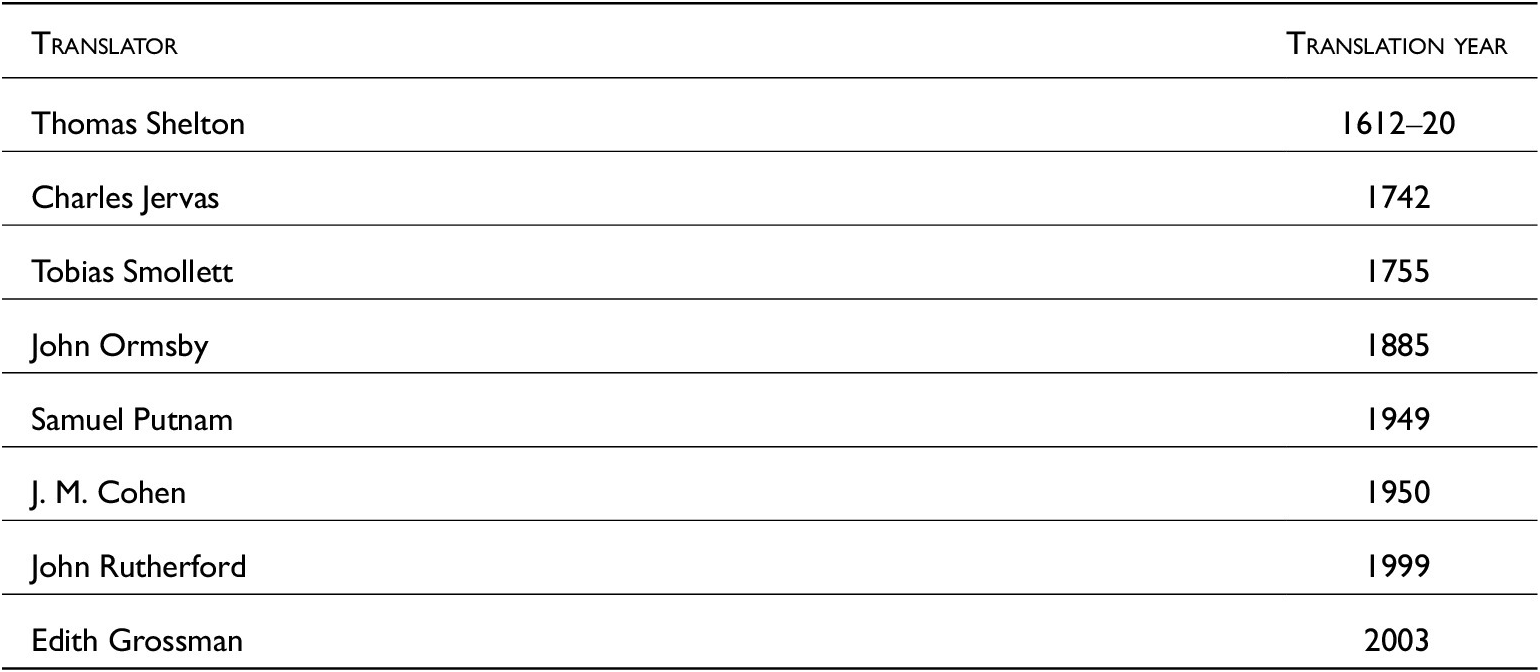
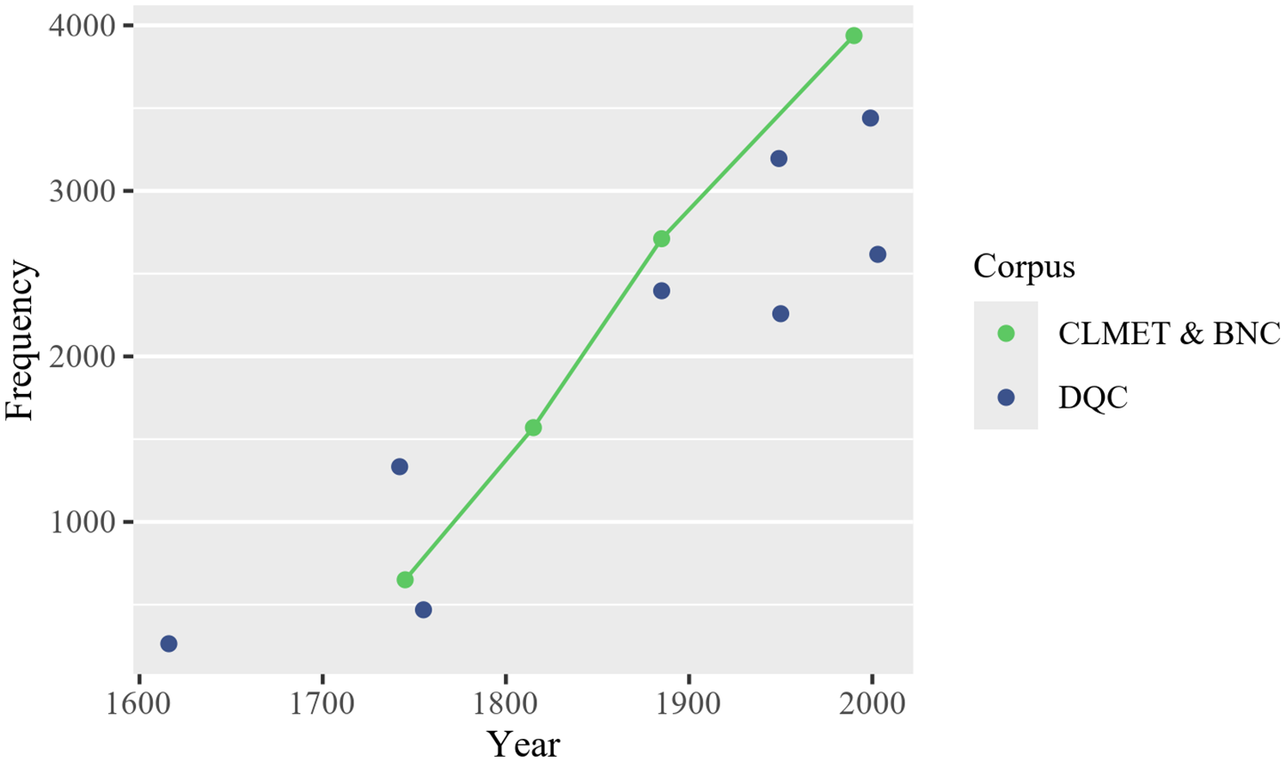
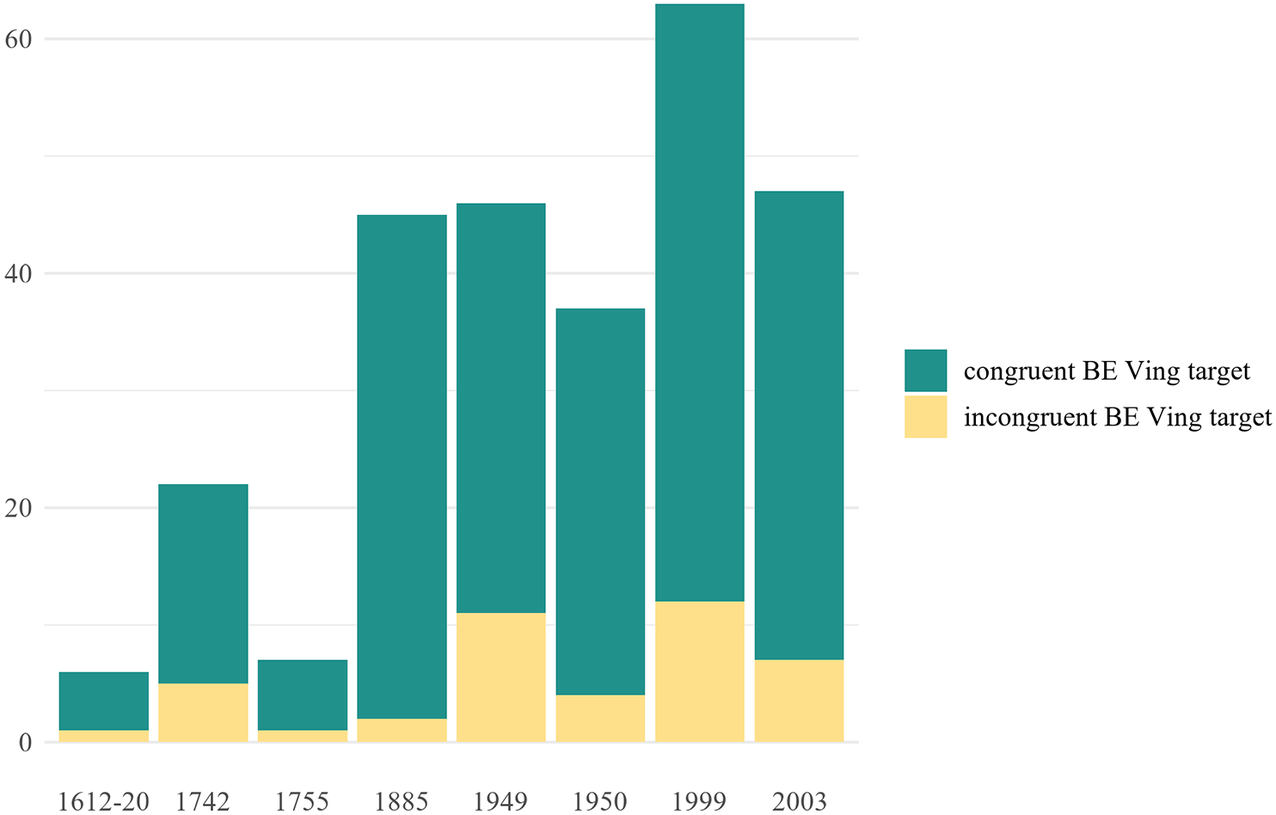
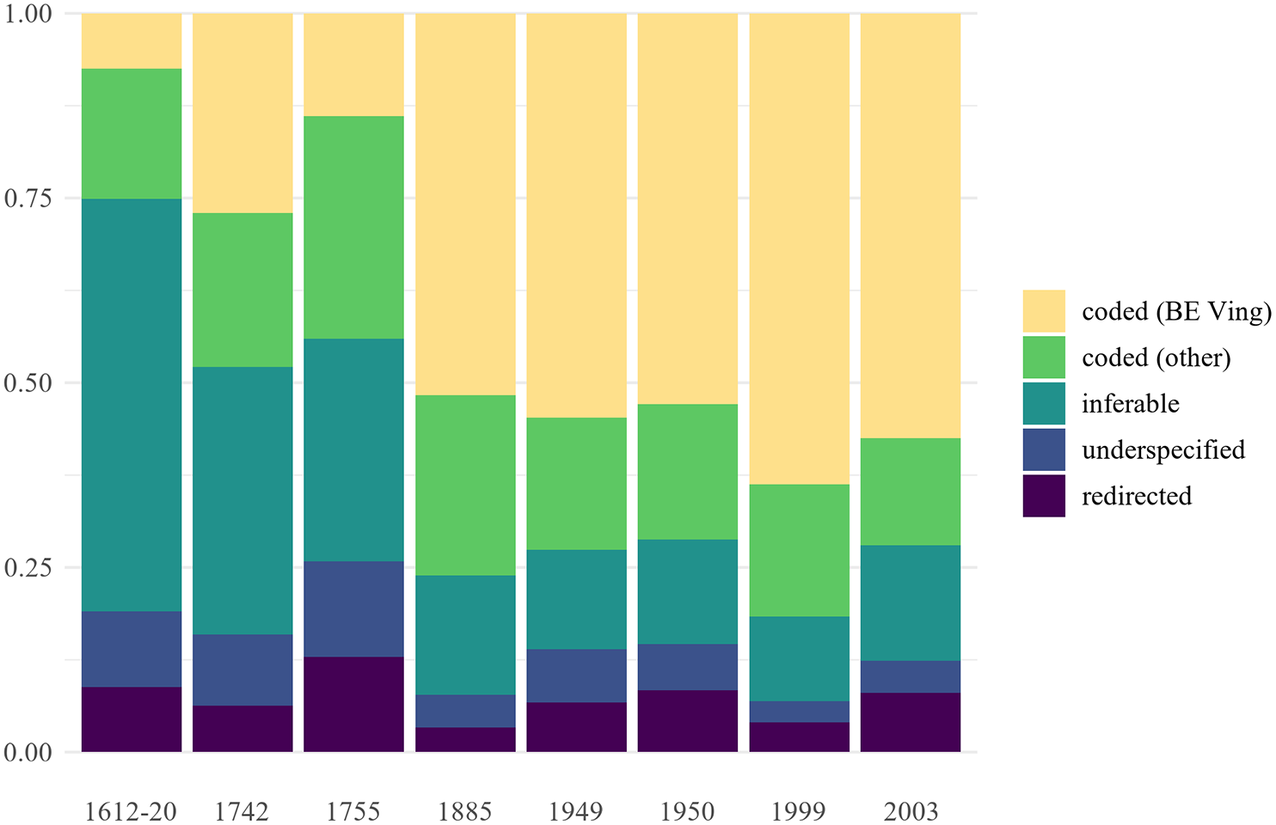
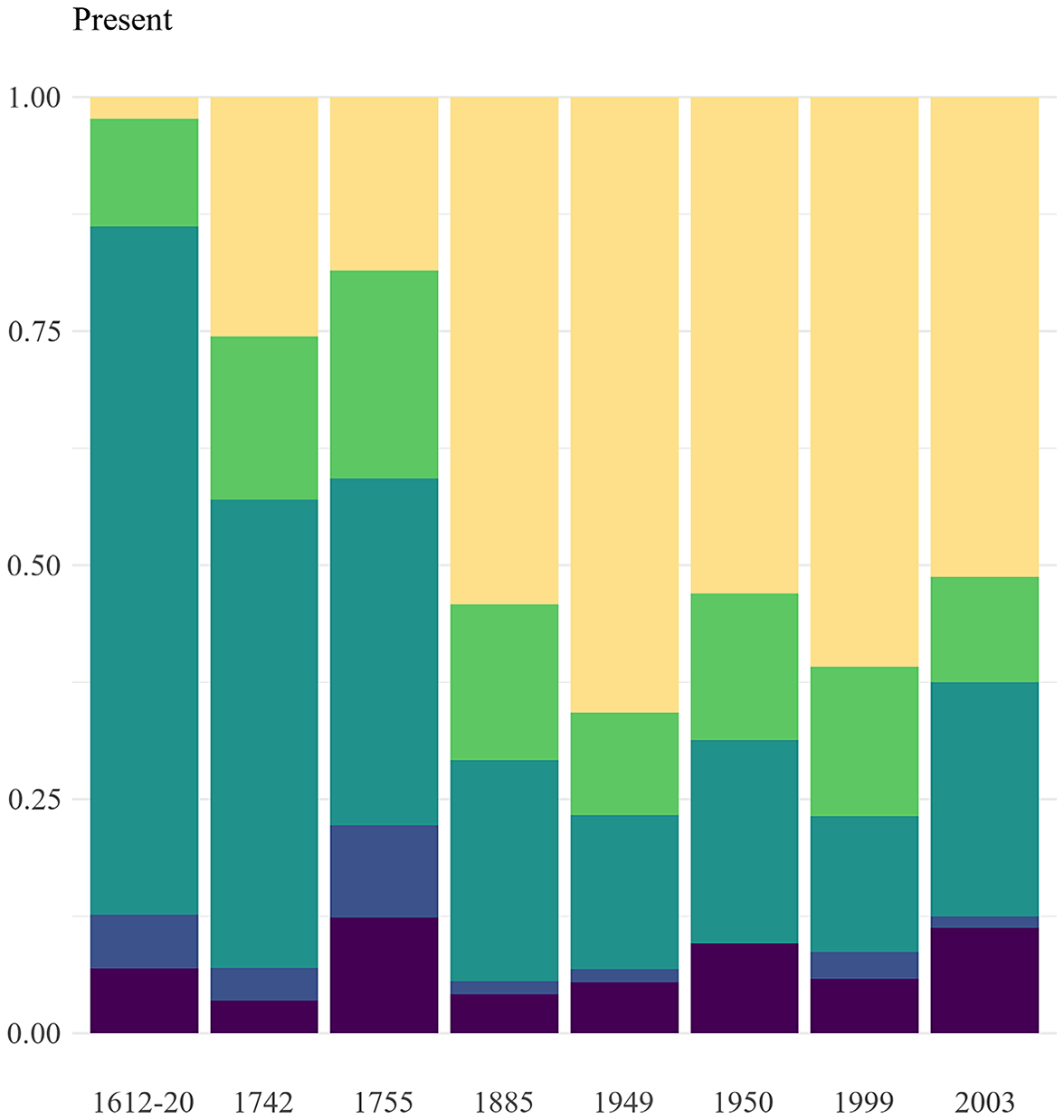
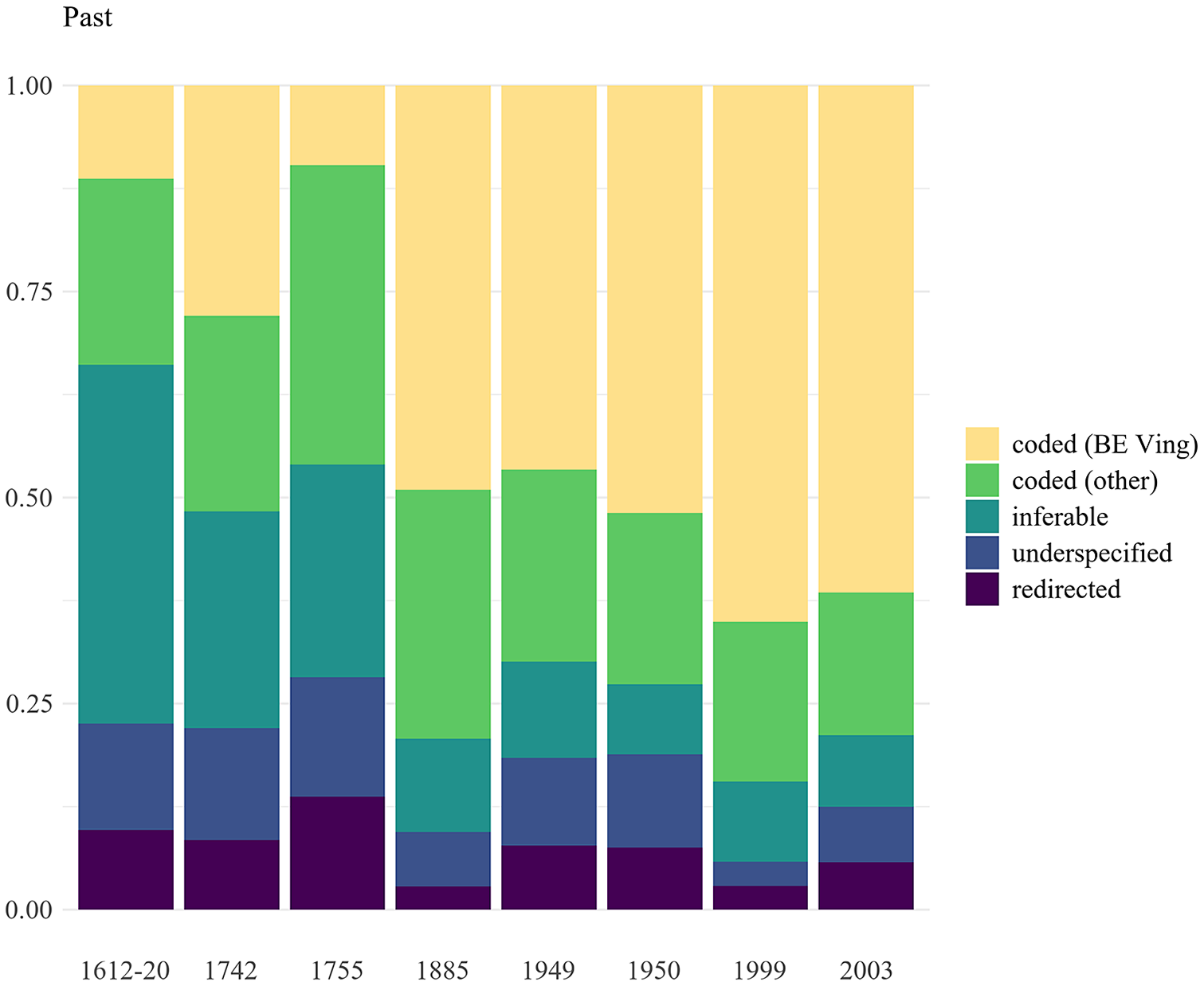

 Open access

