Introduction
Aggression has been studied from a variety of perspectives, including the political, social, psychological, and neurobiological. Aggressive behavior serves an adaptive function to enable the organism to defend itself, or its offspring, against attack and/or to secure access to the resources it needs to survive. The fact that aggressive behavior has been preserved over time and across species speaks to its adaptive value. In humans, however, aggression is often not advantageous, especially as our species has become more civilized and, in today’s society, there are limited circumstances in which aggressive behavior is acceptable (eg, in the case of “self-defense”).
Typically, we distinguish at least 2 forms of aggression: instrumental and impulsive (also called proactive or reactiveReference Dodge 1 ). Instrumental aggression is carried out with the primary goal of obtaining some benefit or reward. This type of aggression is most closely associated with psychopathy and/or antisocial personality disorder. In contrast, aggression that is carried out impulsively or in anger is termed impulsive or reactive aggression. Impulsive aggression characteristically occurs in response to a provocation (which is often social), threat, or frustration. This type of aggression, when it is sufficiently frequent and severe, is exemplified by the diagnosis of intermittent explosive disorder (IED).Reference Coccaro 2 However impulsive aggression is also commonly associated with Cluster B personality disorders, in particular borderline personality disorder and antisocial personality disorder.Reference Berman, Fallon and Coccaro 3 In IED, aggression is not due primarily to a neurological lesion or condition, substance intoxication, mood disorder, or psychotic disorder. The fact that between 5% and 7% of the general population will meet criteria for IED at some point during their lifetime highlights the importance of understanding and addressing aggressive behavior.Reference Kessler, Coccaro, Fava, Jaeger, Jin and Walters 4
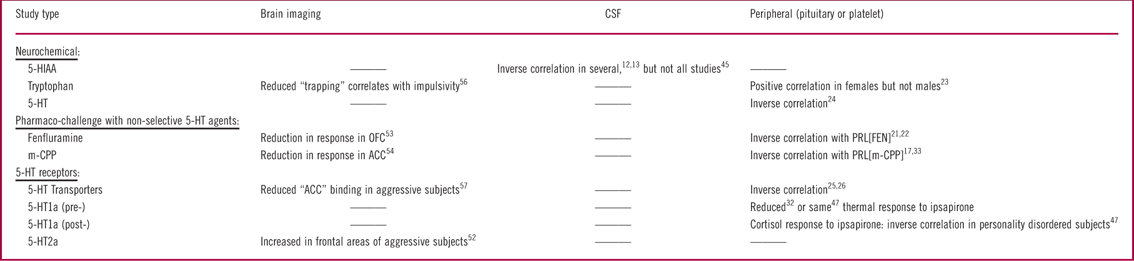
The most extensively studied neurotransmitter with respect to impulsive aggression has been serotoninReference Yanowitch and Coccaro 5 (5-hydoxytryptamine; 5-HT), with a large literature strongly suggesting the involvement of 5-HT in impulsive aggressive behavior in humans (Table 1). While other neurotransmittersReference Coccaro, Kavoussi, Hauger, Cooper and Ferris 6 – Reference Coccaro, Lee and Vezina 9 and modulatorsReference Coccaro, Lee and Coussons-Read 10 have been shown to have a possible role in aggression, this article will focus on the previous, decades-long study of serotonin function and aggression, and then will conclude with the clinical implications of this research.
Relationship between measures of aggression and indices of 5-HT in living human subjects

Serotonin and Suicidality: Precursor Studies to Those Involving Aggression
Early human studies on 5-HT focused on its role in suicidal behavior.Reference Asberg, Schalling, Traskman-Bendz and Wagner 11 This early work revealed that individuals who had committed suicide had lower post-mortem concentrations of 5-HT and the 5-HT metabolite, 5-hydroxyindoleacetic acid (5-HIAA), compared to those who died by other causes.Reference Bourne, Bunney and Colburn 12 – Reference Shaw, Eccleston and Camps 14 The work was followed by studies of cerebrospinal fluid (CSF) levels of 5-HIAA (CSF 5-HIAA), the major, stable metabolite of serotonin in the CSF which is thought to reflect serotonin turnover via the degradation of serotonin following release into the synapse. Since CSF 5-HIAA levels correlate with brain 5-HIAA levels, CSF 5-HIAA has been utilized as a marker of central 5-HT activity.Reference Stanley, Traskman-Bendz and Dorovini-Zis 15 In one of the earliest human studies in depression, Asberg et al Reference Asberg, Träskman and Thorén 16 found a bimodal distribution of CSF 5-HIAA with 29% of depressed subjects comprising a “low 5-HIAA” group. Subjects who attempted suicide using violent methods were significantly more likely to belong to the low 5-HIAA group. Other studies have also observed lower CSF 5-HIAA levels in those who have attempted suicide compared to healthy individuals.Reference Brown, Goodwin, Ballenger, Goyer and Major 17 –– Reference Lidberg, Tuck, Asberg, Scalia-Tomba and Bertilsson 19 In addition, a meta-analysis found clear support for the relationship between suicidal behavior and low CSF 5-HIAA levels,Reference Lester 20 while these authors found mixed support for the notion that lower CSF 5-HIAA levels are associated with violent (as opposed to non-violent) suicide attempts.
Serotonin and Impulsive Aggression: Neurochemical Studies
The earliest study to explore the 5-HT/aggression relationship in humans reported a significant and inverse correlation between CSF 5-HIAA levels and life history of aggressive behavior (r=–.78) in adult Navy recruits being evaluated for “fitness of duty” due to either aggressive or passive aggressive behavior.Reference Brown, Goodwin, Ballenger, Goyer and Major 17 Moreover, subjects with a history of suicide attempt (n=11) had a higher life history of aggression scores and lower 5-HIAA levels compared to subjects with no such history. This correlation between CSF 5-HIAA level and life history of aggression was replicated in a subsequent sample of men with borderline personality disorder.Reference Brown, Ebert and Goyer 18 Several studies of impulsive violent offenders also report lower CSF 5-HIAA levels,Reference Lidberg, Tuck, Asberg, Scalia-Tomba and Bertilsson 19 though not all studies, especially those in subjects not drawn from a criminal justice system, have reported this finding.Reference Coccaro, Kavoussi, Cooper and Hauger 21 – Reference Hibbeln, Umhau, George, Shoaf, Linnoila and Salem 23 For example, Coccaro et al Reference Coccaro, Kavoussi, Cooper and Hauger 21 , Reference Coccaro, Kavoussi, Trestman, Gabriel, Cooper and Siever 22 found no relationship between CSF 5-HIAA levels and life history of aggression in 2 separate samples of personality disorder subjects. Simeon et al Reference Simeon, Stanley, Frances, Mann, Winchel and Stanley 24 found no relation between several indices of 5-HT functioning and life history of aggression or impulsivity in a sample of personality disordered individuals with a history of self-harm. In contrast, a more recent study found that when both CSF 5-HIIAA and CSF HVA levels are placed in the same statistical model, CSF 5-HIAA demonstrates a significant, and positive, correlation with aggression.Reference Coccaro and Lee 25 This is consistent with reduced 5-HT receptor responsiveness as demonstrated in pharmaco-challenge studies.Reference Coccaro, Siever and Klar 26 , Reference Coccaro, Lee and Kavoussi 27 While it is far easier to assess 5-HT–related measures in the periphery, there are limited studies of peripheral levels of tryptophan or of 5-HT and aggression. One study reports a positive relationship of plasma tryptophan with aggression in healthy female, but not male, subjects,Reference Suarez and Krishnan 28 while another reports an inverse relationship between platelet 5-HT and aggression in personality disordered subjects.Reference Goveas, Csernansky and Coccaro 29
Serotonin and Impulsive Aggression: Receptor Studies
Receptor markers on circulating blood platelets have long been used as a model of 5-HT receptors in the central nervous system. Despite considerable platelet receptor work in other psychiatric populations, relatively little research in this area has been published in impulsively aggressive subjects. Simeon et al Reference Simeon, Stanley, Frances, Mann, Winchel and Stanley 24 reported an inverse correlation between the number of platelet 3H-impiramine (5-HT transporter) binding sites and self-mutilation and impulsivity in personality disordered subjects with, but not without, a history of self-mutilation. Coccaro et al Reference Coccaro, Kavoussi, Sheline, Lish and Csernansky 30 first reported that the number of platelet 3H-paroxetine (5-HT transporter) binding sites was inversely correlated with life history of aggression in personality disordered subjects. In a study of overlapping subjects, the same authors noted a positive relationship between platelet 5-HT2a receptors and aggression.Reference Coccaro, Kavoussi, Sheline, Berman and Csernansky 31 However, while a larger study confirmed the relationship between aggression and platelet 3H-paroxetine binding sites,Reference Coccaro, Lee and Kavoussi 32 this was not true for platelet 5-HT2a binding sites.Reference Marseille, Lee and Coccaro 33
Serotonin and Impulsive Aggression: Pharmaco-Challenge Studies
Pharmaco-challenge studies have also provided evidence of a relationship between central 5-HT function and aggression. Coccaro et al Reference Coccaro, Siever and Klar 26 reported a relationship between the prolactin response to d,l-fenfluramine (PRL[d,l-FEN]) challenge and both life history of aggression (r=–.57) as well as the tendency to be aggressive as a personality trait (r=–.52) in subjects with personality disorders. A subsequent study, with a much larger sample, also reported a significant relationship between PRL[d-FEN] and life history of aggression in personality disordered (PD) subjects, though the inverse correlation was smaller in magnitude.Reference Coccaro, Lee and Kavoussi 27 Similar associations were observed by New et al Reference New, Trestman and Mitropoulou 34 in a large sample of PD subjects between PRL[d,l-FEN] and tendency to be aggressive as a personality trait in PD men (r=–.21). Other studies have also found a relationship between blunted hormonal response to 5-HT challenge in patients with borderline personality disorder,Reference Paris, Zweig-Frank, Kin, Schwartz, Steiger and Nair 35 antisocial personality disorder,Reference O'Keane, Moloney, O'Neill, O'Connor, Smith and Dinan 36 and substance use disorder.Reference Moeller, Steinberg and Petty 37 , Reference Moss, Yao and Panzak 38
Serotonin and Impulsive Aggression: Behavioral Challenge Studies
In laboratory studies utilizing behavioral measures that provoke anger in the laboratory (eg, Taylor Aggression Paradigm or the Point Subtraction Aggression Paradigm), aggressiveness has been correlated with blunted PRL response to d-FEN challengeReference Coccaro, Berman, Kavoussi and Hauger 39 and blunted thermal response to ipsapirone challenge.Reference Moeller, Allen, Cherek, Dougherty, Lane and Swann 40 Laboratory manipulations of central 5-HT using tryptophan depletionReference Pihl, Young, Harden, Plotnick, Chamberlain and Ervin 41 or supplementationReference Cleare and Bond 42 have also demonstrated an inverse relationship between provoked aggressive responding and 5-HT activity, particularly in subjects with high trait levels of aggression.Reference Dougherty, Bjork, Marsh and Moeller 43
Serotonin and Impulsive Aggression: Commentary on Extant Empiric Data
Overall, there is considerable data to support the hypothesis that 5-HT is involved in behaviors described as “impulsive” rather than “premeditated.” Linnoila et al Reference Linnoila, Virkkunen, Scheinin, Nuutila, Rimon and Goodwin 44 reported lower CSF 5-HIAA levels among murderers and attempted murderers who had committed impulsive crimes compared to those who committed premeditated crimes, and several hypotheses have been offered to explain the role of 5-HT in modulating behavior. SpoontReference Spoont 45 proposed that 5-HT stabilizes information flow by supporting phase coherence in neural activity, and thereby modulates reactivity to stimuli both internal and external. In this model, high central 5-HT levels are associated with behavioral constraint, while low 5-HT levels are associated with impulsivity and stimulus activity.Reference Spoont 45 Similarly, Linnoila and VirkkunenReference Linnoila and Virkkunen 46 postulated that a “low 5-HT syndrome” characterizes many individuals who engage in violent, impulsive, and antisocial behavior. This hypothesis was largely derived from studies of CSF 5-HIAA. These authors posit that 5-HT serves to constrain behavior, so a 5-HT deficit is associated with increased impulsivity.Reference Linnoila and Virkkunen 46 Another model, the “irritable aggression model” by Coccaro et al,Reference Coccaro, Kavoussi and Lesser 47 suggests that a net hypo-serotonergic state is associated with greater irritability, which is conceptualized as a lower threshold for responding to noxious stimuli with aggressive behavior. This is consistent with findings of an inverse correlation between irritability and PRL[d,l-FEN],Reference Coccaro, Siever and Klar 26 as well as other reports which have suggested that impulsivity may not correlate with measures of 5-HT independently of aggression.Reference Coccaro, Lee and Kavoussi 27 , Reference Coccaro, Lee and Kavoussi 32 Furthermore, research in both animals and humans suggests that noxious, threatening, or provocative stimuli are necessary to elicit aggressive behavior in an organism in a hypo-serotonergic state.Reference Berman, McCloskey, Fanning, Schumacher and Coccaro 48 , Reference Marks, Miller, Schulz, Newcorn and Halperin 49
While early studies in this area produced large effect sizes, a recent meta-analysis reports a more modest estimate of relationship between 5-HT and aggression in human subjects. Duke et al Reference Duke, Bègue, Bell and Eisenlohr-Moul 50 analyzed 171 studies on the serotonin–aggression relationship that examined (a) CSF 5-HIAA levels, (b) acute tryptophan depletion (ATD), (c) pharmaco-challenge, and (d) endocrine challenge. These authors found a small (r=–.12), but significant, inverse relation between measures of 5HT functioning and aggression. Pharmaco-challenge studies yielded the largest (r=–.21), while CSF 5-HIAA studies yielded the smallest, and a nonsignificant, effect size (r=–.06, ns). Small, significant, mean effects were also found for ATD (r=–.10) and endocrine challenge (r=–.14); cortisol response variables were not significantly related to aggression (r=–.02). Neither phenomenological nor drug type characteristics of the subjects moderated the relationships between indices of 5-HT functioning and aggression. These results, as well as other conflicting findings in the literature, suggest that the relationship between 5-HT and behavior is more complex than previously thought.
Serotonin and Impulsive Aggression: 5-HT Receptors and Brain Circuitry
Serotonergic neurons project throughout the brain, with particularly dense projections in the cerebral cortex, limbic structures, basal ganglia, and brainstem. In addition, the 5-HT system comprises at least 14 types of receptors. Certain receptor subtypes (5-HT1a and 5-HT1b) are expressed at both pre- and post- synaptic locations, and 5-HT receptor subtypes appear to exert unique, and perhaps opposing, effects on aggression. For example, aggressive individuals have been shown to have blunted response to 5-HT1a receptor agonists,Reference Cleare and Bond 51 , Reference Almeida, Lee and Coccaro 52 and suicidal subjects have demonstrated unique patterns of 5-HT1a receptor binding, although the results have been mixed.Reference Bortolato, Pivac, Muck Seler, Nikolac Perkovic, Pessia and Di Giovanni 53 5-HT1b agonists may also reduce aggression through effects on impulsivity and 5-HT1b hetero-receptors (located at post-synaptic sites on non-5-HT neurons) in the hypothalamus may be involved in regulating offensive, rather than reactive,Reference Olivier and van Oorschot 54 aggression. The relationship between the 5-HT2a receptor and impulsive aggression has been mixed, with some studies reporting inverse associations with 5-HT2a indices,Reference Meyer, Wilson and Rusjan 55 , Reference Soloff, Price, Mason, Becker and Meltzer 56 while other studies have reported positive associationsReference Rosell, Thompson and Slifstein 57 in areas of the prefrontal cortex. For example, Rosell et al Reference Rosell, Thompson and Slifstein 57 saw increased 5-HT2a availability associated with current, but not past, impulsive aggression in PD subjects, which suggests that dynamic changes in this index may reflect state changes in aggressive behavior. Finally, the 5-HT2c receptor has been of interest because of its possible anti-aggressive effects when stimulated,Reference Bortolato, Pivac, Muck Seler, Nikolac Perkovic, Pessia and Di Giovanni 53 and because the PRL[d-FEN] response appears, in part, to reflect 5-HT2c stimulation.Reference Coccaro, Lee and Kavoussi 27
Neuroimaging methodologies represent a significant advance in the area of psychiatry research. In one of the earliest Positron Emission Tomography (PET) studies in personality disorder subjects, Siever et al Reference Siever, Buchsbaum and New 58 imaged glucose metabolism in impulsively aggressive subjects (n=6) with personality disorder and healthy control (n=5) subjects following a single acute challenge dose of d,l-FEN or placebo. In healthy subjects, the d,l-FEN challenge was associated with increased glucose utilization in the left orbitofrontal (OFC) and anterior cingulate cortex (ACC), while impulsively aggressive subjects had reduced glucose utilization in these areas. Only the inferior parietal lobe showed increased metabolism in response to d,l-FEN in PD subjects. PRL[d,l-FEN] (placebo-corrected) responses did not differ between the aggressive subjects and healthy controls. PRL[d,l-FEN] correlated in the medial frontal cortex (r=.58) and right middle cingulate (r=.63). These correlations were not significant due to the small sample size. A similar finding was obtained in a larger follow-up study. New et al Reference New, Hazlett and Buchsbaum 59 studied similarly impulsively aggressive PD (n=13) and healthy (n=13) subjects with a meta-chlorophenylpiperazine (m-CPP) challenge. Healthy, but not aggressive, subjects showed increased glucose utilization in OFC and anterior cingulate (ie, areas involved in inhibiting aggressive behavior) following m-CPP challenge relative to placebo. Furthermore, these investigators reported that 3 months of fluoxetine treatment appeared to normalize OFC function in impulsively aggressive subjects, which supports the hypothesis that deficits in OFC function are, partially, supported by abnormalities in serotonin function.Reference New, Buchsbaum and Hazlett 60
Other studies suggest that impulsively aggressive subjects have abnormal 5-HT synthesis. In one study, males with borderline personality disorder displayed reduced trapping of a 5-HT precursor analog (ie, reduced 5-HT synthesis capacity) in the medial frontal gyrus, anterior cingulate gyrus (ACG), superior temporal gyrus (STG), and corpus striatum compared to healthy controls, while similar women had lower trapping in the right ACT and superior temporal gyrus.Reference Leyton, Okazawa and Diksic 61 Another study using PET radiotracer for the serotonin transporter (5-HTT) also showed reduced 5-HTT availability in ACG in impulsively aggressive subjects.Reference Frankle, Lombardo and New 62 Finally, a study by Koch et al Reference Koch, Schaaff and Pöpperl 63 using single-photon emission computed tomography (SPECT) examined binding of [I123] ADAM to the serotonin transporter, and found increased binding in impulsively aggressive subjects in both the hypothalamus and brainstem. ADAM binding correlated significantly with impulsivity but not with depression.
Serotonin and Impulsive Aggression: Treatment Correlates
Treatment with selective serotonin reuptake inhibitors (SSRIs; eg, fluoxetine) has been shown to reduce impulsive aggression in human subjects with prominent histories of impulsive aggressive behavior. In addition to several open-label studies, 5 double-blind, placebo-controlled studiesReference Coccaro, Lee and Kavoussi 64 – Reference Salzman, Wolfson and Schatzberg 68 have reported significant reduction in impulsive aggressive behavior in nonbipolar/nonpsychotic psychiatric patients treated with SSRIs. While such treatment brings about full remission of impulsive aggressive behaviors in less than one-third of subjects, up to nearly 50% achieve either full or partial remission.Reference Coccaro, Lee and Kavoussi 64
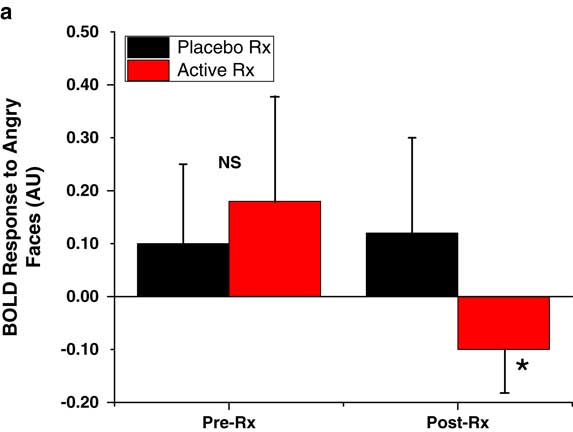
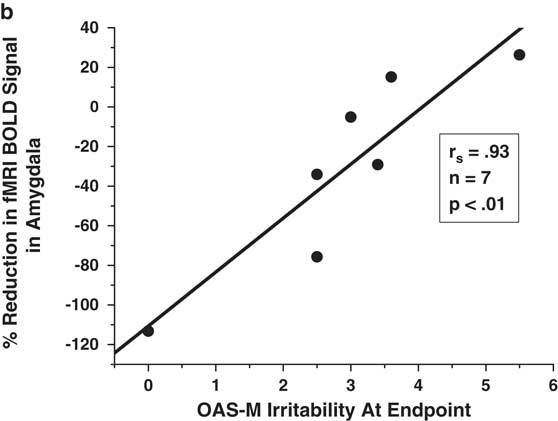
Further, in small, preliminary studies, we have found that anti-aggressive responses to SSRIs appear to be directly related to the intactness of 5-HT synaptic function and to the degree to which cortico-limbic circuits are impacted by treatment. The first work in this area found a positive relationship between the PRL response to d-FEN and improvement in OAS-M Aggression scores. In other words, the lower the PRL[d-FEN] value pre-treatment, the lower the anti-aggressive response to the SSRI.Reference Coccaro, Kavoussi and Hauger 69 While seemingly counterintuitive, these data suggest that in order for SSRIs to have anti-aggressive efficacy, 5-HT synaptic function must be somewhat functional, at the least. This is because SSRIs work by attaching to 5-HT transporters, which leads to an increase in synaptic 5-HT. However, if 5-HT transporters are inversely related to aggression, then there would be fewer for the SSRI to bind to, and therefore would work to block 5-HT uptake. This would lead to less of an increase in synaptic 5-HT as a function of aggression. This is also consistent with data showing that aggressive individuals with the “s” allele (which is associated with less production of the transporter protein) have a poorer anti-aggressive response to SSRIs.Reference Silva, Iturra and Solari 66 More recent preliminary work suggests that effective anti-aggressive treatment, by either SSRIs (fluoxetine) or mood stabilizers (divalproex), is associated with a reduction in the amygdala response to social threat (“anger faces”; see Figure 1a) and a possible normalization of heightened amygdala, and blunted orbito-frontal, response to social threat. Specifically, placebo had no effect on functional magnetic resonance imaging (fMRI) Blood Oxygenation Level Dependent (BOLD) responses in amygdala, but active drug treatment reduced fMRI BOLD signal activity responses to anger faces (p<.05; 181% reduction in signal from 122% to –.099%). In addition, percent reduction in amygdala signal activity to anger faces correlated highly with post-treatment endpoint scores on aggression variables in drug-treated subjects (irritability score on the Overt Aggression Scale: rs=.93, p<.01; see Figure 1b). Conversely, a trend was seen for an increase in fMRI BOLD signal activity to anger faces in OMPFC (p<.10; a 75% increase in signal from -.173% to -.043%). In addition, percent increase in Orbitomedial Prefrontal Cortex (OMPFC) fMRI BOLD activity to anger faces was inversely (though not significantly) correlated with post-treatment scores of OAS-M Irritability (rs=–.60). This suggests that such agents not only affect central 5-HT function, but also alter cortico-limbic circuitry, as expected by our current understanding of clinical neuroscience.Reference Coccaro, Sripada, Yanowitch and Phan 70
Amygdala BOLD responses to social threat (angry faces) before and after 12 weeks of treatment with placebo (n=10) vs . fluoxetine (n=3) or divalproex (n=4); *p<.05.

Clinical Implications
If central 5-HT function plays an important role in the regulation of impulsive aggression, how can clinicians utilize these research data to improve the care of their own patients? First, it is critical that clinicians know that 5-HT is not a unitary system. However, while the various components of the system (receptors and their location in the brain) may have different effects on behavior, a direct relationship between 5-HT and behavioral inhibition is the most parsimonious way to conceptualize the role of 5-HT and impulsive aggression. Thus, the greater the 5-HT system activity, the greater behavioral inhibition the individual will have when confronted with threat or frustration.
As we have discussed above, agents that increase 5-HT activity, such as SSRIs, have efficacy to reduce impulsive aggressive behavior up to a point. If so, other ways to stimulate the central 5-HT system will be needed. For example, one could attempt to increase 5-HT receptor activation by giving a direct 5-HT agonist. Recently, a direct 5-HT2c agonist (lorcaserin) has come onto the market for weight loss and may be studied for its effects on impulsive aggression. Since the PRL response to fenfluramine appears to be mediated by activation of 5-HT2c receptors, it is possible that this agent could reduce impulsive aggression on its own or provide added efficacy to SSRI treatment. Other agents that may or may not have an effect on the central 5-HT system may also be efficacious in reducing aggression include mood stabilizers and some atypical antipsychotic agents. Randomized controlled trial data for SSRIs and for mood stabilizer/antipsychotic agents is not extensive, but studies suggest anti-aggressive doses that are similar to those for treating mood disorders.
Behavioral interventions may also reduce impulsive aggressive behavior, but we do not know yet if these interventions are mediated by changes in brain 5-HT function. We also do not know if the combination of pharmacologic and behavioral treatment will produce better efficacy than either modality alone because such studies have not been performed. Knowing that either modality produces similar results, likely through different pathways, we expect that the combination will result in an improved outcome for combined versus single treatment.
Other gaps in our knowledge include the possibility of gender or age differences in treatment response, as well as when to treat and exactly how to treat. We suggest that treatment is warranted when the frequency and severity of impulsive aggressive outbursts has reached the threshold for meeting Diagnostic and Statistical Manual of Mental Disorders, Fifth Edition (DSM-5) criteria for intermittent explosive disorder because these criteria define the presence of a disorder of impulsive aggression. The type of treatment should include both pharmacologic and behavioral interventions. There is no empiric data to inform us as to which should be tried first, but our recommendation is that behavioral intervention may be tried first when the severity of IED is moderate, but the reverse may be true when IED is more severe.
Conclusion
In summary, an extensive literature supports a role for serotonin in impulsive aggression (and suicidality). Evidence suggests that serotonin modulates activity in areas of the prefrontal cortex, including the orbitofrontal cortex and anterior cingulate, which are implicated in “top-down” control of limbic responding to stimuli. Individuals with personality disorder display impaired serotonergic functioning in these brain regions, which may account for the aggressive and, perhaps, impulsive behaviors seen in these disorders. Treatment of impulsive aggressive behaviors with serotonergic agents may be a good strategy, but this may be less effective in those with severely impaired 5-HT system function. As serotonin is not the only relevant neurotransmitter underlying aggressive behavior,Reference Yanowitch and Coccaro 5 more work needs to be done to examine the role of other neurotransmitter systems in order to more comprehensively treat these behaviors. In addition, neuroimaging methods have the great potential to enhance our understanding of both neurotransmitter and neurocircuitry function in human aggression.Reference Coccaro, Sripada, Yanowitch and Phan 70
Disclosures
Emil Coccaro has the following disclosure: Azevan, Inc., consultant, consulting fees. Royce Lee has the following disclosure: Azevan, Inc., principal investigator, research support. Jenner Fanning and K. Luan Phan do not have anything to disclose.
Endpoint Overt Aggression Scale–Modified (OAS-M) Irritability Score correlates (Spearman) directly with percent suppression of amygdala BOLD responses to social threat (angry faces) after 12 weeks of fluoxetine (n=3) or divalproex (n=4) in subjects currently meeting DSM-5 criteria for IED.