Introduction
Scarcity of feed ingredients is a main obstacle for poultry production in many countries (Rama et al., Reference RAMA, RAJU, PANDA and REDDY2006), due to local availability, cost or import constraints, and the most expensive nutrient is protein (Shi et al., Reference SHI, LU, TONG, ZOU and WANG2012). Due to its ideal amino acids profile and digestibility, soybean meal (SBM) is considered an excellent protein source (Shi et al., Reference SHI, LU, TONG, ZOU and WANG2012; Mushtaq et al., Reference MUSHTAQ, SARWAR, AHMAD, NISA and JAMIL2006; Laudadio et al., Reference LAUDADIO, CECI, LASTELLA and TUFARELLI2014). It is imported to many European and Asian countries (Shi et al., Reference SHI, LU, TONG, ZOU and WANG2012) with concomitant fluctuation in market prices, which creates variation in its inclusion rates for feed formulations (Mushtaq et al., Reference MUSHTAQ, SARWAR, AHMAD, NISA and JAMIL2006). The non-availability of SBM at economical prices supports a need to search for alternate protein sources in least cost formulations for poultry in certain countries (Laudadio et al., Reference LAUDADIO, CECI, LASTELLA and TUFARELLI2014; Rama et al., Reference RAMA, RAJU, PANDA and REDDY2006).
Due to its adaptive capability in various climatic and soil conditions, sunflower (Helianthus annuus L.) is cultivated worldwide (San Juan and Villamide, Reference SAN JUAN and VILLAMIDE2000; Mushtaq et al., Reference MUSHTAQ, SARWAR, AHMAD, NISA and JAMIL2006; Laudadio et al., Reference LAUDADIO, CECI, LASTELLA and TUFARELLI2014; Zhou et al., Reference ZHOU, ZHANG, YE and ZHANG2012; Brenes et al., Reference BRENES, CENTENO, VIVEROS and ARIJA2008) and ranks third in importance as a source of vegetable oil (Rodriguez et al., Reference RODRIGUEZ, ORTIZ, ALZUETA, REBOLE and TREVINO2005). The seeds can be harvested two or three times yearly in tropical areas; the oil is good quality and the meal is a relatively inexpensive protein sources in poultry diets (Hamedi et al., Reference HAMEDI, REZAIAN and SHOMALI2011; Shi et al., Reference SHI, LU, TONG, ZOU and WANG2012; Senkoylu and Dale, Reference SENKOYLU and DALE2006). The increased production of new varieties with high oleic acid content and the upward trends in formulating high density rations for broiler chickens has prompted evaluation of sunflower seed meal (SFSM) as a protein and energy source in rations (Brenes et al., Reference BRENES, CENTENO, VIVEROS and ARIJA2008). SFSM may contain crude protein and crude fibre up to 35% and 25% respectively depending upon the processing techniques. This review paper focuses on processing, use of SFSM in broiler diets and its comparative effects on production parameters in broilers.
Sunflower seed history and processing
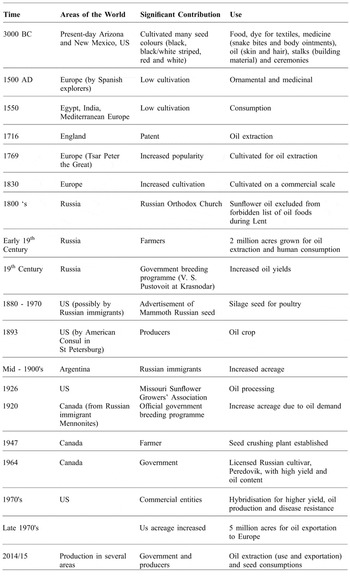
Sunflowers are thought to be one of the first plants cultivated in the Americas, and Helianthus Annuus was developed in North America by Indian tribes and first commercialised in Russia. Its journey to several areas of the world is outlined in Table 1 . Early sunflowers seeds were made into bread, cakes or mush after pounding or grinding. Beans, corn and squash could be mixed with meal, and cracked seeds were used as snacks with the oil used in making bread.
Spread of sunflower seed meal.

(Sunflower, Reference SUNFLOWER2015; Botanical-online; 2015, Schneiter, Reference SCHNEITER1997; Putt, Reference PUTT1978)
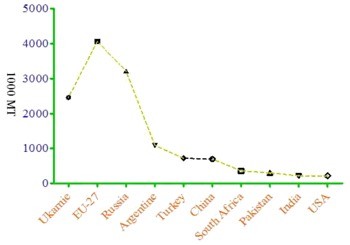
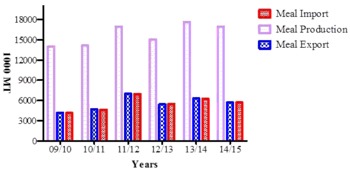
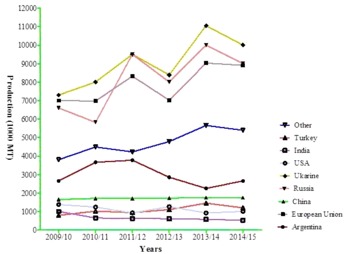
SFSM production and yearly export and import are shown in Figure 1a. Figure 1b indicates that (1) worldwide import and export of meal cancelled each other and (2) there was excess meal that could be added to feed for broiler production. Worldwide production between 2010 and 2015 is shown in Figure 2 . The Ukraine, Russia and India are major producers.
a Sunflower Seed meal production in 2014.

b Yearly sunflower seed meal export and import.

Sunflower production by countries from 2010-2015.

Oil extraction
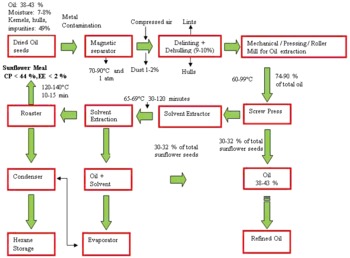
Sunflower seeds are primarily grown for oil production for human consumption (Kocher et al., Reference KOCHER, CHOCT, PORTER and BROZ2000) and have a high oil yield (< 50%). The oil extraction process involves mechanical, thermal, and chemical treatments ( Figure 3 ) that may affect the nutritional value of sunflower by-products (San Juan and Villamide, Reference SAN JUAN and VILLAMIDE2001). Oil extraction usually involves two consecutive steps. The first step includes cracking of kernels (mechanically by centrifugal or pneumatic shellers or abrasion) to extract most of the sunflower oil through screw-presses (expellers). This results in a ‘cake’ containing 15-20% oil. Mechanical extraction is used by smallholder farmers in both developing and developed countries. In the second step, industrial scale solvent (usually n-hexane) extraction increases oil yield (Mandibaya et al., Reference MANDIBAYA, MUTISI and HAMUDIKUWANDA1999) and results in a defatted SFSM by-product. The cell walls of the endosperm in sunflower seed is totally disrupted initially by pressure treatment and afterwards by n-hexane extraction, thus facilitating enzyme action and, therefore, increasing digestibility (San Juan and Villamide, Reference SAN JUAN and VILLAMIDE2000).
High temperatures associated with mechanical pressing (80°C) and solvent evaporation (150°C) can damage protein and amino acids and decrease their availability (Villamide and San Juan, Reference VILLAMIDE and SAN JUAN1998). Generally, the arrangement of lipids within the cell membranes operates as a physical barrier preventing other nutrients from being completely digested. Enhanced digestibility of non-fat constituents occurs due to a greater breakage of cell wall structure during the n-hexane extraction, having a greater effect than press extraction. Overall, cell walls of the endosperm in sunflower seed are totally disrupted initially by pressure treatment and afterwards by n-hexane extraction, thus facilitating enzyme action and, therefore, increasing digestibility (San Juan and Villamide, Reference SAN JUAN and VILLAMIDE2000). As determined by the KOH solubility test, excess heating/over-processing decreases in-vivo availability of lysine, a deficient amino acid in sunflower seed (Zhang and Carl, Reference ZHANG and CARL1994).
Solvent extraction results in a lower fat content, while de-hulling decreases the fibre content, yielding a meal richer in protein. So, there are fully decorticated meals (high protein, low fibre), partially decorticated meals, and non-decorticated meals (low protein, high fibre) without any clear separation among these grades. Like other protein feeds (fish meal or SBM), SFSM is usually sold on the basis of its protein content (Naidu, Reference NAIDU2008). However, the European Union has solvent extraction for SFSM in organic farming (Regulation, Reference REGULATION2007). SFSM must be conditioned (dried) for optimal
storage. It can be ground, broken into small pieces, pelletised or extruded for easier handling and storage (Grompone, Reference GROMPONE2005).
Sunflower seed meal production process.

After oil extraction, the resulting blend is winnowed to separate the hulls from the kernels (Grompone, Reference GROMPONE2005). Its quality depends on the plant characteristics (seed composition, hulls/ kernel ratio, de-hulling potential, growth stage and storage conditions) along with processing (de-hulling, mechanical and/or solvent extraction) techniques (Golob et al., Reference GOLOB, FARRELL and ORCHARD2008). Certain sunflower varieties have thinner hulls which are more difficult to remove and de-hulling is not recommended as it may result in oil loss with increased extraction costs without enhancing oil and SFSM quality (Grompone, Reference GROMPONE2005). Characteristically, seeds contain about 20-30% hulls, and 18-22% of the original amount can be removed by a well-managed de-hulling process. De-hulling by 1% improves pressing capacity by 2.5% (Campbell, Reference CAMPBELL1983). Drying facilitates the kernel separation from hulls. The colour of sunflower seed meal ranges from grey to black depending on the degree of de-hulling (Naidu, Reference NAIDU2008).
Challenges for upgrading SFSM
dehulling
Commonly, SFSM contains 35-40% hulls, 60-65% protein core, 30-34% crude protein (CP), 20-25% cellulose and 8-10% lignin. Efficient solutions for the production of SFSM with CP of 42-46% and 8-14% cellulose have been identified (Sredanovic et al., Reference SREDANOVIC, LEVIC and DJURAGIC2006). De-hulling and oil extraction processes affect the CP contents (29 to 45%) with inverse relation to its fibre (32 to 14%) contents (Villamide and San Juan, Reference VILLAMIDE and SAN JUAN1998). About 55-60 kg SFSM with CP 44-45% and crude fibre (CF) 8-10% can be obtained from 100 kg SFSM with CP (37-38%). A total of 43.3 kg SFSM with CP (43.8%) and CF (12.5%) can be obtained from 100 kg SFSM with CF (37.5%) by centrifugal separation on the sieve with mesh size of 1.5 mm (Sredanovic et al., Reference SREDANOVIC, LEVIC and DURAGIC2011).
Centrifugal separators fractionise the sunflower hulls from kernels. However, firm material adhering to the hull hinders separation (Levic et al., Reference LEVIC, DELIC, IVIC, RAC and STEFANOVIC1992). While these clumps need to be disintegrated, excessive break-up of hulls is to be avoided (Sredanovic, Reference SREDANOVIC2007; Levic et al., Reference LEVIC, SREDANOVIC, DURAGIC and IVANOV2009) or, otherwise, SFSM will contain reduced CP and higher CF contents. Treatment with a roll crusher followed by centrifugal separation on different sieves (mesh size of 1.5; 1.8 and 2.0 mm) enables yields of 48.75-59.33% of SFSM fractions with high CP (40.12-43.37%) and low CF (10.83-13.61%). After the roll crushing, the particles passing through the sieve increase by 14.3 to 59% (Sredanovic et al., Reference SREDANOVIC, LEVIC and DURAGIC2011).
Moghaddam et al. (Reference MOGHADDAM, SALARI, ARSHAMI, GOLIAN and MALEKI2012) concluded that CP levels (29 to 45%) in SFSM depends on the dehulling and oil extraction process and has an inverse relation to fibre content. Higher levels of insoluble fibre reduce the digestibility of nutrients due to reduced intestinal transit time (Rama et al., Reference RAMA, RAJU, PANDA and REDDY2006). SFSM forms powdery dust leading to losses during storage, packaging and transporting and adversely affects homogeneity of compound feeds to which they are added. These disadvantages may be neutralised by pelleting either SFSM or feeds (Sredanovic et al., Reference SREDANOVIC, LEVIC and DJURAGIC2006).
The high fibre contents (26.7%) and its deficiency of lysine are problematic for the inclusion of high amounts of SFSM in broiler diets. A strong negative correlation between the fibre content of the whole sunflower seed and its total metabolizable energy has been reported as well (Viveros et al., Reference VIVEROS, ORTIZ, RODRÍGUEZ, REBOLÉ, ALZUETA, ARIJA, CENTENO and BRENES2009; Selvaraj and Purushothaman, Reference SELVARAJ and PURUSHOTHAMAN2004). Retaining some oil in meal during processing of sunflower seed produces higher energy SFSM (Senkoylu and Dale, Reference SENKOYLU and DALE2006).
digestibility
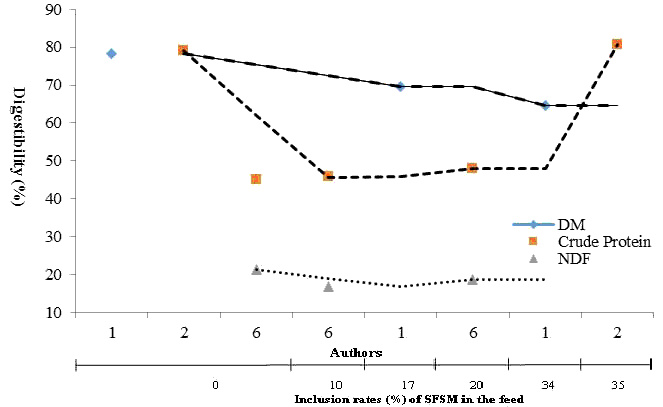
As shown in Figure 4 , higher fibre contents, complex protein structure and residual anti-nutrients cause some digestibility challenges leading to poor nutrient utilisation especially in younger birds. The insufficient enzyme activity in young chicks may be complemented through exogenous enzyme supplementation to promote digestion and utilisation of diets as activities of digestive enzymes from pancreas and intestine are associated with age (Mushtaq et al., Reference MUSHTAQ, SARWAR, AHMAD, NISA and JAMIL2006). Fibre may cause abrasion of the intestinal mucosa which increases the amino acid requirements for the synthesis of replacement mucosal cells. Single feeding with SFSM can adversely affect morphological parameters of small intestinal mucosa of cocks, especially in the ileum, that can lead to a reduction in the absorption of nutrients (Hamedi et al., Reference HAMEDI, REZAIAN and SHOMALI2011).
Digestibility (%) of DM, crude protein and NDF at varying levels of SFSM (Authors: 1: Rama et al., Reference RAMA, RAJU, PANDA and REDDY2006; 2: Kocher et al., Reference KOCHER, CHOCT, PORTER and BROZ2000; 6: Zatari and Sell, Reference ZATARI and SELL1990b).

use of exogenous enzyme in sunflower seed meal feed
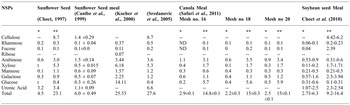
Due to the deleterious effects on oil presses, hulls cause excessive oil extraction and reduce the quality of both oil and meal (Campbell, Reference CAMPBELL1983). The fibre level of SFSM appears to be the most problematic aspect concerning use of the by-product at high levels in chick diets, causing low ME in diets (Brenes et al., Reference BRENES, CENTENO, VIVEROS and ARIJA2008; Senkoylu and Dale, Reference SENKOYLU and DALE2006). Fibre and fat have some opposite effects on digestion. The passage rate of digesta is increased by insoluble fibre and decreased by fat, which could affect carbohydrate and protein digestibility ( Table 2 ). Lignin and fibre components can adsorb bile acids and reduce the ileal resorption of bile salts, resulting in lower fat digestibility (San Juan and Villamide, Reference SAN JUAN and VILLAMIDE2001). Non-starch polysaccharides (NSPs) and oligosaccharides are innate to almost all ingredients of vegetable origin. Being monogastrics, poultry lacks specific enzyme systems to target NSPs (Aftab, Reference AFTAB2009).
NSPs composition of SFSM (g/100 g) compared to other vegetable protein meals.

*: Soluble, **Insoluble, ND: Not detected, t: traces
Most NSPs (xylans and cellulose) of SFSM are insoluble and are derived from hulls, where they are strongly associated with lignin, whereas most soluble NSPs (mainly pectic compounds) are from the parenchyma. Insoluble fibre and lignin increase the rate of passage of digesta in the small and large intestine. This could lead to shorter enzyme activity and consequently to a lower nutrients digestibility in the small intestine (San Juan and Villamide, Reference SAN JUAN and VILLAMIDE2000). SFSM contains 4.5% soluble and 23% insoluble NSPs (Kocher et al., Reference KOCHER, CHOCT, PORTER and BROZ2000), the latter consists of 42% cellulose, 24% pectic polysaccharides, 24% 4-O-methl-glucuronoxylans, 5% glucomannans, and 4.5% fucoxyloglucans (Senkoylu and Dale, Reference SENKOYLU and DALE2006). The main component of soluble NSPs is reported to be uronic acid (Viveros et al., Reference VIVEROS, ORTIZ, RODRÍGUEZ, REBOLÉ, ALZUETA, ARIJA, CENTENO and BRENES2009). Most soluble NSPs (mainly pectic compounds) are from the parenchyma. Soluble NSPs increase digesta viscosity and thereby decrease nutrient digestibility. The addition of commercial enzymes to diets of vegetable origin generally results ( Table 2 ) in significant improvement in performance and a reduction in intestinal viscosity by breakdown of soluble NSPs (Kocher et al., Reference KOCHER, CHOCT, PORTER and BROZ2000). Exogenous enzymes have positively affected the performance of diets containing high concentrations of SFSM (Mushtaq et al., Reference MUSHTAQ, SARWAR, AHMAD, NISA and JAMIL2006).
Earlier reports revealed poor digestibility of SFSM due to its higher lignification. The hemicellulosic compounds are not digested by young birds, whereas adult birds are able to digest substantial amounts of hemicelluloses (Selvaraj and Purushothaman, Reference SELVARAJ and PURUSHOTHAMAN2004). Lignification impairs accessibility to the enzymatic degradation as cellulose, hemicellulose, and pectic compounds are major constituents of NSPs of SFSM (Aftab, Reference AFTAB2009). Pectic compounds derived from parenchyma tissues of seed are highly degradable by enzymes whereas the less solubilised constituents (cellulose and hemicellulose), derived from the hulls, are not as degradable (Villamide and San Juan, Reference VILLAMIDE and SAN JUAN1998).
Sunflower seeds contain substantial amounts of cell-wall material and a high concentration of fat that could affect the nutritive value. The fat content in liver decreased progressively with increasing dietary SFSM while the protein content increased (Brenes et al., Reference BRENES, CENTENO, VIVEROS and ARIJA2008). With increasing dietary SFSM, triglyceride concentration decreased progressively while serum protein concentration decreased. Higher dietary fibre contents in SFSM reduce dietary fat utilisation by decongugation of bile salts which might reduce fat absorption through the gut. Body fat (liver fat) might be utilised for the metabolic needs and therefore increase the HDL concentration in serum (Rama et al., Reference RAMA, RAJU, PANDA and REDDY2006). Fat, protein and other nutrients could be entrapped to varying degrees inside the fibrous structure of the cell walls which can impair the digestion process. As noted above, the use of a crude enzyme preparation might be justified to improve the accessibility of cell contents to digestive enzymes (Brenes et al., Reference BRENES, CENTENO, VIVEROS and ARIJA2008).
rate of passage
According to Villamide and San Juan (Reference VILLAMIDE and SAN JUAN1998), most of DM (SFSM) was excreted during the first 24 h (70%), and about 10% more was obtained from 24 to 36 h. Energy followed the same excretion pattern.
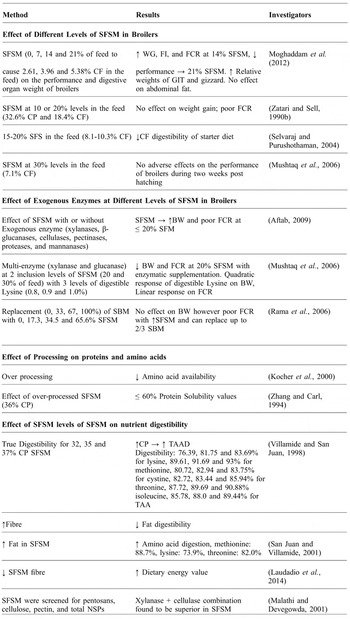
Table 3 shows the outcomes from various published trials using SFSM in poultry.
Results of investigations for sunflower seed meal.

SBM: Soybean Meal, SFS: Sunflower Seeds, FCR: Feed Conversion Ratio, BW: Body Weight, FE: Feed Efficiency, CP: Crude Protein, CF: Crude Protein, FI: Feed Intake, SFSM: Sunflower Meal, NSP: Non-starch Polysaccharides, M + C: Methionine + Cystine, MUFA: Mono-unsaturated fatty acids, PUFA: Poly-unsaturated fatty acids, TAAD: True amino acids digestibility, NSPs: Non-starch polysaccharides, ↑: increase, ↑: decrease, →: may lead to / result in
Inclusion rates for SFSM
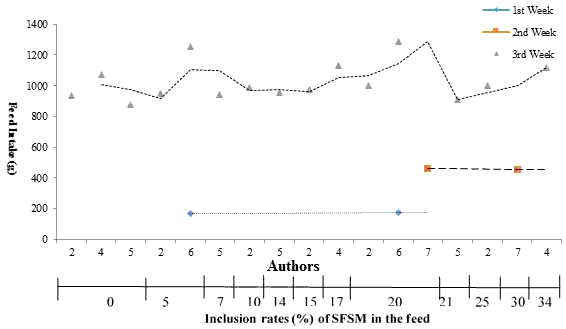
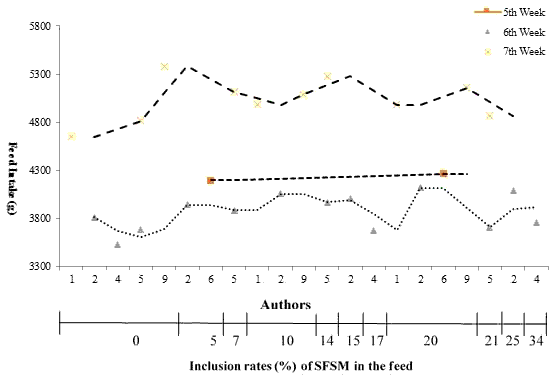
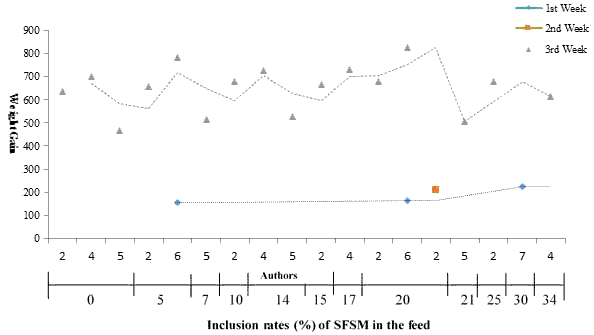
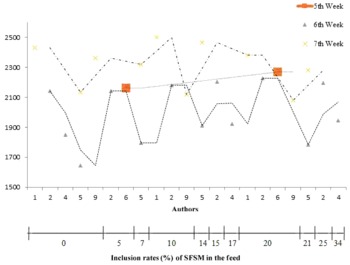
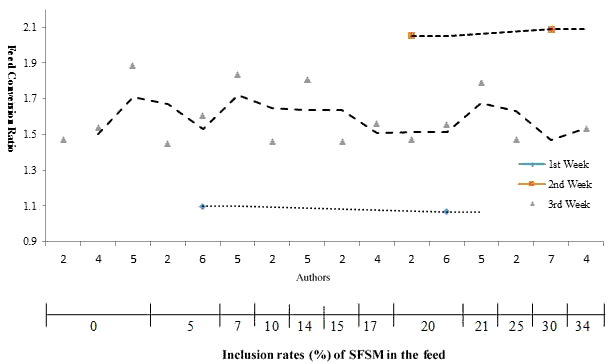
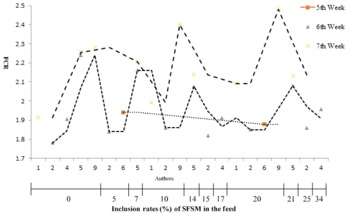
High fibre and lysine deficiency along with a low digestion coefficient for lysine limit SFSM inclusion in poultry feed (Senkoylu and Dale, Reference SENKOYLU and DALE2006; Brenes et al., Reference BRENES, CENTENO, VIVEROS and ARIJA2008) as compared to other oilseeds, especially soybeans (San Juan and Villamide, Reference SAN JUAN and VILLAMIDE2000). Figures 5a-f show graphical effects of varying amounts of sunflower seed meal on feed intake, weight gain and feed conversion ratio.
Comparison of effect of inclusion levels of SFSM on feed intake at 1-3 weeks by various researchers (Authors: 1: Zatari and Sell, Reference ZATARI and SELL1990b; 2: Musharaf, Reference MUSHARAF1991; 3: Kocher et al., Reference KOCHER, CHOCT, PORTER and BROZ2000; 4: Rama et al., Reference RAMA, RAJU, PANDA and REDDY2006; 5: Moghaddam et al., Reference MOGHADDAM, SALARI, ARSHAMI, GOLIAN and MALEKI2012; 6: Aftab, Reference AFTAB2009; 7: Mushtaq et al., Reference MUSHTAQ, SARWAR, AHMAD, NISA and JAMIL2006; 8: Zhang and Carl, Reference ZHANG and CARL1994; 9: Zatari and Sell, Reference ZATARI and SELL1990a).

Comparison of effect of SFSM on feed intake at 5-7 weeks by various researchers (Authors: 1: Zatari and Sell, Reference ZATARI and SELL1990b; 2: Musharaf, Reference MUSHARAF1991; 3: Kocher et al., Reference KOCHER, CHOCT, PORTER and BROZ2000; 4: Rama et al., Reference RAMA, RAJU, PANDA and REDDY2006; 5: Moghaddam et al., Reference MOGHADDAM, SALARI, ARSHAMI, GOLIAN and MALEKI2012; 6: Aftab, Reference AFTAB2009; 7: Mushtaq et al., Reference MUSHTAQ, SARWAR, AHMAD, NISA and JAMIL2006; 8: Zhang and Carl, Reference ZHANG and CARL1994; 9: Zatari and Sell, Reference ZATARI and SELL1990a).

Comparison of effect of SFSM on weight gain at 1-3 weeks by various researchers (Authors: 1: Zatari and Sell, Reference ZATARI and SELL1990b; 2: Musharaf, Reference MUSHARAF1991; 3: Kocher et al., Reference KOCHER, CHOCT, PORTER and BROZ2000; 4: Rama et al., Reference RAMA, RAJU, PANDA and REDDY2006; 5: Moghaddam et al., Reference MOGHADDAM, SALARI, ARSHAMI, GOLIAN and MALEKI2012; 6: Aftab, Reference AFTAB2009; 7: Mushtaq et al., Reference MUSHTAQ, SARWAR, AHMAD, NISA and JAMIL2006; 8: Zhang and Carl, Reference ZHANG and CARL1994; 9: Zatari and Sell, Reference ZATARI and SELL1990a).

Comparison of effect of SFSM on weight gain at 5-7 weeks by various researchers (Authors: 1: Zatari and Sell, Reference ZATARI and SELL1990b; 2: Musharaf, Reference MUSHARAF1991; 3: Kocher et al., Reference KOCHER, CHOCT, PORTER and BROZ2000; 4: Rama et al., Reference RAMA, RAJU, PANDA and REDDY2006; 5: Moghaddam et al., Reference MOGHADDAM, SALARI, ARSHAMI, GOLIAN and MALEKI2012; 6: Aftab, Reference AFTAB2009; 7: Mushtaq et al., Reference MUSHTAQ, SARWAR, AHMAD, NISA and JAMIL2006; 8: Zhang and Carl, Reference ZHANG and CARL1994; 9: Zatari and Sell, Reference ZATARI and SELL1990a).

Comparison of effect of SFSM on feed conversion ratio at 1-3 weeks by various researchers (Authors: 1: Zatari and Sell, Reference ZATARI and SELL1990b; 2: Musharaf, Reference MUSHARAF1991; 3: Kocher et al., Reference KOCHER, CHOCT, PORTER and BROZ2000; 4: Rama et al., Reference RAMA, RAJU, PANDA and REDDY2006; 5: Moghaddam et al., Reference MOGHADDAM, SALARI, ARSHAMI, GOLIAN and MALEKI2012; 6: Aftab, Reference AFTAB2009; 7: Mushtaq et al., Reference MUSHTAQ, SARWAR, AHMAD, NISA and JAMIL2006; 8: Zhang and Carl, Reference ZHANG and CARL1994; 9: Zatari and Sell, Reference ZATARI and SELL1990a).

Comparison of effect of SFSM on feed conversion ratio at 5-7 weeks by various researchers (Authors: 1: Zatari and Sell, Reference ZATARI and SELL1990b; 2: Musharaf, Reference MUSHARAF1991; 3: Kocher et al., Reference KOCHER, CHOCT, PORTER and BROZ2000; 4: Rama et al., Reference RAMA, RAJU, PANDA and REDDY2006; 5: Moghaddam et al., Reference MOGHADDAM, SALARI, ARSHAMI, GOLIAN and MALEKI2012; 6: Aftab, Reference AFTAB2009; 7: Mushtaq et al., Reference MUSHTAQ, SARWAR, AHMAD, NISA and JAMIL2006; 8: Zhang and Carl, Reference ZHANG and CARL1994; 9: Zatari and Sell, Reference ZATARI and SELL1990a).

Despite these limitations, up to 25% sunflower can be used in broilers diets (San Juan and Villamide, Reference SAN JUAN and VILLAMIDE2001) or even up to 35% with supplementation of limiting amino acids without any deleterious effects on production (Rama et al., Reference RAMA, RAJU, PANDA and REDDY2006). Rama et al. (Reference RAMA, RAJU, PANDA and REDDY2006) showed that SFSM can replace up to two thirds of the SBM protein in the starter and finisher phase diets. Moreover, both canola meal and SFSM can replace SBM at 100% if lysine is added, in spite of high indigestible carbohydrate contents (Kocher et al., Reference KOCHER, CHOCT, PORTER and BROZ2000). The variation in maximum possible inclusion of SFSM in broiler diets may be due to the variations in energy and amino acids. The relative intestinal and gizzard weight increased when SBM was totally replaced with SFSM as indicative of higher levels of fibre in the SFSM (Rama et al., Reference RAMA, RAJU, PANDA and REDDY2006). However, inclusion at greater rates (20 to 30%) reduced the growth rate of the chicks (Brenes et al., Reference BRENES, CENTENO, VIVEROS and ARIJA2008).
Conclusions
Sunflower seed meal is obtained by the extraction of oil from sunflower seeds and is found in several parts of the world and can be used as a high protein feed ingredient for broilers. However, chemical, mechanical and thermal treatments can greatly affect the nutritional value of the sunflower by-product during oil extraction. Resultant anti-nutrients, complex protein structure, lack of sufficient amino acids and higher fibre contents can lead to digestibility challenges causing less than optimal nutrient utilisation especially in younger birds. Use of NSP enzymes to improve digestibility and careful monitoring of its inclusion rate enhance the use of SFSM.