Introduction
As listeners in conversation, we make use of various aspects of the grammar that clue us into the epistemic stance of other conversational participants. For instance, in German, the particles ja and doch show that the speaker is “committed to the belief that p is in some sense given, obvious or uncontroversial” (Kaufmann & Kaufmann, Reference Kaufman, Kaufman and Chereches2012, p. 210). Lexical items can also convey such information about speaker commitment to propositional content, or p. In English, epistemic adverbs like possibly, maybe, or probably give a listener information about a speaker's commitment to p. Moreover, modal verbs such as might or may also mark a speaker's degree of commitment. Byrnes and Duff (Reference Byrnes and Duff1989) characterize modality as a continuum of belief and attitudes, ranging from strong disbelief to strong belief, as in (1):

Following this, the utterance Nadia might be married expresses a weaker degree of commitment when compared to the utterance Nadia has to be married, which expresses a high degree of commitment.
In addition to strategies such as particles, adverbs, and modal verbs, prosody is another linguistic resource that speakers of intonation languages like English or Spanish rely upon for conveying a speaker's degree of commitment to p. Fujisaki (Reference Fujisaki, Sagisaka, Campbell and Higuchi1997) defines prosody in the following way:
“the systematic organization of various linguistic units into an utterance or a coherent group of utterances in the process of speech production. Its realization involves both segmental and suprasegmental features of speech, and serves to convey not only linguistic information, but also paralinguistic and non-linguistic information” (p. 28).
In this paper I will be concerned with the linguistic information conveyed through prosody. While prosody can convey general differences in utterance type (e.g., declarative He ate an apple. vs. question He ate an apple?), it can also convey information about speaker certainty. Majorcan Catalan, for example, has a contrast between two falling intonation contours for polar (or yes/no) questions. For both contours, pitch falls from a high tone (H) to a low tone (L) through the final stressed syllable of the question and ends in a low boundary tone (L%) (Vanrell, Mascaró, Torres-Tamarit, & Prieto, Reference Vanrell, Mascaró, Torres-Tamarit and Prieto2013). However, this specific variety of Catalan presents a contrast such that an extra high tone leads the fall through the final stressed syllable (e.g., -ri in the question Teniu mandarines? ‘Do you have oranges?’), when the speaker does not have any particular expectation about the answer (low certainty), while the high tone is not produced as extra high when the speaker is more certain about what the answer is. Thus, if a speaker walked into a store and had no idea whether oranges were sold there, they would use the first type of fall, and if they were fairly sure that oranges were sold in the store, the latter fall would be used. The low certainty tune is labeled ¡H + L L% in the ToBI (Tones and Breaks Indices) system developed for Catalan, Cat_ToBI (Prieto, Reference Prieto and Jun2014), and the high certainty tune is labeled H + L* L%. ToBI labeling systems assume the Autosegmental Metrical model for intonation (Pierrehumbert, Reference Pierrehumbert1980). Importantly, ToBI systems are language specific. A brief overview of ToBI notation is provided in Table 1. For the case of the low certainty tune in ¡H + L* L% in Majorcan Catalan, the ¡ diacritic denotes that the H tone is produced as ‘extra’ high in the speaker's range.
Overview of tonal targets in ToBI transcription systems

Prosodic coding of speaker commitment has been shown cross-linguistically for many utterance types: declaratives (Ward & Hirschberg, Reference Ward and Hirschberg1985, for American English; Gravano, Benuš, Hirschberg, German, & Ward, Reference Gravano, Benuš, Hirschberg, German, Ward, Barbosa, Madureira and Reis2008, for American English; Portes & Lancia, Reference Portes and Lancia2017, for French); polar questions (Hirschberg & Ward, Reference Hirschberg and Ward1995, for American English; Hara, Kawahara, & Feng, Reference Hara, Kawahara and Feng2014, for Mandarin and Japanese; Armstrong & Prieto, Reference Armstrong and Prieto2015; Armstrong, Reference Armstrong2017, for Puerto Rican Spanish; Michelas, Portes, & Champagne-Lavau, Reference Michelas, Portes and Champagne-Lavau2015, for French; Vanrell, Ballone, Schirru, & Prieto, Reference Vanrell, Ballone, Schirru and Prieto2015, for Sardinian; Prieto & Borràs-Comes, Reference Prieto and Borràs-Comes2018, for Central Catalan); imperatives (Armstrong & Lesho, Reference Armstrong and Lesho2017, for American English); and even vocatives (García, unpublished observations, for Asturian). Some of the earliest work applying the Autosegmental Metrical framework (Ward & Hirschberg, Reference Ward and Hirschberg1985, Reference Ward, Hirschberg and Powers1988; Hirschberg & Ward, Reference Hirschberg and Ward1985, Reference Hirschberg and Ward1992, Reference Hirschberg and Ward1995) references the importance of speaker belief state in prosodic meaning as well as the navigation of the mutual belief space (Pierrehumbert & Hirschberg, Reference Pierrehumbert, Hirschberg, Cohen, Morgan and Pollack1990).
Epistemic prosody can be relied on in addition to other strategies for conveying speaker certainty. For instance, in a study looking at how speakers use lexical choice (textual information), prosody, and gesture to convey low, medium, and high degrees of certainty, it was found that textual marking of medium certainty was disambiguated through prosody or gesture (Roseano, González, Borràs-Comes, & Prieto, Reference Roseano, González, Borràs-Comes and Prieto2016). Prosodic strategies may also disambiguate attitudinal information (e.g., positive vs. neutral vs. negative). Benuš, Gravano, and Hirschberg (Reference Benuš, Gravano and Hirschberg2007) found that pitch accent on the first syllable, extended duration, rising pitch accent, and longer duration of coronal closure at a syllable boundary were consistent with the degree of pragmatic negativity for the word whatever in American English. Armstrong and Schwenter (Reference Armstrong and Schwenter2016) showed that stress shift for mid-scalar epistemic adverbs and modal expressions (e.g., maybe, probably, might be, could be) allows for common ground management: through stress shift (e.g., PRObably → probabLY) the speaker is able to give the interlocutor ‘credit’ for being the one to assert p, thereby placing it in the common ground. Armstrong and Schwenter's study shows an example of lexical items/expressions that already convey modal meaning, but this meaning is modulated by prosody, in this case modal meanings that are further refined in terms of the shared belief space (i.e., common ground). This phenomenon presents an interesting problem for acquisition since children must learn the relationships between different prosodies and the meanings associated with them (e.g., belief, disbelief, uncertainty, obviousness, etc.). But they must also learn to use prosody in tandem with lexical meaning to arrive at these more specific meanings that I have mentioned above.
This paper is concerned with children's developmental trajectories in learning to use prosody as a resource for modulating lexically encoded modal meaning. In this particular case, I focus on prosodic modulation of the modal verb might. I turn now to the literature, both that related to L1 acquisition of epistemic prosody, as well as that of the acquisition of modal expressions.
Acquisition of modal expressions
Modal expressions are statements containing a modal auxiliary like must, may, might, etc. that modify or qualify propositional content in a statement (Lyons, Reference Lyons1977; Byrnes & Duff, Reference Byrnes and Duff1989). Through modals, speakers can pragmatically implicate their degree of belief regarding the truth of a given proposition. In the expression Joana might live in Girona, the modal verb might qualifies the proposition Joana lives in Girona; the speaker does not express full certainty about the proposition that Joana lives in Girona. As Byrnes and Duff point out, speakers select modal verbs in the “context of considering their state of knowledge” (Reference Byrnes and Duff1989, p. 369). These authors tested whether preschool-aged children were able to use modal expressions for understanding a speaker's subjective assessment through modal verbs. They found that three- and four-year-olds had some knowledge of modal expressions, and had an understanding of a belief state continuum (from belief to disbelief). For this age-group, the expressions have to and might place a speaker on the belief side of this continuum, while can't and might not place a speaker on the disbelief side of this continuum. However, what was found to be more difficult for children was the ability to make distinctions on the same side of this continuum (e.g., can't vs. might or have to vs. might). Four- and five-year-olds outperformed three-year-olds when making a distinction between has to and might on the belief side of the continuum, and between can't and might not on the disbelief side. The authors propose that children first make a dichotomy between belief and disbelief and later refine this dichotomy. This study shows that around the ages of four and five children are beginning to further refine their belief continua.
Ozturk and Papafragou (Reference Ozturk and Papafragou2015) examined children's knowledge about the pragmatics of modals in an experiment examining four- and five-year-olds’ sensitivity to indirectness for a may statement compared to an unmodalized statement in situations where there were positive or negative consequences for the child, since children are known to reveal their cognitive competence in tasks that engage their interests and goals (Bever, Mehler, & Epstein, Reference Bever, Melher and Epstein1968; Gelman & Greeno, Reference Gelman, Greeno and Resnick1989). An important methodological aspect of this experiment was that, in addition to testing modal verb comprehension, a valence condition was also included. The authors did this because it is often the case in studies of modal verb comprehension that the correct response is the stronger modal. The authors warned that experiments designed in this way could simply reflect a child's bias to choose the stronger modal, and therefore they would not reflect the deep processing of experimental stimuli. As such, they point out that a valence condition is important to include so that the correct answer would be the weaker modal for some of the trials.
In Ozturk and Papafragou's (Reference Ozturk and Papafragou2015) task, children played a game that involved a set of twins who looked alike and dressed alike, but who told the child two different things. Each twin had a box with an object, and the child had to choose a box for themselves based on what the twins said. For the positive trials, the experimenter would ask the child to name something they liked (e.g., ice cream). Once the child named what they liked, the experimenter showed the child a picture on a laptop screen of the identical twins (both female) next to each other. Each twin had a box in front of them, the appearances of the boxes identical. The experimenter would point to the twin on the left of the screen and say “This girl says: In my box, there is ice cream” and then pointed to the twin on the right saying “This girl says: In my box, there may be ice cream”. Children were then asked to choose a box (correct answer = is statement). The same protocol was used for the negative condition, except in this case the child chose something they did not like (e.g., cauliflower) (correct answer = may statement). Children performed above chance on the task (though adults performed significantly better), indicating their comprehension of the weak commitment associated with may. There was also an effect of valence, with negative items being more difficult for children than positive items. Importantly, the authors successfully tested children's comprehension of the pragmatic use of an epistemic modal showing that important strides in development occur around ages four and five, though children do not look completely adult-like. This age window is also reflected in production.
In production, Papafragou (Reference Papafragou1998) found that generally, expressions of epistemic modality emerge sometime after age 3;6, with epistemic uses becoming more frequent after age four, in addition to a wider array of epistemic items used. Later, using longitudinal data for English speakers from the CHILDES database, O'Neill and Atance (Reference O'Neill and Atance2000) looked at the use of modal terms in the speech of children aged 2;0–4;11. Target modal terms were quite rare before 2;6 and referred to present physical events and states (maybe down the street; probably in there) as well as future intentions (Maybe put that one on? Maybe you finish that one?). The authors found one instance of a future epistemic: When we got to his home we maybe see it. Strikingly, the authors note that after 2;6 the use of modal terms increases seven-fold. References to future intention tended to pertain to the self (e.g., Maybe I'll go away) versus others (e.g., Maybe can get this on). It was at this stage that children demonstrated the ability to use modals to refer to future physical events, in which the state is unintentional and is in the future (e.g., it might pop again; maybe these fit here?). Between the ages of 3;0 and 3;5, children start to use what the authors refer to as ‘present epistemic’ modals, which express uncertainty about emotions, perceptions, and beliefs (e.g., he is maybe afraid of) (though these were infrequent). Concerning the modal verb might, the results show that it starts to be used with more regularity between the ages of 3;6 and 4;0. Most instances of might observed between ages 2;0 and 4;11 occurred after the age of 3;6, and tended to reflect children's curiosity about things that might happen (e.g., I might catch the hiccups; He might crash out of the road). The authors also found that might was used in pretend and fantasy contexts (e.g., We might turn into werewolves). At a later stage, between the ages of 4;0 and 4;5, children continued to use might, with a trend such that children mainly used it for future physical events. Might comprised almost half of all modal terms for children between the ages of 4;6 and 4;11, and the majority of these were classified as future physical. This work highlights the fact that there is variability in age and motivation for the use of modal terms. As mentioned above, however, prosody can also take on modal flavors, and this area of acquisition is less explored.
Acquisition of epistemic prosody
Studies involving children's use and comprehension of mental state language have traditionally focused on lexical items such as verbs and adverbs (Shatz, Wellman, & Silber, Reference Shatz, Wellman and Silber1983; Bruner & Lucariella, Reference Bruner, Lucariello and Nelson1989; Moore, Bryant, & Furrow, Reference Moore, Bryant and Furrow1989; Moore, Pure, & Furrow, Reference Moore, Pure and Furrow1990; O'Neill & Atance, Reference O'Neill and Atance2000; Tardif & Wellman, Reference Tardif and Wellman2000; Harris, de Rosnay, & Pons, Reference Harris, de Rosnay and Pons2005; Ozturk & Papafragou, Reference Ozturk and Papafragou2015), but there has been a recent surge in work on children's use of epistemic prosody. Past work has shown that in the preschool (ages three to four) and early school years (ages five to six), important developments are being made in children's ability to comprehend information about epistemic states conveyed through prosody as well as other aspects of the grammar.
Moore, Harris, and Patriquin (Reference Moore, Harris and Patriquin1993) compared children's comprehension of the mental state lexicon to belief state prosody comprehension, and is perhaps one of the earliest studies on children's comprehension of belief state prosody. In a comprehension experiment with children between the ages of three and six, the authors tested children's ability to detect distinctions in speaker commitment for prosody (rising for weak commitment vs. falling for strong commitment) and lexical items (think vs. know; think vs. guess). Children listened to a puppet telling them where a given object was (e.g., It's in the blue box [ + rise] or [ + fall], or I think it's in the blue box vs. I know it's in the blue box for the lexical condition). Three-year-olds performed at chance levels for both prosody and lexical conditions, while both four- and five-year-olds performed at above chance levels for the prosody condition. Older children had trouble discerning two mid-scalar items (think vs. guess) versus comparing a mid-scalar item to an end-scalar item (think vs. know), echoing Byrne and Duff's (Reference Byrnes and Duff1989) findings for modal verbs. Results from a second task where lexical items were either matched with corresponding prosody (e.g., think with rising intonation) or mismatched (e.g., think with falling intonation) showed that having a prosodic cue that reinforces lexical meaning was helpful to five-year-olds, and that mismatched intonation interfered with their comprehension. This shows that while five-year-olds appear to search for lexical cues to speaker's degree of commitment, they are learning to use prosody to guide them to the intended interpretation, and when prosody is not appropriate this can deter them from arriving at the intended meaning.
Armstrong, Andreu, Esteve-Gibert, and Prieto (Reference Armstrong, Andreu, Esteve-Gibert and Prieto2016) used eye-tracking methodology to compare Central Catalan-speaking children's (ages four to six) ability to use lexical vs. prosodic cues to confirm or override contextual information. Both explicit (pointing) and implicit measures showed that the ability to use prosody to override a hypothesis based on situational context was not apparent until age six. The prosodic cues in this study were based on contours that pragmatically conveyed strong commitment (H + L* L%Footnote 1) vs. complete lack of commitment (L* H%) to p. On the other hand, five-year-olds were able to use the lack of commitment tune to confirm their hypothesis. Four-year-olds were not able to use prosody to either confirm or override their hypothesis, though they were able to confirm it through lexical items.
Hübscher, Esteve-Gibert, Igualada, and Prieto (Reference Hübscher, Esteve-Gibert, Igualada and Prieto2017) show evidence that children as young as three are able to make use of intonational cues for weak vs. strong commitment. In their task, children were presented with a scenario where a character was playing a guessing game on a train ride with two friends. She would ask the friends (a set of twins) whether they knew her favorite things. For example, What is my favorite vegetable? For each trial the child was told that one twin was certain of the answer to the question, and the other was not. They had to point to the twin who was uncertain. The study included intonational (rising vs. falling), lexical (potser ‘maybe’ vs. segur que ‘surely’) and gestural (head nod vs. squinted eyes / raised eyebrows / head tilt) conditions. Relevant to the present study, even three-year-olds performed at above chance levels in detecting uncertainty (or weaker commitment). In fact, they were significantly better at doing this based on intonational cues when compared to lexical information.
Work investigating children's detection of disbelief through prosody also confirm the importance of the developmental window demonstrated to be important above. Armstrong (Reference Armstrong, Orman and Valleau2014) showed that Puerto Rican Spanish-speaking children between the ages of four and six perform significantly above chance in detecting disbelief polar questions (L* HL%Footnote 2) when contrasted with neutral echo questions (¡H* L%). In a study using the same experimental paradigm with additional conditions (audio-only, visual-only, and audiovisual), Armstrong, Esteve-Gibert, Hübscher, Igualada, and Prieto (Reference Armstrong, Esteve-Gibert, Hübscher, Igualada and Prieto2018) examined the ability of Central Catalan-speaking children (ages three to six) to detect disbelief through intonation and gesture. An age effect was found, showing that during this time-window, children continue to improve in their ability to comprehend disbelief through both intonation and facial gesture. They also found that children performed significantly better for the audiovisual condition (i.e., when both intonation and facial gesture information were present). This shows that children can benefit from having multimodal cues present which reinforce each other. The study also showed an effect for the ability to pass a false belief task (Wimmer & Perner, Reference Wimmer and Perner1983); children with more sophisticated belief reasoning were more adept in inferring disbelief from intonation, facial gesture, and the combination of the two.
The work on children's production of epistemic prosody is quite limited. In a longitudinal corpus study of two Puerto Rican Spanish-acquiring toddlers between the ages of 1;7 and 3;6, Armstrong (Reference Armstrong2018) found that polar question contours that convey epistemic informationFootnote 3 are not present in the corpora until some time during the third year (one of the toddlers produced her first belief contour at 2;8, while the other produced her first belief contour at 3;0). Each of the toddlers only produced two instances of belief state polar question contours in their respective corpus. Thus, while children may mark the distinction between statements and questions quite early on (Prieto, Estrella, Thorson, & Vanrell, Reference Prieto, Estrella, Thorson and Vanrell2012), the ability to make epistemic distinctions within a given sentence type comes much later. In fact, the response-eliciting vs. non-response-eliciting distinction may appear before a child's first birthday (Halliday, Reference Halliday and Walker2004 [1975]). The finding from Armstrong (Reference Armstrong2018) coincides with the production of other types of mental state language (e.g., Shatz et al., Reference Shatz, Wellman and Silber1983).
Older children do indeed appear to rely on prosody for conveying uncertainty. Krahmer and Swerts (Reference Krahmer and Swerts2005) showed that, in answers to questions, older children (ages seven to eight) tended to use more prosodic cues to uncertainty than adults did. While adults tended to rely on fillers, delays, and higher intonation, children mainly relied on prosodic cues (delays and higher intonation). However, children's cues were shown to be less reliable when both adult and child listeners heard them in a perception task. Visser, Krahmer, and Swerts (Reference Visser, Krahmer and Swerts2014) later examined the auditory and visual cues to uncertainty of older children (eight to eleven) using a quiz game that involved either a collaborative or a competitive setting. Older children in the competitive setting were found to be more expressive in conveying uncertainty through prosody when compared to younger children, and also compared to children in the collaborative setting. This shows that children continue to develop in terms of how they use prosody to convey epistemic information, and this may depend on the specific pragmatic use of epistemic meaning. In light of this, it is important to note the uniqueness of prosodic development with respect to other parts of the grammar. While it is widely accepted that production lags behind perception for lexical, phonological, and syntactic acquisition, an apparent anomaly between production and perception has been noted for the case of prosody, with target-like production often preceding perception (Cutler & Swinney, Reference Cutler and Swinney1987). This asymmetry has also been noted for the case of evidential morphology (Ünal & Papafragou, Reference Ünal and Papafragou2016). While there is a need for more work on this asymmetry in prosodic acquisition, paying close attention to the types of prosodic meaning involved, it is important to bear in mind that the typical assumptions we make in language acquisition may not necessarily apply for prosodic acquisition.
This literature review confirms, both for the acquisition of epistemic modal meanings and for the acquisition of prosody as it relates to epistemic certainty, that the age window of three to six and possibly older is a fruitful locus to assess development. This window has also been shown to be important in children's comprehension of prosody as related to emotional meaning (Morton & Trehub, Reference Morton and Trehub2001; Nelson & Russell, Reference Nelson and Russell2011; Quam & Swingley, Reference Quam and Swingley2012; Armstrong & Hübscher, Reference Armstrong, Hübscher, Prieto and Esteve-Gibert2018), suggesting that children more generally become able to infer the internal states of others through prosody during this window.
Aims and hypothesis
The present paper aims to examine the extent to which preschool and early school-aged children are able to use prosodic information to further specify the meaning of the modal verb might in context. That is, I explore the extent to which children can use prosody to interpret more nuanced aspects of speaker commitment when speaker commitment is already specified by the epistemic modal might. Therefore, while might conveys a lower degree of commitment than will, we can imagine that an utterance like John might come could be produced with different prosodies that convey slightly different meanings. I assume a scale of committedness, as in (2a), with asterisks indicating points on the scale. (2a) shows two end-scalar points on the commitedness scale.

Next, we can assume that might would fall somewhere between the two endpoints, given its mid-scalar meaning, as in (2b).

I make the assumption here that prosody can modulate where might is situated on this scale. For instance, a given prosodic modification could increase speaker commitment, but this increase would still be restricted to the mid-scalar region that is already specified by the lexical item, as in (2c). In this case, might is still mid-scalar, but can be shifted in degree of commitment, i.e., commitment is higher.

Following the same reasoning, prosody could decrease speaker commitment, but again within the mid-scalar region, as in (2d):

The experiment detailed below had the goal of understanding how children come to be able to calculate these shifts on the committedness scale, or ‘modulated’ meanings. One possibility is that children would first need an idea of how to delimit might's space on the continuum described above in order to know how to modulate its meaning. Were this true, we should expect children to show competence in inferring a lower degree of commitment for might as compared to future will (e.g., I might give you markers vs. I will give you markers) before they infer strengthening or weakening of might's meaning through prosody (e.g., the same utterance, I might give you markers, produced with high commitment vs. low commitment prosodies). This experiment explores to what extent children can pass a linguistic comprehension task designed to assess their detection of differences in speaker commitment. Age is also explored as a predictor in success on the task. Ozturk and Papafragou's (Reference Ozturk and Papafragou2015) caveat about experimental design was also considered in this experiment in order to avoid a possible bias for choosing the stronger modal. In order to avoid this bias, a valence condition was included so that both the stronger and weaker forms were the intended correct answers. The task described below was carried out with two conditions: a modal condition where children had to discriminate might vs. will, and a prosody condition where children had to discriminate two might utterances based on strong vs. weak commitment prosodies. The study's design therefore allowed for children's performance on a linguistic comprehension task examining condition (modal vs. prosody), age, and valence (positive vs. negative) as possible predictors to be explored. In the following sections, the experimental methods and data analyses are presented. An analysis of children's comments about their responses is also included. Finally, findings and implications are discussed.
Method
Participants
A total of 59 monolingual American English-speaking children took part in the experiment: Twelve three-year-olds (7 female, 5 male, mean age: 3;6), 13 four-year-olds (8 female, 5 male, mean age: 4;5), 11 five-year-olds (7 female, 4 male, mean age: 5;6), 11 six-year-olds (6 females, 5 males, mean age: 6;5), and 12 seven-year-olds (6 female, 6 male, mean age: 7;4) participated. The child participants were recruited from elementary and preschools in Northampton, Massachusetts and Amherst, Massachusetts. Twenty adult listeners participated as a control group.
Stimuli and procedure
Modal condition
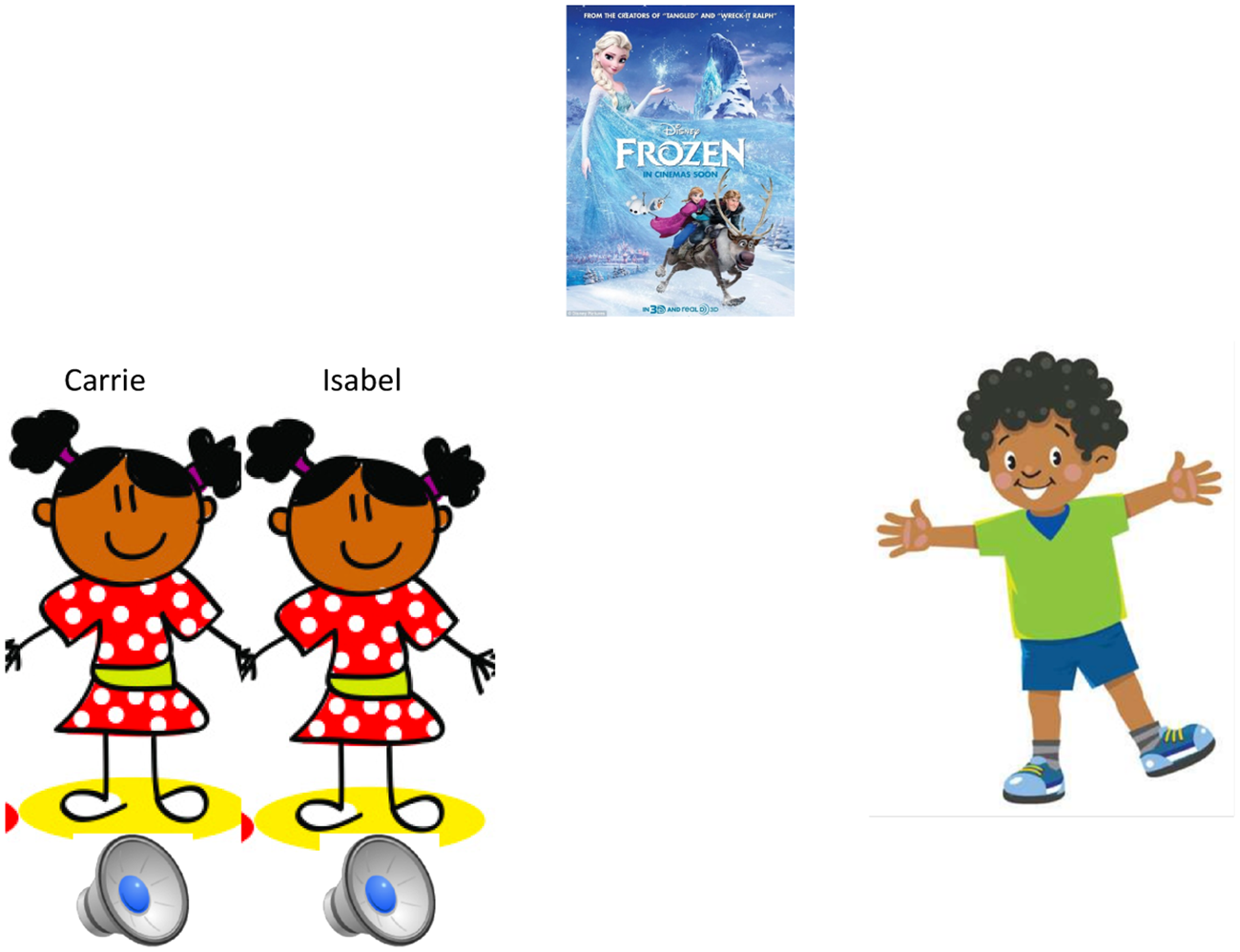
On Day 1 of the experiment, participants were presented with a PowerPoint presentation on a laptop computer. The items for both the modal strength condition and the prosody condition can be found in the ‘Appendix’. At the beginning of the session, the experimenter told participants they were going to play a game. Participants were first presented with a slide, as in Figure 1.
Familiarization slide showing item desired by friend (above), triplets (left) and friend (right).

Participants were told that Carrie, Isabel, and Sofie were triplets. The boy on the right, a friend, was going to have a birthday party and could only invite one of the sisters. Participants were told that the friend really wanted to invite someone who would give him the Frozen DVD. Next, the experimenter played what each sister ‘said’, a prerecorded utterance produced by one female speaker of American English. Carrie said I will not give you the Frozen DVD, Isabel said I might give you the Frozen DVD, and Sofie said I will totally give you the Frozen DVD. All three utterances were recorded by the same female speaker to control for differences in voice (this was also the motivation in using triplets in the experiment). The experimenter then asked the participant, Who will the friend invite? The expected response was that the participant would pick Sofie, since she expressed the strongest commitment to giving the Frozen DVD. The participant was then told that, alas, Sofie could not go to the party because she got in trouble with her parents. Figure 2 shows the subsequent slide, which is representative of the test trials.
Test trial slide showing item desired by friend (above), remaining sisters (left), and friend (right).

On that slide, participants saw only Carrie and Isabel, who now had new things to say. Again, the experimenter played an audio file with an utterance for each sister. In this case Carrie said I will give you the Frozen DVD and Isabel said I might give you the Frozen DVD. Both of the utterances were produced with identical prosody. Intonationally they were characterized by unmarked declarative intonation, H* L-L% (Pierrehumbert & Hirschberg, Reference Pierrehumbert, Hirschberg, Cohen, Morgan and Pollack1990). Again, the child was asked Who will the friend invite? Participants were given credit for a correct answer if they picked the sister who used the stronger modal will. This was considered the positive valence condition, since it was in response to what the friend wanted. A series of five additional test trials with unique friend/gift combinations were subsequently presented, for a total of six test trials for this condition. For half of the trials, Carrie used the stronger modal will, and Isabel used the weaker modal might, while the opposite was true for the other half of the trials, and the order of these was randomized. A negative valence condition was created in a separate block. The participant was introduced to the block in the same way as the positive valence condition. However, in this case the friend who was doing the inviting did not like a specific item. For instance, in Figure 3, participants were told that the boy in the picture hated broccoli and did not want anyone to give it to him for his birthday.
Familiarization slide showing item not desired by friend (above), remaining triplets (left), and friend (right).

This time, Carrie said I will give you broccoli, Isabel said I might give you broccoli, and Sophie said I will not give you broccoli. Participants were then asked Who will the friend invite? Participants were expected to answer that the boy should invite Sophie. Once this question was answered correctly, participants were told that Sophie had once again gotten in trouble, and was not allowed to go to the party. As before, the next slide contained a test item where only Carrie and Isabel were present. This time Carrie said I will give you broccoli and Isabel said I might give you broccoli. In this case participants were given credit for a correct answer if they chose the sister who used the weaker modal might, in this case Isabel.
The ‘Appendix’ contains the complete list of items for each block. The ‘wanted’ items were items that might be stereotypically desirable to children (e.g., Frozen DVD, ice cream maker) while the ‘unwanted’ items were stereotypically undesirable (e.g., broccoli, a broom). As above, a series of five additional test trials with unique friend/gift combinations were subsequently presented, for a total of six test trials for this condition. Which sister produced each of the modal verbs was controlled for, as above. Participants thus received a total of 12 test trials, in two blocks (positive valence block and negative valence block). Half of the participants received the positive valence block first, and the other half received the negative valence block first.
Prosody condition
For the condition designed to test children's ability to use prosody to modulate the meaning of might, the exact same protocol was followed, but the stimuli differed for the test trials only.Footnote 4 The familiarization was identical to the one for the modal condition. This time, for the test trials, both sisters produced an utterance with might, for example I might give you the Frozen DVD. The test items had no lexical differences, but rather they differed in terms of their prosodic realizations: (a) an excited exclamation vs. (b) an utterance with focused might and a boundary tone indicating ellipsis; (a) was intended to intensify or strengthen the meaning of might, indicating higher speaker commitment, while (b) was intended to weaken the meaning of might, indicating a lower degree of commitment. Two distinct intonational contours were used for the higher vs. lower certainty meanings. Figures 4 and 5 show the intonational differences between the two meanings. Mainstream American English ToBI transcriptions (Beckman, Hirschberg, & Shattuck-Hufnagel, Reference Beckman, Hirschberg, Shattuck-Hufnagel and Jun2004) are included.
Waveform, F0 contour, spectrogram, orthographic transcription, and MAE_ToBI labels for strong commitment realization of I might give you a broom.

Waveform, F0 contour, spectrogram, orthographic transcription, and MAE_ToBI labels for weak commitment realization of I might give you a broom.

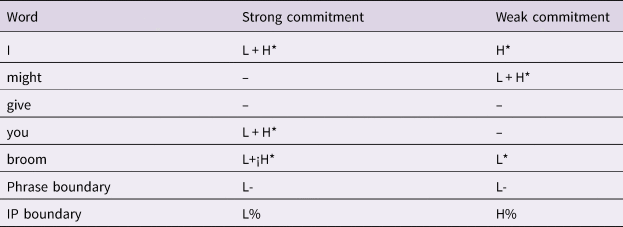
The two utterances differ in terms of the tonal targets used and the words bearing pitch accents, as shown in Table 2.
Tonal targets for strong vs. weak commitment utterances

In terms of the pitch accents used in each utterance, there is a robust difference, since none of the pitch accents on any word coincide between the two utterances. The two prosodic forms differed in terms of the phrase accent/intonational phrase (IP) combinations presented as well. The strong speaker commitment form was produced with a L- phrase accent and a L% IP final boundary tone, while the weak speaker commitment form was produced with a L- phrase accent and a H% IP final boundary tone. Therefore, the two melodies presented various differences. Both are markedly different from neutral declarative intonation in American English, where broad focus declaratives are known to be produced with subsequent H* tones, each produced in a lower pitch register than the prior H* (Pierrehumbert & Hirschberg, Reference Pierrehumbert, Hirschberg, Cohen, Morgan and Pollack1990).
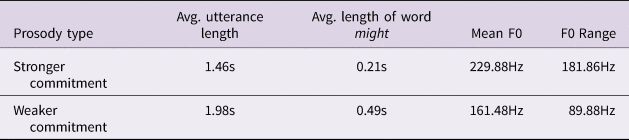
In addition to these intonational differences, there were various other prosodic differences between the strong vs. weak commitment melodies. Table 3 shows the average length of utterance, average length of the word might, mean F0, and F0 range (F0max–F0min) of the entire utterance. Since all the stimuli were produced by one speaker, pitch values were not normalized, and appear in Hz.
Prosodic differences between strengthening and weakening prosodies

The stronger commitment prosody had shorter average utterance length, shorter average length for the word might, higher mean F0, and a wider pitch range when compared to the weaker commitment prosody. Additionally, the stronger commitment realization included a faster speech rate compared to the weaker commitment realization. Temporal features such as total duration and speaking duration are known to be related to degree of speaker certainty (Pon-Barry, Reference Pon-Barry2008), with longer durations indicating lower levels of certainty. Thus, the difference in values found for the stimuli in this experiment was to be expected.
For the prosody condition only, once the child completed the comprehension task, the experimenter asked each child the question How did you know the answer? This was only done for the prosody task, since the utterances were lexically identical, in an effort to assess the child's metalinguistic awareness about prosodic meaning.
Analysis and results
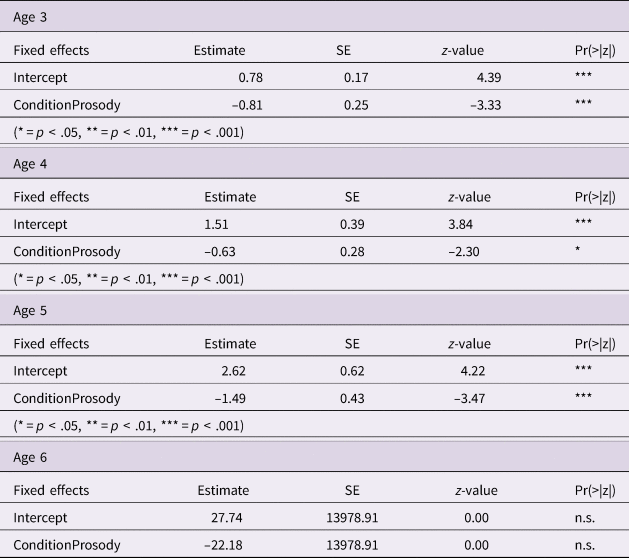
The adult control group performed at ceiling, responding correctly to all items. A total of 708 child responses were submitted to analysis. First, in order to explore the hypothesis that success on the modal condition would precede success on the prosody condition, we look at the overall difference between the modal and prosody conditions by age. Figure 6 shows that, with the exception of seven-year-olds, children are consistently better for the modal condition. A series of generalized linear mixed-effects models were fit in R (R Core Team, 2017) for each age-group, with participant and item as random factors. The dependent variable was performance on the Modal condition (1 = correct response, 0 = incorrect response), and the predictor was performance on the Prosody condition (1 = correct response, 0 = incorrect response).Footnote 5 Children performed significantly better for the modal condition at ages three, four, and five. By age six there was no significant difference for performance on the two conditions, and by age seven participants were at ceiling for both conditions (i.e., adult-like). Table 4 reports the Estimates, SE, z-values and p-values for each of the models for ages three to six.
Mean correct responses on linguistic comprehension task by Age and Condition.

Fixed effects, Estimate, SE, z-values and p-values for generalized mixed effects logistic regressions

(* = p < .05, ** = p < .01, *** = p < .001)
While modal performance was significantly better for ages three to six, Figure 6 reveals that children do continue to improve for both of the conditions over time. The youngest children in the study, the three-year-olds, are performing at chance level for prosody and above chance for the modal condition, but this improves with each age-group.
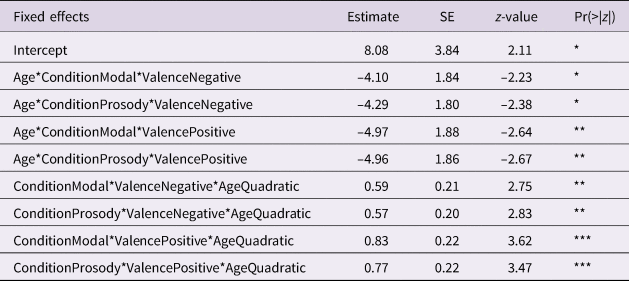
Next, for a more nuanced picture of the relationship between the different age-groups included in the study as well as the linguistic condition (modal vs. prosody) and the valence condition (negative vs. positive), a mixed effects logistic regression was carried out in R (R Core Team, 2017) in which the dependent variable was correct (1 = correct response, 0 = incorrect response), with linguistic condition (modal vs. prosody) and valence (positive vs. negative) as predictors. In addition, the quadratic effect of age was included as a predictorFootnote 6 in order to accommodate a possible nonlinear effect of age. Participant and Item were included as random factors.
Table 5 reports the Estimates, SE, z-values and p-values for the analysis. All interactions were found to be significant. Importantly, the quadratic effect of age is significant, suggesting that the logit probability of correct response does not increase with age at a constant rate, which is the usual assumption of a logistic regression. The quadratic effect of age in the model can be further explored in the plot in Figure 7. The figure shows the log odds of choosing the correct response, which informs us about the speed at which the odds of choosing a correct response increases at different ages.Footnote 7 Note that the plot does not include negative values, which means that the odds were not against any of the age-groups, though the youngest children do indeed show values closer to zero, especially for the prosody condition. In this case odds of zero would be equivalent to chance performance. The line plots for all the condition/valence combinations in Figure 7 demonstrate that the rate of change from one age to the next is not constant. The rate of change is slow between ages three and four, begins to pick up between four and five, and changes even faster from five to six and from six to seven. This tells us that, while the odds are not against the youngest children, the odds in favor begin to increase after age four, and become much better with each subsequent age for all of the conditions. The figure also shows that the odds increase in different ways for the different condition/valence combinations. While the youngest children show better odds for the modal combinations compared to the prosody combinations, the oldest children show the best odds when positive valence is involved compared to when negative valence is involved.
Logit probability curves as a function of age under different combinations of linguistic condition (modal vs. prosody) and valence (negative vs. positive), with error bars.

Fixed effects, Estimate, SE, z-values and p-values for mixed effects logistic regression

(* = p < .05, ** = p < .01, *** = p < .001)
Next, I interpret the significance of the interaction of linguistic condition (modal vs. prosody), valence condition (positive vs. negative), and age. Logit was converted to probability and slopes were plotted. Figure 8 shows the slopes for the correct response probability (crp) as a function of age. Each line in Figure 8 shows how quickly the probability of correctness increases with age. For each age, the y-axis shows us the probability of children at a given age-group choosing a correct response. For instance, at age three, the probability of choosing a correct response for when the condition is prosody and the valence is negative is 60%. The interaction of linguistic condition (modal vs. prosody), valence condition (positive vs. negative), and age indicates that the correct response probability curve as a function of age is significantly different under all the combinations included in the study (i.e., the differences between the four curves in the figures below (modal/positive, modal/negative, prosody/positive, prosody/negative). Thus, the lines we see in Figure 8 for all of the linguistic condition/valence combinations differ significantly from each other.
Correct response probability (crp) curves as a function of age under different combinations of linguistic condition (modal vs. prosody) and valence (negative vs. positive).

We can see in Figure 8 that participants show the best performance for the modal condition when valence is positive. For this condition/valence combination, three-year-olds have a correct response probability (crp) of about 65%, which increases to just above 80% at age four and, by the time participants are five years of age, they are performing close to ceiling. This is the only combination for which five-year-olds are performing in an adult-like manner. When the condition is modal but the valence is negative, however, barely any change in performance is noted between the ages of three and four, though children show a 75% crp at these ages. Between the ages of four and five, crp for this combination increases to 90%, and finally approaches ceiling at age six. Thus, children are comprehending the strength distinction between might and will at above chance levels even at age three, but are slower to improve for the negative valence condition, and less precise for this condition at age five compared to the positive condition, for which they are performing more like adults.
When prosody is involved (prosody/positive and prosody/negative), slopes begin closer to chance levels for three-year-olds (though interestingly the prosody/negative probability is higher than the prosody/positive one). For the prosody/positive condition, the crp for three-year-olds is just around chance, and is slightly higher (60%) at age four. This mirrors the change we find in the modal/prosody combination (65% at age three, 80% at age four); however, it is a smaller change with a lower range of probabilities. But performance increases quickly between ages four and five for the prosody/positive combination. At age five the probability of correct response reaches just over 90%. This means that, for five-year-olds, crp for the prosody/positive combination is equal to that of the modal/negative combination. This is quite a surge in improvement when compared to the change between three and four years for the prosody/positive combination, and coincides with the point at which children are performing at ceiling for modal/positive and 90% for modal/negative. Thus, when children have very high probabilities of choosing the correct response when making a modal distinction, they are also doing well at prosodic modulation. At age six, children's prosody/positive performance is approaching ceiling, and by age seven they are at ceiling for prosody/positive. Prosody/negative was the most difficult of all the combinations for participants. At age three, participants have a 60% crp, which gets worse at age four, at which point it is just above chance. By age five children have a crp of over 70%. While this is not as high as the prosody/positive combination, we can still say that large gains are made for both of the prosody conditions between four and five. By six years of age, children perform at 95%, and children perform at ceiling for prosody/negative at seven years of age. However, the prosody/negative combination shows the slowest improvement of all the slopes.
While children end up at the same ‘place’ by age seven, both Figures 7 and 8 make clear that they arrive at that point via different trajectories – that is to say that we find slightly different paths of acquisition for the four combinations. While the modal/positive combination starts off with a slightly worse crp than the modal/negative condition, this combination shows the fastest rate of increase in the earliest time-window, between ages three and five. Between these ages, the crp for modal/positive is always the highest crp. It is not until age six that performance for modal/negative and prosody/positive catches up to modal/positive, and by age seven all differences have disappeared. On the other hand, no crp changes are noted for modal/negative between ages three and four. Crp for this combination does not improve substantially until between the ages of four and five, and catches up to modal/positive at age six. For both combinations involving prosody, the youngest children start off with lower crps compared to the modal conditions. This is the case for both three- and four-year-olds. However, by age five children's crp for prosody/positive catches up to their crp for modal/negative. Prosody/positive and modal/negative show identical slopes between ages five and seven. Rapid improvement ensues for prosody/negative between ages four and five, though performance on this combination still lags behind the other three combinations. Substantial improvement continues between ages five and six, and by age seven crps are the same for all combinations (i.e., at ceiling).
Comments analysis
As mentioned above, after the children completed the prosody comprehension task they were asked about how they chose the answers for that task. Differences were found in terms of whether or not children provided a comment. Often children conveyed they did not know (e.g., shrugged shoulders, said I don't know) or said nothing at all. Figure 9 shows the percentage of children for each age-group who provided a comment when they were asked about how they knew the answers for the prosody comprehension task. Figure 9 makes clear that children's metalinguistic awareness (and their ability to articulate that awareness) about the prosodic differences between the two utterances changes over time. Note that, while four- and five-year-olds provide very few comments, more comments are found for six-year-olds and even more for seven-year-olds. The specific comments are presented in Table 6. These comments offer an additional perspective with respect to children's developing sensitivity to prosody and its meaning.
Percent of children for each age-group responding to experimenter's post-task question How did you know what the answers were?

Qualitative observations for children's explanation of answers for the prosodic condition

Note. ‘ ’ indicates a direct quote from a child, otherwise indicates experimenter's notes on observations of child.
Reference to prosody
Starting at age four, at least one child in each age-group mentioned the word voice in their answer, indicating awareness of prosodic information. The word voice was mentioned in some way for 42% of all responses in Table 6: 50% of four-year-olds (1/2); 0% of five-year-olds (0/1), 40% of six-year-olds (2/5); 45% of seven-year-olds (5/11). Some terms related to voice that children mentioned include high, soft, pitched up, deep, low, with the first three descriptions used for stronger commitment and the latter two terms referencing weaker commitment. These terms reference real physical differences in the stimuli; utterances designed to convey stronger commitment were indeed produced with higher mean F0 and wider F0 range when compared to utterances designed to convey weaker commitment. The comments offered by the children in this study show that children are indeed sensitive to pitch differences as related to speaker commitment, and show metalinguistic awareness of such differences as early as age four.
Valence terms
Children often used negative valence terms to refer to weak commitment, and positive valence terms to refer to strong commitment. Such terms were often related to affect/emotions. Positive valence terms included real, good, happy, excited, nice, enthusiastically; negative valence terms included sarcastic, wasn't thrilled, sad, badder, mean, sounds like she doesn't like the stuff. Some sort of valence related term was used in 8 out of 19 (42%) responses: 50% of four-year-olds (1/2); 0% of five-year-olds (0/1), 60% of six-year-olds (3/5); 36% of seven-year-olds (4/11). It is noteworthy that, while this behavior peaks at six years of age, seven-year-olds used valence terms to describe the difference less often.Footnote 8 However, as described in the next section, seven-year-olds rely more on terms that reference modality.
Terms referencing modality
Children also explained their answer choices using terms that reference modality/epistemicity. While no four-year-olds used such terms, there was at least one token for five-, six-, and seven-year-olds referencing speaker commitment with epistemic terms or terms related to desire or volition. All of these referenced some kind of modality whether it be epistemic, deontic (desire) or dynamic (volition) (Palmer, Reference Palmer2013): 100% of five-year-olds (1/1), 40% of six-year-olds (2/5); 55% of seven-year-olds (6/11). The one five-year-old who provided comments referred to utterances showing high speaker commitment: the other one said it in a way that she will. The word will indicates volition. One six-year-old used the verb want, indicating speaker desire: Excited or sad - if they are excited they would want to do it versus they wouldn't want to. This answer is especially intriguing since it shows the connection between valence information: sounding excited can lead one to pragmatically infer higher speaker commitment, while sounding sad can indicate lower speaker commitment. Seven-year-olds used more sophisticated epistemic terms to refer to the differences, e.g., She sounded like she wouldn't; … they won't get ’em maybe; probably not; pretty likely. This was also the only age-group that used epistemic adverbs in their answers.
Other observations
Two children (one four-year-old and one seven-year-old) produced facial/head gestures as part of their responses. This is in line with recent work showing that children develop epistemic prosody and facial gestures in tandem (Hübscher et al., Reference Hübscher, Esteve-Gibert, Igualada and Prieto2017; Armstrong et al., Reference Armstrong, Esteve-Gibert, Hübscher, Igualada and Prieto2018; Hübscher, Reference Hübscher2018; Hübscher & Prieto, Reference Hübscher and Prieto2019). The four-year-old produced a nodding gesture to indicate certainty, while the seven-year-old produced a squinting gesture to indicate uncertainty. These gestures are known to be associated with certainty and uncertainty respectively in adult speech (Hübscher et al., Reference Hübscher, Esteve-Gibert, Igualada and Prieto2017). A final observation includes the response of one six-year-old who said I heard some of them say different words – because they sound different. This comment is especially interesting since the child seems to indicate that the difference in sound (prosody) was so salient that they ‘said different words’. There were of course no lexical differences in the stimuli pairs. This observation suggests a keen metalinguistic awareness of prosodic meaning, where different prosodies can do the same work that lexical items might do. In this case, prosody conveys epistemic information just as other epistemic items do.
Comments analysis – summary
Not all children provided comments about how they chose their responses for the prosody comprehension task. However, whether or not a child gave a metalinguistic commentary on their reasoning changed based on age. None of the youngest children (age three) explained how they chose their answers, and four- and five-year-olds did this to a lesser extent. On the other hand, we see six- and seven-year-olds explaining their reasoning more frequently (almost all the time by age seven). However, even at age four we find children making explicit reference to prosodic differences, which are typically indexed by children with the word voice. Based on the way children described the differences they heard, the responses suggest that between the ages of four and seven there is evidence that children have metalinguistic awareness about how pitch differences may affect meaning. The words children used to describe the differences (e.g., high, low) also suggest their sensitivity to intonational differences, since pitch categories contrast in terms of whether they are high or low, falling or rising, etc. In fact, the ToBI labeling system itself relies on these differences when a labeler chooses between and H* vs. L*, for example.
Children also seem to use prosody as cues to valence, making reference to dichotomies like happy vs. sad. It is possible that younger children can more readily discuss prosody in terms of emotion, and later develop the ability to talk about prosodic meaning in terms of belief or commitment. The fact that seven-year-olds rely less on valence terms to describe the prosodic meaning they perceived in this experiment, and are the only group to use epistemic adverbs, suggests that this could be the case. This could also be indicative of a developmental pattern for the ways in which children can reference modality more generally, with affect/valence terms appearing first. The development of emotional prosody has also been shown to be occurring around the same time as internal state prosody (Armstrong & Hübscher, Reference Armstrong, Hübscher, Prieto and Esteve-Gibert2018), so it is perhaps not surprising that children might talk generally about prosody that taps into internal states using terms that relate more to affect. In any case, this analysis shows some clear patterns regarding children's ability to talk about prosodic meaning. The ways in which they choose to talk about prosodic meaning, however, change over time.
Discussion and conclusions
This study examined children's ability to prosodically modulate the epistemic modal verb might, comparing this to their ability to comprehend information about speaker commitment for might vs. will. The effects of age and valence were also examined. I explored the idea that children would first need an idea of how to delimit might's space on the continuum described above in order to know how to modulate its meaning, predicting that younger children should start off with more success on the modal condition (e.g., I might give you markers vs. I will give you markers) when compared to the prosody condition (e.g., I might give you markers, produced with high commitment vs. low commitment prosodies). The results confirmed this prediction. The first analysis showed that children performed significantly better on the modal condition at ages three, four, and five, but that this difference disappeared by age six.
In a second analysis, I applied statistical methods that allow for a closer look at how children are developing their abilities for both the modal condition and the prosody condition, including valence as a predictive factor. Additionally, by including age as a quadratic effect in the study, we are able to understand more about how children's odds of choosing a correct answer changed over time, which was not found to be constant. Improvement increases at faster and slower rates at different points in the age-range examined, with children at the youngest ages improving more slowly for all combinations, and gaining speed in improvement as they get older, though less change is apparent between ages six and seven. The interactions in the analysis also reveal that the different condition/valence/age combinations examined behaved significantly different from each other. This was revealed in the distinct developmental trajectories observed for the modal/positive, modal/negative, prosody/positive, and prosody/negative combinations at different ages. The modal/positive combination starts off with the best performance and improves more quickly than any other combination, reaching adult-like comprehension at age five, while adult-like comprehension is later for the other conditions, but does occur for all conditions by age seven. As shown in the Ozturk and Papafragou (Reference Ozturk and Papafragou2015) study, the negative valence condition did prove to be more difficult for children regardless of the modal or prosody conditions, but the prosody/negative combination improved at the slowest rate, and children did not exhibit adult-like comprehension until age seven for this combination. This could be attributed to the presence of negation in the context of this combination. The participant had to work out that the friend who does not want broccoli would invite the twin who is less likely to bring broccoli. This is perhaps more reasoning than the participant has to do when choosing who is more likely to bring something the friend does want.
What is perhaps most striking about the findings presented here is the speed with which the comprehension of the prosody/positive combination improves between the ages of four and five. Taking a closer look at the meaning of the tune used for weaker commitment for the prosody condition, we might assume a compositional meaning of the focus marker L + H* on LOOKS with a L- phrase boundary and H% IP boundary at the end of the utterance. The L + H* pitch accent is a well-known focus marker in English (Ladd, Reference Ladd2008). The pragmatic implicature generated is that, while it LOOKS like a zebra, it is not in fact a zebra. In addition to conveying contrast, it is possible that the L- phrase boundary and H% IP boundary combination conveys that there is some sort of ellipsis being conveyed by the speaker, since the utterance ends in a rise, which can convey that the speaker is not finished (Gussenhoven, Reference Gussenhoven2004). Even though nothing else is said after the rise, we can think of its implicature being something like +> Footnote 9It looks like a zebra, but it is not (elided information in bold). Crucially, this was the same tune used for the weak commitment prosody condition in the present study, which had a similar intended interpretation. I MIGHT give you markers… +> but I might not. The prosody thus highlights the weaker end of might's meaning in a way that the strong commitment tune does not. Kurumada and Clark (Reference Kurumada and Clark2017) examined children's comprehension of this same contour, by investigating the contrast in meaning between utterances such as It looks like a zebra (with a H* on looks and H* L-L% on zebra) vs. It LOOKS like a zebra … (with L + H* on looks and L* L-H% on zebra, as in the present study). They refer to the former as noun-focus prosody and the latter as verb-focus prosody, with the verb-focus prosody triggering the inference that it, in reality, is not actually a zebra. In this study, while four-year-olds (3;8–4;7) did not perform in an adult-like way for distinguishing noun-focus vs. verb-focus prosody (It looks like a ZEBRA vs. It LOOKS like a zebra …), in a second experiment testing four-year-olds (4;2–4;8) the presence of a semantically stronger alternative expression (It is a zebra) facilitated the comprehension of verb-focus prosody, and children were able to arrive at the intended inference. The authors suggest that children appear to rely more on lexically or structurally encoded contrast than on intonational contrast, since they take structural contrasts to be more “reliably mapped onto distinct interpretations” (p. 876), thus making it difficult for them to rely on prosody to perceive the difference for two structurally identical utterances conveyed through prosody. In the experiment presented here, while children could rely on lexical (might vs. will) contrasts for the modal condition, they could not do so for the prosody condition where, like Kurumada and Clark's first experiment, children were presented with structurally identical utterances that needed to be discriminated through prosody. While the youngest children struggled with this, by age five we see children becoming quite adult-like. We can say, then, that by age five children are showing an ability to become less reliant on what Kurumada and Clark refer to as structural information, and are able to let prosody do more work. Recall also that Moore and colleagues (Reference Moore, Harris and Patriquin1993) found that it was at age five when children were able to start using prosody to reinforce an interpretation and were thwarted by inappropriate prosody. Armstrong et al. (Reference Armstrong, Andreu, Esteve-Gibert and Prieto2016) also found that five-year-olds, but not four-year-olds, were able to use prosody to reinforce an expected outcome.
The above suggests that important developmental changes take place around age five for children, but this is also the time when children are refining semantic spaces with relationship to belief continua. Byrnes and Duff (Reference Byrnes and Duff1989) proposed that children first make a dichotomy between belief and disbelief and later refine it. In their study, children had more difficulty making distinctions on the same side of a continuum (e.g., has to vs. might). The task in the present study was perhaps even more difficult, since children had to make a distinction within the semantic space of one lexical item. The results show that by age five children are becoming quite adept at doing this. The fact that this coincides with children's adult-like discrimination of might vs. will suggests that this improvement is related to the fact that children more fully understand might's position on a belief continuum. The prior work reviewed here suggests that important changes in prosodic development in tandem with a more fully developed understanding of belief continua, as well as the semantic spaces occupied on those continua, conspire in facilitating a child's ability to prosodically modulate a modal verb such as might. The type of prosodic development that is occurring, however, merits more inquiry. For example, no difference was observed between four- and five-year-olds for disbelief comprehension in Armstrong's (Reference Armstrong, Orman and Valleau2014) study. One limitation of that study involves the fact that the prosody condition necessarily involves a judgment about two mid-scalar possibilities, while the might vs. will condition involves comparing a mid- vs. end-scalar item. Moore et al. (Reference Moore, Harris and Patriquin1993) reported that even the older children in their study had difficulty with mid-scalar differentiation (e.g., think vs. guess). It would be helpful to compare how children are able to detect mid-scalar differences in commitment conveyed lexically vs. how children are able to modulate one mid-scalar item's meaning through prosody.
The comments analysis allowed for the examination of children's metalinguistic awareness for prosodic modulation. Age-groups varied in terms of whether they were able (or willing) to comment on how they knew the answers, and the ways in which they referenced prosodic differences. Four- and five-year-old children provided fewer responses than six- and seven-year-olds did. This is perhaps expected given the comprehension task results. Children may be become more implicitly aware of these specific prosodic differences by age five, but their metalinguistic awareness comes a bit later (ages six to seven). On the other hand, this analysis revealed that from age four on children are able to talk about differences in voice, which they describe with words like high or low, suggesting metalinguistic awareness of pitch differences. Whether or not children are referencing pitch range or pitch targets is not clear, and this question would be interesting to explore in further work. However, the fact that children referenced voice differences as a way of qualifying their answer shows their awareness that ‘voice’ differences affect meaning, indicating that even at age four some children have metalinguistic awareness regarding prosody as a means by which meaning can be conveyed. By age four there is also evidence that children are able to use terms relating to valence and emotion to characterize prosodic differences using terms like bad/good, nice, sad, etc. The oldest children were able to talk about epistemic prosody in a more sophisticated way, however, relying more on modal expressions (rather than expressions related to emotion) to refer to the prosodic differences that they heard. As noted above, while the stimuli for the prosody condition did differ in overall intonation contours, the stronger commitment items included wider pitch excursions and a higher mean F0, while the weaker commitment items included more compressed pitch excursions and a lower mean F0. These differences are known to be associated with differences in emotional prosody, such as happy vs. sad (Huttar, Reference Huttar1968; Frick, Reference Frick1985; Banse & Scherer, Reference Banse and Scherer1996). Therefore, the signal could have conveyed both emotional and epistemic information. The epistemic information, however, is perhaps more relevant given the task, and seven-year-olds were able to characterize the epistemic meanings generated by the prosody. Teasing out which information is more salient to children at different ages (phonological pitch targets vs. other, more ‘phonetic’ prosodic information) could be interesting, given the tendencies observed here.
The results presented here confirm what has been found in prior studies both for modal verb acquisition and for the acquisition of prosody related to epistemic states. While earlier work has shown that epistemic state prosody is emerging around the same time as other epistemic state language such as modal verbs and mental state verbs, the present study shows how these aspects of language are emerging within the same window of development. To my knowledge, however, no studies have looked at children's discrimination of might vs. future will specifically, and so this study offers an additional comparison in this sense, showing above-chance performance for this distinction as early as age three. While children continue to improve their comprehension of might as well as their ability to modulate might’s meaning between the ages of three and seven, the results do suggest that, in order to modulate meaning, that meaning must be fairly well established. This was apparent, since it was at the point when children became adult-like for the modal/positive combination that they began to make enormous strides for the prosody/positive combination. The idea that full acquisition of lexical meaning is a prerequisite for its prosodic modulation could be further tested by looking at acquisition patterns for various lexical items and the ability to prosodically modulate their meaning, as well as looking at the individual results for children. At the same time, children become much better at prosodic modulation around the same time that they are refining belief continua and using prosody to reinforce meaning. It is also noteworthy that the abilities examined here involve the pragmatic computation of scalar expressions. Understanding a child's general ability to derive scalar inferences (Ozturk & Papafragou, Reference Ozturk and Papafragou2015) could also have predictive power in assessing the ability to prosodically modulate meaning and to explain individual differences in children. The comments analysis suggests that other factors may also explain individual variation: while some children referenced aspects of pitch and voice, many did not. This suggests that children differ in their general awareness of prosody. But what predicts such differences and how does this affect prosodic acquisition?
Taken together, the analyses offered here provide a magnifying glass for looking at a developmental period that has already been shown to be important for modal acquisition and prosodic acquisition. As I have mentioned, prosody does not exist in a vacuum and works with other parts of the grammar to lead listeners to specific meanings. At the same time, modal expressions do not exist in a vacuum either, and may be produced with varying prosodies in speech. Understanding how these two grammatical resources interact is therefore important for a more ecological account of language development. The findings presented here show that modal acquisition and prosodic acquisition are indeed occurring at the same time during the age-range examined here, though differing factors (in this case age and valence) lead to nuanced developmental trajectories and rates of improvement. Children end up at the same ‘place’ by age seven, when they are most adept at modulating the epistemic meaning investigated here, but it is also at this point that they are truly developing metalinguistic awareness of this modulation.
Acknowledgments
I am indebted to the participants, their parents, and the schools / care centers in Northampton and Amherst who made this research possible: Bridge Street School, Crocker Farm Elementary School, and the Center for Education and Care at UMass. I thank Barbara Pearson for facilitating recruitment, and Aileen Maloney-Baro, who worked as a research assistant and experimenter on this project. I am extremely grateful to Anna Liu (UMass Amherst Department of Mathematics and Statistics / UMass Statistical Consulting and Collaboration Services), who was the consultant for statistical analysis for this paper. I would also like to thank the Language Acquisition Research Center at UMass Amherst for feedback on various stages of this project, as well as Jill DeVilliers for her mentorship at various stages. Finally, this paper has also benefitted significantly from the feedback and comments of the editors and two anonymous reviewers, to whom I am grateful.
Appendix A
Modal Condition
---------------------------------
BLOCK 1: Positive Valence Items
(Target correct response in gray)
---------------------------------
Familiarization
Carrie: I will not give you the Frozen DVD.
Isabel: I might give you the Frozen DVD.
Sofie: I'm totally giving you the Frozen DVD.

Test item #1
Carrie: I will give you the Frozen DVD.
Isabel: I might give you the Frozen DVD.

Test item #2
Carrie: I will give you an ice cream maker.
Isabel: I might give you an ice cream maker.

Test item #3
Carrie: I might give you a chemistry set.
Isabel: I will give you a chemistry set.

Test item #4
Carrie: I might give you some markers.
Isabel: I will give you some markers.

Test item #5
Carrie: I will give you a football.
Isabel: I might give you a football.

Test item #6
Carrie: I might give you binoculars.
Isabel: I will give you binoculars.

---------------------------------
BLOCK 2: Negative Valence Items
(Target correct response in gray)
---------------------------------
Carrie: I will give you broccoli.
Isabel: I might give you broccoli.
Sofie: I will not give you broccoli.

Test trial #7
Carrie: I will give you broccoli.
Isabel: I might give you broccoli.

Test trial #8
Carrie: I might give you socks.
Isabel: I will give you socks.

Test trial #9
Carrie: I will give you a dictionary.
Isabel: I might give you a dictionary.

Test trial #10
Carrie: I will give you a broom.
Isabel: I might give you a broom.

Test trial #11
Carrie: I might give you a toothbrush.
Isabel: I will give you a toothbrush.

Test trial #12
Carrie: I might give you a tarantula.
Isabel: I will give you a tarantula.

Prosody condition
(SC = strong commitment prosody; WC = weak commitment prosody)
---------------------------------
BLOCK 1: Positive Valence Items
(Target correct response in gray)
---------------------------------
Familiarization
Carrie: I will not give you the Frozen DVD.
Isabel: I might give you the Frozen DVD.
Sofie: I'm totally giving you the Frozen DVD.

Test item #1
Carrie: I might give you the Frozen DVD [SC]
Isabel: I might give you the Frozen DVD [WC]

Test item #2
Carrie: I might give you an ice cream maker. [SC]
Isabel: I might give you an ice cream maker. [WC]

Test item #3
Carrie: I might give you a chemistry set. [WC]
Isabel: I might give you a chemistry set. [SC]

Test item #4
Carrie: I might give you markers. [WC]
Isabel: I might give you markers. [SC]

Test item #5
Carrie: I might give you a football. [SC]
Isabel: I might give you a football. [WC]

Test item #6
Carrie: I might give you binoculars. [WC]
Isabel: I might give you binoculars. [SC]

---------------------------------
BLOCK 2: Negative Valence Items
(Target correct response in gray)
---------------------------------
Carrie: I will give you broccoli.
Isabel: I might give you broccoli.
Sofie: I will not give you broccoli.

Test trial #7
Carrie: I might give you broccoli. [SC]
Isabel: I might give you broccoli. [WC]

Test trial #8
Carrie: I might give you socks. [WC]
Isabel: I might give you socks. [SC]

Test trial #9
Carrie: I might give you a dictionary. [SC]
Isabel: I might give you a dictionary. [WC]

Test trial #10
Carrie: I might give you a broom. [SC]
Isabel: I might give you a broom. [WC]

Test trial #11
Carrie: I might give you a toothbrush. [WC]
Isabel: I might give you a toothbrush. [SC]

Test trial #12
Carrie: I might give you a tarantula. [WC]
Isabel: I might give you a tarantula. [SC]