Introduction
As in other European countries, the feminisation of migration flows in Portugal is related to the emergence of new labour market niches in the service sector. The high employment rates and long working hours of Portuguese women, the ageing population and the need to supplement the care work provided by formal services have led to a continued demand for domestic and care workers. In Portugal, it is mainly Portuguese women who are employed in this sector, but there are a growing number of immigrants, mostly Brazilian, Ukrainian and Cape Verdean women (Baptista, Reference Baptista2009).
The aim of this article is threefold: firstly, to map female immigration to Portugal, in the context of recent migration flows and the growing demand for care; secondly, to understand developments in the service sector, by examining the forms of domestic and care work and establishing the extent to which such work has become associated with migrants; lastly, drawing on qualitative research with Brazilian female migrants,Footnote 1 to understand if and why their trajectories are diverging from the classic model of family migration, where the man comes first, the women and children later.
Migration, welfare and care in Portugal
Compared to its long emigration history, Portugal has only recently become a country of immigration. Labour migration flows from its former colonies in Africa, particularly Cape Verde, began during the sixties and increased following colonial independence in the seventies, partly making up for the mass emigration of Portuguese labour in previous decades. However, since the mid-eighties, Portugal has experienced an increasing and diversified flow of immigrants. While in-flows from the former colonies continued, there was also mass migration from Brazil and the Ukraine, as well as smaller flows from Moldavia, Russia, Romania, China, Pakistan and India (Pires, Reference Pires2002). As a result, Portugal has become a receiving-country.Footnote 2 The foreign resident population has increased sharply (to an estimated 440,000 in 2008Footnote 3), and now represents almost 5 per cent of the total population. Migrants from Brazil (106,961), Ukraine (52,494) and Cape Verde (51,353) represent the top three national groups of foreigners.
Within the foreign population, the number of women has always been high, but it has increased steadily during recent decades. Examining residence-permit data from 1980 to 2002, Peixoto (Reference Peixoto2006) found that the proportion of women increased from 40 per cent to 44 per cent, with an estimate of 47 per cent in 2008. In Portugal, the feminisation of migration flows (Morokvasic, Reference Morokvasic1984) must be analysed in the context of the different waves of immigration. Cape Verdean migration has traditionally had a high proportion of female migrants (51 per cent female in 2008), while migration from the Ukraine has been predominantly male followed by large-scale family reunification (52 per cent male in 2008), and Brazilian migration reveals the highest level of feminisation (54 per cent female in 2008).Footnote 4
The increase in migration flows and their feminisation are aspects that place Portugal close to what some authors refer to as a distinctive Southern European immigration pattern (King, Reference King2001; Bettio et al., Reference Bettio, Simonazzi and Villa2006). Key features of this pattern include a rapidly ageing population, a familialistic Welfare State relying on family-based care rather than provision of services, a high proportion of illegal immigrants (making for cheap and flexible labour), the gender segmentation of immigrants’ incorporation in the labour market, and the emergence of a new ‘migrant-in-the-family’ care model where immigrant women replace family carers. Taking the case of elderly care in Italy as an illustration, Bettio et al. show how the absence of services, coupled with generous cash transfers for the care of dependent persons over 65 and the active recruitment of migrant domestic workers, has led to the generalisation of an immigrant-based care model, which has become an affordable alternative for families across all income levels.Footnote 5
Recent analysis of immigration, family policies and care regimes in Portugal, however, reveals commonalities and differences in relation to the Southern European pattern. Increased immigration and an average proportion of illegal migrants (OECD, forthcoming) are connected, as in other Southern European countries, to the demand for migrant workers at the lowest levels of the occupational structure, both in the building and industrial sectors and in the services sector. A second commonality is related to the fact that Portugal is characterised by a strong ideological commitment to the family and more family-centred living arrangements and obligations (Wall, Reference Wall2005). For example, keeping the dependent elderly person at home for as long as possible, with some help from services, day centres or domestic employees, is still considered the best solution, even if institutionalisation is now envisaged as a normal option in cases of severe dependency (Torres et al., Reference Torres, Silva, Monteiro and Cabrita2005; São José and Wall, Reference São José and Wall2006; São José, Reference São José2009).
However, three significant differences must be emphasised. First, the fact that the dual-earner model based on women's full-time participation in the labour market has long been the predominant model of family division of labour. This means that pressure for change in care regimes emerged early on, in particular during the eighties, due to the need for childcare services and services for elderly persons (Wall and Escobedo, Reference Wall, Escobedo, Kamerman and Moss2009). Secondly, the 1974 Revolution led to changes in State responsibility for families, with strong support for women's full-time work and the provision of state-subsidised services to support working families (Wall et al., Reference Wall, Samitca and Leitão2008a). Based on a logic of partnership between the State and non-profit institutions since the early eighties, emphasis on publicly subsidised services for the elderly has led to a steady increase in home-help services, day care centres and residential care-homes. Day centres have become especially important as they provide for frail elderly persons that need ‘watching over’ and daily care rather than full-time nursing (São José and Wall, Reference São José and Wall2006; Wall et al., Reference Wall, Samitca and Leitão2008b). Data on take-up rates show that by 2004 3.5 per cent of elderly people over 65 were in day centres, another 3.8 per cent had home-help services and 3.7 per cent were in residential care-homes.Footnote 6 Waiting lists continue to be long for places in subsidised residential care-homes, revealing that the care burden in low-income families with severely dependent persons is putting strong pressure on the expansion of affordable care-homes.
Thirdly, although data on immigrant care work are not comprehensive, recent studies have shown that in Portugal it is mainly upper-income families that resort to household and care services from migrants, in particular from co-residing minders (Wall et al., Reference Wall, Nunes, Matias, Cabral, Wall, Aboim and Silva2008). In the context of policies that do not actively recruit migrant domestic workers or provide generous cash benefits for elderly dependent persons, as in Italy, live-in or full-time care workers have only emerged as an important and affordable care solution for high-income families. As a result, rather than a predominant ‘migrant in the family’ model driven by transfer and immigration policies, the care deficit in Portugal has led to increasing diversification of care arrangements, to a mixed model including both home-based solutions and institutionalisation, both native and migrant carers, both publicly subsidised and private service provision. In summary, growing demand for care has undoubtedly led to changes in the care regime, but different political and economic contexts have made for different policy perspectives and outcomes (Wall and Escobedo, Reference Wall, Escobedo, Kamerman and Moss2009).
Domestic and care work in Portugal
Domestic and care-work activities have always been highly feminised activities in Portugal. Although until the seventies the majority of Portuguese women did not work outside the home, many would look for a source of income by working as a domestic employee. For some, this would start at a very young age and within a live-in arrangement. Working in the domestic sector would often mean an opportunity for internal migration, from rural areas to the city (Wall, Reference Wall1998).
Nowadays, the situation of female employment has changed drastically. Portuguese women work mainly outside the home and predominantly full time. Portugal has one of the highest rates of female activity in Europe (68.8 per cent according to Employment in Europe, 2008). With less time for household tasks, dual earner couples sometimes look for a third person to help take care of the household or dependent persons, usually another woman. There is also growing demand for care helpers in publicly subsidised services, which have increased strongly over the last two decades in response to an ageing population. Therefore, the domestic and care sector continues to be an area of the labour market where many Portuguese women, in particular those with lower educational levels, find work.Footnote 7
Due to its prevalence in the Portuguese labour market and the specificities it entails, domestic work is regulated by specific legislation (type of contract, working hours, payment, entitlement to holidays, compulsory social security contributions, etc.). However, this does not mean that all employers and workers, in particular immigrant workers, are aware of existing regulations. Moreover, this is a sector where informal working relations are frequent, not only because the work is often carried out in private homes, but also due to the fact that it is a relatively easy way to find work in the informal economy.
In Portugal, working in the domestic and care sector can take different forms in terms of working hours, payment and other arrangements. There are women who only work for one private employer, either in a live-in arrangement or on a full-time basis (in both situations payment is defined on a monthly basis); women who work and are paid ‘by the hour’, dividing their working time between different private homes, and women working for institutions who provide care services or for companies who provide cleaning services. In these particular cases, the company acts as intermediary between the person requiring the service and the person providing it. The live-in arrangement, although very frequent until the seventies, has been decreasing, whereas the working by the hour regime has become the predominant form of work (Guerreiro, Reference Guerreiro2000). The latter, paid at 5 to 8 euros per hour in the main cities, allows women to build up monthly earnings well above the earnings provided by full-time work in other low-qualified jobs.
Research (Peixoto (ed.), Reference Peixoto2006; Peixoto and Figueiredo, Reference Peixoto, Figueiredo and Malheiros2007) suggests that in Portugal the domestic sector is one of the main areas where immigrant women have been able to find a job, not only because there is demand for workers in this sector, but also because it is becoming less attractive for Portuguese workers, in particular in the form of ‘live-in’ work. Nevertheless, existing data seem to indicate that the sector is still dominated by Portuguese women, even if the proportion of immigrants has been on the increase over the last decade. Data from social security contributions of people working in the domestic sector show that the percentage of foreign women in this sector increased from 7 per cent to 11 per cent between 2002 and 2006 (Baptista, Reference Baptista2009). However, given the high levels of informality in this sector, especially in the case of immigrant women, we can expect the presence of immigrant women to be under-estimated. In summary, on the basis of the available data we can emphasise the growing presence of immigrant women in the sector, but it is not possible to say that immigrant women are replacing Portuguese women.
Strategies and trajectories of Brazilian female care workers
The focus on Brazilian female migration is important for three reasons. First, Brazilians represent the largest national group of migrants in Portugal. Secondly, Brazilian immigration has the highest level of feminisation, and initial studies of the Brazilian community suggested the growing importance of domestic and care work for female Brazilians (Peixoto, Reference Peixoto2006; Padilla, Reference Padilla and Malheiros2007). Lastly, an exploratory research project on female migration in Portugal (Wall et al., Reference Wall, Nunes, Matias, Cabral, Wall, Aboim and Silva2008), focusing on the top three national groups (Brazil, Ukraine and Cape Verde), showed that although the pluralisation of female migration trajectories and growing feminisation occur in all three groups, it is above all the Brazilian care workers that families prefer, in particular for live-in care, due to language and perceived historical and cultural proximities (Nunes, Reference Nunes2009). In summary, in order to get a better insight into the interplay between domestic and care work, trajectories and increasing female migration in Portugal, an in-depth case study on Brazilian women immigrants emerged as a relevant research option.
Data and method
A total of 15 interviews were carried out with Brazilian immigrant women, following a semi-structured and open-ended approach.Footnote 8 Interviews included topics focusing on the story of migration and identified a priori (such as the reasons and goals of migration, daily activities, difficulties of integration), but also adopted a more narrative approach, by asking interviewed women to talk freely about the experience of migration.
Main types of trajectories
Brazilian women's reasons to migrate are mainly related to labour market and financial factors, such as unemployment and the need to increase their income, in particular to pay off debts and to save up in order to achieve a specific goal, such as buying a house, paying for health expenses or improving living conditions. Care-work migration is seen as an opportunity to find a job with a higher salary, which will allow women to build ‘a better life’ for themselves and their families, either in Portugal or in the country of origin. Both ‘live-in’ and ‘by the hour’ forms of work are seen as opportunities to earn and save up, even if ‘live-in’ arrangements are perceived as a faster and more reliable way to do this. The wish to ‘find a new life’, linked to the idea of finding a new partner or rebuilding family life, may also emerge, particularly for single or divorced women.
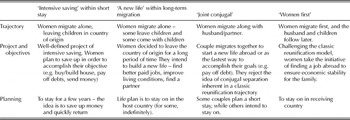
The findings suggest a diversity of migration trajectories, revealing not only the different motivations and objectives that underpin the female care-worker's decision to migrate, but also the events and constraints that shape the trajectories. Brazilian female domestic and care workers tend to migrate ‘alone’, leaving their family (partner and/or children) in the country of origin, ‘before’ their husband/partner, or ‘at the same time’ as their partner and/or children. Analysis of women's discourses revealed differential dynamics of migration, which we classified into four main types of trajectories (Table 1).Footnote 9
Migration trajectories of Brazilian women in Portugal

(1) ‘Intensive saving’ within a short stay – always lone women
Women care workers included in this trajectory have a well-defined migratory project. The main aim is to work intensively for a few years, to save up and to go back as soon as possible. All of these care workers are single or separated women who, when they have young children, leave them in the country of origin. Live-in domestic and care work is experienced as a fast track into the labour market and a way to save money.
This is the case of Neuza, a 23-year-old single mother who migrated alone, leaving a six-month old child in Brazil in the care of her mother. Before migrating, she lived with her mother, and was unemployed, only earning some money selling hand-made dolls. Neuza decided to come to Portugal shortly after her child was born. She needed money to support her daughter and, if possible, to renovate her mother's house. She arrived in Lisbon in October 2005 and went to work as a live-in domestic employee for an upper-class family, also caring for a 93-year-old elderly person. Neuza came to replace a friend of hers who was leaving this job. She has no contract, and all of the working conditions are established informally with her employer. She works from 8.30 am until 9 pm and has two days off. With a salary of 500 euros, she is paying off her debts in Brazil (a bank loan for her plane ticket) and sending money to her mother. She hopes to be able to pay off her debt in one year and then intends to start saving some money for the house. If all goes well, she will stay in Portugal for only three years.
Although working as a domestic employee and taking care of an elderly person was the job opportunity that brought Neuza to Lisbon, several aspects of the work fit in with her personal goals. Neuza recognises that the live-in arrangement has some major advantages, in particular for her migration project, because she is able to save up more money as she has fewer expenses.
Yes, I have a good salary. It's not bad. And also because I am here in the house of Mrs. L., and the way they treat me, it's also very good. And I don't spend a lot of money, because for housing I stay here, and food is also from here.
Illustrating the argument of Lutz concerning the special relationship between employers and domestic employees, which tends to be highly personalised and characterised by mutual dependency (Reference Lutz2008: 1), Neuza feels that, if she decides to leave, she will have to find someone to replace her. This was how she was able to find work in Portugal and she feels it is important to maintain this scheme, not only to give someone else an opportunity to come, but also to fulfil her feelings of obligation toward her employer. The existence and reproduction of what we might call substitution social networks are important to explain how many immigrant women are able to find a job so easily in the domestic sector.
So, I wanted to come to Portugal, but I said to my sister that I would only come if I had a job, if I arrived and already had a job. And so my sister talked to I. [the friend Neuza came to substitute] and then she talked to Mrs. L., that she was leaving but that she would find someone to substitute her . . .’ I am not going to leave Mrs. L. without someone to take care of Mrs. J. . .’, and she worried about that. And I'd never do that either, not me.
(2) ‘A new life’ within long-term migration – lone women on arrival, often cohabiting today
Replacing another immigrant woman in care work was also how Dalila, a 31-year-old single woman, was able to find a job in Portugal. She came to Portugal to replace her sister, who decided to return to Brazil. Although Dalila was unemployed at the time, coming to Portugal was also an opportunity to get away from a difficult relationship and start a new life. So Dalila illustrates a different type of trajectory. While in the case of Neuza there was a clearly defined objective within a short-term project, Dalila's main reason for migrating is to find a better life and to stay on in the host country. She arrived in Portugal in 2001 and at first worked in a live-in arrangement, taking care of the household tasks and of an elderly person, in the house where her sister used to work. Her situation changed when the elderly person passed away. Dalila then began to work as a domestic employee ‘by the hour’ during the morning and in a café during the afternoon and at weekends. She has no days off, but she is pleased to be earning around 840 euros per month. Dalilas's legal situation also differs from that of Neuza, as she has a work contract (in her job as domestic worker in a private home) and was able to ‘legalise’ her situation and to get a residence permit. She is buying a house in Portugal with her partner, a Portuguese citizen, with whom she currently lives. Her intention is to stay in the country indefinitely and all of her ‘investments’ (financial and emotional) reflect this option.
My life is here now . . . Ah, the fact that I have a job is a big difference for me. I have been doing this job [domestic work] for four years now and that is great . . . And, as I always say, I'm going to stay as long as everything goes well.
(3) ‘Joint conjugal’ trajectory − married women, arriving with partner
Immigrant women in this type of trajectory are married or cohabiting and may or may not have dependent children. Joint conjugal migration means that the two members of the couple migrate together, even if the migratory project is related to the woman's capacity to find well-paid domestic or care work in the receiving country. These are dual-earner couples in which the wife has an important breadwinning role.
The case of Ângela illustrates this type of trajectory. Ângela is a 39-year-old married woman who migrated with her husband. The couple has a well-defined project of intensive saving within a short-term stay, their main motivation being to save up in order to pay off a bank loan in Brazil. Their two children, aged 23 and 16, stayed in Brazil on their own (the oldest son takes care of his brother). Although the couple decided to come together, Ângela considers that the decision to migrate was mainly her idea:
My husband and I built a house and we lost our first house and it was very very difficult. We began to build another house and when we finished we had a large debt to the bank. The debt was huge and we were having difficulties in paying for it so I decided ‘let's go, both of us, I can't lose this house, I have my children’ . . . So we both came, because it would not be possible for me to come alone, because my husband is like that, he depends a lot on me. I think women, even though people say that men usually have the initiative, I don't think this is true, it is often the woman who decides. So, I came to Portugal.
Soon after arriving, Ângela was able to find a job as a domestic employee working in different private homes and being paid by the hour. She was able to find work through informal contacts. She earns 6 euros per hour and is able to earn around 1,000 euros per month. In all the different homes where she works, the working conditions, in terms of hours and payment, were established informally. This and her ‘irregular’ situation are not perceived as disadvantages. As she puts it, there are no clear advantages in changing her situation, as she does not intend to stay in Portugal for a long period of time. Moreover, she saves more money by not contributing to social security.
During the first year, Ângela and her husband (a gardener) worked seven days a week in order to pay for their travel expenses. It took them another two years to save up money to pay for their house. Up until February 2007, the couple stayed in Portugal together, then her husband went back to Brazil. Ângela stayed on for a few months to save up more money and only returned to Brazil in August 2007. The decision regarding Ângela's stay in Portugal was related to the fact the she was earning more than her husband as a domestic employee ‘by the hour’. This fact is perceived by Ângela as reinforcing her economic independence and the central place she occupies within the household as an important breadwinner.
I have always worked, I want to have my own money, for sure, but I am very independent, I never depended on my husband here, in fact it was the other way around, he depended on me.
(4) ‘Women first’ trajectory within a long-term stay – married women, alone on arrival, today with family
Antónia works by the hour, but her migration trajectory was different. She was the first member of her family to migrate, and her trajectory shows an inversion of the classic family reunification model. Antónia is a 47-year-old married woman who decided to migrate to Portugal with her adolescent daughter in 2002. Her main reasons for migrating were financial, as she was unemployed and had to pay off some family debts, and was also family-focused, with migration seen as a way of helping her daughter to recover from a recent problem of drug-addiction. Although Antonia only went to school a few months and was a manual worker in Brazil, she has always been the main breadwinner of the family, and even when she arrived in Portugal, she felt it was her responsibility to send money to her husband in the country of origin.
In Portugal, she knew it would be easier to find a job as a domestic employee. However, as she had no personal contacts, in order to find a job she put an advertisement in a newspaper. She was able to find a job two weeks later, working in a private home. Since then, she has been working for several employers ‘by the hour’, and manages to combine this with two more jobs working in the kitchen of a restaurant and cleaning in a pharmacy. Meanwhile, the family decided to come, arriving two years later, and initially relying on Antónia's income.
Conclusion
In this article, we have explored the diversity of female migration trajectories in Portugal. We have focused on immigrant women working in the domestic and care sector, thereby emphasising the linkages between female migration and domestic work in order to capture a variety of trajectories. Our evidence can be only tentative, as the qualitative research is based on 15 in-depth interviews and therefore cannot provide a comprehensive view of immigrant women in the domestic and care sector. However, our findings do suggest that female labour migration trajectories related to this sector have become more diversified over the last two decades. The classic reunification trajectory where the husband migrates first still exists in current migration flows, but we now have to address a new plurality of trajectories: women who come to work in the domestic and care sector seem to migrate more often alone, as single or divorced women, with their partners or children, or before them.
In Portugal, the increased participation of women in the labour market in a full-time regime, the rapid ageing of the population, and Portuguese workers’ rejection of live-in arrangements are important driving forces behind contemporary female immigration flows. Mounting demand for care since the eighties has helped to maintain a market for well-paid domestic employees and carers working ‘by the hour’, to increase publicly subsidised and private provision of services, and to swell the informal market for live-in, around-the-clock carers only afforded by upper-income households. However, it is also true that mounting demand and Portuguese families’ growing care burden would probably not have sufficed, on their own, to generate the integration of female migrants into these labour market niches. The new plurality of female migration trajectories, in the context of mass migration from Brazil and some other countries (Ukraine, Cape Verde), has also allowed for a rapid and successful integration of immigrant women in the care and domestic sector.
Diversification in female migration trajectories seems to be linked to three important factors: first, to major shifts in gender roles in the sending country. For different reasons and in different contexts, most women who come to Portugal to care or undertake domestic work were employed or had already been employed before migration. In the receiving country, they are looking for new employment opportunities and expect to be important or main breadwinners, especially when they have children.
Secondly, diversification also appears to be shaped by changes in family patterns in the sending countries, in particular by the increase in lone motherhood and divorce and by female survival strategies. Lone motherhood is related not only to the rise in separation and divorce, but also to the increase in male poverty and unemployment, which reinforces women's role as lone parents and breadwinners. Job opportunities in the domestic and care-work sector in Europe thus represent an important way out in the struggle for survival and better living conditions for children born out of wedlock or belonging to households where the mother is the main or sole breadwinner.
Lastly, there seems to be a strong connection between Brazilian female Portuguese-speaking migration, ‘live-in’ arrangements as a stepping stone into employment in the sector, and what we have described as ‘substitution social networking’, in which the care worker takes it upon herself to ensure the continuity of the care arrangement on behalf of the employer. Alongside language skills, higher educational levels and cultural proximity, which are of some importance in the acceptance of Brazilian immigrant women in private homes, the social networking strategy creates a stronger connection between this national group of immigrants and families employing domestic and care workers. In the frame of a global economic context where rich and demographically ageing countries need more domestic and care workers, networking and changing gender and family roles may be therefore considered as important intermediary driving forces of the feminisation of immigration.