Implications
Consolidation of the dairy industry with constant increase in herd size has generated the need for systematic programmes to manage reproduction. The advent of synchronisation of ovulation protocols that secure artificial insemination at a pre-established time with adequate fertility has become an integral component of breeding management in multiple production systems. The better understanding of ovarian biology of dairy cows with improved control of follicle growth and luteal lifespan has resulted in refinement of these programmes in the last two decades, providing unique opportunities to manipulate follicle development, improve oocyte quality and enhance embryo survival.
Introduction
Reproductive management in dairy farms has markedly evolved in the past 20 years to a great extent because of the development of synchronisation programmes that allow for fixed-time artificial insemination (AI). Early research on control of follicle development and corpus luteum (CL) lifespan aimed to develop systems that synchronise follicle growth, luteolysis and finally ovulation at a predictable time such that timed AI could be performed to optimise fertility in cattle (Thatcher et al., Reference Thatcher, de la Sota, Schmitt, Diaz, Badinga, Simmen, Staples and Drost1996). Initial work studying the control of follicular wave with gonadotropin-releasing hormone (GnRH) by Macmillan and Thatcher (Reference Macmillan and Thatcher1991) paved the way for the development of the Ovsynch protocol by Pursley et al. (Reference Pursley, Mee and Wiltbank1995). Today, the Ovsynch and variations of its original development are the most common timed AI programme used for reproductive management of dairy cattle in the United States and in many other countries. An excellent review of the development of timed AI has recently been published by Wiltbank and Pursley (Reference Wiltbank and Pursley2014) and the authors indicated that access to engine searches lead to thousands of results involving the Ovsynch protocol, indicating the importance the programme has had on the study of pharmacological control of the oestrus cycle of cattle.
The Ovsynch programme was originally designed to improve insemination rate because of the challenges with oestrus detection in dairy farms (Pursley et al., Reference Pursley, Kosorok and Wiltbank1997; Lopez et al., Reference Lopez, Satter and Wiltbank2004); however, new knowledge of reproductive biology of dairy cows and the ability to manipulate follicle growth and luteal lifespan has created opportunities to optimise fertility at the same time that insemination is assured (Moreira et al., Reference Moreira, Orlandi, Risco, Mattos, Lopes and Thatcher2001; Souza et al., Reference Souza, Ayres, Ferreira and Wiltbank2008). Because of the combined increased insemination rate and acceptable pregnancy per AI (P/AI), it is no surprise that adoption of timed AI programmes for routine management of reproduction in dairy herds has been widespread (Caraviello et al., Reference Caraviello, Weigel, Fricke, Wiltbank, Florent, Cook, Nordlund, Zwald and Rawson2006), and benefits to reproductive efficiency have also translated into economic advantages to the producer. The average value of a pregnancy has been estimated at $278.00 for farms in the United States (De Vries, Reference De Vries2006). Under intensive systems, implementation of timed AI has been considered economically advantageous, particularly when detection of oestrus is low (Ribeiro et al., Reference Ribeiro, Galvão, Thatcher and Santos2012c). When compared with a well-managed natural service breeding programme, timed AI resulted in similar reproductive performance (Lima et al., Reference Lima, Risco, Thatcher, Benzaquen, Archbald, Santos and Thatcher2009a) but increased economic return (Lima et al., Reference Lima, De Vries, Risco, Santos and Thatcher2010). More recently, work from New Zealand in a grazing system clearly demonstrated the economic benefit of timed AI programmes at the beginning of the breeding season in cyclic and anovular dairy cows (McDougall, Reference McDougall2010a).
Detection of oestrus is suboptimal in dairy cows
After the end of the voluntary waiting period, the rate of pregnancy in dairy herds is determined by the rate of submission to insemination and P/AI. One of the limitations for efficient reproduction in many dairy farms is the low rate of oestrus detection and consequently reduced submission to insemination observed in lactating dairy cows. Typically, cows become eligible for insemination once they pass the voluntary waiting period and they are not pregnant. Because the length of the oestrus cycle of dairy cows is assumed to be 21 days, it is expected that eligible cows should show oestrus and be candidates for insemination every 3 weeks. Therefore, detection of oestrus is usually calculated as the percentage of eligible cows that are inseminated for each 21-day period out of the total eligible cows in the same period.
When detection of oestrus is the sole method to inseminate cows, then pregnancy rates usually suffer compared with management programmes that allow for a systematic control of AI (Pursley et al., Reference Pursley, Kosorok and Wiltbank1997; Tenhagen et al., Reference Tenhagen, Drillich, Surholt and Heuwieser2004). The decline in pregnancy rate is caused by the delayed first postpartum insemination and extended interval between reinsemination in non-pregnant cows. Tenhagen et al. (Reference Tenhagen, Drillich, Surholt and Heuwieser2004) evaluated insemination rates in two farms in which a portion of the cows were subjected to either AI following detected oestrus or after timed AI. When cows were inseminated only after detected oestrus, then insemination rates averaged 28.6% and 55.6%; whereas when timed AI was incorporated into the breeding programme, insemination rates increased to 65.4% and 69.6%. Pursley et al. (Reference Pursley, Kosorok and Wiltbank1997) showed that even when cows were subjected only to timed AI, with no insemination between pregnancy diagnoses, time to pregnancy was reduced by 19 days compared with insemination following detected oestrus only.
High-producing cows have shorter and less-intense oestrus events, which has been associated with increased milk production (Lopez et al., Reference Lopez, Satter and Wiltbank2004; Yániz et al., Reference Yániz, Santolaria, Giribet and López-Gatius2006). Lopez et al. (Reference Lopez, Satter and Wiltbank2004) fitted early lactation Holstein cows with mounting pressure sensors to continuously record standing activity in freestalls, and performed frequent ovarian ultrasonography to detect ovulation. After classifying cows as high or low producers, based on production in the 10 days preceding the day of oestrus, the authors observed that the duration of oestrus (6.2 v. 10.9 h), number of standing events (6.3 v. 8.8) and total time standing (21.7 v. 28.2 s) were all less for oestrus events of cows considered to be high (46.4 kg/day) compared with those considered to be low producers (33.5 kg/day). The authors suggested that increased intake of dry matter in cows of high milk production alters splanchnic tissue metabolism and increases catabolism of ovarian steroids, including oestradiol (Lopez et al., Reference Lopez, Satter and Wiltbank2004; Wiltbank et al., Reference Wiltbank, Lopez, Sartori, Sangsritavong and Gümen2006). In fact, the cows categorised as high producing in a study by Lopez et al. (Reference Lopez, Satter and Wiltbank2004) had smaller concentrations of oestradiol in the periovulatory period, despite having larger pre-ovulatory follicles. Others have also shown that signs of oestrus activity using pedometry were suppressed as production increased (Yániz et al., Reference Yániz, Santolaria, Giribet and López-Gatius2006).
Allrich (Reference Allrich1994) described oestrus as an all or none response that is determined by threshold concentrations of oestradiol that reach the hypothalamus of the cow; however, many environmental factors seem to influence how cows respond during the proestrus period. For instance, treatment of dairy cows with bovine somatotropin, a technology commonly used in dairy cows in many countries to stimulate milk synthesis, suppressed oestrus behaviour, despite the fact that treated cows had increased concentrations of oestradiol (Rivera et al., Reference Rivera, Narciso, Oliveira, Cerri, Correa-Calderón, Chebel and Santos2010). Other factors such as floor surface (Vailes and Britt, Reference Vailes and Britt1990), lameness, crowding, rain, mud and heat stress are all known to negatively affect expression of oestrus in dairy cows (Allrich, Reference Allrich1994), which might not be related to concentrations of oestradiol reaching the hypothalamic centres that control oestrus behaviour.
An important component limiting insemination of cows based on oestrus behaviour is the prevalence of anovulation at the end of the voluntary waiting period. In the United States and Canada, 5% to 41.2% of the postpartum dairy cows are anovular by the end of the voluntary waiting period at ∼60 days postpartum (Walsh et al., Reference Walsh, Kelton, Duffield, Leslie, Walton and LeBlanc2007; Santos et al., Reference Santos, Rutigliano and Sá Filho2009), and these cows have delayed insemination (Chebel and Santos, Reference Chebel and Santos2010), reduced P/AI (Santos et al., Reference Santos, Rutigliano and Sá Filho2009) and increased pregnancy loss (Santos et al., Reference Santos, Thatcher, Chebel, Cerri and Galvão2004; McDougall et al., Reference McDougall, Rhodes and Verkerk2005). If left untreated, anovular cows will have extended interval to first insemination, thereby delaying pregnancy and increasing the risk of culling. When herds rely primarily on the detection of oestrus for insemination, little is done to handle anovular cows, unless routine diagnosis is implemented to identify problem cows that might have extended interval to first oestrus and insemination.
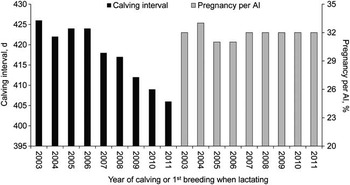
A recent survey of hundreds of large dairy herds in the United States indicated that the insemination rate during the entire year averaged 60.1% for lactating Holsteins and 66.7% for lactating Jersey cows (Souza et al., Reference Souza, Silva-Del-Rio, Batista, VerBoort, Baruselli and Ross2014). In many of these herds, combinations of insemination on oestrus and timed AI were incorporated to manage reproduction to achieve insemination rates above 60%. For instance, the average calving interval has been reduced by 21 days over the last decade, whereas P/AI remained at 32% (Figure 1). Such improvements in reproductive performance have been achieved because, among other factors, the incorporation of timed AI programmes to manage reproduction in dairy farms (Caraviello et al., Reference Caraviello, Weigel, Fricke, Wiltbank, Florent, Cook, Nordlund, Zwald and Rawson2006). In fact, phenotypic trends in daughter fertility have improved substantially in the past 10 years, with increased calculated daughter pregnancy rate from 21% to 27%, whereas the genetic trend has remained mostly unchanged.
Calving interval and pregnancy per AI in US lactating Holstein cows in the last decade. Data summarised from the Animal Improvement Programs Laboratory of the United States Department of Agriculture (http://aipl.arsusda.gov/publish/dhi/current/reproall.html).

The Ovsynch protocol
Numerous programmes are available to synchronise ovulation for timed AI in dairy cows; however, restrictions in drug use for food animals have limited the options to manipulate the oestrus cycle in many countries (Lane et al., Reference Lane, Austin and Crowe2008). Since the initial publication of the Ovsynch protocol (day 0 GnRH, day 7 prostaglandin (PG)F2α , day 9 GnRH, day 10 timed AI; Pursley et al., Reference Pursley, Mee and Wiltbank1995), programmes based on GnRH and PGF2α have been refined to improve the control of follicular development, luteal lifespan and synchrony of ovulation around the time of AI. Ovulation to the first injection of GnRH improves synchronisation of the oestrus cycle and reduces the period of follicular dominance, both associated with greater P/AI (Vasconcelos et al., Reference Vasconcelos, Silcox, Rosa, Pursley and Wiltbank1999; Bleach et al., Reference Bleach, Glencross and Knight2004; Santos et al., Reference Santos, Narciso, Rivera, Thatcher and Chebel2010a). Complete CL demise following treatment with PGF2α and the timing of the final GnRH are also critical to expose cows to an adequate period of proestrus (Ribeiro et al., Reference Ribeiro, Monteiro, Lima, Ayres, Bisinotto, Favoreto, Greco, Marsola, Thatcher and Santos2012b), which controls priming of the uterus for the establishment of pregnancy and the final stages of follicle maturation. Finally, fertility is modulated by the interval between induction of ovulation with the second GnRH and AI (Pursley et al., Reference Pursley, Kosorok and Wiltbank1997), as it determines the window during which oocyte and sperm cells are viable for fertilisation (Saacke, Reference Saacke2008).
Unfortunately, the Ovsynch programme has limitations on its ability to synchronise follicle growth because ovulation to the initial GnRH administered at random stages of the oestrus cycle is usually 50% to 60%, or up to 70% when presynchronisation precedes the Ovsynch (Bisinotto and Santos, Reference Bisinotto and Santos2012; Ribeiro et al., Reference Ribeiro, Bisinotto, Favoreto, Martins, Cerri, Silvestre, Greco, Thatcher and Santos2012a). Even when cows were presynchronised with two sequential Ovsynch protocols (Double Ovsynch), ovulation to the first GnRH of the breeding Ovsynch was <72% (Souza et al., Reference Souza, Ayres, Ferreira and Wiltbank2008; Giordano et al., Reference Giordano, Wiltbank, Fricke, Bas, Pawlisch, Guenther and Nascimento2013). A second limitation of these programmes is the inability of a single dose of PGF2α to induce complete CL regression. To achieve high P/AI, the concentration of progesterone on the day of timed insemination has to be very low, ideally below 0.3 ng/mL (Santos et al., Reference Santos, Narciso, Rivera, Thatcher and Chebel2010a); however, PGF2α administered as a single dose on day 7 or as two doses on days 5 and 6 after GnRH usually results in only 70% to 84% of cows with progesterone <0.3 ng/mL on the day of the timed AI (Santos et al., Reference Santos, Narciso, Rivera, Thatcher and Chebel2010a; Giordano et al., Reference Giordano, Wiltbank, Fricke, Bas, Pawlisch, Guenther and Nascimento2013). Finally, although ovulation is synchronised between 24 and 32 h after the final GnRH injection (Pursley et al., Reference Pursley, Mee and Wiltbank1995), not all cows have a synchronised ovulation, which typically averages 85% (Santos et al., Reference Santos, Narciso, Rivera, Thatcher and Chebel2010a), and this number seems to decline when cows are exposed to heat stress because of the supposed deleterious effects of hyperthermia on ovulation (López-Gatius et al., Reference López-Gatius, Lopez Bejar, Fenech and Hunter2005). Furthermore, herds with increased prevalence of peripartum diseases have reduced response to synchronisation programmes because of increased prevalence of anovular cows, reduced fertilisation and impaired embryo development, which ultimately leads to smaller P/AI and increased pregnancy loss (Santos et al., Reference Santos, Bisinotto, Ribeiro, Lima, Greco, Staples and Thatcher2010b; Ribeiro et al., Reference Ribeiro, Lima, Greco, Bisinotto, Monteiro, Favoreto, Ayres, Marsola, Martinez, Thatcher and Santos2013).
Optimising timed AI programmes
Presynchronisation programmes for first AI postpartum
Response to the Ovsynch protocol improves when cows receive the first injection of GnRH during early dioestrus (Vasconcelos et al., Reference Vasconcelos, Silcox, Rosa, Pursley and Wiltbank1999; Bello et al., Reference Bello, Steibel and Pursley2006). Cows treated between days 5 and 9 of the oestrus cycle have increased ovulatory response, and they are more likely to bear a CL when PGF2α is administered and to have a synchronous ovulation in response to the final GnRH (Vasconcelos et al., Reference Vasconcelos, Silcox, Rosa, Pursley and Wiltbank1999). Nevertheless, ovulation in response to the initial GnRH depends on the presence of a follicle responsive to LH. Because ∼70% of the lactating dairy cows have oestrus cycles with two follicular waves (Townson et al., Reference Townson, Tsang, Butler, Frajblat, Griel, Johnson, Milvae, Niksic and Pate2002), treatment with GnRH at random stages of the oestrus cycle only induce ovulation in 50% to 60% of the cows (Bisinotto and Santos, Reference Bisinotto and Santos2012; Ribeiro et al., Reference Ribeiro, Bisinotto, Favoreto, Martins, Cerri, Silvestre, Greco, Thatcher and Santos2012a). Therefore, presynchronisation of the oestrus cycle has been developed to manage first postpartum AI such that synchronisation responses and P/AI to the Ovsynch protocol are optimised (Moreira et al., Reference Moreira, Orlandi, Risco, Mattos, Lopes and Thatcher2001).
The most common method to presynchronise the oestrus cycle of cows before timed AI is the sequential use of two doses of PGF2α administered 14 days apart, and then start the Ovsynch protocol 12 days later (Moreira et al., Reference Moreira, Orlandi, Risco, Mattos, Lopes and Thatcher2001; El-Zarkouny et al., Reference El-Zarkouny, Cartmill, Hensley and Stevenson2004). This method has become very popular because it improves P/AI in the Ovsynch protocol, but also offers flexibility to allowing insemination on oestrus on farms that decide not to time-inseminate every cow (Chebel and Santos, Reference Chebel and Santos2010). Incorporation of intravaginal controlled internal drug release (CIDR) containing progesterone during presynchronisation did not result in significant changes in fertility (Chebel et al., Reference Chebel, Santos, Cerri, Rutigliano and Bruno2006, Rutigliano et al., Reference Rutigliano, Lima, Cerri, Greco, Vilela, Magalhães, Silvestre, Thatcher and Santos2008). Overall, lactating dairy cows subjected to PGF2α -based presynchronisation programmes had 42% greater odds of becoming pregnant compared with cows that did not receive any presynchronisation before the timed AI protocol (odds ratio (OR)=1.42, 95% CI=1.23 to 1.64; Bisinotto and Santos, Reference Bisinotto and Santos2012).
The Presynch programme was originally designed for a 12-day interval between the presynchronisation and the first GnRH of the Ovsynch protocol (Moreira et al., Reference Moreira, Orlandi, Risco, Mattos, Lopes and Thatcher2001). However, in many farms, convenience prevails and a 14-day interval is used because the PGF2α injections fall on the same day of the week as those of the Ovsynch. However, ovulation in response to GnRH is optimum when cows are in early dioestrus, between days 5 and 9 of the oestrus cycle (Bisinotto and Santos, Reference Bisinotto and Santos2012). Because of that, an interval of 11 days has been suggested as ideal (Galvão et al., Reference Galvão, Sá Filho and Santos2007), and the Presynch 11 days resulted in increased ovulation to the first GnRH of the timed protocol and improved P/AI compared with the Presynch 14 days (Galvão et al., Reference Galvão, Sá Filho and Santos2007).
The major limitation of PGF2α -based presynchronisation programmes is the inability to improve fertility in anovular cows, which represent up to 41% of dairy cows at the end of the voluntary waiting period (Walsh et al., Reference Walsh, Kelton, Duffield, Leslie, Walton and LeBlanc2007; Santos et al., Reference Santos, Rutigliano and Sá Filho2009). A potentially more promising system to improve fertility in this subgroup of cows is the incorporation of GnRH during presynchronisation. Accordingly, the use of GnRH in association with PGF2α showed a large benefit increasing P/AI of dairy cows (OR=1.65, 95% CI=1.42 to 1.93; Bisinotto and Santos, Reference Bisinotto and Santos2012). In fact, presynchronising the oestrus cycle with a combination of PGF2α and GnRH, a protocol labelled G6G (Bello et al., Reference Bello, Steibel and Pursley2006), improved fertility compared with cows subjected to the timed AI protocol including supplemental progesterone through CIDR insert (Ribeiro et al., Reference Ribeiro, Bisinotto, Favoreto, Martins, Cerri, Silvestre, Greco, Thatcher and Santos2012a).
A more precise method to presyncrhonise the oestrus cycle of dairy cows and to induce cyclicity in anovular cows is to use the double Ovsynch programme (Ayres et al., Reference Ayres, Ferreira, Cunha, Araújo and Wiltbank2013). Three experiments have compared the double Ovsynch with the Presynch–Ovsynch for the management of the first postpartum insemination of dairy cows, with two of them showing benefits from using the double Ovsynch in high-producing cows, and one showing no difference between the two programmes in grazing cows. In the first study, synchronising ovulation with the double Ovsynch improved P/AI of primiparous, but not multiparous cows when compared with the Presynch–Ovsynch (Souza et al., Reference Souza, Ayres, Ferreira and Wiltbank2008). A second and larger study in three high-producing herds demonstrated that the double Ovsynch increased P/AI from 38.2% to 46.3% compared with the Presynch–Ovsynch (Herlihy et al., Reference Herlihy, Giordano, Souza, Ayres, Ferreira, Keskin, Nascimento, Guenther, Gaska, Kacuba, Crowe, Butler and Wiltbank2012). Finally, a large study involving three seasonally pasture-based milk production herds resulted in similar fertility responses when cows were subjected to the double Ovsynch compared with the Presynch–Ovsynch (Ribeiro et al., Reference Ribeiro, Monteiro, Lima, Ayres, Bisinotto, Favoreto, Greco, Marsola, Thatcher and Santos2012b). Therefore, if the choice is to subject all cows to timed AI, or if herds have a high prevalence of anovular cows, the programme of choice should be the double Ovsynch protocol for the first postpartum insemination. However, in herds in which the prevalence of anovulation is low and producers want flexibility to also inseminate cows in oestrus, then the Presynch–Ovsynch should be considered.
Supplemental progesterone during the timed AI protocol
Exposure to luteal concentrations of progesterone during growth of the dominant follicle influences subsequent establishment of pregnancy. Although the concentration of progesterone that maximises fertility remains to be defined, most high-producing dairy cows are expected to benefit from progesterone supplementation during synchronisation programmes (Bisinotto and Santos, Reference Bisinotto and Santos2012). Cows that lack a CL at the first GnRH of the timed AI programme, which encompasses anovular and cyclic cows treated during proestrus, oestrus or metoestrus, have smaller progesterone concentrations compared with those that bear a CL when the synchronisation protocol is initiated (0.5 v. 3.4 ng/mL; Bisinotto et al., Reference Bisinotto, Ribeiro, Lima, Martinez, Greco, Barbosa, Bueno, Scagion, Thatcher and Santos2013). This cohort represents nearly 30% of all cows subjected to timed AI in dairy farms. Absence of a CL when the timed AI is initiated is a major limitation to high P/AI regardless whether the cow is anovular or not (Bisinotto et al., Reference Bisinotto, Chebel and Santos2010a). It seems that a minimum of 2.5 to 3.0 ng/mL of progesterone during the Ovsynch protocol is needed for adequate fertility (Denicol et al., Reference Denicol, Lopes, Mendonça, Rivera, Guagnini, Perez, Lima, Bruno, Santos and Chebel2012; Bisinotto et al., Reference Bisinotto, Ribeiro, Lima, Martinez, Greco, Barbosa, Bueno, Scagion, Thatcher and Santos2013). Even when a CL is present, concentration of plasma progesterone in lactating cows is ∼1.5 ng/mL less than that of heifers (Sartori et al., Reference Sartori, Haughian, Shaver, Rosa and Wiltbank2004). The reduced concentration of progesterone is thought to be caused by increased splanchnic tissue catabolism of steroids (Wiltbank et al., Reference Wiltbank, Lopez, Sartori, Sangsritavong and Gümen2006), and it has been associated with compromised embryo quality (Sartori et al., Reference Sartori, Sartor-Bergfelt, Mertens, Guenther, Parrish and Wiltbank2002), which is thought to be one of the reasons for reduced P/AI in lactating dairy cows (Wiltbank et al., Reference Wiltbank, Lopez, Sartori, Sangsritavong and Gümen2006).
A systematic review of the literature depicted that the use of a single CIDR containing progesterone administered from the first GnRH to the PGF2α of the timed AI protocol increased P/AI on day 60 after insemination by 17.9% compared with the untreated controls (34.2% v. 29.6%), and the benefit from progesterone supplementation was similar for cows with and those without a CL (Bisinotto et al., Reference Bisinotto, Martinez, Sinedino, Gomes, Greco, Thatcher and Santos2014). Nevertheless, P/AI for cows without CL treated with a single insert was 10.5% smaller than that of untreated cows that had a CL at the initiation of the timed AI programme (29.0% v. 32.0%). The fact that the incorporation of a single progesterone insert to timed AI programmes improved P/AI in cows that lack a CL at the first GnRH injection, but not to reestablish fertility to the same level as those in dioestrus is likely related to the amount of progesterone released. The CIDR releases ∼90 mg of progesterone/day, which increases plasma concentrations in high-producing lactating dairy cows by ∼0.8 to 1 ng/mL (Cerri et al., Reference Cerri, Rutigliano, Bruno and Santos2009b; Lima et al., Reference Lima, Rivera, Narciso, Oliveira, Chebel and Santos2009b). Bisinotto et al. (Reference Bisinotto, Ribeiro, Lima, Martinez, Greco, Barbosa, Bueno, Scagion, Thatcher and Santos2013) observed that incorporating two CIDR inserts during the timed AI protocol for cows without CL increased concentrations in plasma to 2.65 ng/mL and restored fertility similar to that of cows in dioestrus when the timed AI was initiated. Similar findings had been observed by Lima et al. (Reference Lima, Rivera, Narciso, Oliveira, Chebel and Santos2009b) and Denicol et al. (Reference Denicol, Lopes, Mendonça, Rivera, Guagnini, Perez, Lima, Bruno, Santos and Chebel2012). Therefore, when supplemental progesterone has to be used in high-producing cows, it is suggested that benefits to P/AI will be greater when the resulting concentrations of progesterone in blood resemble those of cows in dioestrus and, in some cases, two intravaginal devices are needed to achieve such concentrations.
Altering the period of follicle dominance and optimising ovulatory follicle diameter
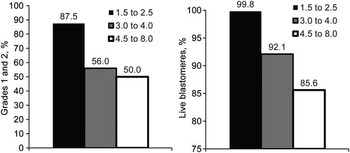
Lactating dairy cows presenting oestrus cycles with three waves of follicle growth have better fertility than cows with two-wave cycles (Townson et al., Reference Townson, Tsang, Butler, Frajblat, Griel, Johnson, Milvae, Niksic and Pate2002). The ovulatory follicle of cows with three-wave cycles has a shorter period of dominance, and cows with extended follicle dominance usually have reduced fertility (Mihm et al., Reference Mihm, Baguisi, Boland and Roche1994; Austin et al., Reference Austin, Mihm, Ryan, Williams and Roche1999; Santos et al. Reference Santos, Thatcher, Chebel, Cerri and Galvão2004). This is likely caused by premature resumption of meiosis by the oocyte originated from follicles having an extended period of dominance (Mihm et al., Reference Mihm, Curran, Hyttel, Knight, Boland and Roche1999). In cows inseminated on oestrus, as the interval from emergence of the ovulatory follicle to ovulation increased, P/AI decreased (Bleach et al., Reference Bleach, Glencross and Knight2004). In fact, when we reviewed data from a study by Cerri et al. (Reference Cerri, Rutigliano, Chebel and Santos2009a) for only cows inseminated after detected oestrus, as the interval between induced luteolysis with PGF2α to oestrus increased, the embryo quality decreased (Figure 2).
Effect of interval between induced luteolysis with prostaglandin (PG)F2α and oestrus on the embryo quality of dairy cows inseminated following detected oestrus. Intervals represent 1.5 to 2.5, 3.0 to 4.0 and 4.5 to 8.0 days. Embryos were classified according to the International Embryo Transfer Society as percentage of all the embryos as grades 1 (excellent and good) and 2 (fair). Data analysed from Cerri et al. (Reference Cerri, Rutigliano, Bruno and Santos2009b).

One method to limit the period of follicle dominance is to reduce the interval between the first GnRH and induced luteolysis from 7 to 5 days (Santos et al., Reference Santos, Narciso, Rivera, Thatcher and Chebel2010a). In dairy and beef cattle, reducing the interval between the first GnRH to induction of luteolysis with PGF2α from 7 to 5 days decreased the period of development of the antral follicle by 2 days, resulting in increased P/AI (Bridges et al., Reference Bridges, Helser, Grum, Mussard, Gasser and Day2008; Santos et al., Reference Santos, Narciso, Rivera, Thatcher and Chebel2010a). In addition to reducing follicle dominance, the 5-day protocol resulted in the ovulation of follicles that were ∼1.5 mm smaller in diameter (17.1 v. 18.5 mm; Santos et al., Reference Santos, Narciso, Rivera, Thatcher and Chebel2010a). It has been suggested that P/AI in the Ovsynch protocol is optimised in high-producing Holstein cows when the ovulatory follicle diameter is neither too small nor too large (Wiltbank et al., Reference Wiltbank, Sartori, Herlihy, Vasconcelos, Nascimento, Souza, Ayres, Cunha, Keskin, Guenther and Gumen2011). Small follicle diameter does not seem to affect fertility of cows inseminated to oestrus, but excessively large follicles usually decrease P/AI because of extended dominance (Wiltbank et al., Reference Wiltbank, Sartori, Herlihy, Vasconcelos, Nascimento, Souza, Ayres, Cunha, Keskin, Guenther and Gumen2011). However, for cows inseminated following timed AI, follicle diameter between 15 and 19 mm seems to be ideal (Souza et al., Reference Souza, Gumen, Silva, Cunha, Guenther, Peto, Caraviello and Wiltbank2007). Unfortunately, the current manipulations of the oestrus cycle still result in large variability in diameter of the ovulatory follicle, partly because of the low ovulation to the initial GnRH and the variable concentrations of progesterone during growth of the pre-ovulatory follicle. Therefore, until new developments occur such that more than 70% of the cows have emergence of a new follicular wave in the first 2 days after the initiation of the timed AI protocol and that high concentrations of progesterone are present until induced luteolysis, it is unlikely to expect consistency in size of the pre-ovulatory follicle of cows subjected to the Ovsynch protocol.
Manipulating the proestrus period and timing of insemination
The success of timed AI programmes is dependent on adequate length of proestrus and proper timing of insemination relative to ovulation. For the standard Ovsynch programme, with 7 days between the initial GnRH and PGF2α , administering the final GnRH 56 h after PGF2α and performing AI 16 h later optimised P/AI in dairy cows (Pursley et al., Reference Pursley, Silcox and Wiltbank1998; Brusveen et al., Reference Brusveen, Cunha, Silva, Cunha, Sterry, Silva, Guenther and Wiltbank2008). Conversely, extending the proestrus longer than 56 h and inseminating cows concurrently with the final GnRH is not ideal for P/AI in dairy cows (Sterry et al., Reference Sterry, Welle and Fricke2006; Brusveen et al., Reference Brusveen, Cunha, Silva, Cunha, Sterry, Silva, Guenther and Wiltbank2008). Allowing 56 h of proestrus helps in additional growth of the ovulatory follicle and increased exposure to oestradiol (Peters and Pursley, Reference Peters and Pursley2003), which is thought to be needed to avoid short oestrus cycles after induced ovulation. On the other hand, for cows subjected to the 5-day timed AI programme, which results in smaller ovulatory follicles and reduced concentrations of oestradiol in the plasma around the time of AI compared with the Ovsynch protocol (Santos et al., Reference Santos, Narciso, Rivera, Thatcher and Chebel2010a), the length of proestrus should be extended to 72 h (Bisinotto et al., Reference Bisinotto, Ribeiro, Martins, Marsola, Greco, Favoreto, Risco, Thatcher and Santos2010b; Ribeiro et al., Reference Ribeiro, Monteiro, Lima, Ayres, Bisinotto, Favoreto, Greco, Marsola, Thatcher and Santos2012b). Therefore, a careful balance involving follicle/oocyte maturation and timing between sperm and oocyte availability must be considered so that optimal fertility can be achieved. Extending the duration of the proestrus during the 5-day timed AI programme compensated for a less optimal interval between induced ovulation and insemination, which allowed for the administration of the final GnRH concurrently with AI at 72 h after PGF2α without rendering P/AI (Bisinotto et al., Reference Bisinotto, Ribeiro, Martins, Marsola, Greco, Favoreto, Risco, Thatcher and Santos2010b).
Use of timed AI protocols in grazing dairy farms
For many years, the use of timed AI programmes for systematic management of reproduction in dairy farms was focused primarily in confinement herds, usually involving high-producing Holstein cows, and most of the research on Ovsynch was generated in the United States. More recently, perhaps because of the acceptance that timed AI results in similar (Chebel et al., Reference Chebel, Santos, Reynolds, Cerri, Juchem and Overton2004) or even better fertility to that observed in cows inseminated after detected oestrus, particularly at the first postpartum AI (Gümen et al., Reference Gümen, Keskin, Yilmazbas-Mecitoglu, Karakaya, Alkan, Okut and Wiltbank2012), timed AI programmes have also been used to improve insemination rates in pasture-based herds. In fact, implementing timed AI protocols for the first AI in the breeding season improved P/AI compared with insemination following detected oestrus (McDougall, Reference McDougall2010b; Herlihy et al., Reference Herlihy, Berry, Crowe, Diskin and Butler2011), and the benefits were observed in cyclic and anovular cows (McDougall, Reference McDougall2010b).
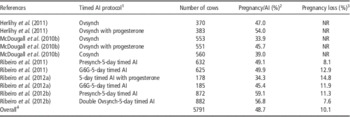
Ribeiro et al. (Reference Ribeiro, Cerri, Bisinotto, Lima, Silvestre, Greco, Thatcher and Santos2011, Reference Ribeiro, Bisinotto, Favoreto, Martins, Cerri, Silvestre, Greco, Thatcher and Santos2012a and 2012b) conducted a series of experiments evaluating different methods of timed AI in grazing cows supplemented with concentrates and producing ∼6500 kg of milk/lactation. In those studies, it was clear that presynchronising the oestrus cycle before subjecting cows to timed AI improved P/AI (Ribeiro et al., Reference Ribeiro, Bisinotto, Favoreto, Martins, Cerri, Silvestre, Greco, Thatcher and Santos2012a; Table 1). The benefits of presynchronisation compared with using an intravaginal insert during the protocol was attributed to an increased proportion of cows with a CL on the 1st day of the timed AI programme and increased ovulatory response to the initial GnRH treatment. In all studies reported by Ribeiro et al. (Reference Ribeiro, Cerri, Bisinotto, Lima, Silvestre, Greco, Thatcher and Santos2011, Reference Ribeiro, Bisinotto, Favoreto, Martins, Cerri, Silvestre, Greco, Thatcher and Santos2012a and 2012b), the 5-day timed AI protocol was utilised in an attempt to reduce the period of follicle dominance and the diameter of the pre-ovulatory follicle.
Pregnancy per artificial insemination (AI) and pregnancy loss in grazing dairy cows subjected to timed AI for the first postpartum insemination of the breeding season

NR=not reported in the study.
1 Detailed description of the synchronisation protocols used is provided by the respective references.
2 Pregnancy per AI based on the first diagnosis of pregnancy reported after the timed insemination.
3 Pregnancy loss between the first and the second pregnancy diagnoses reported in three of the five references listed in the table. For those references, the initial pregnancy diagnosis was performed 35 days after timed AI and the second between 65 and 66 days after timed AI.
4 Results reflect the weighted average based on the number of cows in each experiment.
A summary of fertility responses of grazing cows subjected to timed AI protocols based on GnRH and PGF2α , with or without supplemental progesterone, from recently published studies is presented in Table 1. P/AI varied with experiment, and it was less when cows had not been presynchronised or when the study focused on the subpopulations of cows with high prevalence of anovulation (McDougall, Reference McDougall2010b). Nevertheless, an overall 48.7% of the cows became pregnant to the first insemination performed on day 1 of the breeding season. This is important as having half of the cows pregnant on the 1st day of mating facilitates management and assures economic sustainability of the farm (McDougall and Compton, Reference McDougall and Compton2006).
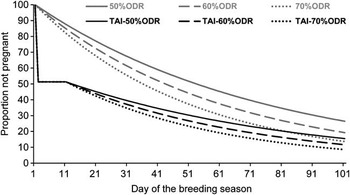
We modelled the interval to pregnancy for 100-day breeding season, assuming 50%, 60% or 70% oestrus detection rate (i.e. 50%, 60% or 70% of eligible cows are inseminated at each 21-day interval of the breeding season), and incorporating timed AI for the first insemination on day 1 of breeding (Figure 3). It was assumed that P/AI would be the same for all breeding programmes and all inseminations, the same 48.7% observed in Table 1. It was also assumed that for programmes using timed AI for first insemination, no cow would return to oestrus until day 11 after the initial breeding. Clearly, improving oestrus detection rate is important to increase the proportion of cows pregnant early in the breeding period. As detection of oestrus increased from 50% to 70%, the median days to pregnancy decreased from 52 to 35. Nevertheless, implementing timed AI for first insemination was superior in all scenarios evaluated, even when for timed AI the follow-up oestrus detection rate was only 50% (median days to pregnancy=12) compared with 70% oestrus detection for cows inseminated only on oestrus (median days to pregnancy=35).
Survival curves for interval from the beginning of the breeding season to pregnancy when cows are inseminated only after detected oestrus or using timed artificial insemination (TAI) for first artificial insemination (AI), and then followed by the detection of oestrus. In both the breeding programmes, pregnancy per AI was assumed to be 48.7% for all inseminations. Three oestrus detection rates (ODR) were used to result in 50%, 60% and 70% of the eligible cows inseminated at each 21-day period in the breeding season. A total of 100 days of breeding was used. For TAI, no cow was assumed to return to oestrus until day 11 after the first insemination. The median days to pregnancy and respective proportion pregnant at the end of the season were: 50%ODR=52 days and 73.6%; 60%ODR=42 days and 80.8%; 70%ODR=35 days and 86.3%; TAI-50%ODR=12 days and 84.5%; TAI-60%ODR=12 days and 88.4%; TAI-70%ODR=12 days and 91.5%.

In pasture-based milk production herds, particularly those using seasonal grazing with a pre-established breeding season, it is critical for cows to be inseminated early in the breeding period because of the subsequent impacts on cow survival and fertility in the subsequent mating seasons. Cows that become pregnant early in the breeding season and to AI, as opposed to natural service, as commonly used in many grazing systems at the end of the season, are more profitable (McDougall and Compton, Reference McDougall and Compton2006). In New Zealand, becoming pregnant early in the mating season assures a longer lactation that has marked effects on production and profitability (McDougall and Compton, Reference McDougall and Compton2006). In fact, the advantages of using timed AI for management of first insemination of grazing cows are similar to those observed with high-producing cows under confinement systems (Ribeiro et al., Reference Ribeiro, Galvão, Thatcher and Santos2012c). The latter are known to benefit from timed AI because of issues with the detection of oestrus.
Conclusion
Manipulation of the oestrus cycle to improve insemination rates continues to be an area of major interest and of active research. Timed AI has become an integral component of reproductive management in many dairy herds because of challenges with the detection of oestrus either because of poor expression of oestrus by cows or the inability of systems in place to identify these animals in oestrus. Despite decades of research and numerous studies, timed AI protocols based on GnRH and PGF2α have limitations on the ability to synchronise the emergence of follicle growth, to induce complete CL regression and to have an ovulation at a predictable time to optimise fertility. In most cases, <60% of the cows experience all these pre-requisites for high fertility. Advantage should be taken to optimise pregnancy at the first postpartum insemination because of the ability to presynchronise the oestrus cycle and improve cow fertility with timed AI programmes. Unfortunately, until new technologies for hormone formulation and delivery become available, improvements in synchrony of follicle growth, luteal regression and ovulation will require additional interventions that might make these programmes less practical or acceptable by producers. It is clear that current and future research need to focus on target groups of cows, such as anovular cows and cows with less than optimal follicle competence and steroid concentrations to maximise response to treatments. Nevertheless, additional gains in fertility after insemination are unlikely to occur with only hormonal manipulation of the oestrous cycle and will require a more holistic approach to reproduction, integrating improvements in peripartum cow health and nutrition.
Acknowledgement
Research conducted by the authors was partially supported by grants from the Southeast Milk Check-Off Dairy Research and Education Projects, Merck Animal Health (Summit, NJ), and Zoetis (Madison, NJ).