1. Introduction
Small-scale fisheries are facing increasing challenges induced by the amplitude and the pace of the changes that are taking place in both their economic and ecological ‘worlds’. In many coastal developing countries, the combined effects of pollution, climate change and overfishing affect marine habitats and reduce resources and diversity (Halpern et al., Reference Halpern, Walbridge and Selkoe2008; Mora, Reference Mora2008). In some places, this situation is exacerbated by the rapid demographic transition that characterizes the developing world (Sunderlin, Reference Sunderlin1994; Botsford et al., Reference Botsford, Castilla and Peterson1997). In that context, while the number of fishers may no longer grow as rapidly as it has in the previous 50 or 60 years, global fishing effort is still increasing, driven mainly by economic forces and the demand from the growing (local and distant) urban population (Kittinger, Reference Kittinger2013).
This paper explores the issue of the viability of small-scale fisheries in this particular context. We are especially interested in considering the importance of the interactions between socio-economic and ecological dynamics, and in analyzing the potential role that cooperation and collective arrangements between agents can play in these interactions to maintain the viability of the system.
The Pacific region is a very relevant ‘prism’ through which to observe and explore these issues. Most of the island countries in the region are still considered to be poor countries, and small-scale fisheries are an important (sometimes the only) economic opportunity for many poor households, especially in the rural and remote parts of these islands (kronen, Reference Kronen2004, Reference Kronen2007). The sector is therefore a keystone of the domestic economy. At the same time, fish is also the main source of protein for the vast majority of the growing (urban and rural) population in the whole region (Oreihaka and Ramohia, Reference Oreihaka and Ramohia1994; Yari, Reference Yari2003/2004; Molea and Vuki, Reference Molea and Vuki2008).
Yet many of these islands are experiencing a rapid degradation of their marine resources which are showing growing signs of over-exploitation (Dalzell et al., Reference Dalzell, Adams and Polunin1996; Aswani and Sabetian, Reference Aswani and Sabetian2009; Masu and Vave-Karamui, Reference Masu and Vave-Karamui2012). The consequences could be disastrous, as degraded marine resources would imply important food security problems for these countries (Bell et al., Reference Bell, Kronen and Vunisea2009; Weeretunge et al., Reference Weeratunge, Pemsl and Rodriguez2011).
Societies from this part of the world are currently experiencing other important socio-economic and cultural challenges. The ancient tradition of barter (Sahlins, Reference Sahlins1963; Sheppard and Walter, Reference Sheppard and Walter2006) and the gift economy (Feinberg, Reference Feinberg1996) that had been present for centuries is being progressively eroded by the increasing need for cash imposed by the globalized economy (Dignan et al., Reference Dignan, Burlingame and Kumar2004). Cash is in fact becoming a central element in the life of these people, even if the subsistence economy is still prevalent, especially in rural areas (Schwarz et al., Reference Schwarz, Ramofafia and Bennett2007; Kronen et al., Reference Kronen, Sauni, Veitayaki, Nielsen, Dodson, Friedland, Hamon, Musick and Verspoor2008; Hardy et al., Reference Hardy, Béné, Doyen and Schwarz2013).
Another important element which is evolving rapidly relates to fishery management. The vast majority of Pacific small-scale fisheries have been traditionally managed through customary systems (Ruddle, Reference Ruddle1988). One important feature of these systems implies a spatial regulation of the fisheries (Cinner, Reference Cinner2005; Fáanunu, Reference Fáanunun.d.). This, however, tends to disappear over time with more and more open-access based fisheries. Fortunately, other features of the traditional systems still exist and help regulate fisheries activities, such as social redistributive mechanisms between groups of fishers (including family and friends). The objective of these redistributive mechanisms is to ensure that each member of the group receives a minimum amount of fish irrespective of their personal catch. The underlying principle is the overall food security of the entire community. In that sense, this ‘redistributive’ element shares some common features with the old concept of mutual aid described in Kropotkin (Reference Kropotkin2009) or Borkman (Reference Borkman1999). These collaborative arrangements of redistribution are named in various ways around the Pacific region: the ‘wantok’ in Papua New Guinea and the Solomon Islands, or the ‘kerekere’ in Fidji (Monsell-Davis, Reference Monsell-Davis1993; Cinner, Reference Cinner2009; Gordon, Reference Gordon2011). We propose to explore whether the establishment of these types of collaborative mechanisms among groups of fishers exploiting the same resource can be a critical element in maintaining the overall viability of the small-scale fishery system in a challenging environment where shocks and sudden changes in resource abundance are frequent.
To explore this hypothesis, we use the concept of resilience as broadly understood in the general literature. Many recent definitions of resilience have been proposed in different disciplines (Manyena, Reference Manyena2006; Bahadur et al., Reference Bahadur, Ibrahim and Tanner2010). Most of them, however, have in common the basic idea that a resilient system is a system that is able to reduce/smooth the negative impacts of shocks, and adapts when these changes affect parts of, or the whole system.
Quantifying or measuring this ability to reduce the impacts of perturbation is, however, methodologically difficult (Armitage et al., Reference Armitage, Béné, Charles, Johnson and Allison2012; Frankenberger and Nelson, Reference Frankenberger and Nelson2013; Béné et al., Reference Béné, Frankenberger and Nelson2015). In our case, that is, under a dynamic framework, we follow Béné et al. (Reference Béné, Doyen and Gabay2001) and Martin (Reference Martin2004) who propose linking resilience to the concept of ‘time of crisis’. ‘Time of crisis’ is the time it takes for a dynamic system to return to a viable state after a shock. In other words, the more resilient a system is, the shorter the time of crisis is expected to be.
In the rest of this paper, a bio-economic model of a small-scale fishery system is developed (based on an example of Pacific fisheries) and two scenarios are considered: the first one involves a community of fishers who do not cooperate with each other{;} the second scenario assumes that the members of these same communities are collaborating. The outcomes of these two scenarios are estimated through numerical simulations with two different settings: one with and one without shock effect. In both cases, the time of crisis of the system is then computed to estimate the system's resilience. Finally, elements of resilience theory are used to revisit these results and structure the discussion.
2. The Solomon Islands case study
Within the Pacific region, the Solomon Islands were chosen for our research essentially due to three reasons: (i) the country is characterized by one of the highest fish consumption rates of the region (35 kg/person/year (Bell et al., Reference Bell, Kronen and Vunisea2009)), emphasizing the critical role that marine resources play in national food security; (ii) these islands also have one of the highest demographic growth rates in the Pacific region (between 2.3 and 2.8 per cent (CIA, 2001)), meaning that the current pressure on these marine resources is expected to continue to intensify in the future, raising some serious concerns about the impact that this pressure could have on their environmental sustainability; and (iii) the Solomon Islands are one of the countries with the lowest Human Development Index of the region (143/186), highlighting the high prevalence of poverty across the whole population.
The Solomon Islands case study is part of a broader group of Small Islands Developing States in the Western Pacific where Johannes (Reference Johannes1981, Reference Johannes2002) has conducted fundamental research on the relationship between customary marine tenure (CMT) and marine resources exploitation. In this region, the CMTs are diverse and rich and are said to provide resilience by special dispositions of resources management (Ruddle et al., Reference Ruddle, Hviding and Johannes1992). CMTs have motivated many reflections on how to address indigenous ecological knowledge for marine resources management (Foale, Reference Foale2006), or overstep political barriers in marine resources conservation (Foale and Manele, Reference Foale and Manele2004). We are thus interested in putting Foale's statement into perspective with a model to get a quantitative understanding of what social arrangements linked to the CMT effectively do for marine resources sustainable management.
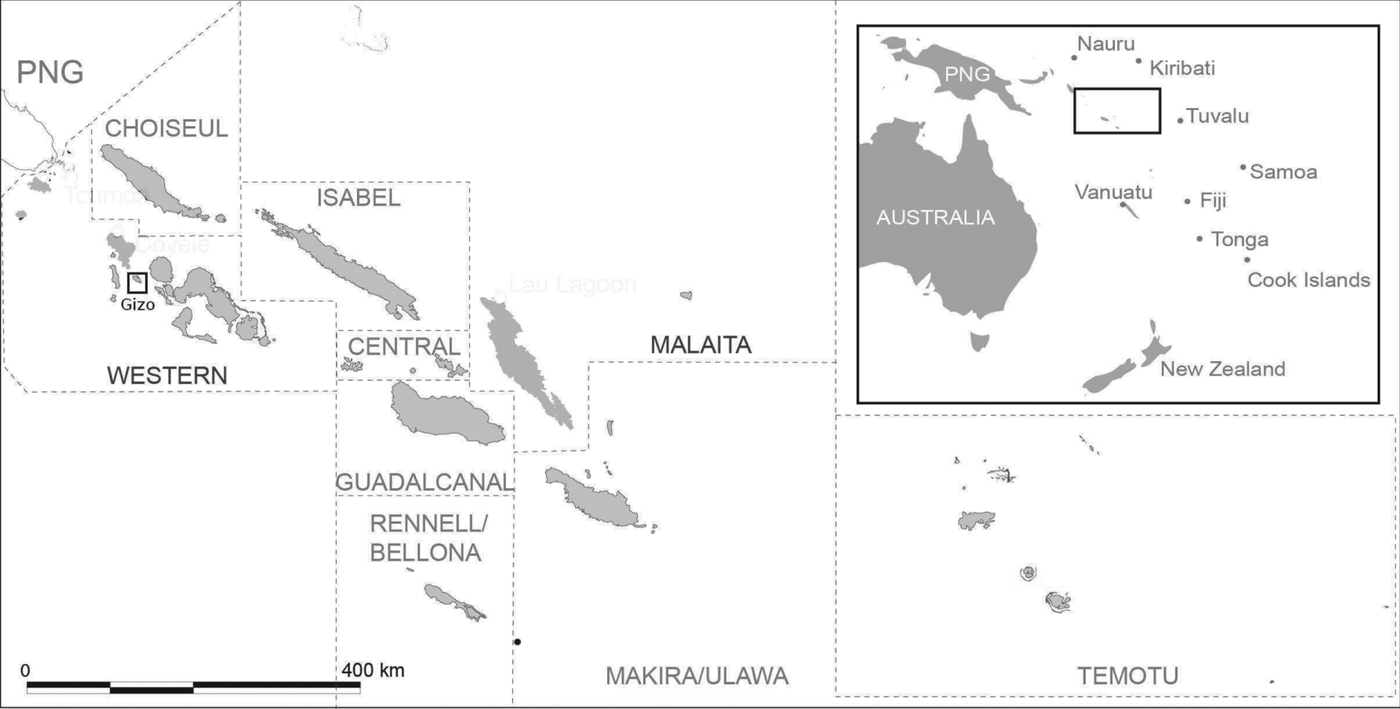
Within the Western Pacific, the Western province (Solomon Islands) was used for our fieldwork (see figure 1). There, the small town of GizoFootnote 1 (on Gizo Island) was selected to illustrate the effect of cooperation among four communities of fishers showing what we call an ‘extended’ wantok. Footnote 2 Gizo Island presents two very interesting features. First, we can study the effect of social arrangement in an open access situation since the waters around Gizo Island are state waters and can be visited by anyone. Secondly, the diversity of communities and their related CMT and their related wantok are informative regarding the genericity of social arrangements. The Gizo town context was therefore used to parametrize the bio-economic model presented below.
Map of the Solomon Islands, indicating the Western province (Gizo) where the research was conducted

3. Bio-economic model
To focus on social arrangement issues, we consider a very stylized and simple ecological model. More complex and ecosystemic models in a Pacific context can be found in Hardy et al. (Reference Hardy, Béné, Doyen and Schwarz2013). The bio-economic model used in this study is based on the dynamic of a renewable resource assumed to be exploited by heterogeneous agents who differ from each other by their operating (fishing) costs and catchability efficiency.Footnote 3 The fishing decisions of these agents are assumed to be driven by cash optimality under subsistence constraints, following cooperative or non-cooperative strategies. In our dynamic framework, both non-cooperative and cooperative agents are assumed to be myopic with respect to the impact of their fishing effort on the stock dynamics; that is, the cooperation is not considered as a way to internalize the stock dynamics, but as a means to concentrate the fishing effort into the hands of the most efficient agent(s) and ensure the fulfillment of the subsistence constraint for all agents.
3.1. The dynamic model
The dynamics of the stock biomass B(t) exploited by a set of N(t) fishers is considered in discrete time. It is characterized by an intrinsic growth r and a carrying capacity K through a logistic growth function:
 $$B\lpar t+1\rpar = B\lpar t\rpar \left(1 + r\left(1-\displaystyle{{B\lpar t\rpar }\over{K}}\right)- \sum_{i=1}^{N\lpar t\rpar } q_{i} e_{i}\lpar t\rpar \right)$$
The stock biomass includes the main fished families in the region (mainly Serranidae, Lutjanidae, Lethrinidae, Acanthuridae, Scaridae and Haemulidae, Labridae, Siganidae, Balistidae, Mullidae, and Kyphosidae to a lesser extent), which together represent more than 80 per cent of the average national catch (Richards et al., Reference Richards, Bell and Bell1994). Using a Schaefer production function, the harvest H i (t) of each agent i can be estimated through the product of their fishing effort e i (t), catchability q i and the stock biomass B(t) as follows:
 $$H_{i}\lpar t\rpar =q_{i}e_{i}\lpar t\rpar B\lpar t\rpar \quad i=1\comma \; \ldots\comma \; N\lpar t\rpar $$
Accounting for the demographic pressure of the human population, the number of fishers is assumed to increase according to the equation
 $$N\lpar t+1\rpar = N\lpar t\rpar \lpar 1+d\rpar$$
where d stands for the demographic growth rate over time.
3.2. Agents' strategies: subsistence versus cash
The different fishers (agents) are assumed to exploit the biomass B(t) to cover their subsistence needs. These needs, which are noted H lim , are assumed to be similar for all agents and represent the minimum fish consumption required every week by individual households. The cash generated by each agent i is the difference between the income derived from the remaining catch after consumption and the costs of fishing operations, as follows
 $$\pi_{i} \lpar t\rpar = p \cdot \lpar H_i\lpar t\rpar -H_{\lim} \rpar - c_{i} \lpar e_{i}\lpar t\rpar \rpar $$
Following Clark (Reference Clark1990) and Doyen and Péreau (Reference Doyen and Péreau2012), the agent's total fishing costs are represented by a quadratic cost function:
 $$c_{i}\lpar e\rpar =c_{0}+c_{1\comma i}e+c_{2}e^{2} $$
where the term c 0 represents the fixed costs and c 1, i is the variable unit costs, which differ between agents. The quadratic cost parameter c 2 can be related to travel costs (Sampson, Reference Sampson1992; Carr and Mendelsohn, Reference Carr and Mendelsohn2003) and ‘social’ costs measured by the time devoted to other social obligations (gardening, family, church) (Hanson and Ryan, Reference Hanson and Ryan1998)Footnote 4 .
‘Agents’ consist of groups of homogeneous fishers (in our case five fishers) from the same community who use the same fishing gear (see below). Each agent is therefore characterized by a specific catchability efficiency q i that reflects his own community's average catchability efficiency plus or minus an individual variation randomly assigned within 20 per cent of the community average. Agents can therefore be ranked by decreasing efficiencies as follows:
 $$\displaystyle{{c_{1\comma 1}}\over{q_{1}}}\leq \displaystyle{{c_{1\comma 2}}\over{q_{2}}}\leq \ldots \leq \displaystyle{{c_{1\comma n}}\over{q_{n}}}$$
Fishers are said to be ‘cooperative’ when they seek to maximize their aggregated revenues and simultaneously take into account the sum of the subsistence constraints for all members in the community. In other words, cooperative fishers would share both their subsistence constraints and cash maximization objective.Footnote 5 In contrast, a non-cooperative strategy corresponds to a strategy where individual fishers factor in their own subsistence constraints while at the same time trying to maximize their own individual cash needs.
Note that the way the cooperative strategy is defined implies that it can be optimal for the most efficient fishers in the group to fish on the behalf of the least efficient fishers (for instance, the old or disabled fishers), to ensure that the H lim requirement is satisfied for all members in the group.
To summarize, the two strategies can be written as follows:
 $$\matrix{\matrix{\hbox{No cooperation}: &\hbox{Cooperation}:}\cr \matrix{\displaystyle\max_{e_{i}(t)} \pi_{i}(t) &\displaystyle\max_{e_{1}(t),\ldots, e_{N(t)}(t) } \sum_{i=1}^{N(t)} \pi_{i}(t)} \cr \matrix{\left\{\matrix{e_{i}(t)\geq 0 \cr H_{i}(t) \geq H_{\lim}}\right. &\left\{\matrix{e_{i}(t) \geq 0 \cr \displaystyle\sum_{i=1}^{N(t)}H_{i}(t) \geq N(t)H_{\lim}}\right.}}$$
We use optimality conditions to derive the effort strategies in both the non-cooperative and cooperative cases. In the case of the non-cooperative strategy, it can be demonstrated that fishers adjust their fishing effort allocation to respond to the level of stock B(t) as follows:
 $$e_{i}^{nc}\lpar B\lpar t\rpar \rpar = \max \left(\displaystyle{{q_{i} B\lpar t\rpar - c_{1\comma i}} \over {c_{2}}}\comma \; \displaystyle{{H_{\lim}}\over {q_{i} B\lpar t\rpar }}\right)$$
where the subscript nc denotes non-cooperative strategy.
In the case of the cooperative strategy (denoted by the subscript co), the allocation of fishing effort is given by:
 $$e_{i}^{co}\lpar B\lpar t\rpar \rpar =\max \left(\displaystyle{{q_{i}B\lpar t\rpar -c_{1\comma i}} \over {c_{2}}}\comma \; \displaystyle{{1}\over{2c_{2}}} \left(\displaystyle{{2N\lpar t\rpar c_{2}q_{i}H_{\lim}}\over{B\lpar t\rpar \delta \lpar t\rpar }}+q_{i}\displaystyle{{\gamma \lpar t\rpar }\over{\delta \lpar t\rpar }}-c_{1\comma i}\right)\right)$$
with
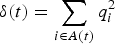 $\delta \lpar t\rpar =\displaystyle\sum_{i\in A\lpar t\rpar }q_{i}^{2}$
and
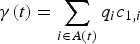 $\gamma \lpar t\rpar = \displaystyle\sum_{i\in A\lpar t\rpar }q_{i}c_{1\comma i}$
, and where A(t) is the set of active fishers with a positive effort and
 $i^{\star }\lpar t\rpar =\max \lpar i\comma \; e_{i}^{co}\lpar B\lpar t\rpar \rpar \rpar >0\rpar $
: such that
 $$A\lpar t\rpar =\left\{i\in \lpar 1\comma \; ..\comma \; i^{\star }\lpar t\rpar \rpar \comma \; q_{i}\left(\displaystyle{{2c_{2}N\lpar t\rpar H_{\lim }+\sum_{j=1}^{i^{\star }\lpar t\rpar }c_{1\comma j}q_{j}} \over {B\lpar t\rpar \sum_{j=1}^{i^{\star }\lpar t\rpar }q_{j}^{2}}}\right)-c_{1\comma i}\geq 0\right\}$$
The mathematical proofs of these expressions are provided in appendix 7.1.
3.3. The resilience index
The modelling analysis is completed by the computation of a resilience index. Following Béné et al., (Reference Béné, Doyen and Gabay2001) and Martin (Reference Martin2004), this resilience index is based on the calculation of the system's ‘crisis time’, that is, the time it takes for a system to come back to a viable configuration after a shock. In our case, this viable configuration corresponds to a situation where the subsistence constraint defined by the threshold H lim is satisfied (i.e., food security is secured for all members of the community N(t)), and where the resource stock is larger than a minimum viability threshold denoted by B lim .Footnote 6
In the non-cooperative case, the crisis time is estimated by:
 $$\eqalign{& \quad\quad\quad\hbox{Crisis}^{nc}\lpar B_0\comma \; H_{\lim}\comma \; N_0\rpar = \sum_{t=t_0}^{T} {\bf 1}^{nc}\lpar t\rpar \cr & \hbox{with} \quad {\bf 1}^{nc}\lpar t\rpar = \left\{{\matrix{ 0 & {\hbox{if}\; H_i\lpar t\rpar \gt H_{\lim}\quad\forall i\quad \hbox{and}\; B\lpar t\rpar \gt B_{lim }} \cr 1 & \hbox{otherwise} \hfill \cr } } \right.}$$
In the cooperative case, the crisis time is estimated by:
 $$\eqalign{& \quad\quad\quad\hbox{Crisis}^{co}\lpar B_0\comma \; H_{\lim}\comma \; N_0\rpar = \sum_{t=t_0}^{T} {\bf 1}^{co}\lpar t\rpar \cr & \hbox{with} \quad {\bf 1}^{co}\lpar t\rpar = \left\{{\matrix{ 0 & {\hbox{if}\; \sum\limits_{i=1}^{N\lpar t\rpar } H_i\lpar t\rpar \gt N\lpar t\rpar H_{\lim}\quad \hbox{and} \quad B\lpar t\rpar \gt B_{lim }} \cr 1 & \hbox{otherwise} \hfill \cr } } \right.}$$
We are interested here in the long-term crisis as the short-term ones are inherent to the systems capacity to bounce back to safe places. In order to account for the long-term crisis, the resilience index is made time-scale invariant, using a ratio depending on the total time T ′ equivalent to a long-term period. The resilience index is defined as:
 $$Res\lpar B_0\comma \; H_{\lim}\comma \; N_0\rpar = \displaystyle{{T^{\prime }- \hbox{Crisis}\lpar B_0\comma \; H_{\lim}\comma \; N_0\rpar } \over {T^{\prime}}} $$
Defined as such, the resilience index varies between 0 and 1. Values close to 1 indicate systems with strong resilience (i.e., situations where a system can return to a food security condition relatively rapidly), while values close to 0 indicate cases where the system has difficulty returning to a viable condition after a crisis. In particular, when resilience equals 0, food insecurity becomes permanent, which also corresponds to an infinite crisis time. As T ′ becomes big enough, the geometrical behavior of the index makes a distinction between very low value in the first case (infinite succession of regular short crisis times), and null value in the second case (infinite unique long-term crisis time).
The calculation of the index also provides a sensitivity metric, which offers the opportunity to study the sensibility of the model to different parameters. In particular, the three principal parameters, B 0, H lim and the catchability repartition among the N 0 agents, represent potential factors of resilience and are susceptible to being influential in the system; as such they will be tested through a sensitivity analysis – see below.
3.4. Calibration of the model
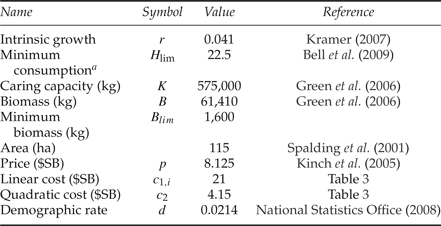
All simulations are based on a weekly time unit. The simulations are run over a 10-year period (T = 10*52 = 520), assumed to correspond to 2011–2021 (most of the field observations were collected in 2011 except the biomass assessment which has been conducted in 2004).Footnote 7 We consider a single marine resource stock where the initial biomass is assumed to be equal to B 0 = 534 kg/ha (Green et al., Reference Green, Lokani, Atu, Ramonia, Thomas and Almany2006),Footnote 8 with an ecosystem carrying capacity of K = 5, 000 kg/ha (which corresponds to the ‘high biomass’ situation referred to in Green et al., Reference Green, Lokani, Atu, Ramonia, Thomas and Almany2006), and an intrinsic growth rate r = 0.0415 (Kramer, Reference Kramer2007). The minimum biomass B lim = 1,600 kgFootnote 9 represents a stock level under which an average fisher will return with no fish even if they operate with the maximum effort of six hours/day/fisher. All parameters are depicted in table 2.
Four groups of fishers (noted k = 1, 2, 3, 4) operate from the town of Gizo. The first group is the foreign Melanesian group from Malaita island (around 15 fishers in total) who fish using gillnets. The second group includes Micronesian individuals (around 70 fishers in total) who fish using spearguns. The last two groups belong to the local Melanesian community originating from Vella Lavella and Ranonga islands. The first of these (about 45 fishers) fish during both day- and nighttime using hook and line, while the second group (around 30 fishers) fish only during the daytime, also using hook and line. In total, the whole fishing community that exploits Gizo's reefs on a weekly basis includes about 160 fishers (which represents 32 agents). The initial number of agents per group N k (t 0) is given in table 1.
The number of agents per community and their relative average catchability parameter

List of parameters and values used in the model
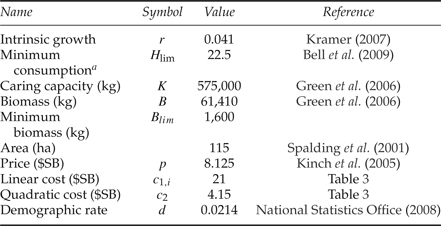
Notes: a The average fish consumption per household was estimated to be 45 kg per year (Bell et al., Reference Bell, Kronen and Vunisea2009). This is equivalent to 22.5 kg/agent/week since the average number of fishers per agent is five and the number of people in a fisher's household is 5.2 (National Statistics Office, 1999).
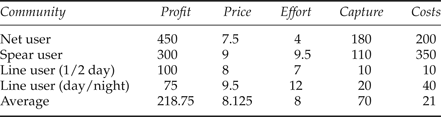
In small towns like Gizo, the fish market price p remains relatively constant over time, around 8.125 Solomon dollars ($SB) per kilo (P.-Y. Hardy, personal observation, 2011). The cost of engaging in fishing activities is assumed to be the same for all fishers, and was estimated to be around c 2 = 4.15$SB (the details of the c 2 calibration are provided in appendix 7.2). As all fishers purchase fishing gear and petrol in Gizo town, we also assumed they share the same variable costs c 1, i . Empirical data suggest that c 1, i varies around 21$SB per hour for every agent i (see appendix 7.2). The fixed costs c 0 are negligible (the investment for a canoe is small when estimated on a weekly scale (Kronen, Reference Kronen2004)). In small towns like Gizo, the average fish consumption per household is estimated to be around 45 kg per year (Bell et al., Reference Bell, Kronen and Vunisea2009). This is equivalent to 22.5 kg/agent/week since the average number of fisher per agent is 5 and the number of people in a fisher's household is 5.2 (National Statistics Office, 1999).
The productivity of the speargun fishers (group 2) as estimated by Sabetian (Reference Sabetian2010) (to be around 5.8 kg/h/fisher) is taken as the reference value. Gillett (Reference Gillett2010) reports values of the same range (3 kg/h/fisher). Gillett (Reference Gillett2010) also estimates catchability values for hook-liners (1.9 kg/h/fisher) and gill-netters (15 kg/h/fisher) for the Pacific region. The Gizo area, however, is likely to be characterized by slightly different values. In particular, based on our field observations, the productivity of the hook and line fishers was observed to be 25 per cent (group 3) to 55 per cent (group 4) lower than the productivity of the speargun fishers, while the netters (group 1) were observed to catch three times more than the speargun fishers during the same time. The productivity expressed in kg/h/fisher was then multiplied by the number of agents and divided by the biomass in kg to obtain the catchability parameters q (in 1/h) (see table 1).
3.5. Sensibility analysis
A sensibility analysis was run to analyze the behavior of the model under different parameter values. In this sensitivity analysis, the initial biomass B 0 was set up to vary from 25 to 275 per cent of its current value (a range which accounts for the uncertainty of the initial biomass evolution) and the food security threshold H lim from 25 to 400 per cent. The initial number of agents, N 0, was set to range from 10 to 60. While the two first ranges were set arbitrarily, the last represents the local situation of the Solomon Islands with 10 agents on average per village (National Statistics Office, 1999), up to 60 agents (300 fishers) in the capital city (Brewer, Reference Brewer2011). For each different number of agents N 0, the catchability vector corresponds to the Melanesian situation and illustrates a combination of different gear in accordance with the regional practices (Cinner, Reference Cinner2005), (15 per cent of net fishing, 25 per cent of speargun fishing, 30 per cent of day line fishing, and 30 per cent of line fishing around the clock). For N 0 = 60, the catchability vector reflects the heterogeneity of 300 fishers. The time T ′ is fixed at 30 years, considered as a long-term period.
4. Results
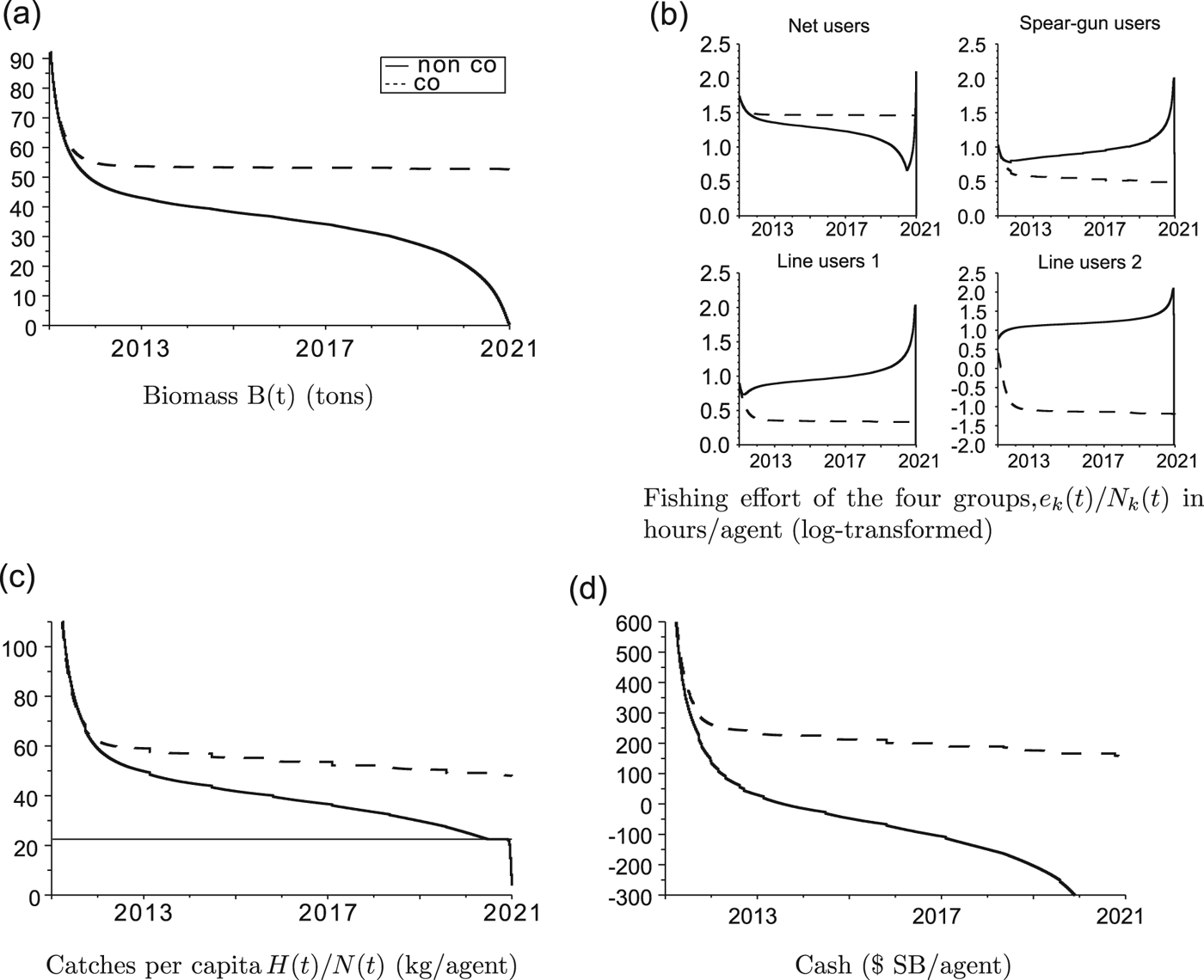
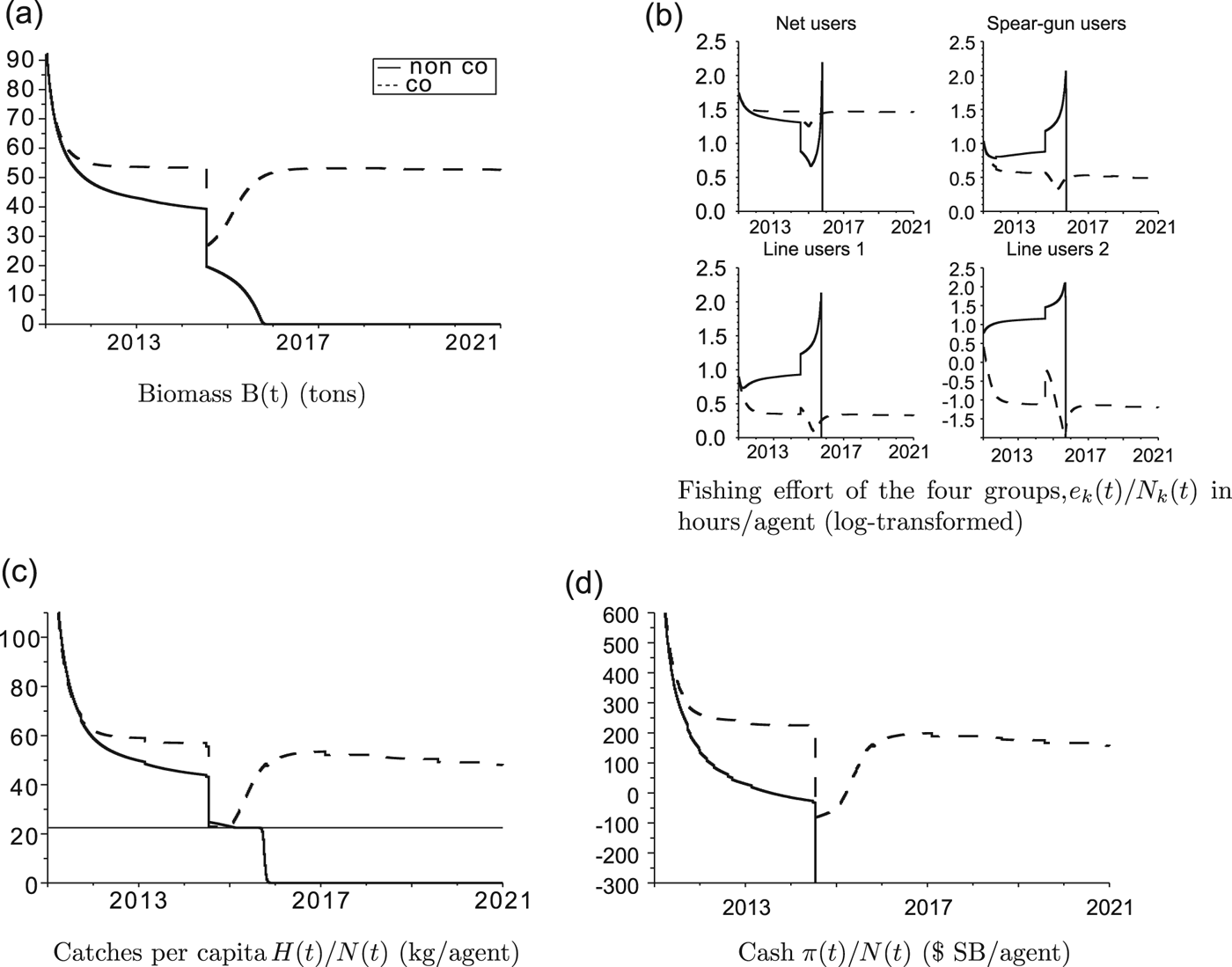
Figure 2 displays the trajectories of the exploited resource B(t), the fishing efforts of the four fisher groups, their subsistence level H(t)/N(t), and cash-income π (t)/N(t) derived from fishing, for both non-collaborative (solid black lines) and collaborative (dashed black lines) strategies. Figure 3 shows the similar curves when the system is affected by a shock. This shock corresponds to a sudden 50 per cent drop in the biomass occurring after 3.5 years (within the 10 years of the simulation).Footnote
10
Figure 4 displays the results of the sensibility analysis. It shows the average resilience indicator
 ${\bar Res}\lpar B_{0}\comma \; H_{\lim}\comma \; N_{0}\rpar $
of the system responding to a 50 per cent shock for different levels of initial biomass (x-axis), food security threshold (y-axis) and initial number of agents (z-axis).
Cooperation vs. non-cooperation in the case without shock

Cooperation vs. non-cooperation in the case with shock of a 50 per cent drop of the biomass

Resilience index: comparison of average resilience index Rēs (B 0, H lim, N 0) for different combinations of initial parameters B 0, H lim, N 0, respectively, ‘Initial biomass’, ‘Food security’, number of initial agents (noted ‘Nb’)

The results show that even in the case with no shock (figure 2) the collaboration between the fishers (that is, when they comply with the wantok rules) is already beneficial. Without collaboration, the four groups of fishers are all fishing to ensure their individual subsistence (figure 2, graph (b), solid black line). The combined effect of their fishing pressure on the resource (graph (a), solid black line) leads the resource biomass B(t) to slowly decline, forcing them to fish more intensively. Eventually, the fishing efforts of the four groups increase exponentially to reach the maximum effort level possible as the resource B(t) collapses. Their cash becomes negative very quickly (graph (d)). In the last few months prior to the fishery collapse, the fishers were just able to maintain their subsistence (graph (c), black curve) at the food security threshold level H lim.
In contrast, the collaborative fishing community manages to maintain the resource B(t) at a sustainable level (figure 2, graph (a), dashed black line) and the aggregated subsistence level well above the food security threshold of 22.5 kg/agent/week (graph (c)). Similarly, cash income decreases slowly but remains positive.Footnote 11 This capacity of the community members to maintain their food security above the threshold H lim is the result of the collaboration between the four different groups. As shown in graph (b) (dashed black line), the fishers of group 1 (the 15 individuals fishing with nets) are the only ones who do not reduce their fishing effort compared to the non-cooperative level, while the existence of the cooperative arrangement allows the other (less efficient) groups to reduce their activities – to two-thirds of the non-cooperative level for the speargun fishers, half of the non-cooperative level for the day and night hook-liners, and one-twentieth for the day hook-liners. In fact, the high efficiency of fishers from group 1 means that they are able to catch enough fish to feed the whole community and still maintain a positive aggregated cash-income for the whole community, while the worst fishers stop fishing very rapidly, thus lessening the average fishing effort.
The scenario with shock further illustrates the benefits of the cooperative strategy (figure 3). Under the effect of the shock, the non-cooperative fishing community and the resource begin to struggle very quickly. The resource base is unable to recover from the initial 50 per cent shock. The fishers, in an attempt to maintain their subsistence at the level of the food security threshold H lim, increase their fishing effort dramatically (figure 3, graph (b), solid black line), leading to the collapse of the stock within a few months (graph (c), solid black line). Simultaneously, the fishers' subsistence level passes below the threshold H lim, indicating a food security crisis.
The case with the cooperative strategy (dashed black line) shows a totally different outcome. As the shock hits the resource, the food security of the community is at stake for a few months during which the household's subsistence is just maintained at the threshold level H lim. Fishers from groups 1 and 2 reduce their activities by half for a few weeks (see graph (b), dashed black line) while the others start to fish a little more. The cash drops to negative values for a few weeks. However, in contrast to the non-cooperative scenario, the resource bounces back relatively rapidly to the level where it was before the shock. Both subsistence and cash-income indicators eventually return to their pre-shock trajectories.
The results of the sensibility analysis (figure 4) put the previous findings into perspective. In particular, they show that for conditions around [115,000, 22.5, 30] – which correspond to the Gizo situation in 2011 – the 50 simulations generate an average resilience index that is not equal to 1 (contrary to what figure 3 suggested), but rather to a lower value (as indicated by the gray color on the graph). In fact, the situation depicted by figure 3 seems to be one of the few cases with 30 agents which leads to full resilience.
What figure 4 also shows, however, is that, overall, the system under a collaboration arrangement still does better than under a non-collaboration arrangement, especially when the number of agents is low. For instance, for conditions close to N = 10 agents, almost the entire range of parameters yields an average resilience index close to 1 (as indicated by the dark zone). Beyond N = 30 agents, however, the ‘improvement’ rapidly becomes minimal or even nil. The second factor which appears to have an important effect on the level of resilience is the food security constraint. This is evident, for instance, at level N = 20, where a threshold above 30 kg/agent/week would not be resilient irrespective of the initial biomass level.
The resilience of the system seems, therefore, to depend essentially on the ‘size’ of the community (number of agents) and the minimum requirement to satisfy food security. In contrast, it seems that the resilience of the system is less sensitive to the third parameter considered, that is, the biomass of the stock.Footnote 12
5. Discussion
5.1. Key findings
The local economy in the Solomon Islands is often presented as an economy of ‘social values rather than of market ones’ (Russell, Reference Russell1948; Oru, Reference Oru2011). White (Reference White1991), Oliver (Reference Oliver1989) and Hivdig (1996) have shown how intricate the production factors are, and how complex the economy that leads a community to sustain itself is. In our case, the bio-economic model purposefully simplifies this complex reality with fixed catchabilities and ignores goods other than fish. Another important factor which is not factored into this analysis is technological innovation. Technological change is generally recognized in the literature as playing an important role in fisheries system dynamics (Squires and Vestergaard, Reference Squires and Vestergaard2013). In the Pacific context, inshore fishing aggregative devices (FADs) or light fishing are two good examples of technological innovations that are becoming more common (Albert et al., Reference Albert, Beare and Schwarz2014). Within Gizo's situation, innovation is certainly expected to take place and a long-term simulation exercise should account for it. In our case, however, the 10-year horizon over which the simulations are run is short enough to assume that any emerging technological innovation would be unlikely to transform the system to such an extent that our model becomes obsolete.
The model is purposefully simple from an ecological perspective, although it focuses on strategic issues of social arrangements within the small-scale fishery sector. Moreover, it provides an original quantitative metrics of resilience applied on an illustrative case study, and it is empirically linked to a specific cultural reality, something which has hardly ever been attempted – we can cite the work of Trosper (Reference Trosper2003) in North American communities, Hann (Reference Hann2014) in rural eastern Europe, and Migliano and Guillon (Reference Migliano and Guillon2012) on hunter-gatherers in Papua New Guinea.
All the main components of the model were calibrated using the Solomon Islands data, and the general trends observed through the model simulations can certainly be paralleled with what fishers operating in the fishery currently experience in their real life. As such, the model provides reasonably realistic insights into the inter-related dynamics of biodiversity conservation, poverty alleviation and food security. A series of initial key points emerge:
5.1.1. Cooperation helps maintain ecological sustainability
In both scenarios (with or without shock), numerical simulations indicate that the biomass level maintained under the wantok system is always superior or equal to the biomass under non-cooperation. In effect, in both scenarios, the biomass under the wantok system stabilizes rapidly around 50 tons or 8.7 tonnes per km2 (except just after the shock where it is reduced by 50 per cent), while it continuously decreases and eventually collapses under the non-cooperative system. When non-cooperation occurs, the effect of the shock on the resource base leads the whole system to collapse very rapidly (within months of the shock), as a combined result of the struggle of the community members to maintain their food security, and the inability of the resource base to sustain this extra pressure in addition to the effect of the shock.Footnote 13 It seems, therefore, that cooperation can help maintain marine resource sustainability.
5.1.2. Cooperation promotes food security
The numerical simulations also indicate that with or without shock, fishers operating under the wantok system land an aggregated catch which is always larger than the non-cooperative fishers. This catch is then shared and redistributed amongst the community members, which guarantees a subsistence level well above the minimum food security threshold for everyone. In other words, the wantok system helps secure more catches, and subsequently guarantees the food security of the whole community. Even during the crisis period (following the shock), the cooperative community was able to maintain its subsistence level at the minimum food security threshold. This ability to preserve a critical function of the system was achieved by a change in the fishing strategy: fishers from group 1 started to fish more for a short period of time, while at the same time other fishers reduced their fishing effort by half on average. This strategy (which can be considered as a coping strategy at the community level) is evidence of the ability of the fishers to adjust and modify their fishing behavior under the wantok system in an attempt to protect their food security.
5.1.3. Cooperation is better for cash viability
Although no specific condition was imposed in the bio-economic model on this dimension, the simulations indicate that the cash income generated by fishers operating under the wantok system is always superior or equal to the cash income derived under non-cooperation, at any time. In fact, in both scenarios, the cash under the wantok system remains positive (except during a short period following the shock), while it very rapidly plummeted below zero under the non-cooperative system. In this sense, cooperation also seems to promote cash viability.
5.1.4. Cooperation strengthens resilience
The model highlights the critical role that the wantok plays in building the system's resilience. This happens through four distinct, but interrelated, processes.
First, the wantok prevents the system from collapsing. This is illustrated through the analysis of the non-cooperative arrangement, where the simulations show how the effect of the shock on the resource base leads the whole system to collapse very rapidly (within months of the shock), as a combined result of the struggle of the community members to maintain their food security, and the inability of the resource base to sustain this extra pressure in addition to the effect of the shock.Footnote 14 In comparison, the system under the wantok system did not collapse.
Secondly, not only did the wantok prevent the system from collapsing, but it also enabled the different components of that system to return to their initial (pre-shock) state. This second result was not necessarily evident, even in light of the first finding above. Indeed, one could easily imagine that following the severe shock on the resource base, the system re-establishes itself at a different, lower, level. This is not the case. The simulations show clearly that the different components of the system (that is, the resource base, fishing effort, income and subsistence) were able to return to the trajectories they were following before the shock occurred.
Thirdly, even during the crisis period that followed the shock, the fishers were able to maintain the subsistence of the entire community at the minimum food security threshold. This ability to preserve a critical function of the system was achieved by a change in the fishing strategy: fishers from group 1 started to fish more for a short period of time, while, at the same time, other fishers reduced their fishing effort by half on average. This strategy (which can be considered as a coping strategy at the community level) is evidence of the ability of the fishers to adjust and modify their fishing behavior under the wantok system in an attempt to protect their food security.
The three mechanisms above are in line with the first two dimensions of resilience as defined by Berkes et al. (Reference Berkes, Colding and Folke2003), namely: (i) the amount of change that a system can undergo and still retain its function and structure; and (ii) the degree to which the system is capable of self-organization (Berkes et al., Reference Berkes, Colding and Folke2003: 13). The third dimension of resilience, which is defined as ‘(iii) the ability to build and increase the capacity for learning, adapting, and where necessary transforming’, is facilitated in our case by the wantok system itself. As shown by the model, it is the adoption of the wantok system in the first place that allows the fishers to adjust their fishing strategy and sustain their food security following the shock on the resource. As such, the wantok system is contributing to this third component (learning and adapting) of resilience.
Finally, it is interesting to note that two other recent studies also mentioned resilience in relation to the wantok system. One is by Handmer and Choong (Reference Handmer, Choong, Grenfell and James2009) who, in the macro-economic context of the Pacific islands, argue that the intersection between the wantok system and localized transnational capital ‘provides for a kind of resilience that is rarely talked about’ (our emphasis). The other is by Gordon (Reference Gordon2011), who considers that the ‘wantok system in this instance is resilient and [as such] a useful safety-net for people when faced with natural and man-made disasters’ (our emphasis). In these two cases, the resilience of the wantok system itself (Gordon, Reference Gordon2011), or the resilience it provides to the rest of the socio-economy (Handmer and Choong, Reference Handmer, Choong, Grenfell and James2009), act as the mechanism that strengthens the overall capacity of the individuals and the society of the Solomon Islands to respond and adapt to the challenging context that they face. Furthermore, the wantok system is resilient for itself as it is self-enforcing once it is adapted: the incentive to maintain the cooperative arrangements comes from the better shape of the resulting resource.
In our case, the use of the concept of resilience is more specifically focused on one particular, but critical, function of the system, that is, food security. We also did not use the concept of resilience as a metaphor as Handmer and Choong (Reference Handmer, Choong, Grenfell and James2009) and Gordon (Reference Gordon2011) did, but instead as an indicator to measure the ability of the community to maintain their level of food security in the aftermath of a severe shock. The resilience we are measuring is therefore of a social nature, and depends on the ability of the community to adapt and adjust their fishing strategy in the context of a cultural institution, that is, the wantok. But the analysis also showed that this social resilience is intimately linked to another – ecological – resilience, which is the ability of the resource-base to bounce back after the shock. In essence, this illustrates the point now made by an increasing number of scholars who recognize the importance of not considering ecological or social resilience separately, but instead of trying to integrate both the social and ecological mechanisms of resilience into one single combined concept, that of social-ecological resilience (Armitage et al., Reference Armitage, Béné, Charles, Johnson and Allison2012). In that context, further work could be envisaged in order to integrate more ecological complexity, for instance using the Models of Intermediate Complexity for Ecosystem assessments' (MICE) framework (Plagányi et al., Reference Plagányi, Punt and Hillary2014).
5.2. Sensitivity analysis
The sensitivity analysis considers the cooperation from a more general viewpoint corresponding to the Melanesian context (i.e., beyond just the conditions encountered in Gizo) and highlights one main result: cooperation between the fishers eases the limits induced by the system constraints and provides some space of ‘maneuver’ to manage the fishery more sustainably under a low biomass context. This conclusion is associated with two related results: (1) cooperation always yields better outcomes, and (2) cooperation can represent a form of CMT.
First, although the sensitivity analysis stresses the non-generalization of the result obtained in figure 3, it does highlight that cooperation always yields better outcomes – in terms of resilience – compared to non-cooperation. Graphically, the dark zone under the cooperation configuration can extend or reduce, but it will always be bigger than the dark zone under the non-cooperation configuration. A closer look at the second term of the effort expressions (6) and (7) – relative to the minimum effort required to supply fish for everyone – strengthens these same observations; an increase in the quadratic cost equivalent to a higher social obligation strengthens the difference between cooperation and non-cooperation, while a decrease still gives an advantage to the cooperation configuration. The fishery might evolve toward more commercial activities, using more efficient gears (i.e., corresponding to the higher range of the catchabilities vector used in the sensitivity analysis), coping with a higher food security threshold,Footnote 15 or involving a higher number of fishers. In all these cases, the level of resilience achieved under non-cooperation is never as high as it is under cooperation. In other terms, cooperation may be seen as a potential approach for fishery management – as discussed in the following paragraph.
Secondly, the sensitivity analysis confirms the structural effect of the food security constraint on the system resilience with the wantok being essentially ‘subsistence driven’. Fish is shared beforehand and subsistence remains the priority (Schwarz et al., Reference Schwarz, Ramofafia and Bennett2007). As such, the redistribution induced by the wantok system can be seen as a ‘fishery tax’ that fishers have to pay to the rest of the community in order to fish. The redistribution induced by the wantok can thus be considered as a form of fishery management tool, especially in an open-access situation, in order to regulate the income incentive to what is strictly required. Note that this regulation effect is effective through gear selection: the best fishers who continue to fish under very low biomass to supply the necessary protein intake are essentially net users and speargun users. In sum, the wantok plays a management role through the social obligation it imposes and the gear selectivity it implies. As such, it forms a type of CMT.
Finally, the wantok's effects are especially obvious in the sensitivity analysis through the 10 agents' case (i.e., a small group of 50 fishers). This corresponds to the conditions encountered in the rural villages of the numerous micro-islands surrounding Gizo Island. Figure 4(b) shows that a stronger resilience is reached under a 10 cooperative agents context, suggesting that these smaller fisher communities may be more resilient under food security fluctuation (ranging from half to twice the current value of consumption) as long as they maintain their wantok system. In comparison, non-cooperation does not guarantee the full resilience of those villages, displaying a lower average resilience index. Generally speaking, the wantok system seems, therefore, more likely to fulfill the protein needs of the rural population. Concerning the urban areas, the wantok system may be extended within constitutive communities in the same manner as depicted with the 20 and 30 cooperative agents context. The application of the wantok system in urban areas like in Gizo, however, brings up the issue of its extension.
5.2.1. Would an extended wantok system work?
The model presented in this paper suggests that the adoption of a wantok arrangement within the four communities of Gizo could drive the local socio-economic system toward a more sustainable and more resilient future. The model was calibrated in this particular context, but is it conceivable that its generalization was possible in the rest of the Solomon Islands, or even in other parts of the Western Pacific region where similar collective customary systems are still prevalent?
Generalizing the application of the wantok system raises a certain number of questions. First, can the wantok be extended, and in particular, would it be easily accepted among different societies and cultures? Secondly, what would be the social impact of a system where the best fishers in a community fish for the worst ones?
The full answer to these complex questions is beyond the scope of this paper, but some element of response can certainly be put forward. First, there is already a strong sense of collaboration and cooperation amongst fishers in the Solomon Islands and, more generally, the Pacific region. Customary systems are still very much prevalent in many of these fisheries (Aswani and Hamilton, Reference Aswani and Hamilton2004). This situation should certainly be seen as a positive initial building block on which to rely to make the adoption of the extended wantok easier, especially if information about the current status of the stock and the risk of depletion is shared and discussed openly with these fishing communities. The extended wantok system could also possibly reduce inequalities between fishers and lessen the risk of exclusion. Good fishers would then be respected by the community for their special role in this more redistributive system. This social recognition would further legitimize their activities through a form of social contract with the rest of the community. Cooperation might even ease tensions between fishers, since only the most efficient fishers would be fishing, and they would exploit a higher biomass, which could thereby reduce the risk of ‘race for fish’ dynamics.
On the other hand, one might fear that this special role and responsibility might be instrumentalized by some of these fishers in an attempt to gain more power over the rest of the community – as has been observed in other circumstances for fishers invited to participate in newly established co-management committees (Béné et al., Reference Béné, Belal, Baba and Neiland2009). In addition, some would argue that a cooperation mechanism such as the wantok system may reduce inequality, and redistribute fish catch within the entire community, but it also effectively dilutes the profit of these good fishers. Monsell-Davis (Reference Monsell-Davis1993), for instance, speaks about the wantok as ‘a system of poverty redistribution’ because of the profit dilution problem combined with a low savings level and some sporadic sign of corruption (Haque, Reference Haque2012). Moreover, the extension of the wantok within the four communities is not on the agenda. The Melanesia community and the Micronesian community do not interact on a daily basis, and the wantok development would certainly face some cultural resistance (Lindstrom and White, Reference Lindstrom and White1994).
The debate about the potential benefits and drawbacks of the wantok system is therefore still unsettled. What is clear, however, is that the full cooperation requested under the extended wantok should not be considered as a magic bullet that can solve all and every over-exploitation problems. As we saw in this modelling exercise, resilience can be lost or non-existent even under a cooperative fishery if the population increases faster than expected, for instance (higher number of fishers and/or higher food security constraints). Similarly, we can imagine that other factors such as pollution, climate change (Hoegh-Guldberg et al., Reference Hoegh-Guldberg, Hoegh-Guldberg and Veron2009; Jeisz and Burnett, Reference Jeisz and Burnett2009; Rasmussen et al., Reference Rasmussen, May, Birk and Yee2009), coastal development or even socio-economic instability (Duncan and Chand, Reference Duncan and Chand2002) could bring down the resource base below these critical thresholds. One key driver for some of these factors (fishing pressure, coastal development, pollution, etc.) is linked to the rapid demographic transition that characterizes these regions (emergence of cash economy, rapid urbanization, rise in living standard and consumption levels, change of food habits, etc.). According to some projection exercises made by the Coral Triangle Initiative (Foale et al., Reference Foale, Adhuri and Aliño2013), this demographic transition will certainly cause more damages to the reef in the future. Hardy et al. (Reference Hardy, Béné, Doyen and Schwarz2013) explore some of the consequences of this issue and show that the system may reach some natural resource productivity limits around the middle of the century if no transformational change takes place.
6. Conclusions
The nexus between food security, poverty alleviation and resource conservation is one of the most challenging problems faced by many countries in the developing world (Adams, Reference Adams2004; Sanderson, Reference Sanderson2005; Béné et al., Reference Béné, Evans and Mills2011; Rice and Garcia, Reference Rice and Garcia2011). In the case of small state islands where natural resources are particularly limited and the dependence of the population on these resources is particularly high, the problem becomes even more acute (Reenberg et al., Reference Reenberg, Birch-Thomsen, Mertz and Christiansen2008; Schwarz et al., Reference Schwarz, Béné and Bennett2010; Hardy et al., Reference Hardy, Béné, Doyen and Schwarz2013). In the Pacific regions where the poverty level remains important, where population demography is still high, and where the reef fisheries providing the main source of protein are under increasing pressure, finding the right balance to satisfy these constraints is particularly difficult (Aswani, Reference Aswani2002; Bell et al., Reference Bell, Kronen and Vunisea2009).
Using the Solomon Islands as a case study, and drawing on a multi-fleet dynamic fisher model, we have explored various scenarios with the aim assessing the importance of the interaction between socio-economic and ecological dynamics, and analyzing more specifically the potential role that a local form of collective arrangements (called the wantok) could play in securing the viability of the system.
Numerical simulations using the dynamic model show that the wantok has the potential to play a critical role in building the resilience of the local small-scale fisheries, and in strengthening the food security of the different members of the community. Combinations of viable fishing strategies were identified which allow the preservation of the resource base and, at the same time, enable the local fisheries to deliver their main social and economic functions. Our analysis shows that this positive outcome, which accounts for the growing demography of the local population and the impact of severe shocks on the resources, was made possible through the adoption of the wantok by these fishing communities.
Yet some challenges remain. The wantok has been implemented for many decades in the Solomon Islands fisheries, but its adaptation to the modern world is a critical issue. In particular, the growing pressure for cash that is imposed by the increased marketization of the economy represents a direct challenge for some of the more fundamental values that underpin this customary system. In that sense, the long-term evolution of the whole fishery is still hard to anticipate. The lessons from the present analysis confirm, however, the importance of the wantok in maintaining the current socio-ecological viability of the whole system, and suggest that this importance may increase in the future as the pressure on the resource continues to increase.
7. Appendix
7.1. Optimal strategies
We aim to solve optimality problems under constraints introduced in (5) both in cooperative and non-cooperative frameworks. A Lagrangian method involving Kuhn and Tucker multipliers is used to compute the optimal effort in both cases.
7.1.1. Non-cooperation
Within the non-cooperation framework, the Lagrangian accounting for the individual cash criterion and subsistence constraint is defined as follows:
 $${\cal L}\lpar e_{i}\comma \; \lambda \rpar = q_{i}e_{i}Bp-c_{0}-c_{1\comma i}e_{i}-c_{2}e_{i}^{2}+\lambda \lpar q_{i}e_{i}B-H_{\lim }\rpar $$
The first-order conditions for the optimal effort
 $e_{i}^{nc}\lpar t\rpar $
are given by:
 $$0=\displaystyle{{\partial {\cal L}}\over{\partial e_{i}}} = q_{i}Bp-c_{1\comma i}-2c_{2}e_{i}+ \lambda^{nc}q_{i}B $$
which leads to:
 $$e_{i}^{nc}=\displaystyle{{\lpar \lambda ^{nc}+p\rpar q_{i}B-c_{1\comma i}} \over {2c_{2}}} $$
Moreover, the optimal multipliers are known to be positive
 $\lambda ^{nc}\geq 0$
and the slackness conditions hold true with
 $$\lambda^{nc}\lpar q_{i}e_{i}B-H_{\lim }\rpar =0$$
We can distinguish between two cases:
-
– If
 $\lambda^{nc} = 0$
, the subsistence constraint is inactive and we deduce
(14)
$$e_{i}^{nc}= \displaystyle{{q_{i} B p - c_{1\comma i}}\over {2 c_{2}}} $$
-
– If
$\lambda^{nc} \neq 0$
, the constraint is active
$q_{i} e_{i}^{nc} B = H_{\lim}$
and we obtain
$$e_{i}^{nc} = \displaystyle{{H_{\lim}}\over{q_{i} B}}$$




Therefore, we can write the non-cooperative strategy as follows
 $$e_{i}^{nc}\lpar t\comma \; B\lpar t\rpar \rpar =\max \left(\displaystyle{{pq_{i}B\lpar t\rpar -c_{1\comma i}} \over {2c_{2}}}\comma \; \displaystyle{{H_{\lim}}\over{q_{i}B}}\right)$$
7.1.2. Cooperation
Within the cooperation framework, the Lagrangian accounting for the individual cash criterion and subsistence constraint is defined as follows:
 $$\eqalign{{\cal L}\lpar e_{1}\comma \; \ldots \comma \; e_{N\lpar t\rpar }\comma \; \lambda \rpar & = \sum_{i=1}^{N\lpar t\rpar }\lpar pq_{i}e_{i}B-c_{0}-c_{1\comma i}e_{i}-c_{2}e_{i}^{2}\rpar \cr & \quad + \lambda \left(\sum_{i=1}^{N\lpar t\rpar }\lpar q_{i}e_{i}B-H_{\lim }\rpar \right)} $$
The first order conditions for the optimal effort
 $e_{i}^{c}\lpar t\rpar $
of every agent are again given by:
 $$0=\displaystyle{{\partial {\cal L}}\over {\partial e_{i}}} = pq_{i}B-c_{1\comma i}-2c_{2}e_{i}+ \lambda ^{c}q_{i}B $$
which leads to
 $$e_{i}^{c}=\displaystyle{{\lpar p+\lambda ^{c}\rpar q_{i}B-c_{1\comma i}}\over{2c_{2}}} $$
Moreover, as the optimal efforts need to remain positive, we write
 $$e_{i}^{c}=\max \left(0\comma \; \displaystyle{{\lpar p+\lambda^{c}\rpar q_{i}B-c_{1\comma i}} \over {2c_{2}}}\right)$$
Furthermore, the optimal multipliers are known to be positive
 $\lambda ^{c}\geq 0$
and the slackness conditions hold true with
 $$\lambda^{c}\sum_{i}^{N\lpar t\rpar }\lpar q_{i}e_{i}B-H_{\lim }\rpar =0$$
We can distinguish between two cases:
– If λ c = 0, the global subsistence constraint is inactive and, similarly to the cooperative case, we deduce
 $$e_{i}^{c}=\displaystyle{{pq_{i}B-c_{1\comma i}}\over{2c_{2}}} $$
– If
 $\lambda ^{c}\neq 0$
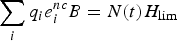
, the constraint is active
 $\sum_{i}q_{i}e_{i}^{nc}B=N\lpar t\rpar H_{\lim }$
and we obtain
 $$\sum_{i\in A\lpar t\rpar }q_{i}B\displaystyle{{pq_{i}B-c_{1\comma i}+\lambda q_{i}B}\over {2c_{2}}} =N\lpar t\rpar H_{\lim}$$
where A(t) is the set of active agents, in the sense of fishermen with a positive optimal effort
 $e_{i}^{\star }=\max e_{i}\gt0$
, which implies
 $$\lpar p+\lambda \rpar q_{i}B\lpar t\rpar -c_{1\comma i} \gt 0$$
Therefore
 $\hbox{A}\lpar \hbox{t}\rpar =$
 $$\left\{\exists i^{\star }\comma \; \; q_{i^{\star }}\left(\displaystyle{{2c_{2}N\lpar t\rpar H_{\lim }+\sum_{j=1}^{i^{\star }}c_{1\comma j}q_{j}}\over{B\lpar t\rpar \sum_{j=1}^{i^{\star }}q_{j}^{2}}}\right)-c_{1\comma i}\geq 0\right\}$$
We deduce that
 $$\lambda =\displaystyle{{1}\over{B^{2}\displaystyle\sum_{i\in A\lpar t\rpar }q_{i}^{2}}}\left(2c_{2}N\lpar t\rpar H_{\lim }-pB^{2}\sum_{i\in A\lpar t\rpar }q_{i}^{2}+B\sum_{i\in A\lpar t\rpar }q_{i}c_{1\comma i}\right)$$
Setting
 $$\delta =\sum_{i\in A\lpar t\rpar }q_{i}^{{\ast }^{2}}\comma \; \; \gamma =\sum_{i\in A\lpar t\rpar }q_{i}^{\ast }c_{1\comma i}$$
we derive the optimal controls when the subsistence constraint is binding
 $$e_{i}^{co}=\displaystyle{{1}\over{2c_{2}}}\left(\displaystyle{{2c_{2}N\lpar t\rpar q_{i}H_{\lim }}\over{B\delta}} +q_{i}\displaystyle{{\gamma}\over{\delta }}-c_{1\comma i}\right)$$
Mixing the two cases, we obtain the feedback control law
 $$e_{i}^{co}\lpar t\comma \; B\lpar t\rpar \rpar = \max \left(\displaystyle{{ p q_{i} B\lpar t\rpar - c_{1\comma i}}\over{2 c_{2}}}\comma \; \displaystyle{{1}\over{2 c_{2}}} \left(\displaystyle{{2 c_{2} N\lpar t\rpar q_{i} H_{\lim}}\over{B \delta}} + q_{i} \displaystyle{{\gamma}\over{\delta}}-c_{1\comma i} \right)\right)$$
The two effort expressions (14) and (20) are similar, then
 $e_{i}^{nc}=e_{i}^{co}$
for λ = 0. The interesting features will come from the second expression of the effort maximization. This expression differs in both cases and drives the potential difference depending on the number of active agents.
7.2. Calibration
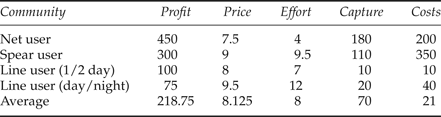
The different parameters used in the second model are taken from the literature related to the Western Region in the Solomon Islands, and from the surveys conducted during two weeks (from 2 to 6 May, and from 16 to 20 May) in the Gizo Market. Table 3 shows the estimated profit fishers would think of: the price, their catch of the day, their effort of the day and their estimated cost of the day have been divided by the effort. The average linear cost equals 21$SB and corresponds to: an ice-block (25$SB) in Gizo, hooks and lines (around 15$SB which last at least three weeks or 5$SB per week), and a liter of gasoline per hour with 17$SB per liter in Gizo (2011 prices).
Market surveys compilation by community, profit, costs and market price are expressed in $ SB, the effort in hours per day per fisher and the catch in per kg.