Implications
The results of this study showed that adopting a flock replacement policy based on crossbreeding Blackface (BF) ewes with Lleyn, Swaledale, Texel (T) or Cheviot (CH) sires can increase productivity of hill flocks compared with pure BF replacements. This is achieved mainly through the increased litter size of the crossbred ewes. While improvements in lamb performance were noted for CH and T-sired ewes, their heavier body weight limits the potential to increase biological efficiency and lamb output per hectare. Assessment of the longevity and lifetime output of these more prolific breed types under hill conditions is, however, essential before crossbreeding can be recommended on a large scale. Overall, age of the ewe has a greater influence on ewe performance than breed. To ensure that the hill sheep sector has a sustainable future, selection for improved ewe longevity needs to be included within objective breeding programmes for the hill sheep breeds.
Introduction
The hill sheep sector is a major contributor to lamb production in Europe, with more than 90% of the 65.8 million breeding ewes in the European Union-25 located within less favoured areas, which include the hills and uplands (European Commission, 2006). In Great Britain, lamb production from hill flocks accounts for 58.5% of all lambs slaughtered, with hill breeds contributing 31% of the total gene pool (Pollott and Stone, Reference Pollott and Stone2006). However, when compared with the other sectors of the industry, lamb output from hill flocks is often constrained by a high proportion of barren ewes, small litter sizes and poor lamb growth rates (Dawson and Carson, Reference Dawson and Carson2002a; Carson et al., Reference Carson, Dawson, Irwin and Kilpatrick2004). If the hill sheep sector is to remain viable, improvements in production efficiency alongside greater returns from the marketplace are essential.
Ewe breed has been shown to influence lamb output of both hill (Carson et al., Reference Carson, Irwin and Kilpatrick2001) and lowland (Carson et al., Reference Carson, Dawson, Irwin and Kilpatrick2004) flocks through its effects on litter size and lamb growth rate. The UK hill sheep sector is dominated by pure breeds with the Scottish Blackface (BF) being the most common (Pollott and Stone, Reference Pollott and Stone2006). Substitution of the BF with another hill breed type (e.g. Cheviot (CH)) is one method that can be used to manipulate flock genetics, but this strategy can be costly to implement (Simm et al., Reference Simm, Conington and Bishop1994) and may have limited performance benefits (Carson et al., Reference Carson, Irwin and Kilpatrick2001). An alternative method is through crossbreeding, which provides opportunities to introduce complementary traits for prolificacy and lamb growth, and also to exploit heterosis for reproduction, survival and ‘fitness’ traits (Fogarty et al., Reference Fogarty, Dickerson and Young1984; Simm et al., Reference Simm, Conington and Bishop1994). In recent years, considerable research has been undertaken to quantify the benefits of using crossbred females within the lowland sector (Dawson and Carson, Reference Dawson and Carson2002a and Reference Dawson and Carson2002b; Dawson et al., Reference Dawson, Carson and Moss2002; Carson et al., Reference Carson, Dawson, Irwin and Kilpatrick2004). However, there have been few comparable studies investigating the merits of crossbred ewes and the most suitable breed combinations for the hill sector.
Crossing BF ewes with other hill breed sires, such as the Swaledale (SW) and North Country CH, has been shown to benefit maternal traits including litter size, lamb birth weight and lamb survival (Al-Nakib et al., Reference Al-Nakib, Bateman, Findlay, Smith and Thompson1997) as well as lamb output (Bateman and Sales, Reference Bateman and Sales1981; Al-Nakib et al., Reference Al-Nakib, Bateman, Findlay, Smith and Thompson1997) when compared with the purebred BF. Using Texel (T)-sired females has benefited lamb carcass conformation in lowland breed ewes (Dawson and Carson, Reference Dawson and Carson2002b; Dawson et al., Reference Dawson, Carson and McClinton2003), but there is paucity of published information on the performance of T-cross ewes within the hill sheep systems. The Lleyn (LL) breed has increased in popularity in recent years with breeding ewe numbers increasing by 325% between 1996 and 2003 (Pollott and Stone, Reference Pollott and Stone2006); however, there is limited published information on the performance of LL ewes and their crosses on which to base breeding decisions. Consequently, the primary objective of this study was to compare the body weight (BW), prolificacy and lamb output of pure Scottish BF ewes with a range of crossbreds.
Age has also been shown to influence the performance of lowland breed ewes, especially their reproductive performance (Cameron et al., Reference Cameron, Smith and Deeble1983; Mann et al., Reference Mann, Smith, King, Nicholson and Sales1984; Dawson and Carson, Reference Dawson and Carson2002a). However, there is paucity of information of age effects on ewe performance within hill flocks. One reason for this could be that, within the stratified breeding structure of the UK sheep industry, hill ewes are traditionally sold for further breeding in lowland flocks after just two to four lamb crops on the hill. Therefore, a secondary objective of this study was to examine the effects of age on hill ewe performance.
Material and methods
This study was carried out on six hill farms, representative of the main hill farming regions of Northern Ireland, over a 5-year period between October 2003 and August 2008. The farms ranged in altitude from 260 to 800 m above sea level on hills where the vegetation was dominated by Calluna, Juncus, Molinia, Nardus and Poa spp. Typically, ewes grazed on improved pastures during the mating period, returned to the hills during pregnancy and were housed at lambing. Following lambing, ewes and lambs were kept on improved pastures for approximately 6 weeks before returning to the hills, where the ewes remained until mating the following year.
Animals
On each of the six hill farms, 200 purebred Lanark-type Scottish BF ewes were allocated to one of five mating groups each year over a 3-year period (2001 to 2003). Mating groups were balanced for ewe live weight, body condition score (BCS) and age, and allocated to one of five crossing sire breeds: Scottish BF, SW, North Country CH, LL and T. In 2001, single-sire mating groups were used on each farm with rams from each breed sourced from pedigree breeders. However, in 2002 and 2003, artificial insemination (AI) using a team of rams was used to create genetic links across all the farms. Rams that had been used in the single-sire mating groups in 2001 were used to cover ewes that failed to conceive to AI in 2002 and 2003. A total of 15 rams from each of the five crossing sire breeds were used to produce the crossbred progeny. Where possible, rams were selected from the UK genetic improvement programmes to represent the top 25% of recorded animals.
The female progeny from each of these crossbred matings – Scottish BF, SW × BF, North Country CH × BF, LL × BF and T × BF – were retained on farm and mated first at approximately 18 months of age. Over a 5-year period, the crossbred ewes were allocated each year to single-sire mating groups, balanced for ewe breed, live weight, BCS and age. In the years 1 and 2 (2003 to 2004), ewes were joined with T, Dorset and LL rams, whereas in the years 3 to 5 (2005 to 2006) T, Dorset, LL and Suffolk rams were used. All of the rams were from the UK genetic improvement programmes and represented the top 25% of recorded sires for each breed.
Measurements
Ewe live weight (to the nearest 0.5 kg) and BCS (Russel et al., Reference Russel, Doney and Gunn1969) were recorded 1 week before mating, 6 weeks pre-lambing, 6 weeks post-lambing and at weaning. Litter size was estimated by ultrasound scanning between days 70 and 100 of pregnancy and ewes determined to be carrying at least one foetus were considered productive. Following birth, the lambs were tagged with a small plastic tag in each ear and the tag number was recorded alongside the dam tag number, date of birth, sex and birth weight (to the nearest 0.1 kg) of the lamb. The lambs were weighed again (to the nearest 0.5 kg) at approximately 6 weeks of age and at weaning (128 ± 11.6 days), and average daily gain (ADG) from birth was determined. Ewes with problem births that required human intervention were also noted.
Statistical analysis
All data were analysed using GenStat (2008). Due to the unbalanced nature of the design, residual maximum likelihood analysis with repeated measures was used to analyse linear mixed models for continuous variables. Where overall effects were significant (P < 0.05), pairs of means were compared using the LSD. Where ewe traits are expressed per ewe mated, analysis was carried out on data from all ewes presented to a ram. However, where traits are expressed per ewe lambed, the data set was restricted to ewes with a litter size >0. Mature weight of ewes was adjusted to a BCS at mating of 3.5.
Binary data (conception rate and lambing assistance) were analysed with generalized linear mixed models, assuming a binomial distribution with a logit-link function. Where overall effects were significant, Fisher’s protected LSD test was used to test for significant differences between breeds.
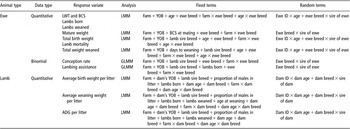
Random effects were included in all of these analyses to account for within-breed variance among sires of the ewes. Information on the sire ID of the lambs was incomplete, and therefore was not included within the random model. Details of the models and analyses, with the fixed and random terms used, are described in Table 1.
Summary of the statistical analysis used and terms included in the statistical models

LWT = live weight; BCS = body condition score; ADG = average daily gain; LMM = linear mixed model; GLMM = generalized linear mixed model (with logit-link function); YOB = year of birth.
Results
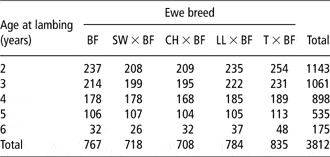
In total, 3812 mating records were investigated across the six farms. A breakdown of these records by age and breed of the ewes is presented in Table 2.
Total number of mating records subdivided by age and breed

BF = Scottish Blackface; SW × BF = Swaledale × Blackface; CH × BF = Cheviot × Blackface; LL × BF = Lleyn × Blackface; T × BF = Texel × Blackface.
Ewe live weight and BCS
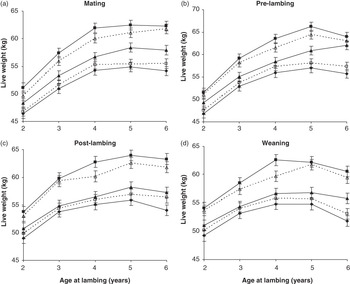
Significant breed × age interactions (P < 0.001) were observed for ewe live weight at mating, pre-lambing, post-lambing and weaning (Figure 1). CH × BF and T × BF ewes had similar live weight throughout the study, except in 4-year-old ewes when CH × BF was heavier at mating, post-lambing and at weaning. CH × BF and T × BF were consistently heavier than the other breeds, although the live weight of the 2-year-old ewes at mating and 6-year-old ewes at 6 weeks pre-lambing was comparable between T × BF and LL × BF. LL × BF was consistently heavier than BF at mating and 6 weeks pre-lambing; however, LL × BF was heavier at 6 weeks post-lambing and weaning in 5- and 6-year-old ewes. Live weight of BF and SW × BF was similar throughout the study. The mature weight of adult BF, SW × BF, CH × BF, LL × BF and T × BF ewes was estimated to be 52.8, 54.9, 60.3, 55.6 and 58.6 kg, respectively (s.e.d. = 0.91 kg, P < 0.001).
Relationships between age and live weight of Blackface (BF; ⧫), Swaledale × BF (□), Cheviot × BF (▪), Lleyn × BF (▴) and Texel × BF (▵) ewes at mating, pre-lambing, post-lambing and weaning.

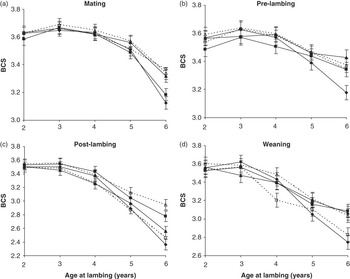
BCS at mating and 6 weeks pre-lambing was similar for all the breeds studied (Figure 2), but both were highest (P < 0.001) in 3-year-old ewes and lowest in 6-year-old ewes. A significant breed × age interaction revealed that there were no effects of breed on BCS at 6 weeks post-lambing in ewes aged 2 and 3 years. However, for ewes aged 4 to 6 years, CH × BF had higher (P < 0.05) post-lambing BCS than SW × BF or LL × BF. T × BF ewes aged 5 and 6 years had higher (P < 0.05) post-lambing BCS than BF, SW × BF and LL × BF ewes of the same age. BCS at weaning of SW × BF ewes was lower (P < 0.05) than CH × BF, LL × BF and T × BF for ewes aged 4 to 6 years. BF had a lower (P < 0.05) BCS at weaning than LL × BF and T × BF ewes aged 5 and 6 years.
Relationships between age and body condition score of Blackface (BF; ⧫), Swaledale × BF (□), Cheviot × BF (▪), Lleyn × BF (▴) and Texel × BF (▵) ewes at mating, pre-lambing, post-lambing and weaning.

Lamb output and dystocia at birth
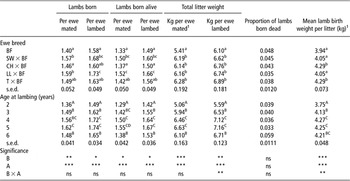
There were no significant breed effects on conception rate of ewes, which averaged 0.92, 0.93, 0.93, 0.95 and 0.93 in 2-, 3-, 4-, 5- and 6-year-old ewes, respectively. LL × BF produced larger (P < 0.05) litters (+0.10 to 0.15 lambs per ewe lambed) compared with BF, CH × BF or T × BF (Table 3), and SW × BF ewes produced larger litters than BF (+0.10 lambs per ewe lambed). As a result, ewe fertility (number of lambs born per ewe mated) was higher for LL × BF and SW × BF compared with BF and CH × BF ewes (P < 0.01). Across all breeds, prolificacy (number of lambs born per ewe lambed) increased linearly with age up to 4 years (2 < 3 = 6 < 4 = 5; P < 0.001) and there was a linear increase (P < 0.001) in ewe fertility up to 5 years. The proportion of lambs that were born dead or died within 24 h after birth was low (0.042) and was not influenced by either the age or breed of the ewe. Consequently, both breed and age effects on the number of lambs born alive per ewe closely mirrored the litter size effects (Table 3).
Effects of ewe breed and age on lamb output, mortality and weight at birth

BF = Scottish Blackface; SW × BF = Swaledale × Blackface; CH × BF = Cheviot × Blackface; LL × BF = Lleyn × Blackface; T × BF = Texel × Blackface; B = breed; A = age.
*P < 0.05, **P < 0.01, ***P < 0.001.
a,b,cDifferences among means within columns sharing the same superscript are not statistically significant (P > 0.05).
A,B,C,DDifferences among means within columns sharing the same superscript are not statistically significant (P > 0.05).
1Significant farm × ewe breed interaction (P < 0.05).
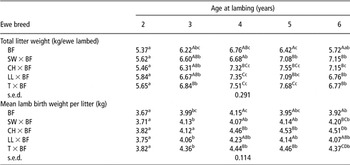
A significant breed × age interaction (P < 0.01) identified that total lamb birth weight per ewe lambed in 2-year-old ewes was similar across all the breeds (Table 4). With the 3-year-old ewes, T × BF had a heavier total litter weight than BF, and in the 4-year-old ewes, CH × BF, LL × BF and T × BF produced heavier litters than SW × BF. All of the crossbred ewes aged 5 and 6 years produced heavier litter weight than the BF. After adjustment for litter size, average lamb birth weight per litter was 0.38 to 0.52 kg lighter (P < 0.001) for primiparous 2-year-old ewes compared with older ewes. Dam breed had no effects on lamb birth weight of 2- and 3-year-old ewes. However, in 4- to 6-year-old ewes, lambs born to CH × BF and T × BF ewes were, on average, 0.17 to 0.59 kg heavier (P < 0.01) than those born to BF, SW × BF or LL × BF.
Interactions between age and breed for total litter weight and mean birth weight

BF = Scottish Blackface; SW × BF = Swaledale × Blackface; CH × BF = Cheviot × Blackface; LL × BF = Lleyn × Blackface; T × BF = Texel × Blackface.
a,b,c,Differences among means within rows sharing the same superscript are not statistically significant (P > 0.05).
A,B,CDifferences among means within columns sharing the same superscript are not statistically significant (P > 0.05)
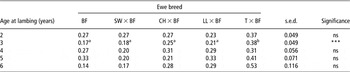
Breed effects on the degree of assistance at lambing were found in 3-year-old ewes only, with a higher (P < 0.001) proportion of T × BF requiring assistance compared to the other breeds (Table 5).
Effect of age and breed on the proportions of ewes assisted at lambing

BF = Scottish Blackface; SW × BF = Swaledale × Blackface; CH × BF = Cheviot × Blackface; LL × BF = Lleyn × Blackface; T × BF = Texel × Blackface.
***P < 0.001.
a,bDifferences among means within rows sharing the same superscript are not statistically significant (P > 0.05).
Lamb output at weaning
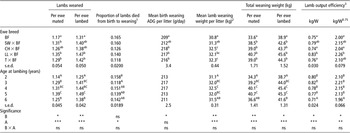
SW × BF, LL × BF and T × BF successfully reared 0.12 to 0.18 lambs per ewe mated (P < 0.05) more than the BF (Table 6). Lamb mortality, in terms of the proportion of lambs born per litter that died before weaning, did not vary significantly between breeds. ADG up to weaning was higher (P < 0.05) for lambs born to CH × BF, LL × BF and T × BF compared with BF dams, resulting in a heavier (P < 0.01) average lamb weaning weight per litter with these ewes. Overall, the total weight of lamb weaned per ewe lambed was significantly higher for LL × BF (+6.7 kg), T × BF (+5.4 kg), CH × BF (+4.8 kg) and SW × BF (+3.7 kg) compared with BF (P < 0.05; Table 6). Production efficiency of the ewes, expressed in terms of lamb output per kilogram BW and lamb output per kilogram metabolic BW (W0.75), was higher (P < 0.05) in LL × BF compared with BF and CH × BF.
Effect of ewe breed and age on weaned lamb output and lamb mortality

ADG = average daily gain; BF = Scottish Blackface; SW × BF = Swaledale × Blackface; CH × BF = Cheviot × Blackface; LL × BF = Lleyn × Blackface; T × BF = Texel × Blackface; B = breed; A = age.
*P < 0.05, **P < 0.01, ***P < 0.001.
a,b,cDifferences among means within columns sharing the same superscript are not statistically significant (P > 0.05).
A,B,CDifferences among means within columns sharing the same superscript are not statistically significant (P > 0.05).
1Includes lambs born dead.
2Significant farm × breed interaction (P < 0.05).
3Determined from ewe live weight at mating (W).
Age effects on the number of lambs weaned per ewe mated and the number of lambs weaned per ewe lambed followed similar trends to litter size at birth, increasing with age up to 5 years but decreasing between the age of 5 and 6 years (P < 0.001). A higher proportion of lambs born to 2-year-old ewes (0.158) failed to survive until weaning compared with those born to 3-year-old ewes (0.118; P < 0.05). Although there were no significant age effects on ADG up to weaning, lambs born to 4-year-old ewes were heavier (P < 0.001) at weaning than those born to 2- and 6-year-olds due to their heavier birth weight. Overall, total weaned lamb output per ewe lambed increased with age up to 5 years but declined in 6-year-old ewes (P < 0.001). Production efficiency per ewe lambed, expressed both in terms of lamb output per kilogram BW and lamb output per kilogram metabolic BW (W0.75), was lower (P < 0.01) for 6-year-old ewes compared with younger ewes.
Discussion
Ewe live weight
As a key determinant of maintenance energy requirements (Agricultural and Food Research Council, 1993), mature BW has implications for the stocking rate on hill flocks. Furthermore, mature weight of an animal is positively related to its meat production potential (Wolf and Smith, Reference Wolf and Smith1983; Taylor, Reference Taylor1985). In this study, BF ewes had an estimated mature weight of 52.8 kg, which is similar to the mature weight of 53.8 kg reported by Carson et al. (Reference Carson, Irwin and Kilpatrick2001). In a review of 11 studies, Friggens et al. (Reference Friggens, Shanks, Kyriazakis, Oldham and McClelland1997) reported the mature weight of BF ewes ranging from 40 to 70 kg depending on strain, level of nutrition and breeding history. Crossbreeding led to a significant increase in mature BW, as shown by Al-Nakib et al. (Reference Al-Nakib, Bateman, Findlay, Smith and Thompson1997). Sire breed had a significant effect on mature weight, with CH × BF (+14.2%) and T × BF (+11.0%) ewes consistently heavier than LL × BF (+5.3%) and SW × BF (+4.0%). Although this effect broadly reflects the heavier mature weight of the sire breeds, heterosis for BW has been shown previously within hill ewes (Donald et al., Reference Donald, Read and Russell1963; Al-Nakib et al., Reference Al-Nakib, Bateman, Findlay, Smith and Thompson1997), which could exacerbate the sire effect.
Ewe performance
Conception rates of the ewes in this study were notably higher than is typical for many UK hill flocks (Al-Nakib et al., Reference Al-Nakib, Findlay and Smith1986; Gunn et al., Reference Gunn, Doney, Smith and Sim1986; Al-Nakib et al., Reference Al-Nakib, Bateman, Findlay, Smith and Thompson1997; Carson et al., Reference Carson, Irwin and Kilpatrick2001) and were not affected by either the breed or age of the ewe. The ewes were in good body condition throughout the study, with a mean BCS at mating of 3.55 ± 0.03 equivalent to the level at which reproductive performance in hill ewes is optimum (Carson et al., Reference Carson, Irwin and Kilpatrick2001). Age has been shown to influence conception rate of ewes. For example, Cameron et al. (Reference Cameron, Smith and Deeble1983) and Mann et al. (Reference Mann, Smith, King, Nicholson and Sales1984) reported significant increases in conception rate between first and second parity ewes when they were first mated as adolescents. Typical of many hill flocks, mating was delayed in this study until ewes were approximately 18 months old in an attempt to remove the constraint of inadequate body size on reproductive performance (Gunn et al., Reference Gunn, Doney, Smith and Sim1986). As a result, the conception rate of the first parity 2-year-old ewes was high (0.92) and did not increase with age.
The number of lambs reared is a key factor affecting the economics of sheep production (Connolly, Reference Connolly2000) and accounted for 0.84 of the variation in weaned lamb output. Relative to the pure BF, weaned lamb output was higher from all crossbred ewes. LL × BF ewes were the most prolific of the breeds studied, weaning an additional 0.16 lambs per ewe and producing 6.7 kg per ewe more lamb than BF ewes. Owen and Whitaker (Reference Owen and Whitaker1987), the only previous study to evaluate the LL crosses, reported that their average litter size (1.40 lambs per ewe) was inferior to those of Border Leicester crosses (1.56 lambs per ewe). However, purebred LL stocks are noted for producing litters of two or more lambs (Minter, Reference Minter1993; Vaughan et al., Reference Vaughan, Long, Parkinson, Smith and Noakes1997) so that higher prolificacy of LL × BF ewes could be expected. In agreement with Al-Nakib et al. (Reference Al-Nakib, Bateman, Findlay, Smith and Thompson1997), SW × BF ewes were also found to be more prolific than BF. Studies in lowland breed ewes by Vesely and Peters (Reference Vesely and Peters1974) and Hanrahan (Reference Hanrahan2007), however, have shown that increasing prolificacy can have an adverse effect on the longevity of ewes. Although not considered here, it is important to consider the effects of using more prolific breed types on longevity and lifetime performance of hill ewes to provide a fair comparison with the BF. These issues will be dealt with in a subsequent paper. Carson et al. (Reference Carson, Irwin and Kilpatrick2001) reported similar prolificacy in pure stocks of CH and BF ewes, which might explain why prolificacy of the BF and CH × BF were similar, in agreement with Al-Nakib et al. (Reference Al-Nakib, Bateman, Findlay, Smith and Thompson1997), as there is no published evidence of heterosis for prolificacy in crossbred matings between these two breeds.
The ability of ewes to lamb without human intervention is crucial for extensive low-input sheep systems. Overall, the degree of assistance at lambing in this study was high (0.27), although this level is not uncommon when terminal sire breeds are the main crossing sires (Carson et al., Reference Carson, Irwin and Kilpatrick2001, Reference Carson, Dawson, Irwin and Kilpatrick2004; Dawson and Carson, Reference Dawson and Carson2002a). T-sired ewes required a higher level of lambing intervention than any of the other breeds studied, which concurs with observations in lowland flocks (Dawson and Carson, Reference Dawson and Carson2002a; Carson et al., Reference Carson, Dawson, Irwin and Kilpatrick2004). Breed effects on birth presentation, incompatibility between the size of the lamb and the pelvic diameter of the ewe and/or uterine inertia could explain the higher levels of dystocia in T × BF ewes (Cloete et al., Reference Cloete, Scholtz, Ten Hoope, Lombard and Franken1998). Nonetheless, the need for high levels of intervention at lambing places a major constraint on the use of T-cross ewes within hill sheep systems.
Lamb output per kilogram of BW (W) or per kilogram of metabolic BW (W0.75) has been used as a measure of efficiency in sheep systems (Cameron et al., Reference Cameron, Smith and Deeble1983; Carson et al., Reference Carson, Irwin and Kilpatrick2001). In this study, LL × BF produced 13% more lamb per unit W0.75 than BF due to their greater prolificacy and higher lamb growth rates. Assuming that half of the 6 million purebred hill ewes of the United Kingdom were replaced with LL × BF, this improvement in production efficiency could enable lamb output from the hill sector to be maintained while reducing methane emissions by more than 4000 tonnes per annum (assuming that ewes produce 25 l methane/day; Ulyatt et al., Reference Ulyatt, Lassey, Shelton and Walker2005). Despite their superior weaned lamb output, the efficiency of CH × BF and T × BF ewes was comparable with BF due to their heavier BW. Previous comparisons of the BF and CH breeds have reported similar efficiency in both purebred ewes (Carson et al., Reference Carson, Irwin and Kilpatrick2001) and their crosses (Al-Nakib et al., Reference Al-Nakib, Bateman, Findlay, Smith and Thompson1997). In practice, changing the breeding policy from pure BF to the heavier CH × BF or T × BF could require stocking rates to be reduced by up to 11%. Without a concomitant increase in biological efficiency, the benefits for lamb output per hectare are small.
Lamb performance
Consistent with earlier studies in hill breed ewes (Mann et al., Reference Mann, Smith, King, Nicholson and Sales1984; Al-Nakib et al., Reference Al-Nakib, Bateman, Findlay, Smith and Thompson1997), lambs from CH × BF and T × BF were, on average, 0.35 kg heavier at birth and 1.5 to 1.7 kg heavier at weaning than those from BF ewes, after correction for litter size and sex effects. These differences closely reflect the difference in mature weight of the ewes, which is not surprising as these parameters are highly correlated with birth weight and ADG (Wolf and Smith, Reference Wolf and Smith1983). Estimates of maternal heterosis for weaning weight are also high (10%; Al-Nakib et al., Reference Al-Nakib, Bateman, Findlay, Smith and Thompson1997) and could be a factor here, although this cannot be quantified. The ability of LL × BF to achieve heavier average lamb weaning weight than the BF, in addition to their higher weaning rates, is particularly interesting and may be an indicator of higher milk production from these ewes.
Lamb mortality is a major economic and welfare issue in hill flocks. Pre-weaning mortality, which averaged 0.125 lambs born per litter, was similar to levels reported previously for hill flocks in Northern Ireland (Carson et al., Reference Carson, Irwin and Kilpatrick2001). Concerns have been expressed about the use of prolific breed types within extensive sheep systems due to the risk of higher lamb mortality (Fogarty et al., Reference Fogarty, Hopkins and van de Ven2000; Kenyon et al., Reference Kenyon, Stafford, Jenkinson, Morris and West2007). However, there was no evidence that lamb survival was compromised in the more prolific crossbred ewes, although it should be noted that ewes were housed over lambing on five of the six farms, which may bias results in favour of the more prolific breeds. Waterhouse et al. (Reference Waterhouse, Logue and Roger1992) found no adverse effects on mortality when hill ewes were treated with Fecundin® (Glaxo Animal Health, UK) to improve prolificacy, although these results were also confounded by the preferential management of the multiple-bearing ewes.
Age effects on hill ewe performance
This study is unique in providing a comprehensive data set on the performance of hill ewes over five successive lamb crops. It should be noted that the age effects reported here are confounded by culling and mortality and do not represent the true biological effects of ageing in sheep, but rather its effects on ewe performance at farm level. Although there is paucity of information on age effects within hill sheep systems, the responses shown here largely concur with earlier reports for lowland bred ewes (Cameron et al., Reference Cameron, Smith and Deeble1983; Mann et al., Reference Mann, Smith, King, Nicholson and Sales1984; Dawson and Carson, Reference Dawson and Carson2002a). In agreement with Mann et al. (Reference Mann, Smith, King, Nicholson and Sales1984), weaned lamb output increased linearly with age up to 5 years, driven mainly by their increased lambing and subsequent weaning rates. However, it is worth noting that all farms involved in the study had a policy of culling out barren ewes from the flock, which could exacerbate the age effects on prolificacy. Despite the subsequent decline in lambing and weaning rates of the 6-year-old ewes, which led to their lower production efficiency, weaned lamb output of these ewes was superior to their 2-year-old replacements. On this basis, these data would not support a blanket culling policy of 6-year-old ewes on the basis of age alone. The lower average birth weight of lambs born to primiparous 2-year-old ewes compared with the older ewes has been associated with impaired placental development and preferential partitioning of nutrients to the maternal body in young ewes (Wallace et al., Reference Wallace, Bourke, Aitken and Cruickshank1999). Considering the association between birth weight and growth rate (Wolf and Smith, Reference Wolf and Smith1983), a significant age of dam effect on ADG of their lambs might have been expected but was not observed. Pre-weaning lamb mortality was also higher in the primiparous ewes, as reported by Cameron et al. (Reference Cameron, Smith and Deeble1983), which could relate to their lower birth weight, although problems with poor mothering instinct have also been reported in young ewes (O’Connor et al., Reference O’Connor, Lawrence and Wood-Gush1992; Dwyer and Lawrence, Reference Dwyer and Lawrence1998).
Overall, the age of the ewe had a greater influence on performance than the breed. When considered on a per ewe mated basis, the percentage increase in number of lambs born, total litter weight, number of lambs weaned and total weight of lamb weaned between first and fourth parity ewes were 19.1%, 31.0%, 21.9% and 18.6%, respectively, compared with 13.6%, 13.9%, 15.4% and 21.1%, respectively, for LL × BF v. BF.
Acknowledgements
The authors wish to express their sincere thanks to the following hill sheep producers for their help and hard work in undertaking this study: Ian Buchanan, Richard Duffin, Maurice McHenry, Seamus Maginn, Stephen Montgomery and Samuel Wharry. The authors are also grateful to the Department of Agriculture and Rural Development for Northern Ireland (DARDNI) and Agrisearch who provided funding for this project.