Introduction
The genus Heleodromia Haliday was little known in North America prior to this study, with only a single described species, Heleodromia pullata (Melander), recorded from New Mexico, and several tentative new boreal species sorted out in the Canadian National Collection of Insects, Arachnids and Nematodes (CNC) by J.G. Chillcott in the early 1960s. The discovery of the first eastern North American record of the genus well south of the boreal forest spurred us to reexamine this CNC material (later sorted by T. Saigusa in 1985) and to expand our study to incorporate more recently collected material in the CNC as well as specimens from other North American collections.
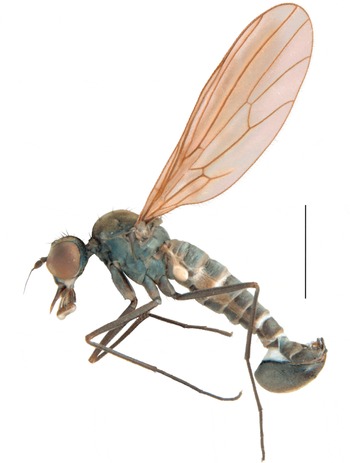
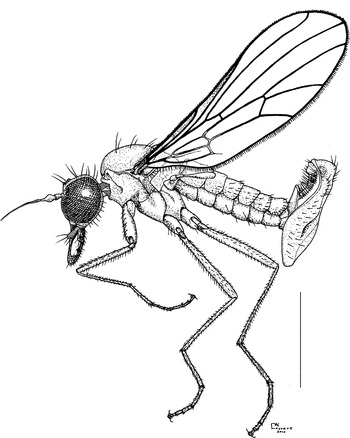
Heleodromia is assigned to the empidoid family Brachystomatidae, subfamily Trichopezinae (Sinclair and Cumming Reference Sinclair and Cumming2006). The genus is currently divided into two subgenera (Wagner Reference Wagner1985), with the nominal subgenus characterized by the typical upright and enlarged genitalia with an expanded and prolonged hypandrium enclosing an enormous ejaculatory apodeme (Figs. 1, 2). The subgenus Neoilliesiella Wagner and Özdikmen (Reference Wagner and Özdikmen2006) (replacement name for Illiesiella Wagner) has the male genitalia more horizontal in orientation with a supposedly characteristic posterior prolongation of the hypandrium, and includes two species from Eastern Europe. Recently, an odd species from Switzerland, with R4+5 branched and an elongate, filiform phallus, was established as a new genus, Pseudheleodromia Wagner (Wagner Reference Wagner2001); otherwise it is identical with Heleodromia.
Heleodromia chillcotti Sinclair sp. nov., habitus photograph. Scale bar=1.0mm.

This study is dedicated to Jim Chillcott for initiating the Manual of Nearctic Diptera project, and for his part in building a world-class Diptera collection at the CNC. We also dedicate this study to the Manual coordinators, Frank McAlpine, Bobbie Peterson, Guy Shewell, Herb Teskey, Dick Vockeroth, and Monty Wood, for seeing this massive undertaking through to completion. In addition, we would like to recognize this dipterological “Group of Seven” for their enormous collecting efforts across Canada and abroad, together spanning over 70 years, from the late 1930s to the present (2011). Their specimens have enhanced a myriad of revisionary studies on flies across the entire order and have helped to develop the CNC Diptera collection into one of the largest and finest of its kind in the world.
Heleodromia cranehollowensis Cumming and Coovert sp. nov., habitus illustration. Scale bar=1.0mm.

Material and methods
Identification of Heleodromia species is based primarily on morphology of the males. Aside from the male terminalia, the species and sexes of Heleodromia in the Nearctic Region are largely indistinguishable. Care must be taken in examining undissected male genitalia because the various components can appear in drastically different positions among conspecific individuals (cf. Collin Reference Collin1961, figs. 279 and 280 of H. immaculata Haliday). Components of the phallus and postgonites are especially prone to positional variation in preserved specimens, from completely or partially exerted and visible to entirely retracted within the genital capsule and mostly hidden from view.
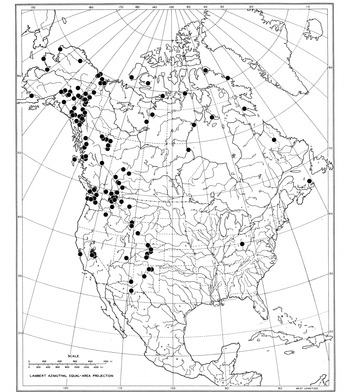
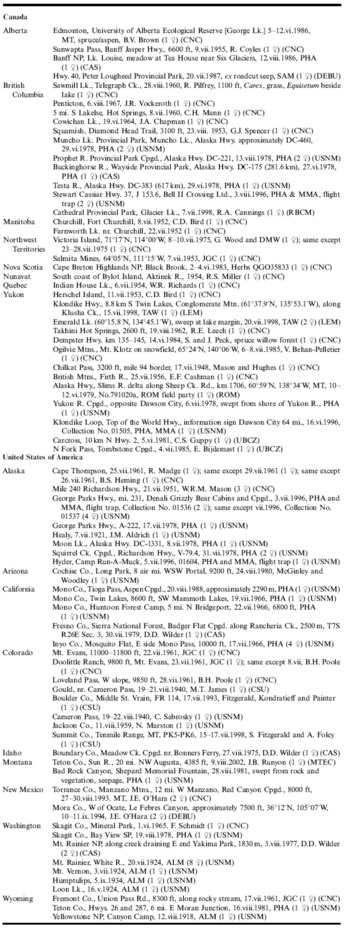
Attempts were made to associate male and female conspecifics, but this was confounded by female genitalic variation and the occurrence of sympatric species (e.g., four species were collected at the Aborigen Field Station locality in the Russian Far East by Monty Wood in 1990). So most female specimens could not be identified to the species level. For collecting events where males of only a single species were captured, associated female specimens from the same collecting event are assumed to be conspecific. For many localities only female specimens have been collected (Appendix A), and in each of these cases the species identity is currently unknown. Consequently our species distribution maps are based solely on male records. However, we provide a composite map of the overall Nearctic distribution of the genus that incorporates all specimen records, including females from localities where no male is known (Fig. 3). The collection of male specimens from these localities or the use of molecular techniques is required to make species associations in these cases.
Overall distribution of the genus Heleodromia in the Nearctic Region, including undetermined female specimens.

This study is based on material borrowed from or deposited in the following institutions: American Museum of Natural History, New York, New York, United States of America (AMNH); Academy of Natural Sciences of Philadelphia, Philadelphia, Pennsylvania, United States of America (ANSP); California Academy of Sciences, San Francisco, California, United States of America (CAS); Crane Hollow Incorporated Collection, Laurelville, Ohio, United States of America (CHIC); Canadian National Collection of Insects, Ottawa, Ontario, Canada (CNC); Colorado State University, Fort Collins, Colorado, United States of America (CSU); University of Guelph Insect Collection, Guelph, Ontario, Canada (DEBU); Lyman Entomological Museum, McGill University, Ste-Anne-de-Bellevue, Quebec, Canada (LEM); Royal British Columbia Museum, Victoria, British Columbia, Canada (RBCM); Royal Ontario Museum, Toronto, Ontario, Canada (ROM); Spencer Entomological Museum, University of British Columbia, Vancouver, British Columbia, Canada (UBCZ); United States National Museum of Natural History, Washington, D.C., United States of America (USNM); Rüdiger Wagner Entomological Collection (private), Kassel, Germany (WEC); and Washington State University, Pullman, Washington, United States of America (WSU). The most frequent collectors, with abbreviations, included in the “Material examined” sections are as follows: Paul H. Arnaud, Jr. (PHA); Paul H. Arnaud, Jr. and Madeline M. Arnaud (PHA and MMA); J.G. Chillcott (JGC); J.F. MacDonald (JFM); S.A. Marshall (SAM); A.L. Melander (ALM); P.J. Skitsko (PJS); T.A. Wheeler (TAW); and D.M. Wood (DMW). The following abbreviations are used in the “Type material” and “Additional material” sections: Ck., creek; Co., County; Cpgd., campground; Hwy., Highway; Lk., lake; mi., mile(s); MT, Malaise trap; Mt., Mount; Mtn(s)., Mountain(s); NP, National Park; R., river; Rd., Road; SP, State Park; Stn., Station; Twp., Township; YPT, yellow pan trap. The following abbreviations are used in the descriptions of scutal bristles: dc, dorsocentrals; pprn, postpronotals; presut spal, presutural supra-alars; npl, notopleurals; pal, postalars; sctl, scutellars.
Terms used for adult structures primarily follow those of McAlpine (Reference McAlpine, McAlpine, Peterson, Shewell, Teskey, Vockeroth and Wood1981) and Cumming and Wood (Reference Cumming, Wood, Brown, Borkent, Cumming, Wood and Zumbado2009), except for the antenna and wing venation, where the terms of Stuckenberg (Reference Stuckenberg1999) and Saigusa (2006), respectively, are used. In the system outlined by Saigusa (2006), the dipteran wing vein A1 (as used in McAlpine Reference Steyskal, Knutson, McAlpine, Peterson, Shewell, Teskey, Vockeroth and Wood1981) is homologized with the mecopteran CuP, and consequently CuA1 (of McAlpine) is termed M4, whereas CuA2 is CuA, the anal cell is cell cua, and the anal vein (A1+CuA2) is CuP+CuA. Homologies of the male terminalia follow those of Sinclair and Cumming (Reference Sinclair and Cumming2006).
Label data for primary types are cited from the top downward, with the data from each label in quotation marks. Labels are cited in full, with original spelling, punctuation, and date, and label lines are delimited by a slash (/). Additional information is included in square brackets ([ ]). The repository of each type is given in parentheses. Secondary type data are abridged and listed alphabetically.
Systematics
Genus Heleodromia Haliday
Heleodromia Reference HalidayHaliday, 1833: 159. Type species:Heleodromia immaculata Haliday, designation by Reference CurtisCurtis 1834 (pl. 519).
Microcera Zetterstedt, Reference Zetterstedt and Voss1838: 572. Type species: Microcera rostrata Zetterstedt [=Heleodromia immaculata Reference HalidayHaliday, 1833: 153] by monotypy.
Sciodromia Haliday in Reference WestwoodWestwood, 1840: 132. Type species: Heleodromia immaculata Haliday, by original designation.
Diagnosis
The genus is characterized by the following features (also see Figs. 1 and 2): small delicate flies (1.7–4.0mm in body length), body dull grayish brown to blackish brown, often with slight bluish tinge; legs slender and mostly lacking distinct setae, dark black brown to partially or entirely pale brown; head with broad V-shaped flattened frons, with subapical ocellar triangle (see fig. 279 in Collin Reference Collin1961); compound eyes dichoptic in male and female; antenna inserted at middle of eye, with postpedicel prolonged apically, bearing a single-articled arista-like stylus lacking apical mechanoreceptor; mouthparts short and slender with large labellum; wings narrow and infuscate, with R4+5 unbranched and cell cua (anal cell) truncate apically; laterotergite bare; male hypopygium large, reniform; hypandrium greatly enlarged, concealing large ejaculatory apodeme, with short anteriorly produced gonocoxal apodeme in certain species (Figs. 5B, 10C); epandrium with finger-like epandrial lobe and well-developed surstylus; male cercus often greatly reduced; male hypoproct with anteriorly curved hook-like process (Figs. 11B, 13A); postgonite present, usually comprised of a medial process (cross-hatched in Figs. 6B, 8B, 10C) and paired lateral processes; female abdomen truncate (Fig. 11A), with tergite 7 bearing fringe of fine setae, tergite 8 with slender, rod-like apodeme projecting anteriorly, sternite 8 attached to anterolateral margin of tergite 8, tergite 10 usually cleft along posterior margin and with 4–6 short acanthophorite spine-like setae on each side, cercus with pointed apex.
Remarks
The genus Heleodromia has been well described by Collin (Reference Collin1961) and briefly redescribed by Wagner (Reference Wagner1985). It is readily identified using the key to genera in Steyskal and Knutson (Reference Steyskal, Knutson, McAlpine, Peterson, Shewell, Teskey, Vockeroth and Wood1981) and is similar to the clinocerine genus Oreothalia Melander, which also has narrow wings and R4+5 unbranched. In the latter genus the laterotergite is bare, the antenna is inserted above the middle of the eye, and the mouthparts are more compact and shorter than in Heleodromia.
In North America, Heleodromia is primarily confined to the western Cordillera and arctic and northern boreal regions, with a single record from southern Ohio (Fig. 3). All six Nearctic species belong in the nominal subgenus. Apart from North America, 19 described species of Heleodromia are known from Europe, India, Korea, Japan, and Nepal (Saigusa Reference Saigusa1963; Smith 1965; Wagner Reference Wagner1983, Reference Wagner1985, Reference Wagner1996Reference Wagner2003; Niesiolowski Reference Niesiolowski1986; Tokarczyk and Kovalev Reference Tokarczyk and Kovalev1986; Joost Reference Joost1991; Wagner et al., Reference Wagner, Leese and Panesar2004). A single species (H. starki Hoffeins, Hoffeins, and Wagner) was described from Eocene Bitterfeld amber (Hoffeins et al. Reference Hoffeins, Hoffeins and Wagner1998), and several additional Eocene Baltic amber species are known, which were originally described by Meunier (Reference Meunier1908) under the genus Phyllodromia Zetterstedt (H. Ulrich, personal communication, 2001).
During our examination of specimens from North American collections, H. immaculata was newly identified from the Russian Far East (Altai Region, 1500m, approximately 50km SE Teletskoe Lake, 11–16.vii.1991, SAM (DEBU)).
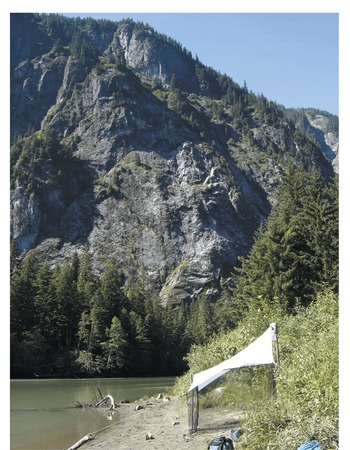
Specimens of Heleodromia have frequently been collected along the banks of rivers (Fig. 4) and streams, on rocks near waterfalls, or on moist soil of forest floors (Saigusa Reference Saigusa1963).
Exchamsiks River locality near Terrace, British Columbia, Canada, where specimens of Heleodromia chillcotti sp. nov. were collected using a Malaise trap and yellow pan traps placed along the river bank.

Heleodromia boreoalpina Saigusa
(Figs. 5, 7B)
Heleodromia boreoalpina Saigusa, Reference Saigusa1963: 125.
Type material
Paratypes: JAPAN. Hokkaido: Mt. Hokuchindake, Daisetsu-zan Mtns., 20.vii.1962, T. Saigusa (1 ♂, 1 ♀, CNC).
Additional material
CANADA. British Columbia: Alaska Hwy., 37km W Fort Nelson, 12.vi–5.ix.1984, intercept, aspen spruce forest, S. and J. Peck (1 ♂, CNC). Northwest Territories: Aklavik, 27.vii.1932, Bryant, Lot 306 (1 ♂, CAS). Nunavut: Kugluktuk, 67.83438°, −115.20987°, Repl. 2, mesic, MT, 3–7.vii.2010, NBP field party (1 ♂, LEM); Kugluktuk, 67.78508°, −115.27573°, Repl. 1, wet, MT, 4–10.viii.2010, NBP field party (1 ♂, LEM). Yukon: Dempster Hwy., km 141, 23.vii.1982, pan trap, DMW (2 ♂, 1 ♀, CNC); Dempster Hwy., mile 87 (approximately km 140), 4–8.viii.1973, G. Wood and DMW (1 ♂, CNC); Dempster Hwy., km 155, 28.vi–16.vii.1982, pan trap, DMW (3 ♂, CNC) 14 mi. E Dawson, 1300 ft, 1.viii.1962, PJS (1 ♂, CNC); 58 mi. E Dawson, Gravel Lk., 2050 ft, 11.viii.1962, PJS (1 ♂, CNC); Firth R., 2.viii.1956, R.E. Leech (2 ♂, CNC); Klondike Hwy., 24km S Carmacks, Montague Road House (64°54′N, 136°03′W), sweep at stream, 19.vii.1998. S. Boucher and TAW (1 ♂, 1 ♀, LEM); Kluane, 19.vii.1987, S.G. Cannings (1 ♂, UBCZ); Minto Landing Territorial Cpgd., Klondike Loop J-148, 4.vii.1978, PHA (1 ♂, USNM); Klondike Loop, J-243 mi. (390km), McQuesten, 14.vi.1996, Collection No. 01500, flight trap, PHA and MMA (1 ♂, USNM); Horseshoe Bay Territorial Cpgd., Kluane Lk., Alaska Hwy. DC-1064, 6.viii.1978, PHA (1 ♂, 2 ♀, USNM); Snag Junction Territorial Cpgd., Alaska Hwy. DC-1189, 5.viii.1978, PHA (1 ♂, 1 ♀, USNM); Takhini Hot Springs, Klondike Loop J-3.6, 8.viii.1978, PHA (1 ♂, CAS). RUSSIA. Magadanskaya Oblast, Aborigen Field Stn., 500m, 25.vii–10.viii.1990, DMW (1 ♂, CNC). UNITED STATES OF AMERICA. Alaska: Isabel Pass, mile 206 Richardson Hwy., 2900 ft, 17.vii.1962, PJS (1 ♂, CNC); King Salmon, Naknek R., 11.vii., 1.viii.1952, W.R. Mason (2 ♂, CNC); Tok, Sourdough Cpgd., 22.vii.1996, PHA and MMA, Collection No. 01575 (1 ♂, USNM); Taylor Hwy., Walker Fork Cpgd., 18.vi.1996, PHA and MMA, Collection No. 01510-A (1 ♂, USNM); Circle Hot Springs, 23.vi.1996, 01522-A, flight trap, PHA and MMA (2 ♂, 4 ♀, USNM), same except 24.vi.1996, Collection No. 01523-A (1 ♂, USNM), same except 26.vi.1996, Collection No. 01526-A (2 ♂, USNM).
Diagnosis
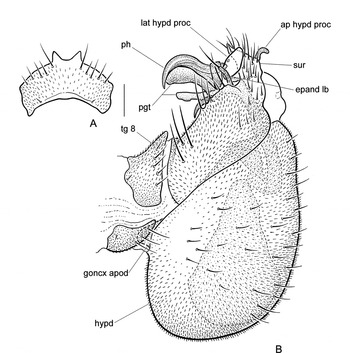
Heleodromia boreoalpina is characterized by male tergite 8 with short median forked process, not distinctly overlapping base of epandrium; phallus with beak-like apex; surstylus subtriangular, clothed in short setae.
Redescription (for complete description see Saigusa 1963)
Apart from male terminalia, habitus and coloration very similar to Figure 1. Antennal stylus about 2 times length of postpedicel. Legs black to dark brown, “knees” often paler reddish brown. Male tergite 8 (Fig. 5A) with short median forked process, not distinctly overlapping base of epandrium (Fig. 5B). Male terminalia (Fig. 5B): Hypandrium broad, height less than twice width; gonocoxal apodeme short, anteriorly produced; lateral hypandrial process arched around surstylus, with apex broadly expanded, bearing large sensillum; apical hypandrial process slender, arched posteriorly. Epandrium with broad dorsal bridge; dorsal margin flat anteriad epandrial lobe, bearing several slender setae; epandrial lobe slender, finger-like, bearing apical seta, seta longer than lobe. Surstylus subtriangular with narrow apex, clothed in short setae; base of surstylus with small thumb-like projection medially. Phallus with strongly hooked beak-like apex. Postgonites well developed with short unpaired finger-like medial process and pair of apically rounded and broadened flap-like lobes laterally flanking phallus.
Heleodromia boreoalpina Saigusa. A, Tergite 8, dorsal view; B, male terminalia, lateral view (ap hypd proc, apical hypandrial process; epand lb, epandrial lobe; goncx apod, goncoxal apodeme; hypd, hypandrium; lat hypd proc, lateral hypandrial process; pgt, postgonite; ph, phallus; sur, surstylus; tg 8, tergite 8). Scale bar=0.1mm.

Distribution
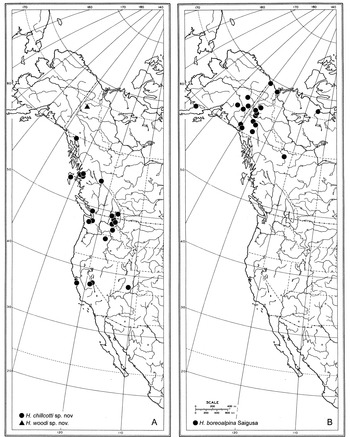
Originally described from Hokkaido, Japan, H. boreoalpina is here newly recorded from the Russian Far East and northwestern North America (Fig. 7B). For the specific locality from the Russian Far East, see the “Additional material” section above. The Nearctic distribution is typical of a Beringian element.
Remarks
The original type series from Japan was collected on moist soil at the edge of a snowfield, in the alpine/boreal zone (Saigusa Reference Saigusa1963). The Nearctic material was also collected in similar arctic/boreal habitats.
Heleodromia chillcotti Sinclair sp. nov.
(Figs. 1, 4, 6, 7A)
Type material
Holotype: ♂, “Kleanza Creek,/ 14 mi.E.Terrace/ B.C. 13.VII.1960/ J.G. Chillcott”; “HOLOTYPE/ Heleodromia/ chillcotti/ Sinclair” [red label] (CNC). Paratypes: CANADA. British Columbia: Terrace, 220 ft, 15.viii.1960, B. Heming (1 ♂, CNC), same except airport, 3.vii.1960 (1 ♂, 1 ♀, CNC), same except airport area, 3.vii.1960, W.W. Moss (1 ♂, CNC); 5 mi. S Terrace, 220 ft, 3.vi.1960, JGC (1 ♂, CNC); 10 mi. W Terrace, 9.vi.1960, JGC (1 ♂, CNC), same except seepage area (1 ♂, CNC); 32 mi. SW Terrace, 11.vi.1960, wet thick poplar cedar forest, JGC (1 ♂, CNC), same except 100 ft, B. Heming (1 ♂, 1 ♀, CNC); 40 mi. W Terrace, 9.vii.1960, marginal sedges, JGC (1 ♂, CNC); 10 mi. N Terrace, Glacier Ck., 7.vii.1960, JGC (2 ♂, CNC); 14 mi. E Terrace, Kleanza Ck., 4.vii.1960, JGC (1 ♂, CNC), same except 13.vii.1960 (3 ♂, CNC); Exchamsiks R., 58km SW Terrace, 54°20.00′N, 129°17.81′W, 15–17.viii.2008, MT, J.M. Cumming and S.E. Brooks (2 ♂, 2 ♀, CNC), same except 17–18.viii.2008, YPT (1 ♂, CNC); Hart Hwy., Bear Lk. Camp, 72km from Prince George, 24.vi.1978, PHA (1 ♂, USNM); Horseshoe Bay, 0–300 ft, 30.v.1961, J.R. Vockeroth (1 ♂, CNC); Kitimat, 2.vi.1960, JGC (1 ♂, CNC); Marysville, 13.viii., C. Garrett (1 ♂, USNM); Queen Charlotte Islands, Graham Island, nr. Queen Charlotte City, 10–23.vii.1988, sweep logging road, SAM (2 ♂, DEBU); Robson, 12.x.1957, 21.iv.1960, H.R. Foxlee (2 ♂, 1 ♀, UBSZ); University of British Columbia, 23.v.1927, G.J. Spencer (1 ♂, UBCZ). UNITED STATES OF AMERICA. Alaska: Skagway, 3.vi.1919, H.G. Dyar (1 ♂, USNM). California: Fresno Co., Huntington Lk., Rancheria, approximately 2600m, 25.vii.1984, JFM (4 ♂, CNC), same except 9.vii.1984 (3 ♂, CNC); Mono Co., Lk. Mamie, 19.vii.1966, PHA (1 ♂, USNM); Santa Cruz Co., along Opal Ck., Big Basin SP, 14.vi.1978, D.D. Wilder (1 ♂, USNM). Idaho: Bonner Co., Sandpoint, Trestle Ck. near Hope, 27.viii.1918, ALM (1 ♂, USNM); Bonner Co., Priest Lk., 1.viii.1916, ALM (1 ♂, 1 ♀, USNM), same except Priest Lk., Cavanaugh Bay, 18.viii.1919, ALM (1 ♂, USNM); Latah Co., Moscow, Moscow Mtn., 12–17.vi.1918, ALM (1 ♂, 1 ♀, USNM). Oregon: Union Co., Whiskey Ck., 23 mi. SSW La Grande, 5120 ft, 27–30.vii.1977, MT baited with CO2, E.J. Davis (1 ♂, USNM). Utah: Garfield Co., Pleasant Ck., 2820m, vi.1994, JFM (1 ♂, 4 ♀, CNC), same except approximately 9600 ft, 17.vi.1994 (2 ♂, CNC), same except 20km N Boulder, Pleasant Ck., 2–7.viii.1993 (1 ♂, WSU). Washington: King Co., Seattle, 5.viii.1898 (1 ♂, USNM); Mason Co., Shelton, Walkers Park, 21.vii.1917, ALM (1 ♂, USNM); Spokane Co., Mt. Spokane, 30.vii.1920, ALM (1 ♂, USNM).
Diagnosis
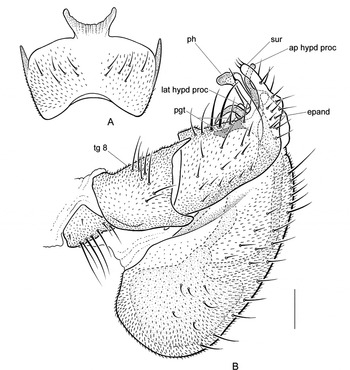
Heleodromia chillcotti is characterized by male tergite 8 with narrow posterolateral extension overlapping anterolateral corner of epandrium and short dorsomedial, broadly forked process overlapping base of epandrium; apex of phallus boot-shaped in lateral view, cleft medially with lateral flap-like lateral ridges; surstylus narrow, finger-like, bearing three short apical setulae.
Description
Habitus as in Figure 1. Antennal stylus about 2 times length of postpedicel. Legs black to reddish brown, “knees” often somewhat paler. Male tergite 8 (Fig. 6A) with narrow posterolateral extension overlapping anterolateral corner of epandrium and short dorsomedial broadly forked process overlapping base of epandrium (Fig. 6B). Male terminalia (Fig. 6B): Hypandrium somewhat broad, height slightly more than twice width; gonocoxal apodeme virtually absent; lateral hypandrial process short, not arched around surstylus; apical hypandrial process slender, arched posteriorly. Epandrium with very slender dorsal bridge; dorsal margin flat anteriad epandrial lobe, bearing 2–3 stout setae; epandrial lobe slender, finger-like, bearing apical seta, seta shorter than lobe. Surstylus with apical two-thirds slender and finger-like, bearing 3 short setulae at tip, basal third broadly expanded and setose, with thumb-like projection medially. Phallus with apex broadly rounded, boot-shaped in lateral view, cleft medially with flap-like lateral ridges. Postgonites well developed, with short unpaired finger-like medial process and pair of slender fin-like lobes laterally flanking phallus.
Heleodromia chillcotti Sinclair sp. nov. A, Tergite 8, dorsal view; B, male terminalia, lateral view (ap hypd proc, apical hypandrial process; epand, epandrium; lat hypd proc, lateral hypandrial process; pgt, postgonite; ph, phallus; sur, surstylus; tg 8, tergite 8). Scale bar=0.1mm.

Distribution
This new species is widespread in western North America, extending from southern Alaska to Washington, Idaho, and northern Oregon, with apparent disjunct populations from California and Utah (Fig. 7A).
Distributions of species of Heleodromia in the Nearctic Region. A, Heleodromia chillcotti Sinclair sp. nov. and H. woodi Brooks sp. nov. B, Heleodromia boreoalpina Saigusa.

Remarks
Collection records indicate that this species is found in a variety of conifer forests (Fig. 4), ranging from coastal Sitka spruce (Picea sitchensis (Bong.) Carrière (Pinaceae)) temperate rainforests to forests above 2000m.
Etymology
This species is named in honour of Jim Chillcott, who made the initial species sorting of Heleodromia, including a manuscript key and simple drawings of the male genitalia. His collecting efforts during the Northern Insect Survey greatly enhanced the CNC collections.
Heleodromia cranehollowensis Cumming and Coovert sp. nov.
(Figs. 2, 8, 9)
Type material
Holotype: ♂, “GAC/ 3185#3” [green label]; “OHIO, Hocking/ Co., Laurel Twp./ Crane Hollow/ Aug. 19, 2009”; “Collector:/ G.A. Coovert/ cf field notes”; “HOLOTYPE/ Heleodromia/ cranehollowensis/ Cumming & Coovert” [red label] (CNC). Paratypes: UNITED STATES OF AMERICA. Ohio: Hocking Co., Laurel Twp., Crane Hollow State Nature Preserve, Double Falls area, 12.viii.2009, GAC 3181#2, on sandstone boulders below Double Falls, G.A. Coovert (1 ♂, 1 ♀, CHIC; 1 ♂, USNM); same except 19.viii.2009, GAC 3185#3 (2 ♂, 1 ♀, CHIC; 1 ♀, CNC); same except 16.viii.2009, GAC 3246#7, sweeping rock/gravel shore of large pool at base of E branch, Hood Hollow falls (1 ♂, CHIC).
Diagnosis
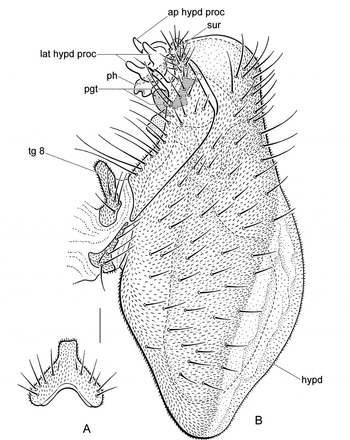
Heleodromia cranehollowensis is the only Nearctic species with a long, slender male genital capsule and pale legs; antennal stylus distinctively lengthened; male tergite 8 produced dorsomedially as a short truncate projection; surstylus slender, clothed in short setae.
Description
Habitus as in Figure 2. Antennal stylus about 2.75 times length of postpedicel. Legs brown to light brown with lower margins distinctly pale. Male tergite 8 slender (Fig. 8), not expanded or overlapping anterolateral corner of epandrium; dorsomedial process short and truncate (Fig. 8A). Male terminalia (Fig. 8B): Hypandrium lengthened, height about 2.5 times width, with ventral margin narrowly rounded to somewhat pointed; gonocoxal apodeme virtually absent; lateral hypandrial process bifid with finger-like projections; apical hypandrial process slender, hooked anteriorly. Epandrium with narrow dorsal bridge; dorsal margin flat to slightly concave anteriad epandrial lobe, bearing several slender setae; epandrial lobe slender, finger-like, bearing apical seta subequal in length to lobe. Surstylus slender, clothed in short setae. Phallus with apex rounded, cleft medially. Postgonites well developed, with short unpaired finger-like medial process and lateral pair of spatulate lobes flanking phallus.
Heleodromia cranehollowensis Cumming and Coovert sp. nov. A, Tergite 8, dorsal view; B, male terminalia, lateral view (ap hypd proc, apical hypandrial process; hypd, hypandrium; lat hypd proc, lateral hypandrial process; pgt, postgonite; ph, phallus; sur, surstylus; tg 8, tergite 8). Scale bar=0.1mm.

Distribution
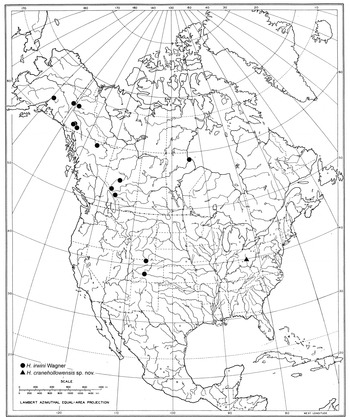
This is the only species of Heleodromia collected in eastern North America south of the Great Lakes (Fig. 9). It is currently known only from the type locality in south-central Ohio.
Distribution of Heleodromia cranehollowensis Cumming and Coovert sp. nov. and Nearctic distribution of H. irwini Wagner.

Remarks
The remarkable discovery of this new species was a direct result of extensive work in a comprehensive All Taxa Biodiversity Inventory being conducted at Crane Hollow. This survey has resulted in a pinned-insect collection of over 100 000 specimens. All specimens of H. cranehollowensis were collected at the base of massive Blackhand sandstone cliffs, typically 30m in height, in a forested area of Hemlock and mixed Mesophytic forest with eastern hemlock (Tsuga canadensis (L.) Carrière, (Pinaceae)) dominant, tuliptree (Liriodendron tulipifera L. (Magnoliaceae)), American beech (Fagus grandifolia Ehrh. (Fagaceae)), and black birch (Betula lenta L. (Betulaceae)) prominent, and yellow birch (Betula alleghaniensis Britton) abundant in the valley floor. The cool moist microclimate created below the cliffs also supports the federally endangered plant species Aconitum noveboracense A. Gray ex Coville (Ranunculaceae), considered to be a glacial relict, left behind in a few unique areas by receding glaciers at the end of the Pleistocene Epoch (Cole and Kuchenreuther Reference Cole and Kuchenreuther2001).
This eastern species differs greatly in the male terminalia from all other Nearctic species. It appears most closely related to H. macropyga Saigusa from Japan (Honshu) on the basis of the long, slender genital capsule and the shape of the apical and lateral hypandrial processes.
Etymology
This species is named after the type locality, currently the only place where it has been collected.
Heleodromia irwini Wagner
(Figs. 9, 10)
Heleodromia irwini Wagner, Reference Wagner1985: 37.
Type material
Paratypes: SCOTLAND. Inverness, Grid Ref. 38/1121, Bridge of Brown, stony river, 15.vi.1982, A. Irwin (1 ♂, WEC); Inverness, Grid Ref. 38/0716, Dorbach Burn, stony, shingle stream, 17.vi.1982, A. Irwin (1 ♀, WEC).
Additional material
CANADA. Alberta: Jasper, 1040–1060 m, 23.vii.1977, N.L.E. Krauss (1 ♂, AMNH); Laggan, 26.vii.1928, O. Bryant (1 ♂, CAS); 10km NW Whitecourt, Hwy. 32 at Sakwatamau R. (54°10′N, 115°42′W), sweep vegetation at river edge, 15.vii.1997, TAW (1 ♂, LEM). British Columbia: waterfall at Peterson Ck. No. 4, Alaska Hwy. DC-445, 29.vi.1978 PHA (1 ♂, USNM). Manitoba: Churchill, Twin Lakes Rd. (58°45.09′N, 93°49.07′W), YPT at gravel-pit pond, 16–29.vii.1997, H.D. White (2 ♂, 1 ♀, LEM). Yukon: Aishihik Rd., 13.5km N Alaska Hwy., flying by forest, 61°01′N, 137°02′W, 21.vi.1981, No. 810584a, B. Marshall (1 ♂, ROM); 14 mi. E Dawson, 1300 ft, 29.vii.1962, R.E. Leech (1 ♂, CNC); Whitehorse, Robert Service Cpgd. (60°42′N, 135°03′W), sweep grass/sedges along Yukon R. margin, 27.vi.1997, TAW (1 ♂, 1 ♀, LEM), same except sweep at Yukon R., 60°42.1′N, 135°02′W, 27.vii.1998 (1 ♂, 1 ♀, LEM); Alaska Hwy. at Marshall Ck. (60°50.1′N, 137°19.9′W), sweep grass at roadside, 18.vii.1998, TAW (1 ♂, 3 ♀, LEM); Wolf Ck. Territorial Cpgd., Alaska Hwy. DC-906, 2.vii.1978, PHA (1 ♂, CAS). GERMANY. Oberbayern, TÖL, Isar-Tal zw. Wallgau und Vorderriβ, 830m, ex Isar dry river beds, 15.vi.2002, B.J. Sinclair (2 ♂, CNC). RUSSIA. Magadanskaya Oblast, Aborigen Field Stn., 500m, 25.vii–10.viii.1990, DMW (25 ♂, CNC). UNITED STATES OF AMERICA. Alaska: Mount McKinley NP, gravel pit outside entrance, 13.vii.1978, PHA (1 ♂, 1 ♀, USNM); old dredge near Jack Wade, Taylor Hwy., Klondike Loop D-90.8, 7.vii.1978, flying low along edge of creek with muddy water, at approximately 1500, in sun, PHA (1 ♂, USNM); Dragonfly Ck., vicinity of entrance to Mount McKinley NP, 13.vii.1978, small rocky creek, PHA (1 ♂, USNM). Colorado: Jackson Co., North Sand Hills SRMA, 5.viii.1993, S. Fitzgerald (1 ♂, CSU); Monarch Pass, 21.vi.1940, 8000 ft, ALM (1 ♂, USNM).
Diagnosis
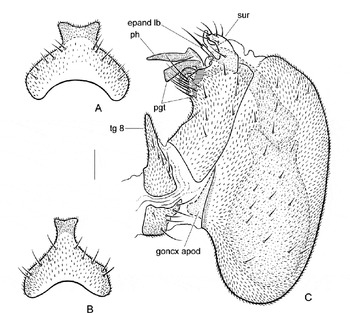
Heleodromia irwini is characterized by male tergite 8 not broader than sternite 8, only produced medially as a shallow bilobed to forked projection and lacking posterolateral projection; phallus with slender, needle-like apex; dorsal margin of epandrium with setose ridge anteriad epandrial lobe; surstylus slender with short dentiform process apically.
Redescription
Apart from male terminalia, habitus and coloration very similar to Figure 1. Antennal stylus about 2 times length of postpedicel. Legs black to reddish brown, “knees” often somewhat paler. Male tergite 8 (Figs. 10A, 10B) slender, not expanded or overlapping anterolateral corner of epandrium (Fig. 10C); dorsomedial process variable, from broad and short (Fig. 10A) to slender and elongate (Fig. 10B), apex shallowly bilobed to forked, overlapping anterior margin of epandrium; depth of apical fork variable from shallow to deeply cleft in type series (see Wagner Reference Wagner1985, Fig. 3). Male terminalia (Fig. 10C): Hypandrium broad, height slightly less than twice width; gonocoxal apodeme short, anteriorly produced; lateral hypandrial process short, arched over base of epandrial lobe; apical hypandrial process slender, arched posteriorly. Epandrium with broad dorsal bridge; dorsal margin with projecting rounded ridge anteriad epandrial lobe bearing row of stout setae; epandrial lobe slender, finger-like, bearing apical seta, seta longer than lobe. Surstylus slender, finger-like, with scattered setae, with small preapical thumb-like projection medially; apex with short dentiform process. Phallus with slender, needle-like apex. Postgonites well developed, with short unpaired finger-like medial process and pair of truncate flap-like lobes laterally flanking phallus.
Heleodromia irwini Wagner. A, B, tergite 8, dorsal view; C, male terminalia, lateral view (epand lb, epandrial lobe; goncx apod, gonocoxal apodeme; pgt, postgonite; ph, phallus; sur, surstylus; tg 8, tergite 8). Scale bar=0.1mm.

Distribution
This species was described on the basis of material from Austria, Italy, Switzerland, and Scotland (Wagner Reference Wagner1985), and is here newly recorded from Germany, the Russian Far East, and western North America (Fig. 9). For the specific localities of the non-Nearctic records, see the “Additional material” section above.
Remarks
As suggested by Plant (Reference Plant2005), H. irwini exhibits a boreo-alpine distribution, with glacial relict populations in England. The same can perhaps be suggested for the Colorado populations, which are widely disjunct from more northern populations in North America (Fig. 9). However, there are numerous records based on unassociated females (Fig. 3) that could possibly link these outliers. The male terminalia of Heleodromia irwini appear to be very similar to the terminalia of H. rami Wagner and Leese from the Indian Himalayas (see fig. 46 in Wagner et al. Reference Wagner, Leese and Panesar2004).
Heleodromia pullata (Melander)
(Figs. 11, 12)
Sciodromia pullata Melander, Reference Melander1902: 345.
Heleodromia pullata (Melander): Melander Reference Melander and Wytsman1928: 225; Reference Melander, Stone, Sabrosky, Wirth, Foote and Coulson1965: 467.
Type material
Lectotype (here designated): ♀, “Top E. Las Veg./ Range NM/ VI.28.[19]02”; “TYPE No./ -94-” [red label]; “Sciodromia/ pullata/ Types Mel.” (ANSP).
Additional material
CANADA. Northwest Territories: Banks Island, Masik R., approximately 15 mi. up (71°37′N, 123°07′W), 10–16.vii.1968, W.R.M. Mason (4 ♂, 4 ♀, CNC), same except 17, 25.vii.1968, G.E. Shewell (2 ♂, 1 ♀, CNC). Nunavut: Baffin Island, Clyde, 17–27.vii.1958, G.E. Shewell (10 ♂, 2 ♀, CNC), same except 1.viii.1958 (1 ♂, CNC), same except 22–28.vi.1958, J.E.H. Martin (1 ♂, 5 ♀, CNC), same except 2–14.vii.1958 (5 ♂, 3 ♀, CNC), same except 27.vii.1958 (1 ♀, CNC), same except 12.viii.1958 (2 ♂, CNC); Baffin Island, Frobisher Bay, 10.vii.1948, T.N. Freeman (1 ♂, CNC), same except 10.viii.1959, J.A. Downes (1 ♂, CNC), same except W.R. Richards (1 ♂, 1 ♀, CNC), same except 10–11.viii.1959, W.R.M. Mason (2 ♂, CNC); Chesterfield Inlet, 3.viii.1950, J.R. Vockeroth (1 ♂, 2 ♀, CNC), same except 8.viii.1950 (2 ♂, CNC); Muskox Lk., 64°45′N, 108°10′W, 10–16.vii.1953, JGC (1 ♂, 1 ♀, CNC); nr. Shingle Point, mouth of Running R., seashore debris, 7.vii.1987 (3 ♂, DEBU); Kugluktuk, 67.83391°, −115.21410°, Repl.2, wet, MT, 19–26.vii.2010, NBP field party (1 ♂, LEM); Kugluktuk, 67.78508°, −115.27573°, Repl.1, wet, MT, 13–19.vii.2010, NBP field party (1 ♂, LEM); Southampton Island, Coral Harbour, 11–13.vii.1948, G.E. Shewell (1 ♂, 1 ♀, CNC); Spence Bay, 18–27.vii.1951, JGC (4 ♂, 3 ♀, CNC); Victoria Island, Cambridge Bay, 22–26.vii.1950, G.K. Sweatman (2 ♂, 2 ♀, CNC), same except 2.viii.1950 (2 ♂, CNC), same except 19.vii.1950, E.H.N. Smith (1 ♂, CNC), same except 7.viii.1950 (1 ♂, CNC). Yukon: Dempster Hwy., km 155, 2.vii.1982, DMW (19 ♂, CNC), same except 10–22.vii.1982, pan trap (1 ♂, CNC), same except up to 16.vii.1982 (8 ♂, CNC), same except Pyramid Mtn., 8.vi–2.vii.1982, pan trap, G. Wood and DMW (2 ♂, CNC); Erebia Ck. Base Camp, mammal runs near creek, 8.vii.1987, SAM (1 ♂, 2 ♀, DEBU), same except 67°58′N, 136°29′W, 5.vii.1987 (1 ♂, 4 ♀, DEBU); Koidern, flood debris, 18.vi.1987, SAM (1 ♂, DEBU); North Fork Crossing, mile 42, Peel Plateau Rd. 3500 ft, 26–27.vi.1962, PJS (3 ♂, 5 ♀, CNC), same except 3–4.vii.1962 (9 ♂, 24 ♀, CNC), same except 24–27.vi.1962, R.E. Leech (1 ♂, 2 ♀, CNC), same except 3–6.vii.1962 (4 ♂, 6 ♀, CNC); North Fork Crossing, Ogilvie Mtns., 1–7.vii.1962, PJS (4 ♂, 3 ♀, CNC); Richardson Mtns., 66°07′N, 136°30′W, 2800 ft, 11.vii.1982, DMW (1 ♂, CNC); Whitehorse, Wolf Ck. Cpgd., pits near spring, 17.vi.–14.vii.1987, SAM (1 ♂, DEBU); Wolf Ck. Territorial Cpgd., Alaska Hwy. DC-906, 2.vii.1978, PHA (1 ♂, USNM). RUSSIA: Magadanskaya Oblast, Aborigen Field Stn., 500m, 25.vii–10.viii.1990, DMW (1 ♂, CNC); Taymyr Nature Reserve, cordon Ary-Mas, 14m, 72.5°N, 101.94°E, right shore of Novaya R., floodplain meadow, 10–12.vii.2010, A. Barkalov (3 ♂, examined by I. Shamshev). UNITED STATES OF AMERICA. Alaska: Nome area, mile 17 of Kougarok Rd., 64°42′22′′N, 165°17′50′′W, 20–26.vi.2005, MT, J. and R. Skevington (1 ♂, CNC); Tangle Lakes, 28.vi–8.vii.1969, MT, J. Matthews (1 ♂, CNC); Unalakleet, 11.viii.1961, R. Madge (1 ♂, CNC); Umiat, 23.vii.1959, R. Madge (1 ♂, CNC); Camp 327 AlskEngComm, 12.vii.1921, J.M. Aldrich (1 ♂, USNM). Arizona: Greelee Co., 12.5km SW Sprucedale, Apache NationalForest, 3.1km N of S jct. Forest Routes 24 and 25 on 24, 33°36′N, 109°21′W, MT No. 5 in canyon leading to Corduroy Ck., W side Rd. 24, S.D. Gaimari (1 ♂, CNC). Colorado: Boulder Co., Boulder, 5.viii.1973, D.D. Wilder (1 ♂, CAS); Chaffee Co., Garfield, on South Arkansas R., 2990m, 12.viii.1973, PHA (2 ♂, CAS).
Diagnosis
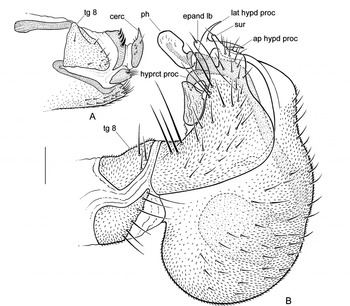
Heleodromia pullata is the only Nearctic species lacking the dorsomedial elongation of male tergite 8; apex of phallus membranous and broad; surstylus slender, finger-like, shorter than epandrial lobe.
Redescription
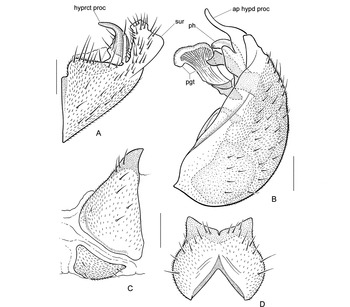
Apart from male terminalia, habitus and coloration very similar to Figure 1. Antennal stylus about 1.5–1.6 times length of postpedicel. Legs black to reddish brown, “knees” often somewhat paler. Male tergite 8 (Fig. 11B) lacking dorsomedial elongation or process. Male terminalia (Fig. 11B): Hypandrium very broad, height less than twice width; apex prolonged into narrow extension; gonocoxal apodeme short, anteriorly produced; lateral hypandrial process elongate, slender, curved posteriorly, with pointed apex; apical hypandrial process straight and slender with pointed apex. Epandrium with broad dorsal bridge; dorsal margin concave anteriad epandrial lobe bearing 2–3 slender setae; epandrial lobe slender, finger-like, bearing apical seta, seta shorter than lobe. Surstylus shorter than epandrial lobe, with apical third slender and finger-like, lower two-thirds broadly expanded and setose; apex bearing 1 short setula; base of surstylus expanded medially as triangular projection. Phallus with apex membranous and broad. Postgonites indistinct.
Heleodromia pullata (Melander). A, Female terminalia, lateral view; B, male terminalia, lateral view (ap hypd proc, apical hypandrial process; cerc, cercus; epand lb, epandrial lobe; hyprct proc, hypoproct process; lat hypd proc, lateral hypandrial process; ph, phallus; sur, surstylus; tg 8, tergite 8). Scale bar=0.1mm.

Distribution
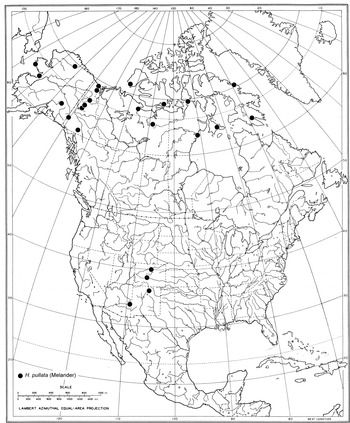
Heleodromia pullata is widely distributed in northern Canada and Alaska, occurring on tundra and in boreal forests (Fig. 12) and is here newly recorded from the Russian Far East. For the specific localities from the Russian Far East, see the “Additional material” section above. Based solely upon male specimens, this species is disjunct in the southern Rocky Mountains (as in H. irwini), but this maybe an artefact. Mason et al. (Reference Mason, Shewell and Cody1972) provides a description of the collection locality on Banks Island (Northwest Territories).
Distribution of Heleodromia pullata (Melander) in the Nearctic Region.

Remarks
The original type series was based on two males and three females collected by H.L. Viereck in the Las Vegas Range of New Mexico (Melander Reference Melander1902). Only a single female syntype remains from the original series. Dissection of the lectotype (designated herein) revealed that this species most closely resembles female specimens that we have associated with males of this species.
Melander (Reference Melander and Wytsman1928, fig. 68) provided a habitus drawing of a male specimen of H. pullata with the genitalia characterized by paired dorsal finger-like processes. This pair of projecting processes (i.e., epandrial lobe and surstylus), combined with a simple male tergite 8, confirms the identity of this species.
Heleodromia woodi Brooks sp. nov.
(Figs. 7A, 13)
Type material
Holotype: ♂, “YUKON km 155/ Dempster Hwy/ up to 16.vii.[19]82/ D.M. Wood/ pan trap”; “HOLOTYPE/ Heleodromia/ woodi/ Brooks” [red label] (CNC). Paratypes: CANADA. Yukon: Dempster Hwy., km 155, up to 16.vii.1982, pan trap, DMW (3 ♂, CNC); same except Pyramid Mtn., 28.vi–2.vii.1982, G. Wood and DMW (1 ♂, CNC); Dempster Hwy., km 155, burrow, 25.vi.1987, SAM (1 ♂, DEBU). RUSSIA. Magadanskaya Oblast, Aborigen Field Stn., 500m, 25.vii–10.viii.1990, DMW (4 ♂, CNC).
Diagnosis
Heleodromia woodi is characterized by the distinctive posterior margin of male tergite 8, which is broadly bifurcate with large triangular dorsolateral processes; large setose surstylus with broadly expanded lower margin and quadrate apex.
Description
Apart from male terminalia, habitus and coloration very similar to Figure 1. Antennal stylus about 1.5–1.8 times length of postpedicel. Legs blackish brown, “knees” often somewhat paler. Male tergite 8 (Figs. 13C, 13D) with posterior margin broadly bifurcate with large triangular dorsolateral processes. Male terminalia (Figs. 13A, 13B): Hypandrium somewhat broad, height about twice width; gonocoxal apodeme virtually absent; lateral hypandrial process short, broadly rounded; apical hypandrial process elongate and slender, weakly arched posteriorly. Epandrium with very narrow dorsal bridge; dorsal margin with rounded projecting ridge anteriad epandrial lobe bearing several slender setae; epandrial lobe with narrowed basal connection, slender, finger-like, bearing short apical seta. Surstylus large, setose, with broadly expanded lower margin and quadrate apex, with small preapical thumb-like projection medially. Phallus with apical portion curved anteriorly, simple, tubular, with bluntly rounded tip. Postgonites well developed, with large unpaired apically expanded apodeme-like medial process and pair of truncate flap-like lobes laterally flanking phallus.
Heleodromia woodi Brooks sp. nov. A, Epandrium and hypoproct, lateral view; B, hypandrium and phallus, lateral view; C, segment 8, lateral view; D, tergite 8, dorsal view (ap hypd proc, apical hypandrial process; hyprct proc, hypoproct process; pgt, postgonite; ph, phallus; sur, surstylus). Scale bars=0.1mm.

Distribution
Heleodromia woodi has a Beringian distribution, and is known from localities in the Russian Far East and Yukon Territory (Fig. 7A).
Remarks
Heleodromia woodi was one of four species (along with H. boreoalpina, H. irwini, and H. pullata) collected at the Aborigen Field Station, in the Russian Far East in 1990 by Monty Wood.
Etymology
This species is named in honour of our esteemed mentor, CNC dipterist and Manual of Nearctic Diptera coordinator Dr. Monty Wood, who also collected nearly all of the specimens in the type series.
Key to males of Nearctic species of Heleodromia
1. Legs with lower margins at least distinctly pale. Tergite 8 with medially produced truncate process, not forked apically (Fig. 8A). Genital capsule long and slender, height greater than 2.75 times width; ventral margin of hypandrium narrowly rounded to somewhat pointed (Fig. 2)………H. cranehollowensis Cumming and Coovert sp. nov.
— Legs dark, at most “knees” slightly pale. Tergite 8 with forked or shallowly bilobed medial process (Figs. 5A, 6A, 10A, 10B, 13D) or process absent (Fig. 11B). Genital capsule oval, height less than 2.25 times width; ventral margin of hypandrium broadly rounded (Fig. 1)………2
2. Tergite 8 simple, lacking long posteromedial process and not produced posterolaterally. Apex of phallus membranous and broad (Fig. 11B)………H. pullata (Melander)
— Tergite 8 with posteromedial process and (or) posterolaterally overlapped terminalia (Figs. 5, 6, 10, 13C, 13D). Apex of phallus pointed, tubular, or boot-shaped (Figs. 5B, 6B, 10C, 13B)………3
3. Tergite 8 broader than sternite 8 in lateral view, broadly expanded both posteriorly and laterally, such that lateral and medial projections often overlap terminalia (Figs. 6, 13C, 13D)………4
— Tergite 8 not broader than sternite 8, only produced medially as forked or shallowly bilobed projection, lacking posterolateral projection (Figs. 5, 10)………5
4. Apex of phallus curved anteriorly, simple, with bluntly rounded tip (Fig. 13B). Epandrial lamellae widely separated, such that dorsal bridge is long and slender; dorsal epandrial margin with rounded projecting ridge anteriad epandrial lobe. Surstylus shorter than hypandrial projections, apex quadrate (Fig. 13A)………H. woodi Brooks sp. nov.
— Apex of phallus broadly rounded, boot-shaped, cleft medially with flap-like lateral ridges (Fig. 6B). Epandrial lamellae narrowly separated, such that dorsal bridge is short; dorsal epandrial margin flat anteriad epandrial lobe. Surstylus long and slender, subequal in length to hypandrial projections, apex rounded, bearing 3 setulae (Fig. 6B)………H. chillcotti Sinclair sp. nov.
5. Phallus with beak-like apex (Fig. 5B). Surstylus subtriangular, clothed in short setae. Tergite 8 with forked projection not distinctly overlapping base of epandrium (Fig. 5)………H. boreoalpina Saigusa
— Phallus with slender, needle-like articulated apex (Fig. 10C). Surstylus slender with short dentiform process apically. Tergite 8 with bilobed or forked projection distinctly overlapping base of epandrium, (Fig. 10)………H. irwini Wagner
Discussion
The genus Heleodromia is now known to comprise at least six species from the Nearctic Region, including four that are Holarctic. Given the diversity of species that occur in the north and the lack of collection records for the genus, additional Nearctic species will likely be discovered. Repeated sampling is also required from localities where only females have been collected, in the hope of obtaining males that can be associated and determined to species. Future studies employing molecular techniques to associate the sexes should also prove useful in more accurately delimiting distributions of Nearctic Heleodromia species.
A phylogenetic analysis of Heleodromia is required to determine the validity of the subgenera and the relationship of Pseudheleodromia to the genus. Determination of the relationships of the species will also elucidate the zoogeographic history of the genus. At least some Asio-Nearctic disjunct sister-group relationships (see Sinclair and Saigusa Reference Sinclair and Saigusa2002) appear probable (e.g., H. cranehollowensis and H. macropyga), which is consistent with the early Tertiary (Eocene) fossil record for the genus.
Acknowledgements
We are indebted to the following curators and their respective institutions for the loan of specimens: D. Grimaldi (AMNH), J. Weintraub (ANSP), C. Griswold (CAS), B. Kondratieff (CSU), S.A. Marshall (DEBU), T.A. Wheeler and S. Boucher (LEM), R.A. Cannings (RBCM); D.C. Currie (ROM), K. Needham (UBCZ), N.E. Woodley (USNM), R. Wagner (WEC), and R.S. Zack (WSU). Barry Flahey (CNC) skilfully inked the genitalic figures. The habitus figure of H. cranehollowensis was kindly illustrated by Holly Coovert. Igor Shamshev (St. Petersburg) and Anatoly Barkalov (Novosibirsk) are thanked for supplying unpublished distributional data on H. pullata. John MacDonald (Purdue University) and Igor Shamshev kindly reviewed the manuscript, and Danielle Takoff provided the French translation of the abstract.
Appendix A
Localities known only from female specimens of Heleodromia spp. (or specimens of indeterminate sex).