Implications
Reduction of CP in diets for piglets requires formulations that provide minimum levels of indispensable AA. However, only limited data on the Leu and His requirements of piglets are available. In addition, low-protein diets are more susceptible to imbalances in AA, in particular of branched-chain AA, with Leu being an AA of special significance. Low-protein diets based on corn contain high concentrations of Leu, which can have an impact on other AA or on growth performance. This work provides data on the Leu and His requirements of piglets and gives novel insight into the impact of a moderate Leu oversupply.
Introduction
The formulation of low-CP diets (14% to 15%) supplemented with essential amino acids (AA) according to the ideal protein concept ensures optimal growth and nitrogen retention of piglets while minimising nitrogen emissions. The ideal protein concept is defined as the AA pattern relative to lysine (Lys) that maximises growth and nitrogen retention efficiency in growing livestock and avoids AA deficiencies or excesses (Boisen et al., Reference Boisen, Hvelplund and Weisbjerg2000). The British Society of Animal Science (BSAS, 2003) and the National Research Council (NRC, 2012) recommend a standardised ileal digestible (SID) leucine (Leu) : Lys level of 100% for optimal growth of pigs weighing 10 to 20 kg. However, data from more recent studies provide contradictory results. In 2013, Gloaguen et al. (Reference Gloaguen, Le Floc’h, Corrent, Primot and van Milgen2013a and Reference Gloaguen, Le Floc’h and van Milgen2013b) estimated the Leu requirement of piglets based on a curvilinear-plateau model and suggested that 102% was an appropriate SID Leu : Lys level to maximise the daily gain of piglets fed a low-CP diet. However, Soumeh et al. (Reference Soumeh, van Milgen, Sloth, Corrent, Poulsen and Nørgaard2015) found that a SID Leu : Lys level of 93% was sufficient to maximise growth in 8 to 12 kg female piglets. Leu is an indispensable AA, but it may also have adverse effects on feed intake (FI) and growth when given in excess amounts in relation to other AA, particularly in relation to valine and isoleucine. Recent studies found that SID Leu : Lys levels of 140% and 150% in diets with the required amounts of valine and isoleucine, respectively, reduced the FI and growth of the pigs (Wiltafsky et al., Reference Wiltafsky, Pfaffl and Roth2010; García et al., Reference García, Morales, Araiza, Htoo and Cervantes2015). Other studies have shown that excessive Leu can directly impair the appetite of pigs. Cota et al. (Reference Cota, Proulx, Smith, Kozma, Thomas, Woods and Seeley2006) suggested that Leu reduces appetite by stimulating mammalian target of rapamycin (mTOR) in the brain. In a recently published study from our group, we showed that high-Leu diets can lower the amount of available cerebral tryptophan, the precursor for the orexigenic neurotransmitter serotonin (Wessels et al., Reference Wessels, Kluge, Hirche, Kiowski, Schutkowski, Corrent, Bartelt, König and Stangl2016). In addition to these cerebral effects, high amounts of Leu have been shown to stimulate the activity of the branched-chain α-keto acid dehydrogenase (BCKDH), which catalyses the degradation of all branched-chain AA, including valine and isoleucine (Murakami et al., Reference Murakami, Matsuo, Shimizu and Shimomura2005; Wiltafsky et al., Reference Wiltafsky, Pfaffl and Roth2010). This means that in a pig fed a high-Leu diet without a simultaneous increase in valine and isoleucine, there could be a marked reduction in the available valine and isoleucine. In particular, maize is a feed ingredient that provides ~3.5 times more Leu than Lys (Rojas and Stein, Reference Rojas and Stein2015). It has therefore been speculated that maize-based diets could provide pigs with critically high amounts of Leu. This should be considered when estimating the Leu requirement of pigs. The quadratic-function model is a statistical model that considers a decline in growth performance upon feeding nutrients to animals in amounts higher than the recommended requirement. In contrast to the quadratic-function model, nonlinear models such as the linear broken-line and curvilinear plateau models (which are normally used for the determination of Leu requirement) do not consider a possible decline in growth performance. The objective of our first study was to estimate the Leu requirement of pigs by considering possible adverse effects of excessive Leu on their appetite and growth.
Another AA that has been given little attention is histidine (His). The BSAS (2003) and the NRC (2012) recommend SID His : Lys levels of 34% to optimise the growth of pigs weighing 10 to 20 kg. In 2013, Gloaguen et al. (Reference Gloaguen, Le Floc’h, Corrent, Primot and van Milgen2013a) found that a SID His : Lys level of 32% was adequate to maximise the daily weight gain of piglets fed a low-CP diet. In that study, His levels that were 10% lower than the estimated requirement reduced daily weight gain by only 3%. In pig nutrition, especially when using low-CP diets, His might become growth limiting. Among the cereals, barley has the lowest His content (Li et al., Reference Li, Zhang and Gong2002). Therefore, low-CP diets, especially when they are based on barley, may need additional His. His is a component of haemoglobin and an important constituent of the dipeptides anserine and carnosine, and is also a precursor of the neurotransmitter histamine and involved in inflammatory processes (Ren et al., Reference Ren, Li, Yin and Blachier2013). The objectives of the current study were to assess the His requirement of piglets, to re-evaluate the optimal SID His : Lys levels to maximise the growth of piglets fed a low-CP diet and to determine whether the use of different statistical models provides an explanation for the heterogeneity of recently published data.
Material and methods
All of the experimental procedures described here were approved by the animal welfare committee of the university (approval number: 42502-3-698 MLU) and were carried out in accordance with the general guidelines outlined in the German animal welfare regulations (Tierschutzgesetz, in the version of 18 May 2006).
Animals and diets
Two studies were conducted with weaned crossbred [(German Landrace×Large White)×Piétrain] male and female piglets derived from their own experimental herd (Agricultural and Nutritional Research Center, Merbitz, Germany); the Leu study was conducted with 60 piglets, and the His study conducted with 120 piglets. In both studies, the piglets were kept in a facility with a controlled relative humidity (55% to 60%), light schedule (0600 to 1800 h) and temperature. The temperature after weaning was 28°C and was reduced by 1°C per week to a minimum of 22°C. All of the piglets had unrestricted access to feed and water. Before the experimental studies, a Lys dose-response study was conducted to ascertain whether Lys was sub-limiting. The Lys level that was found to be sub-limiting was 0.93% SID Lys. This value equated to 91% of the assessed Lys optimum and was calculated based on the average daily gain (ADG) and using an ANOVA (data not shown).
Leucine study
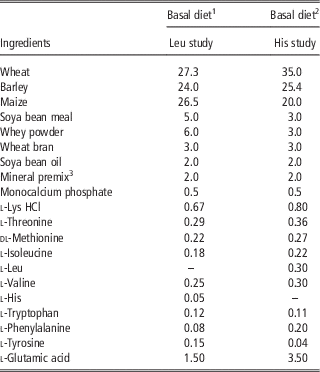
The first study was conducted to evaluate the Leu requirement of piglets. A total of 60 piglets were weaned when they were 28 days old and fed a commercial diet until the beginning of the study. At the age of 35 days, three sets of 20 pigs of similar BW were established. Within each set, the pigs were equally allotted to one of five treatments. All of the piglets were housed individually. The average BW at the beginning of the experiment was 10.0±1.2 kg. The basal diet was based on wheat, barley and maize, and was calculated to have a low CP (15%) (Table 1) and sub-limiting Lys (0.93%). The experimental diets were supplemented with l-Leu to attain SID Leu : Lys levels of 83%, 94%, 104%, 115% and 125%. The diets were formulated to be isoenergetic (calculated average=13.6 MJ of ME/kg). Except for Leu and Lys, all of the other AA, vitamins and minerals were calculated to meet the requirements of the pigs (Gloaguen et al., Reference Gloaguen, Le Floc’h and van Milgen2013b). Glutamic acid was used to adjust the basal diet to a CP content of 15%. The experimental diets were fed to the piglets for 42 days. BW and the FI were recorded weekly. The ADG, average daily feed intake (ADFI) and gain-to-feed ratio (G : F) were calculated based on BW and FI.
Composition of the experimental diets for piglets (%)

Leu=leucine; His=histidine; Lys=lysine; SID=standardised ileal digestible.
1 Leu was added to the basal diet in increasing levels (0%, 0.10%, 0.20%, 0.30% and 0.40%) to attain SID Leu : Lys levels of 83%, 94%, 104%, 115% or 125%.
2 His was added to the basal diet in increasing levels (0%, 0.04%, 0.08%, 0.12% or 0.16%) to attain SID His : Lys levels of 22%, 26%, 30%, 34% and 38%. SID amino acid ratios were calculated based on analysed amino acids in the feed compounds (GfE, 2006) and a mean SID Lys content of 0.93%.
3 Per kg premix: calcium 265 g, sodium 60 g, phosphorus 40 g, magnesium 5.5 g, iron 2.85 g, zinc 2.20 g, copper 0.75 g, manganese 0.73 g, cobalt 15 mg, iodine 10 mg, selenium 10 mg, vitamin A 1 000 000 IU, vitamin D 100 000 IU, nicotinic acid 2.60 g, vitamin E 2.00 g, pantothenic acid 1.25 g, riboflavin 0.50 g, pyridoxine 0.30 g, thiamin 0.20 g, vitamin K 0.15 g, folic acid 30 mg, vitamin B12 2 mg, biotin 1 mg, choline chloride 20 g, aromatic substance 1.50 g.
Histidine study
The second study was conducted to evaluate the His requirement of piglets. A total of 120 piglets were weaned when they were 25 days old, and they were fed a commercial diet until the study began. When they were 31 days old, the piglets were randomly assigned to one of five treatments. The piglets were housed in pairs, with one male and one female piglet in each pair. The average BW at the beginning of the study was 8.3±0.6 kg. The basic diet was calculated to have a low CP (an average CP of 14%), and Lys was sub-limiting (0.93%); however, the diet contained lower amounts of maize, soya bean meal and whey powder than the diet used in the Leu study so that it had a lower basal His content than the diet in the Leu study (Table 1). The experimental diets were supplemented with l-His to attain SID His : Lys levels of 22%, 26%, 30%, 34% and 38%. The diets were formulated to be isoenergetic (calculated average=13.7 MJ of ME/kg). The other AA, vitamins and minerals were added to the diets in the recommended amounts (Gloaguen et al., Reference Gloaguen, Le Floc’h and van Milgen2013b). Glutamic acid was used to adjust the CP content of the basal diet to 14% (Table 1). The experimental diets were fed to the piglets for 42 days. BW and FI were recorded weekly. The ADG, ADFI and G : F were calculated based on BW and FI.
Chemical analyses
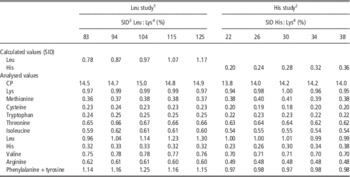
The nitrogen content of the diets was analysed as described elsewhere (Association Française de Normalisation (AFNOR), 1997). The AA content of the diets was analysed using a JLC-500/V AminoTac Amino Acid Analyser (Jeol, Croissy-sur-Seine, France) as described previously (AFNOR, 2005). To quantify levels of methionine and cysteine, samples of the diets were oxidised with performic acid before hydrolysis. Tryptophan was hydrolysed with barium hydroxide before analysis. The AA were separated and quantified via ion exchange chromatography and by photometric detection after derivatisation with ninhydrin (AFNOR, 2005). Table 2 shows the analysed and calculated compositions of the experimental diets.
Calculated and analysed amino acids of the experimental diets fed to the piglets (in %)

Leu=leucine; His=histidine; SID=standardised ileal digestible; Lys=lysine.
1 Calculated contents of the remaining amino acids (AA) in the diets used in the Leu study (% SID): Lys 0.93, methionine 0.37, cysteine 0.20, tryptophan 0.23, threonine 0.61, isoleucine 0.55, His 0.31, valine 0.67, arginine 0.51, phenylalanine+tyrosine 0.94.
2 Calculated contents of the remaining AA in the diets used in the His study (% SID): Lys 0.93, methionine 0.40, cysteine 0.17, tryptophan 0.20, threonine 0.62, isoleucine 0.52, Leu 0.95, valine 0.67, arginine 0.45, phenylalanine+tyrosine 0.90.
3 Calculated based on the analysed AA in the feed compounds (GfE, 2006).
4 Calculated based on a mean SID Lys content of 0.93%.
Statistical analyses
For the evaluation of animal performance, the data were analysed via an ANOVA using mixed linear models (SAS, version 9.4; SAS Institute Inc., Cary, NC, USA). In the Leu study, the unit of observation was the individual pig. The statistical model used in this study included diet as a fixed effect, block as a random effect and initial BW as a linear covariate. In the His study the unit of observation was the pair of pigs housed together. The model used in this study included diet as a fixed effect and initial BW as a linear covariate. In both studies, the initial BW was excluded from the model if the slope was not significantly different from zero. In the case of significant differences between the means of the five groups (within one study), Tukey’s post hoc test was applied.
The NLMIXED procedure of SAS was used for nonlinear regression analysis of the data as described by Robbins et al. (Reference Robbins, Saxton and Southern2006), by fitting data to a linear broken-line model (1), a quadratic broken-line (curvilinear-plateau) model (2), and a quadratic-function model (3). The models are based on the following equations:
 $$y_{{ij}} \,{\equals}\,{\rm L}{\plus}{\rm U} \cdot {\rm (}x\,\lt\,R{\rm )} \cdot {\rm (}R{\minus}x{\rm )}{\plus}{\rm V} \cdot z_{{ij}} {\plus}b_{i} {\plus}e_{{ij}} $$
 $$y_{{ij}} \,{\equals}\,{\rm L}{\plus}{\rm U} \cdot {\rm (}x\,\lt\,R{\rm )} \cdot {\rm (}R{\minus}x{\rm )}^{{\rm 2}} {\plus}{\rm V} \cdot z_{{ij}} {\plus}b_{i} {\plus}e_{{ij}} $$
 $$y_{{ij}} \,{\equals}\,{\rm L}{\plus}{\rm U} \cdot x{\plus}{\rm V} \cdot x^{{\rm 2}} {\plus}{\rm W} \cdot z_{{ij}} {\plus}b_{i} {\plus}e_{{ij}} $$
The variable y
ij
is the response of the jth piglet in the ith block with an initial BW z
ij
at level x of the supplied Leu (or His). The variable
 $$e_{{ij}} {\rm \,\sim\,}\!N{\rm (0,}\sigma _{e}^{{\rm 2}} {\rm )}$$
is the random residual effect corresponding to y
ij
, and the letters L, U, V and W indicate regression coefficients. The parameter R is defined as the unknown breakpoint/plateau of the x values, and
 $$b_{i} {\rm \,\sim\,}\!N{\rm (0,}\sigma _{b}^{{\rm 2}} {\rm )}$$
characterises the block-specific random effect. The term (x<R) is 1 when x is smaller than R; otherwise, this term is zero. In the broken-line models, the plateau y
p
at values x⩾R is given by
 $$y_{P} {\equals}{\rm L}{\plus}{\rm V} \cdot z{}_{a}$$
, where za is the average of initial BW values. The Akaike information criterion (AIC) and the corrected Akaike information criterion (AICC) were used to estimate the best-fitting model (Akaike, Reference Akaike1974). For each performance parameter, the breakpoint and plateau values (in the case of the broken-line and the curvilinear-plateau model) or the extreme values (in the case of the quadratic-function model) of SID Leu : Lys and His : Lys levels were ascertained. The data are presented as least squares means and pooled SE. The means were considered significantly different at P<0.05. Supplementary Tables S1 (Leu study) and S2 (His study) report the parameter estimates from the three models used.
Results
Leucine study
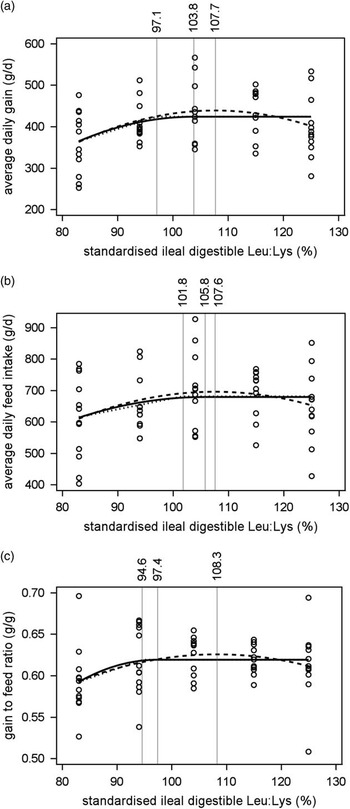
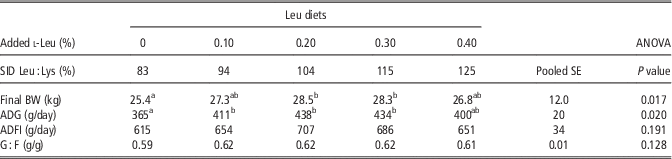
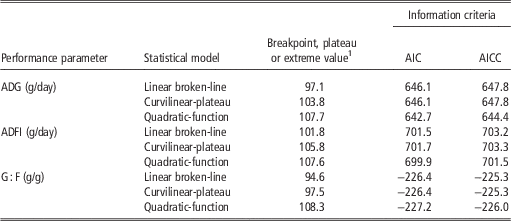
Table 3 shows the effects of varying the SID Leu : Lys levels on the growth performance of the piglets. Piglets fed the low-CP diet with a SID Leu : Lys level of 83% had a lower ADG than piglets fed a diet with SID Leu : Lys levels of 94%, 104% and 115% (P<0.05), indicating that a SID Leu : Lys level of 83% represents an insufficient Leu supply. Piglets that received a diet with a SID Leu : Lys level of 125% tended to have a lower ADG than piglets fed diets with SID Leu : Lys levels of 104% (P=0.092) or 115% (P=0.158). The ADFI and G : F did not differ between the five groups of piglets. The estimated SID Leu : Lys requirements for optimal growth based on analyses using the three different models are shown in Table 4 and Figure 1. The results demonstrate that the estimated Leu requirement depends on the statistical model used for the analysis. The linear broken-line model indicated that a SID Leu : Lys level between 94.6% and 101.8% was adequate. Based on the results of the curvilinear-plateau model, the optimum SID Leu : Lys level ranged between 97.5% and 105.8%. As shown in Figure 1 the quadratic-function model indicated a decline in FI and ADG in response to Leu levels above the estimated requirement. By using the ADG, ADFI and G : F as criteria to estimate the Leu requirement, the quadratic-function model indicated that SID Leu : Lys levels between 107.6% and 108.3% were adequate for piglets. However, the curves based on the quadratic-function model illustrate that a 10% reduction in the estimated SID Leu : Lys levels (from 108% to 97%) was accompanied by only a small decline in the ADG, ADFI and G : F (3.3%, 2.4% and 0.95%, respectively).
Statistical models used to estimate the leucine requirement of weaned piglets fed low-CP diets (15%) with different standardised ileal digestible Leu : Lys levels for 6 weeks. The response parameters were (a) average daily gain, (b) average daily feed intake and (c) gain-to-feed ratio, with the maximum responses expressed as the breakpoint/plateau (R) when the linear broken-line model (۰۰۰۰) and the curvilinear-plateau model (——) were used, or as the extreme value (x max) when the quadratic-function model (- - -) was used. The details of the parameter estimates are given in Supplementary Table S1. Leu=leucine; Lys=lysine.

Effect of dietary SID Leu : Lys levels on the feed intake and growth performance of piglets fed a low-CP diet (Leu study)Footnote 1

SID=standardised ileal digestible; Leu=leucine; Lys=lysine; ADG=average daily gain, ADFI=average daily feed intake, G : F=gain-to-feed ratio.
1 Data are presented as least squares means (n=11 to 12 per group). The average initial BW was 10.0±1.2 kg (n=60).
a,bValues within a row with different superscripts differ significantly at P<0.05 (Tukey’s test).
Estimation of the leucine requirement for piglets fed low-CP diets using the linear broken-line, curvilinear-plateau and quadratic-function models and information criteria according to Akaike

AIC=Akaike information criterion; AICC=corrected Akaike information criterion; ADG=average daily gain; ADFI=average daily feed intake; G : F=gain-to-feed ratio.
1 Breakpoint and the plateau values were used for the linear broken-line and the curvilinear-plateau model, the extreme value was used for the quadratic-function model.
Data show that the linear broken-line and the curvilinear-plateau models provided comparable AIC and AICC values and were, in principle, suitable for the estimation of the minimum Leu required to maximize FI and growth, whereas the quadratic-function model allowed for an estimation of the upper limit of Leu (Table 4).
Histidine study
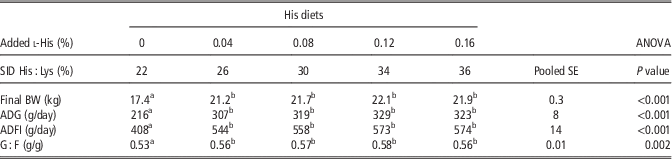
Table 5 shows the responses of the piglets to diets that had differing SID His : Lys levels. Piglets fed a low-CP diet with a SID His : Lys level of 22% had significantly lower ADG, ADFI and G : F (P<0.05) than piglets that received diets with 26%, 30%, 34% and 36% SID His : Lys levels, which indicates that a SID His : Lys level of 22% represents a His-deficient diet.
Effect of dietary SID His : Lys levels on the feed intake and growth performance of piglets fed a low-CP diet (His study)Footnote 1

SID=standardised ileal digestible; His=histidine; Lys=lysine; ADG=average daily gain; ADFI=average daily feed intake; G : F=gain-to-feed ratio.
1 Data are presented as least squares means (n=12 per group). The average initial BW was 8.3±0.6 kg (n=60 pairs).
a,bValues within a row with different superscripts differ significantly at P<0.05 (Tukey’s test).
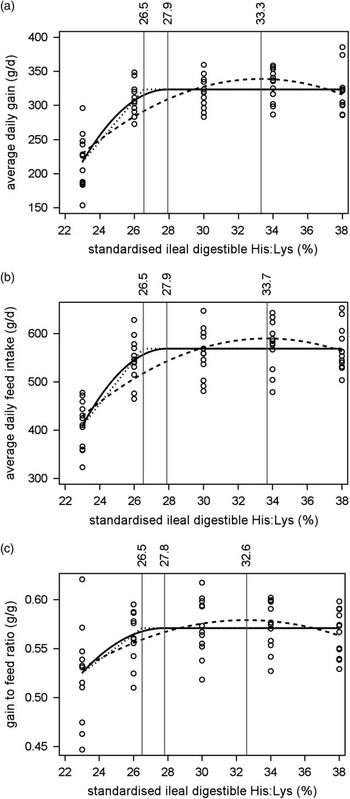
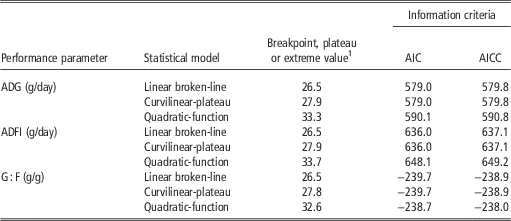
The AIC and AICC results demonstrate that the linear broken-line and the curvilinear-plateau models provided comparable values, but these values were lower than those obtained using the quadratic-function model (Table 6). The minimum SID His : Lys level that ensured a maximum ADG, ADFI and G : F was 26.5% using the linear-broken line model and 27.9% using the curvilinear-plateau model (Table 6 and Figure 2). However, any reduction in the SID His : Lys levels estimated from the broken-line models may have significant adverse effects on growth gains. For example, when piglets were fed a diet with a 10% lower SID His : Lys level than the requirement estimated by the curvilinear-plateau model, the ADG, ADFI and G : F were reduced by 10.6%, 9.2% and 2.7%, respectively. The quadratic-function model analysis revealed that the SID His : Lys level required to optimise the ADG, ADFI and G : F ranged between 32.6% and 33.7% (Table 6 and Figure 2).
Statistical models used to estimate the histidine requirement of weaned piglets fed low-CP diets (14%) with different standardised ileal digestible His : Lys levels for 6 weeks. The response parameters were (a) average daily gain, (b) average daily feed intake and (c) gain-to-feed ratio with the maximum responses expressed as the breakpoint/plateau (R) when the linear broken-line model (۰۰۰۰) and the curvilinear-plateau model (——) were used, or as the extreme value (x max) when the quadratic-function model (- - -) was used. The details of the parameter estimates are given in Supplementary Table S2. His=histidine; Lys=lysine.

Estimation of the histidine requirement for piglets fed low-CP diets using the linear broken-line, curvilinear-plateau and quadratic-function models and information criteria according to Akaike

AIC=Akaike information criterion; AICC=corrected Akaike information criterion; ADG=average daily gain; ADFI=average daily feed intake; G : F=gain-to-feed ratio.
1 Breakpoint and the plateau values were used for the linear broken-line and the curvilinear-plateau model, the extreme value was used for the quadratic-function model.
Discussion
Data on the Leu and His requirement of piglets fed low-CP diets are scarce, and the studies have not adequately considered the possible adverse effects of an excessive intake of branched-chain AA intake on growth performance. The current Leu and His studies were conducted with five different dietary levels of SID Leu : Lys and His : Lys, and both studies used two levels below and two levels above the presumed requirement. In addition to the commonly used models, particularly the linear broken-line and the curvilinear-plateau model, we included a quadratic-function model because this model is the only one that considers a possible decline in the growth parameters when feeding animals with excessive AA.
Estimation of the leucine requirement
In this study, we found that the proper SID Leu : Lys level required to optimise the ADG and G : F of piglets largely depended on the statistical model that was used for assessing the dietary requirement. The results from the two nonlinear models suggested a lower optimum SID Leu : Lys level than the results of the quadratic-function model. However, the results of the Leu study demonstrate that Leu levels exceeding the required amount can adversely affect the ADG, ADFI and G : F of piglets, which is an effect that is not considered when using the nonlinear models. The AIC, which was used to evaluate the adequacy of the models, showed that the quadratic-function model was an appropriate model for estimating the Leu requirement. The quadratic-function analysis revealed that the SID Leu : Lys level required to optimise growth was, on average, 108%, which is markedly higher than the estimates of 102% obtained by Gloaguen et al. (Reference Gloaguen, Le Floc’h, Corrent, Primot and van Milgen2013a) and 93% obtained by Soumeh et al. (Reference Soumeh, van Milgen, Sloth, Corrent, Poulsen and Nørgaard2015) and is also higher than the estimate of 100% recommended by the NRC (2012). The observed effects of the high-Leu diets on FI and growth can probably be explained by the recently described anorexigenic effect of Leu (Cota et al., Reference Cota, Proulx, Smith, Kozma, Thomas, Woods and Seeley2006; Wiltafsky et al., Reference Wiltafsky, Pfaffl and Roth2010; Wessels et al., Reference Wessels, Kluge, Hirche, Kiowski, Schutkowski, Corrent, Bartelt, König and Stangl2016) and the finding that an excessive consumption of Leu may induce its own degradation via an irreversible oxidative-decarboxylation reaction by the BCKDH complex, which limits growth (Wiltafsky et al., Reference Wiltafsky, Pfaffl and Roth2010; Wessels et al., Reference Wessels, Kluge, Hirche, Kiowski, Schutkowski, Corrent, Bartelt, König and Stangl2016). Although circulating levels of branched-chain AA were not analysed in this study, stimulated branched-chain AA degradation and a reduced FI could explain the observed decline in weight gain in piglets fed the high-Leu diet. Pigs are also capable of sensing AA imbalances, which lead to changes in their feed selection or to reductions in their FI (Ettle and Roth, Reference Ettle and Roth2003; Gloaguen et al., Reference Gloaguen, Le Floc’h, Primot, Corrent and van Milgen2012). This finding could explain why piglets fed a diet with a SID Leu : Lys level of 125% tended to reduce their FI. Because feed consumption and growth could easily be affected by inadequate or excessive Leu intake, we assume that the range of Leu intake necessary to optimise FI and growth is relatively small. However, a limitation of the current study is that we included only two groups that received more Leu in their diets than the amount required for growth optimisation. Thus, further studies are needed to address the safe upper range of Leu that can be used in the nutrition of piglets. Although results from the quadratic-function analysis show that a SID Leu : Lys level of 108% provided the best growth performance, it is important to mention that a 10% reduction (97%) or increase (119%) in this level was associated with only a small decline in the ADG (3%). However, deviations greater than 10% in the SID Leu : Lys levels could have significant effects on growth. Diets for piglets that are mainly based on maize contain relatively high amounts of Leu in relation to other AA, and the SID Leu : Lys level may exceed 120%. These findings indicate that, in future studies and in feeding of pigs, more attention should be given to a possible oversupply of Leu.
Estimation of the histidine requirement
Current data show that the SID His : Lys level required to optimise the ADG and G : F was, on average, 26.5% based on the linear broken-line model and 27.9% when using the curvilinear-plateau model for the calculation. As observed for Leu, the quadratic-function model estimated a higher optimum SID His : Lys level, which ranged between 32.6% and 33.7% using the ADG and G : F as the outcome variables. However, in contrast to the results for the analyses of the Leu requirement, the broken-line models appeared to be more suitable than the quadratic-function model for estimating the His requirement because there was no decline in growth when feeding piglets excessive His, and the AIC reached a minimum when using the broken-line models. The current NRC recommendation (NRC, 2012) for His (34%) is primarily based on the results of Izquierdo et al. (Reference Izquierdo, Wedekind and Baker1988) for pigs weighing between 10 and 20 kg. However, in that study the administered diets contained large quantities of corn starch and feather meal, and the dietary concentration of Lys was not analysed. Gloaguen et al. (Reference Gloaguen, Le Floc’h, Corrent, Primot and van Milgen2013a), who used diets with sub-limiting Lys levels and calculated the His requirement on the basis of a curvilinear-plateau model using growth performance as a response parameter, suggested that a SID His : Lys level of 32% was adequate. In our study, we found that the assessed SID His : Lys level required to optimise growth was markedly lower than that recommended by the NRC (2012) and was moderately lower than that defined by Gloaguen et al. (Reference Gloaguen, Le Floc’h, Corrent, Primot and van Milgen2013a). Gloaguen et al. (Reference Gloaguen, Le Floc’h, Corrent, Primot and van Milgen2013a) used diets with CP contents that were 1.3% higher than the diets in our study, which led to a higher growth rate of the animals; this provides one explanation for the observed differences between our current findings and the results of Gloaguen et al. (Reference Gloaguen, Le Floc’h, Corrent, Primot and van Milgen2013a). We assume that the low content of non-essential AA in the low-CP diet used in this study may explain the observed differences in growth. We found that SID His : Lys levels below the estimated 28% can significantly impair growth: thus, the SID His : Lys level should be 28% or higher. Considering the small uncertainties in His analysis results and the natural variations in the His content of feed ingredients, a SID His : Lys level of 30% would represent a safer target level than 28%.
In conclusion, the SID Leu : Lys and His : Lys levels required to optimise the ADG, ADFI and G : F differed depending on the statistical model used for the analysis. The quadratic-function analysis is the best-fitting model to assess the Leu requirement because it considers the adverse effects on growth when feeding excessive amounts of this AA to pigs. Considering this and the fact that a 10% decrease in the optimal SID Leu : Lys level does not significantly affect growth, a SID Leu : Lys level between 97% and 108% can be regarded as an adequate, economically feasible and safe recommendation. The optimal model for estimating the His requirement is the curvilinear-plateau model. A SID His : Lys level lower than the estimated requirement of 28% can significantly impair growth: thus, the SID His : Lys level should be 28% or even 30%, to be on the safe side.
Acknowledgments
The authors thank Dr. Corinna Brandsch who helped to improve the manuscript. We would like to thank the anonymous reviewers for their useful comments on the manuscript.
Supplementary material
To view supplementary material for this article, please visit http://dx.doi.org/10.1017/S1751731116000823