It was August 2006 when I first visited Hadong, a one-time workers' village in Harbin, north-east China. A CommunityFootnote 1 (shequ 社区) director named HongmeiFootnote 2 showed me a file filled with documents regarding the minimum livelihood guarantee (dibao 低保). The documents included a list of families who were receiving dibao from the government. Some photos were attached; all showed the severely handicapped, which Hongmei described as “representative of dibao recipients.” Blind, deaf or developmentally disabled, these “dibao representatives” were photographed holding a rice bag or wearing a winter jacket that they had received from the government. “Among dibao recipients, I expect there are a lot of laid-off workers,” I said to Hongmei, expecting a positive response. I had seen that the streets of Hadong were crowded with numerous workers laid off from a nearby factory. However, Hongmei's response was unexpected. She said, “No. In our community, there are few, if any, dibao recipients who can still work.”
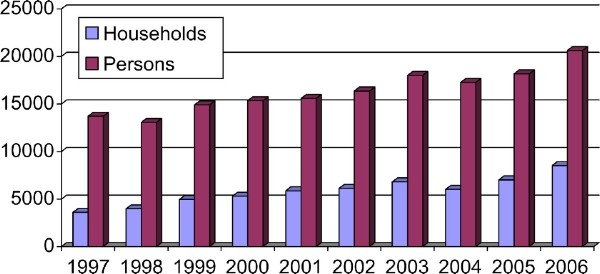
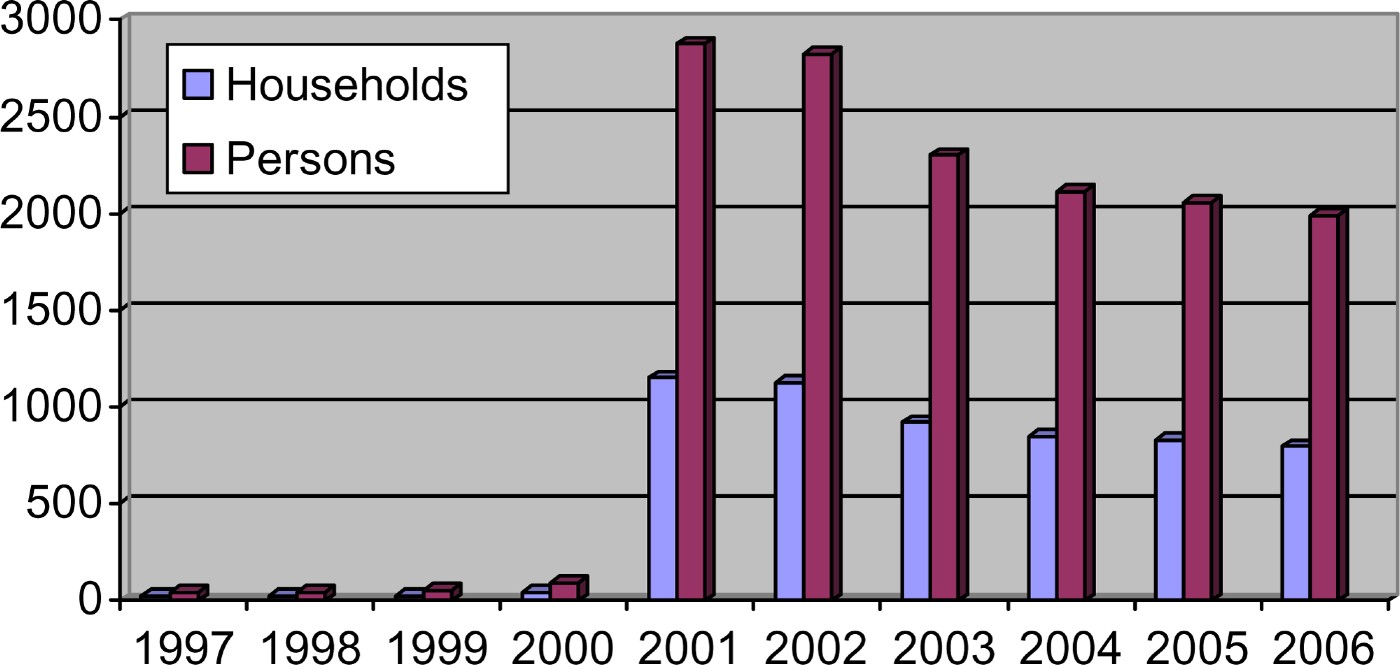
Later, I learned from statistical dataFootnote 3 that after dibao was put in place in Harbin in 1997, the number of dibao recipients in Hadong dramatically increased in 2001 and plunged after 2003 (see Figures 1 and 2).Footnote 4
Entire Population in Hadong (1997–2006)

Dibao Recipients in Hadong (1997–2006)

Currently in Hadong, 80 per cent of dibao recipients cannot work because of disability or illness. Most of the applicants denied dibao benefit are laid-off workers of working age. Residents often grumble: “It is no use applying for dibao unless you are disabled or suffering from cancer.”
This situation seems particularly odd since government officials long understood urban laid-off workers to be the dibao's main target, as discussed below. Their exclusion from the dibao programme also seems odd when one considers the government's long-held emphasis on “dynamic management” (dongtai guanli 动态管理) of poverty. The government has emphasized that dibao recipients need frequent follow-up attention from government monitors because their income is always changing. If dibao is a “dynamic” scheme, with people entering and leaving according to shifts in their income, it is difficult to understand why the specific population of laid-off workers has been mostly excluded. Few urban laid-off workers excluded in 2003 have re-entered the dibao system in subsequent years. Most, in fact, gave up reapplying for dibao because “government officials wouldn't pay attention to [them] unless [they] got cancer,” in the words of one. Many government officials and scholars whom I met attribute this decrease in the dibao population in Hadong – and especially the downturn in the number of laid-off workers receiving the benefit – as a stage in an evolutionary process by which the national policy is moving towards “regularization” (guifanhua 规范化), that is, a more consistent national standard and process for allocating dibao benefit. However, this emphasis on “regularization” is problematic if what local residents say about receiving dibao (it is no use unless you are disabled or have cancer) is true.
Based on my ethnographic research from 2006 to 2008, this article focuses on the actual workings of the (urban) minimum livelihood guarantee (zuidi shenghuo baozhang zhidu 最低生活保障制度), colloquially known as dibao, which has been the party-state's primary policy for dealing with urban poverty since the late 1990s. My primary site was Hadong, one of several dilapidated residential compounds (jiashuqu 家属区) of the Longwang work unitFootnote 5 on the periphery of Harbin, north-east China. The Longwang factory announced official bankruptcy in December 2005 after a decade-long downward slide. Hadong is no longer a “workers' village” but a “shantytown” (pinminku 贫民窟) as most retirees, laid-off workers and their families in the population of about 20,000 barely manage to live with the support of meagre pensions, temporary work or government supports. While looking at the management of urban poverty in Hadong, my study explores a possible answer to the above-mentioned puzzle: why have urban laid-off workers – the dibao's principal target – been gradually excluded from this scheme in Hadong?Footnote 6 Using this puzzle as a springboard, the article examines how local resistance to government attempts to reduce poverty to a technical problem ironically reinforces the precarious state of the poor.
Numerous studies on dibao and other poverty-related policies have contributed to an understanding of the loopholes, malfunctions and contradictions that appear in the process of enacting and enforcing these policies in China.Footnote 7 The studies have indicated such problems as the ambiguous definition of policy targets, the dramatization and fragmentation of relief efforts, and the cleavage between a central policy and its local modifications. My study supplements previous studies, data for which are mostly based on official documents or formal interviews, by exploring the actual relationships between street-level cadres and local residents.
More importantly, by aiming to explore the actual practices by which dibao is allocated, my study delves into the tension embedded in governing urban poverty in China. The tension I address lies in whether to manage impoverished urban workers as “the people” or as “the population.” ReasoningFootnote 8 the poor as “the people” stems from the PRC's ideological (and deeply Maoist) doctrine of “Serve the People,” representing a conviction that gives both voice and leverage to these workers. It highlights intimate (and often paternalistic) relationships between the party-state and its people, displaying the leading role of the state in dealing with the impoverishment of one-time socialist representatives. In contrast, reasoning these workers as “the population” illuminates new sorts of programmatic attempts to convert them into “numbers” without history. These attempts not only advocate the universality of poverty but also dissipate the historicity of urban workers and their political stance by re-situating them among all the poor.
I argue that the practices of dibao oscillate between two modes of reasoning, or “governmentality” in a term of Michel Foucault,Footnote 9 between the political stage of “the people” and the numerical table of “the population.” The logic of “the people” is not entirely displaced by the logic of “the population” but is rather dovetailed with it, as I will discuss through my analyses of dibao's origin, the tension among government officials at different levels and, above all, the resistance of local residents. Impoverished residents have reacted to the new scheme by invoking the socialist claim that they are “the people” (人民 renmin) and conjuring up a fear of popular violence, much as urban workers did during the Mao period, even though their reaction ends up reinforcing their precarious state. Benefiting from scholarship that probes the ambiguity of subject formation in governing,Footnote 10 this article advances how governance in contemporary China is performed through the complex relationships between a governing body and its subjects: it is performed neither merely through the construction of the subjects as a governable group nor merely through their resistance to the apparatus. Only the actual practices and processes of governing may reveal how it is eventually “effected.”Footnote 11
This article discusses the workings of dibao in Hadong and, at times, more generally in China. The first part briefly provides an analysis of how dibao – China's new policy for urban poverty – was, originally, directed not towards the poor in general but towards the specific group of urban laid-off workers. The second section analyses how these former workers have been re-categorized from the working class to the poor population under the dibao scheme. The next part details what exactly troubles the applicants and recipients of dibao. It delves into the dissonance between the discourses which they inhabit and those within which the dibao scheme operates. The final section examines how local residents troubled by the working of dibao challenge it with the socialist claim that they are “the people” and how this resistance produces an unintended outcome of excluding many of them from the scheme in Hadong.
When Does Poverty Matter?
Dibao, the primary focus of this article, came into being amidst the social unrest of the 1990s. During that time, the urban citizens of China increasingly saw the transformation of past social equalities into the present grim inequalities in the wake of strong state action, including the widespread selling off of many state-owned enterprises and the accompanying downsizing of the state workforce, especially after the 15th Party Congress in 1997. Although dibao first started in Shanghai in 1993, it was in the late 1990s that it became the state's foremost urban anti-poverty scheme on a national scale. Urgent pronouncements from the central government had a great impact on its rapid implementation. The State Council officially announced the “Bulletin for Establishing the Minimum-Living-Standard Scheme for Urban Dwellers through the Country” in February 1997 and the “Regulations Regarding the Minimum-Living-Standard Scheme for Urban Residents” (Regulations) in September 1999. The total number of people eligible to receive dibao dramatically increased nationally from 0.85 million in 1996 to 2.66 million in 1999 and 23.3 million in 2008.Footnote 12
It is significant that the explosion of the size of the dibao population does not necessarily indicate a sudden increase in the number of urban poor in general: it indicates a sudden expansion of a specific category among poor people – that is, urban laid-off workers. In fact, mainstream academic histories reveal that throughout the socialist regime Chinese cities have always had large numbers of disadvantaged groups. In the Mao period, many seasonal, temporary and contract workers only had very limited access to the labour insurance benefits that were fully enjoyed by permanent workers in state-owned enterprises.Footnote 13 Many of these workers held a rural household permit (hukou 户口), which made their presence in the city contingent and precarious. In addition, there have always been people without supporters, such as orphans, the elderly, widows and the disabled. These people formed the majority of the “three no's,” those traditionally receiving meagre, if any, relief from the government.Footnote 14 More importantly, since the late 1970s at least 100 million rural migrants have flooded China's cities in search of work. Some of these people live in conditions far worse than those endured by impoverished urbanites. Despite the persistence of several categories of chronically disadvantaged urban poor in the city, however, it was not until massive lay-offs in the late 1990s that the dibao scheme gained its full-fledged form.
The 1997 Bulletin defined dibao recipients to be “city (village) residents holding nonagricultural residence permits whose family per capita income falls below the minimum-living-standard line,” followed by the specification of three routes to eligibility: residents with no source of livelihood, no ability to work, and no one who can be legally designated as responsible for their support; residents who are collecting or have exhausted their unemployment insurance having not yet found re-employment and whose family per capita come falls below the minimum-living-standard line; and residents who are employed workers or laid-off workers collecting salary, minimum wage or basic living-expense payments, or retired workers collecting pensions, who, after receiving the aforementioned payments, have family per capita income that still falls below the minimum-living-standard line.Footnote 15 The first of these were the main target for social relief in the Mao period, while the other two, which mirror the state's critical attention to urban laid-off workers and other “drop-outs” of the market transition, have been newly added to the government scheme.
This attention is manifest in the remarkable change in the dibao budget in the early 2000s, when increasing labour unrest caused by massive lay-offs was considered to be one of the biggest threats to social stability.Footnote 16 The total budget for dibao increased dramatically from 2.2 billion yuanFootnote 17 in 2000 to 4.2 billion yuan in 2001 and 10.9 billion yuan in 2002.Footnote 18 A poverty researcher in the Chinese Academy of Social Sciences explained the background for the sudden increase:
As for the financial support for the dibao budget in 2001 and 2002, nobody can deny that political concern was given a significant weight. At that time, high-level government officials worked in an environment in which it was assumed that the problem of unemployment and lay-offs could be – and should be – solved within a few months. They were highly anxious about social instability in the city.Footnote 19
Of significance is that it was urban laid-off workers, not other categories of the poor, who had been not only the ideological representatives but also the main beneficiaries of the socialist regime. Since the building of socialism in 1949, the PRC has proclaimed that the people are the masters of the country and the Chinese Communist Party represents the interests of the people. Both urban workers and peasants were celebrated as ideological representatives of “the people” in the Mao period. However, de facto socioeconomic benefits fell only to urban workers, in keeping with the state's concentration on urban heavy industry at the expense of agriculture. Scholars engaged in China's labour studies have revealed how urban laid-off workers protested against local governments and their work units by invoking the very language with which the party-state had once acknowledged them. Most prominent in north-east China, an old industrial base of the planned economy, these workers have mobilized historical discourses and performances that evolved around the socialist concept of “the people.”Footnote 20 It is in this context that the Chinese state has given more attention to urban laid-off workers among the poor, thus buttressing both the morality and the stability of the socialist regime. Nevertheless, the historical origin of dibao is in striking contrast to its ahistorical design. The design is tied to the emergence of new rationalities that normalize these former workers into “the population” instead of acknowledging their historical contribution as socialist workers, as some of my informants argue.
From “Working Class” to “the Urban Poor”
I argue that the design of the dibao policy is tied to the emergence of new rationalities that re-categorize urban laid-off workers as “the population,” a term borrowed from Michel Foucault. He sees “the population” as a form of “bio-power,” that is, “the set of mechanisms through which the basic biological features of the human species became the object of a political strategy.”Footnote 21 In his account, “the population” refers not to the series of individuals but to the species of body, the body “imbued with the mechanics of life and serving as the basis of the biological processes.”Footnote 22 Thus, an attempt to govern people as “the population” is deployed not around the multiplicity of individuals but around the calculated management of large, not-yet-differentiated groups through classification and numericization.
During the Mao period, regulating the poor as a specific population was both unacceptable and unnecessary: the Maoist narrative of equal poverty made it impossible to perceive a specific category of “the poor.” Most residents who had lived through the Mao period in Hadong viewed the terms pinmin (贫民, poor people) and laobaixing (老百姓, common people) as mutually interchangeable. Recipients of social aid were subject to specific names such as a “relief family” (jiujihu 救济户) in the parlance of the national government, or a “difficult family” (kunnanhu 困难户) or an “especially difficult family” (tekunhu 特困户) in the parlance of the work unit. Yet residents paid little attention to these names, not only because the number of recipients and the amount of funds were extremely limited, but also because little distinction was felt between the living standard of recipients and that of other workers.
In contrast, the post-Mao policy for urban poverty has created a new regime in which individual poverty has developed into a social “problem,” and “the urban poor” have become a target population in policy implementation as well as in scholarly projects. That is, poverty has become “the object of new problematization,”Footnote 23 which means that it is reborn as a knowable and manageable form for government programming. Under this regime, urban laid-off workers have become a primary target for the policy, in line with the privilege accorded to “the people” who should be protected. However, what it means to belong to “the people” has been transformed under this new regime. Becoming a recipient of dibao has meant becoming part of the poor population (pinkun renkou 贫困人口) – no longer political subjects but a particular “species” to be regulated for social stability. In contrast with social relief in Mao's era, dibao governs impoverished laid-off workers as “the poor population” in post-Reform China. This new way of being impoverished is expressed in four senses.
First, dibao has displaced the historicity of being impoverished by the universality of being poor in the sense that the population that is targeted is then reduced to a series of empirical variables. The most important variable that determines who receives dibao is income – whether a family's per capita income falls below the level of the local minimum living standard (article 2, Regulations). According to this policy, there is no distinction between a former outsider who did not belong to any work unit and a laid-off worker with a history of socialist contribution and pure sacrifice. Instead, the factors used to calculate whether someone is qualified for dibao and how much they may receive are the amount of total income, the degree of disability or disease, the number of children, and the size of present housing.Footnote 24 This scheme thus introduces a new rationality that poverty can be calculated.
Second, dibao has not only reduced impoverished laid-off workers to numbers but has advanced the idea of “the deserving poor,” those who obey the state's policies and maintain a frugal lifestyle. The Harbin government has a specific local regulation that even a family with an income level below the poverty line is not qualified for dibao if the family, for example, has not paid a fine after violating the family planning policy; has drug, gambling or alcohol addicts among its members; has a child whose school was selected at the parents' own expense; has renovated or redecorated the family home within the preceding two years; owns non-necessary goods such as a car, motorbike, air-conditioner or high-quality decorations to the home; and/or invests in stocks.Footnote 25 This regulation allows officials to scrutinize what dibao recipients should and should not do, while distinguishing acceptable desire from improper desire. As for the poor, their desire to consume as well as they are able is called into question. Though they vary from place to place, such local restrictions are widespread across other cities in China. As Dorothy Solinger argues, these restrictions keep dibao recipients “marginal” by restraining their desire and behaviour which “might help them ascend out of poverty.”Footnote 26
Third, dibao has proclaimed the refusal of what I call “theaterization,” that is, visible, face-to-face performances, while highlighting regularization and standardization as the principal techniques of governing the poor population. Policies related to dibao have been enacted against the backdrop of the paternalism of the Mao era when local government or work-unit cadres often visited workers from poor families and opened their hearts to them. The Chinese elite and professional classes have typically welcomed dibao insofar as it has led to a shift away from a moralistic, simple and unprofessional form of relief towards one that is more institutional, comprehensive and scientific. Power over life, or what Foucault calls “bio-power,”Footnote 27 has been exercised alongside extensive care regarding dibao recipients' health, education and housing.Footnote 28 With its careful classification system, however, this care has made emotional contact between the giver and the taker less important.
Finally, dibao has both induced and been induced by the emergence of knowledge that aims to eliminate poverty as a social danger while making it “compatible with a market economy.”Footnote 29 Recent studies about dibao have been deeply influenced by the discourses of international agencies. Intellectuals have learned globally circulated, “scientific” methods from agencies such as the United Nations, the World Bank and the Asian Development Bank.Footnote 30 The crisis of employment and pensions has been resituated into “internationally common” narratives, in which even the word “socialism” is wiped out. These narratives no longer evoke how, in China, the term “unemployment” was truly unfamiliar to most urbanites or how pensions were considered to be a fair compensation for workers' extremely low income under the socialist regime.
So far, I have explored the ways in which dibao shifts impoverished workers into “the population.” Yet how has this new scheme been perceived by the people who are directly affected? What does it actually mean to impoverished workers that dibao has introduced a new way of seeing poverty as an ahistorical and calculable condition? Although the dibao policy is decorated with “scientific” and “objective” language that obscures the socialist past, especially the history of class struggle, its local players are those who are just as familiar with the political stage on which “the people” live as with the numerical table demarcating attributes of “the population.” This tension will often boil over when street-level cadres and poor residents face each other directly at the local level. In the next two sections, I turn to Hadong to show how the normalization of “the people” into “the population” is at stake in the implementation of dibao. Despite the transformation of governance, “numbers” still speak out, and make people listen to them on the streets of Hadong.
Predicaments of the “Calculus Machine”
In Hadong, I found that what troubles the recipients of dibao most is the new form of governance called “dynamic management.” If poverty can be calculated, it can also be considered flexible. All the government officials whom I met strongly emphasized that dibao is not a permanently guaranteed benefit for a particular family because the income of recipients is always changing. When I asked how dibao differs from the previous system of social relief, a former officer of the Civil Affairs Bureau in Heilongjiang province stressed the useful role that dibao has played in the new market economy:
The purpose of dibao is to help you so that you can become accustomed to the market economy. Under the market economy, it is not unusual to be frequently unemployed or re-employed. One day, you are laid off from a factory and become a recipient of dibao. But you graduate from dibao if you find another job. You can even be a boss of a company after graduation!Footnote 31
The dynamic management of poverty, a key to dibao, is based upon the rationalization that poverty is temporary and that economic circumstances are bound to improve following a difficult period – that indeed, one should expect such ups and downs throughout one's life. However, a contradiction arises from the inexorable gap between the great flexibility of a person's life that the dibao plan presumes and the relatively long continuance of a person's poverty in actual life. The case of Li Mei's family in Hadong illustrates this point.
I first met 24-year-old Li Mei in September 2006. Her family had been a recipient of dibao since 2004. With little work to do, Li Mei's father had been in “long vacation” (changjia 长假) at a Longwang factory – an involuntary rest of almost ten years due to the factory's downslide. Li Mei's mother periodically alternated her work. From spring to autumn, she grew vegetables, as a peri-urban farmer. In winter, she worked for 12 hours a day at a nearby small plastics factory. Li Mei had stopped schooling ten years earlier because of hypersensitive asthma. She sometimes sold vegetables that her mother grew or worked as a part-time cashier in a nearby internet café, though her asthma prevented her from doing these jobs for long. Most of the income that Li Mei and her parents made was spent on the schooling of her younger brother, who was preparing for the college entrance exam. In 2006, the Li family received a monthly total of 160 yuan of dibao from the Harbin government: they received 100 yuan after deducting 700 yuan (the family's total income calculated by the government) from 800 yuan (200 yuan [poverty line] × 4 persons); an additional 60 yuan was provided for supplementary school, heating and medical expenses.
In January 2007, however, the Li family was suddenly excluded from dibao when the government entered a cycle of re-emphasizing its policy of “dynamic management.” A Community cadre said to me, “Li Mei's father began to go to the Longwang factory again. He receives more than 500 yuan now. Li Mei is older than 18 years old (the official working age). The presumed incomeFootnote 32 should have been applied to her much earlier, though I know she is sick.” Despite the increased income from Li Mei's father's employment, the family's poverty continues unchanged since they are now excluded from dibao. Li Mei's father does not always receive “more than 500 yuan” because the ailing factory is run irregularly. Li Mei is expected to work, yet her asthma continues to prevent her from having a regular job. To make matters worse, Li Mei's brother is requesting more money to pay for special classes to prepare for the college entrance exam. What is “flexible” is not the family's poverty-stricken life but rather the government techniques for regulating their life. The flexibility of poverty prescribed by the government is opposed to the relative persistence of poverty experienced by local residents.
Nevertheless, local residents cannot easily identify their increasing grievances over dibao because of the dissonance between the discourses that they inhabit and the discourses within which the dibao scheme operates. As stated earlier, dibao has introduced a new rationality that poverty is calculable. In other words, dibao is a “calculus machine”Footnote 33 in which the enormously scrupulous but enigmatic calculation of family income ends up restricting local residents from intervening in the workings of the programme even when they feel it is not producing fair results. Residents cannot usually understand the official jargon. The dibao machine is impervious to the poor's own descriptions of their poverty, which include unaffordable school expenses, dilapidated housing, ailing bodies or even starvation.
The calculus machine baffles even local state officials – especially Community cadres.Footnote 34 Most of the Community cadres in Hadong are middle-aged, female laid-off workers. With the exception of (deputy) directors who are chosen by local election, cadres are hired by those higher up the state apparatus via the state's policy of filling “public posts” (gongyixing gangwei 公益性岗位).Footnote 35 In virtually every public meeting I attended about dibao, officials from the Street Office (jiedao 街道) would criticize Community cadres who, facing as many economic difficulties as their local residents, describe their neighbours' poverty using locally familiar language. In January 2007, Yu Jianhua, who had recently been put in charge of dibao in the Street Office at Hadong, notified Community cadres that the income guidelines for informal work, which were formerly understood as existing in name only and were rarely if ever consulted, let alone applied in particular situations, should henceforth be strictly applied to the calculation of income. She said: “If people have no evidence of wages, you should refer to the table of income guidelines.Footnote 36 You should memorize every detail of this table!” Failing to recognize Yu Jianhua's overly strong tone, a Community cadre, Dai Honghua, began to broach the story of a resident: “One of our residents has two children, each of whom has a disease. Since her husband passed away, she has barely survived on rag picking.” Yu Jianhua responded with obvious irritation: “Did you hear what I told you so far? Do you know how high the wages from rag-picking are (how they are listed on the table)? It is 800–2,500 yuan! No one can change this standard. The state determined it!” Dai Honghua then grumbled to herself, “800–2,500 yuan! Unbelievable!” From haircutting (500–1,500 yuan) to selling snacks on the street (500–2,000 yuan), the table lists the presumed income of each of 70 types of informal work within a wide range, the upper end (or even sometimes the lower end) of which ultimately serves as an excuse for reducing government expenditure.Footnote 37
Local residents who are dissatisfied with a determination to deny, reduce or diminish benefits often visit the Community office, the Street Office and even the district government to plead their desperate cause. Government officials attempt to silence their pleas by explaining how the government fairly calculated the degree of their poverty according to law and policy. By naturalizing a particular rationality based upon calculation as incontestable and authoritative, government officials have reduced local grievances to useless utterances. One dibao recipient, Sun Hong, said to me: “How can the payment of dibao be so different? Since the breakdown of Longwang [the factory in Hadong], we all have had the same difficulties. Why does my neighbour get 200 yuan while I get only 120 yuan for the dibao?” Given her past experience in the work unit, where individual difficulties were addressed by face-to-face relationships between cadres and workers, dibao as a calculus machine is odd indeed: it distances local residents like her from their bond to the state and Party through the play of enigmatic numbers. If the calculus machine prevents the poor from getting their voices heard, what other path is there for them? How do the poor break through the calculus machine? Familiar Maoist narratives about “the people” have re-emerged in an attempt to surpass this predicament, though they end up failing to do so.
Fear of “the People”
The dissonance between the discourses that the poor inhabit and those within which the dibao scheme operates has crippled conversation between government officials and local residents. As conversation is made impossible, angry residents have begun to attack the morality of Community cadres. Grumbles over dibao have grown into uncontrollable rumours about officials' corruption: “Dibao is given to those who make big money by secretly working outside.” “XX got dibao because s/he got along with a Community cadre.” “I couldn't become a recipient because I had no one to help me within the government.” Whether they are true or not, these rumours create a serious problem for Community cadres. Although the dibao plan emphasizes regularization and standardization through the strict enforcement of law, the socialist principle that relief should be made under the supervision of the masses of the people (renmin qunzhong 人民群众) has not been entirely abandoned. A retired worker, Jiang Jun, stresses how the judgement of the people was important during the Maoist era in designating his family as “an especially difficult family” in his factory:
In the past, the work unit posted a notice about the situation of my family. It detailed that I had six children and that my father had cancer. Everyone had a right to determine whether my situation was correct or not. Never did I dare to lie, because any lie would cut my wages and could even cause me to be expelled from the unit permanently. In those days, you were criticized for having a capitalist thought even if you raised only one chicken. How frightening the eyes of the people were!
Under the dibao plan, this system of peer supervision within the work unit has survived in the form of the “public notice” (zhangbang gongbu 张榜公布). Government use of the public notice shows that the dibao calculus machine has not always made a complete break with the logic of “the people” in its way of operating. As article 9 of the Regulations notes, “As for any recipients who will receive the minimum livelihood guarantee, the government agency for screening and managing it should publicly post the information regarding any dibao applicants to allow the general public to judge the eligibility of the applicants.” Indeed, the public notice is precisely the means by which the masses are provided with the right to oversee the government's decision-making and to report any problems with the distribution of dibao. Community cadres are required to post a notice in public gathering places in their neighbourhood, a notice in which recipients' names, the amount of money that they will receive and the reason they will receive dibao are described in detail; the notice must remain posted for at least seven days prior to the making of a final decision. By inviting public scrutiny of each benefit decision, government officials compel residents themselves to determine whether their neighbours are “actually poor” or not. The officials are then required to re-examine the situation of any recipients whose eligibility is cast into doubt by their neighbours.
This public notice has been a source of fear among local cadres, who worry that residents' commentary could make them vulnerable to criticism from their superiors, or even lead to disciplinary action if any wrongdoings are discovered in policy implementation. The public notice portion of the dibao application process was the subject of a meeting in the Street Office on 18 December 2006. Yu Jianhua began to criticize the fact that some Community cadres neglected to put up a public notice about dibao recipients: “Don't you know how important the public notice is? You should definitely put up a poster. If the people disagree with an eligibility determination, there is nothing you can do about it. What if any troubles arise because you didn't? The public notice is not a thing you should be afraid of!” The oldest Community cadre, Xu Ying, began to complain about the public notice: “You know that one of my residents cannot move at all. Totally paralysed, he has no means of livelihood. Should I withdraw his qualification because of bad opinions from the masses?” Yu Jianhua strongly refuted this, however. “I know that you're talking about Liao. Of course, I admit that his life is difficult. But how can he be a recipient without the signature of his neighbours? The dibao money belongs to the Communist Party. It cannot be given to whomever you want. You should keep in mind that when you try to help someone, another four or five people with a similar situation are waiting for their turn. They could raise a rebellion (zaofan 造反)!”Footnote 38
“Rebel” (zaofan) was one of the most popular words during the Cultural Revolution. In this period, antagonism between the rebel faction and the conservative faction was as widespread among workers as it was among Red Guard students. Commonly, the rebel faction consisted of underprivileged groups targeting the radical reversal of Chinese society, while the conservative faction included better-off groups supporting the political status quo.Footnote 39 This antagonism, however, was not necessarily ideological but had a more mundane basis.Footnote 40 Within the same school, factory or even family in Hadong, two opposing groups emerged time and again during the Cultural Revolution, at odds over such matters as whether the group would support the governor of Heilongjiang province, whether they would defend the director of the Longwang factory, or whose faction constituted the real admirers of Chairman Mao. Thus, the word “rebel” was widely used to refer to anyone who challenged authority regardless of current factional struggles. Jiang Jun commented to me while criticizing corrupt officials in recent times: “During the Maoist period, cadres never dared to embezzle even 100 yuan. Who would have dared to practise corruption when the people would've stared at you? The people would rebel against you! ‘We the people’ would put up a ‘big character’ wall poster (dazibao 大字报) and level public criticism at you!” What Jiang Jun addresses is not so much a statement of “fact” as “the shared vision of the history”Footnote 41 in terms of which his critique of current officials could be legitimized.
Although both the use of the wall poster and widespread public criticism of the Cultural Revolution have disappeared, the word “rebel” still haunts low-level government officials and Community cadres despite (and also because of) strict law enforcement against breaches of the dibao regulations. If any trouble occurs during the process of choosing a dibao recipient – for example, if a resident visits the district or city government to complain of an unfair screening process in the neighbourhood – local officials may find themselves deposed not directly through an overthrow by the people but through sanctions from higher-level government, whose primary concern is social stability. During my fieldwork, I rarely saw local residents express their grievances about dibao through organized action. Still, many residents approached, embarrassed and even threatened local officials while visiting them individually or in small groups. For example, a drunken laid-off worker made an abrupt appearance at a meeting in the Street Office and shouted: “Are you really serving the people? Truth is that you do not serve the people (wei renmin fuwu 为人民服务). You serve the money (wei renminbi fuwu 为人民币服务)!” A middle-aged man whose dibao application was not accepted made a threatening retort to a Community director when she said that she was not responsible for the final decision: “If that is the case, to whom should I complain? Shall I go to Hu Jintao [China's president] for this?” Not being able to swallow his anger, he shouted to himself on the street, “There are too many cadres who would have been dragged to public rallies if they had worked in the era of Chairman Mao!” This citizen, and others like him, are not “rebels” in any familiar sense of the term; however, collective memories related to “rebellion” have cultivated a tension between local officials and residents. Because dibao is therefore considered to be a breeding ground for anger and fear rather than the “final safety net,” calculated management based on the level of income has become problematic. Any low-level official might ask: how can I better protect my work position by soothing residents' complaints about dibao?
In Hadong, encountering widespread criticism by the poor themselves, as well as from the media and academia, local government officials gradually began to emphasize the claim of “labour” as the yardstick of who should qualify for dibao. The “ability to work” (laodong nengli 劳动能力) has been considered to be more acceptable by both local officials and residents than the official criteria. Fervour for work was the first and foremost proletarian ethic in Mao's era.Footnote 42 Most adults in Hadong are still familiar with songs like “Labour is most honourable” (laodong zui guangrong 劳动最光荣) or a slogan like “You don't eat if you don't work” (bu laodongzhe bu deshi 不劳动者不得食). Mao himself did not conceal his suspicion about the poor's dependency: “Do not raise the slogan, ‘Open the granaries to relieve the poor.’ Do not foster among them the psychology of depending on the government for relief.”Footnote 43 Gradually, not “income” but an “ability to work” has become an actual criterion for dibao since this is accepted by most residents who are familiar with the socialist preoccupation with “labouring men.” Local officials have applied the presumed income standard to people of working age (up to 45 for women and 55 for men) more strictly. Likewise, they have often dissuaded these individuals from even applying for dibao by saying, “dibao is not for those who can still work.”Footnote 44 Accordingly, at the local level, it has become rare for dibao to be granted to those who are of working age unless they are disabled or gravely ill. In Hadong, the number of dibao households decreased from 1,100 in 2001 to 796 in 2006; those who were expelled from the plan mostly came from the households of relatively young, laid-off workers, although local officials explained this exclusion as “the natural consequence of dynamic management.”
Conclusion
This article has demonstrated how local resistance against government attempts to reduce poverty to a calculus machine ironically reinforces the precarious state of the poor. The new policy for urban poverty has become a kind of calculus machine for introducing new rationalities of governance by subtracting the historicity of the poor and making poverty compatible with the “ebbs and flows” of the market economy. The poor's attempts to communicate with this puzzling machine have ended up excluding many of them from its protection. In other words, China's new management of urban poverty has been created not through the mechanical construction of the poor as “the poor population” but through complex relationships among the poor and different levels of government officials.
Before closing this article, I would like to address one important question: if dibao was created to protect a particular group of the poor – urban laid-off workers – whose lack of income presents a serious concern for social stability, but instead has ended up excluding many of them from its plan, how should the state manage this paradox? How can the state prevent the excluded group from becoming a danger to social stability? Given such circumstances, “theaterization,” an ad hoc style of assistance based on face-to-face interactions and visible performances, is being continued as one of the techniques of managing poverty, although it has been widely criticized as an “unscientific” and “sloppy” Maoist legacy,Footnote 45 as noted earlier. As in Mao's era, the practice of theaterization enhances the visibility of both laid-off workers and the party-state by involving face-to-face relationships based on paternalism. Unlike in Mao's era, however, the practice of theaterization addresses the concerns of these workers insofar as they are one of several “vulnerable groups” (ruoshi qunti 弱势群体) – the state's new term for them. This term strips the workers of the political power they once possessed as “the people,” and local residents rarely welcome the “improvised” form of assistance, which makes no promise of further protection for them. In conclusion, the following anecdote reveals how this practice of theaterization is being continued as the inevitable supplement to the government programme of dibao.
In the autumn of 2006, a man in his late 40s killed himself in Hadong. After being laid off from the Longwang factory, this man had become an alcoholic and ended up divorced from his wife. His 16-year-old daughter headed to the Street Office after her father's death. In tears, she said to a government official: “My dad hanged himself because the government excluded him from dibao.” Yet the official stressed: “Not all the poor are qualified for dibao. Dibao is a policy which has its own regulations.” Although local government officials first defended their “unbiased” acts, the situation became complicated when the story of the man's suicide spread and finally came to the notice of the municipal government. Upon hearing of the situation a week after it happened, the top director of dibao in Harbin immediately visited the local government. Enraged, he ordered that the case be processed on an emergency basis. His visit, followed by several phone calls from other senior officials, led to a sudden turnaround on the part of the local administration. Legality was no longer an issue. Apart from cash donations, government officials in Hadong bought clothes for the daughter of the dead man and even underwrote her father's funeral from a collection from their own pockets. An official in the Street Office announced the “end” of this incident in a weekly meeting with Community cadres. She said:
Everyone knows how we have made great efforts to settle this matter. Senior leaders also rewarded us for our service …. She [the daughter of the dead man] expressed a deep gratitude for our efforts. I told her grandfather that we helped her only out of sympathy and that the government would not take further action related to this incident. Despite this emergency, you should keep in mind that our administration of dibao must be based on law and policy.
Such “emergencies,” have in fact, become normal as the practice of “theaterization” is called forth in order to mediate any problems that dibao does not fully address.