In many countries, mastitis is considered to be one of the most frequent and costly diseases in the dairy industry (Halasa et al. Reference Halasa, Huijps, Østerås and Hogeveen2007). Mastitis related costs are mainly due to milk production losses (Hortet & Seegers, Reference Hortet and Seegers1998a), culling (Houben et al. Reference Houben, Huirne, Dijkhuizen and Kristensen1994), treatment, and discarded milk due to antibiotic residues. Additional costs include decreased fertility (Schrick et al. Reference Schrick, Hockett, Saxton, Lewis, Dowlen and Oliver2001), changed composition of milk (Hortet & Seegers, Reference Hortet and Seegers1998a), and penalties or loss of premiums due to high bulk milk somatic cell count (Allore et al. Reference Allore and Erb1998).
Cases of clinical mastitis are generally treated because the animals are diseased, milk is visibly abnormal and milk production has decreased. With subclinical mastitis, animals are not clinically diseased and milk is not visibly abnormal. Therefore, inflammation is not recognizable without additional testing and treatment may not seem necessary. However, subclinical mastitis, like clinical mastitis, affects milk quality and quantity, and is associated with economic losses (Halasa et al. Reference Halasa, Huijps, Østerås and Hogeveen2007). Furthermore, cows with subclinical mastitis may act as a source of infection for other animals in the herd (Zadoks et al. Reference Zadoks, Gillespie, Barkema, Sampimon, Oliver and Schukken2003). In the Netherlands, Staphylococcus aureus and Streptococcus uberis are the most frequently isolated pathogens from milk samples obtained from cows with subclinical mastitis (Poelarends et al. Reference Poelarends, Hogeveen, Sampimon and Sol2001). Recent studies have shown that treatment of subclinical mastitis caused by non-agalactiae streptococci may reduce the incidence of clinical mastitis (St. Rose et al. Reference St. Rose, Swinkels, Kremer, Kruitwagen and Zadoks2003; DeLuyker et al. Reference DeLuyker, Van Oye and Boucher2005) and prevent streptococcal transmission (Zadoks et al. Reference Zadoks, Allore, Barkema, Sampimon, Gröhn and Schukken2001, Reference Zadoks, Gillespie, Barkema, Sampimon, Oliver and Schukken2003).
While treatment of subclinical mastitis has several advantages, it also entails costs. In the long history of animal health economics several studies have provided appropriate information for decisions on mastitis control based on economic analyses (McInerney et al. Reference McInerney, Howe and Schepers1992; Yalcin et al. Reference Yalcin, Stott, Logue and Gunn1999). More recently Swinkels et al. (Reference Swinkels, Rooijendijk, Zadoks and Hogeveen2005a) analysed the cost-benefit ratio of antibiotic treatment of subclinical Str. dysgalactiae or Str. uberis infections with a deterministic model on the cow level. They concluded that, on average, a 3-d treatment of chronic subclinical mastitis gave a net profit of €11 per treated cow. Their model was deterministic and based on partial budgeting. In addition, mean values were used for input variables such as the duration of infection and the milk production losses. Moreover the outcome of the model, net profit, was a mean value. However, the decision to treat a cow with chronic subclinical mastitis is taken in a situation with much variation and uncertainty. There is much variability in input values and in the effects of treatment or no treatment. Therefore, stochastic modelling might be useful, since it includes variation in the input variables (Swinkels et al. Reference Swinkels, Rooijendijk, Zadoks and Hogeveen2005a). Furthermore, in other previous studies related to animal health, stochastic modelling was suggested (Dijkhuizen et al. Reference Dijkhuizen, Renkema and Stelwagen1991) and used (e.g. Østergaard et al. Reference Østergaard, Chagunda, Friggens, Bennedsgaard and Klaas2005; Vosough-Ahmadi et al. Reference Vosough-Ahmadi, Velthuis, Hogeveen and Huirne2006; Huijps & Hogeveen, Reference Huijps and Hogeveen2007). The range and probabilities of the potential economic outcome can be determined with stochastic modelling.
The goal of this study was to use stochastic modelling to assess the economic effects of treatment of chronic subclinical mastitis caused by Str. uberis. The economic assessment of treatment of only Str. uberis was analysed, because of a higher cure potential in comparison with Staph. aureus. Specific objectives were: (1) to develop a stochastic Monte Carlo model to simulate the dynamics of a chronic subclinical Str. uberis mastitis infection and the economics effects of treatment for a single cow and (2) to use this model to assess the economic effects of treatment v. no treatment for specific cases of subclinical mastitis for Dutch circumstances, taking into account variation in parameters and probabilities.
Materials and Methods
Model development
Monte Carlo simulation is a computer technique to simulate the reaction of a model under repeated samples. The model described in this paper was built using Microsoft Excel with @Risk add-in software (Palisade, Reference Palisade2002). A cow level stochastic Monte Carlo simulation model was built to calculate the costs of treated and non-treated cases of chronic subclinical Str. uberis mastitis. Model outcomes were generated in two steps. First, every iteration (5000 in total) during the simulation process gave a specific cow situation following the diagnosis of chronic subclinical mastitis caused by Str. uberis. The second step involved calculation of the marginal costs for that specific case. Two scenarios were compared: antibiotic treatment and no treatment of a chronic subclinical infected cow.
All discrete events and variability at the cow level were triggered stochastically, using random numbers drawn from distributions. These distributions were based on knowledge of the model domain, information from the literature and expertise of the authors. With this technique, variance of parameters can be specified, so model behaviour can be controlled by a set of decision variables that describe the cow characteristics. Information for input variables were based on the literature and if necessary adjusted to this specific model. If no literature was available input values were based on the expertise of the authors.
Dynamics of Str. uberis infection
In the Dutch milk recording system, a milk somatic cell count (SCC) >250 000 cells/ml is considered an indicator for subclinical mastitis. The model simulates the dynamics of an infection for a cow known to have chronic subclinical mastitis caused by Str. uberis in one quarter, which was defined as an increased cow SCC >250 000 cells/ml for two consecutive test day milkings. Given that milk recording starts not earlier than 7 d in milk and with a 28-d interval, the earliest day in milk to diagnose chronic subclinical mastitis was day 35 (28+7). The day of diagnosis (DD) of a chronic subclinical Str. uberis infection was assumed to be at any day during the lactation with equal probability. Therefore, DD was described by a uniform probability distribution, with a minimum (day 35) and a maximum determined by the length of lactation of this specific cow. Length of lactation (LL) was based on information of NRS, 2005 and described by an unjustified pert distribution. These unjustified distributions were used in our study because of a lack of published data on several input parameters. The unjustified pert distribution is characterized by a minimum, most likely and maximum value (Vose, Reference Vose2000).


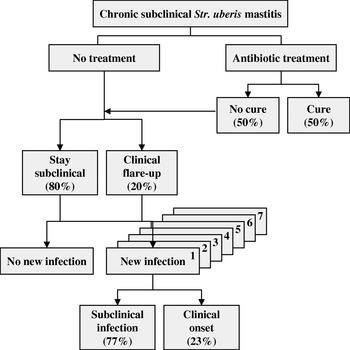
Figure 1 is a schematic representation of the stochastic model for antibiotic treatment v. no treatment of chronic subclinical Str. uberis mastitis. In comparison with a previous study (Swinkels et al. Reference Swinkels, Rooijendijk, Zadoks and Hogeveen2005a) values in Fig. 1 were adjusted to simulate the dynamics of Str. uberis only. Treatment of a chronic subclinical Str. uberis infection with antibiotics was assumed to occur at DD. Cow status after antibiotic treatment (S1) and after no treatment or no cure (S2) was described by a discrete probability distribution. Non-treated cows stayed subclinically infected (probability of 80%) or had a subclinical infection with a clinical flare-up (probability of 20%). For this model a cure rate after antibiotic treatment of 50% was assumed. For non-cured cows the same probabilities were assumed as for non-treated cows for staying infected subclinically (80%) or getting infected clinically (20%) (Fig. 1).


Schematic representation of the stochastic model for antibiotic treatment v. no treatment of chronic subclinical Str. uberis mastitis.

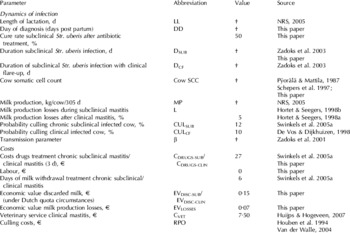
Information sources for some parameters are described in Table 1. The duration of a chronic subclinical Str. uberis infection (DSUB) was described by a pert distribution. Based on information from Zadoks et al. (Reference Zadoks, Gillespie, Barkema, Sampimon, Oliver and Schukken2003) the most likely DSUB was adjusted to 14 d and the most likely duration of a subclinical Str. uberis infection with a clinical flare-up (DCF) was adjusted to 62 d. The day of getting a clinical flare-up (CF) during DCF was assumed to have a uniform probability distribution with a minimum value on the DD and a maximum on the last day of the DCF.



Values, source of value and abbreviation of parameters used in the stochastic simulation model for chronic subclinical mastitis caused by Str. Uberis

† Input variable is described by a distribution
Effects of infection
Milk production losses due to chronic subclinical Str. uberis mastitis were modelled as a function of SCC. The SCC of a cow was described by a pert distribution. Minimum cow SCC for cows with chronic subclinical Str. uberis mastitis was assumed to be 250 000 cells/ml. Mean SCC of an infected quarter with Str. uberis was 106·72 cells/ml (Schepers et al. Reference Schepers, Lam, Schukken, Wilmink and Hanekamp1997). SCC of an uninfected quarter was assumed to be 50 000 cells/ml and therefore the most likely cow SCC was 1 349 518 cells/ml  . Quarter milk can reach 13 000 000 cells/ml without clinical symptoms (Pÿorälä & Mattila, Reference Pÿorälä and Mattila1987). Therefore, the maximum cow SCC was 3 287 500 cells/ml
 .

The 305-d milk production of a cow (MP) was assumed to follow a normal distribution with a mean of 8500 kg and sd of 500 kg.

Daily milk production during lactation was estimated by Wood's lactation curve (Wood, Reference Wood1967). This lactation curve was easy to use and implement in an @RISK model. Parity (P) of a cow was determined by a pert distribution with a minimum of parity 1, a maximum of parity 12 and a most likely parity of 3.

Based on the results of Hortet & Seegers (Reference Hortet and Seegers1998b), a cow with an SCC of 50 000 cells/ml was assumed to be healthy and to have no production losses. For every doubling of the cow SCC above 50 000 cells/ml, a decrease in daily milk production of 0·4 and 0·6 kg was assumed for first parity and multiparous cows, respectively. Based on this information, the milk production loss in kg/d (l) due to an elevated cow SCC above 50 000 cells/ml was calculated as:
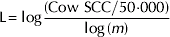
where m=3·17 (P=1) or 5·59 (P>1)
The probability of culling a subclinically (CULSUB) and clinically infected cow (CULCF) (Table 1) was described with a discrete distribution.


Cows with chronic subclinical Str. uberis infection may serve as a source of infection for other cows in a herd (Zadoks et al. Reference Zadoks, Gillespie, Barkema, Sampimon, Oliver and Schukken2003). The infectiousness of a pathogen was expressed in the transmission parameter β, i.e. the average number of new infections caused per day by an infected cow (Zadoks et al. Reference Zadoks, Allore, Barkema, Sampimon, Gröhn and Schukken2001). The value of β for Str. uberis was found to be 0·033 as worst scenario (Zadoks et al. Reference Zadoks, Allore, Barkema, Sampimon, Gröhn and Schukken2001). In our model β was described by a pert distribution with a minimum (0), most likely (0·01) and maximum value (0·033) (Table 1). The total number of new infections caused by an infected cow also depends on the duration of the infection in that cow. The combined effect of infectiousness and duration was represented by the reproductive rate, R, i.e. the total number of new infections caused by an infected cow during its duration of infection. The model rounds R to integer values. Initial runs of the model gave a maximum of seven new infected cows (R=7) that occurred as a consequence of a chronic subclinical Str. uberis infection (Fig. 1).

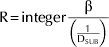
Transmission of Str. uberis infections, caused by the subclinical infected cow, to other herd mates resulted in new subclinical Str. uberis infections (probability of 77%) or new clinical Str. uberis infections (probability of 23%) (Fig. 1). Probability of the different appearances of a new Str. uberis infection (NEW) was described by a discrete probability distribution.

For all newly infected cows also the DD, LL, DSUB, DCF, CF, cow SCC, P, L, MP, CULSUB and CULCF were determined.
Calculation of costs
Costs of an antibiotic treatment of a chronic subclinical infected cow consisted of costs for drugs (CDRUGS-SUB) and discarded milk. Total costs of discarded milk (CDISC-SUB) were determined by the daily milk production on the day of diagnosis (DMPDD) (estimated with Wood's lactation curve), number of days of milk withdrawal, and the economic value of discarded milk (EVDISC). The opportunity costs for extra labour to treat a chronic subclinical mastitis case were assumed to be 0 (Table 1).

During a subclinical infection, milk production is decreased. Costs for these milk production losses (CLDI) depended on L, DSUB and the economic value of milk production losses (EVLOSSES) (Table 1). In this study it was assumed that at the end of the duration of infection or after cure cows did not regain their normal milk production level. Post infection, cows were assumed to have the same production losses as during the subclinical infection. Costs for these losses after subclinical infection (CLAI) were calculated as a function of L, the remaining days in lactation and EVLOSSES.


Total costs for a subclinical infection with clinical flare-up (CCLIN) included costs for drugs (CDRUGS-CLIN), veterinary service (CVET) (Table 1), discarded milk (CDISC-CLIN), milk losses until the day of getting a clinical flare-up (CLTCF) and milk losses due to a lower production level after a clinical flare-up (CLACF). CDISC-CLIN depended on the daily milk production on the day of getting a clinical infection (DMPCF), the number of days of milk withdrawal and the EVDISC. Costs for milk losses till the day of getting a clinical flare-up (CLTCF) depended on L, duration of subclinical infection till the day of getting a clinical flare-up and EVLOSSES. After a clinical flare-up a decrease in daily milk production of 5% was assumed. Costs for these milk losses (CLACF) were based on the DMP, the remaining days in lactation after treatment of a clinical flare-up and the EVLOSSES.




Time of culling for cows with a chronic subclinical infection was assumed at the end of DSUB and time of culling for cows with a clinical infection was assumed at CF. Culling costs (CCUL) of infected cows were expressed using retention pay off (RPO). RPO values were calculated with a stochastic model developed by Houben et al. (Reference Houben, Huirne, Dijkhuizen and Kristensen1994). The model outcomes were updated by Van der Walle (Reference Van der Walle2004), using values for prices and production level from the year 2003. With this model, culling costs are based on specific cow factors such as parity, stage of lactation and production level.
The costs of new subclinically infected cows were calculated as follows:

The total costs of a case of chronic subclinical mastitis were calculated as follows:

Sensitivity analysis
A sensitivity analysis was performed to verify the values of the input parameters and to assess the effect of varying the input parameters on the outcome total costs of antibiotic treatment and no treatment. Values for input variables in the sensitivity analysis were based on information in the literature. When there was no information in the literature, expertise of the authors was used. The sensitivity analysis was performed for the following variables: DD, DSUB, β, cure rate after treatment, production losses after subclinical infection, EVDISC-SUB+EVDISC-CLIN, CDRUGS-SUB+CDRUGS-CLIN and RPO.
Results
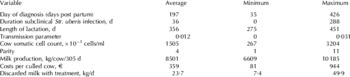
The outcome of cow-specific model parameters under default circumstances is given in Table 2. There was a large amount of variation between cows. On average, a chronic subclinical mastitis case was diagnosed on day 197 of lactation, but diagnosis early and late in lactation was also possible. The average length of a Str. uberis infection, after diagnosis, was 36 d, but varied between 0 and 288 d. There was a large variation in cow SCC. A culled cow cost on average €359, but there was a large variation (€81–€944). On average 23·7 kg milk had to be discarded daily during antibiotic treatment.
Model outcomes for cow-specific parameters under default circumstances

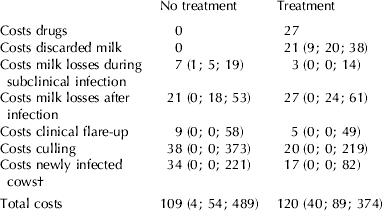
Costs for treated and non-treated cases of chronical subclinical mastitis caused by Str. uberis are presented in Table 3. Costs for non-treated chronic subcliniccal Str. uberis cases after diagnosis were on average €109 and consisted of costs for milk losses during and after the infection, clinical flare-up, culling and new infected cows. With no treatment costs for culling chronic subclinical infected cows (€38) and costs for new infected cows (€34) had the highest contribution to the total average costs. Treatment of a chronic subclinical Str. uberis infection gave lower costs for milk losses during infection, clinical flare-up, culling and new infected cows in comparison with no treatment. However, this did not outweigh the costs for drugs (€27) and discarded milk (€21) in case of treatment. Therefore, on average, treatment gave higher costs than no treatment.
Economic consequences (€/case) of chronic subclinical mastitis caused by Str. uberis after the day of diagnosis as calculated under default circumstances. Average is given for treatment as well as no treatment (5%, 50% and 95% percentiles between brackets)
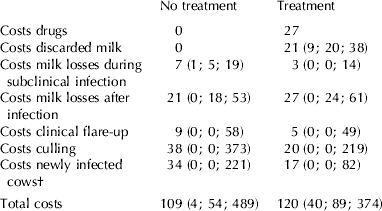
† Including costs for milk production losses, clinical mastitis and culling
In Table 3, the variability in outcomes is shown using 5th and 95th percentiles. The range in outcomes was larger for no treatment than for treatment (€4–489 and €40–374, respectively). In addition the median values (50th percentile) are presented. The median value for total costs for treatment (€89) is higher than the median value for no treatment (€54).
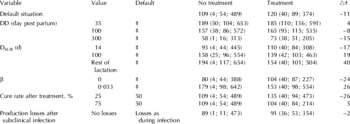
Results of the sensitivity analysis with parameters for the dynamics of infection are given in Table 4. If a subclinical Str. uberis case was diagnosed on day 35 of lactation, total costs for treatment were lower than for no treatment. In this situation it was, on average, economically profitable to treat that chronic subclinical case. It became less profitable to treat chronic subclinical Str. uberis cases diagnosed later in lactation. The duration of an infection also had an effect on the total costs. A chronic subclinical case with a duration of infection of 14 d from day of diagnosis onwards was on average not profitable to treat. However, with a duration of 100 d or more treatment was, on average, profitable. In a situation where no new infections occurred (β=0), total costs were lower compared with the default situation and treatment became even less profitable. In a scenario with a lot of new infections (β=0·033), treatment became economically profitable. Increasing the cure rate after treatment from the default 50% to 75% made treatment just profitable. Assuming milk production to return to the normal level post infection, changed the €11 advantage of non-treatment to, on average, equal costs for treatment and no-treatment.
Sensitivity of the total costs (€/case) of treatment and no treatment of chronic subclinical mastitis caused by Str. uberis for factors on the dynamics of the infection. Average is given for treatment as well as no treatment (5%, 50% and 95% percentiles between brackets)

† Difference in total average costs in € between no treatment and antibiotic treatment
‡ In the default situation this variable was described by a distribution
Results for the sensitivity analysis for economic parameters are given in Table 5. In the default situation the economic value for discarded milk was €0·15. In a situation with an economic value of milk of €0·00 it was on average profitable to treat chronic subclinical Str. uberis mastitis. Also in a situation with an economic value for discarded milk of €0·07 treatment becomes profitable. In the sensitivity analysis culling costs equal to €526 (equal to the culling costs as in Swinkels et al. Reference Swinkels, Rooijendijk, Zadoks and Hogeveen2005a) are analysed. If the costs for a culled cow were equal to €526 it was on average profitable to treat. All outcomes of the sensitivity analysis showed large differences between the average and median values for total costs. Based on median values, antibiotic treatment is only profitable when the subclinical infection has a duration for the rest of lactation or the transmission parameter (β) is 0·033 (Table 4 and 5).
Sensitivity of the total costs (€/case) of treatment and no treatment of chronic subclinical mastitis caused by Str. uberis for economic factors. Average is given for treatment as well as no treatment (5%, 50% and 95% percentiles between brackets)

† Difference in total average costs in € between no treatment and antibiotic treatment
Discussion
The developed stochastic simulation model describes variation in different input values and as a consequence the range of the economic outcome could be presented very well. Results suggest that, on average, treatment of chronic subclinical Str. uberis mastitis might not be profitable economically. Under default conditions, the average economic costs after diagnosis of a cow with chronic subclinical mastitis caused by Str. uberis is estimated to be €109 per case. On average, the total costs increase by €11 when a cow is treated with antibiotics. Based on the median value, it was even less profitable to treat (difference of €35). But, since treatment gives a smaller range in outcomes and therefore less risk, the risk attitude of the dairy farmer is important. Risk-averse farmers will have a preference for treatment while for risk seekers the opposite is true.
In the deterministic model, treatment resulted in an average profit of €11·62 over no treatment (Swinkels et al. Reference Swinkels, Rooijendijk, Zadoks and Hogeveen2005a). Results from the deterministic model were different from our stochastic model. This was mainly due to input variables that were stochastically distributed in our study while in the deterministic model mean values were used. For example, costs for culling in the deterministic model (Swinkels et al. Reference Swinkels, Rooijendijk, Zadoks and Hogeveen2005a) were a fixed value of €526. While in our study this value was case specific, on average a culled cow costs €359 (Table 2). Results from the sensitivity analysis showed that with a fixed value of €526 for culling costs treatment becomes profitable (Table 5), just as in Swinkels et al. (Reference Swinkels, Rooijendijk, Zadoks and Hogeveen2005a).
Because of the structure of the model and the lack of information on number of infected quarters, it was assumed that only one quarter was infected. With more than one infected quarter the costs for antibiotics will increase. Other costs such as costs for discarded milk and culling will stay on the same level as with an infection in one quarter. However, other costs are difficult to calculate because of lack of knowledge on the consequences of two infected quarters on for example cure rates and duration of infections.
No costs for bacteriological culturing were included. It was simply assumed that the involved bacterium was known. The additional costs for bacteriological culture could be added to the total costs. However, the decision for identification of the infected quarters is more complex than that. When no pathogen information is known, the decision options are to do nothing, treat the cow with antibiotics without knowing the pathogen, or spend more money on further diagnosis. To determine which option (no treatment, blind treatment or specific treatment) would be economically most advantageous, a much more complex model is required.
Costs for treatment or no treatment are strongly influenced by the economic input values of the model. Most economic parameters cannot be influenced by the farmer, may vary between countries or regions and depend on specific circumstances. Costs of labour for antibiotic treatment of both clinical and subclinical mastitis are difficult to interpret. Opportunity costs may differ from farm to farm. For our study it is assumed that antibiotic treatment takes place during the milking process and therefore opportunity costs are assumed to be zero. Moreover the economic costs of a lower milk production per cow depend on the structure of the farming business (Halasa et al. Reference Halasa, Huijps, Østerås and Hogeveen2007). The economic impact of treatment will also be different between farms with a low and high prevalence of subclinical mastitis. Equally, bulk milk SCC (BMSCC) is a farm-specific trait. Owing to subclinical mastitis cases BMSCC can strongly increase, which will lead to economic consequences due to penalties. The effects on BMSCC and hence penalties are important. They will depend on dilution effects e.g. herd size and proportion of infected cows. In our study, information on BMSCC is not taken into account. But this information on BMSCC can be valuable for economic calculations since treatment of high SCC cows can decrease BMSCC (St. Rose et al. Reference St. Rose, Swinkels, Kremer, Kruitwagen and Zadoks2003) and prevent penalties. However, antibiotic treatment of subclinical mastitis increases the risk of penalties due to antibiotic residues in milk. Just as for BMSCC, this was not taken into account in our study, but consequences of antibiotic residues in the milk can be considerable.
Results of the sensitivity analysis on dynamics of infection (Table 4) showed that the results were highly dependent on the values of the input parameters. This was especially so for the duration of a chronic subclinical infection. In the literature, no information was available on the remaining duration of a chronic Str. uberis infection, which was already present for at least 28 d (Todhunter et al. Reference Todhunter, Smith and Hogan1995; Zadoks et al. Reference Zadoks, Gillespie, Barkema, Sampimon, Oliver and Schukken2003; McDougall et al. Reference McDougall, Parkinson, Leyland, Anniss and Fenwick2004). The value we used was 14 d. This may be an underestimation and also the effect of treatment may be underestimated. There is a lack of published data on the remaining duration of infection.
Furthermore the input parameter cure rate was highly sensitive (Table 4). Just like duration of infection, information on reported cure rates in the literature after an antibiotic treatment of chronic subclinical Str. uberis infections are scarce. Moreover, in reported literature different definitions of chronic infections, high cow SCC and cure were used (DeLuyker et al. Reference DeLuyker, Michanek, Wuyts, Van Oye and Chester2001, Reference DeLuyker, Van Oye and Boucher2005; St. Rose et al. Reference St. Rose, Swinkels, Kremer, Kruitwagen and Zadoks2003; Oliver et al. Reference Oliver, Gillespie, Headrick, Moorehead, Lunn, Dowlen, Johnson, Lamar, Chester and Moseley2004). Cure rates after treatment for chronic Str. uberis infections ranged in literature from 21% to 72% (DeLuyker et al. Reference DeLuyker, Michanek, Wuyts, Van Oye and Chester2001, Reference DeLuyker, Van Oye and Boucher2005). For this model a cure rate of 50% after an antibiotic treatment was assumed, which was a sensitive assumption. Cure rates are cow dependent. Several significant cow-specific risk factors for cure rates were reported such as parity, cow SCC at treatment, stage of lactation and pathogen strain (Sol et al. Reference Sol, Sampimon, Snoep and Schukken1997, Reference Sol, Sampimon, Barkema and Schukken2000; DeLuyker et al. Reference DeLuyker, Michanek, Wuyts, Van Oye and Chester2001, Reference DeLuyker, Van Oye and Boucher2005; St. Rose et al. Reference St. Rose, Swinkels, Kremer, Kruitwagen and Zadoks2003; Zadoks et al. Reference Zadoks, Gillespie, Barkema, Sampimon, Oliver and Schukken2003). Therefore, it is recommended to take into account cow-specific cure rates for a better decision (Swinkels et al. Reference Swinkels, Hogeveen and Zadoks2005b).
It is known that subclinical mastitis and high SCC increase the risk of culling (Beaudeau et al. Reference Beaudeau, Ducrocq, Fourichon and Seegers1995; Samoré et al. Reference Samoré, Schneider, Canavesi, Bagnato and Groen2003). In our study 12% of all infected cows were culled, average costs per culled cow was €359. This value was much higher than all average total costs for no treatment and treatment (Table 4 and 5) and therefore culling a chronic subclinically infected cow with Str. uberis seems to be unprofitable. Only in worst case scenarios (expressed in 95% percentiles) does it become profitable to cull a chronic subclinically infected cow. However, modelling culling well is very complex because it is a decision of the dairy farmer and a lot of factors are involved. Factors such as milk production, fertility and claw health play a role in the decision to cull. Other complex factors are, for example, the positive effects of culling high SCC cows on risk of mastitis to the remainder of the herd; this should reduce the costs of culling. Several studies have examined optimum replacement and culling strategies for culling of mastitis cows (Houben et al. Reference Houben, Huirne, Dijkhuizen and Kristensen1994; Stott et al. Reference Stott, Jones, Gunn, Chase-Topping, Humphry, Richardson and Logue2002). Culling of diseased cows is a complex modelling task; for reasons of simplicity in our study the culling costs were calculated based on the model of Houben et al. (Reference Houben, Huirne, Dijkhuizen and Kristensen1994).
In our study spread to other cows, expressed in the transmission parameter β, was taken into account. The appearance of new infections can be clinical or subclinical. New infection has a probability of being clinical of 23% (average of Lam, Reference Lam1996: 48%; Jayarao et al. Reference Jayarao, Gillespie, Lewis, Dowlen and Oliver1999: 5%; Zadoks et al. Reference Zadoks, Gillespie, Barkema, Sampimon, Oliver and Schukken2003: 15%). The remaining 77% of the infections are assumed to be subclinical. The sensitivity analysis showed that in a worst case scenario (β=0·033) treatment becomes on average economically profitable. However, usually, the β of the pathogen causing a specific case of subclinical mastitis is strain dependent and not known at the moment of decision making. In the future, strain determination might become a tool to handle this uncertainty (Zadoks et al. Reference Zadoks, Gillespie, Barkema, Sampimon, Oliver and Schukken2003).
Day of diagnosis is an important variable, since it had a large impact on the total costs (Table 4). This variable is known on the day of treatment and has to be taken into account when deciding to treat or not. Other cow specific variables (e.g. duration of infection and cow SCC) are not known on the day of diagnosis, but do influence the decision to treat or not. Also the herd specific variables (e.g. BMSCC and EVDISC) and market specific variables (e.g. prices of antibiotics) do influence the decision to treat or not. Results of our study show the importance of cow-specific factors. Because of the complexity of these effects, simple and generalized protocols will not be enough to enable a dairy farmer to take the most optimal decision around treatment of subclinical mastitis. Ongoing farm automation provides more and more opportunities to implement computerized decision support systems.
In conclusion, under default conditions, the average economic costs from diagnosis onwards of a cow with chronic subclinical mastitis caused by Str. uberis are estimated to be €109 per case. On average, the total costs are increased by €11 when a cow is treated with antibiotics. Obviously, the additional costs of treatment of on average €48 (drugs and discarded milk) were not outweighed by a decrease in costs for factors such as clinical flare-ups culling and spread of mastitis. The spread of economic costs indicates that the risk of high costs is much higher when a cow with chronic subclinical mastitis is not treated than when treated. Sensitivity analysis showed that the total costs for no treatment and treatment of chronic subclinical mastitis are dependent on specific cow, farm and market factors. In the future, computerised decision support systems might be able to support decisions on treatment of subclinical mastitis.
We thank the Dutch Technology Foundation STW (applied science division of NWO and the Technology Programme of the Ministry of Economic Affairs) for financial support and Diederik Pietersma for the critical reading of previous versions of this paper.