Implications
The results of this study indicate that the on-farm cow mortality is related to management decisions implying that actions can be taken to reduce the problem. Most of the identified risk factors may be related to the intensification of the dairy industry, but some of these characteristics can still be manageable and thus to the advantage of the welfare of the cows.
Introduction
High dairy cow mortality (i.e. euthanasia and unassisted death) may indicate sub-optimal herd health or welfare and causes financial losses (Thomsen and Houe, Reference Thomsen and Houe2006). Increasing levels of dairy cow mortality have been reported in Denmark, the United States and Sweden in the last decade (Thomsen et al., Reference Thomsen, Kjeldsen, Sørensen and Houe2004; Miller et al., Reference Miller, Kuhn, Norman and Wright2008; Alvåsen et al., Reference Alvåsen, Jansson Mörk, Hallén Sandgren, Thomsen and Emanuelson2012). In Sweden, cow mortality rates have increased by 1.5 percentage points between 2002 and 2010, and were 6.6 deaths/100 cow years in 2010 (Alvåsen et al., Reference Alvåsen, Jansson Mörk, Hallén Sandgren, Thomsen and Emanuelson2012). Previous studies have identified that longer calving intervals (Raboisson et al., Reference Raboisson, Cahuzac, Sans and Allaire2011; Alvåsen et al., Reference Alvåsen, Jansson Mörk, Hallén Sandgren, Thomsen and Emanuelson2012), Holstein breed (Thomsen et al., Reference Thomsen, Kjeldsen, Sorensen, Houe and Ersboll2006; Raboisson et al., Reference Raboisson, Cahuzac, Sans and Allaire2011; Alvåsen et al., Reference Alvåsen, Jansson Mörk, Hallén Sandgren, Thomsen and Emanuelson2012), conventional (compared with organic) herds (Thomsen et al., Reference Thomsen, Kjeldsen, Sorensen, Houe and Ersboll2006; Alvåsen et al., Reference Alvåsen, Jansson Mörk, Hallén Sandgren, Thomsen and Emanuelson2012), no summer grazing (Thomsen et al., Reference Thomsen, Kjeldsen, Sorensen, Houe and Ersboll2006; Burow et al., Reference Burow, Thomsen, Sørensen and Rousing2011), larger herd size (Smith et al., Reference Smith, Ely and Chapa2000; Thomsen et al., Reference Thomsen, Kjeldsen, Sorensen, Houe and Ersboll2006; Raboisson et al., Reference Raboisson, Cahuzac, Sans and Allaire2011), high proportion of purchased cows (Thomsen et al., Reference Thomsen, Kjeldsen, Sorensen, Houe and Ersboll2006; Raboisson et al., Reference Raboisson, Cahuzac, Sans and Allaire2011) and lower herd mean milk yield (Smith et al., Reference Smith, Ely and Chapa2000; Thomsen et al., Reference Thomsen, Kjeldsen, Sorensen, Houe and Ersboll2006; Alvåsen et al., Reference Alvåsen, Jansson Mörk, Hallén Sandgren, Thomsen and Emanuelson2012), are all factors associated with increased mortality rates. Further, Alvåsen et al. (Reference Alvåsen, Jansson Mörk, Hallén Sandgren, Thomsen and Emanuelson2012) found regional differences in mortality rate and the numerically lowest mortality rate, related to housing and milking systems, that were found in freestalls with an automatic milking system and a mean annual milk yield >9995 kg of energy-corrected milk. This information was based on secondary data retrieved from the Swedish official milk-recording scheme (SOMRS) and is therefore limited to general characteristics of herds and restricted information on actual management. McConnel et al. (Reference McConnel, Lombard, Wagner and Garry2008) suggests that at least 50% of cow death losses are attributable to causes that could be mitigated with proper management. In the United States, Dechow et al. (Reference Dechow, Smith and Goodling2011) demonstrated lower mortality rates in herds with rubber walkways, where a greater part of the labour was performed by the owner or family members, in herds with fewer cows per worker, and in herds not feeding a total mixed ration. There is a need to identify additional herd characteristics and management routines associated with high on-farm cow mortality so that advice for reducing mortality can be given to farmers. This information may also be of interest to animal welfare policy makers.
The objective of this study was to identify herd management practices and herd characteristics that differentiate dairy herds with high on-farm cow mortality from herds with low on-farm cow mortality in Sweden.
Material and methods
Study design and study population
The target population in this study was dairy farms with a high or low cow mortality rate and a herd size of at least 35 cows enrolled in the SOMRS. The SOMRS is a voluntary service that in 2012/13 included 84% of the Swedish dairy cows. The cost for a herd to participate in SOMRS is ∼18 EUR/cow and year (N.-E. Larsson, personal communication). Dairy farmers in Sweden are required by law to report all deaths within 1 week to the SOMRS. To obtain a firm classification of herds, that is, to avoid including herds with either temporary high or low mortality (HM or LM), we used mortality rates from 3 consecutive years. We selected extremes to increase the ability to detect potential differences between the groups. The herds were categorized into HM or LM herds based on the herd average mortality rate during 2008/09, 2009/10 and 2010/11(the SOMRS uses fiscal years running from 1 September to 31 August, and this classification of year is used in the present study, with years referred to as 2009/10, etc.). HM herds had a herd average mortality rate in the fourth quartile of all SOMRS herds during 2009/10 and 2010/11 (>8.1 and >7.7 deaths/100 cow years for the 2 years, respectively) and above the median during 2008/09 (>5.2 deaths/100 cow years). LM herds had mortality rates in the first quartile during 2009/10 and 2010/11 (<2.7 deaths/100 cow years, for both years), and below the median during 2008/09 (<5.2 deaths/100 cow years). The median was used as threshold during 2008/09 to increase the number of eligible herds. Out of 3698 herds registered in the SOMRS, 250 herds met the criteria for HM herds and 194 met those for LM herds.
Questionnaire
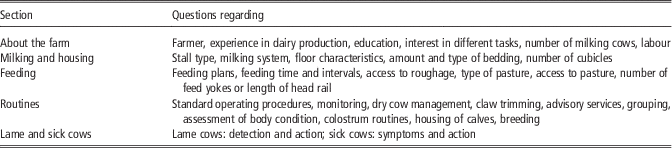
A questionnaire was developed to acquire information on management routines we hypothesized to be related to on-farm mortality in Swedish dairy herds. The initial focus areas were developed by K.A., A.R. and U.E. based on group discussions with researchers and advisors in the dairy field. Questions were formulated by K.A. and A.R. and pre-tested by experienced researchers. The questionnaire was then pilot-tested on 10 dairy farmers. The responses were studied to identify any confusing questions or questions that would not add any valuable information. Based on these results, questions were further rephrased by K.A. and A.R. The responses from the pilot-test were only used to detect improvement areas in the questionnaire and were not included in any analyses, and these farmers were not sampled again with the revised questionnaire. The final questionnaire consisted of 49 questions in five sections: ‘About the farm’, ‘Milking and housing’, ‘Feeding’, ‘Routines’ and ‘Lame and sick cows’. The questions were mostly multiple choice or visual analogue scale type, with a space provided after each question for comments. An overview of the areas covered by the questions is presented in Table 1. The questionnaire (in Swedish or English) is available from the corresponding author upon request.
Overview of areas covered by questions used in the questionnaire sent to farmers with high or low on-farm cow mortality rates

Questionnaires were distributed by mail in October 2012 to all farmers whose herds met the criteria for HM and LM herds. The respondents were informed that all information they provided would be treated as confidential. They were not aware of the purpose of the study or whether they were an HM or LM herd, but general questions regarding longevity and on-farm mortality were posed. After 7 weeks, a reminder, in the form of a postcard, was sent to the non-respondents. In total, 148 questionnaires were returned.
Data editing
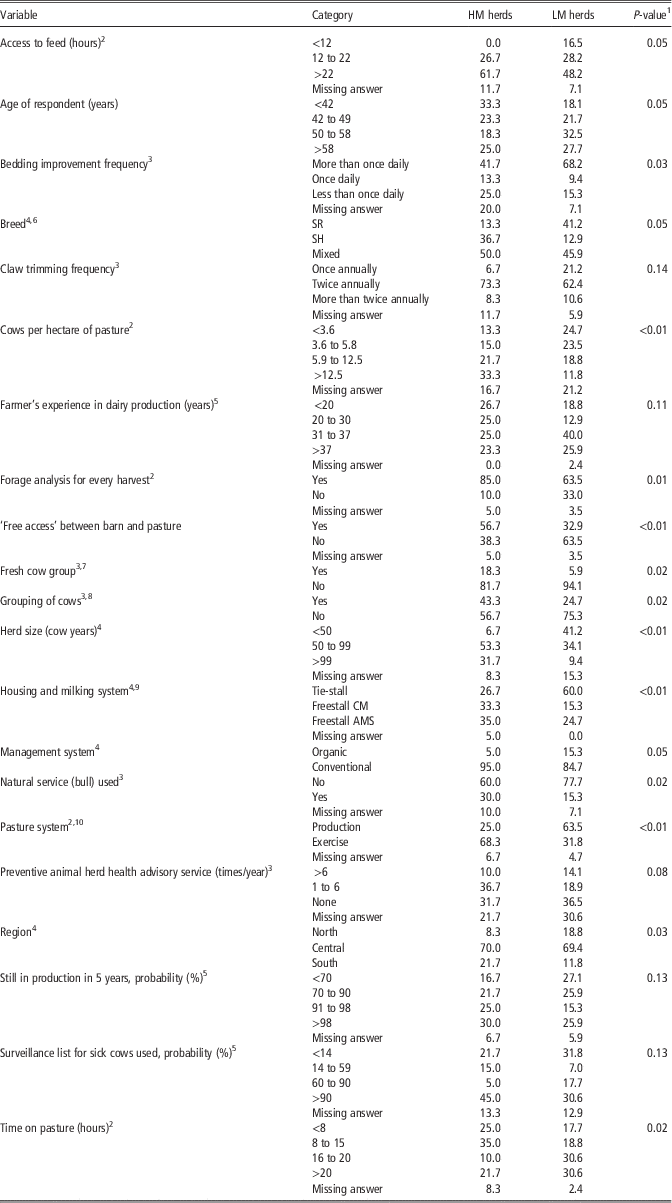
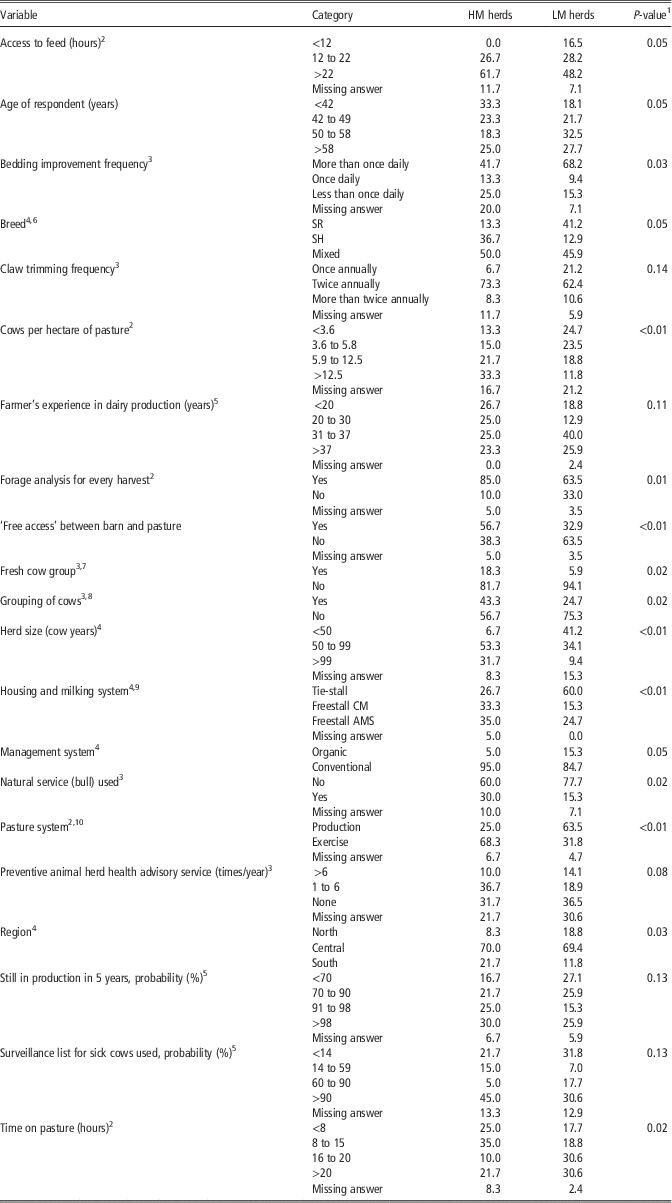
Information from the questionnaires was entered into an OpenOffice database (OpenOffice™ 3.3). Some respondents chose not to respond to specific questions. In most instances, there were a sufficient number of herds with the same missing information to form a category of ‘missing answer’. All questions were treated as categorical variables to avoid losing too many observations in the multivariable model. Variables were categorized using biologically relevant cut-offs if available, and otherwise quartiles (Table 2). Categories with too few observations were merged whenever it was possible to create new biological or logical categories. In cases with too few observations where this was not possible, the variables were not used in the analysis.
Distribution (proportion of observations) of potential risk factors associated with being a dairy herd with high on-farm cow mortality (HM herds; n=60) compared with being a dairy herd with low on-farm cow mortality (LM herds; n=85) subsequently included in the multivariable logistic regression model
1 Significance level (χ 2 test).
2 Sub-model a.
3 Sub-model b.
4 Sub-model c.
5 Sub-model d.
6 SR=>80% Swedish Red; SH=>80% Swedish Holstein; mixed=all other herds.
7 Fresh cows and/or first parity cows grouped together.
8 Any grouping of cows applied (excluding dry cow grouping).
9 Tie-stall=tie-stall with pipeline milking; freestall CM=freestall with conventional milking (e.g. parlour or rotary); freestall AMS=freestall with an automatic milking system.
10 Production=a considerable percentage of the forage requirement is ingested at pasture; exercise=outdoor area without any requirements on grass quality.
Most of the variables in Table 2 are self-explanatory, but some may need an explanation. For instance, ‘production pasture’ is the pasture used when cows obtain part of their daily energy requirement from grazing. This pasture type constitutes grass of good quantity and quality. The ‘exercise pasture’ is an outdoor area where cows rest and spend time, but the major feed intake occurs in the barn.
Additional data were retrieved from the SOMRS. These were mean annual herd-level data and contained the following information: age at first calving, bulk milk somatic cell count (BMSCC), breed, calving interval, herd size, organic or conventional farm, milk yield and on-farm cow mortality rate.
Statistical analysis
Associations between the explanatory variables from the questionnaire and the outcome (risk of being an HM herd) were first analysed in a univariable analysis using χ 2 test. Spearman’s rank-order correlation coefficients were used to assess potential pairwise collinearities between the explanatory variables. Collinearity (ρ⩾|0.6|) was found between ‘Age of the respondent’ and ‘Farmer’s experience in dairy production’, and between ‘Housing and milking system’ and ‘Free access between barn and pasture’. ‘Farmer’s experience in dairy production’ and ‘Housing and milking system’ were used in the analysis as their association with the outcome was stronger than was that of either ‘Age of the respondent’ and ‘Free access between barn and pasture’. All variables with a univariable association with the outcome of P<0.2 were included in the multivariable logistic regression model (Table 2). As this initial full model did not converge, all explanatory variables with a univariable association with the outcome of P<0.2 were grouped into sub-models. Variables included in the four different sub-models are shown in Table 2. A backward elimination was applied to each sub-model and all variables with P<0.1 in the likelihood ratio χ 2 test were entered into a final model. In the final logistic regression model, with HM herd (yes/no) as the outcome, again a backward elimination procedure of the 10 variables that met the inclusion criteria was applied and continued until all remaining effects had P<0.05. Already excluded variables were re-entered whenever a variable was removed, and kept in the model if P<0.05. Potential confounders were considered in each step of the model (and sub-model) development by inspecting changes in the parameter estimates with and without the possible confounder. Any changes >20% were considered to indicate confounding. Finally, all variables (with univariable association with the outcome of P<0.2) were re-entered in the final model and kept in the model if P<0.05. The fit of the model was assessed by a Hosmer–Lemeshow goodness-of-fit test using the deciles as cut-offs. All statistical analyses were performed using SAS version 9.3 (SAS Institute Inc., Cary, NC, USA) and STATA version SE 11.2 (StataCorp LP, College Station, TX, USA).
Results
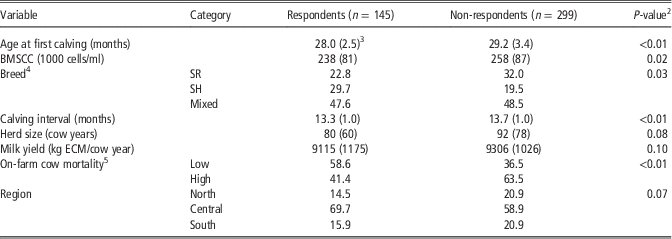
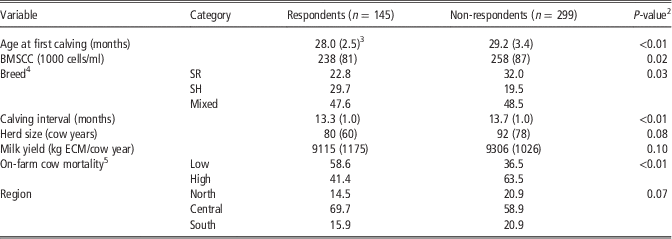
Of the 148 questionnaires returned, one herd had ceased milk production and two herds had sent in blank questionnaires. The number of usable questionnaires was therefore 145 (response rate 32.7%). Herd characteristics of respondents and non-respondents differed slightly (Table 3). The median mortality rate was 5.2, 5.1 and 4.9 for the years 2008/09, 2009/10 and 2010/11, respectively, indicating a declining trend.
Distribution of herd data (percentage of observations for categorical variables and means with standard deviations for continuous variables) among respondents and non-respondents of a questionnaire sent to Swedish dairy herds with high or low on-farm mortality ratesFootnote 1
BMSCC=bulk milk somatic cell counts; ECM=energy-corrected milk.
1 Herd averages during fiscal year 2010/11.
2 Significance level (t test for continuous variables and χ 2 test for categorical variables).
3 Mean (standard deviation).
4 SR=>80% Swedish Red; SH=>80% Swedish Holstein; mixed=all other herds.
5 Low=mortality rates <2.7 deaths/100 cow years for 2010/11 and 2009/10, and <5.2 deaths/100 cow years for 2008/09; high=mortality rates >7.7 deaths/100 cow years for 2010/11, >8.1 deaths/100 cow years for 2009/10 and >5.2 deaths/100 cow years for 2008/09.
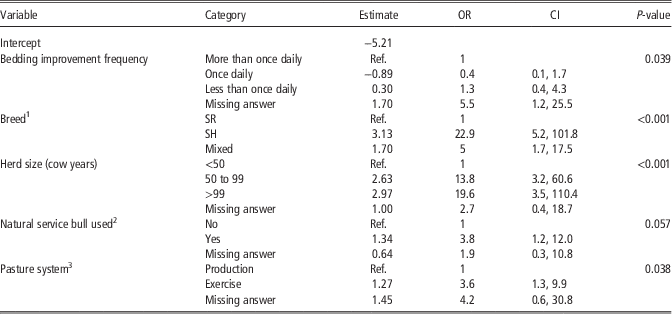
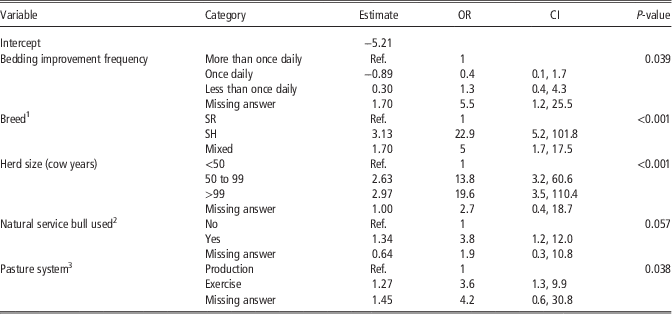
The final multivariable model (Table 4) showed that being an HM or LM herd was associated with mean annual herd size, breed, pasture system and bedding improvement frequency. ‘Natural service bull used’ was borderline significant and was kept in the final model as it confounded point estimates for three variables. The Hosmer–Lemeshow goodness-of-fit test was not significant, indicating adequate fit of the model.
Final logistic regression analysis of risk factors associated with being a herd with a high on-farm cow mortality rate (HM herds; n=60) compared with being a herd with a low on-farm cow mortality rate (LM herds; n=85)
OR=odds ratio; CI=95% confidence interval for odds ratio.
1 SR=>80% Swedish Red; SH=>80% Swedish Holstein; mixed=all other herds.
2 Included as confounder.
3 Production=a considerable percentage of the forage requirement is ingested at pasture; exercise=outdoor area without any requirements regarding grass quality.
Farm characteristics
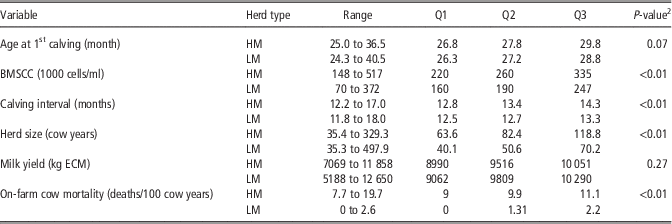
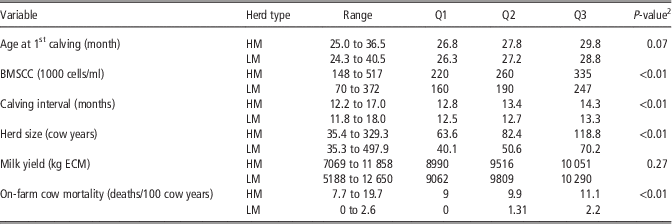
Respondents were females in 23% and 13% of the LM and HM herds, respectively. When asked how to reduce cow mortality, the most common answer (LM=38% and HM=33%) was that no intervention was needed to reduce mortality in the herd, as LM rates mostly depended on luck. The next most common answer was improved genetic material (LM=16% and HM=27%), improved building technology (LM=8% and HM=18%) and higher carcass prices (LM=1% and HM=3%). In all, 14% of the LM herds and 7% of the HM herds answered that this question was not relevant for them. Interestingly, no one answered that better disease control and improved biosecurity would reduce mortality. Herd characteristics of HM and LM herds are presented in Table 5.
Range (minimum to maximum), first quartile (Q1), median (Q2), and third quartile (Q3) for some herd characteristicsFootnote 1 of herds with a high on-farm cow mortality rate (HM herds; n=60) and herds with a low on-farm cow mortality rate (LM herds; n=85) in a questionnaire study of management-related risk factors.
BMSCC=bulk milk somatic cell counts; ECM=energy-corrected milk.
1 Herd averages during milk-recording year 2010/11.
2 Significance level (t test for continuous variables and χ 2 test for categorical variables).
Discussion
In the multivariable analysis, herd size and breed were risk factors with strong associations with dairy cow mortality. Dairy production in Sweden and elsewhere has undergone large structural changes during the last decades. As herd size increases, the number of herds decrease, and new technology is introduced. This structural change and increased intensification of the production has also had effects on amount of man hours per cow and year (Alban and Agger, Reference Alban and Agger1996; Mayer and Kammel, Reference Mayer and Kammel2010) and thus decreased time for surveillance of cows and possibly an increased risk for cow mortality. This is consistent with the study of Nørgaard et al. (Reference Nørgaard, Lind and Agger1999) that concluded that increased mechanization and larger herd size contribute to less attention per cow and increased mortality. Earlier studies have also found that mortality increased with increasing herd size (e.g. Smith et al., Reference Smith, Ely and Chapa2000; Thomsen and Houe, Reference Thomsen and Houe2006; Dechow and Goodling, Reference Dechow and Goodling2008). The Swedish Holstein has become the predominant breed in Sweden and in accordance with earlier studies on dairy cow mortality (Hare et al., Reference Hare, Norman and Wright2006; Thomsen et al., Reference Thomsen, Kjeldsen, Sorensen, Houe and Ersboll2006; Miller et al., Reference Miller, Kuhn, Norman and Wright2008), the Holstein breed was associated with greater mortality levels in the present study. Differences in disease susceptibility may be part of the explanations for this association, because Swedish Red cows have shown in several studies a lower incidence of common production-related diseases (Bendixen et al., Reference Bendixen, Vilson, Ekesbo and Åstrand1987 and Reference Bendixen, Vilson, Ekesbo and Åstrand1988; Emanuelson et al., Reference Emanuelson, Oltenacu and Gröhn1993; Nyman et al., Reference Nyman, Ekman, Emanuelson, Gustafsson, Holtenius, Waller and Sandgren2007).
The results in the present study demonstrated that the use of production pasture was associated with LM herds. Danish studies has found lower mortality rates in grazing herds than in zero-grazing herds (Thomsen et al., Reference Thomsen, Kjeldsen, Sorensen, Houe and Ersboll2006; Burow et al., Reference Burow, Thomsen, Sørensen and Rousing2011). In addition, other studies have found grazing to be associated with better health (Alban and Agger, Reference Alban and Agger1996; Hernandez-Mendo et al., Reference Hernandez-Mendo, von Keyserlingk, Veira and Weary2007), and an increased zero grazing does not seem to be favourable from an animal health perspective.
A missing answer on the question of bedding improvement frequency was the only category that significantly differed from the baseline within that variable. There were no significant differences between the stated bedding improvement frequencies, which is somewhat difficult to explain.
Use of a natural service bull was kept in the model as a confounder, but the variable was borderline significant and there was a significant difference between use of natural service bulls and artificial insemination on the risk of being an HM herd. Farmers with a particular interest in genetics are most likely not using natural service bulls, and might be ‘better’ farmers, taking more interest in their animals. Swedish dairy herds using natural service have also been found to have a greater herd mean stillbirth rate in calves (N.-E. Larsson, personal communication) and stillbirths has been found to be associated with increased risk of unassisted death in dairy cows (Alvåsen et al., Reference Alvåsen, Thomsen, Hallén Sandgren, Jansson Mörk and Emanuelson2014). The increased stillbirth rates when using natural service could be a consequence of the fact that there is usually no exact date for the planned calving and that no selection of the bull has been carried out and the calving traits are therefore unknown (Mee et al., Reference Mee, Sánchez-Miguel and Doherty2014).
Herd size and breed seem to be risk factors with great impact on cow mortality under Swedish production conditions. Many management factors are closely associated with the size of the herd and including herd size in a multivariable model may mask other important factors. When we excluded herd size from the analysis, use of a ‘surveillance list for sick cows’ and ‘use of fresh cow group’ were associated with HM herds. We do not believe that ‘using surveillance list for sick cows’ and ‘fresh cow grouping’ per se increase the mortality risk; rather, these activities are most likely performed more often in larger herds and the associations therefore is a reflection of herd size. Another explanation might be that herds with a lot of problems are adopting these activities to improve the sub-optimal running of the farm.
The questionnaire contained questions focusing on recognition and actions when detecting sick or lame cows. We had expected these variables to differ between HM and LM herds, but none of the differences were significant. One limitation with questionnaire studies is that there is a risk for misunderstandings; that questions are interpreted in the wrong way by the respondent, or that the answers are interpreted wrong by the researcher, or both. This may be the case also in this study, although the questionnaire was both pre-piloted and piloted before distribution. There is also a risk that the respondents answered as they knew they are expected to act or as they want to act (instead of how they really act), so the answers may not fully reflect the real routines on the farm.
Another common problem with questionnaire studies is missing answers. One solution is to use only ‘complete cases’ in the analyses, but it would have severely limited the data in our study and may also have introduced selection bias (Dohoo, Reference Dohoo2014). We chose to consider ‘missing answer’ as a valid category in the statistical analyses and had therefore to categorize all continuous variables. Categorization of continuous variables may lead to a loss of information and the choice of cut-offs may also have an impact on the results. We used cut-offs based on biological relevance or distributional properties, without examining the variables in relation to the outcome, in order to minimize the risk of creating spurious statistically significant associations.
As all farmers did not respond to the questionnaire, selection bias may be present. In this case we believe that farmers of LM herds have more time and interest in research and are more willing to participate in surveys. Respondents had significantly lower age at first calving, lower BMSCC and shorter calving intervals, compared with non-respondents, although the actual differences were rather minimal in most cases. These parameters may indicate the level of management. Herd size, milk yield and region, which had previously been identified as risk factors in Swedish dairy herds (Alvåsen et al., Reference Alvåsen, Jansson Mörk, Hallén Sandgren, Thomsen and Emanuelson2012), did not differ between respondents and non-respondents. Instead a greater proportion of Holstein herds responded at the same time as there was a drop-out of herds with HM. All in all, we believe that the study population was reasonably similar to the target population and that the study thus has an acceptable external validity.
The selection of herds for this study was based on information from 3 consecutive years, to minimize the risk of selecting herds with only a temporarily high or LM rate. The aim was to use herds that were in the first or fourth quartile, respectively, in all 3 years, but we had to use the median as threshold for the 3rd year in order to secure a reasonably large sample of herds to send the questionnaire to. The selection criteria were thus a little less stringent than intended, but we do not expect that the results are much affected because the softer criteria was applied on the year that was most distant from the year the survey was performed.
Associations found in this study may not necessarily indicate causal relationships and further studies are needed to confirm the associations between identified risk factors and on-farm cow mortality. However, most of the associations found in this study suggest that characteristics that are related to intensification of the dairy industry (i.e. Swedish Holstein breed, larger herd size and the use of exercise pasture) are also associated with high on-farm cow mortality.
Acknowledgements
This study was financially supported by the Swedish Farmers’ Foundation for Agricultural Research. The authors acknowledge all farmers for their participation. The authors would also like to thank Johan Waldner (Swedish Board of Agriculture, Sweden), Thure Bjerketorp and Anna-Lena Hegrestad (Växa Sverige, Sweden) for valuable input and interesting discussions. The authors also thank Sigrid Agenäs, Kjell Holtenius and Hanna Ljunggren Bergeå (Swedish University of Agricultural Sciences, Sweden) for valuable discussions.