Introduction
Obstructive sleep apnoea (OSA) is a common sleep disorder in adults and children. In adults, tracheostomies have been used to treat OSA effectively, in both obeseReference Camacho, Teixeira, Abdullatif, Acevedo, Certal and Capasso1 and non-obese adult patients.Reference Camacho, Certal, Brietzke, Holty, Guilleminault and Capasso2 In children, first-line surgery generally consists of adenotonsillectomy.Reference Brietzke and Gallagher3 Second-line treatments for children include myofunctional therapy,Reference Camacho, Certal, Abdullatif, Zaghi, Ruoff and Capasso4 rapid maxillary expansion (for transverse maxillary deficiency), weight loss, anti-inflammatory agents and positive airway pressure therapy.Reference Tapia and Marcus5 However, some children may be candidates for tracheostomy as treatment for OSA, such as select children with craniofacial disorders, severe micrognathia (i.e. Pierre Robin sequence), severe microglossia and severe morbid obesity without adenotonsillar hypertrophy.
To our knowledge, a systematic review with meta-analysis for tracheostomy as a treatment for OSA has not been performed. Therefore, our objective was to search the international literature for the following participants, interventions, comparators, outcomes and study design (‘PICOS’) criteria: (1) the patients were children aged 18 years or younger with OSA; (2) the intervention was tracheostomy; (3) the comparison was pre- versus post-tracheostomy data; (4) the outcomes were sleep study data and qualitative descriptions of sleep-disordered breathing outcomes; and (5) the study design was any design, including randomised trials, cohort studies, case series, case reports, posters and abstracts.
Materials and methods
Search strategy
We performed a search beginning 1 April 2016 through to 20 January 2018. The Preferred Reporting Items for Systematic Reviews and Meta-Analyses (‘PRISMA’) statement was followed. The literature search and article selection details are shown in Figure 1.
Literature search and article selection. OSA = obstructive sleep apnoea; PSG = polysomnography

Each database was searched beginning from its inception. The following databases were searched: Google Scholar, PubMed/Medline, the Cumulative Index to Nursing and Allied Health Literature, Embase, and Scopus. An example of one of the search strategies used in PubMed/Medline is: ‘(((tracheo*) AND (sleep OR apnea OR apnoea)) AND (pediatric OR paediatric OR kid OR kids OR children OR child OR infant OR neonate OR toddler))’.
Study selection
Studies reporting outcomes for respiratory disturbance index, apnoea/hypopnoea index, apnoea index, mean oxygen saturation, lowest oxygen saturation, oxygen desaturation index, complications, quality of life (QoL) outcomes and/or mortality benefit were included. The studies included needed to report outcomes pre- and post-tracheostomy in a quantitative or qualitative fashion. There was no limitation based on language; therefore, the search included English and non-English manuscripts. Studies reporting outcomes for adults only were excluded.
Data abstraction
Four reviewers (MC, AB, JK and KL) independently performed a review of the literature, without regard to language. Abstracted data included the mean ages of children, the publication year, study sample sizes, respiratory disturbance index, apnoea/hypopnoea index, apnoea index, oxygen desaturation index, lowest oxygen saturation, mean oxygen saturation, QoL and/or mortality benefit.
Results
A total of 597 potentially relevant studies were screened. Sixty-four of these were downloaded in full-text form. Eleven of the studies met the criteria.Reference Bannink, Nout, Wolvius, Hoeve, Joosten and Mathijssen6–Reference Rizzi, Amin, Isaiah, Valdez, Jeyakumar and Smart16
A total of 196 patients identified in the literature underwent tracheostomy as treatment for OSA. The patients’ mean age was 4.2 years (range, newborn to 18 years old). Forty patients had detailed qualitative data and six had detailed quantitative data.
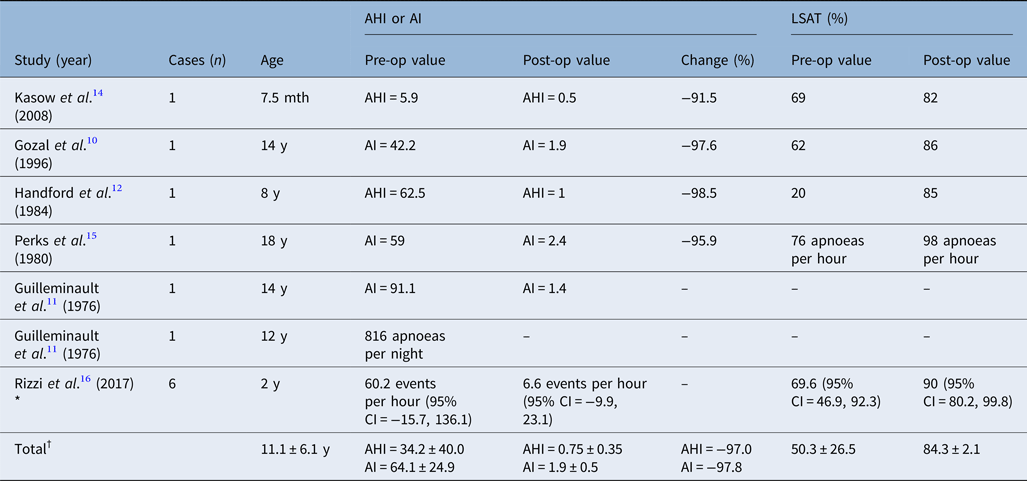
The apnoea/hypopnoea index reduced from 34.2 ± 40 to 0.75 ± 0.35 events per hour (97 per cent reduction; n = 2), and the apnoea index reduced from 64.1 ± 24.9 to 1.9 ± 0.5 events per hour (98 per cent reduction; n = 3). Lowest oxygen saturation improved from 50.3 ± 26.5 to 84.3 ± 2.1 per cent (34 oxygen saturation point improvement; n = 3).
Several other patients demonstrated significant improvements in breathing.
Methodological quality
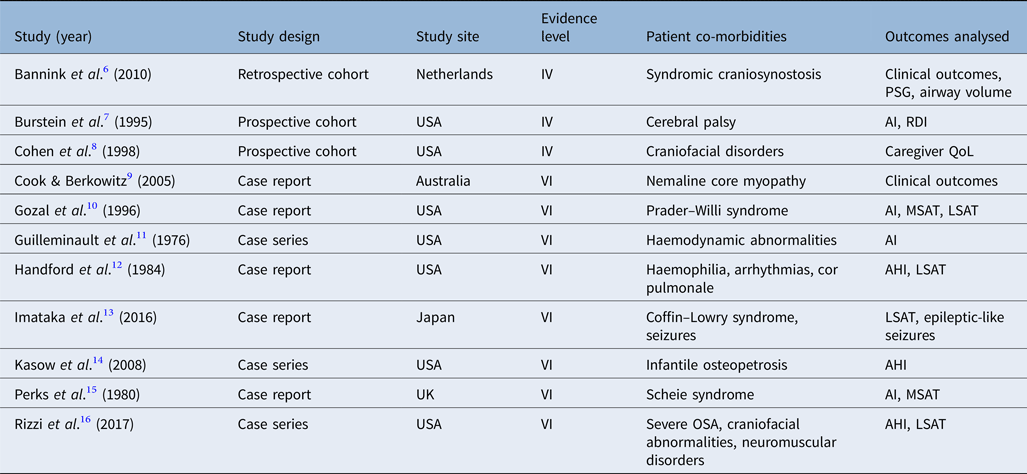
The identified studies included retrospective case series (level 4 evidence) and case reports (level 5 evidence) (Table 1).Reference Bannink, Nout, Wolvius, Hoeve, Joosten and Mathijssen6–Reference Rizzi, Amin, Isaiah, Valdez, Jeyakumar and Smart16 There were no randomised trials identified in the literature.
General characteristics and quality criteria of included studies

PSG = polysomnography; AI = apnoea index; RDI = respiratory disturbance index; QoL = quality of life; MSAT = mean oxygen saturation; LSAT = lowest oxygen saturation; AHI = apnoea/hypopnoea index; OSA = obstructive sleep apnoea
Quantitative data
The quantitative outcomes identified in the literature are summarised in Table 2.Reference Gozal, Torres and Menendez10–Reference Handford, Cadieux, Kales, Ballard and Potter12, Reference Kasow, Stocks, Kaste, Donepudi, Tottenham and Schoumacher14–Reference Rizzi, Amin, Isaiah, Valdez, Jeyakumar and Smart16
Quantitative outcomes identified in literature

*Pre-tracheostomy data based on all patients and post-tracheostomy data based on capped sleep study, and are therefore excluded from total calculations. †Total values are based on studies providing pre- and post-tracheostomy data. AHI = apnoea/hypopnoea index; AI = apnoea index; LSAT = lowest oxygen saturation; pre-op = pre-operative; post-op = post-operative; mth = months; y = years; 95% CI = 95 per cent confidence interval
Kasow et al. described a patient with malignant infantile osteopetrosis, who underwent a tracheostomy at 7.5 months of age.Reference Kasow, Stocks, Kaste, Donepudi, Tottenham and Schoumacher14 The patient's apnoea/hypopnoea index was 5.9 events per hour pre-operatively and 0.5 events per hour post-operatively, corresponding to a 91.5 per cent relative reduction.
Gozal et al. described the longitudinal assessment of a Prader–Willi syndrome patient who underwent a tracheostomy.Reference Gozal, Torres and Menendez10 Pre-operatively, the 14-year-old girl had an apnoea index of 42.2 events per hour, with a mean oxygen saturation level of 93 per cent and a lowest oxygen saturation level of 62 per cent. At four and at nine weeks post-tracheostomy, her apnoea/hypopnoea index was 2.4 and 1 event per hour, her mean oxygen saturation level was 96 and 98 per cent, and her lowest oxygen saturation level was 86 and 89 per cent, respectively. The relative reduction in the apnoea/hypopnoea index was 97.6 per cent.Reference Gozal, Torres and Menendez10
Handford et al. described an eight-year-old haemophilic boy, who had an apnoea/hypopnoea index above 62.5 events per hour, with each event lasting 20–40 seconds.Reference Handford, Cadieux, Kales, Ballard and Potter12 His lowest oxygen saturation level was 20 per cent or lower at times. About 60 per cent of the time, the events were associated with oxygen saturations between 40 and 60 per cent. He had frequent arrhythmias as well. The patient underwent a tonsillectomy, which failed. He subsequently underwent a tracheostomy, with a size 4 Shiley tracheostomy tube inserted. Two weeks later, the patient had no OSA with the tracheostomy in place, with a lowest oxygen saturation level between 85 and 89 per cent. One week later, he had resolving cor pulmonale, based on electrocardiographic and X-ray evidence.Reference Handford, Cadieux, Kales, Ballard and Potter12
Perks et al. described an 18-year-old patient with Scheie's syndrome (mucopolysaccharidosis) who had OSA.Reference Perks, Cooper, Bradbury, Horrocks, Baldock and Allen15 Pre-tracheostomy, the patient had an apnoea index of 59 events per hour and a mean oxygen saturation level of 76 per cent. Post-tracheostomy, the apnoea index reduced to 2.4 events per hour and the mean oxygen saturation level was 98 per cent. The apnoea index demonstrated a relative reduction of 95.9 per cent.Reference Perks, Cooper, Bradbury, Horrocks, Baldock and Allen15
Guilleminault et al. described 2 patients with OSA treated with a tracheostomy: a 14-year-old girl with 91.1 apnoea index and a 12-year-old boy with 816 apnoeas per night.Reference Guilleminault, Eldridge, Simmons and Dement11 Both patients normalised their breathing during sleep with the tracheostomy in place. Both patients also had a dramatic reversal of haemodynamic abnormalities and clinical symptoms within 48 hours of the surgery.Reference Guilleminault, Eldridge, Simmons and Dement11
Qualitative data
Burstein et al. described two children with severe cerebral palsy with flaccidity, who underwent upper airway surgery.Reference Burstein, Cohen, Scott, Teague, Montgomery and Kattos7 Extubation had failed and a tracheostomy was subsequently used for salvage surgery.
Bannink et al. described children with syndromic craniosynostosis and severe OSA.Reference Bannink, Nout, Wolvius, Hoeve, Joosten and Mathijssen6 Five patients underwent tracheostomy. Four children were successfully decannulated after midface advancement, while one patient required the tracheostomy in order to eliminate OSA.
Cohen et al. described sleep apnoea surgery versus tracheostomy, and evaluated QoL outcomes.Reference Cohen, Suzman, Simms, Burstein, Riski and Montgomery8 A 76-item questionnaire was developed and used. Overall, the tracheostomy patients’ parents ranked 95 per cent of all items on the questionnaire as being worse than the sleep apnoea surgery patients’ parents’ rankings. The QoL data assessed in the parents’ questionnaires included hours per day spent on respiratory care, average medical visits per year, estimated costs per month and a psychosocial subscale; all items were scored worse in the tracheostomy group versus the sleep apnoea surgery group.Reference Cohen, Suzman, Simms, Burstein, Riski and Montgomery8
Cook and Berkowitz described a tracheostomy in a child with nemaline core myopathy.Reference Cook and Berkowitz9 Following the failure of adenoidectomy performed as treatment for OSA (lowest oxygen saturation level of 55 per cent), the patient underwent a tracheostomy. Later, the patient developed lobar collapse and sepsis, and was placed on bilevel positive airway pressure therapy. A repeat sleep study conducted six months later showed adequate ventilation.Reference Cook and Berkowitz9
Imataka et al. described a 12-year-old boy with Coffin–Lowry syndrome, who had epileptic-like seizures induced by OSA syndrome.Reference Imataka, Nakajima, Goto, Konno, Hirabayashi and Arisaka13 The patient had a lowest oxygen saturation level down to 60 per cent. He underwent a tracheostomy; the OSA subsequently improved and the epileptic-like seizures were eliminated.
Rizzi et al. described 29 paediatric patients who underwent a tracheostomy for severe OSA.Reference Rizzi, Amin, Isaiah, Valdez, Jeyakumar and Smart16 The mean age at time of surgery was two years. Forty-five per cent of the patients had an associated craniofacial abnormality and 34 per cent had a neuromuscular disorder. The majority of children requiring tracheostomy for OSA remained tracheostomy-dependent for more than 24 months; there were no long-term complications following tracheostomy placement. Over the follow-up period, 6 of 29 patients (21 per cent) underwent a capped sleep study; 5 of these patients were decannulated. The average apnoea/hypopnoea index at the time of the capped study was 6.6 events per hour (95 per cent confidence interval (CI) = 29.9–23.1). The mean blood oxygen saturation nadir on post-operative polysomnography was 90.0 per cent (95 per cent CI = 80.2–99.8). This represented a mean apnoea/hypopnoea index decrease of 89 per cent and a mean blood oxygen saturation nadir increase of 29.3 per cent. Decannulation was achieved in 5 of 29 patients (17 per cent), including 1 self-decannulation. Mean time to decannulation was 40.8 months (95 per cent CI = 7.9–73.7). Of the 16 patients followed up for 24 months, only 1 (6 per cent) had been decannulated at the 24-month mark.Reference Rizzi, Amin, Isaiah, Valdez, Jeyakumar and Smart16
Discussion
This systematic review has three main findings. First, the paediatric patients who underwent a tracheostomy consistently had a significant improvement in OSA outcomes. In the three patients who had pre- and post-tracheostomy apnoea/hypopnoea index outcomes reported, the apnoea/hypopnoea index decreased by 95 per cent. Several other paediatric patients were reported to have normalised their breathing, but did not have the sleep study outcomes reported quantitatively. Additionally, oxygen saturation also improved significantly after surgery in those for whom it was quantified. It is logical that bypassing the upper airway with a tracheostomy provides significant improvement, and even cure, in the majority of patients. Patients with residual OSA could have apnoeas or hypopnoeas secondary to neck soft tissue obstructing the lumen of the tracheostomy tube; in other patients, there may be tracheomalacia contributing to the OSA. In addition, patients with co-morbid obesity hypoventilation syndrome may need positive airway pressure therapy through the tracheostomy tube, in order to eliminate OSA.
Second, the patients who underwent tracheostomy for paediatric OSA were syndromic children, had significant co-morbidities or had severe OSA. We did not identify any mild or moderate OSA patient without significant co-morbidities or syndromes in the literature. This is probably because most of the patients would be treated with traditional adenotonsillectomy, and secondary surgical procedures (e.g. uvulopalatopharyngoplasty, tongue surgery or mandibular advancement surgery) would be attempted before a tracheostomy was placed. Syndromes that predispose patients to OSA are those that cause a small mandible or retrodisplaced mandible, such as Pierre Robin sequence, which can be treated with a temporary tracheostomy while the patient undergoes mandibular advancement surgery.
Third, additional research is needed. Currently, there have been many studies reporting OSA outcomes for adults.Reference Camacho, Certal, Brietzke, Holty, Guilleminault and Capasso2 There are very few studies reporting outcomes in children (11 manuscripts with 46 patients). Because many children undergoing a tracheostomy for OSA are diagnosed clinically, the majority of studies did not report quantitative data, but rather provided qualitative data. Although we value research and quantitative sleep study data, we also have to be reasonable; we are not suggesting that all patients should undergo a sleep study. Given the importance of stabilising the airway of a child in respiratory distress due to severe OSA, it may be inappropriate to wait to perform a tracheostomy in these situations. Additionally, the smallest tracheostomy diameter that can be used to provide relief of OSA is currently not known; however, a systematic review found that mini-tracheostomies as small as 4 mm have been used successfully in the short term to treat acute upper airway obstruction.Reference Camacho, Zaghi, Chang, Song, Szelestey and Certal17
Limitations
There are few studies reporting outcomes in children. Future studies could perform pre- and post-operative sleep study outcomes when it is reasonable. It is unlikely that patients will be randomised between no treatment or tracheostomy groups; however, to increase the level of evidence, the use of prospective studies, and in some cases randomisation to positive pressure therapy or tracheostomy groups, could be considered.
Conclusion
This paper describes a level of evidence 3a study. Based on reports of children who have undergone a tracheostomy, for whom there are pre- and post-operative data, tracheostomy appears to be a successful treatment for OSA. However, given the small number of patients in the literature, additional research is recommended.
Competing interests
The views expressed in this article are the private views of the authors and do not necessarily reflect the official views of the Department of the Army, the Department of Defense, or the US Government.