

Introduction
To meet the challenge of feeding 9 billion people sustainably by 2050, it is necessary to ensure sufficient, safe and nutritious food for all, while safeguarding natural resources. Globally, insects cause losses of about 5–10% in stored products and as much as 40% in some developing countries (Shaaya et al., Reference Shaaya, Kostjukovski, Eilberg and Sukprakarn1997; Weaver and Petroff, Reference Weaver and Petroff2005). Insect damage to grains may result in losses in weight, nutrient value, seed viability, and increased susceptibility to contamination by fungi. This deterioration and contamination by insects and insect parts reduces the quality of the grains and lowers their market value. For example, insect infestation of wheat affects the baking quality of the flour in the form of decreased loaf volume, compact and inelastic crumbs, bitter taste and production of off-flavours (Sánchez-Mariñez et al., Reference Sánchez-Mariñez, Cortez-Rocha, Ortega-Dorame, Morales-Valdes and Silveira1997). Insect fragments are also a major concern for the wheat-flour milling industry, because of legal contamination limits (Edwards et al., Reference Edwards, Short and Abraham1991; Perez-Mendoza et al., Reference Perez-Mendoza, Throne, Dowell and Baker2003). Postharvest losses constitute a major problem limiting availability of food in most regions of sub-Saharan Africa (Obeng-Ofori Reference Obeng-Ofori2007; Sugri and Johnson Reference Sugri and Johnson2009; Adarkwah et al., Reference Adarkwah, Büttner, Reichmuth, Obeng-Ofori, Prozell and Schöller2010a , Reference Adarkwah, Obeng-Ofori, Büttner, Reichmuth and Schöller2010b; Reference Adarkwah, Obeng-Ofori, Adler, Büttner, Reichmuth and Schöller2011; Reference Adarkwah, Fields, Schöller and Reichmuth2012; Reference Adarkwah, Ulrichs, Schaarschmidt, Badii, Addai, Obeng-Ofori and Schöller2014). Improving food security through a reduction of postharvest losses is a development imperative for all economies. High postharvest losses reduce real income for all consumers, divert essential income out of farmers’ pockets and undermine overall food availability. The poor are particularly affected, as they spend a higher proportion of their income on staple foods. It is, therefore, important that postharvest procedures and measures are given as much attention as production practices. Certainly, the development and implementation of technologies and procedures that can reduce losses at the postharvest stage can play a significant role in increasing global food security (Obeng-Ofori, Reference Obeng-Ofori2010).
Cereals (such as maize, rice, wheat, sorghum and millet) are important sources of carbohydrates, and grain legumes (such as cowpea and groundnut) are important sources of protein in sub-Saharan Africa (Broughton et al., Reference Broughton, Hernadez, Blair, Beebe, Gepts and Vanderleyden2003; Adarkwah et al., Reference Adarkwah, Ulrichs, Schaarschmidt, Badii, Addai, Obeng-Ofori and Schöller2014). They are, however, highly susceptible to attack by several species of beetles in the genera Sitophilus, Tribolium, Acanthoscelides, and Callosobruchus in both field and storage (Lale and Vidal, Reference Lale and Vidal2003; Gbaye et al., Reference Gbaye, Millard and Holloway2011). Dry legume grains are destroyed by Acanthoscelides obtectus (Say) and Callosobruchus maculatus (F.) (Coleoptera: Chrysomelidae: Bruchinae) (Gbaye et al., Reference Gbaye, Millard and Holloway2011). Sitophilus granarius (L.) (Coleoptera: Dryophthoridae) and Tribolium castaneum (Coleoptera: Tenebrionidae) are some of the most destructive pests of durable stored cereal grains worldwide.
Globally, control of these insect pests is primarily dependent upon continued applications of synthetic insecticides, which are still the most effective treatments for the protection of stored food, feedstuffs and other agricultural commodities from insect infestation. Although effective, their indiscriminate use over a long period has disrupted biological control by natural enemies and caused the emergence of new insect species, and has sometimes resulted in the development of resistance (Park et al., Reference Park, Lee, Choi, Park and Ahn2003; Isman, Reference Isman2006; Reference Isman and Singh2010; Obeng-Ofori, Reference Obeng-Ofori2010; Adarkwah and Schöller, Reference Adarkwah and Schöller2012). There are also serious concerns about environmental degradation and human health. Furthermore, the majority of farmers in Africa are resource poor and have neither the means nor the skills to obtain and handle pesticides appropriately (Obeng-Ofori, Reference Obeng-Ofori2010).
The body of scientific literature documenting bioactivity of plant derivatives to arthropod pests continues to expand; yet, only a handful of botanical products are used in agriculture in the industrialized world, and there are few prospects for commercial development of new botanical products due to registration requirements (Fields, Reference Fields2006). However, resource-poor farmers in Asia and Africa have been utilizing plant materials to protect grains against insect infestation for a long time (Hassanali et al., Reference Hassanali, Lwande, Ole-Sitayo, Moreka, Nokoe and Chapya1990; Poswal and Akpa, Reference Poswal and Akpa1991; Talukder and Howse, Reference Talukder and Howse1995; Obeng-Ofori, Reference Obeng-Ofori2007; Nukenine, Reference Nukenine2010). Many rural farmers mix wood ash from various plants with grains as a physical control treatment against insect infestation, while others commonly use smoke from burning plant materials to protect on-farm stored cereal grains against pest infestation. The use of these traditional plant materials has stimulated research to establish the scientific basis for their continued use regarding their efficacy, active constituents and effective application technology (Weaver et al., Reference Weaver, Dunkel, Ntezurubanza, Jackson and Stock1991; Schmidt and Streloke, Reference Schmidt and Streloke1994; Bekele et al., Reference Bekele, Obeng-Ofori, Hassanali and Nyamasyo1995; Obeng-Ofori et al., Reference Obeng-Ofori, Reichmuth, Bekele and Hassanali1997; Nukenine et al., Reference Nukenine, Adler and Reichmuth2010).
Some major obstacles to the use of botanicals in stored product protection are that effective rates of application are much higher than for conventional synthetic pesticides, and users lack experience and appreciation of the efficacy of botanicals for pest control. There are still doubts as to the effectiveness of plant-derived products (both ‘home-made’ and commercial products), due to their slow action and lack of rapid knockdown effect; difficulty of registration and patenting of natural products and lack of standardization of botanical pesticide products; instability of the active ingredients when exposed to direct sunlight, as well as competition with synthetic pesticides through aggressive advertising by commercial pesticide dealers; and due to the fact that commercially-formulated botanicals are more expensive than synthetic insecticides and are not as widely available. For example, mixing stored cowpea seeds with 1.0 g or more of Piper guineense dried fruit or neem kernel powders per 20 g of cowpea seed is recommended for control of C. maculatus (Oyeniyi et al., Reference Oyeniyi, Gbaye and Holloway2015). For complete control, large quantities of these insecticidal plant powders are needed, which may not be practicable for large-scale storage.
Clove bud Eugenia aromatica species (Myrtaceae) has long been considered to have medicinal properties (such as being a tonic against digestive disorders and diarrhoea). The Eugenia bud and leaf essential oils contain various compounds, such as acetyleugenol, benzaldehyde, benzyl acetate, benzyl alcohol, α-carophyllene, chavicol, eugenol, R-humulene, m-methoxy benzaldehyde, methyl-n-amyl ketone, methyl salicylate and R-ylangene (Deyama and Horiguchi, Reference Deyama and Horiguchi1971). Insecticidal properties and chemical composition of species of Syngizium aromaticum (E. aromatica) were reported and found to contain eugenol (74.30%), eucalyptol (5.80%), α-cadinol (2.43), β-caryophyllene (18.90%), benzdene-1-ethyl-3-nitro (11.10%) and benzoic acid 3-(1-methylethyl) (8.90%), eugenyl acetate (21.30%), cis-ocimene (2.32%), α-thujene (3.36%) and terpinen-4-o-l (0.35%) (Bhuiyan et al., Reference Bhuiyan, Begum, Nandi and Akter2010). Oboh et al. (Reference Oboh, Akinbola, Ademosun, Sanni, Odubanjo, Olasehinde and Oyeleye2015) reported and found chemical compounds of E. aromatica to contain α-pinene, β-pinene, neral, geranial, gamma terpinene, cis-ocimene, allo ocimene, 1,8-cineole, linalool, borneol, myrcene and pinene-2-ol, α-terpineol, α-copane, cis-ocimene, gamma-terpinene, α-thujene, camphene and isoartemisia.
Moringa oleifera Lam. (Moringaceae) also known as ‘drumstick tree’, ‘horseradish’ or the ‘kelor tree’ is widely cultivated and naturalized in tropical Africa, Malaysia, the Philippines, Mexico, the Malabar region and Sri Lanka (Fahey, Reference Fahey2005; Anwar et al., Reference Anwar, Latif, Ashraf and Gilani2007; Olufunmilayo et al., Reference Olufunmilayo, Adelodun and Akintomiwa2012; Karthika et al., Reference Karthika, Ravishankar, Mariajancyrani and Chandramohan2013). All parts of the Moringa tree are edible and have been consumed for many years by humans. Medicinal uses for M. oleifera include as an antioxidant (Verma et al., Reference Verma, Vijayakumar, Mathela and Rao2009), anticarcinogen (Bharali et al., Reference Bharali, Tabassum and Azad2003), diuretic, anti-inflammatory, antispasmodic, Cáceres et al., Reference Cáceres, Saravia, Rizzo, Zabala, De Leon and Nave1992), and antiulcer, antibacterial and antifungal agent (Cáceres et al., Reference Caceres, Cabrera, Morales, Mollinedo and Mendia1991). Furthermore, its antinociceptive (Sulaiman et al., Reference Sulaiman, Zakaria, Bujarimin, Somchit, Israf and Moin2008) properties, as well as its wound healing ability, have been demonstrated (Rathi et al., Reference Rathi, Bodhankar and Baheti2006). The main chemical components of leaf extracts of M. oleifera showed the presence of phytochemicals, flavonoids, anthraquinones, alkaloids, saponins, steroids, terpenoids, cardiac glycosides, anthocyanin, tannins and carotenoids. Marrufo et al. (Reference Marrufo, Nazzaro, Mancini, Fratianni, Coppola, De Martino, Agostinho and De Feo2013) identified chemical components of M. oleifera to be hexacosane, pentacosane, flavonoids, quercetin, luteolin and heptacosane. Quercetin and kampferol are flavonoids, which are compounds of phenolic hydroxyl groups of M. oleifera with antioxidant action of potential therapeutic use (Pace-Asciak et al., Reference Pace-Asciak, Hahn, Diamandis, Soleas and Goldberg1995). Other insecticidal compositions from leaves of M. oleifera include two nitrile glycosides, niazirin and niazirinin; three mustard oil glycosides, 4-[(4′-O-acetyl-α-l-rhamnosyloxy)benzyl]isothiocyanate, niaziminin A, and niazamin B; ethyl 2-hydroxypropanoate (lactate); cyclobuten-3,4-dione; 1-dimethylamino-2-hydroxy-; 2-[(2-acetoxyethyl)-sufinyl]aniline; linalool oxide; 3-buten-2-ol,2-methyl-4-(1,3, 3-trimethyl-7-oxabicyclo[4.1.0]hept-2-yl)-; 1,2-benzenedicarboxylic acid; bis(2-ethylhexyl) ester; linalool oxide; adenine; and upiol (Karthika et al., Reference Karthika, Ravishankar, Mariajancyrani and Chandramohan2013).
Diatomaceous earth (DE) contains fossilized siliceous remains of diatoms that were deposited during the Cenozoic Era. Diatoms are microscopic unicellular aquatic plants closely related to brown algae that have a fine shell made of silica. DEs offer safer alternatives to synthetic chemicals against storage insect pests (Fields et al., Reference Fields, Allen, Korunic, McLaughlin, Stathers, Credland, Armitage, Bell, Cogan and Highley2003; Stathers et al., Reference Stathers, Denniff and Golob2004; Athanassiou et al., Reference Athanassiou, Vayias, Dimizas, Kavallieratos, Papagregoriou and Buchelos2005; Demissie et al., Reference Demissie, Tefera and Tadesse2008; Korunic and Rozman, Reference Korunic and Rozman2010; Adarkwah et al., Reference Adarkwah, Fields, Schöller and Reichmuth2012). DE has become one of the most well studied alternatives to synthetic insecticides (Fields and Korunic, Reference Fields and Korunic2000; Subramanyam and Roesli, Reference Subramanyam, Roesli, Subramanyam and Hagstrum2000; Mewis and Ulrichs, Reference Mewis and Ulrichs2001; Athanassiou et al., Reference Athanassiou, Vayias, Dimizas, Kavallieratos, Papagregoriou and Buchelos2005; Kavallieratos et al., Reference Kavallieratos, Athanassiou, Pashalidou, Andris and Tomanovic2005; El-Wakeil and Saleh, Reference El-Wakeil and Saleh2009; Iatrou et al., Reference Iatrou, Kavallieratos, Palyvos, Buchelos and Tomanovic2010; Athanassiou et al., Reference Athanassiou, Riudavets and Kavallieratos2011; Kavallieratos et al., Reference Kavallieratos, Athanassiou, Mpassoukou, Mpakou, Tomanovic, Manessioti and Papadopoulou2012). However, information on their efficacy in tropical small-scale grain stores is limited (Stathers et al. Reference Stathers, Chigariro, Mudiwa, Mvumi and Golob2002). Some commercially available enhanced DE products include Dryacide®, Protect-It®, Fossil Shield®, Silico-Sec®, Insecto-Sec®, Diatomenerde®, Damol-D1® and Perma-Guard™. These DE products have been found to be effective against various stored product insect pests (Fields et al., Reference Fields, Allen, Korunic, McLaughlin, Stathers, Credland, Armitage, Bell, Cogan and Highley2003; Stathers et al., Reference Stathers, Denniff and Golob2004; Athanassiou et al., Reference Athanassiou, Vayias, Dimizas, Kavallieratos, Papagregoriou and Buchelos2005; Demissie et al., Reference Demissie, Tefera and Tadesse2008; Korunic and Rozman, Reference Korunic and Rozman2010; Adarkwah et al., Reference Adarkwah, Fields, Schöller and Reichmuth2012; Badii et al., Reference Badii, Adarkwah, Obeng-Ofori and Ulrichs2014).
A major challenge to the practical utilization of botanicals and DE for stored product protection is the large quantity needed for effective control of pests. One approach to address this problem may be to combine insecticidal plant materials that farmers are already familiar with, with DE, but there seems to be limited information in this regard. The objective of this study, therefore, was to assess the toxicity and progeny production of insecticidal dusts containing powders of E. aromatica and M. oleifera to three major stored product beetles—S. granarius, T. castaneum and A. obtectus. This study also examines if these plant products can be used in combination with DE and what doses would be needed in field evaluation to control these cosmopolitan insects.
Materials and methods
Study site
The study was carried out in the Division Urban Plant Ecophysiology, Faculty of Life Sciences, Humboldt-Universität zu Berlin, Berlin, Germany.
Rearing of insects
Adults of S. granarius and T. castaneum were cultured in a controlled environment at 25 ± 1 °C, 65–70% RH and total darkness. They were obtained from laboratory stock culture at the Federal Research Centre for Cultivated Plants (Institute for Ecological Chemistry, Plant Analysis and Stored Product Protection, Berlin, Germany). The strains of insects used are known to have been collected in a grain store in Berlin, Germany in 1968 and have been kept under laboratory conditions since then in the institute. One hundred adults of mixed sex of S. granarius or T. castaneum were introduced into each glass jar of 500 ml containing 200 g of whole wheat grain, with a moisture content of 14.4%, and germ as feed. The jars were covered with nylon mesh held in place with rubber bands, to provide sufficient aeration and also to prevent escape of the insects. Parent adult beetles were removed after a 14-day oviposition period and insects that emerged were collected and used for the various bioassays. Similarly, A. obtectus was maintained on common Bambara groundnut, Vigna subterranea (L.) Verdcourt in a climatic chamber under the above same conditions. One hundred and fifty (150) unsexed adults were placed in jars and covered with a nylon net, to prevent the escape of emerging adults. After a 15-day oviposition period, the parental adults were removed and the newly emerged adult bruchids collected (0–3 days) and used for the bioassays.
Collection and preparation of plant materials
The dry fruits of E. aromatica were obtained from the Department of Crop, Soil, and Pest Management, Federal University of Technology, Akure, Nigeria. Eugenia aromatica was purchased at a local market in Akure, Nigeria in March 2014; therefore, it is unknown exactly when and where it was harvested. The identity was confirmed at the Herbarium, Department of Botany, Obafemi Awolowo University, Ile-Ife, Nigeria. The flower buds were oven-dried to a constant weight at a temperature of 400 °F. The fruit was pulverized in the laboratory using the NAKAI NJ-1731 electric blender and further sieved (mesh size 1 mm2) before being stored in an airtight plastic container. Leaves of M. oleifera were collected around Nyankpala during the 2014 harvesting season of April–July in the Tamale Metropolis of the Northern Region of Ghana. The area is located at latitude 9°25'N, longitude 00°58'W and altitude 183 m. The identity of the plant was confirmed at the Department of Agronomy/Botany, Savannah Research Institute of Ghana, where voucher samples were deposited. The leaves of M. oleifera were shade dried for 1–2 days and then sent to Germany to be milled into powder using the Retsch MM301 grinding machine obtained from Retsch GmbH, Düsseldorf, Germany. A leaf powder of particle size 150 µm was obtained. Each type of plant powder was immediately put into separate plastic containers with airtight lids and kept under ambient laboratory conditions before using them for the various experiments.
Probe A® diatomaceous earth product
Modified DE Probe-A® is a relatively new DE product that has been tested for its effectiveness against storage beetles in cereal grain admixtures (Mewis and Ulrichs, Reference Mewis and Ulrichs2001; Badii et al., Reference Badii, Adarkwah, Obeng-Ofori and Ulrichs2014). Probe-A® contains 89.0% SiO2 with mean particle size of 5–7 µm and 5% silica aerogel. The DE Probe-A® product was obtained from Bein GmbH, D-36232 Eiterfeld, Germany.
Toxicity and progeny production of adult beetles in grain
Toxic effects of M. oleifera and E. aromatica flower bud powders on adult S. granarius, T. castaneum and A. obtectus in stored Bambara groundnut and wheat grains were evaluated in the laboratory.
Ten grammes of disinfested bio wheat (var. Toni) obtained from Erzeugergemeinschaft Biokorntakt GmbH & Co. KG, Berlin, Germany, or Bambara groundnut seeds purchased from Bio-Company in Berlin, Germany were thoroughly mixed with 0.00 (control), 0.25, 0.5, 1.0, 1.5, 2.0, and 2.5% (wt/wt) each of E. aromatica and M. oleifera and E. aromatica flower bud powders in a plastic Petri dish (90 ml). The dosage of each plant powder was measured using the Sartorius sensitive balance obtained from Sartorius AG, Göttingen, Germany. Ten adults each of S. granarius (5–10 days), T. castaneum and A. obtectus (0–3 days) of mixed sex were introduced into each treatment container, which was covered with a perforated mesh lid. The powder and grains were thoroughly mixed for 5 min. The dishes were arranged in a completely randomized design on a laboratory shelf (27 ± 2 °C, 60–80% RH 11:13 light: day) and were not moved throughout the test period to avoid a negative impact on the insects. Each treatment was replicated three times. Dead insects were counted daily for 7 days and then immediately discarded. All insects were confirmed dead when there was no response when their abdomen was gently probed with a camel hairbrush. Eventual morphological changes in adults were observed and recorded. The remaining living adults were removed from the Petri dishes after 7 days. Petri dishes were then kept under the same conditions to monitor the F1 generation emerging from the seeds. The number of F1 progeny produced was recorded after 6 weeks for both S. granarius and T. castaneum and approximately 6 weeks for A. obtectus.
Toxicity of single and combined products to beetles
The effect of M. oleifera leaf powder, E. aromatica flower bud powder and DE applied singly or as mixtures on the mortality of the three beetle species was evaluated in the laboratory. Twenty grammes of wheat grains or Vigna subterranea seeds were treated with 2.0% (wt/wt) of E. aromatica, M. oleifera powders or DE in glass Petri dishes (9.0 cm diameter). Grains were also treated with a mixture of either M. oleifera leaf powder and DE or E. aromatica powder and DE at three ratios, namely 1:1 (1.0% wt/wt) plant powder and (1.0% wt/wt) DE, or 2:1 (1.0% wt/wt) plant powder and (0.5% wt/wt DE), or 1:2 (0.5% wt/wt) plant powder and (1.0% wt/wt) DE. There was a control treatment with no insecticidal material. Twenty unsexed adults each of S. granarius (5–10 d), T. castaneum and A. obtectus (0–3 d) were added to the treated and control containers. Adult mortality was observed and recorded daily for up to 5 days posttreatment. Morphological changes in adults were also observed and recorded. The experiment was replicated three times.
Statistical analyses
Statistical analyses were performed using the software package SigmaStat 3.1. Percentage mortality data of S. granarius, A. obtectus and T. castaneum adults were not corrected for control mortality, because mortality in the treatment was ≤2% (Abbott, Reference Abbott1925). The untreated control population was used as the initial number of offspring. Percentage F1 progeny production was arcsine (square root (x)-transformed and subjected to two-way analysis of variance (ANOVA) followed by all pairwise multiple comparison procedures (Holm–Sidak method). Probit analysis was applied to estimate the LD50 values and their upper and lower confidence interval limits, as well as intercept, by using BioStat Pro version 5.9.8. Lethal exposure times were determined for 50% and 95% mortality (LT50 and LT95) graphically using Sigma-Plot version 12.0. Two-way repeated measures ANOVA (two-way RM ANOVA) followed by all pairwise multiple comparison procedures (Holm–Sidak method) were used to compare percentage mortality of beetles among plant powders and DE treatments applied singly or as mixtures.
Results
Toxicity of plant powders to adult beetles
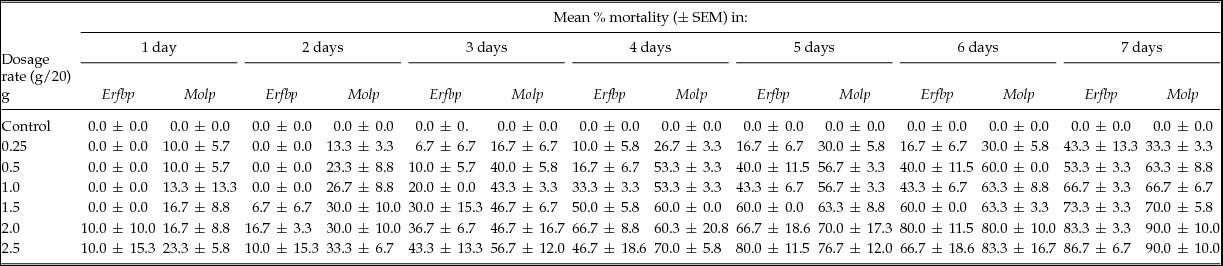
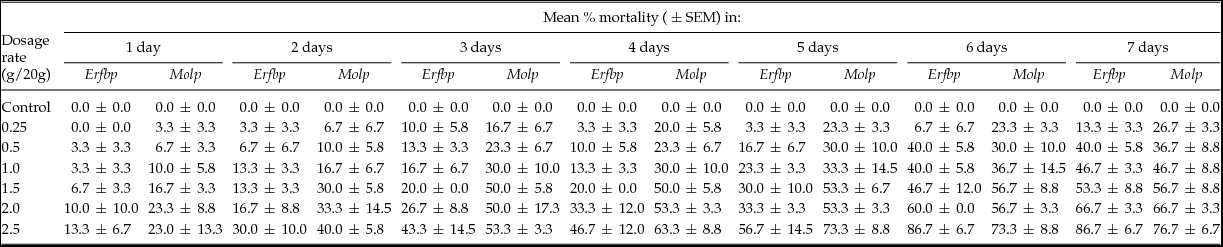
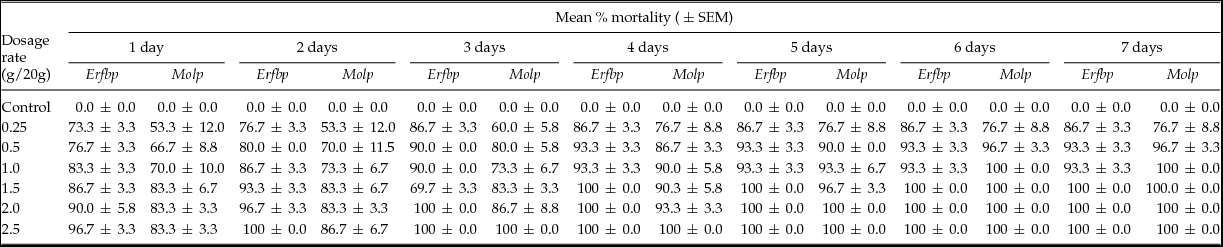
Adult mortality of S. granarius, T. castaneum and A. obtectus exposed to different dosages of leaf powder of M. oleifera and E. aromatica flower bud powder is shown in Tables 1–3. In both plant powders, mortality of the three beetle species increased with increasing dosage and exposure period. There was variation in the toxicity of the two plant powders to the three beetle species. Among the three beetle species tested, the plant powders were most toxic to A. obtectus. Tribolium castaneum was less susceptible to the two plant powders than either S. granarius or A. obtectus. There was no mortality of S. granarius in grains treated with E. aromatica flower bud powder after 24 h of exposure, irrespective of dosage applied, but all adult weevils died in grains treated with the highest dosage of 2.5% wt/wt after 7 days (Table 1). However, none of the dosages of both plant powders was able to kill all T. castaneum even after 7 days’ exposure (Table 2). The highest mortality of T. castaneum (86%) was obtained in grains treated with 2.5% wt/wt of E. aromatica flower bud powder after 6 days (Table 2). Grains treated with 1.5% wt/wt and above of E. aromatica flower bud powder caused 100% mortality of A. obtectus after 3 days exposure, but grains treated with 2.0% wt/wt g and above of M. oleifera leaf powder had a similar effect after 4 days’ exposure (Table 3).
Mortality (%) (± SEM) of adult Sitophilus granarius after 1, 2, 3 4, 5, 6 and 7 days exposure to wheat seeds treated with different dosages of Eugenia aromatica flower bud powder (Erfbp) and Moringa oleifera leaf powder (Molp) at temperature of 25 ± 2 °C and 60–80% relative humidity

Note: Data are means ± SE of three replications of 10 insects each.
Mortality of adult Tribolium castaneum after 1, 2, 3 4, 5, 6 and 7 days exposure to wheat seeds treated with different dosages of Eugenia aromatica flower bud powder (Erfbp) and Moringa oleifera leaf powder (Molp) at temperature of 25 ± 2 °C and 60–80% relative humidity

Note: Data are means ± SE of three replications of 10 insects each.
Adult mortality of Acanthoscelides obtectus after 1, 2, 3 4, 5, 6 and 7 days exposure to Bambara bean seeds treated with different dosages of Eugenia aromatica flower bud powder (Erfbp) and Moringa oleifera leaf powder (Molp) at temperature of 25 ± 2 °C and 60–80% relative humidity

Note: Data are means ± SE of three replications of 10 insects each.
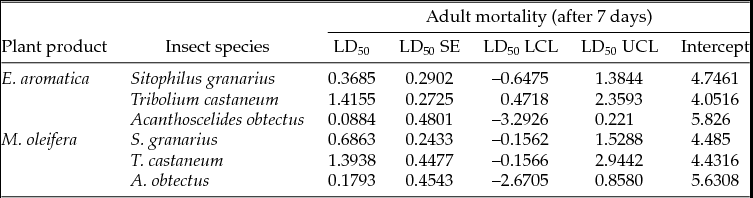
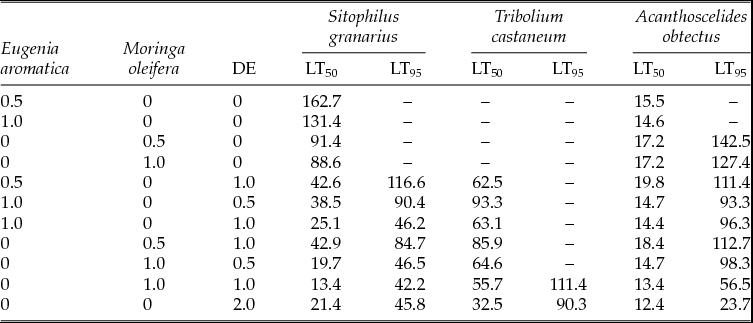
The LD50 and LT95 for E. aromatica flower bud powder and M. oleifera leaf powder against all the three beetle species are shown in Tables 4 and 5. Lethal exposure times/doses estimated (LD50, LT50) for the adult test insects to plant powders, showed that A. obtectus was most susceptible towards the botanicals (LD50 0.1793% wt/wt and 0.0884% wt/wt for E. aromatica and M. oleifera, respectively), followed by S. granarius. Tribolium castaneum was most tolerant (LD50 1.4155% wt/wt and 1.3938% wt/wt for E. aromatica and M. oleifera, respectively, (Table 4).
The mortality of adults of different stored product insects held on wheat or Bambara groundnut seeds and exposed for 7 days to different dosages of Eugenia aromatica flower bud and Moringa oleifera leaf powders

Note: The LD50 and its standard error was estimated using the probit analysis, lower confidence limits (LCL) and upper confidence limits (UCL) provided from Tables 1–3, analyses based upon 6 concentrations [in % wt/wt] and 10 adults/vial.
The survival durations (h) of plant products alone or in combination with diatomaceous earth (% wt/wt)

Note: The LT50 and LT95 estimated graphically using SigmaPlot, data from Tables 1–3 after 7 days exposure held on wheat seeds or on Bambara groundnut seeds (for A. obtectus) and treated with different dosages of leaf powder of M. oleifera (Molp) and E. aromatica (Erfbp) flower bud powder or diatomaceous earth.
Generally, the combined mixture of plant powders and DE controlled the beetles faster than the plant powders alone. LT50 ranged from 55.7 h to 62.5 h for T. castaneum exposed to 1.0% M. oleifera and 1.0% DE, and 0.5% E. aromatica and 1.0% DE, respectively (Table 5). For a dose of 2.0% DE alone the LT50 for S. granarius, T. castaneum and A. obtectus was 12.4, 21.4 and 32.5 h, respectively (Table 5). For the combination of different dosages of flower bud powder of E. aromatica (Erfbp) and DE, i.e. 0.5% wt/wt Erfbp +1.0% wt/wt DE, the LT95 was found to be 116.6 h for S. granarius and 111.4 h for A. obtectus (Table 5). For a dose of 1.0% wt/wt Molp + 0.5% wt/wt DE, the values of the LT95 ranged from 46.5 h for S. granarius to 98.3 h for A. obtectus. The LT95 values of 1.0% wt/wt Erfbp + 1.0% wt/wt DE against S. granarius and A. obtectus were 46.2 and 96.3 h, respectively. At the dosage of 1.0% wt/wt Molp + 1.0% wt/wt DE, the LT95 was 42.2 h, 56.5 h and 111.4 h for S. granarius, A. obtectus and T. castaneum, respectively (Table 5). At the highest dosage 2.0% wt/wt DE alone, the LT95 for S. granarius, T. castaneum and A. obtectus was 23.7, 45.8 and 90.3 h, respectively (Table 5).
Effect of combining DE Probe-A® with insecticidal plant powders on insect mortality
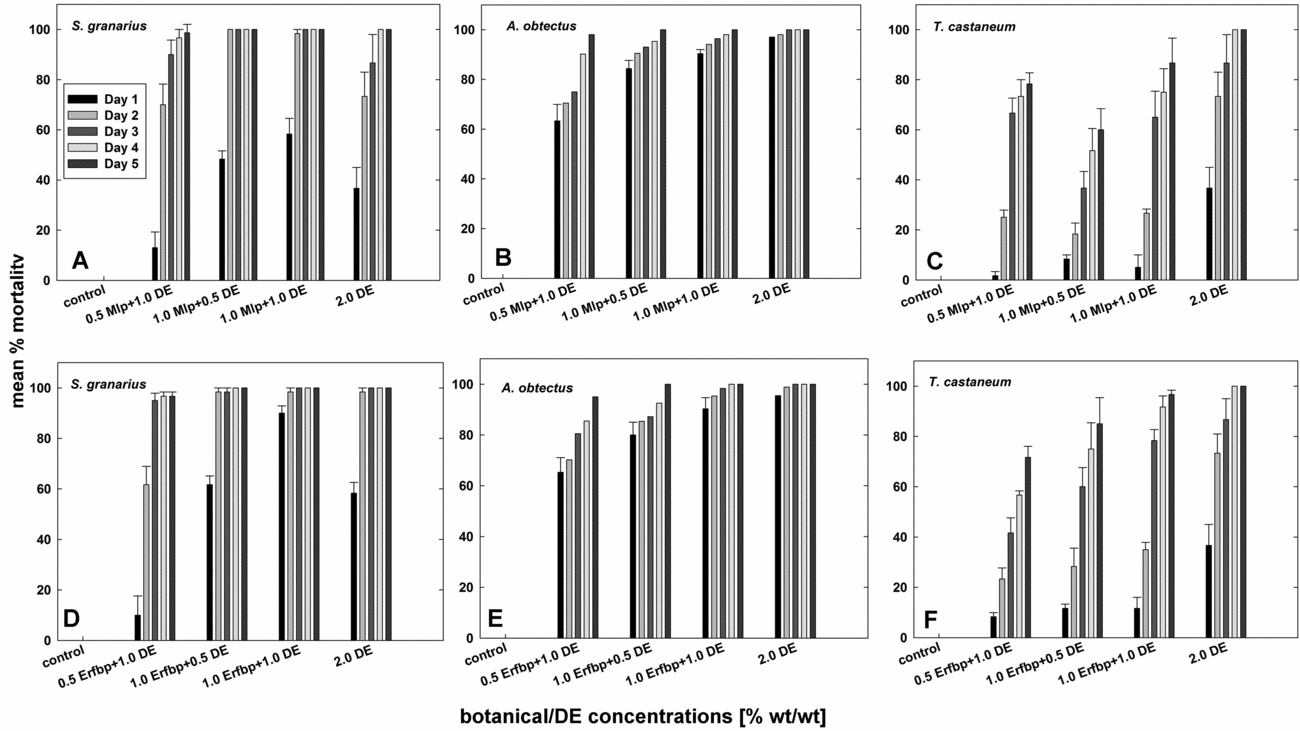
The adult beetles irrespective of species suffered significantly higher mortality when exposed to grain treated with mixtures of both leaf powder of M. oleifera (Molp), E. aromatica (Erfbp) flower bud powder and DE alone. Mortality was dependent on dosage and duration of exposure (Fig. 1A–F). There was, however, considerable variation in the toxicity of the mixtures of plant powders and DE against the three beetle species. The adults of A. obtectus were the most susceptible to the products tested. All the adults of A. obtectus died after 4 days’ exposure to the different mixtures of plant powders and DE while DE alone caused 100% mortality of the beetles after one day (Fig. 1B). For the adults of A. obtectus exposed to M. oleifera leaf powder, there was a significant effect of exposure time (DF = 4, F-value = 43.797, P < 0.001). However, there was statistically no significant interaction between treatment and time (DF = 12, F-value = 1.471, P = 0.203) (two-way RM ANOVA, DF = 59). All treatments were found effective compared to 0.5% wt/wt M. oleifera leaf powder (Molp) and 1.0% wt/wt DE (Holm–Sidak method, P < 0.05). There was no significant difference in effectiveness between the other treatments (DF = 3, F-value = 0.964, P = 0.468, Holm–Sidak method, P < 0.05). For S. granarius, there was both a significant effect of exposure time (DF = 4, F-value = 569.061, P < 0.001) and treatment (P < 0.001). There was also statistically significant interaction between treatment and time (DF = 12, F-value = 18.656, P < 0.001) (two-way RM ANOVA, total DF = 59). The mixture of M. oleifera and DE after 5 days induced the highest mortality of 100% while DE alone killed all the beetles after 4 days (Fig. 1A). There was a significant difference in effectiveness between 1.0% wt/wt Molp + 1.0% wt/wt DE and 2.0% wt/wt DE alone (Holm–Sidak method, P < 0.05). The highest mixture of 1.0% wt/wt Molp + 1.0% wt/wt DE and 2.0% wt/wt DE was both more effective than 0.5% wt/wt Molp + 1.0% wt/wt DE and 1.0% wt/wt Molp + 0.5% wt/wt DE (P < 0.001). A dosage of 1.0% wt/wt Molp + 0.5% wt/wt DE was also more effective than 0.5% wt/wt Molp + 1.0% wt/wt DE (P < 0.001). In the case of T. castaneum, grains treated with M. oleifera leaf powder and 1.0% wt/wt DE killed all the adults of T. castaneum exposed after 4 days while DE alone caused 90% mortality of T. castaneum after 5 days (Fig. 1B). There was both a significant effect of exposure time (DF = 4, F-value = 37.652, P < 0.001) and treatment (DF = 3, F-value = 2.429, P < 0.001). There was statistically significant interaction of exposure time and treatment (DF =12, F-value = 6.511, P < 0.001) (two-way RM ANOVA, total DF = 59). There was no significant difference in effectiveness between 1.0 Molp + 1.0 DE and DE alone (Holm–Sidak method, P < 0.05). However, dosage 1.0% wt/wt Molp + 1.0% wt/wt DE, and DE alone were both more effective than 0.5% wt/wt Molp + 1.0% wt/wt DE, and 1.0% wt/wt Molp + 0.5% wt/wt DE (P < 0.01). The mixture of 0.5% wt/wt Molp + 1.0% wt/wt DE was more effective than 1.0% wt/wt Molp + 0.5% wt/wt DE after 5 days posttreatment (P = 0.163, Fig. 1C).
Cumulative mean percent mortality (± SEM) of adults of Sitophilus granarius, Tribolium castaneum (on wheat) and Acanthoscelides obtectus (on Bambara groundnut seeds) treated with a mixture of different dosages of DE and either of Moringa oleifera leaf powder (Molp), (A, B, C), or Eugenia aromatica flower bud powder (Erfbp), (D, E, F), after 5 days of exposure. Data are means of three replications of 10 insects each.

For the adults of A. obtectus exposed to E. aromatica (Erfbp) flower bud powder, there was a significant effect of exposure time (DF = 4, F-value= 13.863, P < 0.001), but not of treatment (DF = 3, F-value = 0.157, P = 0.921). There was statistically no significant interaction of exposure time and treatment (DF =12, F-value = 0.343, P = 0.971) (two-way RM ANOVA, total DF = 59). A combination of E. aromatica flower bud powder and DE with a dose of 1.0% wt/wt Erfbp + 1.0% wt/wt DE was more effective than 0.5% wt/wt Erfbp + 1.0% wt/wt DE over time (Holm–Sidak method, P < 0.05, Fig. 1E). For the adults of S. granarius exposed to E. aromatica flower bud powder, there was both a significant effect of exposure time (DF = 4, F-value = 55.698, P < 0.001) and treatment (DF = 3, F-value = 27.672, P < 0.001, Fig. 1D). There was also a statistically significant interaction of exposure time and treatment (DF = 12, F-value = 6.859, P < 0.001) (two-way RM ANOVA, total DF = 59). There was no significant difference in effectiveness between dosages 1.0% wt/wt Erfbp + 1.0% wt/wt DE and DE alone, and between 1.0% wt/wt Erfbp + 0.5% wt/wt DE, and 0.5% wt/wt Pg + 1.0% wt/wt DE after 5 days of experimental exposure (Holm–Sidak method, P > 0.05). Both 1.0% wt/wt Erfbp + 1.0% wt/wt DE, and DE alone were significantly more effective than 1.0% wt/wt Erfbp + 0.5% DE, and 0.5% Pg + 1.0% wt/wt DE (Holm–Sidak method, P < 0.05). The mixture of either E. aromatica flower bud powder or DE induced the highest mortality of S. granarius of 100% after 5 days (Fig. 1D).
In the case of T. castaneum, grains treated with the mixture of 1.0% wt/wt Erfbp and 1.0% wt/wt DE caused 97.5% mortality of the beetles after 5 days (Fig. 1F). There was no significant effect of exposure time (DF = 4, F-value = 2.538, P = 0.122) and treatment (DF = 3, F-value = 0.133, P = 0.880). There was a statistically significant interaction between exposure time and treatment (DF = 12, F-value = 2.288, P = 0.043) (two-way RM ANOVA, total DF = 59). On the third day, both 1.0% wt/wt Erfbp + 1.0% wt/wt DE caused 78.8% mortality of insects whereas DE alone caused 87.8% mortality. DE alone was significantly more effective than 1.0% wt/wt Erfbp + 0.5% wt/wt DE and 0.5% wt/wt Erfbp + 1.0% wt/wt DE (Fig. 1F). On the fifth day of experimental exposure, there was no further difference between the treatments 1.0% wt/wt Erfbp + 1.0% wt/wt DE and DE alone (Holm–Sidak method, P < 0.05).
F1 progeny production
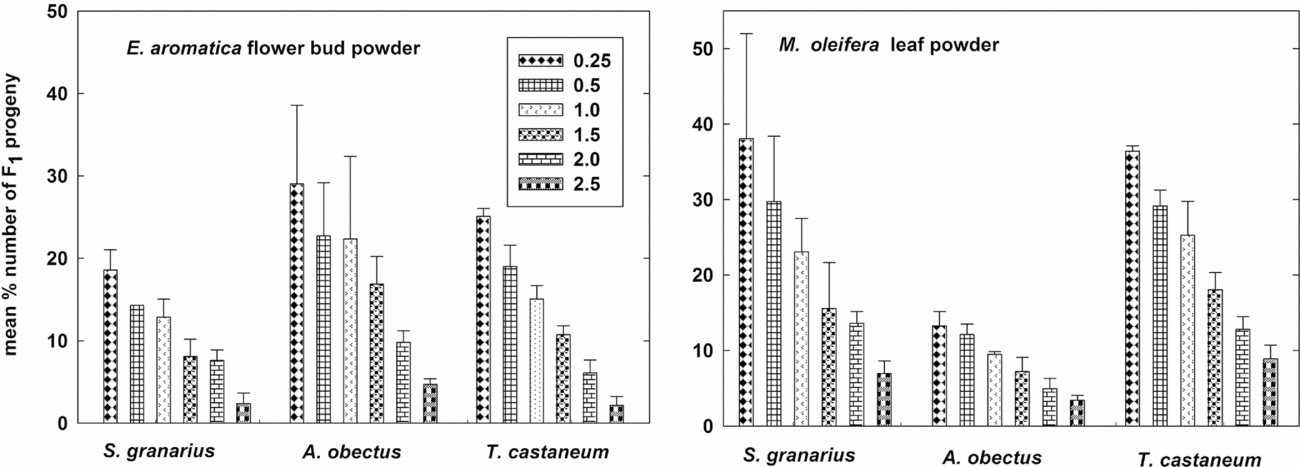
In all the beetle species tested, fewer adult beetles emerged from grains treated with different dosages of E. aromatica flower bud powder and the leaf powder of M. oleifera. Results on the first generation (F1) adults of the three beetle species in grains treated with various dosages of leaf powders of E. aromatica or leaf powder of M. oleifera (Fig. 2) showed a dose-dependent effect on progeny production (DF = 53, F-value = 16.25, P < 0.001, two-way ANOVA). Both powders caused a highly significant reduction in the number of F 1 adults produced by all the three tested beetle species compared to the control (F-value = 4.53, P = 0.018, two-way ANOVA). For the highest dosages of 2.0% wt/wt and dosage 2.5% wt/wt, less than 10% S. granarius, T. castaneum and A. obtectus emerged from the grains treated with E. aromatica flower bud powder compared to the untreated control, whereas more than 10% S. granarius, T. castaneum and A. obtectus F1 adults emerged from the grain treated with different dosages of leaf powder of M. oleifera.
Mean percent (± SEM) of F1 progeny of Sitophilus granarius, Tribolium castaneum (on wheat) and Acanthoscelides obtectus (on Bambara groundnut) expressed as percentage of control, after exposure to Moringa oleifera leaf powder and Eugenia aromatica flower bud powder at different dosages. Data are means of three replications of 10 insects each.

Neither powder of E. aromatica and M. oleifera completely inhibited the progeny production of all the three insects, irrespective of dosage applied. The three beetle species differed significantly in susceptibility towards E. aromatica powder. There was no statistically significant interaction between the dosage and beetle species (two-way ANOVA, DF = 10, F-value = 0.208, P = 0.994). Acanthoscelides obtectus was significantly more tolerant in terms of progeny production to E. aromatica powder compared to S. granarius and T. castaneum (Holm–Sidak method, P < 0.05) but was more susceptible to M. oleifera at a dose of 2.5% wt/wt. Sitophilus granarius and T. castaneum, however, were significantly more tolerant to M. oleifera leaf powder (P < 0.001, two-way ANOVA).
After exposure of the three insect species to different dosages of E. aromatica flower bud powder, there was a statistically significant difference between the species and dosages (DF = 2, F-value = 4.529, P = 0.018). However, there was no difference in effectiveness against A. obtectus and T. castaneum (Holm–Sidak method, P < 0.05). The suppression of F1 production by E. aromatica flower bud powder was dosage-dependent, considering all the three beetle species tested (two-way ANOVA, P < 0.001). The three beetle species differed significantly in susceptibility to E. aromatica flower bud powder (two-way ANOVA, DF = 53, P < 0.001). Acanthoscelides obtectus and T. castaneum significantly differed in F1 suppression by E. aromatica flower bud powder at dosages of 0.5, 1.0 and 1.5% wt/wt. At a dosage of 1.5% wt/wt, all species significantly differed from each other in progeny emergence (Holm–Sidak method, P < 0.05).
Discussion
Insects are a problem in stored grain throughout the world, because they reduce the quantity and quality of grain. The majority of farmers in Africa store grains in traditional granaries that are easily attacked by pests, calling for improved, alternative control strategies to ensure food security in Africa. The process must take into consideration the technologies available for the farmers. The farmers will readily accept a concept or technology that builds up or improves upon one that they are used to rather than one that imposes a totally new idea. Synthetic insecticides are commonly used in the management of stored products in Ghana. However, there is increasing concern about the adverse effects this use has on public health and the environment. There are reports on the traditional use of plant powders to control seed beetles attacking stored cowpea seeds (Adarkwah et al., Reference Adarkwah, Obeng-Ofori, Ulrichs and Schöller2017). Plant powder used in the current study caused significant mortality of the adult beetles and the population growth decreased by either hindering oviposition or causing egg toxicity. Plants are rich sources of bioactive compounds that might have a toxic effect on the insect physiological system (Kim et al., Reference Kim, Roh, Kim, Lee and Ahn2003; Daoubi et al., Reference Daoubi, Deligeorgopoulou, Macias-Sanchez, Hernandez-Galan, Hitchcock, Hanson and Collado2005). Belonging to various categories (alkaloids, glycosides, tannins, proteic amino acids, steroids, phenols, flavonoids, glucosinolates, quinones, terpenoids, etc.), these bioactive compounds have behavioural and physiological effects on pests that have already been identified (Gonzalo, Reference Gonzalo2009). Many of these plant compounds have also been recognized to be effective as potential health promoters in humans (Khan et al., Reference Khan, Ajab Khan, Mujtaba and Hussain2012).
Eugenia aromatica is lethal to storage bruchids, and so there may be justification for its traditional use by farmers for storing legume seeds (Matsumoto, Reference Matsumoto1987). The result obtained from this study indicates that E. aromatica could be a potential substitute for a synthetic pesticide for the control of T. castaneum infestation on wheat. Our results agree with the earlier work of Mahdi and Rahman (Reference Mahdi and Rahman2008) who reported that black gram seeds treated with E. aromatica could suppress F1 progeny production in C. maculatus, which might imply ovicidal action of this plant extract. Adedire and Lajide (Reference Adedire and Lajide1999) also reported that E. aromatica powder had significant contact and fumigant action against C. maculatus. The mechanism of its action according to the report was by inhibition of oviposition and direct toxicity to adults and eggs (ovicidal). Eugenia aromatica has also been reported to retain insecticidal activity for four years after the flower buds were powdered (Ofuya and Dawodu, Reference Ofuya and Dawodu2002). The insecticidal activity of the dusts containing powders of E. aromatica and M. oleifera in different proportions, singly and as mixtures with DE Probe-A® in our study, caused adult mortality and reduction in progeny production of three major stored product beetles. Essential oil constituents isolated from leaf buds of E. aromatica (such as eugenol and methyl salicylate) have previously shown significant toxicity potential against Pediculus capitis (Phthiraptera: Pediculidae) (Yang et al., Reference Yang, Lee, Lee, Choi and Ahn2003). Compounds from E. aromatica are, therefore, most likely active against a wide variety of insects.
Moringa oleifera powders are thought to have insecticidal effects on the oviposition, eclosion and development of the stored product beetles tested on wheat seed and Bambara groundnut. The present study results indicated that the leaf powder of M. oleifera had the highest suppression effect on emerged F1 beetle adults. Moringa oleifera recorded 76% to 100% adult beetle mortality after 7 days of infestation with the highest dosage of 2.5% wt/wt (Tables 1–3). Results also indicated that the powder of M. oleifera leaf and E. aromatica flower bud showed potential in the control of beetles on wheat seed and Bambara groundnut as bioinsecticides. Generally, the effectiveness of such plant extracts as protectants, is highly dosage-dependent (Upadhyay and Jaiswal, Reference Upadhyay and Jaiswal2007).
Using botanical pesticides, either as crude or formulated extracts, has proved an alternative strategy of insect pest management. Moringa oleifera powder failed to cause significant mortality to the adult T. castaneum beetles, but discouraged the pest's population growth. The bioactive agent of M. oleifera has been shown to be a steroidal glycoside, strophantidin, and the seed powder reduced total microbial and coliform counts by 55% and 65%, respectively (Eilert et al., Reference Eilert, Wolters and Nahrstedt1981). The 4-(α-l-rhamnosyloxy-benzyl) isothiocyanate was isolated as the active antimicrobial component in Moringa seeds (Eilert et al., Reference Eilert, Wolters and Nahrstedt1981). The chemical constituents of the M. oleifera seeds contains 4-(α-l-rhamnosyloxy)-benzyl isothiocyanate, 4-(l-rhamnosyloxy) phenylacetonitrile, 4-hydroxyphenylacetonitrile, 4-hydroxyphenyl-acetamide, 4-(α-l-rhamnopyranosyloxy)-benzyl glucosinolate, Roridin E, Veridiflorol, 9-octadecenoic acid, O-ethyl-4-(α-l-rhamnosyloxy) benzyl carbamate, niazimicin, niazirin, β-sitosterol, glycerol-l-(9-octadecenoate), 3-O-(6′-O-oleoyl-β-d-glucopyranosyl)-β-sitosterol and β-sitosterol-3-O-β-d-glucopyranoside (Fahey, Reference Fahey2005). The insecticidal chemical constituents found in M. oleifera leaves and E. aromatica flower bud powders might have contributed to the mortality of insects in our study. The assessment of coagulant M. oleifera lectin (cMoL) on the flour moth (Anagasta kuehniella) suggested that cMoL at 1% w/w could increase the mortality by 27.6%, indicating that the activity of cMoL is a carbohydrate lectin action on the digestive tract (Ramalho de Oliveira et al., Reference Ramalho de Oliveira, Luz, Guedes Paiva, Breitenbach Barroso Coelho, Marangoni and Rodrigues Macedo2011). In our study, a dosage of 1% w/w M. oleifera leaf powder exposed to A. obtectus, S. granarius and T. castaneum caused 93.3%, 56.7% and 33.3% mortality, respectively after 5 days. The much higher mortality observed in our study compared to that of Ramalho de Oliveira et al. (Reference Ramalho de Oliveira, Luz, Guedes Paiva, Breitenbach Barroso Coelho, Marangoni and Rodrigues Macedo2011) could indicate a more powerful effect on beetles compared to moths.
The E. aromatica flower bud powder alone with a dosage of 1.0% wt/wt, therefore, showed longer lasting effects with LT50 ranging from 131.4 h for S. granarius and 14.6 h for A. obtectus, while T. castaneum failed to achieve LT50. This result agrees with Ofuya et al. (Reference Ofuya, Olotuah and Akinyoade2010) who reported that E. aromatica could retain insecticidal activity for as long as four years after the flower buds have been powdered. Generally, the various protectants had low direct toxicity on T. castaneum, which agrees with the report of Richards et al. (Reference Richards, Gibbs, Weinstock, Brown, Denell, Beeman, Gibbs, Bucher, Friedrich, Grimmelikhuijzen, Klingler, Lorenzen, Roth, Schröder, Tautz, Zdobnov, Muzny, Attaway, Bell and Buhay2008) that many species of Tribolium at their adult stage are resistant to many insecticides used for their control. The efficacy of these powdered plant extracts was based on high dosages, since lower dosages of E. aromatica (0.25% wt/wt, 0.5 % wt/wt) were not as effective compared to 2.5% wt/wt. This corroborates other similar studies (Upadhyay and Jaiswal, Reference Upadhyay and Jaiswal2007; Ojo and Ogunleye, Reference Ojo and Ogunleye2013) in which powders of P. guineense applied at 5–10.0% w/w caused 100% mortality in C. maculatus 4 days posttreatment. This is similar to our findings with A. obtectus, in that seeds treated with the lower rates of 0.5–2.5% w/w E. aromatica induced 100% mortality after 5 d exposure.
Oyeniyi et al. (Reference Oyeniyi, Gbaye and Holloway2015) evaluated the efficacy of P. guineense seed powder after 24 h of exposure against C. maculatus and recorded LD50 values ranging from 0.016 g to 0.679 g, depending on the geographical origin of the seed beetle population. The mortalities obtained for A. obtectus in our study were approximately 50% compared to those obtained for C. maculatus by Oyeniyi et al. (Reference Oyeniyi, Gbaye and Holloway2015), indicating both interspecific and host plant effects may be important for seed beetles. Based on our results and those of Oyeniyi et al. (Reference Oyeniyi, Gbaye and Holloway2015), we hypothesize that seed beetles are more susceptible than Tribolium spp. and Sitophilus spp. towards E. aromatica. However, some botanical products (essential oils for example) have a broad spectrum of biological toxicity (Bakkali et al., Reference Bakkali, Averbeck, Averbeck and Idaomar2008), including on mammals. Suthisut et al. (Reference Suthisut, Fields and Chandrapatya2011a , Reference Suthisut, Fields and Chandrapatya2011b) also found that some natural products were as dangerous to use as synthetic insecticides, because much more of the essential oil is needed to control the insects compared to the synthetic fumigant or contact insecticide. Hence, mixing plant powders with DE to prevent these high dosages was found useful in our studies.
The efficacy of DE against stored product insects is well documented (Subramanyam and Roesli, Reference Subramanyam, Roesli, Subramanyam and Hagstrum2000; Rigaux et al., Reference Rigaux, Haubruge and Fields2001). If less than 1.0% wt/wt DE is applied to bulk grain, one cannot sufficiently control S. granarius under field conditions (Schöller and Reichmuth, Reference Schöller and Reichmuth2010). Athanassiou et al. (Reference Athanassiou, Kavallieratos and Andris2004) used three DE formulations and reported survival of T. confusum adults after the application of 1.0% wt/wt DEs. In this study, higher dosages than 1.0% wt/wt DE were applied, to achieve sufficient efficacy within one week. We evaluated the potential synergistic effects of the combination of DE and certain botanical products. Based on the results of the present study, the simultaneous application of both DE and plant powders is feasible, but the results are affected by the target species. Moreover, the insecticidal effect is also affected by the respective dosages of the two components. DEs are slow-acting in comparison with traditional grain protectants (Korunic, Reference Korunic1998). At shorter (3 d) exposures, the speed of kill was generally higher with a mixture of plant powders and DE compared to DE alone. Fast mortality results in prevention of mating and reduction of oviposition; and consequently, in reduced grain damage (Subramanyam and Roesli, Reference Subramanyam, Roesli, Subramanyam and Hagstrum2000; Athanassiou et al., Reference Athanassiou, Kavallieratos, Tsaganou, Vayias, Dimizas and Buchelos2003). DE mixed with botanical products could be a solution to the effects arising, especially from the slow efficacy of DEs against Tribolium species, as Tribolium species are classified among the most DE-tolerant stored grain beetles (Arthur, Reference Arthur2000; Vayias and Athanassiou Reference Vayias and Athanassiou2004; Adarkwah et al., Reference Adarkwah, Fields, Schöller and Reichmuth2012).
The combination of botanical products and DE may be economically attractive, as farmers can plant botanicals to replace the costly DE or synthetic chemicals. On the other hand, the botanical products tested here may not be effective enough if applied alone, and the addition of DE could help to achieve the required effectiveness. In practice, multiple factors may influence the effectiveness of botanical products being used for pest management on stored product beetles, e.g. geographical origin of the beetle strains and cowpea variety, as shown by Oyeniyi et al. (Reference Oyeniyi, Gbaye and Holloway2015).
Furthermore, it is unfortunate that in the use of botanical products, issues of exclusivity, licensing and potential profit in the small portion of the agricultural market that postharvest pesticides represent, are serious barriers to further development and bringing these insecticides to the market. There are a number of issues that must to be addressed before botanical products or extracts of plants can be used as grain protectants. These include type of preparation, host commodity, plant species, test insect and how quickly the botanical becomes ineffective under field conditions. A successful grain protectant must have residual activity to protect grain from infestation for several months. High temperature or high grain moisture content increase the degradation of grain protectants; therefore, field trials under different climatic conditions and with different stored products are needed, to verify these laboratory results for recommendation to farmers, for the preservation of wheat seed and Bambara groundnut against infestation.
Acknowledgements
Financial support obtained from the Rosa Luxemburg Foundation during Charles Adarkwah's short-term research stay in Germany is herein acknowledged. The staff of Humboldt University of Berlin, Faculty of Life Sciences, Division Urban Plant Ecophysiology and Biologische Beratung GmbH, Berlin, Germany assisted in various ways, for which we are most grateful. We are most grateful to Mr Abubakar Adamu and Ayaba A. Atongi Yoonus for their technical support in sampling of plant materials.