Introduction
Palliative care (PC) is a patient-centered approach that intends to view the patient both as an individual and in a holistic manner. To improve this approach for future care, attention needs to be paid to the individual experiences of those in the final stages of life. Gaining a more profound understanding of emotional and psychological aspects by learning from the dying is the most direct way of achieving this goal. The occurrence of an illness is often the result of a long process through which patients seek support, and it can lead patients and their families to reflect upon what is happening (Pierret, Reference Pierret2003). Thinking about one´s own death and the experience of finitude can provoke different reactions, depending on different circumstances inside and outside the person (Dantas & Amazonas, Reference Dantas and Amazonas2016). The impact of an illness on everyday life has been at the center of many studies focusing on the resources that patients actually and potentially tap (Pierret, Reference Pierret2003). Not enough research has yet been carried out with PC patients, specifically on how they cope with potential changes because of their illness. So far, research in PC has been conducted with regard to mapping illness trajectories in several conditions (e.g., cancer, neurological diseases), prognostication, and symptom treatment (e.g., pain, breathlessness). Prognostication in particular is based on the judgment of healthcare professionals’ perspective; little attention has been paid to patients' own experience and coping with the psychological and physical loss of being healthy (Etkind et al., Reference Etkind, Bristowe and Bailey2017). Previous contributions have often concentrated on information from family carers or are found in non-academic sources. A broader knowledge of personal patient experiences will help to gear treatment to the individual, which is essential in end-of-life care (Steinhauser et al., Reference Steinhauser, Christakis and Clipp2000). To analyze individual views of patients with advanced illness, standardized questionnaire-based exploration may not assess the specific concerns that pertain to the individual on a personal level; therefore, qualitative studies are needed. Studies have shown how involvement in research by means of narrative interviews can positively affect PC patients (Marjolein Gysels et al., Reference Gysels, Shipman and Higginson2008) and that these interviews are indeed a worthwhile asset for PC research (Thomas et al., Reference Thomas, Reeve and Bingley2009). Because most qualitative studies have so far focused on, for example, treatment preferences (Preisler et al., Reference Preisler, Heuse and Riemer2017), coping with symptoms (Mosher et al., Reference Mosher, Ott and Hanna2015), advance care planning (Cottingham et al., Reference Cottingham, Cripe and Rand2017), caregiver needs and experiences with PC (Hannon et al., Reference Hannon, Swami and Rodin2017), and decision-making at the end of life (Brogan et al., Reference Brogan, Hasson and McIlfatrick2018), we decided to analyze a more general perspective (i.e., the views on life itself when faced with a terminal illness).
Our study aimed to:
1. gain more comprehensive understanding on the views on life in PC patients by speaking directly to them in a semi-narrative interview situation with audio or video recording,
2. analyze the feasibility of video-taping several interviews, and
3. analyze whether handing over the CD/DVD to the patient to be shared, if welcomed, with relatives and friends will be appreciated.
Several open questions were posed to ascertain the feelings and views of the patient. Three thematic areas were focused on, namely (1) what PC patients deem to be currently essential in their life, (2) whether something has changed concerning their view of life in light of the disease, and (3) whether PC patients would like to give healthy others something to take with them.
Methods
Approval was secured from the Ethical Committee at the University Hospital Cologne (#12-259). Patients were informed that they could withdraw from the study at any time without any effects on their current and future care.
Semi-structured individual interviews were conducted with audio recording by the interviewers (V.R., J.S., J.G.) or video recording by Take-Part Media. Consecutive sampling was applied. Patients were deemed eligible by the treating consultant and informed about the study by the interviewers (V.R./J.S.). Patients were asked whether they would like to be filmed during the interview or audio-taped. Their written consent was then obtained and a date for the interview fixed. The interview grid was not changed during data collection. To minimize stress induced on patients by the filming during video interviews, the film team was limited to three people (interviewer, person filming, person for light).
In a follow-up conversation within the next few days, patients were asked how burdensome the interview had been and if they had any further questions. The interviews were transcribed verbatim and analyzed using content analysis. The visual material was not analyzed separately, only the written transcript according to the audio interviews. Categories were generated inductively during the process of analysis until thematic saturation was achieved (i.e., no new codes were necessary).
Procedure and Setting
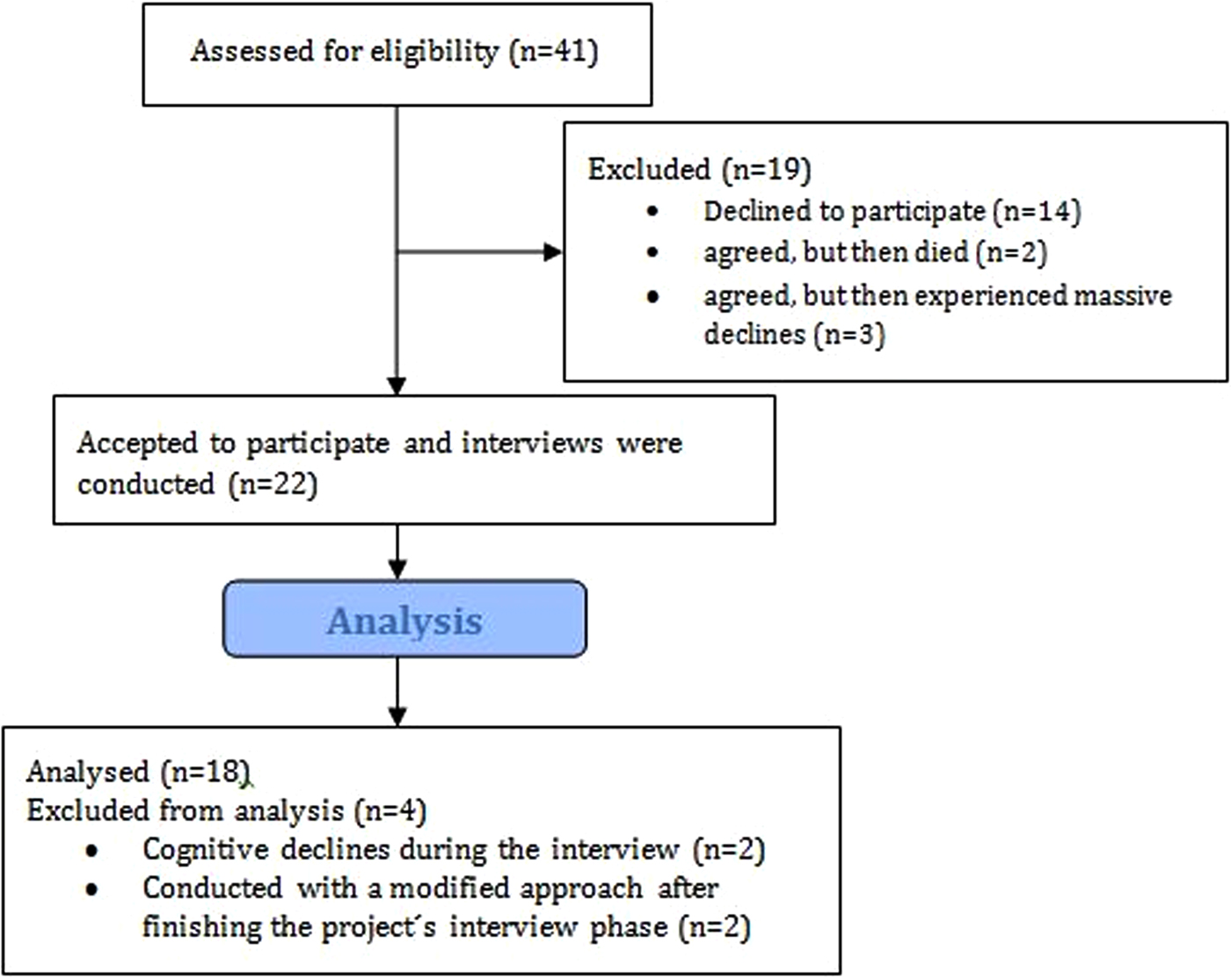
Forty-one patients were contacted by the research team about participation and handed leaflets with information on the project. Information provided covered concerns regarding patients’ autonomy, notes on the project and the interviewers, and the guarantee that the tape- and video-recorded transcriptions would be kept secure. Figure 1 shows the flow chart of patients included.
Flowchart.

Fourteen patients declined immediately for different reasons (i.e., no longer having sufficient energy, were concerned with other things than being interviewed, felt overburdened with their current situation, and being interviewed would be too much). Two patients agreed to take part but died before they could participate. Three other patients agreed, but then the interview had to be cancelled because of the patients’ declines in functional and mental capacities. A total of 22 patients accepted participation in this study; however, interviews could be conducted in 18 (11 audio, 7 video recordings). Four interviews were excluded for analysis: two because the patients showed cognitive impairment during the interview and another two because the procedure was modified and could not be compared with prior interviews.
Interviews were conducted between December 2012 and April 2014. During all interviews, patients, with the exception of two, were interviewed in their hospital bed. The other two were interviewed in the hospital garden. The interviews lasted between 36 and 70 minutes, including short breaks. All interviews were conducted in German language.
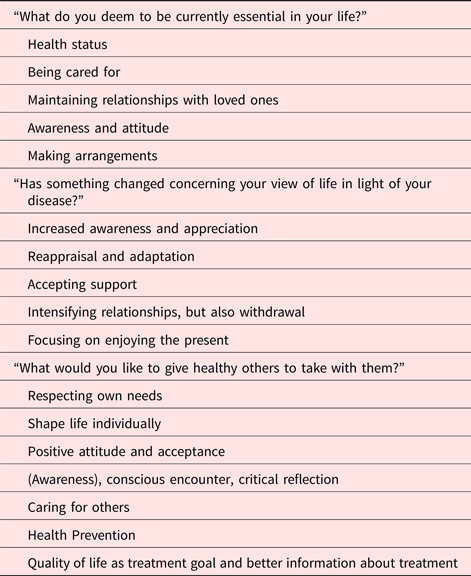
The interview guide consisted of the following questions: (1) “What do you deem to be currently essential in your life?” (2) “Has something changed concerning your view of life in light of your disease?” (3) “What would you like to give healthy others to take with them?”
Data Analysis/Content Analysis
Analysis was performed in the following steps using MAXQDA 2010 software.
1. To gain an understanding of the themes and contexts, the analysis process was started by the analysts reading the transcripts several times and simultaneously listening to the recorded interviews.
2. The transcripts were classified into meaning units, with the authors subsequently determining what was meaningful to code.
3. Codes were constructed into preliminary subthematic and thematic units that reflected the underlying meaning of the text; further analysis was then carried out.
4. Subthemes and themes were repeatedly discussed and reflected on by the authors until consensus was reached.
Results
The sample consists of 18 patients (female: 10; male: 8; ages 41–80 [median: 64]) with 11 documented by audio and 7 by film.
The qualitative analysis of the interviews led to different topics according to the three main interview questions. The content in the text is described according to those three questions and their topics. Quotations for topics have been inserted and marked with a number for each patient. The quotations were translated by a native speaker.
Table 1 shows the extracted topics.
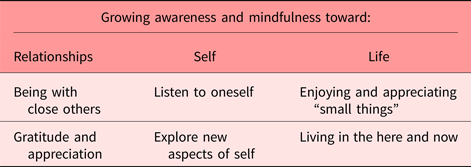
Table 2 shows apsects that gained more focus in interviewees' views on life
Extracted topics

Aspects that gained more focus in interviewees’ views on life

1. “What do you deem to be currently essential in your life?”
Health status and being cared for
This category contains statements concerning personal health status and symptom control, especially in terms of pain, immobility, breathlessness, and weakness. Patients described the loss of abilities and impairment of activities they practiced in the past. Statements highlighted the importance that those symptoms are controlled adequately, sometimes hoping to regain abilities (like mobility to be able to visit family members, being able to do sports) as well as feeling to be in good hands at the palliative care unit.
Maintaining relationships with loved ones
Spending time with their closest family and friends was one of the most important aspects for the interviewees. The statements refer to the importance of having time together and how relationships change. Many patients describe that their relationships have intensified, whereas some also describe that they have lost some close friends during the course of their illness. Patients reported gratefulness towards their loved ones who care for them as well as their worries about the bereaved. Few patients mentioned that they don't want to be a burden for others.
Awareness and attitude
Many patients highlighted that it is important for them to live their current life in the here and now, to be more aware of living and enjoying. Some patients explicitly mentioned that they try to stay optimistic, think positive and make the best out of the situation.
“I think, even during a serious illness, you can find something positive about each day. You just have to look for it.” (Audio-07, 79–80)
Making arrangements
This category contains statements regarding patient decrees and other decisions. Patients describe it as important that they have made decisions, such as a referral to a hospice or stopping chemotherapy. Patients often wanted to arrange things so that their bereaved relatives won't be left stranded.
Hope for a “good death”
Interviewees mentioned that they wished not to die alone; they wished to die without pain and to die peacefully.
2. “Has something changed concerning your view of life in light of your disease?”
Increased awareness and appreciation
Patients described being aware of their limited time to live and that they wanted to carefully and consciously plan how to spend this time. Interviewees described a focus on living in the here and now and that they enjoy “normal” activities more than they did in the past.
“I live more consciously. I find joy in things that I didn't even notice before. I enjoy the birds which fly round the garden, the butterflies, the flowers, all the things that I previously just took for granted, it's just a bit different today. I am much more at ease, where lots of people get stressed about things, I don't know, that they have lots of work to do or that they got a dent in their car.” (Audio-03, 56–63)
Reappraisal and adaptation
Many patients pointed out to enjoy “small,” “normal” events and activities more than they did in the past. One interviewee described how the view on life to be worth living developed:
“Yes, it's remarkable how you continually correct your views and again and again so that you are satisfied with less, so that – well two years ago you would have said ‘oh no it's not worth living anymore.’ All of a sudden a lot less still makes it worthwhile to be alive.” (Audio-01, 604–608)
Patients describe a reappraisal of what is important, such as that the value of material things and vanities decreases. A couple of patients even described how they developed behavior that would formerly have been opposite to their concept of self, such as delegating tasks, accepting help, and emotionally opening up to others and showing their feelings.
3. “What would you like to give healthy others to take with them?”
Respecting own needs
Interviewees highlighted to be sensitive towards what is good for you and what isn't and pointed out the importance of listening more often to one's own needs, feelings and thoughts.
Shape life individually
This “advice” refers to the importance of someone finding their own meaning in life: finding one's own way is everybody's individual/personal responsibility.
Positive attitude and acceptance
This category contains statements about not losing hope and courage, to enjoy and appreciate live life every day, and to have a good time. Other statements in this category encourage others to accept life as it is and suggest that we should be content with what we have in life.
(Awareness), conscious encounter, critical reflection
Interviewees spoke about being more critical toward one's own consuming behavior, suggesting others to ask themselves whether they really need some specific product. Also, reflection on working behavior was mentioned, as was the idea of taking more breaks and working less. Being at peace with oneself was mentioned as being important, as was an early coming to terms with the topic death and dying.
Caring for others
This category contains statements that describe an attitude of respect toward others, behaving considerately and helping others. Some suggested engaging in social affairs, being interested in the lives of others and to reflect on how one's behavior affects others.
Another area of statements concerned the connection to one's family: interviewees mentioned that it is important to be more interested in the family and to ask for and to pass on family wisdom/knowledge.
Preventive health
In terms of prevention, comprehensive preventive healthcare was mentioned as something important to consider, as was carefully preparing advance directives together with your close ones.
To get informed and get a second opinion, to strengthen ones immune system and not to smoke were further aspects that were mentioned concerning preventive measures.
Quality of life as a treatment goal and better information about treatment
These two points were formulated as an appeal toward health professionals. One interviewee pointed out to teach future physicians that palliative care is not about prolonging life but about maintaining and enhancing the quality of life. This same interviewee reported a lack of information given by health professionals about pain that could be caused by treatment.
Participants’ Reflections About the Interview
Each participant was visited by a team member within the next several days after the interview and asked whether there was something troubling them regarding the interview. No worries or concerns were declared.
We were given more detailed feedback by some patients (and their relatives) on the perception of the interviews and that it was an overall pleasant experience. Patients said that it did them good to talk, to articulate, and clear their thoughts. To tell others that life is worth living despite being faced with a terminal illness, to make people sensitive to the situation of the dying and generate understanding for people in PC, to help people who are not (yet) in this situation, and to generally encourage people to listen to each other were reasons mentioned to be part of our study.
The study did not include the systematic assessment of relatives’ feedback. Nevertheless, some relatives gave us feedback, which we find noteworthy to report. One relative (daughter) wrote us an e-mail expressing her gratitude for the interview. Another one called and e-mailed that “We listened to the CD with the interview on it and it showed us, in a sad but also nice way, that Dad was at peace.”
Another relative wrote: “It not only gave my father-in-law a great deal of appreciation and recognition during his last days and the chance to relive many happy thoughts from his life and his achievements, but it has also left us as a family with something very valuable. We wholeheartedly thank you for that and congratulate you on the project; keep up the good work.” After being handed the DVD, one relative highlighted the importance of being able to experience the voice of their relative, their facial expressions, and “aura” beyond the words spoken in the video interview.
Discussion
Our study gave examples that despite being faced with the end of life and it being a complex and painful process, patients still experienced benefits during their illness trajectory. Patients identified resources and coping strategies such as meaningful relationships with family and friends and attention and mindfulness in matters concerning them personally. Shifts have occurred through being faced with the end of life toward taking more time for themselves, being better able to enjoy each moment and live in the present, being more calm and spending more time with family and friends.
Studies looking at how a person is affected by terminal illness have shown how the patient adapts, undergoing a personal transition and changes to find a new meaning in life (Arman & Rehnsfeldt, Reference Arman and Rehnsfeldt2003; Arman et al., Reference Arman, Rehnsfeldt and Lindholm2002; Nissim, Reference Nissim2008). We observed that the number of positive illness-related changes needed time to develop, a result already demonstrated by Tedeschi and Calhoun (Reference Tedeschi and Calhoun2004), who found that patients can benefit from their illness by going through an extensive re-evaluation process. Pinquart et al. (Reference Pinquart, Fröhlich and Silbereisen2007) also found that such adaptive effects can occur and have beneficial effects on psychological health as well. A study by Wrubel et al. (Reference Wrubel, Acree and Goodman2009) demonstrated that not only it is possible to have a good quality of life even in the last days or weeks of life, but also how such positive experiences occur through relational, spiritual, and goal-oriented processes.
Experiencing positive effects when dealing with a severe illness is not an unknown phenomenon. Dealing with a traumatic experience (the confrontation of a life-threatening situation such as a serious illness) can result in posttraumatic growth (Calhoun & Tedeshi, Reference Calhoun and Tedeshi2006; Tedeschi & Calhoun, Reference Tedeschi and Calhoun2004), which is reported for different populations and different cultures (Dong et al., Reference Dong, Li and Liu2017; Khanjani et al., Reference Khanjani, Younesi and Khankeh2017; Zamora et al., Reference Zamora, Yi and Akter2017). Areas in which posttraumatic growth might develop are, among others, the appreciation of life, relating to others, and personal strengths (Calhoun & Tedeshi, Reference Calhoun and Tedeshi2006; Lee, Reference Lee2008), which are also reflected in our results.
To find out what could be important for others to know about the end of life, we asked patients what they would like to pass on. Interestingly, only a few patients wanted to give advice, but mentioned maintaining positive attitudes, caring for others, listening to their own needs, and shaping their unique lives in their own ways. The most mentioned topic throughout was mindfulness. With regard to being mindful, a study by Fish et al. (Reference Fish, Ettridge and Sharplin2013) found that mindfulness seems to be a promising concept in supporting PC patients. They report that mindfulness can be used to improve psychological well-being, reduce distress, and improve quality of life. A study by Blawath et al. (Reference Blawath, Metten and Tschuschke2014) analyzed the relationships between mindfulness, depression, and quality of life in cancer patients, showing that patients benefit from mindfulness through a medium decrease in depression, resulting in higher quality of life.
“Maintaining relationships” and “being able to accept support from family and friends” were categories extracted from the interviews. Johnson et al. (Reference Johnson, Sulmasy and Nolan2007) found that patients use various strategies to manage the fear of burdening their families. Strategies included accepting the support of friends and caregivers, maintaining spiritual beliefs, and making plans for their future care needs. A study by Dobríková et al. (Reference Dobríková, Macková and Pavelek2016) found that social support provided by a close relative had a positive influence on the patient's meaning of life and overall life satisfaction; thus, having and accepting social support is an important aspect at the end of life and is in line with the National Institute for Clinical Excellence clinical guidance on supportive and palliative care stating that people affected by terminal illnesses should be offered a range of physical, emotional, spiritual, and social support.
Patients reported that they take more time for themselves since being faced with a terminal illness, with women mentioning this more often than men. This might be because women are still regarded as “natural” caregivers (Ussher & Sandoval, Reference Ussher and Sandoval2008) and more often also care for a broader range of relatives, leaving little time for themselves in daily routine.
Levenson et al. (Reference Levenson, McCarthy and Lynn2000) found that although functional status decreased and symptoms increased, the majority of patients reported good to excellent quality of life even in the last month of their lives. This is a result consistent with ours. Still, in our sample, some patients expressed good symptom control as a prerequisite to experience a high quality of life.
Our results validate recent research and are congruent with psychoanalytic reflections on mortality as mentioned by Rodin and Zimmermann (Reference Rodin and Zimmermann2008), who state that a heightened positive meaning may also become attached to living, when death appears on the horizon.
“Hoping for a good death” was another category extracted from the interviews. De Jong and Clarke (Reference De Jong and Clarke2009) used narratives to explore aspects for “good” and “bad” death und found that a death free from pain, the sense of a life well lived, and a sense of community were key factors for a death that was seen as “good.” Pertaining to the central tenets of PC, namely symptom control and psychological and spiritual support, the aim is the promotion of death with dignity and higher quality of life. Our study is also consistent with findings by Hack et al. (Reference Hack, McClement, Chochinov, Cann, Hassard, Kristjanson and Harlos2010), positing that as death approaches, a natural process of reflection ensues whereby humans ponder meaningful experiences, actions, beliefs, and other human beings that make up the complex fabric of life. We have analyzed shifts in the dynamics from self to others with patients mentioning to sort of rise above the daily fray and focus on relationships more and finding meaning, as already shown by Frankl (Reference Frankl2005), who described that, even when faced with an inalterable fate, it is within our capability to find meaning in an impossible situation. Conducting our interviews was felt to ease patient's coping with the end of life, an effect found already in so-called “life review” interviews that reduced feelings of loss and isolation, renewed emphasis on the positive aspects of one's life, and reaffirmed self-esteem (Borden, Reference Borden1989; de Ravon, Reference de Ravon1983; Lester, Reference Lester1990; Pickrel, Reference Pickrel1989; Wholihan, Reference Wholihan1992).
All patients, and where possible also their relatives, were asked about how they experienced the interviews. Our results are in line with other findings that research with people at the end of life is feasible (Voltz et al., Reference Voltz, Galushko and Walisko2010; White & Hardy, Reference White and Hardy2010) and welcomed; however, there are difficulties, mainly in recruitment. Data collection lasted 15 months. Research in palliative care is feasible and welcomed by patients but also complex and time-consuming (Gysels et al., Reference Gysels, Shipman and Higginson2008; O'Mara et al., Reference O'Mara, St Germain and Ferrell2009; Voltz et al., Reference Voltz, Galushko and Walisko2010).
Based on our patients' and relatives' reactions to the interviews, and based on the proportion of participants accepting also to be video-taped, our approach appears to be a manageable and acceptable method to gain insight into the views on life of patients admitted to PC. Patients and relatives were strongly in favor of research participation and being able to contribute information that they believed would benefit others and afterwards expressed their gratitude, including being handed the CD/DVD to be shared, which was novel about our method. This approach was inspired by the work of Chochinov and his dignity therapy, in which interviews are turned into books, audio CD sets, or video DVDs, preserving memories to their families, who cherish these keepsakes. A study by Vuksanovic et al. (Reference Vuksanovic, Green and Dyck2016) provided evidence that the unique process of legacy creation positively influenced meaning and acceptance near the end of life and yielded positive reactions for families also. We, too, experienced (although we have not measured) these effects with regard to relatives who gave us promising feedback that they found the interview to be a source of comfort for them.
Strengths and Limitations
Because experience and the needs of palliative patients are complex and individual, qualitative research that aims at the individual experience, the individual view on life, is necessary and valuable. Our study contributes to filling this demand by analyzing patient palliative views on life and illness. Also novel to our approach is that we not only audio-taped the interviews, but also had a film team video-record interviews. Patients and relatives were offered copies of the CDs and DVDs to have a material piece of legacy; future studies could explore whether this legacy can help or hinder (e.g., coping with the illness in patients or the mourning process in relatives).
The category system structuring the data was developed inductively. Quality criteria of the analysis were achieved in terms of exhaustion and saturation (Mayring, Reference Mayring, Flick, Kardorff and Steinke2004; Rustemeyer, Reference Rustemeyer1992).
This study has several limitations. Patients were recruited in only one PC unit; therefore, generalizations made to other groups should be made cautiously. We also hypothesize that only those who consented to take part were already balanced and at ease with themselves, which might compromise the findings as well.
Also, the mainly positive results toward dealing with the end of one's life that we found in this study are potentially influenced by gatekeeping, which is a persistent issue in palliative care research (Kars et al., Reference Kars, van Thiel and van der Graaf2015). We tried to circumvent too much gatekeeping by asking support in recruitment not only by one person, but by several people from the multi-professional team and thus gaining a wider perspective on potential patients. Still, gatekeeping might have influenced the results because more often those that took part in our research seem to have accepted their current state and were more positive in their views.
Reflecting upon what (healthy) people could learn from the views of persons facing the end of life, there seems to be something particularly in line with what has gained increasing attention: the approaches of mindfulness and living in the here and now. One may argue that special circumstances are needed to focus on the here and now to such a great degree (e.g., having only a short time left to live or not having to care about daily routines). Still, it seems worthwhile to try to become more aware and mindful and to think about what really matters to us, perhaps not only when there is definitely not much time left.
Although our results add to the research, they cannot be viewed as rigid. Because the interview took place only once, the interviews represent the views of patients at that specific time and may differ at other times.
Clinically, our findings emphasize the need for practitioners to be aware that symptom control as one goal in treatment is not efficient enough, but that further factors are important to the PC patient and should be supported, such as retaining everyday life, living mindfully, living in the here and now, and doing the best possible.
Conclusion
To summarize, the present study has identified important topics in the narratives of patients in PC regarding their views on life. Patients reported on the challenges experienced with a terminal illness and changes in their views on life. Even though being terminally ill is often a complex and painful process, patients still gave examples of benefits experienced throughout their illness trajectory. Patients identified resources and coping strategies to deal with their terminal illness such as meaningful relationships with family and friends and in attention and mindfulness with regard to themselves. Also the interview itself was felt to have a positive influence on dealing with the end of life, not only for the patients but also for their relatives. Being handed the audio or video record was appreciated by patients and relatives. Nonetheless, more robust research is needed to analyze the effectiveness of these interviews and how to strengthen patients´ resources and coping mechanisms.
Acknowledgments
The authors thank all patients for their time and motivation to speak with us. We thank the relatives for their encouraging feedback. Furthermore, we thank the film team of Take Part Media for their support and flexibility. Also, we thank Heather Graham for translating the original patients’ quotations and Petra Hedjrat for support in recruitment organisation. For funding this survey, we also thank the German Cancer Aid (Deutsche Krebshilfe e.V.) for grant #109290.
Conflicts of interest
The authors declare that there is no conflict of interest.