Introduction
There is consistent evidence from cross-sectional and longitudinal studies that negative life events (NLE) strongly increase the risk for incident anxiety and depression (Finlay-Jones & Brown, Reference Finlay-Jones and Brown1981; Kessler, Reference Kessler1997; Kessler et al. Reference Kessler, Davis and Kendler1997; Brown et al. Reference Brown, Juster, Heimberg and Winning1998; Kendler et al. Reference Kendler, Karkowski and Prescott1998, Reference Kendler, Karkowski and Prescott1999, Reference Kendler, Hettema, Butera, Gardner and Prescott2003; Magee, Reference Magee1999; Chartier et al. Reference Chartier, Walker and Stein2001; Friis et al. Reference Friis, Wittchen, Pfister and Lieb2002; Pine et al. Reference Pine, Cohen, Johnson and Brook2002; Gillespie et al. Reference Gillespie, Whitfield, Williams, Heath and Martin2005; Horesh et al. Reference Horesh, Klomek and Apter2008; Zimmermann et al. Reference Zimmermann, Brückl, Lieb, Nocon, Ising, Beesdo and Wittchen2008; Klauke et al. Reference Klauke, Deckert, Reif, Pauli and Domschke2010; Beesdo-Baum et al. Reference Beesdo-Baum, Winkel, Pine, Hoyer, Höfler, Lieb and Wittchen2011; Asselmann et al. Reference Asselmann, Beesdo-Baum, Lieb and Wittchen2014; Patten et al. Reference Patten, Wilkes, Williams, Lavorato, El-Guebaly, Schopflocher, Wild, Colman and Bulloch2014). Similar, albeit less consistent findings exist respecting the role of NLE for the onset of substance use disorders (e.g., use/abuse of alcohol, nicotine and illicit drugs) (Cole et al. Reference Cole, Tucker and Friedman1990; Covault et al. Reference Covault, Tennen, Armeli, Conner, Herman, Cillessen and Kranzler2007; Blomeyer et al. Reference Blomeyer, Treutlein, Esser, Schmidt, Schumann and Laucht2008; Balk et al. Reference Balk, Lynskey and Agrawal2009).
Moreover, previous research suggests that low levels of perceived coping efficacy (CE) might elevate the risk of developing psychopathology, including anxiety, depressive and substance use disorders (Ehrenberg et al. Reference Ehrenberg, Cox and Koopman1991; Baldwin et al. Reference Baldwin, Oei and Young1993; Lee & Oei, Reference Lee and Oei1993; Bandura et al. Reference Bandura, Pastorelli, Barbaranelli and Caprara1999; Bögels & Zigterman, Reference Bögels and Zigterman2000; Maciejewski et al. Reference Maciejewski, Prigerson and Mazure2000; Oei & Burrow, Reference Oei and Burrow2000; Hasking & Oei, Reference Hasking and Oei2002; Muris, Reference Muris2002; Caprara et al. Reference Caprara, Steca, Gerbino, Paciello and Vecchio2006; Young et al. Reference Young, Connor, Ricciardelli and Saunders2006; Oei & Jardim, Reference Oei and Jardim2007; Connor et al. Reference Connor, George, Gullo, Kelly and Young2011; Sawatzky et al. Reference Sawatzky, Ratner, Richardson, Washburn, Sudmant and Mirwaldt2012; Taneichi et al. Reference Taneichi, Asakura, Sairenchi, Haruyama, Wada and Muto2013; Thorne et al. Reference Thorne, Andrews and Nordstokke2013). CE refers to a person's subjective sense that he/she will be able to cope effectively with difficulties in different areas of life and is conceptually closely related to constructs such as self-efficacy, optimism, perceived competences and problem-solving ability (Schwarzer, Reference Schwarzer1994). As suggested by theory of learned helplessness, lacking CE might foster feelings of non-contingency, uncontrollability and personal helplessness and hence especially trigger the onset of depression (Abramson et al. Reference Abramson, Seligman and Teasdale1978).
A series of prior studies further imply that low levels of CE might mediate the associations between NLE and incident mental disorders, primarily depression. For example, the relation between NLE and depressive symptoms among individuals with prior depression was found to be explained by low levels of self-efficacy (Maciejewski et al. Reference Maciejewski, Prigerson and Mazure2000) and the association between stress and depressive symptoms in students was shown to be explained by low stress-management self-efficacy (Sawatzky et al. Reference Sawatzky, Ratner, Richardson, Washburn, Sudmant and Mirwaldt2012). Moreover, the associations between NLE and symptoms of anxiety and depression were explained by decreased positive and increased negative coping strategies (Meng Xiu Hong et al. Reference Meng, Tao, Wan, Hu and Wang2011).
However, few studies strictly prospectively examined the role of CE for the associations between NLE and various forms of incident psychopathology, although doing so is essential in order to (a) further clarify the role of CE for the aetiology of different mental disorders and to (b) evaluate its usefulness for targeted early interventions in high-risk individuals with adverse experiences (Vitiello, Reference Vitiello2011). Thus, using data from a representative community sample of adolescents and young adults, this study aims to investigate prospective-longitudinal associations of NLE and CE with the onset of various mental disorders. We hypothesise that (a) NLE and low CE at baseline increase the risk for incident anxiety, depressive and substance use disorders at follow-up and that (b) low levels of CE partially mediate the association between NLE and subsequent psychopathology.
Materials and methods
Sample
Data come from the Early Developmental Stages of Psychopathology Study (EDSP), a 10-year prospective-longitudinal study among a representative community sample of adolescents and young adults with one baseline (T0, 1995, N = 3021, response rate 70.8%) and three follow-up investigations (T1, 1996/97, N = 1228, only younger cohort, response rate 88.0%; T2, 1998/99, N = 2548, response rate 84.3%; T3, 2003, N = 2210, response rate 73.2%). The sample was drawn randomly from the Munich area (Germany); participants were aged 14–24 years at baseline and 21–34 years at last follow-up. Because the EDSP focuses on early developmental stages of psychopathology, 14–15-year olds were sampled at twice the probability of individuals aged 16–21 years, and 22–24-year olds were sampled at half this probability. At T1, only the younger EDSP cohort (aged 14–17 at baseline) was examined, whereas at T0, T2 and T3, both cohorts (younger and older, aged 18–24 at baseline) were investigated. Further information on methods and design has been previously presented (Wittchen et al. Reference Wittchen, Perkonigg, Lachner and Nelson1998b ; Lieb et al. Reference Lieb, Isensee, von Sydow and Wittchen2000).
Diagnostic assessment
Diagnostic information was assessed repeatedly using the lifetime (baseline) and interval version (follow-up assessments) of the Computer-Assisted Personal Interview (CAPI) version of the Munich-Composite International Diagnostic Interview (DIA-X/M-CIDI) (Wittchen & Pfister, Reference Wittchen and Pfister1997). The M-CIDI is an updated version of the World Health Organization's CIDI version 1.2 (World Health Organization, 1990) with additional questions to cover DSM-IV (American Psychiatric Association, 1994) and ICD-10 (World Health Organization, 1991) criteria. The M-CIDI can be used to assess symptoms, syndromes and diagnoses of 48 mental disorders along with additional information on onset, duration and clinical/psychosocial severity. Detailed descriptions and psychometric properties have been presented elsewhere (Reed et al. Reference Reed, Gander, Pfister, Steiger, Sonntag, Trenkwalder, Sonntag, Hundt and Wittchen1998; Wittchen et al. Reference Wittchen, Lachner, Wunderlich and Pfister1998a ).
The present study focuses on follow-up incidences (i.e., first lifetime incidences at T1, T2 or T3) of anxiety, depressive and substance use disorders. Anxiety disorders include panic disorder, agoraphobia, generalised anxiety disorder (GAD) and social phobia. For phobias, the impairment criterion was only applied to participants aged 18 years or older (Wittchen et al. Reference Wittchen, Lieb, Schuster, Oldehinkel and Rapoport1999). Depression comprises major depressive episodes and dysthymia (without applying diagnostic exclusion rules). Substance use disorders include alcohol abuse/dependence, nicotine dependence and abuse/dependence of illicit drugs.
Assessment of life events and conditions
Life events and conditions (i.e., ongoing difficulties) were assessed at baseline using the Munich Life Event List (MEL) (Maier-Diewald et al. Reference Maier-Diewald, Wittchen, Hecht and Werner-Eilert1983), a questionnaire-like procedure assessing positive and negative short-term events and chronic conditions. The MEL contains 83 items (74 specific events and 9 open categories), which ask for specific life events and conditions within a concrete time interval in 11 areas of life, including school and education, family, social contacts, professional activities, and living circumstances. In the EDSP, participants were asked to indicate the presence of each life event/condition in yearly intervals from 1995 to 1999, the year of interview. Detailed descriptions and psychometric properties of the MEL have been previously presented (Wittchen et al. Reference Wittchen, Essau, Hecht, Teder and Pfister1989; Friis et al. Reference Friis, Wittchen, Pfister and Lieb2002).
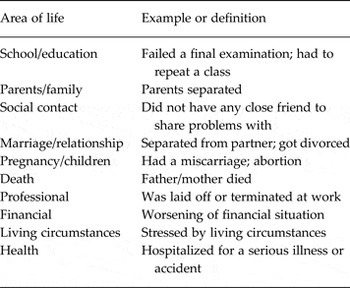
In an expert rating, each MEL item was rated on several event dimensions, including valence. 21 MEL items were classified as positive, 40 as negative and 13 as neutral (if not decidable, ambivalent or neutral). The current analyses consider the number of NLE (i.e., events and conditions classified as negative) within 5 years prior to baseline (from 1995 to 1999). Sample items for negative life events of different areas of life are presented in Table 1.
Sample Items for Negative Life Events from Different Areas of Life

Assessment of CE
Subjectively perceived CE was assessed at baseline using the German Scale for Self-Control and Coping Skills (SSC) (Perkonigg & Wittchen, Reference Perkonigg and Wittchen1995), a self-report with 11 five-point scaled items (labelled from not at all to very much). The SSC assesses a person's sense to be able to effectively cope with difficulties in different areas of life over the following 6 months (I am convinced to be able to cope with difficulties and problems concerning my finances/concerning my living situation/concerning my leisure/at school/work/with my partner/with my friends/with my parents/with my physical health/with my mental health; I am convinced to not take any drugs during the following 6 months/to not start smoking within the following 6 months, for non-smokers only). In the EDSP, the internal consistency of the SSC was high (Cronbach's alpha = 0.81). Higher values indicate lower CE.
Statistical analyses
Statistical analyses refer to individuals with available data on NLE and CE at baseline (N = 3017). However, as for each incident disorder respective baseline cases and cases with no follow-up assessment were excluded from the analyses, the number of participants for individual outcomes is smaller than N = 3017 and varies between N = 1823 for any disorder and N = 2756 for panic disorder. The software package Stata 12.1 (StataCorp., 2011) was used for the analysis. Data (percentages, means, standard deviations (s.d.) and odds ratios (OR)) were weighted to match the original distribution of the sampling frame (frequencies are reported un-weighted). Scores for CE were standardised (M = 0; s.d. = 1). All analyses were adjusted for sex and age at last completed assessment.
First, logistic regressions were used to test associations of NLE and low CE at baseline with incident disorders at follow-up (crude model, not adjusted for any other lifetime disorder prior to baseline; adjusted model, adjusted for any other lifetime disorder prior to baseline). The reported OR describes the increase in association per one NLE more/per s.d. of CE. To assess whether a higher number of NLE was non-monotonically associated with incident psychopathology, each outcome was regressed on both the linear and squared term of NLE (because this is sensitive for identifying non-linear associations). Associations between NLE and CE were tested using linear regressions.
Second, it was tested whether adjustment for low CE at baseline reduced the associations between NLE at baseline and incident disorders at follow-up (in unadjusted and adjusted models). Whenever (a) NLE and low CE, (b) NLE and psychopathology, as well as (c) low CE and psychopathology were associated, the Odds from logistic regressions with NLE as predictor and incident disorder as outcome were compared to the Odds from logistic regressions with NLE and low CE as predictors and incident disorder as outcome. Using Bootstrapping (bias-accelerated method with 2000 replications), a 95% confidence interval was calculated for this reduction.
Results
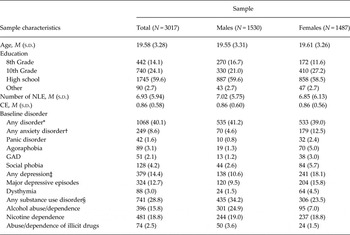
Sample characteristics for the total sample, males and females are presented in Table 2.
Sample characteristics for the total sample, males and females (N = 3017)

NLE, negative life events; CE, coping efficacy, GAD, generalised anxiety disorder; numbers are unweighted, percentages, means and standard deviations are weighted
* Includes any anxiety, depressive and substance use disorder.
† Includes panic disorder, agoraphobia, GAD and social phobia.
‡ Includes major depressive episodes and dysthymia.
§ Includes alcohol abuse/dependence, nicotine dependence and abuse/dependence of illicit drugs.
Associations between NLE at baseline and incident disorders at follow-up
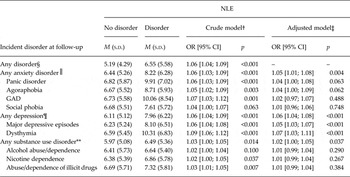
As presented in Table 3, NLE at baseline predicted the onset of any disorder (OR = 1.06 per one NLE more), any anxiety disorder (OR = 1.06), panic disorder (OR = 1.06), agoraphobia (OR = 1.05), GAD (OR = 1.07), any depression (OR = 1.06), major depressive episodes (OR = 1.06), dysthymia (OR = 1.09), any substance use disorder (OR = 1.03), nicotine dependence (OR = 1.02) and abuse/dependence of illicit drugs (OR = 1.03) at follow-up. NLE at baseline were not associated with incident social phobia and incident alcohol abuse/dependence at follow-up (p-values >0.05).
Associations between NLE at baseline and incident disorders at follow-up (N = 3017)*

NLE, negative life events; GAD, generalised anxiety disorder; OR, odds ratio; CI, confidence interval; weighted means and standard deviations.
* Because for each incident disorder, respective baseline cases and cases with no follow-up assessment were excluded from the analyses, the number of participants for individual outcomes is smaller than N = 3017 and varies between N = 1823 for any disorder and N = 2756 for panic disorder.
† Logistic regressions adjusted for sex and age.
‡ Logistic regressions adjusted for sex, age and any other lifetime disorder prior to baseline.
§ Includes any anxiety, depressive and substance use disorder.
‖ Includes panic disorder, agoraphobia, GAD and social phobia.
¶ includes major depressive episodes and dysthymia.
** Includes alcohol abuse/dependence, nicotine dependence, and abuse/dependence of illicit drugs.
Examining whether the risk of developing psychopathology monotonically increased with a higher number of NLE revealed that only for incident dysthymia, the squared term of NLE predicted the outcome beyond the linear term of NLE (squared term of NLE, OR = 0.997; 95% CI: 0.994; 0.9995; p = 0.022). That means, the risk for incident dysthymia increased for up to 27 NLE and decreased for more than 27 NLE. However, of those with no dysthymia at baseline and at least one follow-up assessment (N = 2720), only 21 individuals (0.81%) reported more than 27 NLE. The risk for all of the other mental disorders examined herein appeared to monotonically increase with a higher number of NLE (all p-values for squared terms >0.05).
When adjusting for any other lifetime disorder prior to baseline (adjusted model), merely the associations between NLE and any anxiety disorder (OR = 1.05), any depression (OR = 1.06), major depressive episodes (OR = 1.05), dysthymia (OR = 1.07) and any substance use disorder (OR = 1.02) remained significant.
Associations between low CE at baseline and incident disorders at follow-up
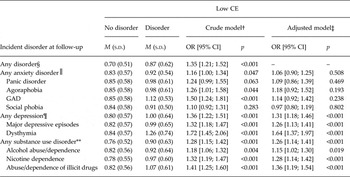
As shown in Table 4, low levels of CE at baseline predicted the onset of any disorder (OR = 1.35 per s.d.), any anxiety disorder (OR = 1.16), agoraphobia (OR = 1.26), GAD (OR = 1.50), any depression (OR = 1.36), major depressive episodes (OR = 1.32), dysthymia (OR = 1.72), any substance use disorder (OR = 1.28), alcohol abuse/dependence (OR = 1.18), nicotine dependence (OR = 1.32) and abuse/dependence of illicit drugs (OR = 1.41) at follow-up. Low CE at baseline was not associated with incident panic disorder and incident social phobia at follow-up (p-values >0.05).
Associations between low CE at baseline and incident disorders at follow-up (N = 3017)*

CE, coping efficacy; GAD, generalised anxiety disorder; OR, odds ratio; CI, confidence interval; weighted means and standard deviations.
* Because for each incident disorder, respective baseline cases and cases with no follow-up assessment were excluded from the analyses, the number of participants for individual outcomes is smaller than N = 3017 and varies between N = 1823 for any disorder and N = 2756 for panic disorder.
† Logistic regressions adjusted for sex and age.
‡ Logistic regressions adjusted for sex, age and any other lifetime disorder prior to baseline.
§ Includes any anxiety, depressive and substance use disorder.
‖ Includes panic disorder, agoraphobia, GAD and social phobia.
¶ includes major depressive episodes and dysthymia.
** Includes alcohol abuse/dependence, nicotine dependence and abuse/dependence of illicit drugs.
When adjusting for any other lifetime disorder prior to baseline (adjusted model), only the associations between low CE and any depression (OR = 1.31), major depressive episodes (OR = 1.26), dysthymia (OR = 1.64), any substance use disorder (OR = 1.26), alcohol abuse/dependence (OR = 1.15), nicotine dependence (OR = 1.28) and abuse/dependence of illicit drugs (OR = 1.36) remained significant.
The role of low CE as mediator
NLE at baseline were strongly associated with lower levels of CE at baseline (Coef. = 0.03 per one NLE more ; 95% CI: 0.03; 0.04; p < 0.001). The associations of NLE and CE at baseline with each of the examined mental disorders at follow-up are described above and presented in Tables 3 and 4.
Adjustment for lower levels of CE at baseline reduced (a) 9.46% of the association between NLE and any incident disorder (CI: 1.50; 17.43; p = 0.020), (b) 13.39% of the association between NLE and any incident depression (CI: 4.70; 22.09; p = 0.003), (c) 12.65% of the association between NLE and incident major depressive episodes (CI: 3.76; 21.54; p = 0.005) and (d) 17.31 % of the association between NLE and incident dysthymia (CI: 6.15; 28.48; p = 0.002).
When adjusting for any other lifetime disorder prior to baseline, the reductions in associations for any depression (9.77%, CI: 1.65; 17.90; p = 0.018) and major depressive episodes (9.40%, CI: 0.38; 18.42; p = 0.041) remained significant, while the reduction in association for dysthymia was attenuated to non-significance.
Discussion
This study revealed that NLE and low CE at baseline strongly increased the risk for various mental disorders at follow-up and that low CE partially explained the association between NLE and incident depression.
We found that NLE elevated the risk for each of the examined mental disorders herein, except for social phobia and alcohol abuse/dependence. Except for dysthymia, the associations between NLE and all types of subsequent psychopathology monotonically increased with a higher number of NLE. The associations between NLE and incident specific anxiety and substance use disorders were attenuated to non-significance when adjusting for any other baseline disorder. This is consistent with previous evidence for NLE to be associated with the onset of psychopathology, especially depression (Finlay-Jones & Brown Reference Finlay-Jones and Brown1981; Cole et al. Reference Cole, Tucker and Friedman1990; Kessler, Reference Kessler1997; Kessler et al. Reference Kessler, Davis and Kendler1997; Kendler et al. Reference Kendler, Karkowski and Prescott1998, Reference Kendler, Karkowski and Prescott1999, Reference Kendler, Hettema, Butera, Gardner and Prescott2003; Friis et al. Reference Friis, Wittchen, Pfister and Lieb2002; Pine et al. Reference Pine, Cohen, Johnson and Brook2002; Gillespie et al. Reference Gillespie, Whitfield, Williams, Heath and Martin2005; Covault et al. Reference Covault, Tennen, Armeli, Conner, Herman, Cillessen and Kranzler2007; Blomeyer et al. Reference Blomeyer, Treutlein, Esser, Schmidt, Schumann and Laucht2008; Horesh et al. Reference Horesh, Klomek and Apter2008; Zimmermann et al. Reference Zimmermann, Brückl, Lieb, Nocon, Ising, Beesdo and Wittchen2008; Balk et al. Reference Balk, Lynskey and Agrawal2009; Klauke et al. Reference Klauke, Deckert, Reif, Pauli and Domschke2010; Beesdo-Baum et al. Reference Beesdo-Baum, Winkel, Pine, Hoyer, Höfler, Lieb and Wittchen2011; Asselmann et al. Reference Asselmann, Beesdo-Baum, Lieb and Wittchen2014; Patten et al. Reference Patten, Wilkes, Williams, Lavorato, El-Guebaly, Schopflocher, Wild, Colman and Bulloch2014). However, in contrast to previous research, we did not find that NLE elevated the risk for social phobia (Kessler et al. Reference Kessler, Davis and Kendler1997; Brown et al. Reference Brown, Juster, Heimberg and Winning1998; Magee Reference Magee1999; Chartier et al. Reference Chartier, Walker and Stein2001), which might lie in the fact that prior studies were often based on cross-sectional designs and/or focused on specific types of life events. Our result that NLE did not predict the onset of alcohol abuse/dependence might be due to the possibility that NLE primarily elevated the risk for alcohol abuse/dependence in subjects with heightened individual (e.g., genetic) vulnerability (Covault et al. Reference Covault, Tennen, Armeli, Conner, Herman, Cillessen and Kranzler2007; Blomeyer et al. Reference Blomeyer, Treutlein, Esser, Schmidt, Schumann and Laucht2008).
In addition, we revealed that low levels of CE increased the risk of a wide variety of mental disorders, except for panic disorder and social phobia. However, the associations between low CE and any as well as specific anxiety disorder(s) were no longer significant when adjusting for any other baseline disorder. These results correspond to and considerably extend previous research findings (Ehrenberg et al. Reference Ehrenberg, Cox and Koopman1991; Baldwin et al. Reference Baldwin, Oei and Young1993; Lee & Oei, Reference Lee and Oei1993; Bandura et al. Reference Bandura, Pastorelli, Barbaranelli and Caprara1999, Bögels & Zigterman, Reference Bögels and Zigterman2000; Maciejewski et al. Reference Maciejewski, Prigerson and Mazure2000; Oei & Burrow, Reference Oei and Burrow2000; Hasking & Oei, Reference Hasking and Oei2002; Muris, Reference Muris2002; Caprara et al. Reference Caprara, Steca, Gerbino, Paciello and Vecchio2006; Young et al. Reference Young, Connor, Ricciardelli and Saunders2006; Oei & Jardim Reference Oei and Jardim2007; Connor et al. Reference Connor, George, Gullo, Kelly and Young2011; Sawatzky et al. Reference Sawatzky, Ratner, Richardson, Washburn, Sudmant and Mirwaldt2012; Taneichi et al. Reference Taneichi, Asakura, Sairenchi, Haruyama, Wada and Muto2013; Thorne et al. Reference Thorne, Andrews and Nordstokke2013), since few prior studies prospectively examined the role of low CE for the onset of various mental disorders, including anxiety, depression and substance use. The particularly strong association between low CE and incident depression might be explained by the possibility that individuals feeling unable to cope with several situations in life developed a sense of non-contingency, uncontrollability and helplessness and therefore became depressed (Abramson et al. Reference Abramson, Seligman and Teasdale1978).
We further revealed that the adjustment for low CE reduced the associations between NLE and the onset of any disorder, any depression, major depressive episodes and dysthymia, but not any or specific anxiety and substance use disorder(s). These findings suggest low CE to particularly mediate the association between NLE and incident depression, although, however, it has to be noted that the overall reduction effects of low CE were relatively low. The current findings are consistent with previous evidence for low self-efficacy and unfavourable coping strategies to partially explain the association between NLE and depressive symptoms (Maciejewski et al. Reference Maciejewski, Prigerson and Mazure2000; Meng Xiu Hong et al. Reference Meng, Tao, Wan, Hu and Wang2011; Sawatzky et al. Reference Sawatzky, Ratner, Richardson, Washburn, Sudmant and Mirwaldt2012) and, moreover, substantially extend prior findings, as we examined the mediating role of CE regarding strictly prospective-longitudinal associations between NLE and a broad range of subsequent incident mental disorders for the first time.
Strengths and limitations
As one of the first large-scaled epidemiological studies, we prospectively investigated the role of low CE for the association between NLE and various forms of subsequent psychopathology, including anxiety, depressive and substance use disorders. However, the following limitations need to be considered: First, in our strictly prospective-longitudinal analyses, only NLE occurring prior to baseline, CE at baseline, and incident disorders at follow-up were considered. That is, individuals with the respective disorder prior to baseline were excluded from the analyses and NLE or changes in CE after baseline were disregarded herein. Second, although NLE prior to baseline were associated with lower levels of CE at baseline, we were not able to control for the temporal relationship between the occurrence of NLE and low CE. That is, individuals with high levels of NLE at baseline might have had low levels of CE prior to the occurrence of NLE. Third, intervals between NLE/low CE at baseline and incident disorders at follow-up included relatively long time-spans of up to 10 years and other factors after baseline might have influenced the associations between NLE/low CE at baseline and psychopathology at follow-up. Fourth, several NLE included herein refer to loss/separation (event types shown to be strongly associated with depression (Finlay-Jones & Brown, Reference Finlay-Jones and Brown1981; Asselmann et al. Reference Asselmann, Beesdo-Baum, Lieb and Wittchen2014)), and different associations of NLE with low CE and incident psychopathology might be found when focusing on other specific event types (e.g., danger events only). Fifth, low CE might have been associated with other vulnerabilities (e.g., low self-esteem and high neuroticism) increasing the risk for incident psychopathology as well. Sixth, the study sample contained adolescents and young adults from a relatively wealthy area in Germany. Thus, the generalisability of our findings – especially to other age groups – might be limited.
Conclusions
We found that NLE and low perceived CE at baseline increased the risk for various types of incident psychopathology (especially depression) at follow-up and that moreover, that low perceived CE partially mediated the association between NLE and incident depression (although, however, reductions in associations due to CE were relatively small). Thus, individuals having experienced a high number of NLE might possibly profit from targeted early interventions, which inter alia focus on strengthening CE to prevent the onset of depression. However, future research is necessary to replicate our findings and to test the efficacy of targeted preventive interventions fostering CE in specified high-risk populations with adverse experiences.
Acknowledgements
Principal investigators are Dr Hans-Ulrich Wittchen and Dr Roselind Lieb. Core staff members of the EDSP group are: Dr Kirsten von Sydow, Dr Gabriele Lachner, Dr Axel Perkonigg, Dr Peter Schuster, Dr Michael Höfler, Dipl.-Psych. Holger Sonntag, Dr Tanja Brückl, Dipl.-Psych. Elzbieta Garczynski, Dr Barbara Isensee, Dr Agnes Nocon, Dr Chris Nelson, Dipl.-Inf. Hildegard Pfister, Dr Victoria Reed, Dipl.-Soz. Barbara Spiegel, Dr Andrea Schreier, Dr Ursula Wunderlich, Dr Petra Zimmermann, Dr Katja Beesdo-Baum, Dr Antje Bittner, Dr Silke Behrendt and Dr Susanne Knappe. Scientific advisors are Dr Jules Angst (Zurich), Dr Jürgen Margraf (Basel), Dr Günther Esser (Potsdam), Dr Kathleen Merikangas (NIMH, Bethesda), Dr Ron Kessler (Harvard, Boston) and Dr Jim van Os (Maastricht).
Financial support
This work is part of the Early Developmental Stages of Psychopathology Study (EDSP) and is funded by the German Federal Ministry of Education and Research (BMBF) project no. 01EB9405/6, 01EB 9901/6, EB01016200, 01EB0140, and 01EB0440. Part of the field work and analyses were also additionally supported by grants of the Deutsche Forschungsgemeinschaft (DFG) LA1148/1-1, WI2246/1-1, WI 709/7-1, and WI 709/8-1. The first author (Dr Eva Asselmann) was funded by a doctoral stipend of the German National Academic Foundation (Studienstiftung des Deutschen Volkes).
Statement of interest
Dr Hans-Ulrich Wittchen reports the following items that might be perceived as a potential conflict of interest: Dr Hans-Ulrich Wittchen is on the advisory board and has received grant support to his institution by Servier, Novartis, Lundbeck, Pfizer, Sanofi and Hoffmann La Roche. All other authors declare that they have no financial relationships that might be perceived as a conflict of interest.
Ethical standards
The authors assert that all procedures contributing to this work have been approved by the Ethics Committee of the Medical Faculty of the Technische Universität Dresden (No: EK-13811) and comply with the Helsinki Declaration of 1975, as revised in 2013.