The mystery of the so-called Dunhuang Library Cave (Mogao Cave 17) derives primarily from the elusive nature of the astounding number of manuscripts found sealed in the cave. The past 100 years of scholarship in Dunhuang studies have yielded different theories on the nature of the manuscripts deposited in Cave 17.Footnote 2 These theories include principally (1) the “sacred waste” hypothesis of Stein,Footnote 3 Fujieda,Footnote 4 and Fang Guangchang;Footnote 5 (2) the “war hoard” theory of Pelliot;Footnote 6 (3) the “monastic library” of Rong Xinjiang;Footnote 7 (4) the “funerary depository” of Huntington;Footnote 8 and (5) the notion of the Dharma treasure repository prepared for the demise of the Dharma.Footnote 9 In the most recent critical review of the pre-existing theories, van Schaik and Galambos (Reference van Schaik and Galambos2012: 18–27) have advanced another feasible theory; namely, (6) that Cave 17 was a storeroom for commissioned and donated items.
Van Schaik and Galambos direct our attention specifically to the remarkably large number of copies of popular Buddhist scriptures commissioned by Tibetan emperorsFootnote 10 and the many private donations found intactFootnote 11 in Cave 17. They argue that a proper understanding of the nature of these commissioned or donated copies of Buddhist texts (or other items) can shed light on at least one facet of the nature of Cave 17. We already know well that Buddhist copying activities were not geared merely towards producing texts to read, but function more like rituals to procure merit on the part of the donors. The manuscripts produced in this process resembled “receipts for merit-giving transactions”, as Kieschnick insightfully puts it,Footnote 12 rather than actual reading material. Once the copies were donated and the merit was accrued, these manuscripts had no further practical use. However, their sacredness still endured, and these Buddhist manuscripts continued to be viewed as the presence of the Buddha and the representation of the Dharma. Therefore, commissioned or donated manuscripts had to be stored in a safe place, even if they were fragmentary or deteriorated. As a prominent centre for copying Buddhist texts for centuries, Dunhuang must have accumulated a multitude of such copied manuscripts to be stored. This observation is particularly valid for the Tibetan ruling period, as Dunhuang was one of the official state scriptoria of the Tibetan empire. Paying attention to the votive and ritual function of Buddhist manuscripts, van Schaik and Galambos argue that Cave 17 once served as the “ritual depository” for donated or commissioned items.
Moreover, van Schaik and Galambos (Reference van Schaik and Galambos2012: 18–27) comment that we do not have to choose between these theories, as “it may be best to approach Cave 17 as having multiple functions during the century and a half between its creation and its sealing” (p. 25). They prefer a “multi-functional” model that encompasses the theories of “funerary chapel for leading monks”, “library collections”, “storage for wasted manuscripts”, and “repository for commissioned or donated materials”. By proposing such a polyfunctional model, van Schaik and Galambos in fact accentuate the diversity of the Dunhuang manuscripts amid their dynamic context.Footnote 13 Indeed, the changing historical circumstances over the 150 years between the opening and closure of Cave 17 mean that the deposited manuscripts may have different “systematic ages”Footnote 14 across historical milieus: new functions of the cave may have emerged in history and even replaced the old functions; those who built the cave and those who maintained it might have come from diverse social and ethnic backgrounds and had different purposes; and among the various manuscripts, one collection of texts may have been deposited for a different reason from another collection. That is to say, that perhaps no universal explanation for the practice of depositing manuscripts in Dunhuang ever existed. The lack of scholarly consensus on the nature of the Dunhuang manuscripts does not imply the insolubility of the question, however, but rather the necessity of asking different questions: are we asking why the cave was built, or are we discussing why the cave was closed?Footnote 15 Which group of manuscripts are we addressing: are we dealing with the scraps and fragments, or with the complete and well-written manuscripts? Are we dealing with the manuscripts deposited earlier on in history, or those placed there immediately before the sealing of the cave?
The “multi-functional” model has a further advantage for ascertaining the nature of particular manuscripts. In the shadow of the past “mono-functional” theories – especially under the dominant “waste” theory – we have been quick to assume that a manuscript represents an overwritten scrap of an obsolete text when there are texts in totally different handwritings and incomplete sentences. This situation particularly applies to some bilingual manuscripts in which cursive or untidy Tibetan texts were written on the reverse side of Chinese texts.Footnote 16
However, not all manuscripts featuring Tibetan texts in cursive script together with Chinese lines resulted from the process of recycling obsolete Chinese manuscripts. In this paper, I will discuss the bilingual manuscripts IOL Tib J 3 and 218, whose textual nature is easily, and indeed largely has been, misunderstood. Bearing rather sloppy cursive handwriting and clear marks of deletion, the two manuscripts contain fragments of seemingly independent Chinese and Tibetan content. However, the two manuscripts were by no means simply recycled scraps, but had a much more complicated textual nature. In the following section of this paper, I will demonstrate that the texts of the two manuscripts are all Vinaya works, though of different genres, and can be viewed as an organic and coherent textual unity. The Chinese texts in red script and the Tibetan texts in smaller script, both being excerpts from Mūlasarvāstivāda Vinaya texts, largely correspond to each other in theme; the Tibetan passages in larger script, moreover, were commentaries of one Mūlasarvāstivāda tradition.
I. IOL Tib J 3 and 218: A brief introduction
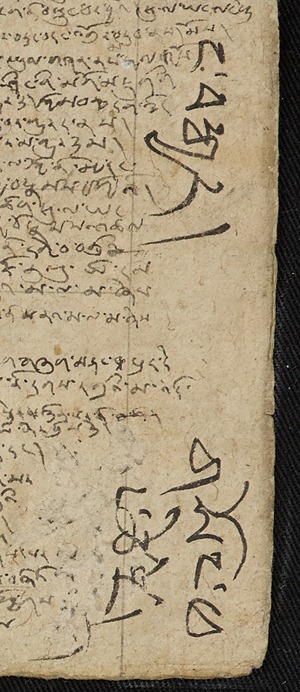
IOL Tib J 3 and 218 are both in poṭhī format, with the same measurements (46.5 cm in length and 11.7 cm in width), and each contains three distinctive layers of handwriting in Chinese and Tibetan. IOL Tib J 218, for example, has three folios containing both Chinese and Tibetan. On the first folio, there are Chinese verses written in a larger, red script (Figure 1); overlapping this Chinese text are incomplete Tibetan sentences with a larger, less cursive script in black ink (Figure 2).Footnote 17 The same handwriting appears at the beginning of the second folio and at the edge of the third folio (Figures 3 and 4). The remaining space on all three folios is filled with highly cursive Tibetan writing in a tiny and tightly compressed script (Figure 5).
© British Library Board, IOL Tib J 218, partial view

© British Library Board, IOL Tib J 218, partial view

© British Library Board, IOL Tib J 218, partial view

© British Library Board, IOL Tib J 218, partial view

© British Library Board, IOL Tib J 218, partial view

© British Library Board, IOL Tib J 218, partial view

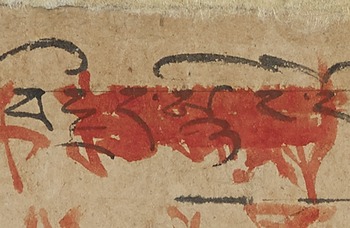
Regarding the chronology of the three layers of writing, the larger Tibetan dbu can sentences seem to have been written first. It can be seen that the red ink is layered on top of the black ink of the name ban de gzi brjid snying po (Figure 6). In Figure 3, we can see clear traces of the larger Tibetan script crossing out with a thin pen. The cross-line seems to have been written with the same pen as was used to write the small, cursive Tibetan. In Figure 4, some larger Tibetan words were erased to make space for the smaller, cursive Tibetan sentences. There is good reason to believe that in writing the manuscripts, the larger Tibetan script was probably written first, but was later deleted or erased so the manuscripts could be used for another writing project. On the other hand, the small cursive Tibetan and the Chinese texts belonged to one and the same initiative, and I will elaborate further on this in discussions of the content of the two manuscripts below. Moreover, from Figure 1, we can make the observation that the Tibetan passages in smaller script were added after the Chinese writing. The Chinese and Tibetan sentences in the smaller script are thematically connected (as discussed below), but their relationship to the Tibetan content in the larger script is still unclear to me, except that all the texts in the manuscript concern Vinaya.
The content and nature of IOL Tib J 218 have long been misunderstood, perhaps due to its tightly compressed handwriting and its elusive, multi-layered content, which is hard to interpret. La Vallée Poussin's catalogueFootnote 18 registers this manuscript as part of the mDzangs (or ’Dzangs) blun Footnote 19 (D.314 “The Sūtra of the Wise and Foolish”, the Tibetan translation of the Chinese Xianyu jing 賢愚經), based on the fact that IOL Tib J 218 contains a similar story as chapter 23 of the mDzangs blun. As for the Chinese part, Enoki notes that these sentences, the meaning of which is unclear, were possibly written “by way of pastime”.Footnote 20 The identification of IOL Tib J 218 as the mDzangs blun, which I demonstrate to be incorrect in the following discussion, further led scholars to ascribe the handwriting of this text to the translator Chos grub.Footnote 21 Despite bearing handwriting quite similar to that of Chos grub,Footnote 22 this manuscript was not a mDzangs blun text, but a Vinaya text, a topic to which I will return in the next section. There is no solid evidence to prove that Chos grub was the scribe.
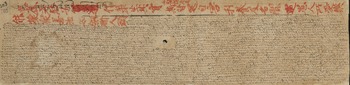
IOL Tib J 3, with two folios, has attracted only limited scholarly attention, perhaps also due to its remarkably cursive, compressed, and tedious-to-read handwriting. Like IOL Tib J 218, IOL Tib J 3 also has three distinct layers of handwriting: the larger, red Chinese characters take up the front side of the second folio (Figure 7; for practical reasons, I adopt the pagination of La Vallée Poussin's catalogue); on the reverse side of the same folio and on both sides of the first folio, we find the same smaller, compressed Tibetan letters as contained in IOL Tib J 218 (Figure 8); at the beginning of the front side of the first folio are the same larger, less cursive Tibetan letters that we also find in IOL Tib J 218 (Figure 9). Based on several discernible words or phrases – for instance, ’dul ba and gso sbyong gyi dngos po las – La Vallée PoussinFootnote 23 recognizes that the manuscript contains extracts from the Mūlasarvāstivāda Vinaya.
IOL Tib J 3-2v. © British Library Board

IOL Tib J 3-1r, partial image. © British Library Board

IOL Tib J 3-1r, partial image. © British Library Board

In the catalogue, Enoki notes that the Chinese parts of IOL Tib J 3 and 218 were written by the same hand.Footnote 24 In fact, the Tibetan parts of the two manuscripts were also likely created by the same group of Buddhists, judging from the remarkably similar handwriting. In this light, the two manuscripts were probably two parts of the same text.
Nevertheless, by the time Stein catalogued the two manuscripts, they had already become separated. The original expedition number of IOL Tib J 3 is “Ch. 73 vii. fr. 7”, which signifies that it was found in the Qianfo Dong 千佛洞, the seventh fragment in the seventh bundle from site number 73.Footnote 25 IOL Tib J 218, however, was marked in a different identification system;Footnote 26 La Vallée Poussin's catalogue records IOL Tib J 218 as “Ch. 03 20”, which possibly means that he found this manuscript (IOL Tib J 218) as the twentieth manuscript fragment from site number 03.Footnote 27
In view of the current research on IOL Tib J 3 and 218,Footnote 28 the actual content of the two manuscripts, the inner-textuality between the different parts of the two manuscripts, and their intertextuality with other texts (especially the canonical texts) have remained largely unknown, not to mention that their value as two complicated philological objects and their surprisingly significant historical implications have not yet been explored. In the discussion that follows, I will investigate the content of each text, identify their textual sources, and clarify the textual relationship between the different parts of the manuscripts and with the other Dunhuang texts and their younger canonical parallels. These two local artefactsFootnote 29 reveal a colourful picture of the multilingual and multicultural Dunhuang society, inform us of what the local communities read and wrote, and suggest how they spread their expert knowledge and communicated with the outside world. When situating these findings in their meaningful historical or social contexts, we will find that they contain information significant for reconstructing part of the cultural history not only of Dunhuang but also Tibet.
II. The content of IOL Tib J 3 and 218: inner- and intertextuality
A glimpse at the different writings in the two manuscripts seems to suggest that the manuscripts were reused for various purposes by at least three (groups of) people. However, closer examination reveals that all of the manuscript content, regardless of language or script, consists of excerpts or direct quotations from Mūlasarvāstivāda Vinaya texts. Furthermore, some Chinese and Tibetan passages were not written independently but corresponded to each other in content. That is to say, the original text – consisting of IOL Tib J 3, IOL Tib J 218, and probably many other missing folios – was a collection of Vinaya texts.
In the following analysis of the manuscript, I will view the two manuscripts as a unity and give a brief introduction to each text and the canonical parallels. This process inevitably involves a reconstruction of the sequence among the five folios of the two manuscripts. Luckily, each folio contains multiple complete texts. Therefore, even if an extant folio was not contiguous with any of the other folios surviving from the original, full manuscript, we can still understand its content. In this scenario, determining the inner-folio sequence – which means we identify which side was the front and which was the back – would suffice for our understanding. On the above grounds, and for the sake of convenience, I analyse the content of the two manuscripts in the following sequence: IOL Tib J 3-2; IOL Tib J 3-1; IOL Tib J 218-1; IOL Tib J 218-2; IOL Tib J 218-3.
II.1. IOL Tib J 3-2
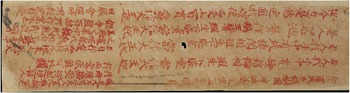
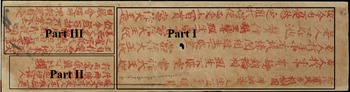
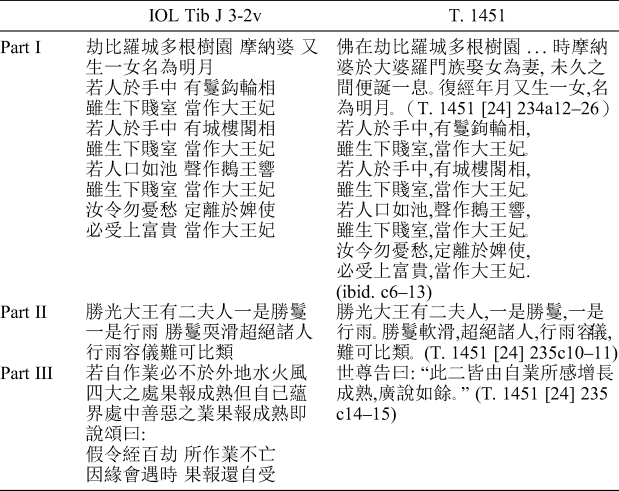
IOL Tib J 3-2v contains three Chinese passages (Figure 10) that are easy to trace in modern versions of the Chinese canon. I compare these Chinese passages with their parallels in the canonical version of Yijing's translations (T. 1451) in Table 1.Footnote 30
IOL Tib J 3-2v. © British Library Board

The canonical parallel of IOL Tib J 3-2v

Parts IFootnote 31 and II both come from the same story about the marriage of Prasenajit (Chin. shengguang wang 勝光王, Tib. rgyal po gsal rgyal) and Mallikā (Chin. shengman nü 勝鬘女, Tib. phreng ldan ma) from the Mūlasarvāstivāda Kṣudrakavastu (Chin. genben shuoyiqie youbu pinaiye zashi 根本說一切有部毘奈耶雜事 T. 1451). The first line of Part I briefly gives the narrative background (劫比羅城多根樹園, 摩納婆, 又生一女, 名為明月), while the remaining verses repeat verbatim the prediction made of Mallikā, who bore the signs of being the queen (T. 1451 [24] 234c6–13). Part II contains the conclusion of the story, in which Prasenajit has two wonderful wives, Mallikā and Varṣākārā (Chin. xingyu 行雨, Tib. dbyar tshul ma). This part can be found in the Chinese Kṣudrakavastu T. 1451 (24) 235c10–11.Footnote 32
The identification of Part III in the canonical sources is somewhat tricky. Although it is literally identical to a passage from the eighth Saṅghāvaśeṣa of the Chinese Mūlasarvāstivāda Vinayavibhaṅga (Chin. 根本說一切有部毘奈耶, T. 1442 [23] 698 a21–25),Footnote 33 there would be quite a huge textual jump from the Kṣudrakavastu to the Vinayavibhaṅga. Instead, it is plausible that Part III is still a quotation from Prasenajit and Mallikā's story in the Kṣudrakavastu. Although the canonical version of the Kṣudrakavastu is in abbreviated form, both the Taishō and Dunhuang version convey the same message that one is subject to the consequences of his own ripened karma. Moreover, in the Tibetan canonical parallel text, this part is presented in an unabbreviated form.Footnote 34 It is unclear to me where the unabbreviated Part III came from – whether the Dunhuang monks had before them an unabbreviated Chinese version, or they expanded the abbreviated version by relying on their memory of the full passage in the Chinese Vinayavibhaṅga part (the aforementioned T. 1442 [23] 698 a21–25), perhaps under the influence of the Tibetan parallel. Moreover, the verse quoted here, 假令經百劫, 所作業不亡, 因緣會遇時, 果報還自受,Footnote 35 is quite common throughout the Mūlasarvāstivāda Vinaya, including the Kṣudrakavastu, as I will soon demonstrate.
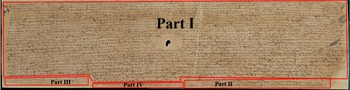
On the back of the Chinese passages, namely, IOL Tib J 3-2r (Figure 11), we find Tibetan texts in a tiny and highly cursive script. These are all summaries from the Mūlasarvāstivāda Kṣudrakavastu texts.
IOL Tib J 3-2r. © British Library Board

Part IFootnote 36 narrates the same story of the marriage of Prasenajit and Mallikā, i.e. the one we have just seen in Chinese on the other side of the folio (Parts I and II, IOL Tib 3-2v). However, this Tibetan version of the story is not a translation from Chinese, but a summary of the Tibetan translation of the Sanskrit Kṣudrakavastu produced by Vidyākaraprabha, Dharmaśrīprabha, dPal ’byor, et al., which was later included in the Tibetan Kanjurs under the title ’Dul ba phran tshegs kyi gzhi. Almost every sentence from this Dunhuang version finds its source in the version later collected in the Kanjurs, but sometimes in different wording or in a more simplified manner. Therefore, it is safe to call the Dunhuang text a summary.Footnote 37
It is hardly a coincidence that the Chinese and Tibetan versions of the same story are written on either side of this folio. The Chinese Part I contains the beginning of the narrative and the prediction that Mallikā would become a queen, while the Tibetan text contains the story from the beginning until Prasenajit's marriage to Mallikā when he takes her to Kośala. However, the Chinese Part II, which narrates the later development of the story, after Mallikā is taken to Kośala, is not contained in this Dunhuang Tibetan text. Neither is it clear why the Chinese version features only excerpts, while the Tibetan preserves the details of the story. In any case, the Chinese and Tibetan texts combined provide different textual sources for the same Vinaya story. The thematic correspondence between the Chinese and Tibetan content suggests that the creators of this manuscript were proficient in both languages, and they could freely refer to the Chinese or Tibetan version of the same Vinaya story. We can imagine that in this bilingual or even trilingual team language was by no means a barrier.
It is likewise noteworthy that all the Chinese passages in the manuscript are written in red ink. Usually, a text in red ink signifies that it is a root text. In the case of this bilingual folio, the Chinese texts are in red ink perhaps because they are direct quotations rather than comments or paraphrases.Footnote 38 In contrast, the Tibetan passages are summaries, perhaps providing narrative details related to the Chinese text.
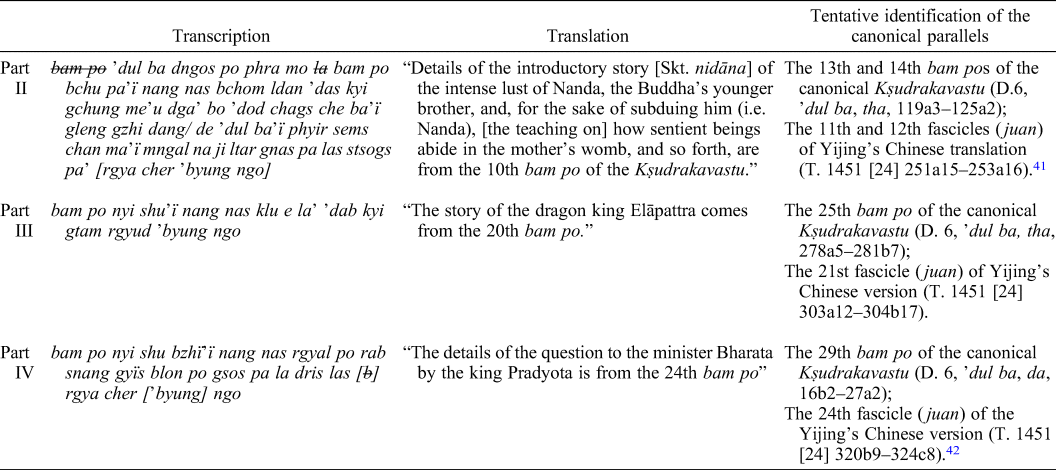
Although IOL Tib J 3-2r (Part I) was generally summarized from the text later canonized in the Kanjurs as the ’Dul ba phran tshegs kyi gzhi, it demonstrates many pre-classical features. For instance, it translates the title Kṣudrakavastu as mDo phra mo'i dngos po, different from the ’Dul ba phran tshegs kyi gzhi adopted in most Kanjurs.Footnote 39 As we will see later, the rendering of the Sanskrit term vastu as dngos po is consistent throughout this manuscript, deviating from the more canonical term gzhi.Footnote 40 Apart from Part I, which takes up the majority of the space on this side of the folio, we also find three colophon-style sentences that inform us of the themes and textual sources of three further narratives (Figures 12–14). The content of the stories is not preserved in the manuscript, but we can assume their canonical parallels based on the records of the theme and source of the stories (see Table 2). These short sentences possibly function as a mnemonic to help the scribe recollect the next story to preach about.
IOL Tib J 3-2r (Part II). © British Library Board

IOL Tib J 3-2r (Part III). © British Library Board

IOL Tib J 3-2r (Part IV). © British Library Board

IOL Tib J 3-2r, Parts II–IV

The connection between the above three Tibetan texts and the Chinese texts on the other side of the folio is not quite clear. Although it seems likely that the location of the three stories in the Dunhuang version (the 10th, 20th, 24th bam po respectively) is closer to that of the Chinese canonical parallels (the 11–12th, 21st, 24th fascicle, respectively), than that of the Kanjur parallels (13–14th, 25th, 29th bam po respectively), this is a rather questionable observation since we are not sure whether the unit of bam-po in the Dunhuang version was of the same length as that in the Kanjur version. As I will demonstrate later in Table 9 and Figure 19, it is most likely that the Dunhuang version adopts a different calculation of the length of a bam po. On the other hand, it is interesting to note that the complete texts of the canonical parallel to Parts II and III in the Kanjurs contain the Tibetan verse that corresponds to IOL Tib J 3-2v Chinese Part III 假令経百劫,所作業不亡,因緣會遇時,果報還自受.Footnote 43 It is not clear whether this could be read as a connection between the Chinese Part III and the Tibetan Parts II and III, since the same verse appears in many other parts of the Tibetan Kṣudrakavastu.
In sum, the above discussion sheds light on the correlation between the Chinese and Tibetan passages of folio IOL Tib J 3-2. To start with, the Chinese Parts I and II and the Tibetan Part I are two versions of the same story from the same Vinaya text, the Kṣudrakavastu. They all tell of the marriage between Prasenajit and Mallikā and, therefore, the affinity between (at least part of) the Chinese and Tibetan content is confirmed. Moreover, the verse contained in the Chinese Part III reappears in the concluding section of the canonical texts of the Tibetan Parts II and III, which perhaps suggests another connection between the Chinese Part III and the Tibetan Parts II and III, although it is not possible to confirm this (since the same verse appears repeatedly in other parts of the Kṣudrakavastu). At the very least, the correspondence between the Chinese Parts I and II and the Tibetan Part I reveals that the Chinese and Tibetan texts were not written randomly or independently, but grouped together intentionally, perhaps to provide different textual sources from the Kṣudrakavastu during a Vinaya study or preaching.
II.2. IOL Tib J 3-1
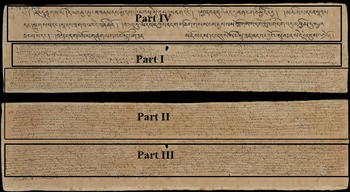
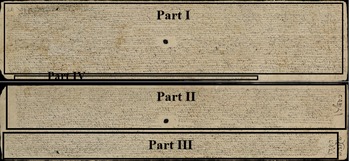
IOL Tib J 3-1 (Figure 15) contains only Tibetan texts, but of two different genres: Parts I to III are written in a smaller, cursive script and are excerpts from the Mūlasarvāstivāda Vinaya texts, while Part IV, in a larger dbu can script, is a Vinaya commentary text.
IOL Tib J 3-1. © British Library Board

The first sentence of Part I states that the story comes from the gSo sbyin kyi dngos po (Poṣadhavastu), the twelfth bam po of the Vinaya.Footnote 44 It corresponds to the Kanjur gSo sbyong gi gzhi (D. 1, ’dul ba, ka, 148b4–149a3). In the passage of the Kanjur version, the Buddha explains to Upāli what host monks (naivāsika)Footnote 45 must do to welcome guest monks (āgantuka, dge slong glo bur ba) who are masters of sūtras, vinayas, or mātṛkās.Footnote 46 When we compare the Dunhuang summary with its Kanjur parallel, we find that the two texts, while not identical, display a close textual affinity.Footnote 47 It is worth noting that the Poṣadhavastu has no existing Chinese translation.
Part II summarizes the introductory story of the monastic rule against the mātṛghātaka crime, which is taken from the Mūlasarvāstivāda Pravrajyāvastu. Footnote 48 It displays a close textual affinity with its Kanjur parallel (D. 1, ’dul ba, ka, 120a7–124a2).Footnote 49 In the canonical version of the story (the Dunhuang version is roughly the same), a boy murders his mother out of rage when the mother attempts to prevent him from going out on a date with a young girl. Although he manages to escape the punishment of the law, he is fully aware of the gravity of his sin of matricide and joins the Buddhist community with the hope of redeeming his transgression. When the other monks learn of his matricide, they report the issue to the Buddha. The Buddha orders the monks to expel him and enact the rule that a matricide should never be ordained. The matricide, therefore, must travel to another region to resume his monkhood.Footnote 50 Nevertheless, he successfully helps his disciples achieve arhatship. After his death, one of his arhat disciples learns that his teacher (upādhyāya), the matricide, was punished in the Avīci hell but was later reborn in heaven. The story concludes with the smile of the matricide's arhat disciple and his explanation that the Buddhist teaching is so excellent that it can even rinse off the grave sin of matricide.
Part III retells a two-bam po story from the Pravrajyāvastu. According to its last sentence,Footnote 51 this story is taken from the first two bam pos of the Vinayavastus (also the first two bam pos of the Pravrajyāvastu), in which the early lives of Śāriputra and Maudgalyāyana are narrated. This Dunhuang version starts with the debate between a young brahmin who has travelled from the South to King Bimbisāra's state, and Māṭhara, a local brahmin who was the grandfather of Śāriputra. Māṭhara defeated this young brahmin in debate and served as the patriarch of Nālada village. Later, the Dunhuang version narrates another competition between Māṭhara and Śāriputra's father Tiṣya, and continues with the marriage of Tiṣya and Śārikā.Footnote 52 It then elaborates on Śāriputra's birth and naming.Footnote 53 The last few sentences (lines 25–26) of this part make a brief mention of Maudgalyāyana's early life, including his birth and naming.
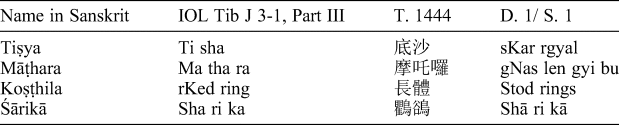
What is noteworthy here is that Part III seems to have been based on a version not identical to either the Chinese or Tibetan canonical versions. For example, in the Chinese version, the young travelling brahmin who was defeated by Māṭhara is named dishi 地师, which should be a phonetic transcription of Tiṣya (the Chinese translators perhaps confused this brahmin with Śāriputra's father Tiṣya, who appears later in the story and also opposes Māṭhara in a debate), while in the Dunhuang and Tibetan Kanjur versions, this young brahmin is not named at all. However, in some other places, the Dunhuang version displays a closer textual intimacy with the Chinese canonical version. For example, when Śāriputra's father Tiṣya is introduced for the first time, the Dunhuang and Chinese versions both state that Tiṣya comes from the South,Footnote 54 whereas the Kanjur version contains no statement of his place of origin in the corresponding part.Footnote 55 It is also interesting to note that the personal names adopted in the Dunhuang version seem to have been transcribed or directly translated from Sanskrit,Footnote 56 not based on the translations adopted in the Chinese or Tibetan classical versions (Table 3). A more precise textual relationship among the Dunhuang Tibetan version, the Chinese classical version, the Tibetan classical version, and the Sanskrit version needs to be established by further investigations.
Persons’ names in different versions of the Pravrajyāvastu

Part IVFootnote 57 contains three lines written in the larger dbu can script, the same script that also appears in IOL Tib J 218. It contains commentaries on two Vinaya rules.Footnote 58 The first part (lines 1–2) concerns the rule against pouring filth such as excrement, urine (bshang gci), saliva (mchim [mchil in modern orthography] ma), phlegm (bsnabs), vomit (skyugs pa), or snot (sna nas zag pa) into the water (hereafter “Water Rule”). This rule is found in the Prātimokṣasūtra Footnote 59 as the penultimate śikṣākaraṇīya (Chin. Zhongxue fa 衆學法, Tib. bslab pa'i chos, “Rules dictating etiquette”).Footnote 60 As for the second part (lines 2–3), which merely preserves a part of the narrative frame but omits the actual rule, I tentatively recognize it as the last śikṣākaraṇīya rule against climbing trees that are taller than a man's height (hereafter “Tree Rule”).Footnote 61
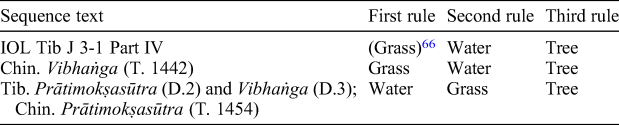
It is worth noting that this Dunhuang version casts the above rules as two consecutive parts, diverging from the sequence found in the Tibetan Vinayavibhaṅga or Prātimokṣasūtra. Each of the latter texts inserts the rule against pouring filth onto the grass between the above two rules. In comparison, the Dunhuang version attests a sequence of rules similar to that of the Chinese Vinayavibhaṅga (T. 1442): the Chinese Vinayavibhaṅga places the above two rules consecutively, after the rule against pouring filth onto the grass (hereafter “Grass Rule”).Footnote 62 However, the Chinese version of the Prātimokṣasūtra does not agree with the Chinese Vinayavibhaṅga in the sequence of these rules, but with the Tibetan source (see Table 4). It is unclear to me whether the divergence between the Chinese Prātimokṣasūtra and the Chinese Vinayavibhaṅga suggests that different Indic versions were used for the two Chinese texts, or that the disagreement was the result of the emendation of one version during its transmission in China. However, since the Mūlasarvāstivāda tradition did not possess a stable Bhikṣuprātimokṣa textual tradition,Footnote 63 it is more likely that the two Chinese were based on different Sanskrit versions with varying rule sequences.Footnote 64 If we believe that the sequence adopted in the Dunhuang Tibetan excerpt has some meaningful implication, instead of being merely a byproduct of casual writing, it is a tenable hypothesis that the Tibetan IOL J 3-1 Part IV adopted the sequence of the textual tradition of the Chinese Vinayavibhaṅga. Footnote 65 However, there is still doubt as to the nature of Part IV of IOL Tib J 3-1 (as well as IOL Tib J 14). I could not find any of its passages verbatim in the canonical Vinaya texts accessible to me, but I frequently spotted verbal parallelism in canonical texts: is this Dunhuang version a local composition, or is it a quotation from a text that is inaccessible? For the moment, I prefer to treat them as local compositions from Dunhuang, as they probably reflect the confluence of Chinese and Tibetan Vinaya traditions that was a feature of Dunhuang Buddhism.
Different sequences among the last three Śikṣākaraṇīya rules in different sources

In sum, IOL Tib J 3 contains rich and complex philological information. To start with, the thematic correspondence between the Chinese and Tibetan passages of folio IOL Tib J 3-2 suggests that the composers were from a highly practised bilingual community. The Buddhist community seems to have been quite familiar with the textual correlation between the Chinese and Tibetan versions, and clearly knew which parts of the texts attested or lacked parallels. Moreover, the Tibetan texts available to the composers of IOL Tib J 3-1 seem, for the most part, to have been very close to the versions later canonized in the Kanjur (for instance, Parts I and II). However, Part III seems to have been based on a version that was not quite the same as its Kanjur parallel. Furthermore, the content in the larger script seems to have been produced in a separate project, which possibly also melded Tibetan and Chinese Vinaya traditions: while its content recalls the Vinaya commentarial tradition in Tibetan, the sequence of the rules is much closer to the Chinese version.
On the motive for the use of three different scripts in the same manuscripts, in light of the evidence that the texts in the larger Tibetan script were erased to write the smaller Tibetan script (e.g. Figures 3 and 4 show deletion and scrubbing), a possible scenario may be reconstructed thus: the manuscript was first intended to contain Vinaya commentaries in the larger Tibetan script. However, the writing project yielded discarded folios, which were then used to write texts in the smaller Tibetan script and the red Chinese script. As I will discuss below, IOL Tib J 218 also contains an excerpt from a Vinaya commentary in the dbu can script, which suggests a secure connection between the textual genre and the type of script in creating this composite manuscript.
II.3. IOL Tib J 218-1 r&v
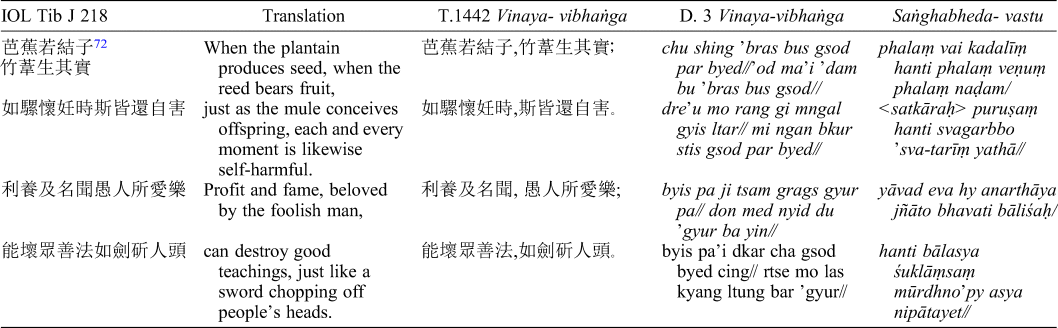
The Chinese verse on IOL Tib J 218-1r (Part I of Figure 16) is also written in red ink and serves to teach how easily worldly desires can deprave people.Footnote 67 In the extant corpus of Yijing's translation of the Chinese Mūlasarvāstivāda Vinaya texts, the complete verse is found only in the tenth Saṅghāvaśeṣa of the Chinese Mūlasarvāstivāda Vinayavibhaṅga (T. 1442 [23] 701b5–b8), in which the story of Devadatta swallowing Ajātaśatru's saliva for the sake of patronage is narrated.Footnote 68 Elsewhere, the verse's content is found in the Saṅghabhedavastu, also associated with Devadatta's stories, but in prose.Footnote 69 Since the extant Mūlasarvāstivāda texts in the Chinese Tripiṭaka are incomplete, in order to ascertain the source of this verse on IOL Tib J 218-1, it is necessary to search the Mūlasarvāstivāda texts in Tibetan and Sanskrit. A digital search demonstrates that similar content is found in the Tibetan and Sanskrit versions of the Vinayavibhaṅga and Saṅghabhedavastu.Footnote 70 However, in Sanskrit, the complete verse is found only in the Saṅghabhedavastu, unlike in Chinese and Tibetan, in which the complete verse appears only in the Vinayavibhaṅga. The comparison of the content of the Dunhuang version with that of the Vinayavibhaṅga and Saṅghabhedavastu versions in Chinese, Tibetan, and Sanskrit, together with an English translation of the Dunhuang version, is shown in Table 5.Footnote 71
IOL Tib J 218-1

The verse in different sources

It seems plausible that either the source of the Dunhuang verse in red Chinese was the Vinayavibhaṅga as now preserved in the Chinese Tripiṭaka, or the verse was introduced as part of the Saṅghabhedavastu by the Dunhuang monks (possibly due to the strong connection of this verse and Devadatta's stories). Considering that the following parts (II and III) of IOL Tib J 218-1 are both Vinayavastu texts, it is not impossible that Part I came from the Saṅghabhedavastu, the text directly following Parts II and III's sources, the Śayanāsanavastu and Adhikaraṇavastu, in the proper order of the Mūlasarvāstivāda Vinayavastus.
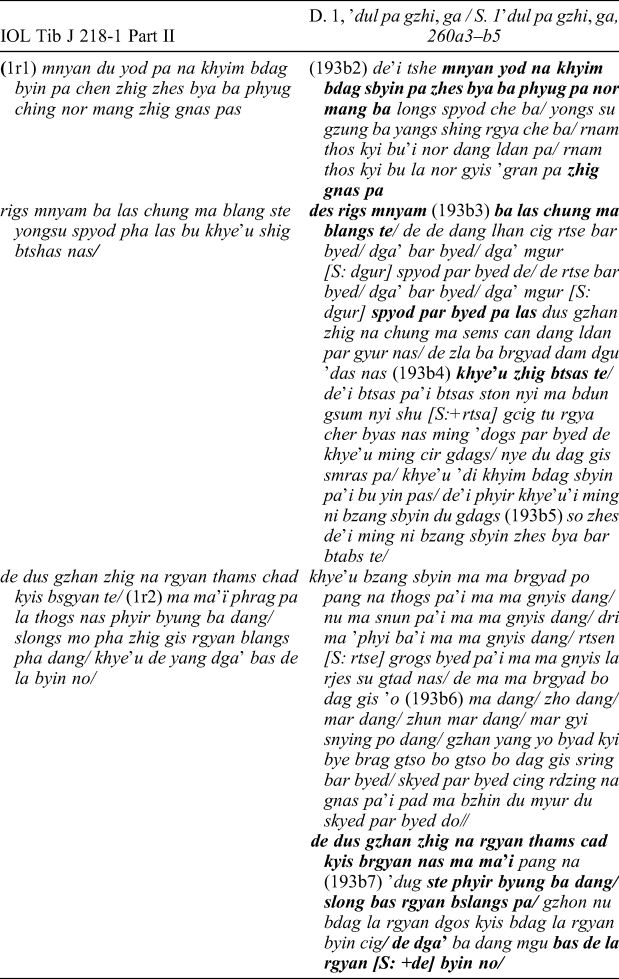
Part II is inscribed in the smaller Tibetan script, and its content spans the recto and part of the verso of the first folio. It is a long story about the birth and early life of the famous donor Anāthapiṇḍada, his encounter with the Buddha in Rājagṛha, and the building of the Jeta Grove, assisted by Śāriputra. The source of the story is indicated in the manuscript as the Mal stan gyi dngos po, Footnote 73 a Tibetan translation of the Sanskrit name Śayanāsanavastu. The Dunhuang text is taken from the 55th and 56th bam pos of the Vinaya that was available to the composers. When we compare this Dunhuang text with the Kanjur version of the Śayanāsanavastu,Footnote 74 we find that Part II is not a verbatim copy but a summary and, for the most part, the Dunhuang version is close to the Kanjur version of the Śayanāsanavastu (for practical reasons, I compare only the beginning of the two texts; see Table 6). However, some details still differ: in Table 6, the Dunhuang version tells us that, when the boy went outside, he was carried on his nurse's shoulder (ma ma’ï phrag pa la thogs); however, in the Kanjur version, he was seated on his nurse's lap (pang na ’dug). That is to say, the content of the source text of this Dunhuang summary was not identical to the Kanjur version we now read, although they were similar for the most part. Yijing's Chinese translation of this vastu is not preserved, and I was therefore unable to compare the Dunhuang version with the Chinese translation.
The comparison of Dunhuang and Kanjur versions of the Śayanāsanavastu

Part III does not preserve its title, but it is in fact a summary of the rTsod pa zhi bar byed pa'i gzhi, the Tibetan translation of the Adhikaraṇavastu of the Mūlasarvāstivādavinaya. Footnote 75 The main contents of Part III range from how to settle different types of monastic disputes – for instance, vivādādhikaraṇam (“dispute [that has its basis] in controversy”,Footnote 76 Tib.’gyed pa'i rtsod pa, Chin. yanzheng 言諍), āpatyadhikaraṇam (“dispute [that has its basis in] offence”,Footnote 77 Tib. ltung ba'i rtsod pa, Chin. fanzheng 犯諍), kṛtyādhikaraṇam (“dispute [that has its basis in] obligation”,Footnote 78 Tib. bya ba'i rtsod pa, Chin. shizheng 事諍) – to the story in which the Buddha absolves the monk Mṛgāraputra from suspension because the procedure by which he was suspended is invalid.Footnote 79 No Chinese translation of this vastu is preserved.
Since it is not completely clear where the Chinese Part I comes from, the correlation between the Chinese Part I and the Tibetan Parts II and III is difficult to clarify. Nevertheless, it is noticeable that Parts II and III are from two consecutive vastus of the Mūlasarvāstivāda Vinaya, which again confirms that the content of IOL Tib J 218 was not produced randomly but was composed according to the structure of the Vinaya in hand.
II.4. IOL Tib J 218-2 r&v
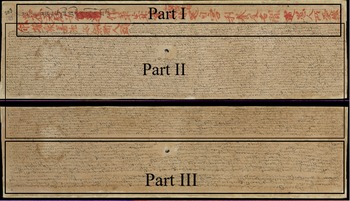
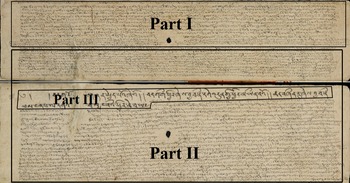
When this folio was catalogued for the British Library, its front and back were mistakenly reversed. Based on its content, the catalogued verso actually comes before the catalogued recto. I adjust the pagination in my discussion, and mark the side of folio with only the small script as the recto, and that with the large script as the verso (Figure 17).
IOL Tib J 218-2

IOL Tib J 218-2r starts with a story (Part I) summarized from the Mūlasarvāstivāda Śayanāsanavastu.Footnote 80 The summary recounts the famous story of the four animal friends – a hare, an elephant, a monkey, and a bird – determining who among them was the most senior in age. In the Śayanāsanavastu, this story occurs before the life story of Anāthapiṇḍada, which appears as Part II of the first folio of IOL Tib 218. It is possible that IOL Tib J 218-2 was initially placed before IOL Tib J 218-1.
Part II, written on the front and back sides of this folio, is an excerpt from the Adhikaraṇavastu.Footnote 81 It contains sections of the Buddha's sermons to King Śuddhodana, the Buddha's permission for Śākya women to listen to the Dharma, the story of Muktikā and the Buddha's portrait,Footnote 82 the fourfold dispute, and so forth.Footnote 83 Just like the two Śayanāsanavastu excerpts of this Dunhuang manuscript (i.e. IOL Tib J 218-1 Part II and IOL Tib J 218-2 Part I), this Adhikaraṇavastu section appears almost immediately before the other Adhikaraṇavastu excerpts (i.e. Part III of the first folio of IOL Tib J 218). This observation confirms the supposition that IOL Tib J 218-2 preceded IOL Tib J 218-1 in the original manuscript.
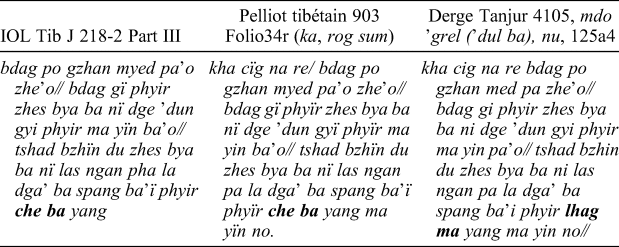
Part III is a Vinaya commentary in genre and is written in the same larger Tibetan script that appears in IOL Tib J 3-1 Part IV. It contains a passage that is also found in the ’Dul ba bsdus pa (*Vinayasaṃgraha, Derge Tanjur 4105), a commentary on the Prātimokṣa created by Viśeṣamitra (Tib. Khyad par bshes gnyen, Chin. shengyou 勝友), translated into Tibetan by Śīlendrabodhi, Śākyaprabha, and Vairocanarakṣita, and revised by Jñānaśrībhadra, rGyal ba shes rab, and Shākya bshes gnyen.Footnote 84 The text ’Dul ba bsdus pa is also partially preserved in another Dunhuang manuscript, Pelliot tibétain 903, in which the text in IOL Tib J 218-2 Part III is also found. A comparison between the two Dunhuang versions and the Tanjur version is presented in Table 7. As Table 7 demonstrates, the two Dunhuang versions are exactly the same, while the Tanjur version contains some variant readings, such as lhag ma instead of che ba. It is safe to conclude that IOL Tib J 218-2 Part III comes from the version of ’Dul ba bsdus pa that was circulating in Dunhuang.
A comparison between Dunhuang and Tanjur versions of the Vinayasaṃgraha

The writing in the larger script in this part of the manuscript should have been created under the same project as Part IV of IOL Tib J 3-1 (as well as IOL Tib J 14). Just like IOL Tib J 3-1 Part IV, the writing of this Vinaya commentary was also abandoned halfway, resulting in incomplete sentences. In addition, we can see these sentences were crossed out with a thin pencil stroke. It is plausible that the writers discarded this folio in the commentary project due to the low quality of the paper: part of this folio is made of coarse, rough paper fibres that are not quite suitable for writing. Many discarded folios, and perhaps also blank folios prepared for the commentary project, were then recycled to write down the Chinese and the Tibetan in the smaller script.
II.5. IOL Tib J 218-3
The third folio of IOL Tib J 218 contains passages in both smaller and larger Tibetan scripts (Figure 18). At the beginning of IOL Tib J 218-3r, we see the vestiges of several Tibetan words in the larger script, which were erased and overwritten in the smaller script. It can be seen that the paper contains a small hole on the upper left, which was possibly the reason why this folio was discarded by the commentary project. On the other side of the folio, IOL Tib J 218-3v, we see words such as nga brgyad (“fifty-eight”) and gsong pha (“secret”) in the larger script at the right edge, whose meaning in context entirely eludes me. Below the word gsong pha, we see syllables nga tshe pa (?) and traces of scrubbing on the left side of and below nga tshe pa (Figure 4). It seems nga tshe pa (possibly including gsong pha) was part of a longer phrase that had been partly scrubbed.
IOL Tib J 218-3

Parts I and II are summaries of the Gos kyi dngos po, a Tibetan translation of the Mūlasarvāstivāda Cīvaravastu. As the textual comparison reveals, this Dunhuang version was not identical to its Kanjur parallel.Footnote 85 Part I contains two stories from the beginning of the Cīvaravastu, the forty-first and forty-second bam pos of the Vinayavastu in the hand of the Dunhuang monks.Footnote 86 It starts from the family story of the minister Khaṇḍa, the father of Siṃha and maternal grandfather of the famous patricide Ajātaśatru, and continues up to the beginning of the story of Jīvaka.Footnote 87 Part II proceeds to narrate the story of Viśākhā, the clever lady whose 32 sons had been killed, also from the Gos kyi dngos po, specifically the 43rd and 44th bam pos of the Vinayavastu. Footnote 88 Part III is summarized from the 47th bam po of the Vinayavastu, the last bam po of the Cīvaravastu.Footnote 89 We can calculate that the length of the version of the Cīvaravastu, on which these Dunhuang summaries were based, was seven bam pos, roughly the same length as the Kanjur version.
Part IV consists of a one-sentence note on the Mūlasarvāstivāda Poṣadhasthāpanavastu. It is partially legible and reads as follows: gso sbyin ’jog pa’ï dngos po zhes bya ba las nï chos bzhin ma yin par gso sbyin ’jog pa rnam pha bchu dang/ chos bzhin ba rnam bcu dang/ dge [slong] ++++ zhes ’chad de gzhan myi ’byung. The ten poṣadha ceremonies not in accordance with the Dharma and the ten in accordance with the Dharma constitute the majority of the content of this vastu.Footnote 90
III. Observations
(1) In terms of the relationship between the manuscripts IOL Tib J 3 and 218, they most probably belonged to one and the same manuscript in its original form. A single glance tells us that the two separated manuscripts have an identical physical appearance (i.e. the pothī format with the same measurements and three layers of handwriting in both Chinese and Tibetan). Moreover, they share the same genre of content (i.e. excerpts of, or notes on, the Mūlasarvāstivāda Vinaya texts). On account of the sequence by which the stories of the Mūlasarvāstivāda Vinaya are arranged, IOL Tib J 3 would have been placed before IOL Tib J 218 in the presumed “original” manuscript.
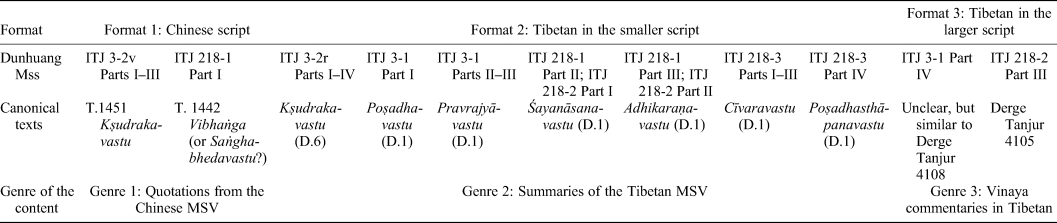
(2) In the two manuscripts, the format (i.e. script and language) and content are clearly linked (Table 8). The three layers of handwriting convey three distinct genres of texts. Specifically, the Chinese writings are always in red and are mostly verbatim quotation from Yijing's Chinese translation of the Mūlasarvāstivāda Vinaya. For instance, IOL Tib J 3-2r Parts I and II come from the Chinese Kṣudrakavastu (today's T. 1451), while IOL Tib J 218-1r Part I is literally identical to the verse from the Chinese Vibhaṅga (today's T. 1442). The Tibetan writings in the smaller, cursive script are not direct quotations, but summaries of the Tibetan translations of the Mūlasarvāstivāda Vinaya, including the Kṣudrakavastu, Poṣadhavastu, Pravrajyāvastu, Śayanāsanavastu, Adhikaraṇavastu, Cīvaravastu, and Poṣadhasthāpanavastu. Of the two Tibetan passages in the larger script, one is an extract from the Vinayasaṅgraha, while the source of the other is unclear, but it should be a commentary in genre.
The correspondences between format and content

(3) The three layers of handwriting were not written randomly but display a noticeable (albeit not always clear) inner-textual affinity. First, there is notable textual correspondence between the Chinese parts and the Tibetan in the smaller script. In the case of IOL Tib J 3-2, Chinese Parts I and II on the recto and the Tibetan passages on the verso narrate one and the same story of the marriage of Prasenajit and Mallikā. In addition, all the texts in IOL Tib J 3-2, whether in Chinese or Tibetan, come from the same text, the Mūlasarvāstivāda Kṣudrakavastu. It is likewise essential to note that all of the above Chinese versions are part of Yijing's translation from Sanskrit, while the Tibetan versions are summaries from the translation from Sanskrit produced by Vidyākaraprabha, Dharmaśrīprabha, dPal ’byor, et al. Although the source texts are independent translations in different languages, the scribe(s) of these manuscripts could read and refer to them with great facility and incorporated them into the same manuscript, which reveals the remarkably high level of bilingualism in Dunhuang. The inner-textuality between the Chinese and Tibetan texts further demonstrates that these manuscripts were not hasty scribbles but a production with a careful textual arrangement. In the case of IOL Tib J 3-2, the Chinese sentences written in red ink and the Tibetan text (Part I) represent different textual sources of the same Vinaya story. In other words, we can tell from IOL Tib J 3-2 that, however diverse these texts seem to be in terms of language or script, the Chinese Parts I and II and Tibetan Part I form a thematically connected and coherent narrative unit. The creators could use the texts in Chinese or Tibetan without any difficulty.
Concerning the Tibetan in the larger script and the other two handwritings, they seem to have been originally produced in different writing projects. The two passages in the larger Tibetan script are in genre Vinaya commentaries on the Prātimokṣasūtra, which were plausibly written in the same project as another Dunhuang manuscript IOL Tib J 14.Footnote 91 Most sentences in the larger script of IOL Tib J 3 and 218 were deleted or scrubbed to write the Tibetan passages in the smaller script. It is possible that the two manuscripts were first intended to feature Vinaya commentaries in the larger script, but were discarded for various reasons (possibly scribal errors, the poor condition of the paper, or the halting of the project), and other Buddhists later reused these folios as the support for writing the bilingual Vinaya content. Under this hypothesis, the passages in the larger Tibetan script would be regarded as a textual production independent of the other two layers of writings.Footnote 92
(4) A purely speculative scenario for the creation of the two manuscripts, at least their Chinese parts and Tibetan parts in the smaller script, is that Dunhuang monks composed this bilingual composite manuscript as notes or a syllabus for Vinaya learning, preaching, or commentary composition. It is also possible that these two manuscripts were intended as (part of) the draft for a Vinaya anthology or reference book for preaching or monastic education. I intend to publish in the future many more similar Dunhuang manuscripts carrying stories summarized from the Vinaya. Whether all of them belonged to the same manuscript project or not needs still to be scrutinized. Judging from the cursive and compressed writing, these manuscripts were most likely not intended for circulation among students or laypeople. They were possibly created for personal use among a limited number of Vinaya specialists.
(5) Textual comparisons have revealed that the Dunhuang summaries of the Tibetan Mūlasarvāstivāda Vinaya texts do not entirely resemble their corresponding versions in the Kanjurs. First, as discussed above, many Tibetan translations of proper names in these Dunhuang manuscripts differ from the Kanjur translations, and seem to have been rendered directly from Sanskrit (e.g. IOL Tib J 3-1 and IOL Tib J 218-3). Second, we also observe many linguistically pre-classical features in the Dunhuang manuscripts:Footnote 93 for instance, the appearance of reverse gi gu; the insertion of ya subscripts between the letter ma and the vowels gi gu or ’greng bu; the regular use of da drag; and the frequent interchange of the graphemes c/ch, ts/tsh, p/b (and sometimes ph), and t/d.
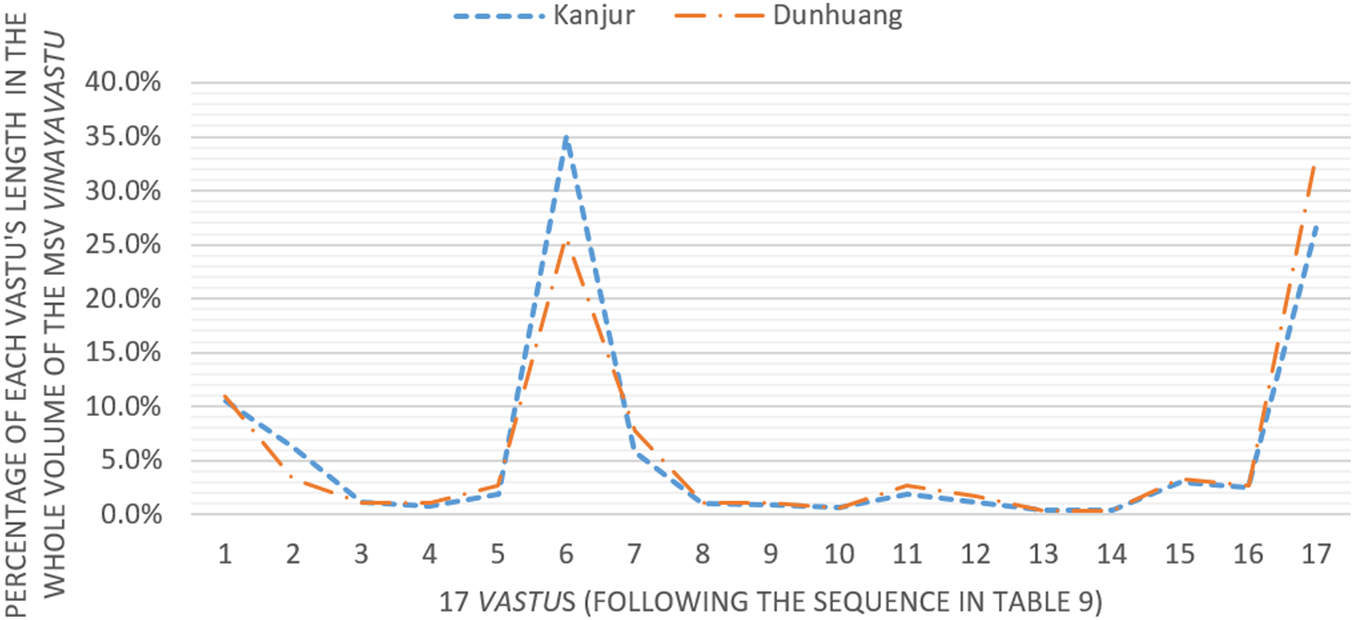
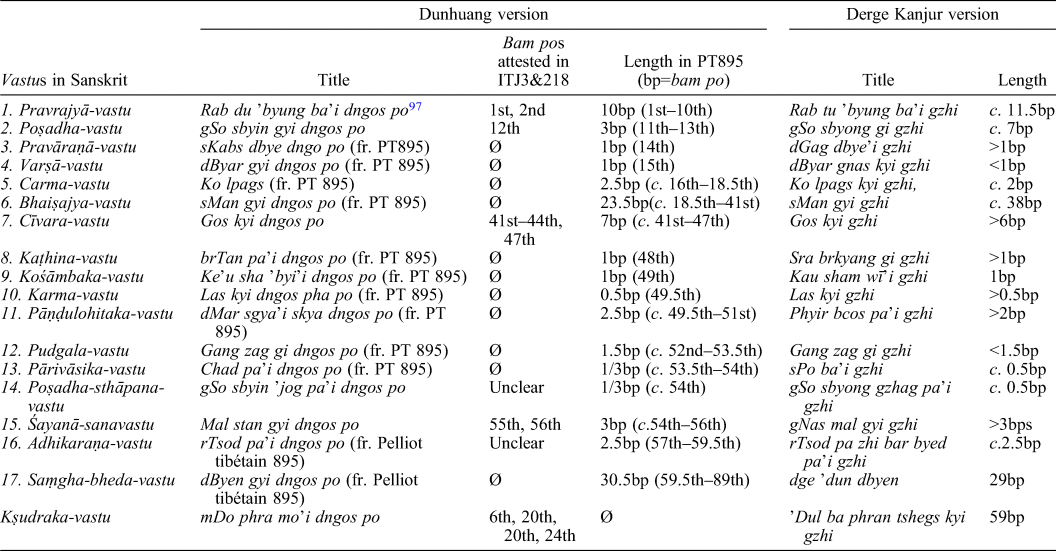
Putting the orthographical issues aside, the most salient discrepancy between the Dunhuang and the Kanjur versions lies in their different ways of translating the titles. The Kanjurs, following the translations included in the Mahāvyutpatti, render the Sanskrit vastu as gzhi,Footnote 94 while the Dunhuang version adopts dngos po, another popular translation of vastu. Moreover, I find a list of 17 Vinayavastus in another Dunhuang manuscript, Pelliot tibétain 895, in which the Tibetan title, sometimes together with variant titles, and the textual length are also provided.Footnote 95 Table 9 offers a comparison between the Dunhuang and Kanjur versions with regard to each chapter's title and length. From the table, we can see that IOL Tib J 3 and 218 agree with Pelliot tibétain 895 in both title and textual length. These three manuscripts possibly reflect the popular version of Mūlasarvāstivāda Vinayavastu texts in Dunhuang.Footnote 96 There are points of both agreement and disagreement between the version of the Mūlasarvāstivāda Vinayavastu texts popular in Dunhuang and that later canonized in Kanjurs. The Dunhuang and Kanjur versions accept the same sequence of the 17 Vinayavastus. Moreover, in the canonical Mūlasarvāstivāda traditions, the Kṣudrakavastu is not usually counted among the Vinayavastus, but is treated as a separate section (Clarke Reference Clarke and Silk2015: 63). The separate treatment of Kṣudrakavastu is likewise attested in Dunhuang manuscripts: in IOL Tib J 3, the Kṣudrakavastu's bam pos were not counted together with other Vinayavastus (cf. also Table 9). However, the Dunhuang version may have adopted a different bam-po calculation method compared to the Kanjur version, if we could not say for sure that the Dunhuang version of the Mūlasarvāstivāda Vinayavastu is absolutely shorter than the Kanjur version – as Table 9 reveals, the Dunhuang version contains approximately 91 bam pos in total, in contrast to the 109 bam pos in the Kanjurs. Figure 19 compares how the Dunhuang version differs from the Kanjur version based on the length of each vastu as a proportion of the entire Mūlasarvāstivāda Vinayavastu. We can tell that the two versions trace similar graphic lines for the most part, which means that the Dunhuang and Kanjur versions share similar proportions for each vastu across the whole of the Mūlasarvāstivāda Vinayavastu. In other words, the Dunhuang and Kanjur versions do not differ considerably from each other in the proportion of each vastu compared to the full text. The main difference between the two versions lies in the textual length of the Poṣadhavastu, Bhaiṣajyavastu, and Saṅghabhedavastu: in the cases of the Poṣadhavastu and Bhaiṣajyavastu, their Kanjur version is conspicuously longer than the Dunhuang version, while the Saṅghabhedavastu takes a larger proportion in the Dunhuang version of the Mūlasarvāstivāda Vinayavastu.
A comparison between the Dunhuang and Kanjur versions of the length of each MSV Vinayavastu

Titles and length of MSV Vinayavastus in the Dunhuang and Kanjur versions

It is still an open question whether a complete Mūlasarvāstivāda Vinaya collection was circulating in Dunhuang. We have now seen Vinayavastu summaries from a variety of Vinayavastus, including Poṣadhavastu, Pravrajyāvastu, Śayanāsanavastu, Adhikaraṇavastu, Cīvaravastu (all above are from IOL Tib J 3 and 218 discussed in this paper); moreover, we also encounter the Poṣadhasthāpanavastu (fr. IOL Tib J 1), Saṅghabhedavastu (fr. IOL Tib J 1), and the Kṣudrakavastu (fr. Pelliot tibétain 913, 914, IOL Tib J 3 and 218). These summaries seem to have been composed locally in Dunhuang, as we encounter different summaries for the same story in different manuscripts (for instance, the one from the project of IOL TIB J 3 and 218 is not identical with the other from IOL Tib J 1). Moreover, there is the recurring expression zhib tu [ni] ’dul ba'i dngos po bam po XX la ’byung ngo at the end of many summaries (such as in Pelliot tibétain 913-3r6 and IOL Tib J 1-7r10). This seems to suggest that a collection of Vinayavastu texts was at the disposal of interested Dunhuang monks.
IV. Conclusion
Under the sway of the dominant “waste” theories – whether the “library waste” or the “sacred waste” theory – we tend to default to the conclusion that IOL Tib J 3 and 218 contain independent Chinese and Tibetan texts joined in the process of recycling discarded manuscripts. As such, it would not appear worthwhile to spend time on these two unrefined manuscripts that bear clear marks of deletion and erasure, much less to take pains to read their tiny, ornately cursive, and tightly compressed writings.
However, the present paper demonstrates that the two Dunhuang manuscripts IOL Tib J 3 and 218 have a much more complicated textual nature and contain rich philological implications that have long been neglected. With regard to their inner-textual relationship, on the one hand, these two manuscripts were probably part of the same text, in light of the shared three-layer handwriting layout and the common genre of textual sources. On the other hand, the three layers of handwriting were not written randomly, but exhibit clear-cut functions: while the larger Tibetan script was used to write Vinaya commentaries, the smaller Tibetan script was used in writing summaries from Tibetan translations of the Mūlasarvāstivāda Vinaya mūla texts, while the Chinese consists of direct quotations from Chinese Mūlasarvāstivāda Vinaya translations. Independently of whether the texts in the larger Tibetan script were created by the same group of Buddhists as the other two handwritings, the Chinese texts and the Tibetan text in the smaller script display a strong thematic affinity in certain cases: the Chinese texts and the Tibetan Part I of IOL Tib J 3-2 both narrate the story of the marriage of Prasenajit and Mallikā. Further, it is worth mentioning that Tibetan Part I of IOL Tib J 3-2 in the smaller script, though functioning as narrative details on the corresponding Chinese texts, were not translations from Chinese, but from Sanskrit. We can perceive that these texts proceeded from the high-level bilingualism of Dunhuang Buddhist communities, who could read Chinese and Tibetan fluently and freely. Moreover, the Chinese texts contained in these two Dunhuang manuscripts resemble the canonical Chinese versions. However, the Tibetan summaries found in Dunhuang are not totally identical to their Kanjur parallels: apart from the divergence in translating specific nouns, the version of the Mūlasarvāstivāda Vinayavastu on which the Dunhuang summaries are based is much shorter than the Kanjur versions. As for the function of the composition of these manuscripts, it is speculated the bilingual composite manuscripts serve as notes, syllabi, or drafts of a Vinaya anthology for Vinaya teaching, preaching, or commentary composition. The cursive and compressed style of writing suggests that these manuscripts were most likely not intended for circulation among students or laypeople, but for personal use among a limited number of Vinaya specialists.
Last but not least, there remain many questions that still puzzle me. For instance, the identity of the monk gZi brjid snying po and his role in creating this manuscript is by no means clear. Moreover, there remains the complicated question of why the creators chose to make summaries of certain chapters of the Mūlasarvāstivāda Vinayavastus and not others. To put it differently, the motivation for the creation of these composite manuscripts is still not entirely clear. Although I have identified all texts but one (IOL Tib J 3 Part IV) in the canonical versions, the present study still only sheds a glimmer of light onto these enigmatic artefacts and needs further research, combined with the study of manuscripts such as Pelliot tibétain 895, 896, 908, 912, 913, 914 and IOL Tib J 1 and 14.