INTRODUCTION
The trend of increasingly frequent natural disasters and infectious disease outbreaks has been observed, in both developing and developed nations.Reference Guha-Sapir, Hoyois and Below1 These public health emergencies place considerable demand on the health care service, increasing the demand for human and material resources. Pre-emergency planning is vital to minimize the burden of these events on the health service and is a health care priority.Reference Nelson, Lurie, Wasserman and Zakowski2 In these situations, the medical student population has the potential to provide much needed volunteer support, relieving some of the burden placed on the health care service.Reference Nelson, Lurie, Wasserman and Zakowski2 Using the concept of ready, willing, and able by McCabe et al., they suggest that to achieve an appropriate response to a disaster, individuals must be adequately trained, available to take prompt action, and willing to be involved.Reference McCabe, Barnett, Taylor and Links3 Previous work has demonstrated variable interest among health care workers and students to volunteer in emergency situations, ranging widely from 27% to 96%.Reference Ko, Feng and Chiu4Reference Fothergill, Palumbo and Rambur8 The implementation of a disaster medicine curriculum has been demonstrated to be feasible in other jurisdictions but has yet been introduced into the Irish medical education curriculum. Volunteering has long been a feature of university student life: It is generally viewed as good for students and communities. Student volunteering involves helping out and giving back in the communities in which students are learning. Factors influencing their willingness to volunteer include prior training, prior emergency volunteer experience, the perception of value of the experience, the belief in duty, financial security, and the availability of personal protective equipment.
Willingness of Irish medical students to volunteer in emergency situations is unknown. An understanding of student willingness and influencing factors will assist policy-makers and non-governmental organizations in successfully preparing and deploying health care teams in emergency situations, which may be augmented by medical student participation. Our study aimed to identify medical student willingness to volunteer in various emergency situations, motivating factors, barriers to volunteering, and to explore potential roles of medical students in an emergency.
METHODS
We developed a cross-sectional survey study employing an online survey data collection tool (SurveyMonkey.net). Participants were recruited from all students enrolled in medical courses in the National University of Ireland, Galway. Participants were provided with a URL to survey by e-mail, which was disseminated by school administrators. The survey remained open for 2 months (October and November of 2015). Students were provided with an information sheet and gave online consent before commencing the survey.
Statistical Analysis
All analyses were conducted using SPSS version 22 (IBM Corp, Armonk, NY) analytical software. Scalar variables were described using means and standard deviations. Pearson’s chi square correlation, independent t-tests, and multinomial regression were used to assess the significance between respondent demographics and willingness to volunteer in emergency situations.
The free text data were independently analyzed by 2 investigators using a general inductive approach. Responses were read several times to familiarize the coders with the data. A coding framework was then developed, where the coding framework was altered and the data reanalyzed if new themes were identified. Through this process, broad categories were identified, reviewed, and defined.
Ethics
Ethical approval was granted by the National University of Ireland, Galway College of Medicine Nursing and Health Sciences Research Ethics Committee.
RESULTS
Participant Demographics
The survey was sent out to 910 medical students, of whom 274 replied (30.1% response rate). The mean age of participants was 21.4 +/- 2.0, and 189 (69.0%) were female. Of participants, 211 (77.0%) were Irish, 23 (8.4%) were from North America, 32 (11.7%) were Asian, 2 (0.7%) were from other European Union countries, and 6 (2.2%) were from other non-European Union countries; 57 (20.8%) were junior medical students, 122 (44.5%) were intermediate medical students, and 95 (34.7%) were senior medical students.
Previous Health Care Volunteer Experience
Among the 274 respondents, 88 (32.1%) had previous experience of volunteering in the health care setting. Respondents were given the opportunity to elaborate using free text to describe their previous health care experience and their individual roles; 35 (39.8%) volunteered with an Irish health organization, 28 (31.8%) with a health organization outside of Ireland, and 25 (28.1%) with an Irish student organization. Students were actively involved in community activities, providing first aid at community events such as races and sporting events. Many were actively involved in patient care, assisting in dressing changes, feeding, wellness checks, and vaccine administration. In addition, a few have volunteered in social aspects of patient care, talking with patients, directing patients around the hospital, and transporting patients around the hospital.
Motivating Factors
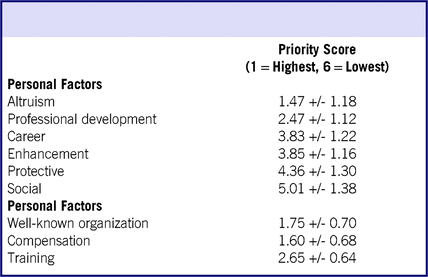
Of participants, 97.8% (n = 268) indicated that altruism (concern for welfare of others or helping those in need) was a motivating factor, 82.5% (n = 226) indicated professional development (opportunity to learn new skills, get more training in emergency response and work in a new environment), 55.1% (n = 151) indicated career (chance to improve CV, increase job opportunities, and make contacts), 16.1% (n = 44) indicated social (social obligation to community), 9.9% (n = 27) indicated protective (reduces guilt about those less fortunate), and 56.6% (n = 155) indicated enhancement (increase in self-confidence in similar situations). Participants were asked to rank these 6 motivating personal factors (Table 1), with altruism and professional development ranking the highest. Non-personal factors that were identified included participating with a well-known and well-run organization 82.8% (n = 227), receiving compensation for travel or accommodation 32.8% (n = 90), and receiving training before work 91.6% (n = 251). Participants were asked to rank these factors (see Table 1), with receiving training before volunteering ranking the highest.
Ranking of Motivating Factors

Barriers to Volunteering
Identified barriers included work commitments 19.7% (n = 54), family/social commitments 25.2% (n = 69), academic commitments 78.1% (n = 214), lack of information on opportunities 61.3% (n = 168), and financial implications of volunteering 66.1% (n = 181).
Opinions on Volunteering in Emergency Situations
The majority (53.6%, n = 147) of participants agreed that health care professionals have a moral obligation to volunteer in emergency situations, and 81.0% (n = 222) believed that students should be encouraged to volunteer in an emergency situation. Only a minority of students (23.7%, n = 65) believe that their current skills and experience would be useful in an emergency situation. The majority (59.9%, n = 164) believed that volunteering in an emergency setting held a high risk of danger.
Of participants, 69.0% (n = 189) were willing to volunteer in the event of a natural disaster (earthquake, tsunami, etc.), whereas only 59.1% (n = 162) were willing to volunteer in an event of an infectious epidemic. This was further reduced to 30.7% (n = 84) when asked specifically about malaria or Ebola outbreaks. Only a minority of students (35.0%, n = 96) were more willing to volunteer in a developed country rather than a developing country.
Roles During Emergency Situations
Participants were asked what roles they would expect to assume in the event of a large-scale emergency situation using free text, where 211 participants provided responses. Only a small minority of respondents (n = 12; 5.7%) believed that there was no role for them to play in an emergency situation; these respondents defended their opinions by indicating that a lack of training was their deterrent. The remainder of responses were coded into 3 categories: direct medical role, indirect medical role, and administrative role. The vast majority of respondents indicated that they saw themselves in direct medical roles (n = 151; 71.6%). These respondents also commonly identified that their lack of training was a major barrier; however, they were eager to provide any medical assistance that was within their level of knowledge. This included taking histories and conducting physical exams, collecting vitals and minor wound care, obtaining intravenous access, taking bloods, and administering vaccinations. Responses often indicated that they would be happy taking instructions from senior physicians and helping wherever they were needed. Respondents also indicated that they would assume an indirect medical role (n = 28; 13.3%). This included distributing food and water, setting up mobile clinics, transporting patients, providing health counseling, patient advocacy, and various tasks as needed that would streamline the care pathway. Finally, 20 (9.5%) of respondents indicated that they see themselves playing an administrative role. This included the distribution of medication and equipment between sites, finding accommodation for displaced individuals and communication between sites.
DISCUSSION
Our study demonstrates that 32.1% of medical students have previously volunteered in a health care setting. Respondents also indicated that they were willing to volunteer in an emergency setting, ranging from 69.0% in the event on a natural disaster to 59.1% in the event of an infectious outbreak.
In comparison, a study of inactive nurses demonstrated that 27% would be interested in volunteering in a disaster situation,Reference Fothergill, Palumbo and Rambur8 with motivating factors including altruism and a sense of professional identity. A large survey conducted at a Canadian university also demonstrated that 49% of staff and students would likely volunteer during an influenza outbreak.Reference Rosychuk, Bailey and Haines5 The study also demonstrated a strong belief (79%) that health care students have a moral and professional obligation to volunteer during an epidemic, a belief that is echoed in both our study and others.Reference Kaiser, Barnett and Hsu7, Reference Mortelmans, Bouman and Gaakeer9
While these studies demonstrate a willingness of medical students to volunteer during a health care emergency, there is doubt amongst respondents as to whether they have the skills necessary to be involved. Our study demonstrated that only 24% believed that their current skill level would be beneficial, akin to results from other studies.Reference Kaiser, Barnett and Hsu7, Reference Markenson, Woolf, Redlener and Reilly10 These findings would support the development and implementation of “just-in-time” training programs by organizations that might plan to utilize medical student volunteers.Reference Motola, Burns and Brotons11, Reference Ardalan, Linkov, Shubnikov and LaPorte12 These programs may enhance student confidence, willingness to volunteer, and address the concerns of medical students that they lack the required skills to be of use.
Undergraduate and postgraduate training programs alike are being encouraged to develop core global health clinical competencies that may help provide medical students with the knowledge and skills required, and some medical schools are developing curriculum on disaster preparedness.13
These studies highlight that medical students represent an untapped potential volunteer workforce during a health care emergency. However, it is worth reflecting on the effects of volunteering during a chaotic emergency situation on future health care practitioners.Reference Chen, Goodman and Flore14 One study of medical students who volunteered during the March 2011 Japanese tsunami and earthquake did not demonstrate a harmful event on medical student volunteers.Reference Anderson, Prioleau and Taku15 Previous experience in emergency planning shows the biggest challenge may be the identification and recruitment of volunteers. With proper training, medical students demonstrate a strong interest in filling that void.
One of the challenges we have seen in previous disasters is that they arrive with previously unseen challenges and environments. Effective disaster medicine preparedness organizations must create a culture that promotes creativity and willingness to adapt.Reference Harrald16 In the face of the high demand for volunteers, there is a need for these organizations to recognize, train, and mobilize this potential medical student volunteer force.
Study Strengths and Limitations
In our study of 274 medical students (response rate – 30.1%), it is possible that students who have an interest in volunteering will be more likely to complete the survey, influencing the generalizability of our results with the potential of non-responder bias.
CONCLUSION
Medical students have demonstrated considerable willingness to actively participate during health care emergencies. Further research and experience are needed to design structured training programs and to identify appropriate roles of medical students during these events that will allow them to be ready, willing, and able when the call arises.Reference McCabe, Barnett, Taylor and Links3
Conflict of Interest Statement
The authors have no conflicts of interest to declare.