INTRODUCTION
Speech is not a uniform, constant signal. Instead, it evokes the impression of melodic and rhythmic fluctuations, with certain parts (i.e. words, syllables) standing out more than others. The patterning of alternations between stronger and weaker syllables belongs to the study of prosody. Prosody seems to be a universal feature of human languages, as it has also been described in sign languages, which do not use the acoustic modality (Brentari, Reference Brentari1998). This paper aims to study the development of prosodic prominence in early utterances, babble and words, of typically developing infants acquiring Belgian Dutch. Moreover, the impact of the emergence of vocabulary on prosodic abilities is of particular interest in this study.
Prosodic phenomena have been described at several levels. At word level, the most prominent syllable is said to bear word stress, e.g. the syllable straw in strawberry. sentence stress or sentence accent denotes the most prominent word at the sentence level (for in-depth discussions, see Nespor & Vogel, Reference Nespor and Vogel1986, and Selkirk, Reference Selkirk1984). Acoustically, prominence at different linguistic levels is usually the result of the single or combined use of an increase in fundamental frequency (f0), intensity, and duration in syllables (Kochanski, Grabe, Coleman & Rosner, Reference Kochanski, Grabe, Coleman and Rosner2005; Lieberman, Reference Lieberman1960).
The acoustic properties of word stress seem to be highly salient to infants, and they already play a role from birth onwards (Sansavini, Bertoncini & Giovanelli, Reference Sansavini, Bertoncini and Giovanelli1997). Studies focusing on the perception of word stress in the first year of life confirm this early sensitivity by showing a preference for the predominant stress pattern of the ambient language (Friederici, Friedrich & Christophe, Reference Friederici, Friedrich and Christophe2007; Jusczyk, Cutler & Redanz, Reference Jusczyk, Cutler and Redanz1993). These results with very young infants suggest that it is possible to acquire the acoustic correlates of stress through a purely bottom-up, acoustic strategy. However, the acoustics of prosodic phenomena are not always transparent. Pierrehumbert (Reference Pierrehumbert2003) offers a thorough discussion of the problem of phonetic variability in acquisition, pointing out that frequently a one-to-one relation between a prosodic phenomenon and an acoustic cue may not be evident: different acoustic correlates of stress are used across languages and talkers (Nespor, Shukla, van de Vijver, Avesani, Schraudolf & Donati, Reference Nespor, Shukla, van de Vijver, Avesani, Schraudolf and Donati2008; Sluijter & van Heuven, Reference Sluijter and van Heuven1995).
Experimental evidence further suggests that a bottom-up acquisition strategy cannot be the sole mechanism, since the manner in which word stress is encoded and processed also depends on its function within a language (Cutler, Reference Cutler, Pisoni and Remez2005; Dupoux, Sebastian-Galles, Navarrete & Peperkamp, Reference Dupoux, Sebastian-Galles, Navarrete and Peperkamp2008). For instance, Skoruppa et al. (Reference Skoruppa, Pons, Christophe, Bosch, Dupoux, Sebastian-Galles, Limissuri and Peperkamp2009) found that the acoustic sensitivity of 9-month-old infants was determined by the lexical function of word stress in the ambient language. Infants were more sensitive to changes in stress patterns if they acquired a language which uses contrastive lexical stress to differentiate between homonyms, like Spanish, than when acquiring a language with fixed word stress, like French. Hence, the phonology of stress and its role in the vocabulary influences the ability of infants to abstract and store patterns of the acoustic input.
A similar situation has been described in the literature on early speech production, where a role for the infant's vocabulary in learning to produce word stress has been posited. This suggestion emerged because although some research found evidence that infants potentially had the necessary control of the acoustic cues for the production of prominences in speech, they did not always apply this consistently, or in accord with the stress pattern of their native language (Davis, MacNeilage, Matyear & Powel, Reference Davis, MacNeilage, Matyear and Powell2000). Indeed, findings of the early acquisition of word stress are not always conclusive, and there is conflicting evidence regarding the use of prosodic cues in babble and words. For example, whilst Hallé, De Boysson-Bardies, and Vihman (1991) reported language-appropriate control of f0 contours for 18-month-old French and Japanese infants, with French infants mainly producing rising and Japanese infants falling f0 contours, Vihman, DePaolis, and Davis (Reference Vihman, DePaolis and Davis1998) found no language-specific strategies in the use of f0 and intensity on first disyllabic words of English and French infants. Hallé et al. (Reference Hallé, De Boysson-Bardies and Vihman1991) found that vowel duration in the babble and words of their participants showed features of the ambient language: French infants displayed final syllable lengthening whereas Japanese infants did not, as this is also reduced in adult Japanese. In contrast, Vihman et al. (Reference Vihman, DePaolis and Davis1998) and Davis et al. (Reference Davis, MacNeilage, Matyear and Powell2000) found little overall evidence for final syllable lengthening in disyllabic babble of 7- to 14-month-old English infants in comparison to adults.
Davis et al. (Reference Davis, MacNeilage, Matyear and Powell2000) approached these inconsistent findings by comparing disyllabic babbled utterances that were judged by adult raters to be clearly stressed with those that were not. Fewer than half of the babbled utterances were judged to contain a clearly prominent syllable, but in these clearly stressed utterances, f0, intensity, and duration were produced in a similar manner to a control group of adult speakers. Furthermore, there was no obvious influence of the predominant strong–weak (trochaic) pattern of English word stress in the clearly stressed syllables. Instead, infants seemed to follow individual preferences for stress assignment, with some producing mainly trochaic forms whilst others favoured iambs (weak–strong). Davis et al. concluded that infants had the capacity to render the necessary cues for prominence, but did not do this consistently in babbled utterances. Moreover, even when they were producing adult-like cues, the preferred adult stress pattern was not yet evident.
These findings led DePaolis, Vihman, and Kunnari (Reference DePaolis, Vihman and Kunnari2008) to conjecture that prosodic control may emerge with the advent of first words. They therefore compared the disyllables at the four-word-point (i.e. the first recording in which the infant spontaneously produced four different identifiable words, with ages ranging from 10 to 18 months) in French, Welsh, English, and Finnish. These languages were chosen because the first two have predominantly iambic word stress patterns and the latter have a majority of trochaic word forms. These stress patterns were, however, not clearly discernible in babble. They argue that language-specific differences in the use of acoustic cues might only emerge at around 18 months, when relatively more words than babble are produced. All four groups realized durational differences in line with their target language. It was concluded that “a more finely tuned use of prosody may require a level of attention to linguistic detail that begins to be possible only as word production becomes well established” (p. 417). It should, however, be noted that this hypothesis could not be verified with inferential statistics, as the study only included the very beginnings of vocabulary acquisition and therefore yielded an insufficient number of words for statistical comparison to babble.
The hypothesis of DePaolis et al. (Reference DePaolis, Vihman and Kunnari2008) is especially relevant, as theories emphasizing the role of vocabulary in phonetic and phonological development have gained increasing interest (see, e.g. Edwards, Beckman & Munson, Reference Edwards, Beckman and Munson2004; Edwards, Munson & Beckman, Reference Edwards, Munson and Beckman2011; Stoel-Gammon, Reference Stoel-Gammon2011; Vihman, Reference Vihman and Foster-Cohen2009). Pierrehumbert (Reference Pierrehumbert2003) conceptualized phonetic development as the process of abstracting phonetic detail over stored lexical items. Werker and Tees (Reference Werker and Tees2005) have argued for a cascading model of perceptual tuning for speech sounds, where complex and integrated tasks such as word learning rest on earlier, more basic sensory acquisition of phonetic categories. These levels are interdependent and linked by feed-forward as well as feed-backward mechanisms, so that lexical representations can in turn guide the uptake of new phonetic information to establish and solidify categories.
These theories were examined in children and adults in a number of studies. Munson (Reference Munson2001) used a nonsense word repetition task to investigate the influence of lexical factors on speech production in three-year-old children and adults. Children repeated less-frequent phoneme sequences with reduced accuracy, longer durations, and more phonetic variability. Adults' productions were also affected, with less-fluent and more variable repetitions of infrequent sequences. This showed that phoneme-sequence frequency effects in the vocabulary had a direct impact on children's phonological abilities to repeat novel words, whilst for adults it had an effect on phonetic skill. The relationship between vocabulary and speech production in children was further explored by Edwards et al. (Reference Edwards, Beckman and Munson2004), who found that children with smaller vocabularies showed a larger influence of lexical frequency on the repetition accuracy of phoneme sequences in nonsense words. Again, low-frequency sequences had longer durations and more phonetic variability than sequences with high lexical frequency. It was argued that children with larger vocabularies had extracted more robust and flexible independent representations for each phoneme, and were therefore able to extend them to new contexts more easily. Finally, Storkel (Reference Storkel2001, Reference Storkel2003) showed that novel word learning was affected by the phonotactic probability contained within the words: words with sound sequences that were more common in children's lexicons were learned more easily. In summary, these studies suggest that different aspects of the lexicon influence phonological and phonetic abilities in children and adults. These factors are the vocabulary size and the frequency and phonotactic probabilities of phoneme sequences contained in the lexicon.
Given the link between lexical and phonetic/phonological abilities in later developmental stages and adulthood, the next question is how early the influence of higher-order language processing can be detected on lower-level phonetic acquisition. The studies reviewed in the previous paragraph showed lexical effects on segmental development, but the impact of vocabulary acquisition on prosodic development is an under-researched area. Moreover, recall that DePaolis et al. (Reference DePaolis, Vihman and Kunnari2008) were not able to confirm the link between the emergence of stable, language-specific stress patterns and the appearance of words through inferential statistics.
The present study therefore seeks to begin to address this gap in the literature by means of a longitudinal phonetic study of prominence patterns in spontaneous speech, and by looking at disyllabic babble and first words. This study not only compares the prelexical and lexical stage, but also includes babble which is produced during the lexical stage. By comparing prelexical and lexical utterances which occur at the same time in development, it is possible to create a more complete picture of the acquisition of prominence than in previous studies. Fundamental frequency, intensity, and duration were measured in the utterances of infants acquiring Belgian Dutch, from the onset of babbling until a vocabulary of 200 words was reached. By including a longer developmental time span than DePaolis et al. (Reference DePaolis, Vihman and Kunnari2008), we aim to assess the effect of vocabulary development through a direct comparison of disyllabic babble and words over time. Just like DePaolis et al., the present study does not make representational claims for the prosodic phenomena measured, instead the focus is on the infants’ ability to render the acoustic surface form of prominence in Dutch, and whether the emergence of vocabulary affects this ability.
To summarize, two sets of research questions are the focus of the present study:
-
1. Is the acoustic realization of prosodic differentiation more prominent in words than in babble? Is there a bias toward the trochaic stress pattern, and if so, is this more prominent in words than in babble?
-
2. Is the development of the acoustic correlates of stress predicted by infants’ vocabulary size, or is stress mastered early in the production of words?
For the first research question, if DePaolis et al.’s (2008) prediction is correct, the ambient trochaic pattern will be clearly present in early words, and individual acoustic cues should show greater differentiation across stressed and unstressed syllables in words than in babble. It is also hypothesized that infants will be aiming at a strong–weak (trochaic) pattern in words, since, in Dutch, the adult lexicon is predominantly trochaic (Cutler, Reference Cutler, Pisoni and Remez2005; Daelemans, Gillis & Durieux, Reference Daelemans, Gillis and Durieux1994; Schiller, Meyer, Baayen & Levelt, Reference Schiller, Meyer, Baayen and Levelt1996).Footnote 1 For babble, it is doubtful whether a clear effect of the strong–weak pattern will be evident, given the ambiguous results of the literature on babbling.
The hypothesis for the second research question is less clear-cut, as there are two equally likely outcomes. As some accounts suggest that phonetic development unfolds as an abstraction over an increasing mass of lexical items (Pierrehumbert, Reference Pierrehumbert2003; Vihman, Reference Vihman and Foster-Cohen2009), it might be the case that an infant's vocabulary size determines how detailed phonetic representations are. Alternatively it can be hypothesized that the nature of lexical utterances themselves strengthens phonetics, i.e. the fact that they are spoken with communicative intent and have linguistic representations may already be enough to increase the infant's ability to produce more differentiated prominence patterns. Therefore, although the lexical status of disyllables should influence cues, an effect of vocabulary size per se will not be seen.
MATERIALS AND METHOD
Participants
The data for this study were taken from the CLiPS Child Language Corpus (CCLC), which is a collection of longitudinal audio–video data and transcriptions of forty typically developing Belgian-Dutch-acquiring infants.
For the purpose of this study, nine children were randomly selected from the corpus. The infants were recruited from daycare centres, families known by the researchers, and by announcements. The infants had been raised in monolingual homes, acquiring the standard variety of Belgian Dutch (Verhoeven, Reference Verhoeven2005). All children were tested for congenital hearing loss in the first month of life by means of an otoacoustic emissions test. All the infants had normal hearing and no cases of otitis media were reported. The typical development of these children had been established on the basis of parent report and a checklist of the attainment of communicative and motor milestones, which is largely based on the checklist developed by Kind en Gezin, the Belgian infant welfare centre (Molemans, van den Berg, Van Severen & Gillis, Reference Molemans, van den Berg, Van Severen and Gillis2012). Normal language development was verified by means of the Dutch version of the CDI (N-CDI) administered at ages (years;months) 1;0, 1;6, and 2;0 (Zink & Lejaegere, Reference Zink and Lejaegere2001).
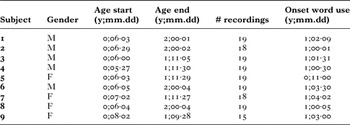
The mean age of these children at the beginning of the recordings was 0;06 (SD = 0;00·22). The mean age at the cut-off point of 200 words was 1;10 (SD = 0;03) (see ‘Data selection’ for more information on the cut-off point). The ages of the individual children at the time of recording are specified in Table 1.
Ages of the individual children at the time of recording

note: Age start = the onset of babbling.
Corpus
The CCLC consisted of monthly recordings of spontaneous interactions between the children and their caretakers in their home environment. For more details on the corpus and transcription, see Van Severen, Gillis, Molemans, van den Berg, De Maeyer, and Gillis (Reference Van Severen, Gillis, Molemans, van den Berg, De Maeyer and Gillis2013). A JVC digital video camera with built-in unidirectional microphone was used to record the data. Recordings lasted 60–90 minutes and the fragments during which the child was most vocally active and in uninterrupted interaction with a caretaker were selected. The final selection was approximately 20 minutes long.
The recordings were phonemically transcribed following the CHAT conventions (MacWhinney, Reference MacWhinney2000). The criteria for distinguishing words (lexical items) from babble were based on Vihman and McCune (Reference Vihman and McCune1994). In order to qualify as a lexical item, utterances had to meet at least two out of three criteria: the first was based on the recurring interactional context in which the utterance occurred: i.e. a context where no other word could fit (e.g. the child utterance baba is interpreted as bal ‘ball’ as it was produced regularly whilst the child showed a ball), or the mother's identification clarified the meaning (e.g. the child utterance baba was interpreted as bal ‘ball’ by the mother). Second, the shape of the vocalization was used as a criterion: it was either an exact phonological match or it matched two or more segments of the target (i.e. pal for bal ‘ball’), or the utterance matched the target in its intonation contour or prosody. The third criterion took into account the relation to other vocalizations: the utterance was imitated or all occurrences of the utterance were identical (i.e. consistent use of popo for opa ‘grandpa’).
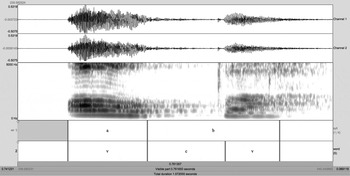
CHAT transcriptions were converted to Praat (Boersma & Weenink, Reference Boersma and Weenink2014) TextGrids using the CHAT2PRAAT function in the CLAN program (MacWhinney, Reference MacWhinney2013). The video files were converted to audio files using Free-Video-Converter (Qixingshi Technology, 2012). The resulting TextGrids were time-aligned to the audio files at the utterance level, as illustrated in Figure 1.
An annotated disyllabic word (auto, /ʌuto/, ‘car’) in PRAAT. The waveform (top) and spectrogram (bottom) were used to segment the speech stream.

Data selection
For the present study, speech data were included from the onset of babbling until children had reached a cumulative vocabulary of 200 words. This cut-off point was chosen because it provided enough relevant data to include all children in statistical analyses. Moreover, vocabulary level as a developmental point is used in other studies (Vihman et al., Reference Vihman, DePaolis and Davis1998). Cumulative vocabulary is used as a standard measure to track lexical development in psycholinguistic studies (Huttenlocher, Haight, Bryk, Seltzer & Lyons, Reference Huttenlocher, Haight, Bryk, Seltzer and Lyons1991; Vanormelingen, De Maeyer & Gillis, Reference Vanormelingen, De Maeyer and Gillis2015), and it is based on a list of the word forms a child produces per individual recording session in a longitudinal study. The first cumulative number of vocabulary items comes from the number of words in the first recording session. For every recording that follows, the list of word types in the new session is compared to the previous one, and the number of new word forms produced is added to the cumulative vocabulary count. The period over which data were collected thus spans the onset of babbling, the emergence of first words, and, as vocabulary sizes increased, the appearance of two- and multi-word utterances (Bates & Goodman, Reference Bates and Goodman1997).
Onset of canonical babbling was determined by a True Canonical Babbling Ratio (tCBR) of 0·15 or higher (Chapman, Hardin-Jones, Schulte & Halter, Reference Chapman, Hardin-Jones, Schulte and Halter2001; Molemans et al., Reference Molemans, van den Berg, Van Severen and Gillis2012). The tCBR is the proportion of syllables with true consonants (i.e. all consonants except glottals (/h/, glottal stop) and glides (/w/, /j/)) over all syllables produced. Since a longitudinal approach was taken in the current study, no artificial boundaries were placed between a babbling phase and a lexical phase, as there was a transitional period where babble and words co-occurred.
Inclusion criteria for disyllables
The waveforms and spectrograms associated with the speech files were examined in order to identify the disyllabic babble and words to be tagged in the PRAAT TextGrids (see Figure 1). Sound sequences were considered to be disyllables when they consisted of two vocalic phases minimally separated by a clear consonantal phase (see ‘Segmentation criteria for consonants and vowels’ below for specification). Additional consonants flanking the vocalic sections were allowed. The inclusion criteria for the disyllables were based on DePaolis et al. (Reference DePaolis, Vihman and Kunnari2008). In order to be considered a single unit, the disyllables had to occur within the same intonation contour or adjacent to a prosodic break such as a pause or an in-breath at the beginning of a new breath group (Lieberman, Reference Lieberman1984). Furthermore, disyllables had to be clearly separated from the surrounding speech by a silence of at least 400 ms with an intersyllabic pause of less than 400 ms. For a small number of items produced at a low speech rate, the pause criterion was relaxed up to 500 ms as long as the two syllables were part of a single intonation contour, indicating cohesion (Cruttenden, Reference Cruttenden1986). However, lexical items from a multiword context were not included in this study. Disyllables were excluded if there was concurrent speech or noise or if they were produced with a creaky, breathy, excessively loud, or whispery voice. An example of a selected utterance is provided in Figure 1.
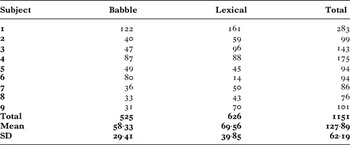
The recordings in the range studied contained a total of 40,928 child utterances, of which 27,807 were prelexical (i.e. babble and vocal play) and 13,121 lexical. The inclusion criteria significantly reduced the number of utterances analyzed. The number of babbled and lexical disyllables per subject is summarized in Table 2.
Number of selected disyllables per subject and utterance type (babble and lexical)

Segmentation criteria for consonants and vowels
The disyllables identified by the procedure described above were further segmented into consonants and vowels, since the acoustic measurements in this study were conducted in the vocalic portion of each syllable. Figure 1 illustrates the annotation of an utterance. The waveform, spectrogram, f0, and intensity curve were used (a) to determine the word boundaries and (b) to segment the disyllables into consonants and vowels. The segment boundaries were identified on the basis of the consistent application of the segmentation criteria, which are described in detail in DePaolis et al. (Reference DePaolis, Vihman and Kunnari2008), and to which the interested reader is referred for more information. Since DePaolis et al. did not specify any criteria for the segmentation of /l/, the onset and offset of the lateral approximant were determined on the basis of the discontinuity on the spectrogram in the intensity and/or frequency of the formants of /l/ and those associated with the preceding or following vowel.
Reliability of the annotations
The data were annotated by the author IDC. Approximately 20% of the data (n = 250) was re-annotated by the author MP. The reliability of the placement of the segment boundaries was analyzed by means of the Pearson's product–moment correlation between the time-points of both annotators. The correlation between the two sets of annotations was 0·99 (p < ·001), which indicates excellent inter-annotator agreement; annotators located the boundaries of segments at virtually the same time-points.
Acoustic analysis
The disyllables that were identified by the procedure described above were analyzed acoustically for the prosodic cues which are relevant to the perception of syllable prominence, duration, intensity, and f0. The acoustic analyses were carried out by means of a PRAAT script (Boersma & Weenink, Reference Boersma and Weenink2014). Each of the three acoustic parameters was measured in the vowels of the disyllables only, not the entire syllable. This was done to reduce potential effects of syllable composition on the measurements. Duration (in ms) was measured from the start to the end of each vowel. Intensity was measured in dB as the mean energy averaged over the total number of analysis frames in the vowel. F0 was determined by means of the PRAAT autocorrelation method and expressed in Hz as the mean f0 averaged over the total number of analysis frames in the vowel. Intensity and f0 were analyzed by the PRAAT analysis settings adjusted to child speech, i.e. the f0 range was set at 150–800 Hz. As there is no gold standard procedure for f0 measurements in child speech we performed multiple analyses to test the robustness of the f0 range setting and reliability of automatic f0 measurements used in this study. These are provided under ‘Supplementary material 1’ (available at <https://doi.org/10.1017/S0305000916000532>).
The intensity range was set at 0–100 dB. It should be mentioned that intensity measurements in general need to be treated with caution. Intensity is very sensitive to background noise and recording quality. Since participants in this study were highly mobile, and clip-on microphones were not used, we controlled for possible problematic intensity values by applying rigid selection criteria, cleaning the collected dataset for outliers, and, most importantly, by computing the ratio between the intensity measurements of the two syllables. Ratio measures have been used in other studies relying on acoustic (Shriberg, Campbell, Karlsson, Brown, McSweeny & Nadler, Reference Shriberg, Campbell, Karlsson, Brown, McSweeny and Nadler2003) and kinematic (Goffman, Reference Goffman1999) analyses of prosodic modulation. The purpose of this study was to investigate the acoustic differentiation between syllables of utterances. Therefore, a ratio between the measurements in each syllable was computed to quantify this differentiation (i.e. durationV1/durationV2 and intensityV1/intensityV2). This also had the effect of normalizing the intensity in louder utterances. The direction of the prosodic differentiation is contained in the ratio: a trochaic tendency is a ratio above one and an iambic tendency is a ratio below one. The perceptual f0 distance between the first and the second vowel in each disyllable was calculated by means of the formula |39,86 log10(f0V2/f0V1)|. The absolute pitch distance specifies the perceptual distance in semitones between the first and the second vowel in each disyllable. For the pitch distance, the polarity of the signed value indicates the direction of the differentiation: a negative value represents a trochaic pattern whereas a positive number is an iambic pattern.
The final dataset consisted of 1151 disyllables, of which 525 were babble and 626 were words (for numbers per participant, see Table 2). The data were cleaned by means of the interquartile rule (IQR). This was done separately for every acoustic measurement, i.e. pitch distance, intensity ratio, and duration ratio, and for babble and words separately. Per measurement, every value above or below the IQR threshold was identified as an outlier and excluded from the statistical analysis. For pitch distance, 4·1% of the disyllables were considered outliers, and 1103 utterances were included in the statistical analysis. For intensity ratios, 5·7% of the disyllables were outliers, and 1085 utterances were statistically analyzed. For duration ratios, 0·01% of the utterances were outliers, and 1139 utterances were analyzed. Utterances excluded for one of the three cues were not necessarily outliers for the other cues.
Statistical approach
Linear mixed models (LMM) were used for the data analysis (Baayen, Reference Baayen2008). LMM are particularly suited for analyzing longitudinal corpus data because of their hierarchical structure: the observations (n = 1151) are measured at different time-points embedded in different participants (n = 9). Moreover, linear mixed models are robust to missing and unequal numbers of observations for participants and time-points. Importantly, when examining the effects of independent variables, LMM take into account variation at the participant level as well as variation over time.
The analyses were carried out in R (R Core Team, 2013) using the lme4 package (Bates, Maechler, Bolker & Walker, Reference Bates, Maechler, Bolker and Walker2014) to generate models for the ratio of each prosodic cue. Each model consisted of random and fixed effects. In all analyses, the random effects provided random intercepts and slopes for each individual and the age-points within individuals. The fixed effects that were added to each model depended on the research question addressed by the analysis and are clarified in the next paragraphs. The statistical procedure consisted of two phases. A hierarchical approach was taken to build the models; the random and fixed effects were added one by one. At each step, a likelihood ratio test was carried out to arrive at the best-fitting model for the data, i.e. the model explaining the largest amount of variance with the fewest predictors. In the second phase, we took the best-fitting model and checked which effects were significant predictors. The estimates (henceforth E), standard errors (S.E.), t-, and p-values of the fixed effects of the best-fitting models are reported in the ‘Results’ section.
The first research question concerned the effect of age and utterance type (i.e. babble or word) on the three acoustic cues. Therefore these predictors and their interactions were entered as fixed effects in the first set of analyses. For all models, age squared was added to test for non-linear development, but since this effect never significantly improved the fit of the models it will not be reported. The second research question concerned the effect of vocabulary size on the realization of the three cues. Therefore a second set of analyses with cumulative vocabulary as a fixed effect was conducted on the lexical utterances only (n = 626) for each of the acoustic cues. Again, the random effects provided random intercepts and slopes for each individual and the developmental points within individuals.
However, since age and cumulative vocabulary were highly correlated in our dataset (the Pearson's correlation coefficient r = 0·81, p < ·001), the possible vocabulary effect will be linked to increasing age. The best-fitting model with vocabulary as fixed effect and the best-fitting model with age as fixed effect were compared by inspecting the residual variances. All models with cumulative vocabulary as a longitudinal predictor had the lowest residual variances and were therefore deemed the most explanatory. Therefore only these models will be reported in the ‘Results’ section (the output of all models is provided in ‘Supplementary material 2’). In the build-up of the models, cumulative vocabulary squared was added, but as this never significantly improved the fit it will not be reported further.
RESULTS
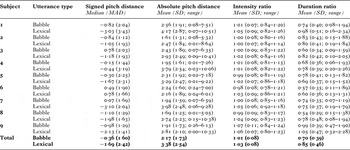
Table 3 summarizes all three measurements per subject and utterance type.
Summary of the measurements per subject and utterance type (Babble and Lexical)

notes: MAD = median absolute deviation; SD = standard deviation; pitch distance: negative value = trochaic pattern, positive value = iambic pattern; intensity and duration ratio: ratio > 1 = trochaic pattern, ratio < 1 = iambic pattern.
Analysis 1: prosodic differentiation in babble and words
Fundamental frequency
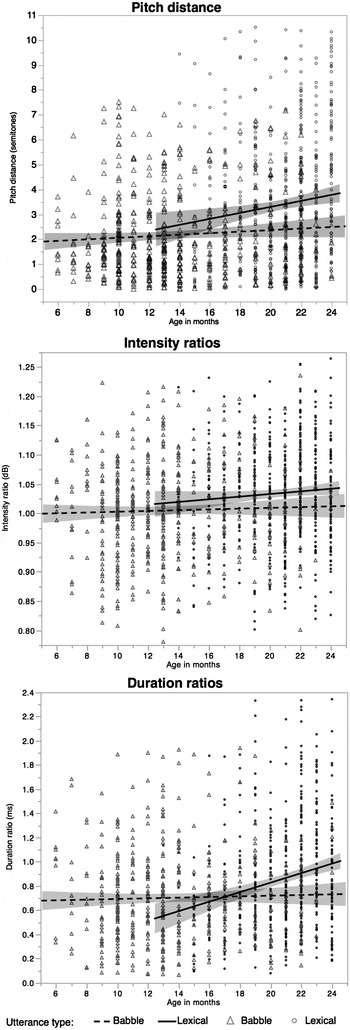
For pitch distance, the absolute pitch distances (i.e. the unsigned value of the distance score between syllable 1 and syllable 2) were entered into the model. The best-fitting model consisted of the fixed effects of age and utterance type (babble or word). The results are displayed in Figure 2 and the output of the statistical model is provided in ‘Supplementary material 2’. The estimate of the intercept was 3·261 (SE = 0·236, t = 13·769, p < ·001), with ‘words’ as reference level for the factor of utterance type. The fixed effect of age showed no significant development over time (E = 0·045, SE = 0·028, t = 1. 593, p = ·127), indicating that pitch distance did not increase in older infants. However, there was a significant effect of utterance type on pitch distance (E = –0·694, SE = 0·197, t = –3·529, p < ·001); this fixed effect indicates that the pitch distance was substantially larger in words than in babble. If we were furthermore interested in the type of stress pattern, the polarity of the signed pitch distance numbers need to be taken into account. Negative pitch distances indicate higher pitch on the first syllable (i.e. a trochaic tendency); positive pitch distances imply higher pitch on the second syllable (i.e. an iambic tendency). Table 3 shows the descriptive statistics that ascertain the type of stress pattern. Since no inferential statistics were performed on the stress pattern, these findings should be interpreted cautiously. The values in Table 3 show that a trochaic tendency is apparent in the babble of six out of nine infants and is boosted towards an even stronger trochaic tendency in the words of eight infants, as signed pitch distance values became more negative. Only participant 6 did not expand the differentiation towards a trochaic pattern. This might be due to the limited lexical utterances for this participant (n = 14, see Table 2).
Scatterplots of the measurements for both lexical and babbled utterances.

In answer to research question one, pitch distance on words was thus greater than on babble, and negative polarity suggested a trochaic pattern on words which was already partly evident in babble.
Intensity
As for fundamental frequency, the best-fitting model for intensity had age and utterance type as fixed effects in the statistical model (see ‘Supplementary material 2’). The estimate of the intercept was 1·030 (SE = 0·009, t = 115·786, p < ·001), again with ‘words’ as the reference level for the factor of utterance type. Although the fixed effect of age significantly improved the fit of the model, the effect itself was not significant, indicating hardly any development over time (E = 0·001, SE = 0·001, t = 0·809, p = ·427). However, the fixed effect of utterance type (E = –0·016, SE = 0·007, t = –2·183, p = ·029) suggests that intensity was not used to the same extent for babble and lexical material, with Figure 2 confirming that the intensity ratio was smaller in babble. In addition, the mean intensity ratios of babble and words were above or around 1, indicating a tendency towards a trochaic pattern (see Table 3). This was confirmed in the words of all nine participants and in the babble of six subjects, as can be seen in the individual data. Thus, in relation to the first research question, words showed increased amplitude modulation in comparison to babble, with the direction of modulation consistent with a trochaic prosodic structure.
Duration
The best statistical model for duration included utterance type and the interaction between age and utterance type as fixed effects in the statistical model (see Supplementary material 2). The estimate of the intercept was 0·856 (SE = 0·055, t = 15·678, p < ·001), with ‘words’ as reference for the factor of utterance type, as above. There was a significant interaction effect between utterance type and age (E = –0·037, SE = 0·010, t = –3·790, p < ·001), indicating that the ratios increased in the words with age. Since the estimate for the duration ratio was smaller than one, an increased ratio over time indicates a decrease in differentiation between syllables, i.e. a trend towards more even-timed syllables in words. The significant effect of age (E = 0·037, SE = 0·009, t = 3·920, p < ·001), irrespective of utterance type, is likely to be driven by the ratio increase on the lexical utterances, since the slope for babble is flat (see Figure 2). Indeed, utterance type was also a significant effect, since babble overall had smaller duration ratios than did lexical utterances (E = –0·126, SE = 0·48, t = –2·614, p = ·009), indicating a bigger durational contrast between syllables in babble than in words.
The mean durational ratios were below one (see Table 3), indicating that the second syllable was longer than the first in both babble and words. On the surface, this pattern is more suggestive of an iambic acoustic pattern, although final lengthening effects cannot be ruled out (Sluijter & Van Heuven, Reference Sluijter and van Heuven1995). The individual data confirm this tendency. Interestingly, the ratios on words grew closer to one, which indicates that the second syllable became shorter in words compared to babble, and that the syllables were less differentiated in terms of length. Therefore, in respect of research question one, duration differences between syllables actually lessened on words in comparison to babble, though the trochaic pattern was not evident in either words or babble.
Analysis 2: the effect of cumulative vocabulary on lexical utterances
The first set of analyses showed a significant effect of utterance type on all three correlates of stress, with words having greater differentiation than babble in terms of f0 and intensity, and less differentiation for duration. Even the babble produced during the lexical period differed significantly from the lexical utterances produced at the same time in development. Consequently, the question arose whether these changes were systemic, i.e. whether the expansion of the lexicon enabled infants to produce finer and more controlled phonetic structures, or whether instead the intrinsic lexical nature of these utterances caused this development. Therefore, we examined whether the increasing cumulative vocabulary had an effect on the acoustic correlates of stress in lexical utterances.
Fundamental frequency and intensity
Comparable results were obtained for pitch and intensity. The only fixed effect in both analyses was cumulative vocabulary. The estimate of the intercept for pitch was 2·943 (SE = 0·323, t = 9·109, p < ·001). For intensity this was 1·029 (SE = 0·011, t = 90·643, p < ·001). Both for pitch (E = 0·002, SE = 0·003, t = 0·785, p = ·454) and intensity (E = 0·000, SE = 0·000, t = 0·094, p = ·928) there was no significant effect of cumulative vocabulary on the prosodic differentiation (see ‘Supplementary material 2’). This indicates that there was no gradual increase in prosodic differentiation between syllables as infants acquired a larger vocabulary. In answer to the second research question, neither pitch distance nor intensity were predicted by infants’ vocabulary sizes.
Duration
For duration, the construction of the best models was the same as for fundamental frequency and intensity. The estimate of the intercept was 0·648 (SE = 0·049, t = 13·349, p < ·001). However, the results for this cue were different: the analysis showed a significant effect of increasing cumulative vocabulary (E = 0·001, SE = 0·000, t = 3·159, p = ·016) on duration ratios (see ‘Supplementary material 2’). In response to the second research question, it thus seems that vocabulary level has an effect on prosodic differentiation between syllables in terms of duration: the more words infants acquire, the more the ratios tend towards one (see Table 3), indicating a tendency towards a more equally stressed acoustic pattern.
DISCUSSION
This study examined the development of prominence production in the spontaneous babble and words of nine typically developing infants acquiring Dutch. Two research questions were addressed: first, we explored whether there was a difference between babble and words regarding the production of fundamental frequency, intensity, and duration in differentiating between syllables. Furthermore, it was investigated whether an influence of the ambient trochaic stress pattern would be evident in either the babble or words of the infants. The second point of interest concerned the impact of vocabulary acquisition, i.e. whether there was an effect of vocabulary size on the realization of the cues to prosodic prominence in words. In discussing the present findings, it should be borne in mind that nine infants make up a limited population sample, and that further studies would strengthen the present claims. Nevertheless, the substantial size of the dataset allowed us to report findings that were robust to variation from individual participants (see Table 2).
Regarding the first research question, the analyses showed similar findings for f0 and intensity in that age did not have a significant impact, whereas utterance type did: the difference in f0 and intensity between syllables was significantly larger in words than in babble. Age was not a determining factor in prosodic development, whereas prosodic prominence was more contrastive in lexical disyllables than in babble. If the advent of vocabulary exerted an influence on babble, we should see a concomitant increase in the regression lines for babble. However, this was not the case, as regression lines stayed remarkably flat even once vocabulary disyllables appeared. On words, first syllables typically received higher f0 and intensity than second syllables and this trochaic pattern is in keeping with the predominant stress pattern in Dutch (Cutler, Reference Cutler, Pisoni and Remez2005; Daelemans et al., Reference Daelemans, Gillis and Durieux1994; Schiller et al., Reference Schiller, Meyer, Baayen and Levelt1996). Although the acoustic signature of a trochaic pattern is present, it is not known whether adults also perceive this pattern as trochaic, and this will be investigated in future research. Moreover, as pointed out in the ‘Results’ section, we only consider descriptive statistics to ascertain the type of stress pattern. These findings should therefore be interpreted cautiously.
Intriguingly, the results for pitch difference and intensity ratio seem to suggest subtle traces of the trochaic pattern in the babbling stage, although this tendency is smaller than in words, both in terms of signed pitch distance and in the number of children who display it. Again, the perceptual effect of these measurements is unclear, but the descriptive statistics indicate that a trochaic pattern is potentially present at this early stage. The present results on babble as well as the ambiguous results on language-specific stress patterns reported by Davis et al. (Reference Davis, MacNeilage, Matyear and Powell2000) and DePaolis et al. (Reference DePaolis, Vihman and Kunnari2008) are reminiscent of the concept of covert contrasts in child phonology. A child is said to have a covert contrast between two phonemes when small acoustic differences can be detected, e.g. VOT differences for /b/ and /p/, which are not perceivable by adult listeners (Macken & Barton, Reference Macken and Barton1980; Gierut & Dinnsen, Reference Gierut and Dinnsen1986). The pattern in the data of the present study could similarly signal the beginning of language structure, which gradually emerges through fine phonetics for the majority of the infants. Since this is such a subtle phenomenon, a fairly large dataset might be required to detect it. Previous studies have used relatively small datasets: Davis et al. (Reference Davis, MacNeilage, Matyear and Powell2000) had 162 babble and DePaolis et al. (Reference DePaolis, Vihman and Kunnari2008) analyzed 687 disyllables distributed over four languages. The present study measured prosody in 525 babble and 626 words; by virtue of this large number of observations it may have been possible to observe this broad tendency in the phonetic system that had gone unnoticed so far. Alternatively, Goffman (1999) has suggested that children initially produce trochees by falling back on a motoric default which emerges during canonical babble. In order to disentangle motoric from linguistic influences, similar studies should be carried out with languages which have an iambic default stress pattern, such as Hebrew (Segal, Nir-Sagiv, Kishon-Rabin & Ravid, Reference Segal, Nir-Sagiv, Kishon-Rabin and Ravid2009), to name but one.
For duration, the results were somewhat different. Whilst there was a clear effect of lexical status on duration, in that there was a decrease in durational contrast on words, the data also show that the second syllable was longer in both babble and words. The overall longer second syllable appears to contradict the findings for f0 and intensity and seems to go against the trochaic tendency in Dutch. However, it should be recalled that, for duration, it is unclear exactly which aspect of prosody is being tapped: since these are isolated disyllables, they are also utterance-final, which means that they are subject to prosodic lengthening effects (White & Turk, Reference White and Turk2010), and we are therefore unable to dissociate the effect of emerging word stress from utterance-final lengthening. A comparison between words which have an iambic target in the adult lexicon and those with a trochaic target would have shed further light on the control of duration for word stress marking, but infants produced too few iambic target words to allow meaningful statistical analyses to be made. For the duration ratios, there was an effect of age, and a significant interaction between age and lexical status, suggesting that age had a different effect in babble and words. When considering the slopes for the development of duration in Figure 2, it appears that the significance of the age effect is caused by words alone, as the slope for babble is again virtually flat.
Interestingly, the duration ratio closer to one on words points to the fact that there is less modulation between the syllables in words than in babble, i.e. there was a reduction in the final lengthening effect on words, leading to a more even-timed pattern. The question that follows is whether this trend is a step towards the adult language or not. On the one hand, metrical theories such as the Trochaic/Iambic law (Hayes, Reference Hayes1985) claim that trochaic feet are marked with no durational contrast: the head and the tail of a trochee have even duration. Hence, final lengthening applied to a weak syllable might give the appearance of an unmodulated syllable. It might thus be the case that the words of the infants in the present study show this adult trend.
In contrast, Snow (Reference Snow1994) states that isochrony in stress production signals a period of reorganization. In his study of durational and intonational abilities, he described less modulation at the transition from single to multiword utterances. Infants displayed adult-like final lengthening on their first words, before regressing to more equally timed syllables between the single and multiword stage, and eventually reverted to final lengthening once they were fully established in the multiword period. Snow suggested that two different mechanisms were at the root of the early and later abilities: physiological constraints (Lieberman, Reference Lieberman1984; Robb & Saxman, Reference Robb and Saxman1990) are thought to underlie the first stage, and volitional, linguistic control over final lengthening is only evident once the child has entered the stage of combining words. The intervening period of relative isochrony signals a period of reorganization, where the emerging word combinations prompt children to actively try to control duration in utterances. As this skill is not yet acquired, and has to be integrated with nascent word combination, children temporarily fall back on rhythmic simplification. In the data of the present study, the shift towards more even-timed syllables in words may represent a similar process at the transition from babble to first words: the effort of producing an utterance which has an adult phonetic target and which is semantically and pragmatically appropriate for the context may put enough pressure on the infant's language processing to trigger rhythmic simplification. However, since our data also encompass measurements at the transition to the multiword stage (Bates & Goodman, Reference Bates and Goodman1997; Devescovi, Caselli, Marchione, Pasqualetti, Reilly & Bates, Reference Devescovi, Caselli, Marchione, Pasqualetti, Reilly and Bates2005), the loss of final lengthening may partly be driven by utterances measured at this stage. Future research may therefore attempt to disentangle the effects of the transition from babble to words and single words to multiwords on durational phenomena in child speech.
In summary, regarding the first research question, it can be concluded that the arrival of first words does indeed represent a marked transition in the ability to render prosodic differences between syllables: all three cues changed with the advent of first words, i.e. the f0 and intensity distinction between syllables became significantly larger, and there was a significant reduction of utterance-final lengthening towards a more evenly timed pattern in words. Moreover, the influence of the ambient trochaic stress pattern was reflected in mean f0 and intensity, possibly already at the babbling stage. Utterance-final lengthening appeared to be present in babble and reduced significantly with age on first words. A discontinuity in phonetic learning due to the emergence of vocabulary has been described for the segmental domain by Vihman and colleagues (Vihman & Velleman, Reference Vihman and Velleman2000; Vihman & Kunnari, Reference Vihman and Kunnari2006). In their surface form, Welsh and Finnish share long medial consonants. In Welsh, these are due to accentual lengthening, in Finnish, long and short consonants have a lexical function as they distinguish words. At the 4-word point, Welsh and Finnish infants produced long medial consonants. By the 25-word point, Finnish infants approximated the adult bimodal distribution, whereas the productions of Welsh infants did not show development. The authors concluded that lexical learning seemed to provide a further basis for pattern induction (Vihman & Kunnari, Reference Vihman and Kunnari2006, p. 158), and we would like to extend their proposal to the prosodic domain.
The second research question concerned the nature of the influence of the vocabulary. To address this, lexical disyllables were analyzed separately, and we examined whether cumulative vocabulary or age were significant predictors for each cue. Analyses were also carried out with age squared and cumulative vocabulary squared as predictors to test for non-linear development. For f0 and intensity, none of these predictors were significant, suggesting that vocabulary size does not influence use of these cues. Vocabulary size was, however, a significant predictor for duration, and it provided a model with a significantly better fit for the data than age. This indicated that an increase in vocabulary size brought about reduced final lengthening independently of chronological age. This may be consistent with Snow (Reference Snow1994), as bigger vocabulary sizes are also more likely to be associated with the appearance of word combinations (Bates & Goodman, Reference Bates and Goodman1997; Devescovi et al., Reference Devescovi, Caselli, Marchione, Pasqualetti, Reilly and Bates2005). The fact that results on the role of vocabulary size dissociate between f0 and intensity on the one hand and duration on the other lends further support to the idea that the three cues are tapping different levels of prosody (Sluijter & van Heuven, Reference Sluijter and van Heuven1995).
There was no impact of cumulative vocabulary size on f0 and intensity, although a link would be predicted by lexicalist theories of phonetic development which rely purely on frequency effects and strength of associations. If it were a question of needing a critical mass of vocabulary items before change can take place (Vihman & Velleman, Reference Vihman and Velleman1989; Walley, Reference Walley1993), we should see an effect for age squared, which signals non-linear development. Instead it seems that, by virtue of being lexical items, disyllables become prosodically more distinct. Unlike babble, lexical disyllables have a clear adult model and a communicative function, although babble can be communicative too in a more global way (Stoel-Gammon & Cooper, Reference Stoel-Gammon and Cooper1984). In agreement with Vihman and colleagues (Vihman & Velleman, Reference Vihman and Velleman2000; Vihman & Kunnari, Reference Vihman and Kunnari2006), it is further proposed that the linguistic nature of words causes infants to pay greater attention to phonetic detail and to consolidate representations. This is backed by a number of findings in different domains: in speech perception, a similar refinement of phonetic learning in words has been described. Yeung and Werker (Reference Yeung and Werker2009) showed that 9-month-old infants were able to discriminate a non-native phonetic contrast if the training phase used the contrast in a meaningful way: if syllables differing by the relevant contrast were consistently used with two different objects, the infants, who had not been able to discriminate the contrast before training, were able to do so after. If, however, the training phase randomly assigned different syllables to the two objects, infants did not succeed at test. Therefore, a labelling function appears to aid phonetic perception. Further support comes from Swingley (Reference Swingley2009), who suggested that a small proto-lexicon may help infants in the acquisition of phonetics by making boundaries between phonetic categories more evident. Crucially, it was hypothesized that this mechanism may be more efficient with a smaller than a larger vocabulary, as a small vocabulary results in clearer boundaries between phonetic categories. Feldman, Griffiths, and Morgan (Reference Feldman, Griffiths, Morgan, Taatgen and Rijn2009) explored this idea by simulating lexically constrained phonetic category learning. They reported better category distinction for a Bayesian model which incorporated some lexical knowledge than a more classical model (see, e.g. Maye, Werker & Gerken, Reference Maye, Werker and Gerken2002), which only computed categories from the distributional properties of the acoustic space. Finally, in the speech-motor domain, the impact of lexical status on articulatory stability has been examined experimentally in four- to six-year-old children (Heisler, Goffman & Younger, Reference Heisler, Goffman and Younger2010). In a fast-mapping task, children's repetitions had greater kinematic stability when a nonsense string was presented with a visual referent than without. It should be noted that this task did not incorporate a communicative function, suggesting that lexicalization alone was sufficient to stabilize motor patterns in these older children.
We agree with lexicalist accounts that the size of the vocabulary has a prominent role to play in phonetic and phonological development, but it is suggested that this may become more important at later stages of language development. Instead, we propose that, for the early stages investigated in the present study, the role of vocabulary development may be somewhat different, in that the function of first words for prosody production is similar to the highlighting effect on phonetic perception suggested by Werker, Yeung, and Yoshida (Reference Werker, Yeung and Yoshida2012). Furthermore, this can be seen as analogous to work showing that language, and in particular labels, have a facilitatory effect on visual category formation (Waxman & Markow, Reference Waxman and Markow1995), and can even influence looking behaviour towards objects (Althaus & Marechal, Reference Althaus and Marechal2014). In the same manner, the emergence of true linguistic behaviour brings about a reorganization and refinement of prosodic phonetics.
In conclusion, it can be said that traces of the ambient trochaic stress pattern are already present in the babble of Belgian-Dutch-learning infants, which was only observable by virtue of a substantial dataset. Vocabulary items bring about an abrupt transition: f0 and intensity increase significantly, and the control of durational aspects appears to change. The increase in f0 and intensity differentiation is not related to vocabulary size, and therefore accounts which rely only on frequency or practice effects may not be appropriate for the emergence of early prominence marking. Instead, the communicative and linguistic nature of first words engenders phonetic enhancement.
SUPPLEMENTARY MATERIALS
For supplementary materials for this paper, please visit: <https://doi.org/10.1017/S0305000916000532>.