Introduction
The dispatch of Advanced Life Support (ALS) teams in the context of Emergency Medical Services (EMS) is still a hardly studied aspect of prehospital emergency logistics. Reference Fevang, Lockey, Thompson, Lossius and Torpo1 The different qualifications and competences of the professional figures dispatched on emergency vehicles and the geographical characteristics of the covered area further complicate the picture of EMS. Reference Bohm and Kurland2
There are several different models of dispatch systems used by EMS agencies. These include the Medical Priority Dispatch System, Rapid Emergency Triage and Treatment System, or the criteria-based dispatch system. Reference Andersen, Johnsen, Sørensen, Jepsen, Hansen and Christensen3
Advanced Life Support teams can be dispatched on ambulances or carried in vehicles not able to transport patients, such as medical cars, decoupling enhanced care from transport. Two models of dispatch for ALS teams currently exist: primary dispatch, utilizing dedicated dispatch criteria in order to minimize delays in arriving at the scene for patients with critical illnesses; and secondary or two-tiered dispatch models, which dispatch ALS teams following EMS request from scene, thus increasing their availability but carrying the risk of a delayed arrival on critical scenarios. Reference McQueen, Smyth, Fisher and Perkins4
The ability of the dispatching system to discriminate between the required EMS resources and their priority is fundamental in order to grant patients’ safety, system efficiency, and cost control. Reference Bohm and Kurland2 Moreover, inappropriate severity code assignment and resource allocation accounted for up to 65% of incident reports described for emergency dispatch centres; Reference Mortaro, Pascu and Zerman5 therefore, the accurate identification of patients that need an on-scene enhanced care team intervention is fundamental.
Finally, high-priority dispatch codes usually involve the use of sirens and road traffic rule exemptions for the dispatched vehicles; this is of concern for EMS personnel, passengers, and other road users so that the risk should only be accepted when it allows a clinically significant time saving for management of patients who are critically injured. Reference Rehn, Davies, Smith and Lockey6
In the context of a continuous system efficiency optimization program, in 2015, the Emilia Est Emergency Operations Centre (EE-EOC; Modena, Italy) underwent a profound revision of its dispatch criteria and deployment procedures of ALS teams with the objective to rationalize their primary deployment by increasing the ability of the system to correctly target critical patients and also considering the skills of the first responding team.
The primary objective of the present study was the evaluation of the effects on the appropriateness of ALS intervention and ALS vehicle utilization time of a transition from primary to secondary ALS activation when a team with Immediate Life Support (ILS) skills manages high-priority dispatches. Secondary objective was to describe the effects of the modification of the triage algorithm in terms of sensitivity and specificity in predicting an emergency transport response.
Methods
Setting
The EE-EOC manages the emergency calls and dispatches vehicles for the three provinces of Bologna, Ferrara, and Modena, covering a total of 2.5 million inhabitants.
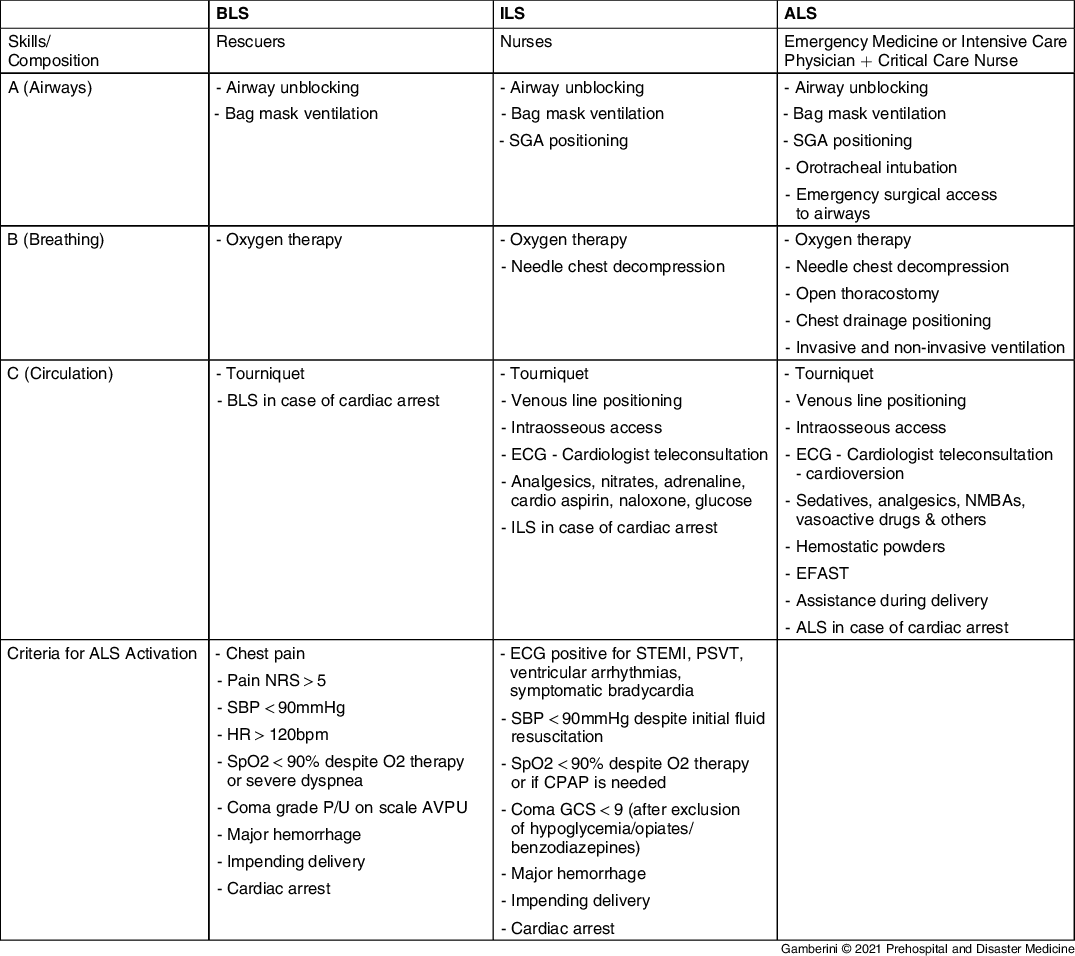
In particular, the urban area of Bologna and its surrounding municipalities Casalecchio and San Lazzaro have a population of 450,739 inhabitants with a density of 2265.36 inhabitants/km Reference Bohm and Kurland2 . Its EMS is composed of eight ambulances equipped with Basic Life Support (BLS) skilled rescuers (BLS vehicles); four ambulances equipped with ILS skilled nurses (ILS vehicles); and two medical cars carrying an enhanced critical care team composed by an emergency physician (Emergency Medicine or Anesthesia and Intensive Care specialists) and a nurse (ALS vehicles) with ALS skills Reference Greif, Lockey and Conaghan7 (ALS skills are intended as all the knowledge and training needed to understand and perform ALS as per European Resuscitation Council [ERC; Niel, Belgium] 2015 Guidelines Reference Greif, Lockey and Conaghan7 ). The specific competences of the personnel of the different emergency vehicles are described in Table 1.
Composition and Skills of the Personnel Working on the Different Emergency Vehicles

Abbreviations: SGA, supraglottic airway; BLS, Basic Life Support and defibrillation; ALS, Advanced Life Support; ECG, electrocardiogram; NMBA, neuromuscular blocking agents; NRS, numeric rating scale; PSVT, paroxysmal supraventricular tachycardia; EFAST, extended focused assessment sonography for trauma; ECG, electrocardiogram; SBP, systolic blood pressure; SpO2, peripheral oxygen saturation; CPAP, continuous positive airway pressure; AVPU scale, Alert/Verbal/Pain/Unresponsive; GCS, Glasgow Coma Scale.
Dispatching System
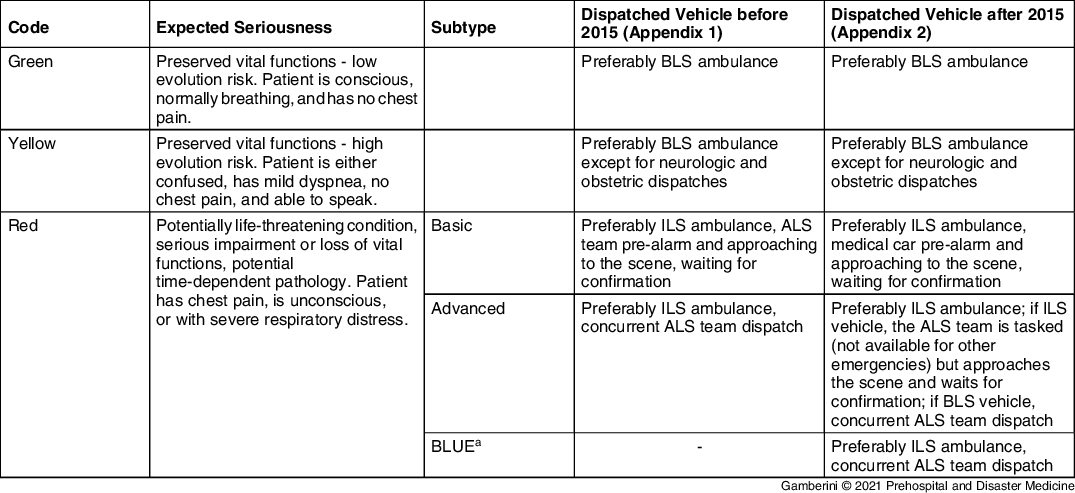
The EE-EOC dispatching center uses a criteria-based, computer-aided dispatch system developed in the internal Emergency Logistics analysis and development team (Appendix 1 and 2; available online only); emergency vehicles are dispatched on the basis of a three-graded priority protocol (green, yellow, red) according to the presumed severity of the event (Table 2).
Dispatch Codes and Vehicles

Note: See Appendix 1 and 2 for further details.
a Code BLUE is a “Red Advanced” code where the patient is unconscious and not breathing, having high sensitivity for cardiac arrest. See methods section for further details on BLUE code.
The two cardinal criteria for emergency priority estimation are based on the evaluation of breath activity and consciousness; the crossbreed of these two evaluations drives the interview into an algorithm that further refines the dispatch priority. Thus, a final output is composed of a NATO phonetic alphabet letter indicating the location, a number indicating the suspected pathology category, and a color indicating the suspected priority. Additional information collected from the telephonic interview is sent to an on-board computer of the vehicles tasked to the job.
Because at the EE-EOC both the call taker and the dispatcher operator are nurses, there is also the possibility that the two override the priority set by the protocol, based on their experience. Reference Voskens, Van Rein and Van Der Sluijs8,Reference Hamada, Gauss and Duchateau9
ALS Teams’ Dispatch Protocol and Severity Return Codes
The ALS vehicles (medical cars) are independent units not available for patient transport but dedicated to supporting BLS or ILS vehicles in managing critical patients; they are usually activated in red codes, but they can also be requested in any other emergency, regardless of the code priority, if it is deemed necessary from the personnel already at the scene.
Red code is furtherly subclassified into two categories, basic and advanced, that identify two different levels of potential need for ALS intervention. “Red code basic” provides a two-tiered management of the emergency with a direct dispatch of a BLS or ILS ambulance on scene while the ALS team is pre-alerted and eventually secondarily dispatched to the emergency site on the basis of a second triage decision from the team on scene. During this time, ALS is considered available for any other emergency. Second triage on the field relies on the evaluation of vital parameter derangements not correctable with devices and skills available for the dispatched ambulance, or in case of symptoms that require additional evaluation that may modify the diagnostic-therapeutic path of the patient.
The “red code advanced” instead identifies emergencies probably requiring an immediate ALS intervention; therefore, the enhanced care team is primarily dispatched to the scene in order to avoid any possible delay, and is thus considered tasked and no longer available for the system. Once on scene and after the patient’s assessment and treatment, the dispatched personnel assign a severity return code based on their field criteria, which goes from zero (treated in loco, not needing hospitalization) to four (dead; Supplement Table 1 – available online only). A medical accompaniment to the hospital is usually mandatory, if available, for severity code three. However, in case of potential instability, the ALS crew may escort patients with a severity code two (“2ALS”- Supplement Table 1).
Interventions to Increase the Appropriateness of ALS Team Dispatch
In order to improve the appropriateness of ALS dispatch, in 2015, a revision of dispatch criteria was performed on the basis of the analysis of internal data in order to reduce dispatch priority for categories frequently resulting in low-priority return codes (Appendix 1 and 2).
Moreover, primary and secondary dispatch criteria for ALS were reviewed on the basis of available literature Reference McQueen, Smyth, Fisher and Perkins4 and the recognition that ILS skilled personnel is able to manage the initial stabilization of most of the potentially critical patients and actively discuss with ALS teams and hospital consultants the effective need for an ALS intervention (Supplement Table 1).
Therefore, in order to reduce the effect of over-triage related to the dispatch algorithm and as an additional measure, secondary ALS dispatch was extended to advanced red codes when an ILS ambulance was tasked to that emergency. Reference Wilmer, Chalk, Davies, Weaver and Lockey10 No changes were made for BLS vehicles in case of advanced red codes (Table 2).
Moreover, a new code named BLUE, that is a variation of the “red code advanced,” is automatically proposed by the new algorithm (Appendix 2) for patients that are unconscious and not breathing, gasping, or in case of unknown information about the breath activity, thus having a high sensitivity for potential out-of-hospital cardiac arrests. Reference Viereck, Møller, Rothman, Folke and Lippert11 In this case, the ALS is primarily dispatched to the scene, regardless of the co-dispatched vehicle, in order not to delay the advanced resuscitation maneuvers (Appendix 1 and 2 for criteria of assignment of BLUE code).
Study Design
After Institutional Review Board approval (150/2020/OSS/AUSLBO), a single center pre-post intervention retrospective observational study was performed involving all the emergency dispatches managed by the EE-EOC in the years 2013-2014 and 2017-2018 in the urban area of Bologna and its surrounding municipalities Casalecchio and San Lazzaro. The years 2015-2016 were not considered as they were considered years of transition from the old algorithm to the new one.
Inclusion criteria were emergency dispatches managed by the EE-EOC during the prementioned periods involving a BLS/ILS ambulance and/or an ALS team. Exclusion criteria were incomplete data, helicopter EMS missions, and secondary transfers.
Data were extracted from the electronic database of the EE-EOC by an operator blind to the objectives of the study; no training was needed for the abstractor since the data extracted were not at risk for inter-rater variability.
The dispatch code was collected and the return severity code for each emergency call, the clinical classification of each emergency, the type of emergency vehicle dispatched, the age of the patients treated, and for medical cars carrying ALS teams, the arrival time on scene and the unit utilization time. An ALS intervention was considered appropriate if the return code was two (with physician on board), three, or four (Supplement Table 1).
In case of interventions involving more than one patient with the same emergency ID and dispatch code, such as road accidents with multiple casualties, the return code with the highest severity was considered for sensitivity test.
Human intervention on algorithm output accounted for less than 2.5% of cases; therefore, raw algorithm output is not shown, and only the final dispatch codes were taken into consideration.
Statistical Analysis
The study population was divided into two groups on the basis of the year of intervention (2013-2014 versus 2017-2018).
Statistical analyses were performed using Stata/SE 14.2 for Windows (Stata Statistical Software: Release 14; StataCorp LP; College Station, Texas USA); continuous variables were expressed as mean (standard deviation) or medians and interquartile range; categorical data were expressed as numbers (percentages).
For the continuous variables, an independent samples t-test was used, and the Kruskal-Wallis test when appropriate. For the categorical variables, the Chi square test was used. DeLong test was used to compare the AUC of the ROC curves of the two algorithms.
Sensitivity and specificity (with relative 95% confidence intervals) were calculated on the global dispatch output considering an expected return code zero, one, or two for dispatch code green and yellow, and an expected return code “2ALS,” three, or four for dispatch code red.
Another sensitivity and specificity test was performed only considering red codes in order to evaluate the direct ALS dispatch; in this case, an expected return code zero, one, or two was set for dispatch red code basic and an expected return code “2ALS,” three, or four was set for red code advanced and BLUE dispatch codes.
Results
During the study periods, the EE-EOC received a total of 242,501 emergency calls, 56,567 of these generated red codes. There were no records excluded due to missing data since the data storage system extracts the dispatch-related data directly from the onboard computers of the vehicles involved.
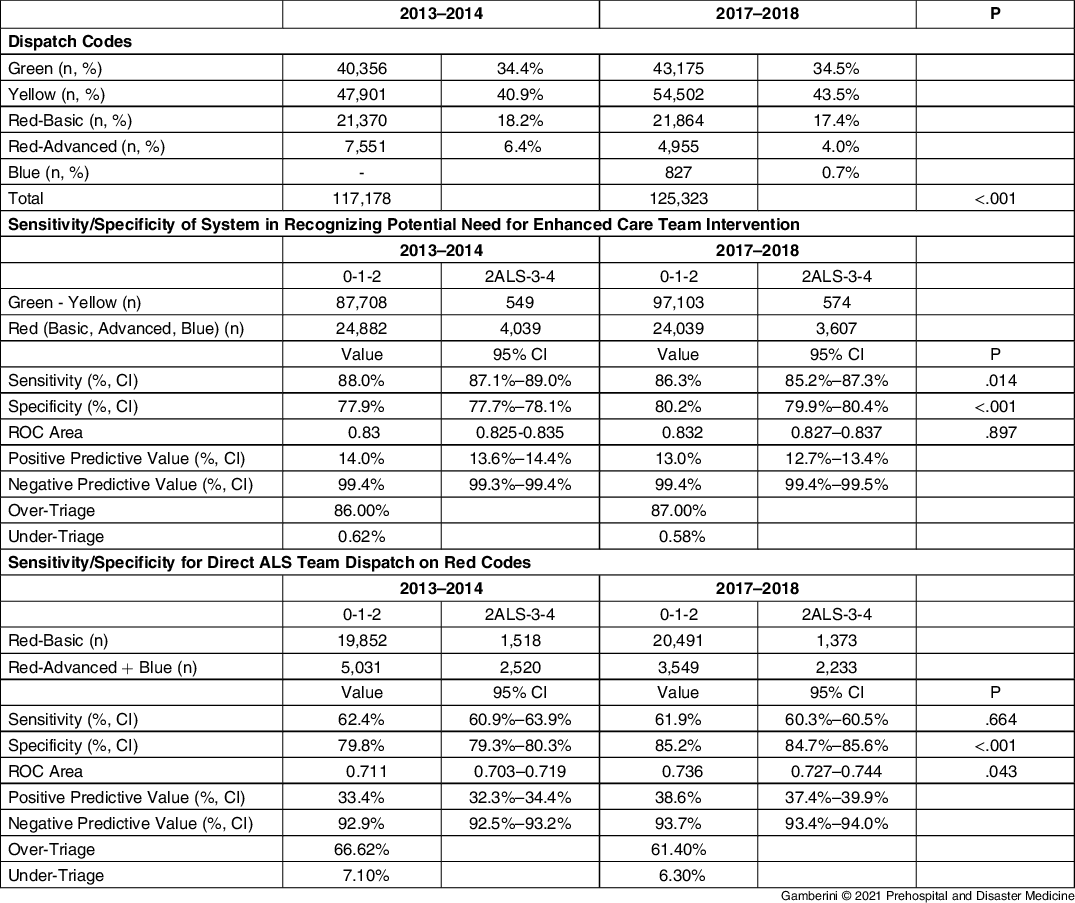
Globally, the composition of the dispatch output underwent a significant modification after the implementation of the new algorithm, with a proportional reduction in red codes and an increase of yellow codes (Table 3). Moreover, the distribution of pathologies generating red codes underwent a significant modification with a relatively lower representation of respiratory pathologies and an increase in trauma, cardiovascular, and neurologic codes (Supplement Figure 1; available online only).
Distribution of Dispatch Codes, Sensitivity and Specificity Analysis

Notes: Chi square test was used to compare the dispatch outputs of the two different periods, sensitivity and specificity. DeLong test was used to compare the ROC areas.
The new algorithm significantly modified the global specificity of the system in terms of recognition of potential need for ALS intervention and, moreover, it significantly increased the specificity in terms of direct ALS dispatch (Table 3).
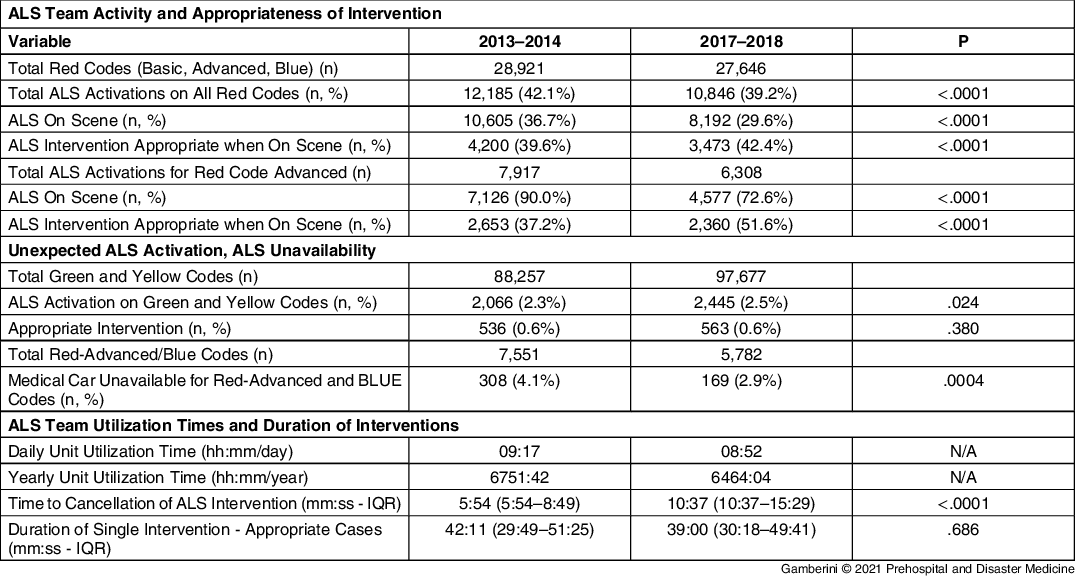
The ALS teams were required at the scene significantly less frequently after system modification, and the appropriateness of intervention significantly increased both considering all red codes with ALS activation (from 39.6% to 42.4%) and especially for red code advanced (from 37.2% to 51.6%), where the two-tiered deployment based on ILS second triage was activated (Table 4).
Appropriateness of Medical Car Intervention and Availability of ALS Vehicles

Notes:
- Chi square test was used to compare frequencies. Mann Whitney U test was used to compare the continuous variables with non-normal distribution (expressed as median and interquartile range – IQR).
- The total number of Red-Advanced/Blue codes is lower than the number of ECT activations on the same dispatch codes because some dispatches involve more than one patient (eg, road traffic accidents); therefore, one dispatch code could be followed by two or more return codes.
- The variable “ECT for Red-Advanced and Blue codes” refers to unavailability of an ECT vehicle at the moment of the dispatch; the vehicle could have been sent later during the mission.
A little but significant increase was observed in the amount of unexpected ALS activations from 2.34% to 2.5% (green and yellow codes); however, the number of appropriate interventions for unexpected activations was not significantly different. On the other hand, the number of red code advanced and BLUE codes without available ALS vehicles at the moment of the dispatch significantly decreased.
The total unit utilization time per year of ALS vehicles decreased after system implementation with a mean reduction of 144 hours per year, while the utilization time per dispatch in case of appropriate tasking was not significantly affected.
Discussion
The main result of the study is that the transition from primary to secondary dispatch of ALS teams in case of suspected high-priority emergency scenarios managed by nurses with ILS skills are effective measures to increase the specificity of the system, to control over-triage for primary ALS intervention, and to reduce the unit utilization time, therefore keeping ALS available for other high-priority emergencies.
The change in algorithm output in terms of color codes is responsible for the increase in specificity of the dispatch system, while the extension of the secondary ALS dispatch on high-priority codes is the main cause for over-estimation control and the increase in appropriateness of ALS intervention.
When considering prehospital emergency systems, generalization is difficult due to the high variability of structures, logistic aspects, and skills of the personnel. Reference Bohm and Kurland2 However, two main points of discussion come from these results: dispatch criteria and primary versus secondary ALS dispatch.
Dispatch Criteria
The non-proprietary criteria-based dispatch system developed and applied at this institution demonstrated a sensitivity in line with literature reports from both proprietary and non-proprietary algorithms, Reference Sporer, Youngblood and Rodriguez12–Reference Ball, Williams and Smith14 with a higher specificity at the expense of a high over-triage (61% for direct ALS dispatch).
It is important for EMS running non-proprietary algorithms to periodically check the sensitivity and specificity of the algorithms adopted in order to gradually refine the whole system capability to deliver the right assistance to the right patient. This plasticity could be an advantage in terms of progressive adaptation to local characteristics and, moreover, it also represents a major limitation for this study in terms of external reproducibility. The full version of the dispatch algorithm is available as an online supplement (Appendix 2).
Primary versus Secondary ALS Team Dispatch
The most interesting and externally reproducible aspect investigated from this study is the effectiveness of a secondary dispatch for ALS teams aiming to drastically control primary over-estimation. In fact, medical cars were requested on scene in only 29.6% of red codes.
The extension of a secondary dispatch to high-priority codes when the tasked team had ILS competences furtherly decreased the net effect of over-estimation on ALS interventions without increasing prehospital times (see following Safety section).
A key aspect of this system is the availability of ALS teams as independent figures on the network, not involved into patient transport, allowing to reserve their intervention to most critical patients and thus rapidly becoming available again in case of unnecessary intervention.
Safety
The transition to the new algorithm globally produced a significant decrease in all red code output and an increase in yellow and green dispatches; however, while a significant increase was observed in the activation of ALS team intervention from crews managing low-priority dispatches, the number of appropriate activations in this context was not significantly different. Moreover, the number of red advanced and BLUE dispatches created without any enhanced care team available at the moment of creation significantly dropped.
Despite the secondary dispatch of ALS teams, the total duration of appropriate interventions was not different after algorithm implementation; this was probably due to the effective initial stabilization by ILS teams.
Finally, in case of suspected cardiac arrest, the possibility to override the algorithm by the BLUE codes grants the primary dispatch of ALS teams helping to avoid the delay of advanced assistance.
Limitations
The main limitations of this study rely in its retrospective nature and the difficult comparability among dispatch algorithms, as discussed above. Furthermore, there is a time factor bias related to a before and after study, as it is for the lack of external validity and possible undetected variable that could have affected outcome of the vehicles’ job over the time.
Conclusion
The extension of secondary dispatch of ALS teams to critical dispatches managed by ILS vehicles and based on their field triage could significantly improve the refinement of primary dispatch over-triage and increase the appropriateness of ALS interventions, fostering the redistribution of advanced resources towards the most critical patients. The periodic revision of dispatch criteria on the basis of effective appropriateness of previous dispatch outputs could significantly improve the performances of non-proprietary algorithms.
Conflicts of interest/financial disclosures
None declared.
Author Contributions
Lorenzo Gamberini and Cosimo Picoco ideated and designed the study; Donatella Del Giudice developed the software and contributed with Cosimo Picoco, Fabrizio Bizzi, and Stefano Santini to structural changes in the algorithm; Corrado Zenesini performed the statistical analysis; Lorenzo Gamberini and Marco Tartaglione wrote the manuscript; Federico Semeraro, Carlo Coniglio, and Giovanni Gordini reviewed the manuscript.
Supplementary Materials
To view supplementary material for this article, please visit https://doi.org/10.1017/S1049023X21000030