



The League of Nations was everywhere in interwar Australia. Australians learned about the League at school and prayed for it in church. They listened to shows about it on the radio, watched films about it at the cinema, and read stories about it in newspapers, pamphlets, and books. They celebrated it through festivals and holidays, including annually at League of Nations Balls and on League of Nations Day, where they flew League flags, sang League songs, and wore League dress. All major political parties, religious institutions, and voluntary associations in Australia supported the League. Soldiers were said to have died for the League. Civilians claimed to live for it. And children pledged their allegiance to it. In 1935, Robert Menzies, a conservative politician and later Australia’s longest-serving prime minister, estimated that 97% of Australians believed in the League. On this account, millions of Australians in the interwar period were League internationalists.Footnote 1
In some ways, these Australian League internationalists were remarkably diverse. They included women as well as men, conservatives as well as liberals and socialists, Protestants as well as Jews and Catholics. They included members of the working class, as well as those of the middle and upper classes. They included inhabitants of some of the world’s most isolated towns in the centre and west of the continent as well as those of some of the world’s largest and fastest-growing cities like Melbourne and Sydney in the east. In one way, however, they were almost all the same: they were white. More than this, most were white supremacists.
Australia was one of the most racist societies on earth in this period. This took several forms. Australia was the quintessential ‘white man’s country’, its nationalism rooted in racial homogeneity. The leading nationalist magazine The Bulletin took as its slogan ‘Australia for the White Man’.Footnote 2 Australia was the model ‘fortress state’, pioneering a system for excluding Asians and Pacific Islanders known as the ‘White Australia’ policy that was copied across the Anglophone world.Footnote 3 As a direct result, the percentage of European Australians increased from 94% in 1901 to almost 99% in 1939.Footnote 4 And Australia was the archetypal practitioner of ‘settler colonialism’, attempting to exterminate Indigenous Australians through violence, dispossession, assimilation, and, famously in the case of Aboriginal Tasmanians, genocide.Footnote 5 By 1919, a pre-contact population of 750,000 Indigenous Australians had been reduced to less than 70,000—a fall of more than 90%.Footnote 6 Not all Australian League internationalists were white and not all were white nationalists. But the vast majority were both. They were, in a phrase, white internationalists.Footnote 7
Investigating the white Australian League movement globalizes the history of internationalism in at least two ways. First, it reveals the centrality of white supremacy to support for the League around the world. Historians of the League have explored the international organization’s compatibility with nationalism and empire: specifically, by combining a membership through the state, including nation-states, with an institutional structure that privileged and perpetuated empire, most notably in the system for holding territories under ‘mandate’.Footnote 8 However, they have generally overlooked the relationship between the League of Nations and whiteness. This was obviously inherent to the mandates system, since it was in some ways colonialism by a different name.Footnote 9 But it also extended to the structure of the organization itself, from its hierarchy on the basis of race of its members to its silence on racial equality.Footnote 10 In this sense, the League of Nations was not just a League of Nations and not just a League of Empires but a League of Whites.Footnote 11
In global terms, Australia’s white internationalists were relatively insignificant. The country’s entire population was less than that of New York City at the time—four and a half million—spread across a landmass larger than the contiguous United States.Footnote 12 Through prevailing racial ideas, however, Australians were connected to millions of others around the world: to fellow members of the ‘British race’ in Britain and the other white dominions; to fellow members of the broader ‘Anglo-Saxon race’, which also included America; and to fellow members of the still broader ‘European race’, which encompassed Europe and other settler societies as well.Footnote 13 Australian League internationalists are useful in exposing the importance of whiteness because they were some of the most blatant about this relationship. But they were far from the only League supporters for which this was the case. In this sense, the history of the Australian League movement points the way to a global history of white internationalism.
We can get a sense of the relationship between internationalism and whiteness in the globally uneven spread of popular League groups. In the interwar period, societies sprung up around the world to teach people about the League and convert them to the cause. Sizeable League societies existed in practically every white-majority country, both in Europe and beyond. The largest were in Europe: the biggest of which was the British League of Nations Union with a peak of more than 400,000 members, followed by the French Fédération française des associations pour la Société des nations with its 250,000 members.Footnote 14 But substantial groups also operated in all of the British dominions and the United States, as well as other, lesser-known white settler colonies. The only associations in South America, for example, were in Argentina and Chile. The only one in the Middle East was in Mandatory Palestine, where it was run by Zionists.Footnote 15 By contrast, League societies operated in non-white countries but there were far fewer of them and they were much smaller than their white counterparts, even accounting for their under-representation in the League. The largest of these, the Japanese League of Nations Association, claimed fewer members at its peak than Australia’s—less than 12,000—despite Japan’s population at the time being thirteen times greater than Australia’s. China’s was even more restricted.Footnote 16 A global history of white internationalism may account for this. Scholars of African and African American history have underscored the importance of race for Black internationalism.Footnote 17 This article explores its racist white counterpart.
At the same time, Australia’s white League movement points the way towards a global history of internationalism from below. On the one hand, Australia’s internationalists underscore the importance of voluntary associations. In studying ‘civil society’, global historians have tended to focus on elite organizations like think tanks, interest groups, and foundations.Footnote 18 Shifting our attention to mass membership organizations—often organized nationally, like the various League societies—reveals a grassroots strain of internationalism. On the other hand, Australia’s internationalists reveal the limits of this approach. Indeed, historians of Britain and the United States have explored how charities and other non-governmental organizations including Amnesty International, Oxfam, and Save the Children, spread ‘popular internationalism’ among their members in the twentieth century.Footnote 19 The membership of these groups could be genuinely wide-reaching, none more so than the British League of Nations Union. Ultimately, however, even the membership of the British Union was unrepresentative of the wider British populace. Instead, they were dominated by what Susan Pedersen, quoting Michael Frayn, calls ‘the signers of petitions; the backbone of the BBC’: liberal elites who thought they needed to mould ‘ordinary people’ into internationalists.Footnote 20 Australia’s white internationalists suggest a much broader movement that went beyond formal membership in a League society. Indeed, only a small fraction of Australia’s white internationalists—less than 15,000—joined the Australian League of Nations Union.Footnote 21 By focusing only on the leaders and members of these organizations, historians have thus far overlooked the bulk of ordinary internationalists. This is particularly important as historians begin to globalize the history of popular internationalism beyond Britain and the United States, exploring places where such voluntary associations did not exist or where people were simply less likely to join them. Popular internationalism was not just handed down from above or mediated from the middle. It was taken up from below.
Writing the global history of white internationalism requires drawing on social and cultural approaches, as opposed to the political and intellectual ones that have dominated the literature on international organizations.Footnote 22 As with the much older history of ‘popular imperialism’, it requires assembling an archive of everyday life: at home, at work, and at all the places people frequent beyond them.Footnote 23 In this article, for instance, I draw on newspapers, films, and memoirs; lectures, sermons, and debates; a cartoon, a poster, and even a children’s story. I begin by exploring the extent of support for the League in interwar Australia. I then probe the relationship between the League and white supremacy through the three issues that were most central to Australian internationalists: the White Australia policy; Australia’s mandates over New Guinea and Nauru; and the treatment of Indigenous Australians. Finally, I reflect on the stakes of this article for global history generally and consider the ways in which, even after the League’s demise, white internationalism lived on.
Popular internationalism in interwar Australia
Australian internationalism predated the League of Nations. Before the First World War, however, internationalism in Australia was excluded from mainstream politics and confined to feminists, socialists, and Indigenous peoples, among others. These groups continued after 1919. As we will see, many of them even supported the League.Footnote 24 In the interwar period, however, internationalism--specifically, a version of liberal internationalism--became mainstream in Australia.
There were at least two reasons for this. The first was the First World War itself. Australians were profoundly affected by the war. Of the 331,000 Australians who served in the war, two thirds were either killed or wounded. Indeed, Australia’s casualty rate was among the highest of belligerent countries: roughly one in every two families lost a member. As a result of the war, many Australians became convinced that a new approach to international relations was needed to prevent future devastation.Footnote 25 The second was the new world organization itself, the League, of which Australia was a founding member. This was the first time Australia had joined an international institution as a member in its own right. Before that, Australia had only ever participated in world organizations via the British Empire. From the start, then, Australia’s membership in the League was wrapped up with nationalism.Footnote 26
To be sure, Australians did not all turn into internationalists overnight. Instead, they were converted over the course of the interwar period. As in many other countries, the central driver of this was a voluntary association, the Australian League of Nations Union. The first state branch was established in South Australia in 1920 on the model of its British forebear and by 1923, offices had been established in all six states. These state branches were all headquartered in their respective capital city. But sub-branches spread to suburbs and country towns across the country. Like League societies in other places, the Australian League of Nations Union was bipartisan. It was supported by all the major political parties that formed state and federal governments in the period: from the Labor Party on the left to the Nationalist, United Australia, and Country Parties on the right.Footnote 27 As one pacifist lamented, the Australian League of Nations Union was ‘no rebel society’.Footnote 28
The membership of the Australian League of Nations Union never approached anything like that of the British one, hitting fewer than 15,000 at its peak.Footnote 29 By comparison, the Australian Labor Party had a membership of 370,000 in the same period.Footnote 30 Even the fascist paramilitary organization the New Guard counted 60,000 members in the 1930s.Footnote 31
But League influence extended far beyond the ranks of formal membership in the Australian League Union. In Australian schools, for instance, children were taught about the League. Education departments across the country, which were state-based, added the League to the syllabus for subjects including civics, history, English, geography, ethics, and economics.Footnote 32 They required that teachers’ colleges include lectures on the League and provided teachers with lesson plans and books on the League.Footnote 33 Australian children also learned about the League after class. School newspapers published articles about the League, debating clubs set League issues as their topics for discussions, and drama clubs staged re-enactments of League meetings.Footnote 34 Schools even set up entire rooms known as ‘League of Nations Corners’ in which the walls were plastered with colourful posters advertising different countries and desks were piled high with reading materials.Footnote 35
Most revealingly, students joined junior branches of the Union. These Junior Unions operated much like contemporaneous organizations like the Boy Scouts. Members were officially inducted into the Union at a ceremony where they read out an oath, sung hymns, and were issued a badge. Since by this time, schooling was compulsory until the age of fifteen, this meant a lot of Australian child internationalists.Footnote 36 By 1937, more than 100,000 boys and girls had joined in New South Wales alone, representing more than a fifth of all students in the state.Footnote 37
If Australian schools raised children to be internationalists, Australian universities did the same for young adults. Professors were some of the most avid promoters of the League. Historians, Classicists, political scientists, and others incorporated the League into their classes and delivered public lectures on the League.Footnote 38 Students also took part. They held study circles on international issues, wrote articles about the League for the university newspaper, and opened branches of the Australian League Union on campus.Footnote 39 These were some of the first of such groups formed on Australian campuses. Students at the University of Western Australia, for example, formed a branch when the university consisted of just a few tin sheds on the outskirts of Perth.Footnote 40 For many university students, their interest in the League took precedence even over domestic politics. An English student at Adelaide University later recalled that while her and her friends could have explained the ins and outs of League politics, they would not have been able to name the leader of their state government.Footnote 41
Australian adults also learned about the League. This occurred partly through various voluntary organizations. The 1920s were the heyday of associations in Australia.Footnote 42 Groups that supported the League ran the political gamut: from middle-class organizations like Rotary Clubs to working-class organizations like trade unions; from progressive feminist organizations like the Women’s Service Guild to conservative women’s organizations like the Housewives Association; and from veterans’ organizations like the Returned and Services League (RSL) to sporting bodies. All of these organizations officially partnered with the Australian League of Nations Union by paying to become ‘corporate members’ of it. Through these voluntary associations, members were exposed to lectures, debates, and study circles on the League.Footnote 43
But the institutions that were most influential in spreading internationalism in Australia were religious. In the interwar period, more than 97% of Australians identified as religious and roughly 40% regularly attended a place of worship.Footnote 44 For a small minority, this was a synagogue. Jewish religious leaders generally supported the League. Indeed, a rabbi from Perth represented Australia at the League Assembly in 1933—the first rabbi from any country to do so.Footnote 45 For most Australians, however, their place of worship was a Christian church. Protestant or Catholic priests around the country regularly sermonized on the League, led prayers for the League, and observed an annual ‘League of Nations Sunday’ at which, according to one overwhelmed congregant, ‘the subject was dealt with more or less exhaustively’.Footnote 46 Some even donated their collection plates to the League.Footnote 47 In churches and synagogues, then, Australians worshipped the League.
Mass media and entertainment meant the League suffused Australians’ leisure time as well. Newspapers in cities and towns across Australia carried weekly or fortnightly columns on the League.Footnote 48 This included some of the most-circulated dailies in the country.Footnote 49 Publishers printed books and other writings about the League. For example, Keith Hancock ended his bestselling history of Australia with the country joining the League of Nations.Footnote 50 Radio stations broadcast shows about the League.Footnote 51 By 1939, these shows could reach more than a million Australians.Footnote 52 This included Australians in the most remote of areas. The host of one such show began by noting: ‘From many a distant cattle station and goldfield in West Australia, from many an outpost in the lonely bush, come requests for information about world affairs and the League of Nations’.Footnote 53 Theatres staged League-themed plays. Adelaide’s Theatre Royal, for example, put on an original performance about the League titled ‘The Warrior’, which somehow managed to combine a ballet, a musical concert, and a dramatic re-enactment of the League Council.Footnote 54 And cinemas showed short films and talks about the League. Australian screenings of the 1925 Hollywood blockbuster The Big Parade, for instance, were preceded by the short film Pen versus Sword: The Story of the League of Nations. It was a huge box office success, ultimately playing in almost every theatre—some 800—in the country.Footnote 55 In print and on the airwaves, on the stage and on the screen, then, Australians read, listened to, and watched the League.
If Australians engaged with the League passively through media and entertainment, they engaged with it actively on holidays and at festivals. The annual League of Nations Day offers an example of this. By the early 1930s, the Day was celebrated in every state. Public and private institutions even flew League flags.Footnote 56 The celebration of League of Nations Day was particularly active in schools and by 1938 almost all schools in the country observed it.Footnote 57 At the beginning of the Day, Australian schoolchildren would recite a pledge consisting of seven beliefs and ending with: ‘I BELIEVE that we should work with all our strength to help the League of Nations…’Footnote 58 They combined this with demonstrations of their support. In 1931, for instance, students from over a thousand schools across New South Wales voted on whether or not to accept the ideals of the League: evidently a stacked hand, since 155,164 voted in favour, with just 181 against.Footnote 59 Interestingly, this was several years before the British League of Nations Union would hold a ‘Peace Ballot’ asking Britons to vote on the League.Footnote 60 Mostly, however, they spent the Day staging plays, concerts, and other dramatizations of the League.Footnote 61 Students at a high school in Sydney, for example, put on a play featuring roles such as the League of Nations, the Queen of Peace, and ‘War’, who, according to the script, would wear a ‘red and black dress, gas mask (optional), [and] sword’.Footnote 62 In this way, the League became so ubiquitous in Australia as to be taken for granted—banal even.Footnote 63
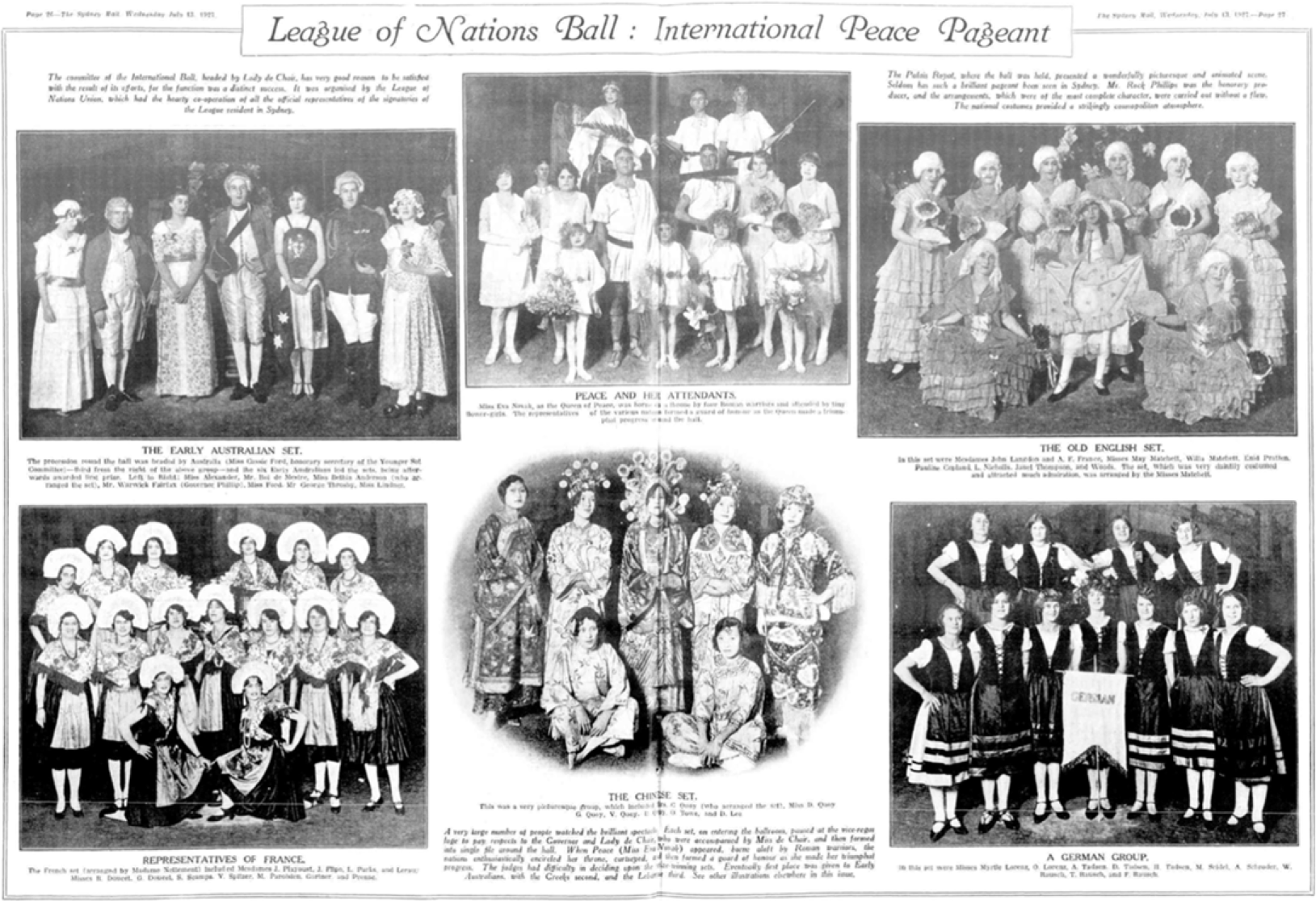
But the best illustration of popular internationalism in Australia was the League of Nations Ball. In Britain, League pageants were held as early as 1919.Footnote 64 The Australian institution of the League Ball was similar. The highlight of the evening was a pageant in which locals dressed up in ‘national costumes’ representing different countries and paraded around a hall (Figure 1). While the event originated in Sydney in 1927, the Ball quickly spread to every other state capitals as well as towns throughout the continent. Even the timber town of Manjimup, home to a few thousand people in Western Australia, hosted one.Footnote 65 It thus became the League’s own ‘invented tradition’.Footnote 66 While Australia was always represented in the pageant, it was represented differently. At the 1927 Ball in Sydney, for instance, it was as historically inaccurate ‘colonial settlers’, with women in bonnets and floral dresses and men in powdered wigs and breeches.Footnote 67 Another year, it was as soldiers or ‘diggers’, with men in khaki shirts smoking from pipes.Footnote 68 Still another year, it was as the Australian forest, ‘the bush’ (Figure 2). This was arguably more difficult to pull off. The woman tasked with it did so by simply standing next to a shrub and attempting, in the words of one reporter, to ‘impersonate [its] spirit’.Footnote 69
The Ball also featured participants dressed as other countries. Often, these were Australians with no connection to the peoples they were depicting. This showed in the dubious accuracy of their portrayal. In Manjimup, for example, participants wore clearly Orientalist costumes. Dressed as so-called ‘Arabs’, it consisted of three men wearing white cloaks or burnouses and black boots, accompanied by a group of ‘demure little harem ladies, whose bright eyes gleamed from above their “qashmaks” [niqabs]’.Footnote 70 At some Balls, however, participants were of the nationality that they were depicting. For the Ball in Sydney in 1929, for instance, Chinese Australians participated. They even paid for a costume designer to travel to Melbourne and bring back eight large chests full of clothing from different historical periods.Footnote 71
As this example suggests, the Balls allowed non-white Australians to express their interest in the League—even at the height of White Australia.Footnote 72 Most Australian internationalists, however, were white. Indeed, one of the main ways in which they expressed their internationalism was in their beliefs about the League’s relationship to the White Australia policy.
Australian internationalists and the White Australia policy
White supremacy was at the heart of Australian national identity in the early twentieth century and the White Australia policy was central to this. Support for the policy spanned the ideological spectrum: from socialists who saw democracy and labour rights as impossible without racial uniformity to conservatives who worried about Australia’s proximity to Asia.Footnote 73 This included Australian internationalists. Historian and South Australian Union member Keith Hancock called it ‘the indispensable condition of every other policy’ in Australia.Footnote 74 Even pacifists were not immune. Journalist Janet Mitchell wrote in her memoir in 1939: ‘[A]lthough I am a pacifist…all my primitive instincts would urge me to fight for White Australia if it were attacked’.Footnote 75
At the Paris Peace Conference of 1919, it seemed as if the League could threaten this policy. During the drafting of the League’s constitution, the Japanese delegates proposed inserting a clause protecting racial equality. The Australian delegation, led by Prime Minister ‘Billy’ Hughes saw it as a direct affront to his country’s immigration practices. In the end, however, Hughes got his way. When the delegates voted, a majority sided with Japan, but American President Woodrow Wilson ruled that it required unanimity to pass (despite having allowed majority votes earlier).Footnote 76 On his return from Paris, Hughes announced to Parliament: ‘White Australia is yours…I have brought that great principle back to you from the Conference…as safe as the day when it was first adopted…’Footnote 77 (Hughes’s speech later served as the ending for the 1928 silent film The Birth of White Australia, which film critics have described as the Antipodean version of America’s The Birth of a Nation).Footnote 78 Hughes had in other words paved the way for a White Australia in a League world.
Over the next few years, Australian internationalists sometimes worried that the League could still endanger the White Australia policy. At public meetings, citizens bombarded leaders of the Australian League Union with questions about whether White Australia was under attack.Footnote 79 Invariably, Union leaders reassured Australians that there was nothing to fear. Union leaders made different arguments in doing so. Law professors made legal arguments as to why the White Australia policy was immune from League interference. They reminded their audience that Hughes had succeeded in defeating Japan’s racial equality clause; that Article 10 of the League Covenant preserved the ‘existing political independence’ of all League members, which covered all domestic legislation; and that Article 15 barred the League from interfering with domestic policies.Footnote 80 Others were less legalistic and more plainspoken. Speaking to a meeting of the Housewives’ Association on her return from the League Assembly in 1922, representative Marguerite Dale clarified simply that ‘the League never touches questions of domestic policy’.Footnote 81
The issue came to a head in 1924. That year, the League Assembly, including Australia’s delegates, approved a draft treaty known as the Geneva Protocol for the Pacific Settlement of International Disputes. This treaty would give an international court at The Hague, the Permanent Court of International Justice, compulsory jurisdiction over disputes between the Protocol’s signatories.Footnote 82 Back home, Australians worried this would allow Japan to drag their country before the Court over its immigration practices. Once again, however, the Australian League Union put Australians’ minds at ease. The New South Wales Union, for instance, produced a report declaring that in fact ‘existing safeguards to the White Australia policy are probably increased under the protocol’. This was because of an article in the Protocol that meant that any state that ignored the court’s ruling that a matter was a question of domestic policy—as, for example, with Japan in relation to the White Australia policy—would be branded an aggressor and subject to League sanctions.Footnote 83 To announce the release of the report, the country’s highest-selling Sunday newspaper announced on its front page: ‘White Australia Policy Safe’ under the Protocol.Footnote 84 Regardless, any lingering fears were dispelled after Britain refused to ratify the Protocol and it collapsed.Footnote 85
It appears that most Australian internationalists were satisfied with these explanations. At a debating competition in Sydney in 1920, for example, students were asked to argue over whether the White Australia policy was ‘essential’ for Australia’s ‘well-being’. After the competition was done, the opposing side described it as ‘one of the hardest tussles of the Competition’ since the Policy was clearly ‘recognised’ by the League Covenant.Footnote 86
Many Australians went even further in viewing the League as defending White Australia. This perspective is best captured by a cartoon from the time (Figure 3). It was published in a newspaper aimed at farmers, an offshoot of one of the country’s most-circulated dailies, the conservative Melbourne Herald.Footnote 87 The context was 1924, amidst the debate over the Geneva Protocol. The cartoon depicts a racialized figure representing Japan. He is using a battering ram labelled ‘racial equality’ to attempt to break through a door labelled ‘League of Nations’. Behind it, a man cowers behind a much smaller gate bearing the name ‘White Australia’. ‘Once down with this door and the goal is within reach!’, exclaims the man personifying Japan. At first glance, what appears most clear is that White Australia is under attack. On reflection, however, a second meaning comes into view: the League of Nations is its guardian. The accompanying article explains that while the Japanese proposal for racial equality had threatened the White Australia policy, the status quo under the League protected it. In particular, the article explained, because of the League Covenant, ‘no Asiatic nation can appeal against that exclusion to the League’ even though the White Australia policy excluded Asian people.Footnote 88 For many Australians, the League was not a threat to White Australia. To the contrary, it was the League that was helping to keep Australia White.
So successful were Union leaders at making this case that some began to wonder whether they had overdone it. This was the experience, for example, of the Melbourne lawyer John Latham, who had accompanied Prime Minister Hughes at the Paris Peace Conference and co-founded the Victorian branch of the Union upon his return. Addressing an audience at Melbourne University in 1919, Latham had stressed that it would be ‘very difficult, if not impossible’ for any state to bring a complaint about the White Australia policy before the League.Footnote 89 Four years later, however, he adopted the opposite position. One of the ‘most common misconceptions’ about Australia’s position in the League, he complained in a letter to the editor of The Argus, is that ‘it is impossible for the White Australia policy to become an issue before the League’. This was untrue, he argued, regardless of the fate of the Geneva Protocol. After all, he explained, the League Covenant empowered the Council, not member-states themselves, to determine whether a matter was one of domestic jurisdiction. If the Council found that it was not, the League could then interfere.Footnote 90 In less than half a decade, Latham had gone from dismissing concerns over the White Australia policy to fanning them.
In a lecture in Brisbane in 1929, Latham was even more explicit: ‘The fact is that domestic legislation…which specifically affects…nationals of other States must necessarily have an international significance. It is useless to shut our eyes to this fact’. He cited Australia’s immigration laws in particular. In such cases, he explained, ‘they may be made the subject of international protest and may become the cause of grave international disputes’. Latham wanted to avoid this from happening by pushing for Australia to engage in diplomacy with other countries to help them understand the reasons for the policy. In this way, he argued, ‘a vital Australian policy’ could be shown to be consistent ‘with international good manners and a courteous consideration of the views of other nations’. He recognized, however, that he was alone in these views. ‘It is the universal opinion in Australia’, he observed, that immigration policy should not be regulated through the League.Footnote 91 By the League’s tenth anniversary, the view of most Australians was set: the international organization was not a danger to White Australia. But if no one would believe Latham that the League had changed the White Australia policy, they all agreed that it had changed another key concern for Australian internationalists: the country’s overseas empire.
Some of the national costumes worn at the League of Nations Ball in Sydney in 1927: ‘Early Australia’, ‘Old England’, France, China, and Germany. ‘League of Nations Ball: International Pageant’, Sydney Mail, July 13, 1927, 26.
Woman representing Australia at the League of Nations Ball in 1929. The caption reads: ‘Mrs. M. L. Cox will impersonate the spirit of the Australian Bush’: ‘Peace on Earth. International Ball Visions’, The Sun, August 29, 1929.

Sam Wells, ‘Bangzai!’, illustration, The Weekly Times (Melbourne), October 4, 1924, 5.

‘Our Two Mandates’, poster published in Australasian Methodist Missionary Review 31, no. 1 (May 1921): 7.

‘Women Arrange Display for Peace Week’, The Advertiser (Adelaide), October 4, 1938, 6. Courtesy of the National Library of Australia, Canberra. The caption reads: ‘Some of the international dolls which will make a colorful contribution to Peace Week. From left, they represent:--Czechoslovakia, Australia, Poland, Abyssinia [Ethiopia], and Esthonia.’

Australian internationalists and the mandates
Australia’s possession of external colonies predated the League. Most notably, Australia had governed the territory of Papua, which comprised the south-eastern quarter of the island of New Guinea, since 1902. But the League altered the Australian Empire in two ways. First, it made it much larger and more populous. Australia gained control of two new territories in particular: former German New Guinea, which consisted of the north-eastern quarter of New Guinea (above Papua) as well as some six hundred other islands, which together were the size of Portugal; and Nauru, a single, oyster-shaped island.Footnote 92 Mandatory New Guinea’s population alone was perhaps as high as one million—equivalent to one fifth of Australia’s population in 1919.Footnote 93
The second way in which the League altered Australia’s Empire was political. The League mandates ‘internationalized’ empire, to use Susan Pedersen’s concept. In their rule over these territories, the mandatory powers agreed to be overseen by a special League group, the Permanent Mandates Commission. As a result, the League and the Australian Empire were intertwined—arguably to a greater extent than any of the other mandatory powers except perhaps South Africa.Footnote 94
Most Australians supported control over Mandatory New Guinea and Nauru. Indeed, the mandates only sparked public debate a handful of times and even then it focused not on whether they should be governed by Australia but how.Footnote 95 For some Australian internationalists, the reason for this was humanitarian: they were concerned for the indigenous inhabitants of New Guinea and Nauru. In keeping with this, the Australian government in their administration over these territories embraced the language and methods of anthropology to a greater extent than any other mandatory power, though it made scant difference to the nature of their rule: indentured labour and corporal punishment remained rampant, as did mass killings of Indigenous peoples by whites, including with machine guns.Footnote 96 For other Australian internationalists, the reason for supporting it was economic: the mandates paid, at least Australians thought they would. In particular, Mandatory New Guinea had gold as well as a large system of plantations producing dried coconut known as copra.Footnote 97 Nauru was potentially even more lucrative: 80% of its surface was covered in what was sometimes called ‘white gold’: guano or bird shit. This was the miracle fertilizer that would prove crucial to the development of agriculture in Australia. In the nineteenth century, the United States had annexed ninety-four such islands, mining 400,000 tons of guano from them in total. But all of this paled in comparison to Nauru, which was estimated to contain as much as 112 million tons.Footnote 98
But Australian internationalists’ support for the mandates system was also ideological: specifically, it upheld their ideas of whiteness. In many ways, the League mandates regime was perfectly compatible with white supremacy. Indeed, the entire system was rooted in a taxonomy of races. According to the League Covenant, the mandatory powers agreed to be responsible for the ‘well-being and development’ of peoples ‘not yet able to stand by themselves under the strenuous conditions of the modern world’. The mandates were sorted into three groups according to the ‘stage of development’ of the people who lived in them: A, B, and C. Mandatory New Guinea and Nauru were both sorted into the last of these three. As the mandatory power for class C territories, the Australian government was required to allow equal access to trade and commerce to other League members and abide by a few humanitarian principles. Otherwise, however, Australia was left to govern them ‘as integral portions’ of its own territory.Footnote 99 Inherent to the League mandates system, then, was a racial hierarchy in which Australians and other whites were placed on top and Pacific Islanders were relegated to the very bottom. For Australia’s internationalists, the mandates system legitimized white supremacy on a global scale.
Even Australian humanitarians were explicit about the importance of whiteness in justifying mandatory rule. This is perhaps most evident in a poster produced by the Australasian Methodist Church (Figure 4). While unnamed, the author was probably John Burton, general secretary of the Church’s Missionary Society who oversaw its work in Mandatory New Guinea.Footnote 100 The poster makes clear Australian internationalists’ understanding of the mandates system as a racial obligation. It announces that the mandates are ‘our responsibility’; that ‘1,000,000 people need the help and guidance of a higher race’, and that ‘the Brown Pacific Appeals to White Australia’. Accompanying the appeal is an illustration of an Indigenous inhabitant of the islands, looking seriously off into the distance and featuring several racial stereotypes: facial tattoos, ornamental jewellery, and a bare chest. At the bottom of the poster, the author even quotes Rudyard Kipling’s famous poem from 1899, ‘The White Man’s Burden’. The racialization of mandatory rule is even reflected visually: while Australia is shaded in white, Mandatory New Guinea as well as the adjoining colony of Papua are shown in black. For internationalists like Burton, it was because of their whiteness that Australians had a responsibility to the mandates.
For other Australian internationalists, the mandates were a way to prove their whiteness on a global stage. This idea is reflected in a children’s story from the period. The story appeared in a magazine for students and was distributed in primary schools throughout the state. The author is not identified, but it was probably Ivy Brookes, a member of the Victorian Union as well as a musician, philanthropist, and daughter of Australia’s second prime minister; I discovered drafts of the story among her personal papers.Footnote 101 The story centres on an Australian family: two young children, Peter and Margaret Trent, and their parents. It takes place on a steamship en route to the capital of Mandatory New Guinea, Rabaul. The family are relocating so that the father can take up a post as an anthropologist for the government there. The story is worth quoting at length:
‘But, Mummy,’ said Peter, who always wanted to know the reasons of things, ‘why must we go all the way to New Guinea to bother about the natives there? Can’t Daddy find enough work to do among our own aborigines without going to New Guinea?’ …
‘Yes,’ replied his mother, ‘there is much work that Daddy could do in Australia, but it is a great honour for your father to be asked to do this special work… Because Great Britain had splendid experience in the governing of races, she received several mandates… Because Australia is close to New Guinea we were asked to govern it as a mandate. But we cannot do what we like there. We have to govern it according to the rules set down by the League of Nations.’ …
‘Well, it is not much fun having an Empire these days,’ said Peter. ‘Too much like hard work! …
‘Yes,’ replied his mother, ‘an Empire to-day means great responsibilities, and sometimes even sacrifices have to be made by the Mother Country for the sake of the peoples under her care.’
Suddenly a new idea dawned on Peter, and he laughed. ‘I say, Mother! I suppose Dad will be an Empire-builder, will he?’
‘Well, not exactly a British Empire-builder,’ she replied, ‘because New Guinea does not really belong to Australia. But if he does his work well, it will help the British Empire, and he will also be one of the builders of the Empire of Humanity, which is the greatest of all empires!’Footnote 102
So much about the enmeshing of Australia’s mandates and white supremacy is captured in this short text. There is the idea of the British Empire as the leading imperial power with its ‘splendid experience in the governing of races’. There is the idea of Australia as a young empire with ‘much work’ still to do with its own indigenous population: Australia needs to prove itself, ‘Mommy’ explains, by taking on these ‘great responsibilities’ and by making ‘sacrifices’. This is all embodied in the quite literally paternal figure of the anthropologist ‘Daddy’. And there is the idea of the League as both an extension of these two empires and an empire in itself: ‘the Empire of Humanity’, ‘the greatest of all empires’.Footnote 103 According to this children’s story, the mandates present a test for white Australians to prove their ability to govern other races generally.
In the eyes of Australian internationalists, the mandates system validated Australian racism in more particular ways as well. This included that key mechanism, the White Australia policy. The League Covenant provided that C-class mandates like New Guinea and Nauru should be administered as ‘integral portions’ of the mandatory power. This meant the Australian government could extend its immigration restrictions to its mandates.Footnote 104 Indeed, while members of the Mandate’s Commission in Geneva routinely questioned the Australian government about the need for it, they accepted that it was within Australia’s rights as a mandatory power.Footnote 105
Interestingly, the Australian government adopted opposite positions in relation to the application of the policy to Mandatory New Guinea and Nauru. In the case of New Guinea, they implemented it. In fact, it was the first law the administration there passed.Footnote 106 The issue formed the focus of a series of meetings convened by the Victorian Union in 1928. Union members all supported the White Australia policy’s application to New Guinea but for different reasons. Some did so on humanitarian grounds. One speaker claimed that Asian immigrants would disrupt ‘native’ culture, breeding with and thus corrupting the New Guinean ‘race’, and introducing ‘all the evils of the indentured system’. (Apparently, the indentured system that the Australian government imposed was free of evil). Others did so because they were concerned for the economic well-being of whites in Mandatory New Guinea. Conjuring evidence of past experience in ‘Africa’, one speaker proclaimed that Asians would ‘get control of the whole of the retail trade, driving Europeans out’. But the majority were concerned with Australia’s defence and security. ‘Many Australians’, the group’s final report concluded, consider Asians’ presence in New Guinea ‘a peril to Australia and a menace to the White Australia policy’.Footnote 107 For most Australian internationalists, then, White Australia required a White New Guinea.
In the case of Nauru, however, it was the reverse: the Australian government did not apply the White Australia policy. To the contrary, they imported indentured workers from other Pacific islands as well as China such that they eventually made up more than half the island’s population.Footnote 108 Some Australian internationalists protested against this situation. Humanitarians like the Classics professor and South Australian Union member Darnley Naylor objected to the indentured labourers’ working conditions.Footnote 109 Socialists condemned this aspect too, while also railing against the exorbitant profits made by what one called ‘the money-grubbing company’ that employed them.Footnote 110 But most Australian internationalists supported Nauru’s excision from White Australia. They justified it on the grounds that the island was small and distant and its white population tiny. The Australian government had made similar exceptions in the past for other industries in far-flung parts of Australia, like pearling.Footnote 111 In addition, there were practical reasons. Most white Australians thought Europeans ill-suited to such work.Footnote 112 And all Australians benefited from the cheap fertilizer provided by non-white workers, especially farmers. As Prime Minister Hughes put it, ‘nothing had been more valuable to the man on the land than the acquisition of the phosphate deposits of…Nauru’.Footnote 113 In this way, Australia’s white internationalists distinguished between the immigration policies of Mandatory New Guinea and Nauru. White Australia depended on a non-white Nauru as much as it demanded a White New Guinea. In both cases, the mandates system was seen as perfectly consistent with white supremacy.
Australian internationalists and Indigenous Australians
The White Australia policy and the mandates system mostly concerned non-white people beyond Australia’s borders. But Australia also had an important population of non-white people within its borders: Indigenous Australians. In this area, the relationship between the League and white supremacy in Australia was less clear. Across Australia, activists, Aboriginal and non-Aboriginal alike, sought to invoke the League against the country’s mistreatment of Indigenous Australians. Mary Bennett in Western Australia, Pearl Gibbs in New South Wales, and Amy Brown in Victoria, among others, all inveigled Australia for violating the League Covenant in its treatment of Indigenous Australians.Footnote 114 Bennett in particular idealized the League as an anti-racist organization: a ‘society where aggression against one race was aggression against all’.Footnote 115 None of these complaints got anywhere. In this, Aboriginal Australians, like Indigenous peoples all over the world, were excluded from the League system: denied inclusion as members, mandatory populations, or even colonial populations, they fell outside the international organization’s purview.Footnote 116
For most Australian internationalists, however, the League was irrelevant to their Indigenous compatriots. As with the White Australia policy, Australia’s jurisdiction over its Indigenous population was shielded by the protection against interference in domestic policy in the League Covenant.Footnote 117 As one Australian senator put it: ‘The League of Nations and the Covenant have nothing whatever to do with the Australian Aboriginals’.Footnote 118 I have found no evidence of Aboriginal Australians joining the Union or participating in any of its activities, not even the League Balls which, as we have seen, often included non-white Australians. And Union members rarely mentioned Aboriginal Australians.Footnote 119 When they did, it was mostly to remark that Indigenous Australians were doomed to extinction.Footnote 120
One of the few references in Union materials to Aboriginal Australia is not to an animate Indigenous Australian but an inanimate one. An exhibition put on in 1938 by women from the South Australian Union featured dolls representing some thirty nations (Figure 5). They included one supposed to represent an Indigenous person, described as ‘a warrior’ wearing traditional ceremonial garb, including a spear carved from a eucalyptus tree and a boomerang made from red cedar.Footnote 121 There is no information about who supplied the doll or where it came from. Like Aboriginal Australians in the minds of most white Australian internationalists, it was barely there.
White internationalism without the League
This article has uncovered a history of white internationalism in interwar Australia. It has done so by focusing on three key pillars of both the Australian League movement and of White Australia: immigration restrictions, empire, and settler colonialism. But these issues were not restricted to Australia in this period: immigration restrictions were rampant across the Anglophone world; empire was perhaps at its peak; old settler colonies operated around the world and newer ones were emerging, from Palestine to Kenya. A global history of white internationalism through the League will need to take account of all of these places, drawing out the similarities and differences.
This global history will also need to look beyond the League. Returning to Australia, the League began to lose support from Australians in the late 1930s. As the British and Australian governments abandoned the League, a gulf opened up between the Union and politicians, and the Union lost its bipartisan image.Footnote 122 Some Australian branches, like the Western Australian one, folded completely.Footnote 123 Others saw their membership plummet. By 1940, the New South Wales branch counted little over 400 adult members.Footnote 124 The president of the Victorian branch in 1942, pronounced his tenure ‘a dismal failure—decline in public estimation of the League, decline in membership of the Union, poor attendance at meetings, a public press just “not interested in either League or Union.”’ He concluded that most Australians thought: ‘The League is dead and can’t be resurrected’.Footnote 125
And yet, popular internationalism in Australia survived After the war, the League movement reconstituted itself around the United Nations. The League of Nations Union changed its name to the United Nations Association of Australia.Footnote 126 League of Nations Day became United Nations Day.Footnote 127 The League of Nations Ball became the United Nations Ball.Footnote 128 And federal and state governments lowered the navy blue and yellow League flag and hoisted the light blue and white UN flag in its place.Footnote 129 This process was not restricted to Australia. The British League of Nations Union became the United Nations Association of the United Kingdom, which had 60,000 members by the 1950s.Footnote 130 The American League of Nations Association became the United Nations Association of the United States. By 1965, it had 50,000 members.Footnote 131 Globally, then, the League movement thus transformed into the UN movement.
No doubt, the persistence of popular internationalism in Australia had much to do with the relationship between the UN and white supremacy. As with the League, Australian internationalists saw the new international organization as furthering White Australia. At the San Francisco conference that drafted the Charter of the United Nations Organization in 1945, Foreign Minister H. V. Evatt insisted the new international organization would need to respect the domestic sovereignty of member-states so as not to infringe upon the White Australia policy.Footnote 132 In addition, Mandatory New Guinea and Nauru were converted into United Nations ‘trust’ territories.Footnote 133 Finally, the UN remained compatible with settler colonialism. Indigenous Australians and their advocates would petition the United Nations from the 1960s, but the UN Charter, like the League Covenant, prohibited the United Nations from interfering.Footnote 134 If popular internationalism in Australia survived the League, it was largely because white supremacy did too. The global history of white internationalism extends, then, beyond the interwar period.
Even in interwar Australia, however, white internationalism was never the only form that support for the League could take. Aboriginal Australian A. M. Fernando, for instance, espoused a very different vision of the international organization. Born in Sydney in 1864, Fernando spent much of his life travelling the world decrying Australia’s treatment of Indigenous Australians. In the 1930s, for instance, he protested outside the Australian embassy in London. He wore a black coat on which he pinned dozens of white toy skeletons and shouted: ‘This is all that Australia has left of my people’. Inspired by the idea of the League, he travelled to Switzerland to appeal to them to place Aboriginal Australians under mandate. He was, in other words, a non-white, anti-racist Australian internationalist. But Fernando was an outcast and a Black man. Few White Australians listened to him. He died four years later and was buried in an unmarked grave.Footnote 135
Acknowledgements
The author would like to thank David Armitage, Boyd van Dijk, John Hayashi, Maya Jasanoff, Caroline Kahlenberg, Marilyn Lake, Penny Russell, Rafi Stern, the anonymous reviewers, Heidi Tworek, and especially Glenda Sluga. The author also would like to thank the Committee on Australian Studies at Harvard University and the History Departments at the universities of Harvard and Sydney for funding the research on which this article is based.
Aden Knaap is a PhD Candidate in History at Harvard University.



