Introduction
The formation and development of organizations are not totally independent of outside influence; rather, they are shaped or constrained by various constituents in the same organizational field because organizations need to behave in accordance with the institutional logics endorsed by the constituents in order to gain the legitimacy and resources necessary for their survival (Kraatz & Block, Reference Kraatz and Block2008; Thornton & Ocasio, Reference Uhl-Bien, Marion and McKelvey2008; Wooten & Hoffman, Reference Wooten and Hoffman2008). However, these constituents often have different interests; therefore, they have different or even conflicting expectations from a particular organization. Thus, organizations often face the challenge of institutional complexity as they confront incompatible prescriptions from multiple institutional logics (Greenwood, Raynard, Kodeih, Michelotta, & Lounsbury, Reference Greenwood, Raynard, Kodeih, Micelotta and Lounsbury2011). For example, universities constantly struggle to strike a balance between teaching and research. Students and parents tend to expect academics to be effective in delivering teaching materials and to be inspiring in teaching methods. In contrast, government science/technology departments and funding agencies look for the academics’ research publication performance. However, since the time and resources of academics are limited, they always need to find an optimal balance between the resources to be invested and potential returns.
To deal with the issue of institutional complexity, prior researchers have proposed several strategies to tackle the conflicts within and between organizations. The success of these solutions fundamentally hinges on achieving clarity. Many researchers suggested the compartmentalization strategy, in which organizations try to satisfy the requirements of different institutional logics by separating and locating them in different buildings or geographical sites to deal with institutional complexity (Pratt & Foreman, Reference Pratt and Foreman2000; Kraatz & Block, Reference Kraatz and Block2008; Greenwood et al., Reference Greenwood, Raynard, Kodeih, Micelotta and Lounsbury2011; Pache & Santos, Reference Pache and Santos2013). For example, Pratt and Foreman (Reference Pratt and Foreman2000) explained that despite the conflicting identities of a not-for-profit hospital and a for-profit insurance company, they could be contained in the same organization by locating them at different sites and keeping their operations independent. Other researchers discussed the elimination strategy in the context of institutional complexity: after careful calculation of the potential benefits, organizations choose to meet a particular institutional logic and reject another. This sometimes occurs when organizations are merged (Oliver, Reference Oliver1991; Pratt & Forman, Reference Pratt and Foreman2000; Battilana & Lee, Reference Battilana and Lee2014). In general, these strategies aim to send a clear message to the stakeholders about who they are and what they do.
However, clear and specifically defined organizational statements and practices may hinder an organization’s ability to be flexible in satisfying external and internal stakeholders, whose expectations may change over time. Consequently, the organization’s adaptability and survival would be undermined. Moreover, rigid statements may constrain an organization’s ability to justify a decision after it has been made. For instance, according to Eisenberg (Reference Eisenberg1984), managers who have been overly clear in setting policy have found that the slightest violation of a rule by a valued employee places the supervisor in the untenable position of having to make a good decision while remaining consistent. In other words, the decision of retaining that valued employee could be justified when there is sufficient ambiguity in the rule to allow room for positive interpretation. In fact, prior research has suggested that organizations might experience a relatively low degree of institutional complexity if the institutional prescriptions are ambiguous or without detailed specifications (Greenwood et al., Reference Greenwood, Raynard, Kodeih, Micelotta and Lounsbury2011: 36). Additionally, firms may deliberately keep their mission statements and codes of conduct unspecific so that employees can react to external environment dynamics with flexibility (Stone & Brush, Reference Suchman1996; Halff, Reference Halff2010; Carmon, Reference Carmon2013). The extant evidence indicates a weak relationship between clearly stated mission statements and the financial performance of organizations (Kirk & Nolan, Reference Kirk and Beth Nolan2010). If mission statements are treated as messages that organizations send to external stakeholders, there is room for the incorporation of ambiguity into organizations. For example, even in a system as rigid as the law, there is sufficient ambiguity to allow room for interpretation by government bureaucrats and organizations that need to obey the law (Edelman, Petterson, Chambliss, & Erlanger, Reference Edelman, Petterson, Chambliss and Erlanger1991; Edelman, Reference Edelman1992). Further, managers and consultants can easily interpret under-defined management concepts or practices when they want to introduce them into organizations (Benders & Van Veen, Reference Benders and Van Veen2001; Giroux, Reference Giroux2006). Moreover, managers use a strategy of ambiguity to initiate organizational changes or to manage knowledge workers in order to avoid strong resistance while accommodating the interests of various stakeholders inside organizations because equivocal statements allow the employees to arrive at their own interpretations of the planned changes (Miller, Joseph, & Apker, Reference Miller, Joseph and Apker2000; Robertson & Swan, Reference Selsky and Parker2003; Sillince, Jarzabkowski, & Shaw, Reference Simon2012). In sum, clarity is not necessarily the best solution for institutional complexity, which is defined as the situation where organizations face different requirements – which are incompatible or conflict with one another – from different external stakeholders or constituents (Greenwood et al., Reference Greenwood, Raynard, Kodeih, Micelotta and Lounsbury2011). Ambiguous statements allow people to maintain individual interpretations while believing that they are in agreement (Eisenberg, Reference Eisenberg1984). Conflicts are unavoidable for a manager who is overly explicit in the statement of missions and goals. Ambiguity allows divergent interpretations to coexist and is effective in allowing diverse groups to work together (Eisenberg & Witten, Reference Eisenberg and Witten1987).
Apart from the search for clarity, the use of ambiguity, vagueness, or equivocality is part of organizational life; it is incorporated into the logic of individuals’ sense-making processes and reasoning as they seek to succeed or at least survive in an organization. Instead of making things, ideas, and thoughts more clear and specific, people sometimes learn to appreciate the reality of fuzziness. This phenomenon has been observed and studied in various social science fields, including the economic analysis of commercial contracts (Bernheim & Whinston, Reference Bernheim and Whinston1998; Hart & Moore, Reference Hart and Moore1999), political research on election campaigns (Glazer, Reference Glazer1990; Aragones & Neeman, Reference Aragones and Neeman2000), and the history of scientific development (Star & Griesemer, Reference Stone and Brush1989). Systematic study of organizational theory is necessary. According to Greenwood et al. (Reference Greenwood, Raynard, Kodeih, Micelotta and Lounsbury2011: 336), the role of ambiguity with respect to institutional complexity in organizations is still unclear and sometimes contradictory.
In this study, I borrow the concept of ‘fuzzy logic’ from computer science to describe how people enact and react to ambiguity, vagueness, and equivocality in order to achieve their own purposes and safeguard their interests in complex institutional environments. Originally, computer scientists used the term fuzzy logic to describe how human thinking often relies on imprecise and incomplete information for finding better solutions (discussed further in Section 3). Even though this insightful observation was initially applied in computer programming, I was surprised by the extent to which it resembles the use of ambiguous language or behavior for finding better solutions in complicated organizational life. Therefore, in this study, I replaced the term ‘fuzzy logic’ with ‘ambiguity logic’ to conceptualize the ambiguous discourse or behavior found in organizations.
This study contributes to the theoretical discussions on institutional complexity by proposing the concept of ambiguity logic. I argue that ambiguity logic can be used by organizational members to tackle the issue of institutional complexity as an alternative to the clarity-based strategies suggested by other scholars. Specifically, I offer a middle-range theoretical (Merton, Reference Merton1986) conceptual framework that depicts when ambiguity logic can be better applied by organizational members to achieve their purposes while dealing with institutional complexity. I begin the task by reviewing the extant research on the issue of institutional complexity, especially those related to its causes and consequences, and existing strategies for dealing with the conflicts caused by this complexity. Subsequently, I present my critique of existing approaches and explain the concept of ambiguity logic, and why it may be beneficial for the survival of organizations in a complex institutional environment. Finally, I propose a conceptual framework to provide a more holistic and systematic understanding of the role of ambiguity logic in institutional complexity and discuss when it can be effectively used to address the conflicts resulting from complexity.
THEORETICAL BACKGROUND
According to Greenwood et al. (Reference Greenwood, Raynard, Kodeih, Micelotta and Lounsbury2011), institutional complexity refers to a situation in which organizations face incompatible prescriptions from multiple institutional logics, normally defined as socially constructed, historical patterns of material practices, assumptions, values, beliefs, and rules. Kraatz and Block (Reference Kraatz and Block2008) described such a situation as institutional pluralism, in which organizations are subject to multiple regulatory regimes, embedded within multiple normative orders, and made of more than one cultural logic. Institutional complexity is something that organizations need to deal with as it causes conflicts that disturb the organizations’ members. Conflicts are particularly salient when organizations need to meet external stakeholders’ requirements in organizational fields such as governments of different levels, funding agencies, or accreditors.
Organizations seek legitimacy in order to acquire resources and gain support from stakeholders. Legitimacy could be viewed as a ‘generalized perception or assumption that the actions of an entity are desirable, proper, or appropriate within some socially constructed system of norms, values, beliefs, and definitions’ (Suchman, Reference Suchman and Edelman1995). With legitimacy, an organization justifies its right to exist to a peer or superordinate system. Legitimacy is sought for several reasons (Dowling & Pfeffer, Reference Dowling and Pfeffer1975; Suchman, Reference Suchman and Edelman1995). First, stakeholders are most likely to supply resources to organizations that they recognize as desirable, proper, or appropriate. In some cases, organizations might proactively seek legitimacy because they need to compete with others for highly demanded resources. Second, people view a legitimate organization as not only more worthy but also more meaningful, more predictable, and more trustworthy. Third, lack of legitimacy may bring threats to organizations in the form of legal, economic, and other social sanctions. Therefore, legitimacy is critical to organizations’ survival as it helps them gain the tangible/intangible resources required to maintain their operations (Dowling & Pfeffer, Reference Dowling and Pfeffer1975; Kraatz & Block, Reference Kraatz and Block2008; Greenwood et al., Reference Greenwood, Raynard, Kodeih, Micelotta and Lounsbury2011).
Various approaches have been suggested for managing conflicts to gain organizational legitimacy; these can be grouped into two categories. In the first category, strategies are proposed without specifying the conditions in which a particular type of legitimacy strategy is most appropriate (Dowling & Pfeffer, Reference Dowling and Pfeffer1975; Suchman, Reference Suchman and Edelman1995; Kraatz & Block, Reference Kraatz and Block2008; Greenwood et al., Reference Greenwood, Raynard, Kodeih, Micelotta and Lounsbury2011; Batillana & Lee, Reference Battilana and Lee2014). In the second category, the contextual factors that help determine how organizations respond to plural conflicts are identified, which is a step further (Oliver, Reference Oliver1991; Pratt & Foreman, Reference Pratt and Foreman2000). These approaches largely depend on the logic of clarity, that is, they aim to clearly show the external or internal stakeholders what the organization’s purpose is, and what constitutes appropriate behaviors in the context of that purpose. Prior authors suggest that organizations choose from among four ways of responding to institutional complexity. First, organizations could use conformation: they could accept the different logics and try to forge links between them, with a hierarchy or priority order for the different logics. Second, organizations could use the deletion approach, in which they modify themselves to fit one logic or choose the environment that best suits their original self. Third, organizations could use separation by giving different identities to independent organizations that are separate from the original one. Finally, organizations could use an incarnation strategy by mixing different logics and creating a new image for the organization.
I argue that the fundamental thinking behind these approaches is to create a clear image for the internal and external stakeholders in order to avoid confusion. This tendency might be related to the perception of an independent, rational, and exogenously established organizational field to which an organization has to respond (Edelman & Suchman, Reference Edelman and Suchman1997). It is also related to the description of organizational members as rational decision makers and to the reluctance to study the less positive (or even dark) side of organizational life. That is, organizational members are expected to respond to institutional pressures in appropriate ways, instead of faking it, for example (Crilly, Zollo, & Hansen, Reference Crilly, Zollo and Hansen2012). In fact, the thinking behind managing institutional complexity based on clarity reflects mainstream management theory to some extent, which treats ambiguity as a problem to be dealt with or an issue to be clarified, as in the study of role ambiguity and conflict (Rizzo, House, & Lirtzman, Reference Robertson and Swan1970; Van Sell, Brief, & Schuler, Reference Van Sell, Brief and Schuler1981). However, some scholars in areas such as strategic planning (Stone & Brush, Reference Suchman1996; Abdallah & Langley, Reference Abdallah and Langley2014), rhetoric/discursive strategy (Jarzabkowski & Sillince, Reference Jarzabkowski, Sillince and Shaw2007), business communication (Eisenberg, Reference Eisenberg1984), and management fashion (Benders & Van Veen, Reference Benders and Van Veen2001; Giroux, Reference Giroux2006) have advocated for an alternative way of managing conflicts and uncertainties using ambiguity. Evidence from a recent study of social enterprises indicated that instead of opting for any of these proposed solutions, the social enterprises that were studied selectively adapted both social and commercial practices to create an ambiguous image of their hybrid organizations in order to please different stakeholders (Pache & Santos, Reference Pache and Santos2013). Further, most studies of institutional complexity focus on the conflicts that occur within organizations when they face different institutional logics (e.g., Thornton, Reference Thornton and Ocasio2002; Reay & Hinings, Reference Reay and Hinings2009). Few studies discuss the consequences of and solutions to the conflicts that occur when organizations with different institutional logics encounter each other, especially when these organizations need to sort out the differences between them and work together; for instance, in the collaboration between charity organizations and commercial companies, or between the public and private sectors.
Therefore, I explore when ambiguity, as opposed to clarity, can be better leveraged to deal with institutional complexity. In doing so, I do not attempt to disqualify the response strategies proposed in prior research; instead, I aim to explore an alternative perspective on this issue.
ROLE OF AMBIGUITY LOGIC IN INSTITUTIONAL COMPLEXITY
What is ambiguity logic?
I borrow the concept of fuzzy logic, which is widely used in computer science,Footnote 1 to describe how the principle of ambiguity is applied in organizations. According to the Oxford Dictionary, the word ‘fuzzy’ is defined as ‘difficult to perceive; indistinct or vague.’ Thus, the concept of fuzziness is related to ambiguity, vagueness, or lack of a specific definition. The word ‘logic’ is defined as ‘the quality of being justifiable by reason.’ Putting the two words together, it would seem irrational to suggest that one could argue about something with imprecise definitions. However, as Zadeh (Reference Zadeh1988) suggested, people often make rational decisions in an environment of ambiguity and imprecision. They are able to do so because of their ability to infer an approximate answer to a question based on a store of knowledge that is inexact, incomplete, and/or not completely reliable. Therefore, Zadeh (Reference Zadeh1988) considered fuzzy logic to involve ‘formal principles of approximate reasoning, with precise reason viewed as a limiting case.’ In computer science and related areas, fuzzy logic has been widely accepted and applied to teach machines to think more like human beings. While it may not be possible to completely adapt the theory to the context of organizational research, it would at least point to the fact that people often reason or make judgments based on inexact, that is, fuzzy and ambiguous information and knowledge. In using this fuzzy information/knowledge, people learn to interpret and translate it. During this process, unrelated information is deleted, while useful information is given meaning.
Organizational members often rely on incomplete information when making judgments in the context of ambiguity. As such Herbert Simon (Reference Star and Griesemer1972) argued that people use ‘bounded rationality,’ instead of rationality, when making decisions because in reality, they do not have unlimited time and resources to search for all relevant information about all possible solutions. However, unlike in computer science, they may also be involved in the making of ambiguous statements through discourse or rhetoric. For example, a university might present its mission statement of becoming one of the top 100 universities without specifying according to which ranking system or the time needed to achieve the goal, or a candidate might make vague promises during an election campaign to attract more votes from supporters belonging to different backgrounds. Therefore, I define ambiguity logic in organizations as the ways in which organizational members purposely construct and translate ambiguous discourse, rhetoric, or behavior to satisfy their own purposes. One of the purposes could be to avoid conflicts brought on by institutional complexity (discussed further later). In general, ambiguity logic is applied in an organizational context through two types of interactive relationships: between management and external stakeholders, and between management and internal stakeholders. That is, the construction and translation of ambiguity occur among these three actors. In the following sections, I demonstrate the ambiguity logic found in these two interrelated relationships.
Ambiguity in the field and management’s construction of ambiguity
As was discussed earlier, prior response strategies largely hinge on the principle of clarity. Such reactions seem to be based on the assumption of an external environment or organizational field in which rules, regulations, or polices are clearly defined. This theoretical assumption, however, contradicts what can be observed in reality. In fact, there is space for ambiguity as well in the field, which is under-discussed by organizational theorists. For instance, contrary to the normal perception of concreteness and precision, the goals of laws and the technologies used to ensure compliance could be ambiguous, messy, and contradictory, and consequently, they are subject to interpretation (Edelman et al., Reference Edelman, Petterson, Chambliss and Erlanger1991; Edelman, Reference Edelman1992; Suchman & Edelman, Reference Suddaby and Greenwood1996; Edelman & Suchman, Reference Edelman and Suchman1997). Apart from organizational members, legal ambiguity could involve interpretation by street-level bureaucrats (in the form of administrative discretion) and by legal professionals working with organizations, who read the ambiguity in laws (Bornstein, Reference Bornstein1985; Moore, Reference Moore1990). Additionally, it has been argued that the construction of popular management practices such as total quality management and business reengineering also involve ambiguity in terms of what the concepts really are, and how to apply them in practice; ambiguity is helpful for the diffusion of these practices among industries and academics (Benders & Van Veen, Reference Benders and Van Veen2001; Giroux, Reference Giroux2006). Moreover, medical procedure guidelines may be subject to organizational discretion in cases where the ambiguity surrounding institutional standards is high (Goodrick & Salancik, Reference Goodrick and Salancik1996).
Organizational fields are definitely not full of ambiguity. I try to highlight that the environments in which organizations are embedded are fuzzier than most organizational theorists have previously assumed. This is why Suchman and Edelman (Reference Edelman and Suchman1997: 932), discussing the myths of legal rationality, pointed out that ‘contrary to the casual assertions of institutional theorists, it is simply untrue that organizations can only be in compliance or not in compliance with specific regulations.’ Rather, it is about how you define the term ‘compliance’ (Edelman & Talesh, Reference Edelman and Talesh2011). Many cases indicate that, whenever possible, organizational members tend to apply or interpret the ambiguity in their organizational field in favor of their own interests. Local governments may, for example, interpret and apply laws in different ways according to their own political agendas (Edelman et al., Reference Edelman, Petterson, Chambliss and Erlanger1991). Managers may include whatever they intend to achieve under the umbrella of management fashions/practices, which are intentionally defined in ambiguous ways to suit different reading or meanings (McCabe, Reference McCabe2011). In other words, ambiguity in the field may be interpreted strategically to serve the purposes of organizational members.
Such use of ambiguity is possible because discourses play a critical role in the formation of organizational institutions (Lawrence, Hardy, & Phillips, Reference Lawrence, Hardy and Phillips2002; Phillips, Lawrence, & Hardy, Reference Phillips, Lawrence and Hardy2004). Specifically, discourses that are not highly contested by competing discourses are more likely to produce institutions. Thus, management could choose less controversial discourses while constructing their policies in order to avoid conflicts. This proposition corresponds to what Eisenberg (Reference Eisenberg1984) called the use of ‘strategic ambiguity,’ in which people use a communicative strategy of ambiguity to achieve three things: to promote unified diversity, to facilitate organizational change, and to amplify existing source attributions and preserve privileged positions. He explained that when organizational members confront multiple situational requirements and develop multiple and often conflicting goals, clarity would not necessarily be the best solution. Instead, ambiguous statements would allow people to maintain individual interpretations while believing they are in agreement. Further, organizational goals are expressed ambiguously so that maladaptive operations can be altered in the course of organizational changes. In some cases, ambiguity allows specific interpretations of policies that might otherwise do more harm than good.
Empirical case studies have found that managers use various approaches to construct ambiguous statements. For instance, Abdallah and Langley (Reference Abdallah and Langley2014) studied a film production firm and found that managers used three forms of ambiguity in writing strategic plans: structural duality, linguistic equivocality, and content expansiveness. In this case, ambiguity played an enabling role as the participants engaged in enacting their respective interpretations of a strategy. For example, film producers who emphasized their mission of addressing social issues through films welcomed the strategic plan because both social/creative and commercial goals are included (structural duality ambiguity); therefore, it would give them more resources to make the films they wanted. Gioia, Nag, and Corley (Reference Gioia, Nag and Corley2012) considered non-specificity and low emphasis to be two important aspects of effective ambiguous language for launching organizational change because they are related to imprecision in describing the outcomes and the means by which general goals might be achieved. Denis, Dompierre, Langley, and Rouleau’s (Reference Denis, Dompierre, Langley and Rouleau2011) investigation identified five types of practices used by hospital management to mask divergence during strategic decision-making processes: equivocal language, inflation, postponement, preservation of future rights to participate, and equivocal commitment. In their case study of mergers involving hospitals, the most challenging issues were deliberately kept vague and unsettled so that the merger process could proceed based on whatever was agreed on. For example, the initial versions of the merger document provided more details than the final version did about the configuration of services on each of the sites in order to allow people to sign the document(s) in comfort. Sillince, Jarabkowsky, and Shaw (Reference Simon2012) found that a business school’s manager and academics used protective ambiguity, invitational ambiguity, and adaptive ambiguity while introducing an internationalization accreditation program. Initially, academics were reluctant to participate because the preparation required would distract them from their research activities. The business school’s ambiguity strategy was to link values of internationalization and research by telling academics that the accreditation would lead to further research opportunities such as international collaborations. The intention was to get the academics to agree that an international reputation that supports research activities was in their interest. In such cases, managers often use ambiguity to raise the organizational members’ willingness to participate by either extending the coverage of goals, emphasizing the relevant benefits that the plans might bring in the future, or deliberately leaving controversial issues vague or undecided. Thus, members with conflicting interests would become more inclined to trade their discontents with perceived future benefits, and the managers’ plans can proceed more smoothly.
Therefore, I argue that from the perspective of dealing with internal conflicts, ambiguity in the field (the ambiguity in the institutional norms or rules made by external stakeholders; e.g., judicial laws or government policies) is helpful in dealing with internal conflicts caused by institutional complexity. On the one hand, the greater the ambiguity in the field, the more space there is for organizational members to interpret the ambiguous institutions in favor of their own organizations. In other words, ambiguity in the field undermines the potential impact of institutional complexity on organizations. On the other hand, whenever there is more space to interpret ambiguity in the field, it is easier for management to construct ambiguous goals or statements to tackle and accommodate the internal diverse interests of organizational members (strategic ambiguity). Therefore, I propose that:
Proposition 1: Ambiguity in an organization’s field can help organizational members to deal with internal conflicts when facing institutional complexity.
Thus far, I introduced the issue of institutional complexity, in which organizations confront incompatible prescriptions from multiple institutional logics. To deal with the issue, prior scholars proposed several strategies, which were mainly based on the principle of clarity. However, I have demonstrated that organizational life is not completely defined by clarity alone; there could be ambiguity in the field, which could be transferred and translated into the organization in favor of management’s policies. In the following sections, I address two issues in this framework further. The first one is about how employees, as internal stakeholders, may react to management’s ambiguity logic. The second one is related to the ambiguity logic found between organizations and their external stakeholders.
Employee reactions to ambiguity
In response to management-constructed ambiguity, employees might interpret ambiguous discourses to have different meanings that suit their purposes and, consequently, lead to different actions. For example, in their study of a filmmaking company’s strategic planning, Abdallah and Langley (Reference Abdallah and Langley2014) identified at least four ways of reading and decoding the ambiguity in the company’s new strategic plan. The producers and filmmakers had mostly positive interpretations, as they paid attention only to texts that reinforced their value in the future development of the company and legitimized their intentions to make more films by exploiting the expansiveness of the plan, which included broad strategies but did not include specific numbered targets or specifically stated priorities. In contrast to their enthusiasm, a group of professionals interpreted the plan as having nothing new and having barely anything to do with their day-to-day work, which involved discussions with filmmakers. Sillince, Jarzabkowski, and Shaw (Reference Simon2012) documentation of a business school’s internationalization strategy showed similar phenomena. Initially, the administration and academic faculty had different attitudes about whether internationalization accreditation was a worthy goal for their business school. The former reacted with conformity or responsibility rhetoric and warmly welcomed the effort to gain recognition, as they believed it would enhance the school’s reputation at home and abroad. However, the academic faculty adopted either doubting or distancing rhetoric and were reluctant to fully support such a strategy because the accreditation program had stringent requirements for teaching activities, which they believed would distract them from producing more research, and research was a critical component in their applications for funding and for their long-term careers. Further, Jarzabkowski and Sillince’s (Reference Jarzabkowski, Sillince and Shaw2007) comparisons of academics in different universities indicated that even though they belonged to the same professional group, their interpretations of the universities’ multiple strategic goals could be very different, depending on whether they perceived the upcoming changes as producing positive synergies for the work with which they were originally involved. Thus, the internal stakeholders’ interpretation of ambiguity seems to be related to the potential benefits they perceive. Therefore, I propose that:
Proposition 2: Internal stakeholders’ positive interpretation of ambiguity is related to their perceived benefits.
Ambiguity constructed by employees
As stated earlier, ambiguity logic is found in management. Additionally, employees can leverage it in response to management policies that might conflict with the employees’ interests. Prior empirical case studies have shown that employees construct their own versions of ambiguity by exploiting management’s vagueness or by making their actions difficult for managers to interpret. Such behavior is particularly evident when management tries to use ambiguity as a tool to control organizational activities.
It seems to be counterintuitive to imagine that managers deliberately make rules and policies more ambiguous in order to gain more power and control. However, Davenport and Leitch (Reference Davenport and Leitch2005) studied a funding agency and demonstrated that by making rules more ambiguous, the funding agency actually gained more discretionary power in its final decisions about whether to grant funding to specific entities. This was partly because there was more space for them to interpret the application rules when the rules were ambiguous than when the rules were stated clearly. However, this would not have been possible if there had not been an imbalanced relationship between the funding agency and its external stakeholders, where the latter relied on the former to obtain resources. Another case study on a design firm showed a similar exercise of power through ambiguity, in which the founder of the company gave only a general description of what the design project should be like, without giving details or instructions during the design process. Consequently, the founder constantly turned down the designers’ work, denying the appropriateness of the fundamental project concepts (Markham, Reference Markham1996). This is how ambiguity can be used to control employees’ work when the process of making products may be more difficult to monitor than standard working processes.
Although it is management’s wish to control through ambiguity, the employees’ response to such actions is sometimes unpredictable. Instead of total compliance or open confrontation over new management policies, employees may react by constructing their own ambiguity to resist management control (Fleming & Sewell, Reference Fleming and Sewell2002; McCabe, Reference McCabe2010). Such resistance may take different forms. Employees could intentionally distort management messages and try to construct their own discourse to legitimate their resistance actions (Drummond, Reference Drummond1998; Prasad & Prasad, Reference Prasad and Prasad2000; McCabe, Reference McCabe2011). They could also deliberately hide work-related information in order to undermine the progress of new management programs (Laine & Vaara, Reference Laine and Vaara2007; McCabe, Reference McCabe2010). Finally, they might support new practices without truly believing in their value and expecting change to happen. In such contexts, it is the managers’ task to judge or interpret the authenticity of the employees’ behavior (Kelemen, Reference Kelemen2000; Kelemen & Papasolomou-Doukakis, Reference Kelemen and Papasolomou-Doukakis2004). Thus, the construction of ambiguity is not limited to rhetoric but includes actions as well. As Lerner (Reference Lerner1978: 7) argued, ambiguity can arise when people have trouble reading the actions of others. Thus, manipulating the observable or the rules of observation could increase ambiguity.
The ambiguity constructed by employees may be interpreted as a way of avoiding direct conflicts within organizations since it leaves some room for ongoing dialogue between management and other organizational members. However, such potential may not apply to all equally. When comparing the case of the design firm to other cases in which managers attempted to introduce organizational changes such as information systems, total quality management practices, and internal customer marketing, it was found that project designers were unable to manipulate management’s ambiguity or to construct their own, while the employees in other organizations might engage in some forms of resistance through ambiguity. I believe the difference is related to the criticality of the issues where potential ambiguity might be created. A designer’s project is almost all that he/she can be evaluated on, with regard to work performance. In contrast, for an employee, non-participation or ambiguous participation in management programs may constitute only part of how the superiors evaluate his/her work performance. Thus, the potential negative impacts of ambiguous disobedience are relatively lower; therefore, they are more likely to play the game of ambiguity. Further, the success or failure of a design project has greater influence on the overall organizational performance compared to the influence of employee resistance to organizational change programs. Managers may be less motivated to closely monitor and control employees’ behavior, thus leaving more room for ambiguity construction. Therefore, I argue that:
Proposition 3: The employees’ ability to construct ambiguity for a particular issue is related to the issue’s criticality to them and to the organization to which they belong.
Co-constructed ambiguity
Thus far, I have discussed how ambiguity logic is constructed, interpreted, and responded to from organizational fields into organizations. In this section, I discuss how ambiguity could also be intentionally achieved when organizations with different interests work together. In other words, what happens when organizations from different organizational fields need to cooperate? For example, collaboration between the government tourism bureau, the environmental protection bureau, and the travel industry may be required to create sustainable tourism; or collaboration between the public, private, and third sectors may be required to build social enterprises to help the marginalized groups in society. Partners may have different priorities and even conflicting interests and values (Selsky & Parker, Reference Sillince, Jarzabkowski and Shaw2005; Babiak & Thibault, Reference Babiak and Thibault2009). Collaboration between organizations may take different forms, ranging from contract agreements to project-based teams to the formation of a new organization. In this study, I do not intend to discuss the institutional complexity faced in such inter-organizational situations. However, based on the evidence from prior research in other areas, I expect this type of partnership would also need to deal with the issue of institutional complexity.
Co-constructed ambiguity leaves space for interpretation in an agreement so that conflicts between partners can be resolved, and obstacles can be overcome in order to achieve a higher purpose. Most important stakeholders are involved in the process of creating such ambiguity, which is different from the ambiguity constructed by either management or employees alone. For example, in dealing with conflicts over the issue of water resource usage, the governments of Israel and Jordan deliberately included ambiguity in their agreement in areas such as the legal status of the exchanged water and in technical terms such as storage capacity and average minimum, so that the each side could interpret the agreement and present the treaty differently at home, thereby defusing domestic opposition (Fischhendler, Reference Fischhendler2008). This co-constructed ambiguity helped both the governments to win support from their respective countries to proceed with the project and to share water resources. In other words, it helped to create a win-win solution. Similarly, a pragmatic planning approach was advocated to deal with the conflicting agendas related to the tourism and environmental concerns of a national park. This was done by going beyond labels such as environmentalism and ecological integrity, which could impede collaboration, and trying to collectively create a more flexible and fluid shared description during the planning process (Jamal, Stein, & Harper, Reference Jamal, Stein and Harper2002). In some cases, the stakeholders may not have formal agreements about their partnership; they may rely on the so-called shared territory of ambiguity while executing their missions. For example, the loosely defined term ‘sustainability’ is used to initiate dialogues between stakeholders who have different interpretations of the term – some of them could emphasize economic sustainability, while others could stress environmental sustainability (Leitch & Davenport, Reference Leitch and Davenport2007; Evans & Jones, Reference Evans and Jones2008). It has been argued that such ambiguity facilitates the participation of discourse actors who subscribe to ideologies that are relatively incommensurable. As Wexler (Reference Wexler2009) suggested, the various combinations of sustainability elements (people, profit, and planet) create imprecision, lack of specificity, and operational indices that lead people to believe that they are far better off joining a coalition than going it alone. An ambiguous but inclusive organizational mission statement that is mutually agreed upon could help different university departments to put aside their differences and make efforts to pursue the same goal (Contractor & Ehrlich, Reference Contractor and Ehrlich1993).
I argue that when the power relationship between the stakeholders involved is more balanced, the stakeholders are more likely to engage in the co-construction of ambiguity because the discourse is related to an exercise of power. The strategic use of rhetoric and discourse is, of course, related to power (Davenport & Leitch, Reference Davenport and Leitch2005; McCabe, Reference McCabe2010). Suddaby and Greenwood (Reference Thornton2005) stated that power, as a fundamental element of an organization, is embedded in the rhetoric used to create, maintain, and alter the meaning of the systems that constitute institutions. In other words, in the case of power-asymmetric relationships, the more powerful a stakeholder is, the greater would be his/her capability to define meanings. In contrast, when power is more equally distributed among the stakeholders, the possibility of defining meanings through rhetoric and discourse independently from others is lower. For example, Phillips and Hardy’s (Reference Phillips and Hardy1997) study of the UK’s refugee system found that the UK government’s definition of refugees dominated the system, as it has the legitimate authority to determine the outcomes of applications for asylum, even though related semi-government organizations and non-governmental organizations held different views about the definition of a refugee, and who should be regarded as a refugee. Similar power asymmetry could also be found between management and employees, as discussed earlier. In both contexts, the stakeholders have less motivation to engage in the co-construction of ambiguity because one party has more power to create, define, and alter the meanings than the others in the relationship. In contrast, the stakeholders of different logics possess relatively symmetric power. Thus, the attempt to define the rules of the game will very likely encounter great resistance from others. A solution to this is to invite others to participate in the process of constructing meanings, as was done in the case of Israel and Jordan governments.
Proposition 4: Co-constructed ambiguity is more likely to develop when power is equally distributed among different stakeholders than in the context of a power-asymmetric relationship.
Ambiguity for external stakeholders
Organizational members not only translate ambiguity from the external environment into their organizations but also construct and send ambiguous messages to external stakeholders in an attempt to accommodate diverse interests and gain stakeholder commitment. In practice, an organization’s ambiguous messages are sent outward through channels such as mission statements (Carmon, Reference Carmon2013), strategic planning (Stone & Brush, Reference Suchman1996; Abdallah & Langley, Reference Abdallah and Langley2014), and public websites (Leitch & Davenport, Reference Leitch and Davenport2003), all of which reveal information related to the purposes or goals of the organization, and how they intend to achieve those goals. All these channels reveal this information in an imprecise fashion, leaving space for interpretation by external stakeholders.
Prior studies on this issue generally focus on two issues. First, scholars have discussed the extent to which ambiguous mission statements or less explicitly articulated strategic plans are related to performance. The answers to this question, however, are contradictory rather than conclusive. Some have questioned the link between clear mission statements and financial performance (Baetz & Kenneth, Reference Baetz and Kenneth1998; Bartkus, Glassman, & McAfee, Reference Bartkus, Glassman and McAfee2006; Kirk & Nolan, Reference Kirk and Beth Nolan2010), while others have indicated a negative relationship between ambiguous organizational goals and organizational performance (Chun & Rainey, Reference Chun and Rainey2005a; Jung, Reference Jung2011). Further, others have indicated that some elements of a mission statement are more closely related to performance compared to others (Bart & Tabone, Reference Bart and Tabone1998, Reference Bart and Tabone1999). Instead of a linear relationship between ambiguity and performance, Love, Priem, & Lumpkin’s (Reference Love, Priem and Lumpkin2002) study indicated a U-shaped relationship, where very high explicitness (low ambiguity) and very low explicitness (high ambiguity) in strategic planning are associated with higher performance, while moderate explicitness is linked to lower performance. They found that an explicitly articulated strategy produced better performance in decentralized organizations, whereas an ambiguous strategy led to better performance in centralized organizations. Some might attribute these different views about the relation between ambiguity and performance to the ways in which the researchers defined and measured ambiguity and performance. Nonetheless, these views show that an organization’s decisions to construct ambiguous messages for external stakeholder and to deconstruct ambiguous messages from external stakeholders depend on other factors, which is the second issue that many scholars have focused on.
Specifically, the degree of ambiguity in an organization’s goal is related to the number of external stakeholders because a greater number of external stakeholders potentially could mean greater conflict of interests among them; therefore, organizations would tend to have more ambiguous goals to accommodate their diverse interests (Chu & Rainey, Reference Chun and Rainey2005b). However, I consider the requirement for specificity among stakeholders that will affect the organization’s decisions to be a more important factor than the number of stakeholders. Even though the number of stakeholders might be high, if most of them allow the organization to be ambiguous, the space for ambiguity within the organization would increase. Thus, organizations face varied pressures to achieve a degree of conformity with regard to specificity. As suggested by Stone and Brush (Reference Suchman1996), some organizations face greater pressure to achieve legitimacy because the external stakeholders believe that the organizations need to accomplish specific ends, while others face less of this pressure because they only need to provide general directions. For example, if government agencies rely more on governmental financial support than private organizations do, the goal statements of the former would be more ambiguous. This is because unlike private firms, government departments have no economic markets for their outputs and lack clear performance measures such as profits and sales. Consequently, agencies working with governments are under less pressure from specific performance scrutiny in order to gain legitimacy (Chu & Rainey, Reference Chun and Rainey2005b). Thus, there is an isomorphism of ambiguity logic across such organizations. In contrast, even if there are not many external stakeholders, the space for ambiguity within organizations will be small when most of the stakeholders require specificities. Thus, I argue that:
Proposition 5: Organizations are more likely to construct ambiguous messages when there are fewer external stakeholders who require specific conformity.
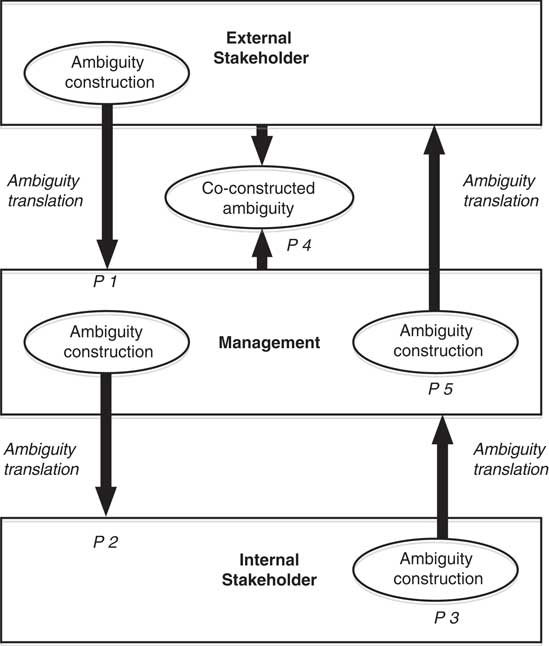
The five propositions are summarized and illustrated in Figure 1 to show when ambiguity logic might be better applied within and across organizations or stakeholders. P1 (Proposition 1) refers to the translating and transferring of ambiguity in the field (ambiguity constructed by external stakeholders) into organizations. P2 (Proposition 2) refers to the employees’ reactions to management’s ambiguity logic. P3 (Proposition 3) refers to the ambiguity constructed by employees. P4 (Proposition 4) refers to the ambiguity co-constructed between organizations and external stakeholders. Finally, P5 (Proposition 5) refers to the ambiguity constructed by management targeting external stakeholders.
Conceptual framework of ambiguity logic

Our main concern is when ambiguity logic can be better used to deal with conflict. The answer lies in a key theoretical logic underlying this framework: the use of ambiguity logic is associated with power. Specifically, ambiguity logic is applied in organizations when power is more evenly distributed among the stakeholders. For example, Davenport and Leitch’s (Reference Davenport and Leitch2005) case study demonstrated how a public sector research funding organization employed strategic ambiguity to delegate considerable authority to stakeholders, thereby stimulating a variety of creative responses. Thus, ambiguity is associated with the sharing of power among stakeholders, that is, in making power more equally distributed among stakeholders. In other cases, the use of the ambiguity strategy was usually found among relatively more power-symmetric relationships between management and other stakeholders, such as university academics (Contractor & Ehrlick, Reference Contractor and Ehrlich1993; Jarzabkowski & Sillince, Reference Jarzabkowski, Sillince and Shaw2007; Jarzabkowski, Sillince, and Shaw, Reference Jarzabkowski and Sillince2010; Sillince et al., Reference Simon2012), medical doctors in hospitals (Denis et al., Reference Denis, Dompierre, Langley and Rouleau2011), and film producers and makers (Abdallah & Langley, Reference Abdallah and Langley2014). These professionals possess relatively more power over management compared to other kinds of employees because of their valuable knowledge and skill background. They are capable of using their power against management when they disagree with management policies. In such contexts, the ambiguity strategy can be used to accommodate diverse interests and opinions and to avoid resistance or discontent related to the direct requirements of compliance. Specifically, these professionals are more willing to accept ambiguous discourses because of the perceived benefits, as argued in Proposition 2. The association between ambiguity and symmetric power relations can also be found in inter-organizational domains, as suggested in Proposition 4 that suggests co-constructed ambiguity is more likely to develop when power is equally distributed among different stakeholders than in the context of a power-asymmetric relationship. In Proposition 5, when there are fewer external stakeholders who require specific conformity, the organization faces less pressure from the external stakeholders, which implies a more power-symmetric relationship between them. Lastly, the power balance between stakeholders may not always be fixed; rather, it could be dynamic and could have the potential to change according to situational factors such the issue’s criticality (Proposition 3). Management may intend to assert certain issues more strongly over employees, which would allow less space for diverse interpretations.
CONCLUSIONS AND DISCUSSION
In this study, I proposed that the concept of ambiguity logic can help to deal with institutional complexity, although I do not attempt to deny the validity of other response strategies. Rather, I want to explore when ambiguity might be better used as an option for organizations. I argue that management can better leverage ambiguity logic if there is ambiguous space as well in the organizational field to allow for interpretation. Further, when applying ambiguity logic, managers need to foresee how employees might react to it and carefully design their discourse strategy to avoid conflicts. Moreover, managers need to consider the issues to which they should apply ambiguity logic rather than clarity. Managers are more likely to adapt this strategy when the issue may not cause immediate and substantial damage to the organizations. With regard to inter-organizational relationships, I argue that managers may adapt ambiguity logic when the power among collaborating partners is relatively equal.
This paper contributes to the theoretical discussion of institutional complexity in three ways. First of all, it shows that apart from clarity-based solutions, ambiguity logic is also a possible response strategy for the institutional complexity issue. Second, it shows that ambiguity logic is better applied in organizations when power is more evenly distributed among the stakeholders. Finally, it shows that organizations’ responses to institutional complexity should be regarded as a dynamic decision-making process, rather than as a single best solution as suggested by other scholars (see the theoretical background section). A single best solution may be less effective when organizations face a fast-changing environment in which flexibility is needed to ensure their survival. Ambiguity logic that allows negations between stakeholders provides the needed flexibility. In other words, organizations may choose to adapt an ambiguity strategy at first, and then initiate dialogue with different stakeholders to find out potential solutions during the negotiation process. As such, this paper shows that a process perspective of analyzing how organizations respond to institutional complexity is more appropriate. Based on this process perspective, scholars in the future may investigate how different response strategies, including ambiguity logics, are used in organizations at different points in time for various situations.
Ambiguity is not an antidote to all the conflicts resulting from competing logics; however, it is a pragmatic approach for initiating dialogues among stakeholders with different views, for seeking possible solutions, and for maximizing shared interests in order to resolve deadlocks. Such an approach is particularly important when clearly stated intentions impede the possibility of mutual understanding and constructive interactions among organizational members. In other words, ambiguity logic helps to create a space of dialogue to buffer conflicts. The likelihood of success in creating such a space is related to other organizational factors such as trust among organizational members. Managers trust their employees to react in positive and creative ways; simultaneously, employees trust that managers will not abuse their power and consequently become toxic leaders who manipulate employees. This reminds us of the ethical concerns related to ambiguity logic (Paul & Strbiak, Reference Paul and Strbiak1997), which need to be further explored in future research to determine how they can be resolved in reality. After all, trust is not only a base for ambiguity logic (Leitch & Davenport, Reference Leitch and Davenport2003; Bess, Reference Bess2006) but also an end product produced through constructive dialogue (Jamal et al., Reference Jamal, Stein and Harper2002). Moreover, managers should make efforts to adapt ‘complexity leadership’ by allowing tensions between heterogeneous groups on the one hand and encouraging interactions among them on the other, so that creative solutions or learning activities may occur (Uhl-Bien, Marion, & McKelvey, Reference Rizzo, House and Lirtzman2007). Allowing such tensions would create an atmosphere that tolerates dissent and divergent perspectives about problems, one in which organizational members are charged with resolving their differences and finding solutions to their problems. Encouraging interactions would enable information and knowledge flow through organizations, so that creativity dynamic is more likely to happen.
In conclusion, I suggest some research directions that could be investigated in future research. First, scholars might want to further explore the relationship between the intention to use a strategy of ambiguity and other factors such as size and lifecycle stage. According to the resource-based view, firms seek to gain unique resources in order to secure their competitive advantage and survival (Barney, Reference Barney2001). Since small or newly established firms usually lack internal resources, therefore, they may be more desperate to acquire resources from different external stakeholders and so become more inclined to adapt ambiguity logic. In such a context, a strategy of ambiguity would help the firm to accommodate different stakeholders. As companies grow larger, they may become less reliant on external support or they may have more resources to engage in institutional entrepreneurship, thereby shaping the environment in which they are embedded. However, from the perspective of company reputation, society definitely pays more attention to larger companies than to smaller companies. Thus, the former face greater scrutiny from outside than the latter; therefore, larger companies will be more motivated to adopt a strategy of ambiguity. Internally, ambiguity logic seeks to encourage employees to provide creative responses to loosely defined goals; in other words, the focus is on the end rather than on the process. Therefore, it may be more effectively applied in an organization in which the process of getting things done is difficult to define or monitor; for example, organizations comprising professional service providers such as consultants or doctors. Externally, when firms directly participate in institutional entrepreneurship activities (Maguire, Hardy, & Lawrence, Reference Maguire, Hardy and Lawrence2004; Greenwood & Suddaby, Reference Greenwood and Suddaby2006) or are indirectly involved in the managerialization of the legal environment (Edelman, Fuller, & Mara-Drita, Reference Edelman, Fuller and Mara-Drita2001), scholars might want to study how they intentionally or unintentionally make the institutional environment more ambiguous so that there is greater room for interpretation.
Additionally, related empirical studies would help to verify the extent to which this framework is used in real organizational life. For instance, it would be interesting to empirically investigate the pattern between the level of ambiguity and the proper management of internal conflicts (Proposition 1). Empirical studies might be conducted in organizations undergoing strategic organizational changes that involve external stakeholders; for example, the internationalization accreditation of business schools or the International Organization for Standardization certification.