One of the most exciting and distinctive features of political science is the use of comparative logic to understand and explain the social world. Indeed, our discipline would not exist without the explicit and implicit use of comparison. Yet, one of the greatest challenges we face as political scientists is to teach undergraduates how to think comparatively. If you have ever offered students the choice of selecting their own research topics, you will have noticed that they frequently opt to write detailed descriptions of a single election, a single revolution, a single war, and so on. This is not because students are lazy, but because of our own shortcomings in the classroom to convey why and how to compare. So we optimistically refer to their papers as “single-case studies” when in reality it is painfully obvious that students rarely understand what a “case” is.
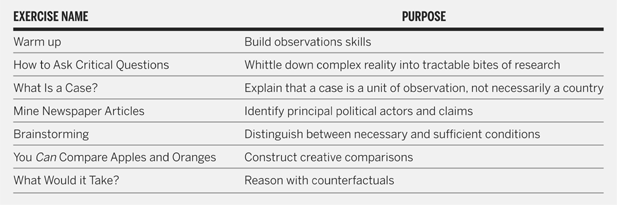
This article proposes seven in-class exercises that instructors can easily incorporate into their teaching to turn curious undergraduates into smart social scientists who think comparatively about the world. The exercises encourage students to explain complex political events, understand what a case is, construct creative comparisons, and reason using conditions and counterfactuals. While they are no panacea for the uneven methods training that undergraduates receive in political science programs (Thies and Hogan Reference Thies and Hogan2005), the exercises endow students with the building blocks of comparative reasoning.
Our aim here is not to show students the mechanics of the comparative method. Instead, we have two other goals: First, to drive home the general lesson that comparative logic underwrites every aspect of our lives, from everyday transactions to the organization of knowledge in myriad fields.Footnote 1 Second, to prod students to ask pointed questions and develop smart answers using comparative reasoning.
Using these exercises should not require restructuring of well-crafted syllabi. Whether you teach an introductory survey course in comparative politics, international relations, or American politics, and regardless of whether you adopt a country-based or theme-based approach on your syllabus,Footnote 2 the exercises can be easily incorporated into lecture and/or discussion sections. At the end of the article, we suggest a number of options for evaluating students on these exercises. Our sole warning is that effectively channeling in-class student participation can be much more difficult than straight lecturing. As seasoned teachers know, when called to participate, students may fall silent or raise extraneous issues. The unpredictability of student behavior can add some color to the classroom, and channeling it is beneficial both for the instructor and the students. Our own and others' experiences in the classroom (O'Leary Reference O'Leary2002, 92) indicate that in-class exercises help to enliven the abstract concepts of our discipline, demystify complex real-world events, and engage both students and professors in the relevance of political science (Beavers Reference Beavers2005, 770).
EXERCISES FOR THE CLASSROOM
1. Warm-Up Exercises
Use a preparatory warm-up exercise in the first two weeks of class to build students' skills of observation and description. Before they can analyze and compare, students first have to understand what is going on. Powner (Reference Powner2006) proposes an innovative classroom activity that walks students through the process of describing and measuring the unobservable concepts that constitute social science research. In peer groups, students describe and theorize about the identity of an oddly shaped object concealed in a small fabric bag without touching it. This exercise allows the instructor to convey both the difficulty and importance of measuring common political science concepts such as anarchy, culture, and federalism—concepts that we can only identify indirectly through their observable implications (Powner Reference Powner2006, 521).Footnote 3
Additionally, we suggest the following exercise. To drive home the point that trained observation is the building block of social science, distribute and discuss the famous extract from the Sherlock Holmes story The Sign of Four (Doyle Reference Doyle2001). In the story, the shrewd detective infers a startlingly accurate portrait of an owner of a watch simply from close examination of the object. Cuts on the watchcase suggest a careless owner who kept the watch in the same pocket with hard objects (coins and keys), and thousands of scratches all over the winding keyhole suggest the unsteady hands of a drunkard. When Watson is incredulous, Holmes patiently explains, “What seems strange to you is only so because you do not follow my train of thought or observe the small facts upon which large inferences may depend” (Reference Doyle2001, 11). The story can be used to jump-start a discussion about how his foolproof deductions may be better framed as hypotheses to explain real-world political events.
Follow this up with a second step that allows students to record their own precise observations. Screen a short, un-narrated five- to seven-minute video of a protest, parliamentary or congressional debate, courtroom scene, or your favorite political phenomenon.Footnote 4 Showing news photographs on a projector serves the same purpose. Ask students to spend five minutes writing a description of what they saw as clearly and precisely as possible, as if they were forensic experts in a lab peering at slides under a microscope. Then call on volunteers to read out their observations. Two things happen when students are aware that they are learning the art of observation. First, in trying to describe what they see, they naturally segue into hypothesis generation to explain what they're observing; and second, they stumble upon political science concepts and models without knowing it, which you can make explicit.Footnote 5
2. How to Ask Critical Questions
This exercise tackles a crucial skill that is most difficult to teach: how to ask effective questions. Belanger (Reference Belanger2004) rightly notes that when students finish a course, it is more important that they remember how to ask the right questions than to recall specific substantive details. Asking questions is a powerful form of reasoning, and what, why, and why not questions in particular are “three mental prods to inventiveness” (Howard and Barton Reference Howard and Barton1986, 73).
Prepare a straightforward empirical lecture of no more than 20 minutes on a relevant topic in your subfield. We have used turning points in the Israeli-Palestinian conflict, narratives stringing together major events leading up to the Iranian revolution of 1979, and events leading to World War I, to name just a few. To accompany the lecture, distribute a one-page handout containing a chronology or key facts to aid student retention. Before delving into the lecture, tell students that they ought to jot down basic why questions as they listen to your narrative. At the end of your lecture, call on volunteers to read out their questions for discussion.
In the lecture on the Israeli-Palestinian conflict, one student was intrigued by the events that led up to the 1987 Intifada and asked: why did the Intifada happen in that year but not in the early 1980s when social conditions seemed more conducive? Another student came back in the next session with a perceptive research question: why has the occupation of Tibet not earned China the level of international opprobrium that Israel's occupation of the West Bank and Gaza has elicited? This exercise shows students that why is “the principal interrogative of science” (Shepsle and Bonchek Reference Shepsle and Bonchek1997, 7). In practicing the formulation of their own why questions, students may also be inspired to compose more interesting research papers.
3. What Is a Case?
The definition of a case as a unit of observation is not intuitive to undergraduates; this exercise helps them understand what a case is by presenting concrete examples of very different kinds of case studies, then having students begin to construct their own comparative designs.
Prepare a lecture that offers a snapshot of some comparative studies in your subfield; we use the following five works that demonstrate the wide variation in what political scientists mean by a case. Robert Michels (Reference Michels1962) and Robert Dahl (Reference Dahl1961) have written theoretically driven single-case studies that respectively focus on the party and the city government as their units of observation. Jack Snyder's Myths of Empire (Reference Snyder1991) compares five cases of imperial overreach; Morris Fiorina's Congress: Keystone of the Washington Establishment (Reference Fiorina1989) investigates two nearly identical electoral districts from the same state and region; and Robert Putnam's Making Democracy Work (Reference Putnam1994) compares six regional Italian governments. To build on the previous exercise, show students that all of these authors begin with concrete research questions: Is there a tradeoff between democracy and organization (Michels)? Is American politics driven by a power elite (Dahl)? Why do great powers repeatedly overextend themselves (Snyder)? What explains the declining competitiveness of congressional elections over time (Fiorina)? Why are some Italian regional governments less corrupt than others (Putnam)?
Now have the students work together for 15 minutes to devise their own case comparisons. To get them started, select a single country, say Chile, and show students the ways in which multiple cases can be squeezed out, for example by comparing popular activism in four neighborhoods, factionalism within three political parties, or protest behavior of two different women's movements (Baldez Reference Baldez2002). Now ask students to select their favorite country and come up with three different scales of comparison. This exercise can also be modified into a take-home assignment, with students referring to the useful Library of Congress Country Studies Series as a basis of information. As an alternative, propose several concrete research questions to students and have them specify different units of observation. For example, what units would they choose to shed light on patterns of religious mobilization, patterns of regime change, and patterns of voter behavior?
4. Mine Newspaper Articles
This trusty staple remains an effective method of introducing students to comparative thinking. Today's students are usually accustomed to catching snippets of news online and are often pleasantly surprised to encounter a deeper and more intelligent print media. On any given day, a number of major world newspapers such as the Financial Times, the New York Times, the Economist, the LA Times, and the Guardian contain articles on events from election campaigning to insurgent violence to trade agreements to the rise and fall of coalition governments. Since most articles combine fact reporting with evaluative analysis, press accounts offer a nice warm up for class discussion and they habituate students to that timeworn ritual of good citizenship: reading the newspaper with care and insight.
Start by selecting a newspaper article sufficiently rich in detail and related to the class topic at hand. Hand out copies of the article in class or project it on a screen. Give students time to read and think about the article, and instruct them to jot down key facts and concepts. When they are done reading, begin by asking basic but overlooked questions such as: Who are the actors? What are they agreeing to/fighting about? What sorts of claims are they advancing? What are the possible causes of their actions? What is the journalist's interpretive stance? Then follow up with higher-order questions: Why did this happen in the country in the article but not in neighboring or similar countries? Why now but not last month or five years ago? What sort of past events can help us understand the unfolding event(s)? Where else might such events unfold in the future?
The idea behind this exercise is to start with simple questions about the basic elements of the event and then, slowly, work up to a more abstract discussion of its comparative dimensions. Always end with the political scientist's signature question: What is this a case of? In contrast to the prior exercise, which teaches students what a case is by virtue of polished political science work, this one asks the students to go a good step further and classify local events into broader categories. Students will begin thinking like political scientists when they understand that the news article describing horrifying civilian deaths in Congo can be classified under the rubric of insurgent strategies in civil war, or that an article discussing inmate numbers across U.S. counties is, among other things, about the imposition of state coercion. As most newspaper articles make for brief reading, this exercise can be repeated often throughout the semester; we find that it requires no more than 15 efficient minutes of class time.
5. Brainstorming
Many theories and comparisons in our field are based on arguments of necessity and sufficiency. Was a certain condition necessary to trigger a given ethnic conflict or merely sufficient? Are certain conditions jointly necessary and sufficient for institutional reform? In our experience, undergraduates find the idea of necessary and sufficient causes intuitive and relatively easy to grasp—just not in the abstract.
To drive home the logic of necessary and sufficient conditions, we suggest the following: Choose an outcome that is a popular item of study in your subfield, say a particular revolution, UN Security Council resolution, war, election outcome, or ethnic “riot.” Ask the students to list all the possible factors that may have caused the outcome. List these on the board as the students name them. Then ask students to eliminate superfluous causes one by one, retaining only those that are sufficient to induce the outcome. Do not reveal beforehand that the purpose of the exercise is elimination.
Two things happen with this exercise. First, students are compelled to make a choice and therefore must compare and weigh the relative significance of different causes. Second, disagreement generates lively debate and requires students to defend their elimination and retention choices. One of us recently tried this exercise using the Rwanda genocide. In the course of 15 minutes, students first enumerated over a dozen causes and then whittled them down to three. Although no consensus emerged on a single condition, a number of students declared that they had a much better understanding of the difference between describing and explaining an outcome.
A variation of this exercise can also be used to link two class sessions. Start the exercise in the last 10 minutes of one class by having students list a multitude of causes. Then complete it in the first 20 minutes of the next class by asking students to come prepared to defend their pared-down causes. Add an increment of complexity by having future iterations of this exercise involve multiple cases of similar phenomena. We have done this with the overthrow of autocrats, UN intervention in ethnic conflicts, and the decision to build walls along international boundaries.
6. You Can Compare Apples and Oranges
Even when students explicitly think in comparative terms, they tend to stick to the adage “you can't compare apples and oranges.” So they select comparisons of similar units, for example, comparing legislatures in the United States and Britain, comparing wars Saddam Hussein initiated during his tenure, comparing American presidents' leadership styles, and so on. You can push them one step further and have them think about how to compare otherwise very dissimilar countries, and what we learn from doing so.
Building on the previous lesson that comparison must be anchored in concrete questions, begin this exercise by giving students sample comparison-construction questions: Why do democracies collapse? Why does the Catholic Church sometimes support authoritarian governments and sometimes oppose them? Why do women become presidents or prime ministers in some countries but not in others? Why does the international community recognize some secessionist movements but not others?
Then choose from a variety of ways to carry out this exercise. One way is to split up the class into groups of four to six students with a 20-minute time limit and ask them to consider how to choose cases to answer a particular question. For instance, for the democratic-collapse question, you can instruct each group to propose a research design that uses four or more cases. The goal here is not to have the students come up with actual instances of collapsed democracies. Rather, the goal of each group is to reflect on the logic of case selection. Would they select four cases of collapse, or two of collapse and two of survival, or some other combination? What do we learn from each selection strategy? For the religion and politics question, compose a shortlist of cases from which four or more can be selected to anchor the investigation. Ask students to deliberate on the advantages and disadvantages of comparing multiple cases from the same region (say Latin America's Catholic churches) versus selecting cases from different regions (for example, the Catholic churches of Argentina, Spain, Democratic Republic of Congo, and Poland). This helps students understand that the cases they select will often affect the answers they get (Geddes Reference Geddes1990). For example, students who select cases within a single continent may hone in on regionally specific explanations, very different than students who choose cases of the same phenomenon that span continents.
Another variation of this exercise can be done with two cases as a take-home assignment. Assign individual students randomly selected pairs of countries (e.g., France and Uruguay, Israel and Serbia, India and the United States, Mexico and Egypt, etc.) and have them come up with a specific research question. Like exercise 3, this exercise shows that there are many different units of comparison within the same pair of countries: some students may elect to compare ruling parties in Egypt and Mexico, others may focus on peasant mobilization, or economic-policy formation, or judicial politics in the same two states. While this particular variation may appear easier given the two-case parameter, this assignment is quite difficult; the random pairing challenges students to think hard about comparisons that are far from obvious. We should note that the objects of random pairing can be chosen by instructors to easily accommodate subfield themes: perhaps wars for international relations courses and cities and legislative committees for courses in urban or American politics.
In addition to reinforcing the point that comparison must be anchored in concrete questions, this exercise sensitizes students to the scale of comparison. They will have already understood that it is meaningless to compare countries or wars as such; now they will know to specify what they are comparing, and to understand that comparing apples and oranges is legitimate so long as they have clearly specified the basis of comparison. Instructors may reserve this assignment for later in the semester when students have a solid grounding in the course material.Footnote 6
7. What Would it Take?
Usually, though not always, the study of politics and society in the United States takes place in isolation from that of other countries. The drawback of such an approach is that students often resist comparing the United States even to other advanced industrialized democracies. We can upend this widespread assumption in our classroom to students' advantage.
Ask the students to think with implicit comparisons and counterfactuals that involve the United States in unlikely outcomes. For example, under what conditions could civil war or democratic breakdown occur in the United States? What would lead the United States to adopt a planned economy? Under what conditions could ethnic conflict occur here? You can expand this exercise to additional countries, asking students to specify the conditions that would transform countries into polar opposites of what they are today. What would make the Democratic Republic of Congo a stable democracy? Under what conditions would Great Britain become an autocracy? As always, specific examples can work to great effect. How did Argentina in the space of one year transform from being a Latin American economic powerhouse to experiencing a wholesale economic meltdown in 2001–2002? How did Botswana escape the debilitating poverty and chronic political instability of many of its resource-rich neighbors, becoming not only the world's largest producer of diamonds, but Africa's longest continuous democracy?
The purpose of this exercise is to introduce students to disciplined counterfactual thinking, one of the most exciting yet least-taught areas in social science. There are a number of useful studies to orient the instructor that describe the parameters of good counterfactuals and the pitfalls of bad ones (Fearon Reference Fearon1991; King and Zeng Reference King and Zeng2006). In an introductory course, you will want to save this exercise for later in the semester when you have tried and modified some of the exercises suggested above. By invoking concrete examples of improbable transformations, students are encouraged to think theoretically, comparatively, and in terms of logical connections and processes rather than exceptions and impossibilities. (See Table 1.)
Exercises for the Undergraduate Political Science Classroom

EVALUATING THE STUDENTS
The above interactive learning exercises can be used to evaluate the students in a number of ways depending on class size and instructor preferences. One option for smaller classes of no more than 30 students is to have participation make up a sizeable portion of the grade (10–20%). Instructors must take care to actively record student participation both individually and in groups. This places the burden on the instructor to learn student names early on and monitor group activity during the exercise to prevent free riding.
Another evaluation option for both large and small classes is to have students turn in brief one-page memos summarizing their ideas or solutions to the problems posed in the exercises. Both memos and quizzes can be graded with a check-plus/check-minus system. A third option for classes of 30 or fewer and discussion sections is to conduct peer evaluations. The instructor can designate a different group of students for each exercise. The designated students sit out the exercise and serve as judges, ranking or evaluating the presentations of each group. While this does not create a formal grade-based evaluation, it is helpful for the students to occasionally assume the role of the evaluator so they can better understand what contributes to a strong and weak presentation. Whichever evaluation combination you use, keep in mind that the importance of the suggested exercises is to improve critical thinking and embolden students rather than to dole out grades.
CONCLUSION
Introductory and survey courses are important gateways that constitute undergraduates' first exposure to political science, and for better or worse these first impressions are hard to shake. Based on our own experiences as undergraduate political science majors and now instructors, we have sought to enliven our own introductory courses with concrete exercises and plenty of examples that will attract students to political science for reasons other than its default status as a pre-law major. The above exercises harness undergraduates' refreshing curiosity about the world and serve as a stepping stone for higher-order work in social science reasoning. By guiding students to ask basic, perceptive, and comparative questions, we hope to show them the vitality of political science and its resonance with the real world.