Floral scents play an important role in attracting pollinators and are composed of various chemicals, including terpenoids, benzenoids, and fatty acids (Dobson Reference Dobson2005). Plant–pollinator interactions have varied the floral scent composition, and some plant species emit characteristic fragrances based on their pollination syndrome (Dobson Reference Dobson2005). For example, many orchid (Orchidaceae) species attract specific pollinators by deceit, and some deceptive orchids emit chemicals mimicking food sources of these pollinators as floral scents to attract them (Edens-Meier and Bernhardt Reference Edens-Meier and Bernhardt2014). There are many studies dealing with relationships between floral scents of orchids and pollinators. For example, the butterfly-pollinated orchid, Gymnadenia conopsea Linnaeus, has a floral scent consisting mainly benzyl alcohol, benzyl acetate, benzyl benzoate, eugenol, and methyl eugenol; two of these compounds (i.e., benzyl alcohol and methyl eugenol) are butterfly attractants associated with food rewards (Huber et al. Reference Huber, Kaiser, Sauter and Schiestl2005). Platanthera bifolia Linnaeus emits benzyl alcohol, 2-phenylethanol, methyl benzoate, linalool, and lilac aldehyde during the night, but only the latter compound is highly attractive to the moth pollinators (Plepys et al. Reference Plepys, Ibarra and Löfstedt2002). The wasps pollinated orchids, Epipactis helleborine (Linnaeus) Crantz and E. purpurata Smith, mimic green-leaf volatiles (e.g., hexyl acetate, nonanal) that are released from cabbage leaves when being fed on by caterpillars, which serve as an attractant for prey-hunting wasps, Vespula germanica Fabricius and Vespula vulgaris Linnaeus (Hymenoptera: Vespidae) (Brodmann et al. Reference Brodmann, Twele, Francke, Hölzler, Zhang and Ayasse2008). Dracula chestertonii (Reichenbach) Luer, mimics fungus-like odours consisting primarily of 1-octen-3-ol, and is pollinated by a fungivorous fly that associates these odours with oviposition site (Kaiser Reference Kaiser1993). Thus, to understand the co-evolution of orchids and their pollinators, it is important to investigate the attractant system of used by orchids.
Cremastra appendiculata (Don) Makino is a rewarding orchid with flowers that are deep purplish pink, with a strong floral scent, plentiful nectar, and long labellum, sepals, and petals (Sugiura Reference Sugiura1996). The inflorescence of C. appendiculata is an erect raceme with 3–47 flowers hat open acropetally (Lund Reference Lund1987). The pollinarium comprises four laterally flattened pollinia and viscidium (Lund Reference Lund1987). The flowers are not regularly autogamous and need pollinators to set fruit (Sugiura Reference Sugiura1996). In Kobe, Japan, C. appendiculata is pollinated by queens of the long-tongued bumble bee, Bombus diversus diversus Smith (Hymenoptera: Apidae) (Sugiura Reference Sugiura1996). However, there are no studies on the pollinator-attractant system employed by C. appendiculata. We hypothesised that C. appendiculata floral scent plays an important role in attracting its pollinators. Thus, in this study, we investigated the pollinator-attractant system of C. appendiculata in Hokkaido, Japan using chemical, electrophysiological, and bumble bee behavioural techniques.
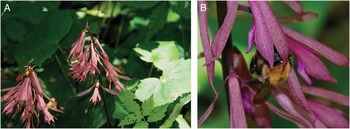
We observed a population of C. appendiculata (Fig. 1A) for four days (10–13 June 2008) in a secondary forest in Sapporo, Hokkaido, Japan. This forest canopy was mainly coniferous. The understorey was dominated by shrubs, low herbs, and ferns, with C. appendiculata growing abundantly among them. A total of 40 C. appendiculata inflorescences were observed from 10:00 AM to 03:00 PM each day during the observation period to confirm the pollinator species and their intrafloral behaviour. We collected 36 B. diversus tersatus Smith queens (henceforth called B. diversus), a subspecies occurring in this area, which were used for electrophysiological analyses and behavioural tests.
(A) External appearance of Cremastra appendiculata. (B) Close-up of a Bombus diversus tersatus queen visiting a C. appendiculata flower.

The methodology used for collecting and analysing floral scents followed that of Tholl and Röse (Reference Tholl and Röse2005). Unvisited inflorescences of C. appendiculata were collected, and their floral scent was analysed. Each flower was placed in a 13.5-mL glass vial and sealed with aluminium foil (septum). The vials had been previously washed using a synthetic detergent and acetone and then conditioned with the aluminium septum at 200 °C for two hours. Volatiles in the head space of each vial were collected using a solid-phase microextraction (SPME) holder with a 100-µm polydimethylsiloxane fibre (Supelco; Sigma-Aldrich, St. Louis, Missouri, United States of America) for 10 minutes.
To investigate the antennal responses of B. diversus queen to the floral scent emitted by C. appendiculata, the volatiles captured on the SPME fibre were analysed using a gas chromatography–electroantennographic detector (GC–EAD) system (Taiyo, Tsukuba, Japan). An Agilent Technologies 7890A Series gas chromatograph (Agilent Technologies, Santa Clara, California, United States of America) was fitted with a polar DB-5MS column. The temperatures of the injection port and flame ionisation detector (FID) port were 250 °C and 300 °C, respectively. The oven temperature was set to 120 °C, which was increased by 10 °C/minute to 250 °C for the polar column. Injections were made in the splitless mode using helium as the carrier gas at a flow rate of 6.5 mL/minute. The hydrogen gas and air-flow rates at the FID port were 30 and 400 mL/minute, respectively.
A single antenna, including the scape, was gently removed from individual live queens with forceps under a microscope, and positioned between silver chloride electrodes fitted with an amplifier before placing them in conductive gel (Aquasonic; Parker Laboratories, Fairfield, New Jersey, United States of America). The analysis was repeated in duplicate.
The electroantennographic detector (EAD) active components were analysed by GC–mass spectrometry under the same conditions as those used for GC–EAD analyses. The ion source temperature was 200 °C, and the interface temperature was 260 °C. Compounds were identified based on mass spectral matches with library spectra (Wiley 229), followed by comparison of the retention times with chemical standards. Nerol and ethyl dodecanoate (Sigma-Aldrich) and methyl decanoate, methyl dodecanoate, methyl tetradecanoate, ethyl tetradecanoate, and methyl hexadecanoate (Tokyo Kasei Industry, Tokyo, Japan) were used as chemical standards for identification and in the behavioural tests.
The behavioural experiment involved the use of a Y-tube olfactometer (length 50 cm, diameter 3.5 cm) covered with foil to prevent visual disturbance (Brodmann et al. Reference Brodmann, Twele, Francke, Yi-bo, Xi-qiang and Ayasse2009). Glass cylinders (length 10 cm, diameter 2.5 cm) containing a mixture of EAD active components, flower extract, or the solvent control were connected by silicone tubing to the Y-tube. Both glass cylinders were connected to an air pump via silicone tubing of equal lengths. Air was forced into each glass cylinder (3 mL/minute) via a single inlet and filtered through activated charcoal to remove any atmospheric pollutants. To test the volatile substances, 2 µL of a mixture of EAD active components, flower extracts, or pure solvent (pentane) was applied to a piece of filter paper in a glass cylinder, which was connected to each end of the shorter Y-tube arms (length 15 cm, diameter 3.5 cm).
Bumble bee queens were fasted for 12 hours before performing the behavioural test. A fasted bumble bee queen was released into the plastic chamber connected to the long arm (length 35 cm, diameter 3.5 cm) of the Y-tube in each test. The bee’s “choice” was recorded when it reached the end of the tube within five minutes. To avoid any preference for one arm of the Y-tube, the positions of the treatment and control were changed after every run.
The following samples were used in the Y-tube test for each B. diversus queen: (1) flower extracts of C. appendiculata in pentane versus solvent control (pentane) and (2) 0.01% nerol, methyl decanoate, methyl dodecanoate, methyl tetradecanoate, methyl hexadecanoate, ethyl dodecanoate, and ethyl tetradecanoate equally dissolved in pentane versus solvent control (pentane). A total of 17 bumble bee queens were bioassayed in each test.
According to our field observation, six inflorescences of C. appendiculata were visited and pollinated by only queens of B. diversus (Fig. 1B) at four visits/hour, extremely low flower-visiting frequencies. The observation period was early in the season so no workers were present. Three queens were observed with C. appendiculata pollinia on the femur of one or both prothoracic legs; the pollinia had attached to the femur of one or both prothoracic legs during their entry into flower.
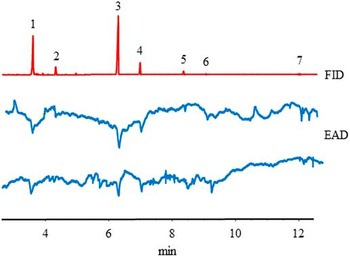
Based on GC–EAD analyses of SPME extracts collected from C. appendiculata flowers, we identified seven peaks (nerol, methyl decanoate, methyl dodecanoate, methyl tetradecanoate, methyl hexadecanoate, ethyl dodecanoate, and ethyl tetradecanoate) that caused electrophysiological responses in the antennae of B. diversus queens (Fig. 2).
Simultaneous gas chromatography–flame ionisation detector and electroantennographic detector recordings obtained from Bombus diversus tersatus queens with floral scents of Cremastra appendiculata. 1: nerol, 2: methyl decanoate, 3: methyl dodecanoate, 4: ethyl dodecanoate, 5: methyl tetradecanoate, 6: ethyl tetradecanoate, and 7: methyl hexadecanoate. FID, flame ionisation detector; EAD, electroantennographic detector; min, minutes.

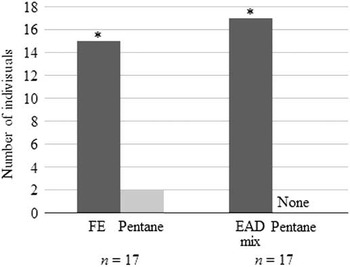
Y-tube olfactometer test results showed that B. diversus queens significantly preferred both flower extracts (binomial test, P<0.05, n=17) and the synthetic mixture of seven EAD active compounds (nerol, methyl decanoate, methyl dodecanoate, methyl tetradecanoate, methyl hexadecanoate, ethyl dodecanoate, and ethyl tetradecanoate) identified in C. appendiculata (binomial test, P<0.05, n=17) compared with pentane (solvent control) (Fig. 3).
Comparison of attractiveness of scents from flower extracts (FEs), synthetic mixture of electroantennographic detector (EAD)-active compounds of flower extracts (EAD mix), and pentane (binomial test, *P<0.05, n=17 for each test).

Queens of B. diversus play an important role as pollinators of C. appendiculata (Sugiura Reference Sugiura1996). The floral morphology supports the observation that long-tongued bumble bees are important for pollination: the flower nectary is concealed in the column, forming a long tube and making nectar collection impossible for insects with a short proboscis. The malar space and proboscis of queen B. diversus are long enough to reach nectar at the bottom of the column. Conversely, any flower-visiting insect duped into probing the flower may accidentally bear the pollinia and potentially transfer pollinia without collecting the nectar, because the nectar is offered deep in the corolla tube, while the pollinia is offered at the top of the corolla.
The results of EAD analyses and behavioural tests suggested that C. appendiculata flowers emitted a scent compound (nerol, methyl decanoate, methyl dodecanoate, methyl tetradecanoate, methyl hexadecanoate, ethyl dodecanoate, and ethyl tetradecanoate) with innate attractiveness for B. diversus queens. Bee-pollinated orchids emit a wide range of floral scents, which have been described to display tones that are rosy (i.e., citronellol, nerol, geraniol, farnesol, and phenylethyl alcohol), iononic (i.e., β-ionone and its derivatives), spicy (i.e., eugenol, isoeugenol, and vanilline), aromatic (i.e., methyl benzoate and methyl salicylate), and all combinations (Kaiser Reference Kaiser1993). In general, bees (especially honey bees and bumble bees) appear to detect a wide range of floral volatiles and discriminate between individual volatiles and different combinations (Wright et al. Reference Wright, Skinner and Smith2002; Paldi et al. Reference Paldi, Zilber and Shafir2003; Laloi and Pham-Delègue Reference Laloi and Pham-Delègue2004). For bumble bee–orchid interactions, floral scents play an important role in attracting the pollinators. For example, the non-rewarding orchid, Dactylorhiza romana Soó attracts bumble bee queens using linalool and benzaldehyde as a floral scent (Salzmann and Schiestl Reference Salzmann and Schiestl2007), and Orchis pauciflora Tenore emits a chemical (2,3-dihydrofarnesol) mimicking the male sex pheromone of Bombus terrestris Linnaeus to attract B. terrestris queens (Valterová et al. Reference Valterová, Kunze, Gumbert, Luxová, Liblikas, Kalinová and Borg-Karlson2007). Nerol is a common floral scent emitted by rewarding and unrewarding orchids (Kaiser Reference Kaiser1993), but the fatty acid methyl and ethyl esters detected in C. appendiculata are rare compounds in floral scents. These esters are common bumble bee-wax scents emitted by bumble bee colonies, and wax scents play an important role in identifying their own colonies when bumble bees return to the nest (Rottler-Hoermann et al. Reference Rottler-Hoermann, Schulz and Ayasse2013). Cremastra appendiculata may mimic bumble bee-wax scent to attract bumble bees, as bumble bee queens individually search for nest sites and/or find their own nests during the flowering season of C. appendiculata. Although the other mechanisms of pollinator attraction (i.e., floral colour and shape) and potential interactions (e.g., whether bumble bees prefer the scent of this orchid to the scents of other flowers) must be investigated for future study, we suggest that floral scent emitted by C. appendiculata play an important role in attracting B. diversus queens.
Acknowledgements
This work was partially supported by Grant-in-Aid for Scientific Research (B) of Japan Society for the Promotion of Science (17380038) to M.O. and the Strategic Research Center Establishment Program (S0901017) from the Ministry of Education, Culture, Sports, Science and Technology of Japan.