Introduction
Rediscoveries are important to taxonomists, because new collections may provide new morphological data for a taxon, which can be used to help better circumscribe species; to biogeographers, because they add to knowledge of poorly known species distributions and can be used to test theories of human effects on species occurrences (Ladle et al., Reference Ladle, Jepson, Malhado, Jennings and Barua2011); and to conservationists, because they reduce uncertainty in extinction risk assessments, thereby contributing to better-grounded threat levels and providing support for conservation interventions (Ladle et al., Reference Ladle, Jepson, Malhado, Jennings and Barua2011), which are especially needed in heavily threatened natural biomes.
The Brazilian Cerrado biome is currently highly threatened by human activity, mostly the use of land for mechanised soybean plantations and livestock grazing (Ratter et al., Reference Ratter, Ribeiro and Bridgewater1997; Klink & Machado, Reference Klink and Machado2005; BFG, 2015). It is estimated that of its original area of approximately 2 million square kilometres, more than 50% has already been profoundly modified (Beuchle et al., Reference Beuchle, Grecchi, Shimabukuro, Seliger, Eva, Sano and Achard2015). The Cerrado biome has the highest plant diversity of any savanna in the world, with currently 12,103 species of seed plants recorded, of which 35% are endemic (Forzza et al., Reference Forzza, Baumgratz, Bicudo, Canhos, Carvalho, Coelho, Costa, Costa, Hopkins, Leitman, Lohmann, Lughadha, Maia, Martinelli, Menezes, Morim, Peixoto, Pirani, Prado, Queiroz, Souza, Souza, Stehmann, Sylvestre, Walter and Zappi2012; BFG, 2015). This combination of high diversity and endemism with the pressing threat level makes it a priority area for conservation (Myers et al., Reference Myers, Mittermeier, Mittermeier, Fonseca and Kent2000; Mittermeier et al., Reference Mittermeier, Gil, Hoffman, Pilgrim, Brooks, Mittermeier, Lamoureux and Fonseca2004).
A large number of plant species that occur on the Cerrrado are known only from historical collections (Martinelli et al., Reference Martinelli, Messina and Santos-Filho2014), and some recent research deals with species ‘rediscoveries’ in this biome (e.g. Echternacht et al., Reference Echternacht, Trovó and Sano2010; Medeiros et al., Reference Medeiros, Alves and Senna-Valle2011; Bove & Philbrick, Reference Bove and Philbrick2014; Silva et al., Reference Silva, Sodré and Berry2015; Borges & Antar, Reference Borges and Antar2016; Scatigna et al., Reference Scatigna, Amaral, Munhoz, Souza and Simões2016). The first botanical expeditions into the Cerrado biome were carried out by European naturalists during the nineteenth and early twentieth centuries, including William Burchell, Auguste Glaziou, Johann Emanuel Pohl, Jacques Samuel Blanchet, Augustin Saint-Hilaire, Ludwig Riedel, Friedrich Sellow and George Gardner (Urban, Reference Urban, Martius and Eichler1906), resulting in the description of many new species (Walter et al., Reference Walter, Cavalcanti, Filgueiras, Cavalcanti and Ramos2001). Afterwards, there followed a period without systematic botanical collections in the Cerrado biome, particularly in the core area of the Cerrado (Eiten, Reference Eiten1972) in central-western Brazil, these recommencing only in the early 1960s (Ratter et al., Reference Ratter, Ribeiro and Bridgewater1997; Walter et al., Reference Walter, Cavalcanti, Filgueiras, Cavalcanti and Ramos2001). Despite these efforts, some Cerrado areas remain under-sampled (BFG, 2015).
One such under-sampled area is the Jalapão region, located in the far east of Tocantins state near the border between Piauí, Tocantins, Maranhão and Bahia states (Proença et al., Reference Proença, Farias-Singer and Gomes2007). Fortunately, the Jalapão region is the best conserved and largest continuous protected area of the Cerrado (Silva & Bates, Reference Silva and Bates2002), with the most important protected areas being the Parque Estadual do Jalapão, the Estação Ecológica Serra Geral do Tocantins and the Parque Nacional das Nascentes do Rio Parnaíba (Schmidt et al., Reference Schmidt, Figueiredo and Scariot2007). This region and the surrounding areas were explored relatively late in colonial history, owing to their distance from the coast and the lack of transport infrastructure (Souza-Júnior, Reference Souza-Júnior2002). Consequently, few botanical expeditions have been carried out in the area, contributing to a paucity of detailed floristic information (Proença et al., Reference Proença, Farias-Singer and Gomes2007). Recent efforts have been made to improve sampling of the flora of the region (Scariot et al., Reference Scariot, Cavalcanti, Sevilha, Sampaio, Silva and Silva2002; Seplan, 2003), most prominently fieldwork by the Brazilian Agricultural Research Corporation (Embrapa) and the University of Brasília. As a result, species lists have been compiled showing high richness (Arruda & Behr, Reference Arruda and Behr2002; Scariot et al., Reference Scariot, Cavalcanti, Sevilha, Sampaio, Silva and Silva2002; Seplan, 2003), although plant diversity continues to be under-sampled (Antar & Sano, in preparation).
During a recent survey carried out with the aim of producing a new checklist for the Jalapão region (Antar & Sano, in preparation), four rediscoveries of angiosperms were made. The current work reports these and provides new information about the species’ morphology, distribution, ecology and conservation status.
Materials and Methods
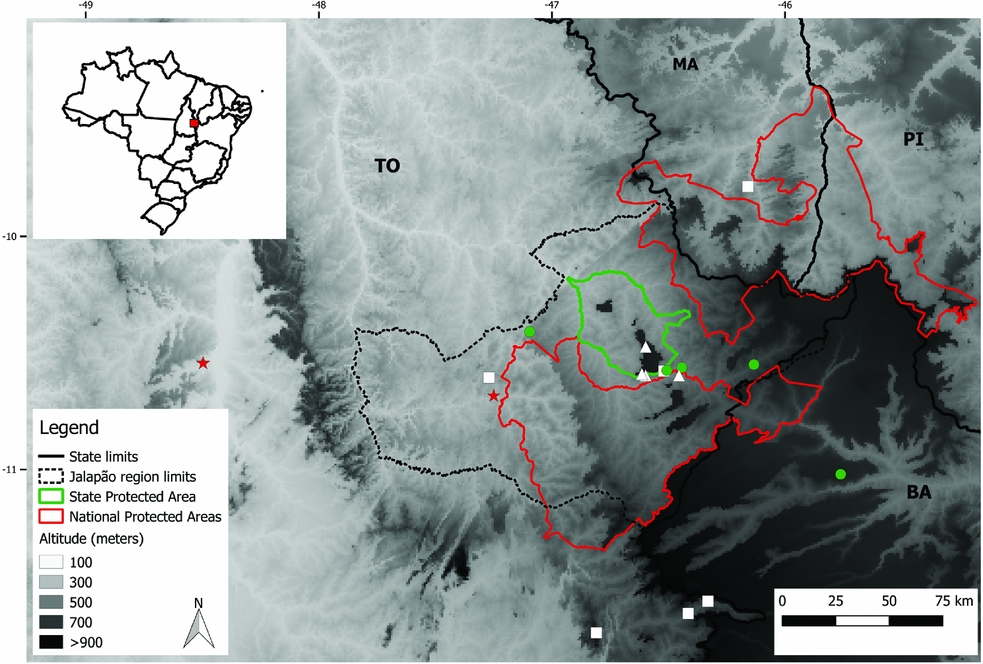
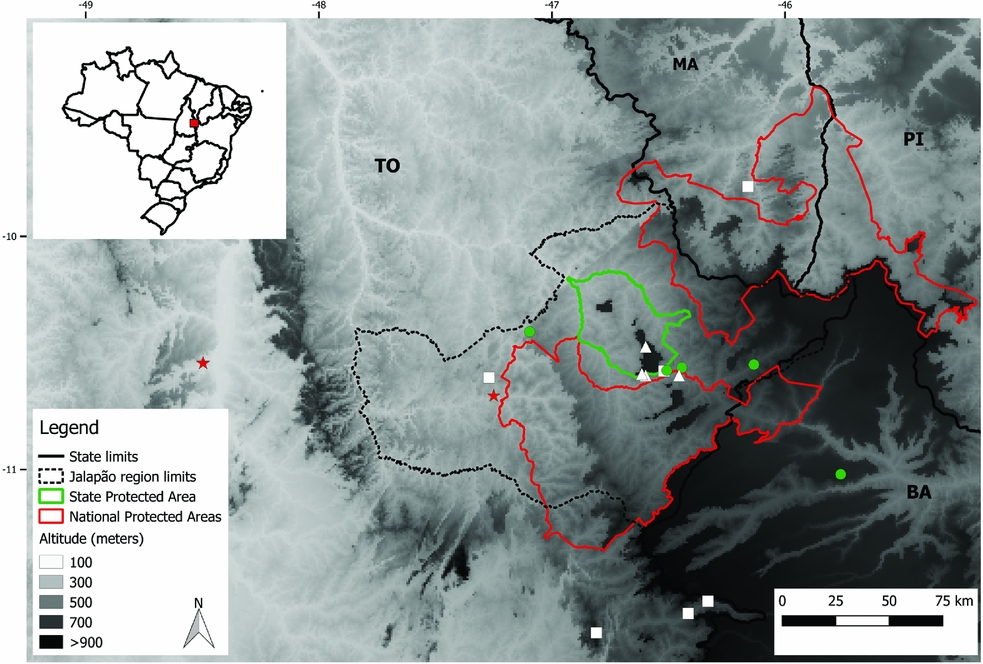
The Jalapão region, covering an area of approximately 18 million square kilometres, is located in the far east of Tocantins state, near the border between Bahia, Maranhão and Piauí, and includes the municipalities of Mateiros, Ponte Alta do Tocantins and São Felix do Tocantins (Fig. 1). The climate corresponds to Köppen's category Aw (Alvares et al., Reference Alvares, Stape, Sentelhas, Gonçalves and Spavorek2014), with two well-differentiated seasons: a rainy one from October to March, and a dry one from April to September (Ratter et al., Reference Ratter, Ribeiro and Bridgewater1997). Mean precipitation is approximately 1500 mm/year, and mean annual temperature is approximately 26°C (Seplan, 2012). The soils are sandy, well-drained and nutrient-poor quartzitic neosoils. Elevation ranges mostly from 400 to 550 m above sea level, reaching up to 800 m in some cases (Seplan, 2012). The principal phytophysiognomies (sensu Ribeiro & Walter, Reference Ribeiro, Walter, Sano, Almeida and Ribeiro2008) are swamp forests (veredas) accompanying the innumerous drainage lines (Schmidt et al., Reference Schmidt, Figueiredo and Scariot2007; Sampaio et al., Reference Sampaio, Schmidt and Figueiredo2008) and savanna vegetation, mainly open subtypes such as campo sujo and cerrado sensu stricto (Seplan, 2003).
Study area and distribution of Hyptis caduca (red stars), Duguetia rotundifolia (white triangles), Diospyros ovalis (green circles) and Rhabdodendron gardnerianum (white squares). BA, Bahia; MA, Maranhão; PI, Piauí; TO, Tocantins.
Six field expeditions to the area were undertaken between 2013 and 2015, spanning both dry and wet months. All fertile angiosperms were collected following Filgueiras et al. (Reference Filgueiras, Nogueira, Brochado and Guala1994). Specimens collected were processed following Fidalgo & Bonini (Reference Fidalgo and Bononi1984), with vouchers collected deposited in the SPF herbarium. In addition, the following herbaria (abbreviations according to Thiers, continuously updated) were visited and identifications reviewed: BHCB, CEN, CEPEC, ESA, HCF, HEPH, HRCB, HTO, HUEFS, HUTO, MBM, RB, SPF, UB and UEC. Images of type specimens of the species rediscovered were studied using JSTOR Global Plants (no date).
Morphological features of the specimens were analysed with a × 10–60 magnification stereomicroscope. Terminology follows Harris & Harris (Reference Harris and Harris2001) for general morphology, Hickey et al. (Reference Hickey1973) for leaf morphology, and specific literature for each taxon: Hyptis (Epling, Reference Epling1949; Harley & Pastore, Reference Harley and Pastore2012), Duguetia (Maas et al., Reference Maas, Westra and Chatrou2003), Diospyros (Hiern, Reference Hiern1873; Wallnöfer, Reference Wallnöfer2001) and Rhabdodendron (Prance, Reference Prance1972; Puff & Weber, Reference Puff and Weber1976; Prance, Reference Prance, Smith, Mori, Henderson, Stevenson and Heald2004).
IUCN criteria (IUCN, 2001; IUCN Standards and Petitions Subcommittee, 2016), together with the GeoCAT tool (Bachman et al., Reference Bachman, Moat, Hill, Torre and Scott2011), were used to infer conservation status, with IUCN default values for extent of occurrence and area of occupancy analysis. The distribution map was produced in QGIS version 2.8.1 (QGIS Development Team, 2016). When herbarium specimens were not georeferenced, geographical coordinates were approximated using the locality description on the label; in cases of unspecific locality description, the coordinates of the centroid of the municipality were used. In the absence of at least three points of occurrence, mandatory for GeoCAT, existing points were replicated and slightly dislocated on the map, following Borges & Antar (Reference Borges and Antar2016).
Results
Four angiosperm species were rediscovered and are described here, with all descriptions including new morphological data. Notes are provided for all taxa clarifying the type collection locality, this being necessary owing to changes in state and municipality borders in Brazil or because of inaccurate descriptions on the original labels. Ecological aspects and conservation status are also discussed.
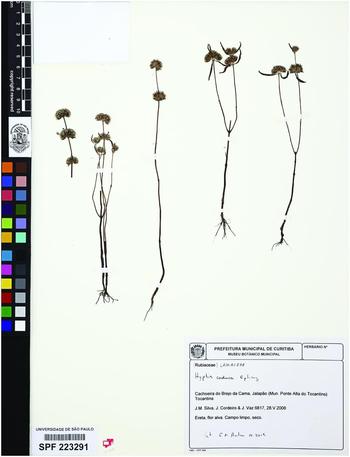
Hyptis caduca Epling, Repert. Spec. Nov., Beih. 85: 320. 1937. – Type: Brazil, Goiás [Tocantins]: Porto Real [Porto Nacional], April 1829, Burchell 8762 (holo US; iso F, GH, K [scan seen – K000192538], P). Fig. 2 .
The second known specimen of Hyptis caduca Epling (SPF-223291). Image courtesy of the SPF herbarium; reproduced with permission.

Annual herb up to 30 cm. Stem internodes usually longer than the leaf, unbranched or once-branched, 2–4(–7) pairs of leaves per branch. Leaves opposite, mostly concentrated near the inflorescences; leaf blade 1–2 × 1 cm, linear, crenate, indumentum hirsute of simple delicate trichomes and glandular sessile trichomes; petiole absent to 1–2 mm long. Inflorescence capituliform, formed by 2 (or 3) glomerules in the axils of superior leaves; peduncle 1–2(–3) mm long; involucral bracts 5–7 × 2–3 mm, connate at the base, broadly lanceolate, acuminate, acumen c.1 mm long, indumentum hirsute of trichomes concentrated in the margins and glandular sessile trichomes. Flowers subsessile on pedicels c.0.5 mm long; calyx at anthesis 3–4 mm long, tube 2–3 mm long, externally hirsute, internally glabrous, the apex of the tube densely hirsute, calyx lobes linear, equal, 1–2 mm long, hirsute, calyx in fruit c.5 mm long; corolla c.4 mm long, tube c.3.5 mm long, narrowly cylindrical, glabrous except for the hirsute apices of lobes; stamens with glabrous filaments; gynoecium glabrous. Nutlet c.1 × 0.5 mm, ellipsoid, glabrous, wrinkled, mucilaginous when wet.
Distribution
Hyptis caduca is known only from Tocantins state, occurring in the municipalities of Ponte Alta do Tocantins and Porto Nacional (Fig. 1).
Specimen examined. Brazil: Tocantins: Ponte Alta do Tocantins, Jalapão, 28 v 2008, J.M. Silva et al. 6817 (MBM!, SPF!).
Habitat
The species can be found from 400 to 500 m above sea level in dry sandy fields (campo limpo).
Phenology
Fertile specimens of Hyptis caduca were collected in April and May.
Conservation status
The area of occupancy is reduced, being just 8000 km², and the extent of occurence is 0.456 km². None of the collections were found inside protected areas, although populations of Hyptis caduca probably occur inside the nearby protected areas of Jalapão. The type populations may be extinct owing to urbanisation and agriculture in Porto Nacional. The conservation status of this species is assessed as Critically Endangered according to IUCN criteria B1ab(iii)+2ab(iii) (IUCN, 2001).
Hyptis caduca was previously known only from the type specimen, collected by Burchell in 1829, in the municipality of Porto Nacional, Tocantins state (Epling, Reference Epling1949; Harley & França, Reference Harley, França, Giulietti, Rapini, Andrade, Queiroz and Silva2009). Tocantins state was created in 1989, when it was separated from Goías. Before 1861, when Tocantins was still part of the state of Goiás, the locality was known as Porto Real (Dias, Reference Dias2016). This re-collection occurs after 179 years, in the municipality of Ponte Alta do Tocantins, c.125 km east of Porto Nacional.
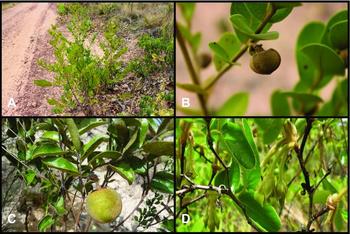
Duguetia rotundifolia R.E.Fr., Bull. Herb. Boissier, ser. 2. 7: 1003. 1907. – Type: Brazil: Goiás [Tocantins], Mission of Duro [Dianópolis], ix 1839, Gardner 2998 (holo K [scan seen – K000487384]). Fig. 3 A,B.
A, B. Duguetia rotundifolia. A, Habit; B, flower buds. C, D, Diospyros ovalis. C, Habit and fruits; D, flowers.

Shrubs 0.4–2 m tall. Stems covered with stellate scales. Leaves alternate, arranged along the entire stem; leaf blade 2.5–9.8 × 1.7–5.5 cm, ovate, elliptic or orbicular, apex rounded to emarginated, rarely slightly acute, base obtuse to rounded, adaxially glabrous, shiny, abaxially sparsely covered with stellate scales, more densely dispersed in the midrib, brown; petiole 1–2(–3) mm long. Inflorescence 1-flowered, subaxillary; peduncle 2–3(–5) mm long, densely covered with stellate scales, external bract 5–7 mm long, triangular, adaxially glabrescent, abaxially densely covered with stellate scales, upper bract 4–7 mm long, adaxially glabrescent to pubescent with simple trichomes, abaxially densely covered with stellate scales. Flowers with pedicels 8– 10 mm long, densely covered with stellate scales; flower buds deltoid; calyx 1-whorled, sepals brown, 14–22 × 12–20 mm, broadly ovate, apex acute, base rounded, adaxially tomentose with simple tricomes, abaxially densely covered with stellate hairs; corolla 2-whorled, petals cream, subequal, 11–15 × 11–14 mm, deltoid, apex obtuse, base rounded to truncate, abaxially covered with stellate hairs, adaxially tomentose with simple trichomes; stamens numerous, c.1 mm long; carpels numerous, c.4 mm long, stigma glabrous, ovary tomentose with simple trichomes and some stellate scales. Fruit not seen.
Distribution
Duguetia rotundifolia is known from Tocantins and Maranhão states, occurring in the municipalities of Ponte Alta do Tocantins (Tocantins), Porto Nacional (Tocantins) and Alto Parnaíba (Maranhão) (Fig. 1).
Specimens examined. Brazil, Maranhão: Alto Parnaíba, estrada de acesso ao povoado Curralinho, 09°47′10.26″S, 46°01′51.28″W, xi 2013, H.G. Silva et al. 236 (SP, SPF!). Tocantins: Dianópolis, 11°33′55″S, 46°19′50″W, 26 ix 2003, A.O. Scariot 776 (CEN, SPF!); Ibidem, 11°37′03″S, 46°24′55″W, 27 ix 2003, A.O. Scariot 924 (CEN, SPF!); Mateiros, 10.5623°S, 46.4426°W, 7 x 2007, J. Paula-Souza et al. 9136 (CTES, SI, SPF!); Ibidem, Parque Estadual do Jalapão, 10°34′40.25″S, 46°31′09.78″W, 21 ix 2014, G.M. Antar et al. 536 (SPF!, W!); Ponte Alta do Tocantins; 10.6055°S, 47.2701°W, 6 x 2007, J. Paula-Souza et al. 9011 (SPF!).
Habitat
Duguetia rotundifolia occurs in different phytophysiognomies of the Cerrado: open fields (campo sujo) and savanna (cerrado s.s.) on dry sandy soils, and near swamp forests (veredas) on wetter soils. It was also recorded as occurring in disturbed savanna. It can be found from 450 to 750 m above sea level.
Phenology
Duguetia rotundifolia was found in flower from September to November. Fruiting period is unknown.
Conservation status
The area of occupancy is 24 km² and the extent of occurrence 14,823.217 km². Collections were found inside the Parque Estadual do Jalapão and Parque Nacional das Nascentes do Rio Parnaíba protected areas. The conservation status is assessed as Vulnerable according to IUCN criteria B1ab(iii)+2ab(iii) (IUCN, 2001).
Duguetia rotundifolia was previously known only from the type specimen, collected by Gardner in 1839 (Maas et al., Reference Maas, Westra and Chatrou2003; CNCFlora, 2012), and considered to be rare (Rodrigues, Reference Rodrigues, Giulietti, Rapini, Andrade, Queiroz and Silva2009a). It is rediscovered after 164 years, and the petals are described for the first time. Although it is now known from the type and six additional specimens, fruiting material is still unknown.
Mission of Duro is a rather common locality in Gardner's expedition collections. According to Hind (Reference Hind2012), he stayed in the area for several days and collected a large number of specimens. Comparing his diary with maps (IBGE, 1984), it is possible to determine that this locality is in the current municipality of Dianópolis in the state of Tocantins, as supported by Arbo (Reference Arbo1993), Cavalcanti (Reference Cavalcanti1995) and Dias (Reference Dias2016).
Diospyros ovalis Hiern, Trans. Cambridge Philos. Soc. XII: 248. 1873. – Type: Brazil, Pernambuco [Bahia]: Rio Preto [Formosa do Rio Preto], ix 1839, Gardner 2813 (syn F, K [scan seen – K000644381], MG, P). Fig. 3 C,D.
Subshrubs to shrubs 0.3–1 m tall, dioecious. Stems ferruginous-sericeous when young, the older ones becoming glabrous. Leaves alternate, present only in new season branches and concentrated in the upper parts of stems; leaf blade 1.5–5.1 × 0.8– 2.6 cm, elliptic, oval to ovate, apex obtuse with a tuft c.1 mm long of trichomes coming from the abaxial midrib, base cordate to rounded, adaxially shiny, black to dark grey when dried, glabrescent to sericeous in younger leaves, trichomes concentrated in the midrib, abaxially ferruginous, sericeous, mostly in the midrib; petiole almost absent to 1 mm long, sericeous. Inflorescence cymose, 1- to 6-flowered, axillary, bracts c.0.5 × 0.4 mm, sericeous, oval, concave. Flowers tetramerous (trimerous); pedicels 2–6 mm long; bracteoles soon deciduous c.3 mm long; calyx sericeous, brown, sepals 5–7 × 2–3.5 mm, lanceolate, slightly connate at the base; corolla infundibuliform, externally sericeous just alongside the central portion, internally glabrous, green, petals c.10–12 × 3–4 mm, lanceolate, connate in the base; male flowers with 20–28 stamens, subequal, the inner ones shorter than the outer or equal, all attached together at base and to the base of the corolla, 3–5 mm long, glabrous, anthers linear; pistilode 1–3 mm long, hispid. Female flowers with few staminodes or absent, if present adnate to the base of corolla, c.3 mm long, ovary c.5 mm long, hispid, ovoid, stigma 3. Fruit a fleshy berry, sericeous, globose, not seen in mature condition.
Distribution
Diospyros ovalis is known from Tocantins and Bahia states, occurring in the municipalities of Dianópolis, Mateiros, Ponte Alta do Bom Jesus and Ponte Alta do Tocantins in Tocantins and Formosa do Rio Preto in Bahia (Fig. 1).
Specimens examined. Brazil: Tocantins: Dianópolis, 11°40′14,7″S, 46°40′37″W, 17 x 2008, R.C. Mendonça et al. 6263 (IBGE, SPF!); Mateiros, 10.5623°S, 46.4426°W, 7 x 2007, J. Paula-Souza et al. 9136 (CTES, SI, SPF!); Ibidem, Parque Estadual do Jalapão, 10°34′31″S, 46°30′22.9″W, 30 x 2013, G.M. Antar & M. Escaramai 296 (CEN!, RB!, SPF!); Ponte Alta do Bom Jesus, 11°47′44″S, 46°22′51″W, 20 iv 2017, G.M. Antar et al. 1551 (SPF!); Ponte Alta do Tocantins, 10.4091°S, 47.0956°W, 6 x 2007, J. Paula-Souza et al. 9085 (CTES, SI, SPF!).
Habitat
Occurring in open fields (campo sujo) and savanna (cerrado s.s.) on dry sandy soils.
Phenology
Diospyros ovalis was found in bloom from September to October and in fruit in October.
Conservation status
The area of occupancy is 24 km² and the extent of occurrence 13,057.486 km². Some collections were found inside the protected area Parque Estadual do Jalapão. Because of the few records of Diospyros ovalis (six collections), its conservation status is assessed as Vulnerable according to IUCN criteria B1ab(iii)+2ab(iii) (IUCN, 2001).
Diospyros ovalis was previously known only from the type specimen and was referred to as the least known species of the genus in Brazil (Cavalcante, Reference Cavalcante1963). Recent collections made in the Jalapão region led to its rediscovery after 168 years. Personal observations suggest that despite having a small area of occurrence, Diospyros ovalis is rather common throughout the area. Female flowers are described for the first time. A lectotype of Diospyros ovalis will soon be provided by the specialist in the genus (B. Wallnöfer, Vienna, personal communication).
Pernambuco province encompassed the areas east of the São Francisco river, and was therefore referred to as Comarca de São Francisco until 1827, when it was transferred to Bahia (Brandão, Reference Brandão2010; IBGE, 2011). Gardner gathered the type collection of Diospyros ovalis in 1839 when the area was already part of Bahia province, but he was using the old delimitation and annotated the specimen as coming from Pernambuco (Urban, Reference Urban, Martius and Eichler1906; Hind, Reference Hind2012). The locality Rio Preto listed by Gardner, and neighbouring localities such as Santa Rosa, Santa Maria, Serra do Mato Grosso and Serra da Batalha, were a source of confusion among different botanists. These localities were misplaced in Piauí (e.g. Epling, Reference Epling1949; Stafleu, Reference Stafleu1953; Rodrigues, Reference Rodrigues1976; Pennington, Reference Pennington1990; Koschnitzke & Martins, Reference Koschnitzke and Martins2007), Pernambuco (e.g. Trelease, Reference Trelease1916; Irwin & Barneby, Reference Irwin and Barneby1982; Khan, Reference Khan2007; Souza & Giulietti, Reference Souza and Giulietti2009; Oliveira & Bove, Reference Oliveira and Bove2015) or Mato Grosso (e.g. Lima et al., Reference Lima, Queiroz, Tozzi and Lewis2014). According to the nearby places listed in Gardner's diary (Hind, Reference Hind2012) and cartographic information (IBGE, 1984), these localities are part of the actual municipality of Formosa do Rio Preto in Bahia, near the border between Bahia, Piauí, Tocantins and Maranhão. This conclusion is also supported by other botanists (Urban, Reference Urban, Martius and Eichler1906; Prance, Reference Prance1972; MacLeish, Reference MacLeish1987; Harley, Reference Harley1988; Prance, Reference Prance, Smith, Mori, Henderson, Stevenson and Heald2004).
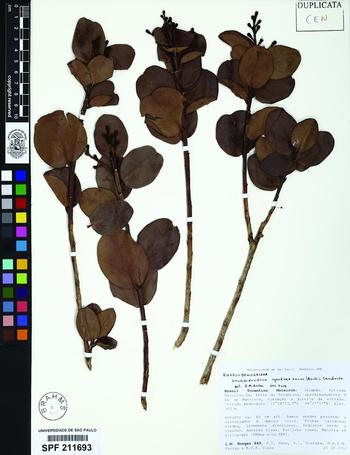
Rhabdodendron gardnerianum (Benth.) Sandwith, J. Arnold Arb. 24: 224. 1943. – Type: Brazil, Pernambuco [Bahia]: Rio Preto [Formosa do Rio Preto], ix 1839, Gardner 2814 (holo K [scan seen]; iso BM [scan seen], CGE, GH, NY, OXF, P). Fig. 4 .
One of the re-collections of Rhabdodendron gardnerianum from Jalapão region (SPF-211693), Borges et al. 849. Image courtesy of the SPF herbarium; reproduced with permission.

Shrubs 0.4–1.0 m tall. Stems covered with peltate trichomes when young, the older ones glabrous. Leaves alternate; leaf blade (1.2–)3–7.1 × (0.5–)2.5–4.8 cm, orbicular, broadly elliptic or narrowly oblong, apex shortly acuminate, obtuse or rarely emarginated, base cordate, rounded, subcuneate or cuneate, margin slightly revolute, adaxially glabrous, frequently shiny, smooth or slightly rugose, midrib plane, primary veins obscured, abaxially sparsely covered with peltate trichomes to glabrous, midrib prominulous, primary veins inconspicuous; petiole (1–)3–5(–8) mm long, covered with peltate trichomes to glabrous. Inflorescence racemose, axillary; bracts and bracteoles scale-like, 1(–2.5) mm long, lanceolate, covered with peltate trichomes; prophylls scale-like, up to 3 per flower. Flower pedicels (2–)3–5 mm long, sparsely covered with stellate scales, green to vinaceous; receptacles broad, concave; calyx pentamerous, sepals up to 1 mm long, connate at the base, apex broadly obtuse, covered with peltate trichomes; corolla pentamerous, aestivation imbricate, caducous, petals 4–5 mm long, c.2 mm wide, oblong-elliptic, apex rounded, base truncate, minutely punctate; stamens c.45–50, 2–3 mm long, filaments minute, persistent, anthers linear, erect; ovary globose, apex covered with trichomes, 2-ovulate, c.1 mm long, style arising from base of ovary to one side of it. Fruit a drupe, subglobose, 5–7 mm diameter, exocarp pubescent, shiny, dark green, wrinkled when dry.
Distribution
Rhabdodendron gardnerianum is known from Tocantins and Bahia states, occurring in the municipalities of Mateiros (Tocantins) and Formosa do Rio Preto (Bahia) (Fig. 1).
Specimens examined. Brazil: Tocantins: Mateiros, 10°28′23,9″S, 46°27′17″W, 20 xi 2012, L.M. Borges et al. 849 (CEN!, SPF!); Ibidem, 10°35′47,2″S, 46°35′51,9″W, 10 iii 2006, M.L.O. Trovó et al. 245 (SPF!); Mateiros, Parque Estadual do Jalapão, Serra do Espírito Santo, 10°35′25.6″S, 46°36′50.5″W, 30 viii 2010, M.G. Caxambu et al. 3224 (HCF!); Mateiros, Parque Estadual do Jalapão, 10°35′47.3″S, 46°35′52″W, 30 vi 2014, J.A. Lombardi et al. 10230 (HRCB!, UPCB). 46°22′08″W.
Habitat
Occurring in open fields (campo sujo), rocky fields, and savanna (cerrado s.s.) on dry sandy soils.
Phenology
Rhabdodendron gardnerianum was found with flowers in September and with fruits between March and September.
Conservation status
The area of occupancy is 16 km² and the extent of occurrence 119.501 km². Although most collections were made inside the area of the Parque Estadual do Jalapão, the species is only known from five specimens. The conservation status is assessed as Endangered, following IUCN criteria B1ab(iii)+2ab(iii) (IUCN, 2001).
Rhabdodendron gardnerianum was previously known only from the type specimen collected in Formosa do Rio Preto (Prance, Reference Prance1972, Reference Prance, Smith, Mori, Henderson, Stevenson and Heald2004), and considered to be rare (Rodrigues, Reference Rodrigues, Giulietti, Rapini, Andrade, Queiroz and Silva2009b) or thought to be extinct (Prance, Reference Prance, Smith, Mori, Henderson, Stevenson and Heald2004). It has been rediscovered in Jalapão after 167 years. The type locality is the same as previously discussed for Diospyros ovalis.
Fruits of Rhabdodendron gardnerianum are described for the first time, as well as trichomes on the ovary and fruits. This observation contrast with reports in the literature (Prance, Reference Prance1972; Puff & Weber, Reference Puff and Weber1976; Prance, Reference Prance, Smith, Mori, Henderson, Stevenson and Heald2004), in which the family is described as having glabrous ovary and fruits, based on the two other species of the genus. Scanning electron microscopy is needed to clarify the type of the trichomes.
When compared with the type material (Gardner 2814), the specimens of Rhabdodendron gardnerianum found in the Jalapão region have significant morphological differences, especially in leaf morphology. Gardner's specimen shows narrower leaves that are aggregate, perhaps indicating a resprout after a fire event. Despite that, because the collections were made in nearby areas and the differences are small, we here propose an expansion of the concept of Rhabdodendron gardnerianum to encompass the morphology found in Jalapão region. Further collections, particularly in the municipality of Formosa do Rio Preto (Bahia), may clarify the species circumscription.
Discussion
Of the few large areas of conserved Cerrado that still exist, Jalapão region is the largest and best conserved (Silva & Bates, Reference Silva and Bates2002), owing to its very low population density and the historically limited human economic activities in the area (Seplan, 2003). The economy is poorly developed, mostly owing to the poor sandy soils, which are unsuitable for traditional agriculture. The high biodiversity near roads and the absence of exotic species of Poaceae in Jalapão that are so common in more disturbed areas of the Cerrado (Pivello et al., Reference Pivello, Shida and Meirelles1999) are good indications of the well-conserved nature of the region (Filgueiras, Reference Filgueiras, Oliveiras and Marquis2002). Nonetheless, growing tourism and especially the rapid advance of the agricultural frontier, mainly with soybean cultivation and Eucalyptus cropping encouraged by the Brazilian government (e.g. the creation of MATOPIBA; Presidência da República, 2015), are beginning to be seen in the surrounding areas, replacing the natural vegetation of the region. Nearby areas from the state of Bahia (particularly the municipality of Formosa do Rio Preto, where Gardner made some of his collections) are already highly degraded as a result of agricultural activity, which is now advancing towards the Jalapão region (Borges & Antar, Reference Borges and Antar2016). To better conserve an area, scientific knowledge is highly desirable, because it valorises biodiversity and supports proposals for well-grounded conservation strategies (Mace, Reference Mace2004). The rediscovery of these four rare plants is important, because it extends the knowledge of plant diversity in the Jalapão and draws attention to its high plant richness, the rapid deforestation of the Cerrado and the lack of an acceptable floristic knowledge of the region, thereby contributing to the conservation of a highly threatened biome.
These rediscoveries are also important because in all cases they expand the known areas of occurrence, reveal new morphological data that can be used to help better circumscribe species (especially in the case of Rhabdodendron gardnerianum), and enable the systematic positioning of species (particularly Duguetia rotundifolia, which has an unresolved phylogenetic position within the genus; Maas et al., Reference Maas, Westra and Chatrou2003).
The species treated here were either considered to be extinct, as with Rhabdodendron gardnerianum by Prance (Reference Prance, Smith, Mori, Henderson, Stevenson and Heald2004), or thought to be rare, as in the cases of Hyptis caduca (Harley & França, Reference Harley, França, Giulietti, Rapini, Andrade, Queiroz and Silva2009), Duguetia rotundifolia (Rodrigues, Reference Rodrigues, Giulietti, Rapini, Andrade, Queiroz and Silva2009a) and Rhabdodendron gardnerianum (Rodrigues, Reference Rodrigues, Giulietti, Rapini, Andrade, Queiroz and Silva2009b). In the Cerrado Red List, all were classified as Data Deficient, except for Diospyros ovalis, which was not considered. According to Penedo et al. (Reference Penedo, Moraes, Borges, Maurenza, Judice and Martinelli2015), indicating that a species to be extinct when it still exists in nature is very harmful for its conservation. The preliminary assessments of the conservation status of these species made here is a useful starting point, but further collections are needed to make final assessments.
These four rediscoveries in the Jalapão region are, following Ladle et al. (Reference Ladle, Jepson, Malhado, Jennings and Barua2011), categorised as rediscoveries of species poorly represented in museums that occur in areas with poor accessibility and lack of sampling. This highlights that the flora of Jalapão region and its neighbouring areas, extending to the borders of Bahia, Piauí, Pernambuco and Maranhão states, remains poorly known. Better sampling of these areas will make it possible to detail their biodiversity, allowing more accurate proposals in conservation plans. The region would be an ideal target for further taxonomic work, as the plants restricted to the area are mostly represented by few collections in herbaria.
Categories of extinction threat for the rediscovered species were assessed. They must be considered in conservation plans for the area, and new populations should be searched for, marked and used as indicators to promote the conservation of the area (Ladle et al., Reference Ladle, Jepson, Malhado, Jennings and Barua2011).
Acknowledgements
We appreciate the help of L. Nascimento, M. Escaramai, U. R. Chagas and H. P. Antar for fieldwork; the staff of the Estação Ecológica Serra Geral do Tocantins and Parque Estadual do Jalapão for fieldwork logistics; Frederico Alves, Elizabeth Nichols, Ghillean Prance and Cristina Banks-Leite for comments on early versions of the manuscript; Jenifer Carvalho Lopes for helping with the bibliography; Roberta Figueiredo for providing the plant images; and Gisele Alves for helping with the understanding of Rhabdodendron gardnerianum indumentum. G.M.A. thanks CAPES, FAPESP (2014/01851-7) and Idea Wild. M.F.S. and P.T.S. thank CNPq (grant #150217/2016-1, grant #310437/2015-6) for financial support.