INTRODUCTION
Natural disasters have long-term negative effects on survivors’ physical and mental health.Reference Cao, Chen and Tian 1 On March 11, 2011, the Great East Japan Earthquake (GEJE) and the accompanying tsunami struck the northeastern coastal area of Japan, leaving approximately 18 500 people dead or missing and 400 000 buildings destroyed.Reference Ishigaki, Higashi and Sakamoto 2 Further, the disaster caused damage to the Fukushima Dai-ichi Nuclear Power Plant, which led to radiation leakage. Although 6 years have passed since the disaster, 119 000 survivors are still unable to return to their hometowns.Reference Hagiwara, Sekiguchi and Sugawara 3 These conditions have greatly affected survivors, and high rates of musculoskeletal pain and psychological distress have been reported, even 1 to 2 years after the GEJE.Reference Sugimoto, Umeda and Shinozaki 4 , Reference Yabuki, Ouchi and Kikuchi 5
Psychological distress is a common symptom after natural disasters.Reference Chang, Chen and Lung 6 Disasters such as hurricanes, floods, and earthquakes occur suddenly and unexpectedly, resulting in a loss of possessions, homes, and lives.Reference Cao, Chen and Tian 1 These stressful conditions lead to survivors’ psychological distress immediately after the events.Reference Boden, Fergusson and Horwood 7 Although acute responses to a disaster gradually decrease among most survivors, some suffer severe mental health issues for extended periods of time.Reference Harada, Shigemura and Tanichi 8 Further, several factors lead to psychological distress after natural disasters.Reference Brooks, Dunn and Amlot 9 Evacuation from hometowns,Reference Chang, Chen and Lung 6 loss of jobs,Reference Boden, Fergusson and Horwood 7 low socioeconomic status,Reference Seplaki, Goldman and Weinstein 10 and disruption of social networksReference Kilic, Aydin and Taskintuna 11 are associated with psychological distress, the prevalence of which remains high even years after natural disasters.Reference Kane, Luitel and Jordans 12 Musculoskeletal pain, generally considered to be related to psychological distress,Reference Kroenke, Wu and Bair 13 also increases after disasters.Reference Angeletti, Guetti and Ursini 14 However, there are no studies examining the association of musculoskeletal pain with psychological distress after natural disasters.
The aim of this study was to examine the association of musculoskeletal pain with new-onset psychological distress after the GEJE. For this purpose, we analyzed panel data from surveys conducted in the severely damaged coastal areas 2 and 3 years after the GEJE.
METHODS
Participants
A questionnaire survey had been conducted involving the GEJE survivors (18 years of age or older) every 6 months since June 2011, which was 3 months after the disaster. The aim of the survey was to evaluate the mental and physical status of the survivors of the GEJE. The study population comprised residents who were included in the Residential Registry for Ogatsu and Oshika areas in Ishinomaki City, and residents who had lived in prefabricated housing in Wakabayashi Ward in Sendai City in Miyagi Prefecture. Questionnaires were administered from November 2012 to February 2013, 2 years after the GEJE, and from November 2013 to February 2014, 3 years after the GEJE. A self-reported questionnaire and an informed consent document were mailed to the participants.
Outcome Variables
The outcome of interest was new-onset psychological distress, defined as psychological distress absent at the first period (2 years after the GEJE) and present at second period (3 years after the GEJE). Psychological distress was assessed using the Kessler Psychological Distress Scale-6 (K6).Reference Kessler, Andrews and Colpe 15 Two cut-off points, 10 and 13 on the K6, have been commonly used to assess psychological distress,Reference Tanji, Sugawara and Tomata 16 - Reference Watanabe, Iwama and Nishigori 19 and we defined a score of ≥10 (out of 24) as indicating psychological distress, as has been done in previous investigations of the GEJE.Reference Sone, Nakaya and Sugawara 17 , Reference Suzuki, Fukasawa and Obara 18
Main Predictors
To assess musculoskeletal pain at the first period, the Comprehensive Survey of Living Conditions was used. 20 The question was, “Have you had symptoms in the last few days? If yes, please place a check mark next to your symptoms.” Multiple symptoms could be chosen. The 28 choices included dizziness, constipation, irritation, gastric pain, low back pain, knee pain, hand or foot pain, shoulder pain, and katakori (a Japanese term, similar to neck pain in western countries).Reference Cerezo-Tellez, Torres-Lacomba and Fuentes-Gallardo 21 Among those, low back pain, knee pain, hand or foot pain, shoulder pain, and katakori were categorized as musculoskeletal pain. The data were further categorized into 3 groups according to the number of painful sites (0, 1, or ≥2).
Covariates
Sociodemographic characteristics, lifestyle, health condition, subjective economic condition, and social network variables were collected using a self-report questionnaire, and the following were included in the analysis as covariates because they were considered to be potential cofounding factors: age,Reference Inoue and Yamaoka 22 , Reference Koyama, Aida and Kawachi 23 sex,Reference Sugimoto, Umeda and Shinozaki 4 living area,Reference Boden, Fergusson and Horwood 7 body mass index (calculated using self-reported weight and height values),Reference Hamer and Stamatakis 24 work status,Reference Inoue and Yamaoka 22 , Reference Koyama, Aida and Kawachi 23 drinking habits,Reference Nakagawa, Mafune and Inoue 25 smoking habits,Reference Skov-Ettrup, Nordestgaard and Petersen 26 walking time per day,Reference Tanji, Sugawara and Tomata 16 living status (housing situation),Reference Nagata, Matsunaga and Teramoto 27 complications (hypertension, myocardial infarction, diabetes mellitus, and cerebral stroke),Reference Sugimoto, Umeda and Shinozaki 4 , Reference Goodwin, Takahashi and Sun 28 subjective economic status,Reference Yokoyama, Otsuka and Kawakami 29 sleep disturbance (Athens Insomnia Scale: AIS),Reference Soldatos, Dikeos and Paparrigopoulos 30 , Reference Araghi, Jagielski and Neira 31 and social isolation (Lubben Social Network Scale [LSNS-6])Reference Sone, Nakaya and Sugawara 17 , Reference Inoue and Yamaoka 22 , Reference Matsuyama, Aida and Hase 32 at the first period. Sleep disturbance and social isolation were defined as a score of ≥6 out of 24 on the AISReference Soldatos, Dikeos and Paparrigopoulos 30 and <12 out of 30 on the LSNS-6,Reference Sone, Nakaya and Sugawara 17 respectively.
Statistical Analysis
Univariate and multivariate logistic regression models were used to calculate the odds ratio (OR) and 95% confidence interval (95% CI) for new-onset psychological distress according to musculoskeletal pain reported at the first period. Variables considered in the models were age (<65 years or ≥65 years), sex (male or female), living area (Ogatsu, Oshika, or Wakabayashi), body mass index (<18.5, 18.5 to<25, ≥25, or unknown), work status (unemployed, employed, or unknown), drinking habits (none,<45.6 grams of alcohol per day, ≥45.6 grams of alcohol per day, or unknown), smoking habits (nonsmoker, smoker, or unknown), walking time per day (<30 min, 30 min to<1 h, ≥1 h, or unknown), living status (living in the same house as before the earthquake, living in a prefabricated house, living in a new house, other, or unknown), complications (absence or presence of hypertension, myocardial infarction, diabetes mellitus, or cerebral stroke), subjective economic hardship (normal, a little bit hard, hard, very hard, or unknown), AIS (<6, ≥6, or unknown), and LSNS-6 (<12, ≥12, or unknown). Odds ratio and 95% CI for new-onset psychological distress according to each musculoskeletal pain site were also calculated. All statistical analyses were performed using SPSS version 24.0 (SPSS Japan Inc., Tokyo, Japan). A P value of<.05 was considered statistically significant.
Ethical Considerations
This study was approved by the institutional review board of our university (approval number 201192).
RESULTS
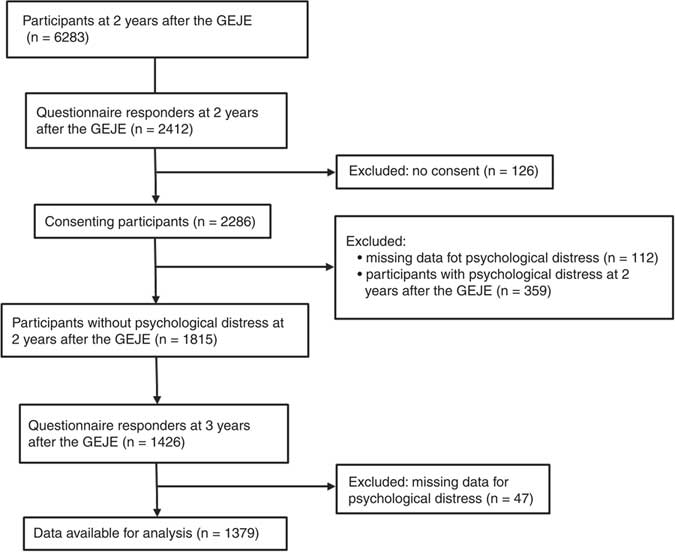
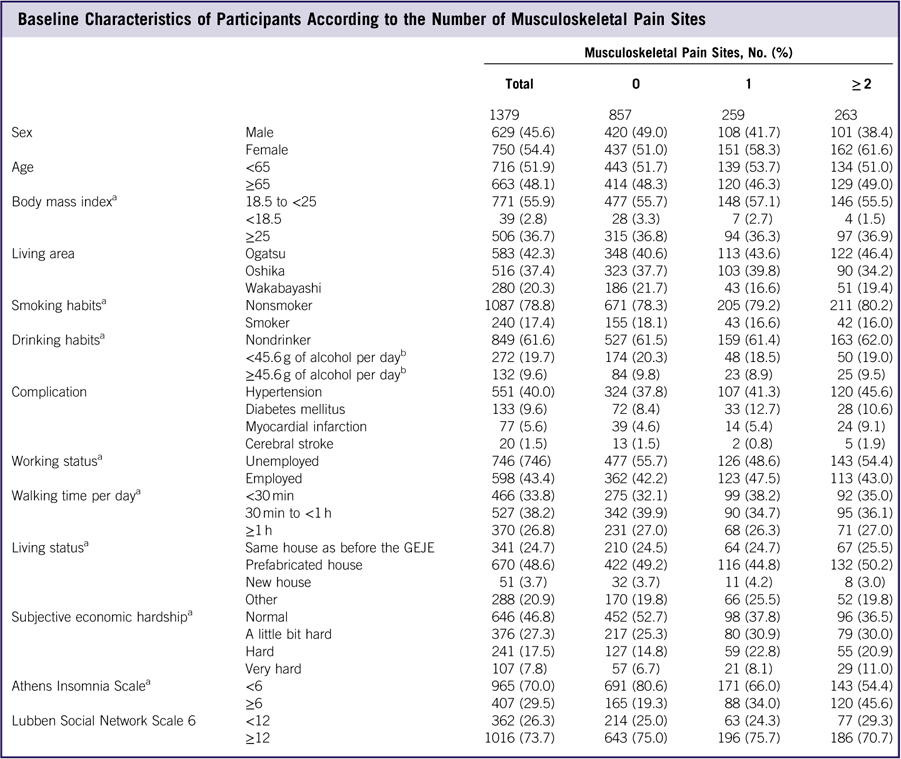
The response rate of the first period was 38.4% (2412 out of 6283), and 2286 participants provided informed consent. Among those, 112 individuals who had missing data for psychological distress and 359 who had psychological distress during this period were excluded. The follow-up rate at the second period was 78.6% (1426 out of 1815), and 47 individuals were excluded for missing data regarding psychological distress. Finally, data on 1379 participants were included in the analysis (Figure 1). Baseline characteristics of the participants are shown in Table 1.
Flowchart Describing the Present Analysis. Abbreviation: GEJE, Great East Japan Earthquake.

Baseline Characteristics of Participants According to the Number of Musculoskeletal Pain Sites

a Because each item has a limited number of respondents, the actual number is not necessarily in accordance with the total.
b 22.8 g of alcohol amounts to 1 go or traditional unit of sake (180 mL), which approximates 2 glasses of wine (200 mL) or beer (500 mL) in terms of alcohol content.
Categorical variables are presented as numbers and percentage (%).
Abbreviation: GEJE, Great East Japan Earthquake.
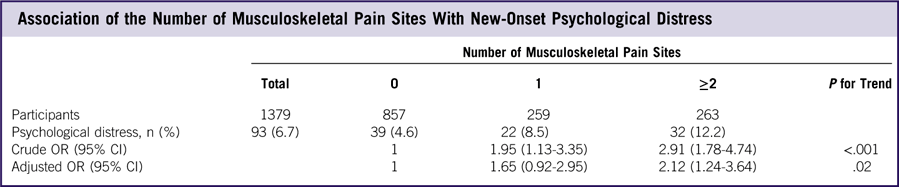
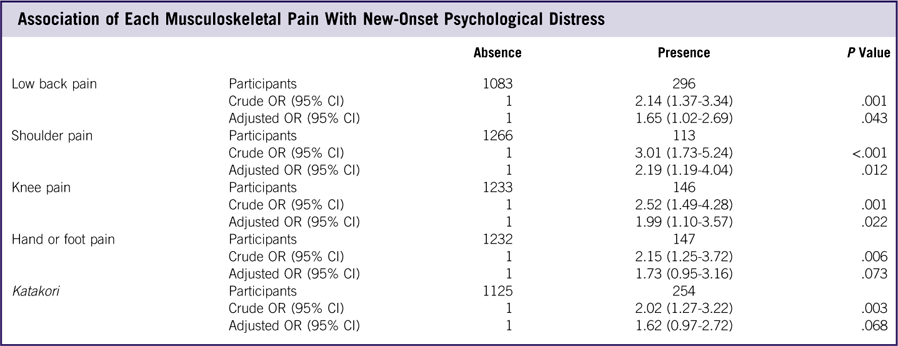
The rate of new-onset psychological distress was 6.7% (93/1,379). The crude and adjusted ORs (95% CI) for new-onset psychological distress according to the number of musculoskeletal pain sites are shown in Table 2. New-onset psychological distress was significantly associated with the presence of musculoskeletal pain in crude (P value for trend<0.001) and adjusted (P value for trend=0.02) analyses. Using “0” as a reference for the number of musculoskeletal pain sites, the adjusted ORs (95% CI) for new-onset psychological distress were 1.65 (0.92-2.95) in “1” and 2.12 (1.24-3.64) in “≥2.” For each musculoskeletal pain site, the adjusted ORs (95% CI) for new-onset psychological distress were 1.65 (1.02-2.69) in low back pain, 2.19 (1.19-4.04) in shoulder pain, 1.99 (1.10-3.57) in knee pain, 1.73 (0.95-3.16) in hand or foot pain, and 1.62 (0.97-2.72) in katakori (Table 3).
Association of the Number of Musculoskeletal Pain Sites With New-Onset Psychological Distress

Adjusted for sex, age, body mass index, living area, smoking habits, drinking habits, complications, working status, walking time, living status, subjective economic condition, Athens Insomnia Scale, and Lubben Social Network Scale (LSNS-6).
Abbreviations: OR, odds ratio; CI, confidence interval.
Association of Each Musculoskeletal Pain With New-Onset Psychological Distress

Adjusted for sex, age, body mass index, living area, smoking habits, drinking habits, complications, work status, walking time, living status, subjective economic condition, Athens Insomnia Scale, and Lubben Social Network Scale (LSNS-6).
Abbreviations: CI, confidence interval; OR, odds ratio.
DISCUSSION
The present study revealed that musculoskeletal pain was associated with new-onset psychological distress among survivors after the GEJE. Many authors reported increasing psychological distress after the GEJE. Yokoyama et al. reported that among survivors living in the severely damaged coastal area 6 to 12 months after the GEJE, 6.2% of respondents scored ≥13 and 36.4% scored 5 to 12 on the K6.Reference Yokoyama, Otsuka and Kawakami 29 Goodwin et al. reported that among survivors living in rental houses paid for by the local government 1 year after the disaster, 9% of respondents scored ≥13 and 18% scored 8 to 12 on the K6.Reference Goodwin, Takahashi and Sun 28 In this study, the rate of survivors with a score of ≥10 out of 24 on the K6 2 years after the disaster was 16.5% (359 out of 2174). Furthermore, the rate of new-onset psychological distress 3 years after the disaster was 6.7%. Psychological distress was a common symptom even years after the GEJE. There have been other reports revealing factors related to psychological distress after the GEJE.Reference Koyama, Aida and Kawachi 23 , Reference Niitsu, Takaoka and Uemura 33 Many survivors experienced loss of family, friends, homes, properties, or jobs, which led to psychological distress and a long recovery.Reference Inoue and Yamaoka 22 Some authors also highlighted social isolation as a risk factor for psychological distress.Reference Sone, Nakaya and Sugawara 17 , Reference Matsuyama, Aida and Hase 32 Relocation from hometowns disrupted community bonds,Reference Goodwin, Takahashi and Sun 28 decreased social participation, and damaged social networks, which caused social isolation and psychological distress.Reference Goodwin, Takahashi and Sun 28 , Reference Yokoyama, Otsuka and Kawakami 29 Further, severe changes in economic status,Reference Koyama, Aida and Kawachi 23 , Reference Yokoyama, Otsuka and Kawakami 29 a lack of prospects for future housing,Reference Nakaya, Nakamura and Tsuchiya 34 and the presence of health complaintsReference Yokoyama, Otsuka and Kawakami 29 are reportedly associated with psychological distress after the GEJE. Many survivors have suffered from psychological distress even years after the GEJE, and it is important to identify related factors and to reduce survivors’ psychological distress, in order to better their health and quality of life.
It is well known that psychological distress is associated with pain, including pain in musculoskeletal areas.Reference Christensen, Johansen and Knardahl 35 Furthermore, pain is common in patients with psychological distress.Reference de Heer, Gerrits and Beekman 36 Conversely, individuals suffering from pain tend to show increased psychological distress.Reference Tsuji, Matsudaira and Sato 37 The relationship between psychological distress and pain is considered to be bidirectional.Reference Sturgeon 38 There have been some reports examining the effect of pain on the onset of psychological distress.Reference Kroenke, Wu and Bair 13 , Reference Chou 39 Chou et al. reported that pain was an independent predictor of psychological distress 2 years after the onset of pain.Reference Chou 39 Although the mechanisms are not well understood, the regions of the brain controlling pain perception have connectivity with the regions modulating emotional states, and chronic pain alters these regions.Reference Crofford 40 Among types of pain, musculoskeletal pain has the highest association with psychological distress.Reference de Heer, Gerrits and Beekman 36 Further, Shiri et al. reported that psychological distress is more common in individuals with multiple pain sites.Reference Shiri, Kaila-Kangas and Ahola 41 This study also found the association of musculoskeletal pain with new-onset psychological distress to be significant when multiple pain sites were present. Further, the association of musculoskeletal pain with new-onset psychological distress was different for each pain site. It was significant in shoulder, knee, and low back pain, but not in hand or foot pain or katakori. Although the reason is not clear, the results may be related to a difference in pain severity or in the degree of functional disability due to pain.
This study has several limitations. First, psychological distress and musculoskeletal pain were assessed at only 2 periods, leaving changes at other periods unknown. In addition, the questionnaires and informed consent documents were mailed to the participants, resulting in a low response rate. The responders might demonstrate a higher health consciousness or might have more physical and psychological complaints than nonresponders, which may have affected the results. Lastly, all participants of this study were GEJE survivors, and it is unknown whether the results are applicable to the general population.
CONCLUSIONS
Musculoskeletal pain is associated with new-onset psychological distress among survivors of the GEJE. It is important to closely manage musculoskeletal pain to aid in the prevention and treatment of psychological distress in survivors after natural disasters.
Acknowledgments
This study was supported by the Health Sciences Research Grant for Health Services (H23-Tokubetsu-Shitei-002, H24-Kenki-Shitei-002, H25-Kenki-Shitei-002 [Fukko]), Ministry of Health, Labour and Welfare, Japan and by a grant from The Japanese Society for Musculoskeletal Medicine (H24).
Disclosure Statement
The authors declare no conflict of interest.