1. From Art to Engineering
Origami, traditionally an artistic practice, has been a bridge between creativity and engineering. The folding of a thin sheet can generate complex deployable systems that balance aesthetics and function. This paradigm shift from art to engineering has enabled innovations that combine compactness, load distribution, and structural reconfigurability.
Origami-based designs have found applications across multiple scales, from nanoscale devices to architectural designs. In medicine, folding geometries inspire stents, drug-delivery systems, and self-deploying surgical tools for minimally invasive procedures (Meredith et al. Reference Meredith, Yue, Sierra, Sheng, Bradford, Hongliang, Junichi and Zion Tsz Ho2017). At the macroscale, reconfigurable shelters (Thrall and Quaglia Reference Thrall and Quaglia2014), portable furniture, retractable roofs, and façades (Foschi Reference Foschi2022) benefit from the same principles of transformability and compact structure.
In aerospace and astronomy, deployable origami structures address the challenge of fitting large functional systems within limited launch volumes. Applications include solar sails, starshades, antennas, and segmented space telescope mirrors that unfold autonomously after launch (Yue Reference Yue2023; Badagavi et al. 2017), as illustrated in Figure 1. Even an origami approximation of the cosmic web is presented by Neyrinck (Reference Neyrinck2014).
Origami-inspired aerospace systems.

Figure 1 Long description
Panel A: Three photos side-by-side showing the starshade folding and deployment sequence. The first photo shows a compact, folded structure with people standing nearby for scale. The second photo displays the starshade partially deployed with a golden, petal-like structure. The third photo shows the fully deployed starshade, which is large and circular with a central opening. Panel B: Two diagrams side-by-side. The first diagram shows a deployable antenna in a folded state, with a compact, stacked structure. The second diagram shows the same antenna in a deployed state, with a flat, disc-like structure supported by legs. Panel C: One photo showing a solar sail, LightSail 2, in space with Earth visible below and the sail fully deployed, appearing as a large, reflective diamond shape.
2. Origami Engineering
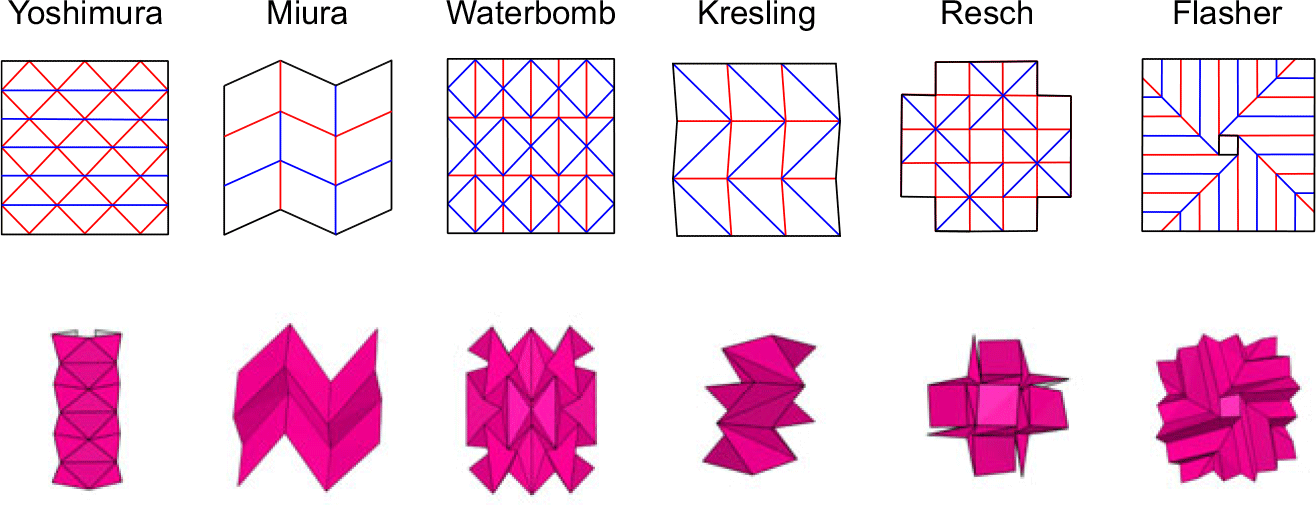
The foundation of origami engineering lies in its folding patterns, which translate geometric principles into mechanical behavior. Fundamental patterns, such as Miura, Yoshimura, Kresling, Resch, Flasher, and Waterbomb, shown in Figure 2, each exhibit distinct kinematic and structural properties (Meloni et al. Reference Meloni, Cai, Zhang, Sang-Hoon Lee, Li, Ma, Parashkevov and Feng2021; Gardiner Reference Gardiner2019). The geometry and the mountain-valley crease pattern determine the degrees of freedom, structural stiffness, and achievable shapes during deployment. The advantages of origami include multistability, compactness, reconfigurability, and scalability. These attributes position origami as a design strategy for adaptive systems in different disciplines.
Crease patterns and folded configurations of origami patterns.

Certain origami tessellations can generate curvature through geometric variations, enabling flat sheets to approximate singly or doubly curved surfaces. By tuning angles, distances, and vertex connectivity, planar surfaces can be transformed into cylindrical, conical, parabolic, or spherical configurations that closely reproduce the desired three-dimensional shape (Gardiner et al. Reference Gardiner, Aigner, Ogawa and Hanlon2018; Yu et al. Reference Yu, Chen and Paulino2023; Zhao et al. Reference Zhao, Wei, Jia, Li, Zhang, Zeng, Yang and Mitani2022; Liu et al. Reference Liu, Zhang and Fang2023). Such capability is particularly valuable in aerospace engineering and astronomy, where deployable structures often require continuous surfaces, such as parabolic reflectors, domes, or optical arrays, that can be efficiently approximated using origami tiles.
Origami engineering integrates analytical geometry, materials science, and computational mechanics to design systems that combine functionality and adaptability. Recent advances in simulation and optimization tools make it possible to evaluate mechanical behavior, energy absorption, and deployment efficiency under realistic operational conditions. Numerical frameworks based on bar-and-hinge formulations are capable of capturing the nonlinear kinematics and mechanical behavior inherent to foldable structures (Liu and Paulino Reference Liu and Paulino2017). Such tools have advanced origami design from pure geometric modeling toward modeling, simulation, and optimization of mechanical performance and dynamic response.
3. Origami in Aerospace and Astronomy
Origami-inspired engineering allows addressing one of the main challenges in spacecraft design: fitting large, functional systems within the confined volume of a launch vehicle fairing. By transferring geometric folding principles into mechanical design, origami enables compact packaging, lightweight efficiency, deployment, and even reconfigurability once in orbit (Meloni et al. Reference Meloni, Cai, Zhang, Sang-Hoon Lee, Li, Ma, Parashkevov and Feng2021; Yue Reference Yue2023; Badagavi et al. 2017).
Examples of applications in aerospace and astronomy, summarized in Table 1, include solar sails, which use ultra-thin membranes that fold compactly for launch and expand in space. Similarly, antennas and reflectors employ foldable tessellation patterns to achieve the desired shape, including curved surfaces, while maintaining deployability. In modern space observatories, segmented mirrors are used to stow optical assemblies compactly and unfold with high positional accuracy. Among the astronomical applications is the starshade, a deployable optical screen designed to suppress starlight and enable direct exoplanet imaging. Beyond optical instruments, reconfigurable metasurfaces inspired by origami principles are being developed for wavefront control and holographic imaging (Song et al. Reference Song, Zhu, Wang, Zhang, Min, Cao, He, Han, Wang, Zhu, Wu and Qiu2024; Zhu et al. Reference Zhu, Jiang, Qin, Li, Wang, Jia, Zheng and Qu2024). These emerging metasurfaces exploit the dynamic reconfiguration potential of origami geometries, extending the concept from mechanical folding to electromagnetic functionality.
Origami-inspired aerospace and astronomical applications.

Table 1 Long description
A table with three columns: Application, Pattern/Approach, and Function. The table has six rows, each describing different applications in aerospace and astronomy. Row 1: Application: Solar sails; Pattern/Approach: Flashers (Wu et al. 2025), Miura (Wu et al. 2018); Function: Propulsion membranes with origami-inspired designs can adjust the magnitude and the direction of solar radiation pressure. Row 2: Application: Antennas and reflectors; Pattern/Approach: Yoshimura (Russo et al. 2023), Miura, Kresling, Flasher, Waterbomb (Georgakopoulos et al. 2021); Function: Compact radio and radar systems, physically reconfigurable and tunable. Row 3: Application: Telescopes and sunshields; Pattern/Approach: Flasher (Bolanos 2022), Kresling (Wilson et al. 2013), Yoshimura (Kempenaers and Vandepitte 2025); Function: Segmented, reconfigurable mirror assemblies for compact storage. Row 4: Application: Starshade; Pattern/Approach: Flasher (Arya et al. 2020), Axisymmetric Miura-Ori (Sigel et al. 2014; Rausch 2024); Function: Starlight suppression and exoplanet imaging. Row 5: Application: Energy harvesting; Pattern/Approach: Miura, Flasher (Jagarlapudi et al. 2019); Function: Mechanically tunable photovoltaic or piezoelectric panels. Row 6: Application: Reconfigurable metasurfaces; Pattern/Approach: Miura (Song et al. 2024); Function: Dynamically control of electromagnetic waves (Zhu et al. 2024).
Table 1 summarizes representative implementations of origami-inspired deployable structures and the origami patterns used in each application.
4. Case Study: Waterbomb Pattern
To analyze the mechanical behavior of origami systems beyond geometry and kinematics, an open-source Python-based computational framework, PyPiroflexia, was developed. The tool implements a bar-and-hinge formulation (Liu and Paulino Reference Liu and Paulino2017) capable of capturing nonlinear folding mechanics, large displacements, and multistable responses of origami structures.
Among the patterns illustrated in Figure 2, the Waterbomb pattern stands out for its radial symmetry and its ability to approximate single and double curvatures. The Waterbomb pattern was simulated using a tessellation of three horizontal by three vertical cells, with material stiffness
 $E = 1\times10^{6}$
, folding stiffness
 $K_{f} = 1\times10^{-1}$
, bending stiffness
 $K_{b} = 1\times10^{4}$
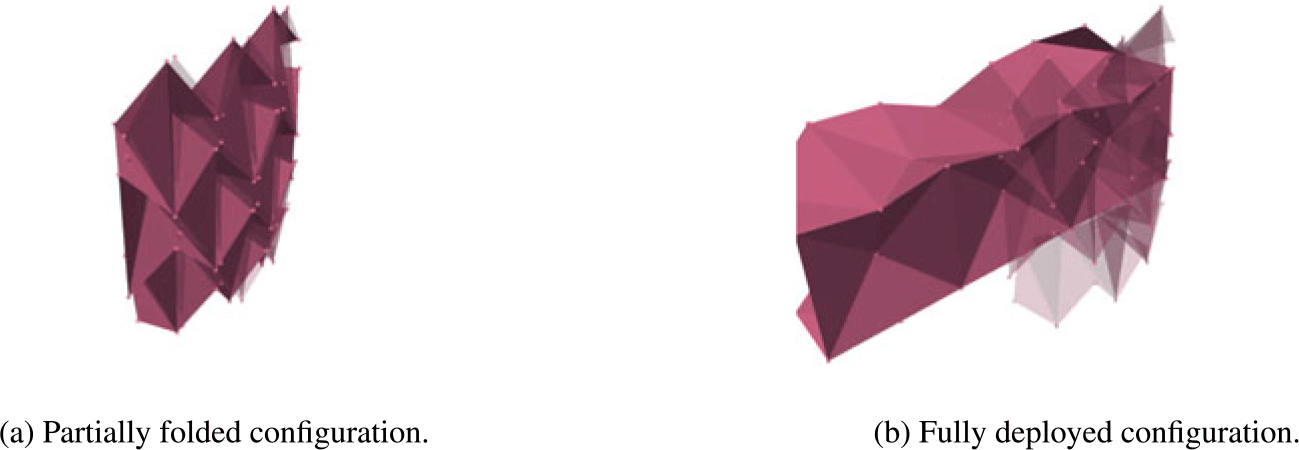
, and a total of 60 incremental load steps. Figure 3 illustrates the deployment evolution of the pattern, transitioning from a partially folded configuration to a deployed state.
Waterbomb pattern deployment sequence simulated with the PyPiroflexia framework.

The mechanical response of the pattern is presented in Figure 4. The load–displacement curve exhibits a stable trajectory, indicating continuous deployment. The stored energy profile increases progressively. The Waterbomb configuration demonstrates geometric adaptability and mechanical stability. Its multistability, curvature approximation, and compact foldability make it a promising candidate for adaptive and lightweight deployable systems such as telescope domes, starshades, and reflector membranes in aerospace and astronomical applications.
Mechanical response of the Waterbomb pattern.

5. Conclusions
Origami-inspired structures bridge art and engineering, establishing a powerful framework for designing deployable and reconfigurable systems that meet the extreme demands of space and other fields. Through computational modeling and nonlinear simulation, folding principles can be transformed into practical mechanical solutions. Moreover, the ability to model and optimize the geometry and folding behavior through computational simulation reinforces the relevance of origami engineering in the design of next-generation deployable structures. The Waterbomb case study illustrates how geometric tessellations can evolve into functional architectures capable of approximating curved and double-curved surfaces. Such configurations hold significant potential for aerospace and astronomical applications, enabling lightweight structures that can be tuned, reconfigured, and operated according to mission requirements.
Acknowledgment
The authors appreciate the support of Universidad EAFIT. Funding and resources were provided through an institutional scholarship program.
Supplementary material
To view supplementary material for this article, please visit https://doi.org/10.1017/S1743921326107297.