Introduction
Recent years have seen an increase in disaster situations all over the world, including in Europe.1-Reference Gillani, Li and Akbar4 Disaster management requires a team effort. However, because of specific characteristics and roles of emergency medicine in non-disaster situations, emergency physicians (EPs) often hold critical roles in all phases of medical disaster preparedness and response.Reference Wolfe5
Emergency medicine forms the interface between the community and the hospital system.Reference Wolfe5 Its core missions and principles—efficient initial triage, assessment, stabilization, and disposition of patients—remain largely unchanged during disaster situations.Reference Wolfe5
Due to the nature of their training and their work, emergency physicians acquire skills and knowledge that make them especially fit for—and critical to—disaster management.Reference Wolfe5 They are used to work with patients of all ages and types, presenting with the whole scope of acute diseases and traumas.Reference Wolfe5 They are used to adapting to changing workloads and might be better at shifting from a routine to a disaster work mode.Reference Wolfe5, Reference Dennis, Brandt and Steinberg6 They are used to working and communicating with a large spectrum of medical and non-medical professional partners, who might also be involved in disaster response (EMS, police, other medical or surgical specialties, etc.). This allows them to deliver and optimize care in disaster situations.Reference Wolfe5
Finally, disaster medicine has traditionally been integrated into the emergency medicine specialty training and scope of practice, and studies suggest that EPs might be better prepared and skilled in the face of disasters, even at resident level.Reference Wolfe5, Reference Dennis, Brandt and Steinberg6
Emergency physicians are therefore often involved in critical clinical and non-clinical (administrative, educational, research, and expert) roles and are often effectively leading the medical preparedness and response to disasters.Reference Wolfe5, Reference Ryan, Mostaghimi, Dugas and Goralnick7
While Emergency Medicine (EM) has been recognized as a specialty in the United States since 1979,Reference Anyone8, 9 it is much more recent and heterogeneous throughout Europe,10-Reference Baldursson, Björnsson and Palomäki15 in terms of recognition of the specialty, of its scope of practice, and of duration and content of specialty training.
The European Society for Emergency Medicine (EuSEM) aims to develop common training standards throughout Europe.10 EuSEM recommends a dedicated disaster medicine (DM) training for all European EPs.10 There is, however, no current international description of disaster preparedness (DP) among European EPs, a gap that this study aimed to address, to allow for better harmonize and improve individual and collective DP in this population.
This study’s primary objective was therefore to make a transversal, multicentric, and international description of the current self-reported DP levels among European EPs, using an electronic survey and a modified KArP (Knowledge-Attitude-readiness-to-Practice) model of DP analysis. The secondary objectives were to map the levels of education, training, and experience in DM among EPs throughout Europe, and to identify potential correlations between the participants’ characteristics and their KArP-scores.
Methods
Study Design
An international survey-based observational study of DP levels was conducted between April and June 2024 among post-residency EPs in 9 European countries (see Annex 1 for the list of participating countries). To our knowledge, there is no validated tool for the evaluation of DP levels among EPs. After a review of similar studies using the PubMed database, an electronic survey was developed, based on the KArP model of DP analysis.Reference Gillani, Li and Akbar4, Reference Al-Ziftawi, Elamin and Mohamed Ibrahim16, Reference Gillani, Mohamed Ibrahim and Akbar17 The general structure and characteristics of previous KArP questionnaires were used with adaptation to the specificities of this study’s population of European EPs.Reference Gillani, Li and Akbar4, Reference Behringer and Brown12, Reference Rief, Auinger and Eichinger13, Reference Al-Ziftawi, Elamin and Mohamed Ibrahim16, Reference Gillani, Mohamed Ibrahim and Akbar17
Our questionnaire had 3 different parts: part 1 was dedicated to information and consent of the participants; part 2 addressed inclusion and exclusion criteria, as well as the participants’ characteristics (general demographic data and data related to education, training, and experience in DM); part 3 consisted of a KArP-analysis of the DP levels among participating European EPs. The questionnaire is available in Supplementary Digital Content (see Annex 2).
Each item of the KArP analysis used a Likert scale, with a score ranging from 1 to 5 (1 being associated with the lowest DP and 5 with the highest DP for each question). Individual and mean K-, A-, and rP-scores were calculated. The KArP-score was calculated as the average of the K-, A-, and rP-scores, with identical weighting of each of the K-, A-, and rP-modules. The questionnaire’s reliability (part 3—KArP analysis) was calculated using Cronbach’s alpha.
The questionnaire was transcribed on the LimeSurvey® software for diffusion and data collection. It was then distributed to post-residency EPs in the participating European countries through the participating national EM societies, through the participating countries’ university-linked emergency departments (ED) (hospital-based and prehospital, general and pediatric, with distribution to each department’s physicians, as well as to physicians from other non-university-linked EDs), and through interindividual diffusion from one physician to another. Contact for inclusion of national EM societies was progressive and followed a regional logic.
Data was collected over 3 months, from April 2024 to June 2024. The answers to the survey were extracted directly from the LimeSurvey® software to Microsoft® Excel.
Participants
Medical disaster preparedness and response require a team effort, involving physicians from multiples specialties in and outside the ED, as well as multiple other health care and non-health care personnel. Due to the diversity of professionals involved—even at ED-level—and to the heterogeneity of the multiple emergency care systems across Europe, this study focused on DP among EPs only.
The population of interest consisted of all post-residency physicians practicing EM in a hospital-based or prehospital ED, regardless of their primary specialty of training. Those specialists were regrouped under the term European EPs.
Participating countries were defined as those whose national EM society was affiliated with EuSEM18 and which, when contacted, agreed to participate and to diffuse the survey to its members.
All participants who did not agree to participate in the study or did not give their consent for the use of their data, those who were not post-residency, and those who did not primarily work in one of the participating countries were excluded.
The definition of European EPs is heterogeneous from one country to another and published data lack regarding the number of European EPs in each participating country. It was therefore possible to establish neither the total number of eligible participants nor their rate of exposure to the questionnaire. The response rate to the questionnaire was therefore estimated indirectly relatively to the total medical population of each country, using common WHO data regarding the number of practicing physicians in all the 9 participating countries in 2020.19, 20 More specifically, each country’s total number of practicing physicians was estimated using the country’s density of physicians (per 10,000 population)19 and its total population.20 Each country’s response rate to the questionnaire was then estimated using the country’s number of included participants out of its total number of practicing physicians. The size of the sample was therefore not estimated a priori and the diffusion strategy aimed at maximizing participation.
Ethical Considerations and Institutional Review Board Statement
The questionnaire was developed after permission was given by Gillani et al.Reference Gillani, Li and Akbar4, Reference Gillani, Mohamed Ibrahim and Akbar17 in August 2023 to adapt their KArP-model of DP analysis.
The study was conducted in accordance with the Declaration of Helsinki and respected the European Union’s GDPR standards. Prior to conducting the study, the protocol was approved and registered by the UPEC University’s ethical board review (registration number #16) on 16/01/2024. Storage and treatment of the participants’ data remained strictly on the European Union’s territory.
The participants’ written and informed consent was gathered electronically before their access to the survey. The participants were fully informed about the study’s objectives and methodology. They were informed about the protection and the anonymization of their personal data and about their rights regarding their personal data.
Data Analysis
The statistical analysis used the Microsoft® Excel and R++© (Christophe Genolini, Andeol Evain, Julien Lopez, Marc Heinrich, Released 2023-12-13, “R++, l’essentiel” for Windows, Version 1.6.15, Toulouse, France) software.
A descriptive analysis of the participants’ characteristics (notably of their levels of education, training, and experience in DM) and of their KArP DP scores was realized (with analysis of frequency in percentage for noncontinuous variables, and mean value determination with standard deviation [SD] for continuous variables) for all included participants and subgroups.
Statistical associations were sought using non-parametric tests (the normality of data distribution being not assumed; the Wilcoxon Rank test, Kruskal-Wallis Rank test, and Spearman’s Correlation test were used) between the participants’ characteristics and their DP scores, for all included participants. The study focused on the clinically relevant rP- and KArP-scores. Statistical associations between elements from part 2 of the questionnaire were sought using Fisher’s exact test, especially to identify differences depending on the country of practice.
The level of significance was a priori defined as 0,05.
Results
Participation and Response Rate
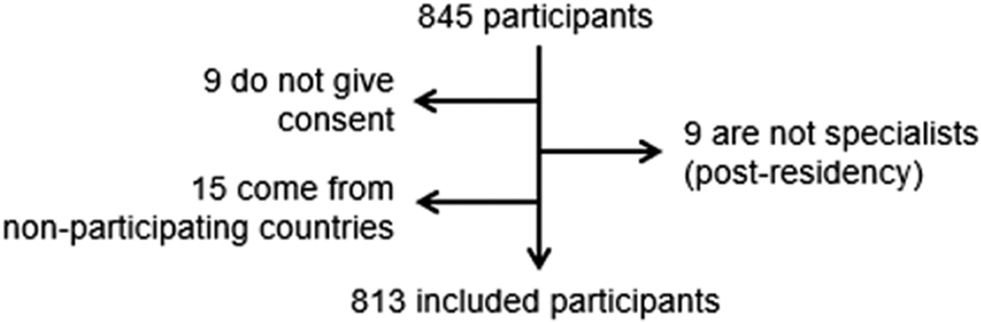
Eighteen national EM societies were contacted, 9 accepted to participate (see Annex 1). Between April and June 2024, results from 845 participants were collected, of whom 32 (3,8%) were excluded (see Figure 1). A total of 813 participants were included in the analysis. The global response rate was 0,172% of all participating countries’ total medical population. National response rates ranged from a maximum of 0,505% of the country’s total medical population in Iceland to a minimum of 0,018% in the Netherlands (see Table 1).
Inclusion and exclusion of the participants.

Estimation of the response rate relative to each country’s total medical population

General data for all 813 participants

Questionnaire’s Reliability
Part 3 of the questionnaire (KArP-analysis) had a Cronbach’s alpha of 0.8952 and showed thereby good internal consistency.Reference Nunnally and Bernstein21
Description of General Characteristics for All Participants (See Table 2)
Only half of the participants reported a dedicated practical DM training during specialty training, whereas 23% reported no DM training. Only 57% reported full-scale disaster drills in the previous year. Details from high-participation countries are available in Table 3 and Annexes 3, 4, and 5.
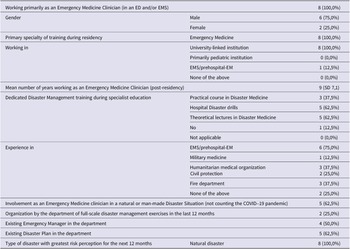
General data for all the 8 participants working primarily in Iceland

Scores per question and K-, A-, rP-, and KArP-scores

Note: Scores per question are expressed out of 5; modular and global scores are expressed as percentages; NA: not applicable, SD: standard deviation.
The description of participants practicing in Iceland (see Table 3) is of special interest: Iceland had the highest participation rate of all participating countries (0,505%); all participants had been trained as EPs and worked in the same university hospital,Reference Baldursson, Björnsson and Palomäki15 which was confirmed to have a disaster plan in place. However, only 5 out of 8 participants reported a department disaster plan, only 2 out of 8 participants reported full-scale disaster drills in their department during the previous year, and only 4 out of 8 participants reported a department emergency manager.
Global KArP-results (See Table 4)
Participants had a mean K-score of 71,88% (SD 16,57). Participants had the overall highest score at the Attitude module with 77,09% (SD 11,02) and the overall lowest score at the readiness to Practice module with 66,54% (SD 14,99). The 813 participants had a mean polymodular KArP-score of 71,83% (SD 12,45).
Correlation Analysis for All Participants (See Table 5)
Several factors were identified that were significantly associated with DP scores. The primary country of practice was notably associated with all the K-, A-, rP-, and KArP-scores (see Table 5), as well as with all the elements related to per-specialization DM training. DP scores were notably lower among pediatric EPs.
Univariate analysis between participants’ characteristics and their K-, A-, rP-, and KArP-scores

Note: * significant, ns: non-significant.
Discussion
KArP-analysis
In the Knowledge module of their KArP-analysis of Pakistani health care professionals, Gillani et al.Reference Gillani, Li and Akbar4 found only 27,6% of participants with previous exposure to the topic of DP, and only 33,7% with a prior experience in dealing with disasters. Corrigan et al.Reference Corrigan and Samrasinghe22 found a low level of knowledge in disaster management and only 12,9% of participants with real experience of disaster management among 140 subjects working in 9 different departments and with key roles in an Australian trauma center’s disaster response. Nofal et al.Reference Nofal, Alfayyad and Khan23 reported a satisfactory level of knowledge with a score of 6.2/8 (SD 2.5) (equivalent to a score of 77,5%) among 189 physicians and nurses working in a Saudi ED. Our participants’ K-score contrasts with very heterogeneous results in the literature.
Responses to the Attitude module suggested that participants were feeling directly concerned and responsible for medical disaster response, with great risk perception and willingness to train. These results concur with previously published data: in the study of Gillani et al.,Reference Gillani, Li and Akbar4 2 of the 3 highest scores per question in the Attitude module regarded the willingness to get involved in the medical response to a disaster and to train in DM; moreover, 78,2% of participants thought Pakistan to be at risk of disasters.
In the readiness to Practice module, questions rP3 and rP7 regarding collective DP had respective mean scores of 3,3/5 and 2,8/5. This must be analyzed together with the answers to questions 12, 13, and 14: only 57,6% of the 813 participants reported full-scale disaster drills in their department during the previous year, 82,2% reported a department emergency manager, and 91,4% reported a department disaster plan. Those numbers contrast with national and international standards: in the USA, the 2022 Joint Commission standards require hospitals to plan and conduct at least two exercises annually, to have a qualified individual to lead the hospital’s emergency management program and to have a disaster plan,24 while in France, the health ministry recommends at least one annual regional exercise with health care professionals, as well as their participation to national exercises.25 A significant association was found between the country of practice and the rate of reported disaster drills in the previous year (from 19,3% in Switzerland to 77,4% in France). Our results concur with the study of Corrigan et al.,Reference Corrigan and Samrasinghe22 in which most participants reported low individual and collective DP; moreover, only 37.9% of the participants reported having attended a disaster drill. Our results further concur with the study of Gillani et al.,Reference Gillani, Li and Akbar4 in which the mean rP-score was deemed unsatisfactory. On the other hand, in the study of Nofal et al.,Reference Nofal, Alfayyad and Khan23 a total of 81% of participants reported the conduct of a disaster drill at their hospital. This result could, however, be influenced by the study’s monocentric design, in a tertiary care hospital; moreover, participants did not give any information regarding the frequency of disaster drills, suggesting a possible overestimation of the drill frequency when compared to our study.
Gillani et al.Reference Gillani, Li and Akbar4 reported a lower KArP-score of 83.99/157 (SD 12.21) (equivalent to a score of 53,5%). This discordance with our results is likely due to the important adaptations of the questionnaire, to potential selection biases, and to our highly specific target population of post-residency EPs, with potentially much higher interest for and training in DM compared to other health care professionals. Direct comparison to previous studies is therefore impossible.
Impact of the Country of Practice
Our results suggest a heterogeneity in DM education and in DP levels in European EPs from one country to another. Based on these data, it is, however, not possible to directly compare one country to another, especially in countries with very different response rates, because of differences in participants’ selection. One of the most interesting findings in our study is, however, that it still was possible to identify factors influencing DP levels in every national emergency care system. The heterogeneity in levels of DM education and DP in European EPs from one country to another has yet to be confirmed on bigger samples.
Collective Disaster Preparedness
This study gives a first description of the collective DP levels among European EPs. Results from participants practicing in Iceland (see Table 3) were of special interest and suggested that some participants might have been unaware of DP tools in place in their department. This concurs with previous results from a 2018 study by Nofal et al.Reference Nofal, Alfayyad and Khan23 and highlights a probable widespread lack of awareness of the DP tools available within EDs throughout the world. In addition to development and implementation of new DP tools, focusing on raising awareness on the already available DP tools within EDs could therefore be an easy, cheap, and efficient way to improve collective DP in European EDs.
Perspectives
Because of their roles in all phases of medical disaster preparedness and response, improving and harmonizing individual and collective DP in European EPs is crucial.
Several factors were identified that were significantly associated with the clinically relevant rP- and KArP-scores. Based on these factors, simple checklists aimed at optimizing individual and collective DP levels were proposed. These checklists are available in Supplementary Digital Content (see Annexes 6 and 7).
Regarding the objective of optimizing physicians’ individual DP, we propose that EM training should include both theoretical and practical DM training, and that trainees should be exposed to at least one hospital disaster drill and at least one of the relevant clinical experiences listed in Annex 6.
Regarding the objective of optimizing EDs’ collective DP, we propose that EDs systematically organize at least one full-scale hospital disaster drill annually, have a department emergency manager, and have a regularly updated department disaster plan. We could probably recommend that the nature of the drills vary to cover as much as possible of the disaster risk picture, specific to each country/institution.
Finally, medical disaster preparedness and response require multiple health care and non-health care personnel, even at ED level. Future studies should evaluate DP determinants in other professionals involved in medical disaster preparedness and response.
Limitations
One of the strengths of this study lies in its international, multicentric design and its substantial size. The cross-sectional design prevented loss to follow-up. To our knowledge, this is the first international description of DP among European EPs. Several factors were identified that were significantly associated with DP scores. Our questionnaire was adapted to the heterogeneity of the EM specialty and of its scope of practice across Europe. The KArP analysis had a Cronbach’s alpha of 0.8952 and showed thereby good internal consistency.Reference Nunnally and Bernstein21 It might be worthwhile to replicate this study in other EP populations using the same tool and to adapt it to other professionals involved in medical disaster preparedness and response. The present study could then serve as a reference framework for understanding, optimizing, and harmonizing DP—notably among EPs—across the multiple European emergency care systems.
This study had several limitations. A non-validated tool was used because of the lack of any preexisting tool adapted to and validated for the specifics of EPs. Pending validation of this KArP tool in future studies, this study still provides a valuable description of DP among European EPs. As this study relied on self-reporting, the results might suffer from a reporting bias. Given the very different—and sometimes low—participation rates from one country and from one specialty to another and because of potential differences in exposure and participation, selection biases are likely, both for individual participants and for the departments they are from. Furthermore, with the indirect estimation of the response rate, due to the impossibility of establishing the total number of eligible participants or their rate of exposure to the questionnaire, the representativeness of the sample cannot be adequately evaluated, which also raises concerns about potential selection bias, especially in countries with low participation. Finally, given the heterogeneity and complexity of the European emergency care systems,Reference Behringer and Brown12, Reference Rief, Auinger and Eichinger13 comparability of the results from one country to another remains very limited.
Conclusions
This is the first international description of DP among European EPs. Mean rP-score for all participants was 66,54% (SD 14,99) while mean KArP-score was 71,83% (SD 12,45). This study identified significant weaknesses in individual and collective DP. Only half of the participants reported a dedicated practical DM training during specialty training, whereas almost 25% reported no DM training. Only 57% reported full-scale disaster drills in their department in the previous year.
Several factors were identified that were significantly associated with DP scores. The country of practice was significantly associated with all the K-, A-, rP-, and KArP-scores, as well as with all the elements related to per-specialization DM training. DP scores were significantly lower among pediatric EPs.
Improving and harmonizing individual and collective DP in European EPs is crucial. Based on the results, simple checklists aimed at optimizing individual and collective DP levels were proposed.
Supplementary material
The supplementary material for this article can be found at http://doi.org/10.1017/dmp.2026.10367.
Funding statement
None.
Competing interests
None.