Clostridoides difficile infection (CDI) practice guidelines published by the Society for Healthcare Epidemiology of America (SHEA) and the Infectious Diseases Society of America (IDSA) and the American College of Gastroenterology (ACG) provide treatment recommendations based on severity of illness.Reference Cohen, Gerding and Johnson1, Reference Surawicz, Brandt and Binion2 Prior to the recent update in treatment recommendations from the IDSA, both guidelines recommended the use of metronidazole for mild-to-moderate CDI and oral vancomycin for severe and complicated infections.
Recent studies have found that only 49% of CDI patients were treated appropriately with first-line treatment according to hospital algorithms.Reference Wieczorkiewicz and Zatarski3 With literature demonstrating improved outcomes and reduced complications with the use of guideline-based CDI treatment recommendations, antimicrobial stewardship programs (ASPs) have focused on methods to increase guideline-based prescribing.Reference Brown and Seifert4–Reference Stevens, Nelson and Schwab-Daugherty6 One tool to improve guideline-based prescribing is integrating clinical decision support systems (CDSS) into electronic medical records. Best practices with CDSS are to provide information in a form that is most appropriate for those who are most likely to act on it, to anticipate workflows in design, and to provide meaningful data that is directly actionable.Reference Wright, Phansalkar and Bloomrosen7 Although CDSS may take many forms, a common intervention is an electronic best practice alert (BPA) directed toward prescribers, which presents relevant clinical data linked to an action, such as an order set.
In March 2014 our institution’s antimicrobial stewardship program (ASP) implemented an electronic alert via a BPA linking a positive test result for CDI to guideline-based orders for those not currently on CDI therapy. We sought to evaluate the utility of this BPA and linked a CDI treatment order set while measuring guideline-based prescribing and CDI complications.
Methods
Study design
This retrospective, single-center, quasi-experimental study utilized chart review to evaluate CDI guideline adherence before and after the implementation of a BPA and linked a severity-based treatment order set in March 2014. Adult inpatients (aged >19 years) with laboratory-confirmed CDI were included in the study. Patients were excluded if they had a documented vancomycin or metronidazole allergy or intolerance. Those diagnosed with CDI in 2013 served as controls before BPA implementation and patients from 2016 served as cases, allowing for a washout period after implementing the CDSS tool. Infection severity was defined by the 2010 IDSA guidelines for CDI diagnosed in 2013 and in 2016 using a modified algorithm of the IDSA and ACG guidelines (Supplementary Fig. 2).
Best practice alert and linked severity-based treatment order set
To improve CDI treatment and outcomes, we created a CDI clinical pathway, a severity-based treatment order set, and a BPA linked to this order set, which went live in March 2014. The clinical pathway was based on national guidelines and made available to providers on the hospital’s website (www.NebraskaMed.com/asp). The guidance included (1) a description of CDI symptoms that may prompt testing such as significant or persistent diarrhea with leukocytosis, fever, new-onset abdominal pain and/or distention; (2) C. difficile assay characteristics and interpretation; infection control requirements; and (3) severity-based treatment recommendations. In addition, recommendations for discontinuation of concomitant antimicrobials and acid suppressants, if possible, and appropriate consult services were included. No specific CDI education was provided to groups either before or after implementation other than a short summary of the CDI treatment guideline with a link to the website, which was distributed via an institutional electronic newsletter. No other novel interventions specific to CDI were implemented.
Our institution’s CDI testing throughout the study period was unchanged. CDI testing was performed on liquid stools only (ie, the laboratory rejected formed stool samples) and the initial test was an immunoassay for the CDI antigen (glutamate dehydrogenase) and toxin A and B immunoassay (Quik Chek Complete, Techlab). Samples that were antigen positive but toxin negative underwent reflex nucleic acid amplification test (NAAT) testing, with an overall turnaround time of <24 hours. Toxigenic CDI was only defined as positive for both GDH and toxin or positive for both GDH and NAAT. For patients diagnosed with CDI, both the clinical pathway and treatment order set provided severity-based treatment recommendations.
The BPA (Supplementary Fig. 3) was active for inpatients and was generated upon chart entry only on patients with a positive Clostridoides difficile laboratory result without active orders for CDI treatment. Medications that suppressed the BPA included oral and intravenous metronidazole, oral vancomycin, or fidaxomicin. Accepting the BPA would direct the provider to the severity-based treatment order set. The BPA would remain active within the patient chart for 36 hours after the reporting of a positive result unless the alert was accepted or CDI treatment was ordered.
Outcomes
We assessed provider adherence to practice guidelines, with noncompliant therapy defined as wrong drug, dose, or route based on institutional guidelines (Supplementary Fig. 2), before and after implementation of this clinical decision support tool. The primary outcome was guideline-compliant initial CDI treatment. Secondary end points included resolution of diarrhea (<3 stools/day), length of stay, in-hospital mortality, 30-day recurrence, and readmission rate.
Statistical analysis
Descriptive statistics were reported for demographic data. Continuous variables were analyzed using a 2-tailed Student t test, or for nonnormally distributed data, the Mann-Whitney U test, and categorical variables were analyzed using the χ2 test with an α set at <0.05 for statistical significance. A power calculation indicated 130 total patients were required for 80% power to detect an increase in guideline-based prescribing from 40% to 70%.
Results
A total of 278 and 409 laboratory-confirmed cases of CDI occurred in 2013 and 2016, respectively. A total of 145 charts were reviewed with 14 patients excluded based on the prespecified criteria (Figure 1), resulting in a total of 66 preimplementation controls and 65 postimplementation cases. As subjects were not matched, there were some notable differences between the 2 groups (Supplementary Table 2). More subjects in the preimplementation group were immunocompromised and more subjects in the postimplementation group had a history of previous CDI. CDI severity was comparable between the 2 groups, with a slightly higher proportion of cases in the postimplementation group having mild-to-moderate infection. Accordingly, the postimplementation group had more cases of mild-to-moderate infection and, thus, a slightly higher proportion of cases initially treated with metronidazole monotherapy.
Study participants. Note. BPA, best practice alert.

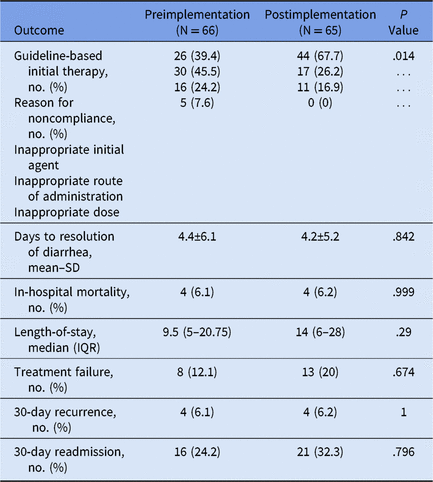
Patients with CDI were more likely to receive guideline-compliant initial CDI therapy after implementation of the BPA and severity-based order set: 44 of 65 (67.7%) in the postimplementation group versus 26 of 66 (39.4%) in the preimplementation group (P = .014) (Table 1).
Guideline-Based Clostridoides difficile Infection Prescribing and Outcomes Before and After Implementation of a Best Practice Alert Linked to a Treatment Order Set

Note. BPA, best practice alert; SD, standard deviation; IQR, interquartile range.
The BPA was generated for 57 of the 65 postimplementation cases who had no active orders for CDI treatment with alert acceptance in 28 of 57 encounters (49%). When accepted, orders were subsequently signed from the CDI order set in 23 of 28 cases (82%), correlating with an overall positive response rate of 40%. As an institutional comparison, of all the 2016 nonquality metric BPAs, the positive response rate was 8.3%.
Discussion
We have demonstrated a significant improvement in the appropriateness of CDI therapy after implementation of the intervention. The increase in guideline-based prescribing was due to improvements in initial agent selection, route of administration, and antimicrobial dose (Supplementary Fig. 4). Prior to the implementation of the BPA and linked order set, providers were more likely to order intravenous metronidazole, which has demonstrated inferior mortality outcomes compared to oral metronidazole.Reference Wenisch, Schmid and Kuo8 Although we were not adequately powered to identify a statistically significant difference in CDI outcomes, it is reasonable to hypothesize based on other trials that improved guideline adherence will lead to fewer recurrences, improved lengths of stay, hospital costs, and readmission rates.
A previous study using a BPA and linked CDI treatment order set, activated by either an order for a C. difficile nucleic acid amplification test (NAAT) or oral vancomycin, led to a significant increase in order-set utilization; however, the clinical decision support tool did not increase guideline-based prescribing.Reference Revolinski9 This BPA was generated upon CDI test ordering; thus, many BPAs would have occurred in patients not needing therapy, resulting in alert fatigue. Also, patients prescribed CDI therapies other than oral vancomycin were not included and may have contributed to the lack of improvement in guideline-based prescribing. Finally, having the BPA linked to CDI test ordering may have increased the prescribing of CDI therapies for patients without a confirmed infection, leading to unnecessary antibiotic use and a risk for toxicity or resistance.
Numerous factors likely led to the improvement in initial guideline-based prescribing in the postimplementation group. First, the BPA alerted providers to positive CDI results when no therapy orders were active, highlighting critical patient information that most clinicians would act on. The alert provided an immediate link to actionable severity-based treatment recommendations approved by the institution. Interestingly, only a portion of post-BPA cases had CDI treatment ordered through the BPA and order set, suggesting that education, either through the BPA and order set or the CDI clinical pathway, may have contributed to improved compliance. Additionally, familiarity with the 2010 IDSA and 2013 ACG guidelines likely improved over time via external mechanisms.
Several limitations should be considered with our study. The retrospective design introduces several opportunities for confounding that are difficult to identify through chart review and may have impacted prescribing. The effect of daily interactions with the stewardship team and various ID consult services over time may have influenced practice as well. Additionally, electronic charting may not have been consistent and outcomes, such as bowel movements and outpatient symptoms, may have been poorly documented. The BPA was only triggered for those not on therapy, limiting its ability to influence treatment of those empirically initiated on therapy. The impact of this was likely limited as CDI turnaround time is rapid at our institution and empiric therapy is rarely used. Also, the building requirements to create a CDSS that would evaluate appropriateness of therapy after initiation was complex and beyond our technical ability at the time. Finally, multiple treatment guidelines exist for CDI, including the IDSA and ACG guidelines, with some discrepancies noted between them. Therefore, providers had several outside resources available to guide their decision-making process for CDI treatment. We attempted to alleviate this limitation by evaluating the post-BPA and order-set group using a modified severity assessment requiring 2 of 3 criteria for severe CDI.
Although the positive response seen for the CDI BPA in our study was impressive compared to our institutional BPAs, opportunities exist to improve order-set utilization and guideline-based prescribing. New IDSA CDI guidelines were published in early 2018 with a recommendation to treat mild-to-moderate CDI preferentially with oral vancomycin therapy.Reference McDonald, Gerding and Johnson10 In 2018, our institutional BPA, linked order set and clinical pathway were updated to be in alignment with the new IDSA treatment recommendations. In this way, the BPA has proven to be a useful method to rapidly provide education on changes in clinical guidelines. Application of the BPA for outpatient antimicrobial stewardship and recommending discontinuation of active CDI treatment following negative CDI laboratory results may be feasible extensions of the alert. With further advancements in CDSS, data mining features could determine a patient’s CDI severity and the corresponding guideline-based treatment recommendation in the future.
Supplementary material
To view supplementary material for this article, please visit https://doi.org/10.1017/ice.2019.18.
Author ORCIDs
Holly Reed, 0000-0001-8240-070X
Financial support
None reported outside of routine work at each authors’ institution.
Conflicts of interest
All authors report no conflicts of interest relevant to this article.