



Ageing and disease
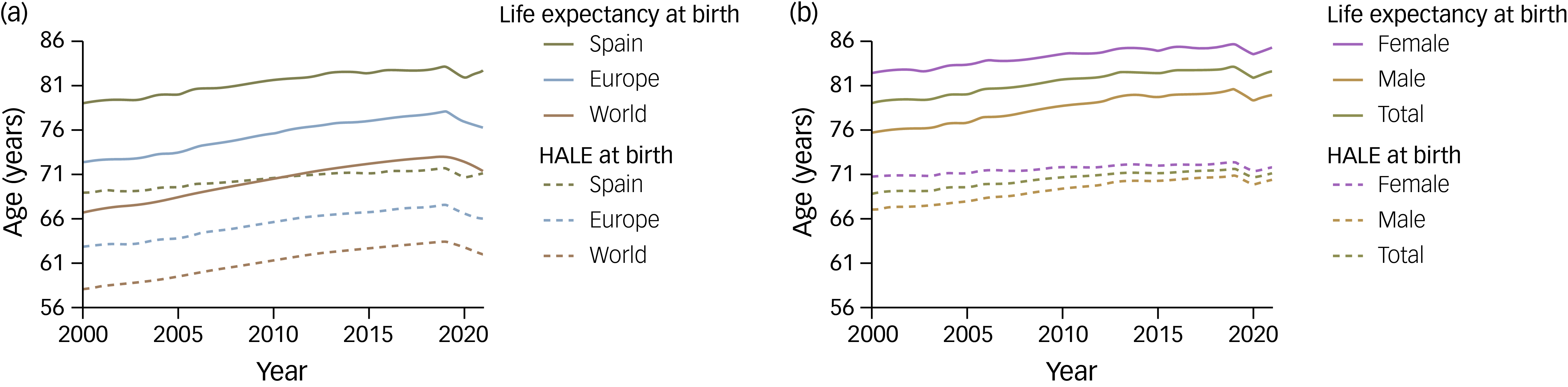
The progressive increase of ageing populations is among the biggest global health challenges, owing to the fact that old age and disease are usually intertwined. Longer lifespans can be seen as a positive outcome of the medical and sanitary improvements that started in the early 20th century and led to a reduction in death rates.1 However, they also led to an increase in the number of years lived with chronic conditions, as age-related diseases became more frequent. This brought to the forefront the concept of healthy life expectancy to define the growing gap between lifespan and healthspan. For instance, recent data show that whereas life expectancy at birth increased by 6.3 years in the first two decades of the 21st century, before the disruption introduced by the COVID-19 pandemic, healthy life expectancy at birth increased by only 5.4 years during the same period (Fig. 1).
Trends in life expectancy and healthy life expectancy (HALE) at birth by gender and region, 2000–2021. (a) Comparison of worldwide trends with those of Europe and a representative country with high life expectancy (Spain). (b) Life expectancy and HALE in Spain, total and separated by gender. Solid lines represent life expectancy; dashed lines represent HALE. Demographic data was extracted from the World Health Organization Global Health Estimates.1

Fig. 1 Long description
Panel A: A line graph compares worldwide trends in life expectancy and healthy life expectancy (HALE) at birth with those of Europe and Spain from 2000 to 2021. The x-axis represents the year, and the y-axis represents age in years. Solid lines represent life expectancy, while dashed lines represent HALE. Spain, Europe, and the world show increasing trends in both life expectancy and HALE, with Spain having the highest values. Panel B: Another line graph shows life expectancy and HALE in Spain, separated by gender (female, male, and total) from 2000 to 2021. The x-axis represents the year, and the y-axis represents age in years. Solid lines represent life expectancy, while dashed lines represent HALE. Females have higher life expectancy and HALE compared to males, and both show increasing trends over time.
To study this divergence, first we must recognise that human ageing is an heterogenous degenerative process that advances at a particular speed in each person. This is particularly obvious if we look at extreme cases. At one end of the spectrum, individuals with the early-onset pathological ageing known as progeria show signs of ageing as early as 1 year old and have an expected life span of 14.6 years; at the other end, supercentenarians (those over 110 years old) seem to have slower progression of the ageing phenotype than most of the population. Reference Santos-Pujol, Noguera-Castells, Casado-Pelaez, García-Prieto, Vasallo and Campillo-Marcos2 Humans are distributed evenly between these two extremes, showing signs of pathological ageing (or frailty) at different chronological ages.
Moreover, ageing does not occur uniformly across the same organism, as tissues also age at different rates. Reference Wen, Tian, Skampardoni, Yang, Cui and Anagnostakis3 Therefore, it has been proposed that organs that show more age-related biological changes, for whatever reason, are at higher risk of developing diseases. For example, an accelerated molecular decline in the brain, even in the absence of clinical damage, could eventually contribute to cognitive impairment. However, it must also be considered that organ-specific ageing patterns are likely to be interconnected through organism-level networks, suggesting that age-related diseases may be actually linked to a general accelerated ageing phenotype. Thus, diseases such as Alzheimer’s and other age-related ailments of the brain could be seen as the visible tip of an iceberg that includes other organ-specific vulnerabilities that have not yet resulted in a clinical outcome.
Biological features of ageing in the brain
Normal brain ageing is a multifactorial process associated with cellular and structural changes that progressively lead to functional decline. It affects multiple domains of brain function, including processing speed, memory, cognition, executive function and even emotional regulation. Consistent with the general features of ageing, the pace and severity of this decline can vary substantially among individuals, particularly owing to interactions among genetic, environmental and lifestyle factors. Brain ageing does not necessarily imply severe neurological disease or dementia. Whereas some degree of age-dependent deterioration is to be expected, there is a boundary between healthy and pathological brain ageing, although the limits are not always completely clear. Thus, understanding the biological mechanisms of brain ageing in all these situations is essential not only for disease diagnosis and treatment but also to identify interventions that could prevent or delay both naturally occurring neurodegeneration and abnormally accelerated pathologies.
The main hallmarks of brain ageing are dysregulated calcium homeostasis, oxidative damage, mitochondrial dysfunction, impaired molecular waste disposal, impaired DNA repair, aberrant neuronal activity network activity, stem cell exhaustion, glial cell activation and inflammation, and impaired adaptive stress response signalling, which show good correlations with the more generic hallmarks of ageing. Reference Blasco, Partridge, Serrano and Kroemer4 Notably, cell senescence and telomere attrition can both be present in different cell types in the brain and thus further contribute to the ageing phenotype. Reference Mattson and Arumugam5 In any tissue, accumulation of senescent cells leads to exhaustion of progenitor cells or stem cells, causing a decline in tissue regenerative capacity during ageing or upon injury. Consistent with this, astrocytes, microglia, neurons and endothelial cells express high levels of senescence markers in the brains of patients with Alzheimer’s disease, in which self-repair by neoneurogenesis is thwarted.
For these reasons, therapies targeting biological hallmarks of ageing may have a clinical effect in brain disorders. For instance, removal of senescent cells also decreases Aβ- and tau-induced neuropathology and improves memory in mouse models of Alzheimer’s. We have also shown that reducing accumulation of senescent cells in the brain delays age-related cognitive decline in a mouse model of pathological ageing, Reference Ekpenyong-Akiba, Poblocka, Althubiti, Rada, Jurk and Germano6 further confirming that targeting senescent cells could have a positive effect on diseases of the aged brain.
Considering schizophrenia as an age-related disease
Schizophrenia is not traditionally included in the list of age-related diseases of the brain. However, a growing body of evidence suggests that this point of view should be revised. In a recent review, Reference Fernandez-Egea, Garcia-Rizo and Kirkpatrick7 Fernandez-Egea et al collected data from the literature to build a case for schizophrenia as part of an accelerated ageing phenotype in which the brain is the organ most visibly affected, a provocative hypothesis that the authors first put forward almost 20 years ago. Reference Kirkpatrick, Messias, Harvey, Fernandez-Egea and Bowie8 This hypothesis is supported by the concomitance of several age-related symptoms in individuals with schizophrenia, ranging from increased insulin resistance to sarcopenia, which would suggest general acceleration of biological ageing. The reduction of around 20% in life expectancy and increased risk of cognitive decline and/or dementia in these patients further strengthen the case.
Moreover, several molecular markers of ageing are clearly increased in schizophrenia. Whether these increases are driven exclusively by the adverse effects of lifestyle and medication following illness onset or represent part of the pathophysiology of the disorder itself, as the review suggests, remains to be elucidated. If the former is the case, understanding the pathways of ageing in schizophrenia could still help to reduce the markedly shortened lifespan of this population, by mobilising faster access to therapeutic interventions and increasing prioritisation within care pathways. Should ageing mechanisms also be involved in the pathophysiology, the therapeutic implications would be larger and more conceptual.
Schizophrenia is currently viewed as a neurodevelopmental disorder with a strong genetic component leading to abnormal dopamine and/or glutamate signalling. This is not incompatible with a model in which ageing processes play a part in the onset of the disease. For example, shortened telomeres and other ageing markers are detectable during development in disease models that only express metabolic complications later in life. Evaluation of these markers in individuals with first-episode psychosis or in at-risk mental state populations could therefore provide predictors of both illness onset and progression.
In an alternative model, the multiple causes of schizophrenia could be exacerbated by a conductive microenvironment established by the biological hallmarks of ageing, in which the threshold for clinical manifestations are lowered, similar to models that could be proposed for Alzheimer’s and Parkinson’s diseases. A third option would present these brain disorders as plants that need a soil in which to germinate and grow; following this metaphor, schizophrenia, as any other age-related disease, would only manifest if the conditions in the organ in which it arises are adequate, in this case, owing to accelerated brain ageing.
Either of these (and perhaps other) models, which are not mutually exclusive, would add a new layer of complexity to the causal definition of schizophrenia by bringing into the fold a biological process that may itself be the most multifaceted and complicated ever studied. Nevertheless, recent advances in our understanding of the biology of ageing may prove useful in elucidating the evolution of disorders such as schizophrenia that are still a puzzle.
Why it makes a difference
Defining the potential links between schizophrenia and ageing is not a moot point with a mere taxonomic interest. As well as contributing to clarification of the poorly defined causes of schizophrenia, confirmation that the molecular bases of the condition may be rooted in the changes brought by ageing could revolutionise its management. For instance, this could enable definition of a set of biological markers that could aid in early diagnosis and perhaps even prognostic prediction. Indeed, several efforts are underway to characterise various panels of markers that could be measured in blood and might be correlated with the biological age of a particular organ. Although we are far from reaching a consensus, it is likely that a combination of epigenomic, proteomic and metabolomic markers with clinical and imaging data could, in the near future, allow us to estimate the biological age of an organ in relation to the chronological age of its owner and thus predict the risk of associated diseases.
Even more importantly, if ageing were indeed shown to be a defining factor in schizophrenia, this would indicate the possibility of a whole new range of targeted treatments. Drugs against several of the hallmarks of ageing are currently being studied. Those that aim to reduce the effects of the accumulation of senescent cells, collectively known as senotherapies, are probably the most advanced and are already undergoing clinical trials. Reference Dhokia, Albati, Smith, Thomas and Macip9 These and other treatments for the biological changes caused by ageing, such as gene therapy to rejuvenate cells, which is currently in clinical trials for glaucoma, could also prove to be effective in schizophrenia. For a disease with so few therapeutic options, this could be groundbreaking, even if the effects were not fully curative.
Still a long road ahead
Although there is ample evidence that ageing may be involved in the emergence and/or progression of schizophrenia, there is a lack of fundamental molecular proof for this hypothesis. Some measurements point in this direction, such as increased BrainAGE scores, shorter telomeres or elevated figures in epigenetic clocks. Reference Fernandez-Egea, Garcia-Rizo and Kirkpatrick7 However, more experiments should be designed to test the possibility of abnormally increased biological features of ageing in the brains of schizophrenia patients, particularly accumulation of senescent cells, which could explain many of the features observed. These would not be not easy studies to perform, given the shortage of samples to analyse. Finding proxy circulating markers in blood may be simpler and more clinically relevant, but it would depend on general advances in the field of biomarkers of ageing, which are probably still years away.
In parallel, in vivo experiments would be needed to test the positive and negative effects of drugs such as senotherapeutics or regenerative gene therapy on schizophrenia. These preclinical studies would benefit from data on safety and efficiency; such data are already available for many of these drugs in mammalian models for other age-related diseases, and this could speed up potential clinical trials.
In the future, schizophrenia may be added to a list of diseases that – although perhaps not cured – could be ameliorated or even delayed by treatment of the common underlying condition that enables them. This would represent a paradigm shift from current therapeutic approaches, as instead of targeting the causes, we would focus on diluting the microenvironmental cues that aid them. A single intervention could thus have the potential to keep in check a host of age-related conditions and, by doing so, finally help to reduce the gap between lifespan and healthspan.
Data availability
Data availability is not applicable to this article as no new data were created or analysed in this study.
Author contributions
J.R.-B., J.G.-F. and S.M. wrote the manuscript.
Funding
This work was supported by the M.C. Andreu Memorial Fund. J.R.-B. was supported by an Universitat Oberta de Catalunya doctoral fellowship. J.G.-F. was supported by a Midlands Integrative Biosciences Training Partnership fellowship.
Declaration of interest
S.M. has a patent on markers of senescence and has participated in meetings organised by Pfizer, Sanofi Pasteur, Amgen, AstraZeneca, Esteve, Grifols and Adeslas, for which he has received speaker’s fees.



eLetters
No eLetters have been published for this article.