I. INTRODUCTION
In the last years, there have been constant efforts in developing high-performance isotropic nanocomposite permanent magnets with unique microstructure and magnetic properties.Reference Luo and Wang1–Reference Jian, Luo, Tao and Yan4 Recently, considerable work has been dedicated to the increase of the glass forming ability (GFA) and the enhancement of the mechanical and magnetic properties of (Nd,Pr)3–12–Febal–M–B6–30; (M = Co, Mo, Nb, Ti, V, and Zr) alloy systems.Reference Tao, Ma, Jian, Ahmad, Tong and Yan5–Reference Chang, Shih, Hsieh, Chang and Shen7 The synthesis of permanent magnets through copper mold casting technique was found to be facile, viable, and economical because of the single processing step and less amount of expensive rare earth elements used than in sintered magnets. The conventional way to develop a permanent magnet through copper mold casting is to make the amorphous alloy and then anneal it at 600–700 °C for 10–30 min. In fact, the nonoptimal remanence and energy product restricted the widespread applications of these materials, especially the use of small dimensional rods of 0.5–1.1 mm in diameter. This discrepancy is attributed to the difficulties in obtaining a uniform microstructure, which determines the exchange coupling between the soft and hard magnetic phases. Researchers have adopted two approaches for the development of well-performing bulk nanostructured magnets: by the modification of the alloy composition and by the optimization of processing parameters.
Recently, the bulk metallic glasses (BMGs) studies have shown that doping of (Nd,Pr)–Fe–B alloys with Nb,Reference Zhang, Lim, Feng and Li8 Y,Reference Zhian, Ji, Yanli and Zhimeng9 or ZrReference Tan, Xu, Bai, Zhao and Dong10 has beneficial effects on the GFA and magnetic properties. Zhang et al.Reference Zhang, Lim, Feng and Li8 reported that after optimal crystallization, the bulk Nd9.5FebalNb4B22.08 alloy shows large intrinsic coercivity of 1098.5 kA/m and (BH)max = 31.8 kJ/m3. It was pointed out that Y is effective in improving the GFA, stabilizing the amorphous phase, reducing the oxides during melting or heat treatment, especially in low-purity alloys.Reference Zhian, Ji, Yanli and Zhimeng9 Tan et al.Reference Tan, Xu, Bai, Zhao and Dong10 developed Nd5Y4Fe68Zr2B21 bulk sheet specimens with relatively larger size of 0.8 × 10 × 50 mm3, which after crystallization at 690 °C exhibit permanent magnetic properties with jH c = 382 kA/m and (BH)max = 42.9 kJ/m3. However, some challenges still remain in the improvement of GFA and magnetic properties of (Nd,Pr)–Fe–B–Y alloy system. Indeed, very little attention has been paid to investigate the effect of annealing temperature on magnetic and microstructural properties of Nd–Fe–B–Y–Nb alloy system. The aim of the present work is to investigate the structural and magnetic properties of Fe64B22.8Nd6.6Y3.9Nb2.7 nanocomposite permanent magnets along with their dependence on annealing process. The Fe64B22.8Nd6.6Y3.9Nb2.7 alloy was selected based on our previous studiesReference Jian, Luo, Tao and Yan4, Reference Tao, Ma, Jian, Ahmad, Tong and Yan5, Reference Tao, Ahmad, Jian, Ma and Yan11 and considering the thermodynamic empirical rules reported in Ref.Reference Takeuchi and Inoue12.
II. EXPERIMENTAL
The Fe64B22.8Nd6.6Y3.9Nb2.7 ingots were prepared by arc melting the pure metals (Fe, Nd, Y, Nb) and Fe–B alloy (Fe 99.5%, Nd, Nb, Y, FeB 99.9% pure) under high-purity Ar atmosphere. The cast ingots were remelted six times to ensure their homogeneity. Amorphous rods of 2 mm in diameter and 25 mm in length were prepared by injection copper mold casting technique. The alloy composition was verified by inductively coupled plasma spectrometry and atomic absorption spectrometry. The samples were annealed at 660, 700, and 770 °C for 15 min. The crystalline structure was determined by x-ray diffraction (XRD) technique, using Cu kα radiation. The XRD patterns were measured in the 2θ scan range of 20–90° using a scan speed of 1.0°/min and a step size of 0.002°. The crystalline phases present in the nanocomposites were identified by comparing the observed peak positions (2θ) and their corresponding intensities (I) with the standard powder diffraction files using the Hanawalt method.Reference Hanawalt, Rinn and Frevel13 The mean crystallite sizes were determined from the XRD patterns using the Scherrer equation.Reference Scherrer14 The density of the magnetic samples was measured using Archimedes principle. The glass transition and crystallization temperatures of the amorphous phase were measured using a differential scanning calorimeter at a constant heating rate of 5 °C/min. Microstructural studies were performed using a high-resolution transmission electron microscope (HRTEM). The compositions of the observed phases were determined by energy dispersive spectroscopy analysis. The magnetic properties were measured at room temperature by using a Quantum Design MPMS-75 superconducting quantum interference device (Quantum Design, San Diego, CA) with a maximum applied field of 5 T, after the calibration with a standard sample.
III. RESULTS AND DISCUSSION
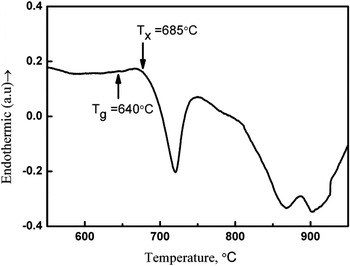
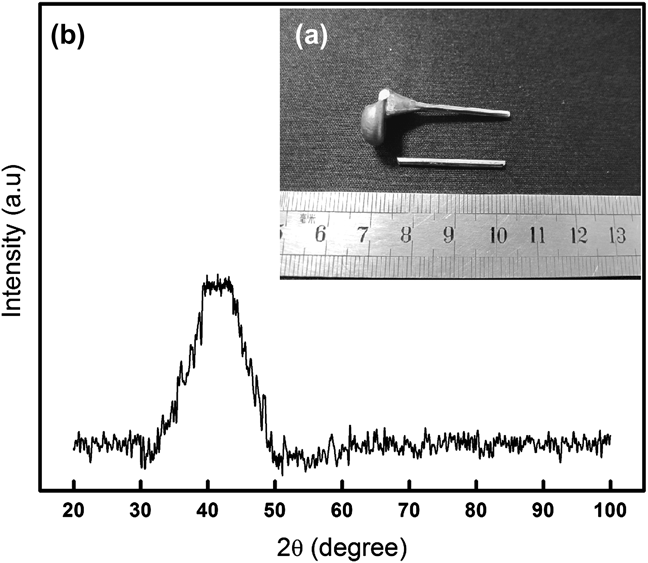
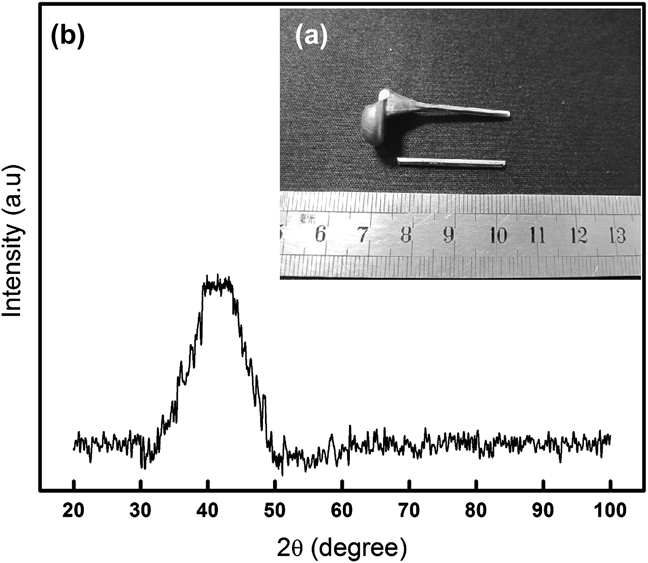
Figure 1 presents the differential scanning calorimetry curve for the as-cast alloy. As seen, the curve shows two crystallization temperatures located at about 685 and 875 °C, respectively. The physical appearance and x-ray diffractogram of the as-cast alloy are shown in Figs. 2(a) and 2(b). The as-cast alloy of 2 mm in diameter and about 50 mm in length shows a metallic luster surface [Fig. 2(a)]. The XRD pattern reveals a broad peak for the as-cast alloy [Fig. 2(b)], suggesting an amorphous structure within the detection limits of XRD.
Differential scanning calorimetry profile of the as-cast rod of 2 mm in diameter.

(a) Physical appearance and (b) x-ray diffraction (XRD) pattern of the as-cast alloy.
Shen and InoueReference Shen and Schwarz15, Reference Inoue16 figured out that the Fe-based BMGs with large GFA should satisfy the following empirical rules: (i) the alloy must have at least three components, two of which are metallic; (ii) the alloy must contain two or more metallic elements with different atomic sizes and near zero heats of mixing; (iii) the metallic elements must have large negative heats of mixing with the metalloid; (iv) the total metalloid content must be in the vicinity of 20 at.%. The GFA of Fe64 B22.8Nd6.6Y3.9Nb2.7 alloy can be better understood by considering the aforesaid empirical rules. In Fe64 B22.8Nd6.6Y3.9Nb2.7 alloy, the atomic radii of the constituents are Fe 0.124 nm, Nb 0.146 nm, Nd 0.164 nm, Y 0.182 nm, and B 0.09 nm.Reference Takeuchi and Inoue12 The atomic size of the elements decreases in the order Y > Nd > Nb > Fe > B. The differences in the atomic radii of Y, Nd, Nb, Fe, and B improve the atomic packing density, which, in turn, enhances the GFA.Reference Ponnambalam, Poon, Shiflet, Keppens, Taylor and Petculescu17 The second benefit for the enhancement of the GFA is the presence of large negative enthalpies of mixing among the atomic pairs, i.e., −54 kJ/mol for Fe–Y, −42 kJ/mol for Fe–Nb, −27 kJ/mol for Fe–B, and −58 kJ/mol for Y–B.Reference Takeuchi and Inoue12 These negative enthalpies of mixing indicate that there might be a strong cohesion and attractive interaction among the alloy constituents,Reference Ponnambalam, Poon, Shiflet, Keppens, Taylor and Petculescu17 which allow us to cast amorphous alloy of 2 mm in diameter and 25 mm in length.
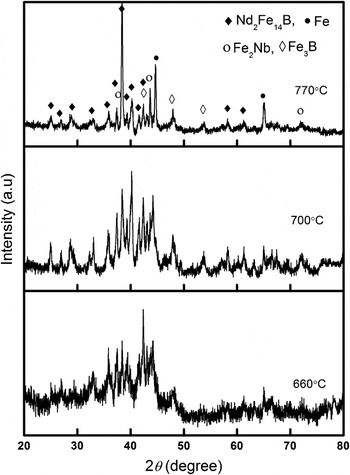
Figure 3 presents the XRD patterns of the samples annealed at 660,700, and 770 °C for 15 min, respectively. Annealing at 660 °C results in the formation of α-Fe, Fe3B, Fe2Nb, and Nd2Fe14B phases. The mean crystallite sizes are calculated as being 18.4 nm for the α-Fe soft magnetic phase and 37.7 nm for the Nd2Fe14B hard magnetic phase. After annealing at 700 °C, the same α-Fe, Fe2Nb, Fe3B, and Nd2Fe14B phases are identified, but the peak intensities increased compared with the sample annealed at 660 °C, indicating that the volume fraction of the crystalline phases changed. The mean crystallite sizes for the α-Fe and Nd2Fe14B magnetic phases were measured as 21.7 and 42.2 nm, respectively, for the samples annealed at 700 °C. After annealing at 770 °C, the peak intensities of α-Fe, Fe2Nb, Fe3B, Nd2Fe14B phases are even higher and the full widths at half maximum of the reflections are smaller compared with the samples annealed at 660 and 700 °C, indicating the increase of the crystallites size. The mean crystallite sizes for α-Fe and Nd2Fe14B grains of the samples annealed at 770 °C are 34.7 and 45.6 nm, respectively.
XRD patterns of thermally treated samples.

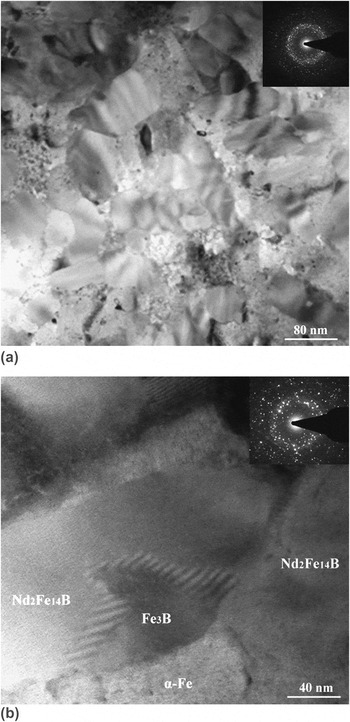
The magnet annealed at 700 °C has the optimum magnetic properties. Hence, it was chosen as a representative sample for the investigation of the microstructure by the HRTEM. Figure 4(a) shows the bright-field image and the corresponding selected area electron diffraction pattern of the sample annealed at 700 °C for 15 min. It shows a multiphase microstructure. The energy dispersive x-ray microanalysis confirms the existence of α-Fe, Fe3B, and Nd2Fe14B magnetic grains [Fig. 4(b)]. However, it was difficult to identify the Fe2Nb grains due to the overlapping with other phase grains. Thus, based on the transmission electron microscopic (TEM) observations, it can be concluded that the nanocomposite microstructure consists of fine, soft and hard magnetic grains with almost homogenous distribution. The mean grain size for the Nd2Fe14B hard magnetic phase is measured as 50 ± 5 nm, whereas the mean grain sizes for the α-Fe and Fe3B soft magnetic phases are about 25 ± 5 and 30 ± 5 nm, respectively. The mean grain sizes measured with TEM almost coincide with the values determined from the XRD patterns. No other phases were detected in the annealed microstructure.
Transmission electron microscopic bright-field images of the magnet annealed at 700 °C showing (a) morphology of magnetic phases and (b) a high-magnification image of soft and hard magnetic grains. The insets are the corresponding electron-diffraction patterns.

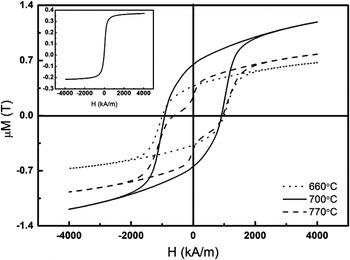
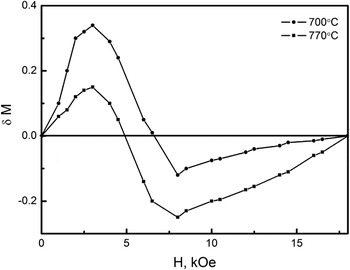
The hysteresis loops for the as-cast and annealed samples at 660, 700, and 770 °C for 15 min are presented in Fig. 5. The as-cast sample shows a soft magnetic behavior, which turns into a hard magnetic upon annealing. The samples annealed at 660 and 700 °C show smooth hysteresis curves, without steps, indicating the exchange coupling between the soft and hard magnetic phases. The exchange coupling becomes worse at 770 °C due to the coarsening of magnetic phases. The changes of δM [= m d(H) − {1 − 2m r(H) }],Reference Chang, Chiou, Ma and Bounds18, Reference Chang, Shih, Chang, Hsieh, Cheng, Chang, Sun and Yao19 where m d(H) is the reduced magnetization and m r(H) is the reduced remanence, with respect to the applied magnetic field for the magnets annealed at 700 and 770 °C, respectively, are measured and are plotted in Fig. 6. The magnitude of the positive δM peak for the annealed magnet at 700 °C is significantly higher than the one of the magnet annealed at 770 °C, indicating a strong exchange coupling between the soft and hard magnetic grains. The coarsening of phase grains causes the decrease of the positive δM peak for the sample annealed at 770 °C.
Hysteresis loops for the thermally treated magnets. The inset shows the hysteresis loop for the as-cast sample.

The δM plots as a function of the applied field for the samples annealed at 700 and 770 °C.

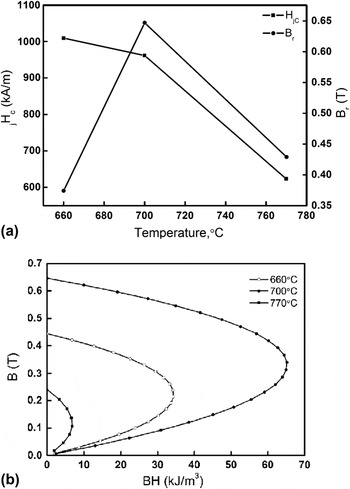
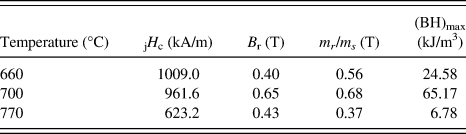
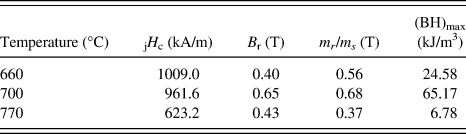
The magnetic characteristics of the annealed magnets are presented in Fig. 7, and their values are summarized in Table I. As seen in Figs. 7(a) and 7(b), the samples annealed at 660 °C exhibit jH c of 1009 kA/m, B r of 0.4 T, and BHmax of 24.58 kJ/m3. At low annealing temperature (660 °C), though the crystallites of α-Fe phase are small, the incomplete crystallization of the amorphous phase is obviously unfavorable for the magnetic properties of nanocomposite magnets. Annealing at 700 °C increases B r up to 0.65 T at the expense of reducing the coercivity from 1009 to 961.6 kA/m, in agreement with the results reported for α-Fe/(Nd, Pr)2Fe14B and Fe3B/(Nd, Pr)2Fe14B nanocomposite magnets.Reference Fischer and Kronmuller20, Reference Chen, Zhang, Ding, Hadjipanayis, Chen and Ma21 The annealing at 700 °C induces the favorable volume fractions and grain sizes of soft magnetic α-Fe and Fe3B phases, which will play an essential role in improving the remanence as compared with the sample annealed at 660 °C.Reference Parhofer, Wecker, Kuhrt, Gieres and Schultz22 At high annealing temperatures, the magnetic properties degrade due to coarsening of both the soft and hard magnetic phases. Hence, it can be concluded that the magnetic properties of the Fe64B22.8Nd6.6Y3.9Nb2.7 nanocomposite magnets are affected by the intrinsic properties, i.e., the grain size, the volume content, and the distribution of the magnetic phases.
Dependence of (a) jH c, B r and (b) BHmax (b) on annealing temperature.

Magnetic properties of the annealed magnets with a diameter of 2 mm.
IV. CONCLUSIONS
We have developed a new nanocomposite Fe64B22.8Nd6.6Y3.9Nb2.7 permanent magnet by annealing the amorphous precursor prepared by the conventional copper mold injection casting technique. The magnetic behavior of the Fe64B22.8Nd6.6Y3.9Nb2.7 nanocomposite permanent magnet depends on the intrinsic properties of the soft and hard magnetic phases, as well as their amount and distribution. The nanocomposite microstructure is mainly composed of α-Fe, Fe3B, and Nd2Fe14B magnetic phases. The optimum magnetic properties are achieved for the rods of 2 mm in diameter, i.e., jH c = 961.6 kA/m (12.0 kOe), B r = 0.65 T (6.5 kG), and BHmax = 65.17 kJ/m3 (8.19 MGOe).
ACKNOWLEDGMENT
This work was supported by The Foundation for the Author of National Excellent Postdoctoral Dissertation (FANEDD-201037) of the People’s Republic of China.