In February 1906, Richard Rogers Bowker, a New York newspaper editor, sent a fifty-dollar check to Hollis B. Frissell, principal of the Hampton Normal and Agricultural Institute. In the enclosed letter he apologized for the delay: “I had not forgotten my custom of making the first ‘good works’ check of the new year to Hampton, but this year I had been rather late in arranging for those matters, which even in small amounts make a rather difficult total for anyone not rolling in wealth.” Nevertheless, he wrote that he “should be sorry not to be counted among the loyal supporters of Hampton, and I take pleasure in sending you my small contribution, with all good wishes.”Footnote 1 By 1906, Bowker had become a loyal, if small, donor to Hampton; he had given regularly since at least 1896, fifty dollars being his typical amount (worth about $1,300 in current dollars), and he would send small donations to the school throughout his life. Bowker's biographer called him a “militant liberal” who, “aside from national politics and tariff reform,” supported numerous “liberal causes,” including the American Civil Liberties Union, birth control, and the settlement house movement, and protested “child labor, compulsory military training in the colleges, and antisemitism.” Support for African American education fit into his liberal ideology; he also gave to other Black schools like Tuskegee, Snow Hill, and Mayesville Institutes.Footnote 2 Bowker was one of the thousands of donors who gave to Hampton between 1893 and 1917, during Frissell's tenure as its second principal. During this period, Hampton became the wealthiest school for African Americans, and the Hampton idea was at its most influential, attracting numerous followers as well as detractors.Footnote 3
This essay examines the workings of Hampton's external relations program to show how the school developed these loyal supporters and donors. Little has been written about how Hampton actually raised money and few have explored in any detail why it was more successful in fundraising than other schools for African Americans. However, because of the prominent role that board president Robert C. Ogden, trustee George Foster Peabody, and Principal Frissell would play in the southern education movement in the early twentieth century, and because Hampton's educational philosophy undergirded the movement, Hampton figures prominently in the literature about African American education and strategies for equality and advancement in this period.
More than a century later, Hampton still looms large among scholars, along with Tuskegee Institute, as having an outsized (and deleterious effect) on the course of African American education after Emancipation.Footnote 4 However, much of the literature on Hampton focuses on the tenure of Samuel Chapman Armstrong, its first principal. Armstrong, though, was dead by 1893; two years before Booker T. Washington's Atlanta Exposition Speech, five years before the first Capon Springs Conference for Education in the South, and nine years before the founding of the General Education Board (GEB). When Armstrong died, the success of Hampton, or the philosophy it represented, was far from assured.
That the Hampton Institute not only survived, but thrived, in the quarter century after Armstrong's death was because its leaders, namely Armstrong's successor, Frissell, and board president Ogden, developed a comprehensive, state-of-the-art external relations program that forged meaningful connections with its supporters. Hampton's coordinated outreach efforts were highly effective at connecting with its target audience—wealthy White Northerners—making them feel closely connected to Hampton and its students. This program consisted of a multichannel communications plan encompassing direct marketing, advertising, in-house publications, and strategically placed articles in newspapers, combined with personal outreach, including letter correspondence, large events in public halls, small events in more intimate settings, and carefully choreographed visits to the Hampton campus. Beyond monetary gifts, Hampton's northern friends donated their time and talents in support of the school. Hampton relied on its loyal volunteers to organize events, open up their social networks, and raise money on Hampton's behalf.
These strategies not only attracted but also retained supporters. Moreover, by positioning its fundraising as part of a larger strategy to create awareness of the Hampton plan to solve the so-called “Negro problem” and “Indian problem,” its supporters could feel that they were part of something larger than just benefactors of a southern normal school for African Americans and Native Americans.
Philanthropy in Black Education: Context
After the Civil War, education for Blacks was very much a Black-led effort, and freed people needed no encouragement from the North to begin educating themselves. However, sympathetic northern Whites assumed that education for the freed people could not last long without their help, and so into the field entered many White-led benevolent and missionary organizations. The most prominent of these was the American Missionary Association (AMA); in addition to hundreds of common schools, the AMA would also have a hand in founding Hampton Institute, Berea College, Atlanta University, Fisk University, Tougaloo College, Dillard University, Talladega University, LeMoyne-Owen College, Huston-Tillotson University, College of Charleston, and Howard University, and would contribute “approximately one-third of the $20 million the numerous benevolent and government agencies spent helping ex-slaves between 1861 and 1890.”Footnote 5
With or without White help, historian John Thelin points out that “black church and community associations were deeply committed to founding and funding their own local colleges.”Footnote 6 The churches active in this effort included the “African Methodist Episcopal (AME) Church, the African Methodist Episcopal Zion (AMEZ) Church, and the Colored Methodist Episcopal (CME) Church (later renamed the Christian Methodist Episcopal Church) [which] were better prepared to enter the educational arena because they possessed denominational structures that facilitated the establishment and systematic funding of institutions.”Footnote 7 Although Blacks themselves contributed an estimated $25 million toward education between 1865 and 1915 (compared to $57 million by northern Whites), the schools that depended the most on the Black community were also the most financially undernourished. Especially after 1900, this search for funding led many schools to, at least nominally, adopt an industrial training curriculum in the hopes of securing funds from the GEB, the Slater Fund, and other northern institutional sources.Footnote 8
Whether their curriculum was classical or vocational, or led by Blacks or by Whites, or whether they secured foundation or denominational funding or not, all of these schools had to raise additional funds to make ends meet. This was done in at least one of three ways. One, some schools, especially those runs by Blacks, held local fundraising drives in the surrounding community.Footnote 9 Two, the schools sent fliers and appeals to the North, with occasional “begging” tours by the principal or senior officers, sometimes accompanied by students, such as the Fisk Jubilee Singers. Finally, schools that could afford to employed field agents to canvass for funds.Footnote 10
Two things made Hampton stand out among other schools for Blacks. First, it cannot be denied that having a White principal and well-connected White friends helped the school gain entrée to wealthy White Northerners. However, having White leadership did not in itself assure financial security. Second, to build upon this advantage, Hampton created a systematic, integrated, and long-term approach to fundraising and public relations. This is an important detail, as it represents a turning point in the professionalization of fundraising. The word development as the accepted term for nonprofit fundraising would not be coined until the 1920s and was not in common use until the 1950s. However, Harold Seymour, in his influential 1966 Designs for Fund-Raising, considered something of a bible for fundraisers in the years after its publication, said that development should not be considered synonymous with fundraising; rather, development was the “broad term for the planned promotion of understanding, participation, and support.”Footnote 11 In other words, “fund-raising is asking for money; it is episodic. Development cultivates and sustains ongoing relationships that often extend over decades.”Footnote 12 Frissell and Ogden understood this concept, if subconsciously, decades before it became best practice. While Hampton was not the first or only school to fundraise in this way, the commitment to a long-term approach to fundraising helped put them ahead of their peers.Footnote 13
Perfecting the Business Operation
Ogden became president of Hampton's board of trustees shortly after Frissell became principal in 1893.Footnote 14 The two formed a partnership toward “the perfecting of its business operations” to improve the school's efficiency.Footnote 15 Ogden at this time was a partner in Philadelphia with John Wanamaker, the “merchant prince” who pioneered the concept of the department store. Wanamaker's focus on building long-term relationships with customers was a change from the prevailing transactional nature merchants typically practiced, which focused more on making a sale than developing an ongoing relationship. Wanamaker made sure his stores were appealing to his customers and designed with “comfort and convenience in mind.” His advertising, attractive and truthful, was another way of gaining loyalty. Though his ethical business approach was costly, he gained loyal customers who, by 1885, made his the most successful retail stores in the United States.Footnote 16
Ogden recommended many of these same relationship marketing principles, which Frissell was quick to adapt.Footnote 17 He sent Frissell suggestions he had learned from another charity in Philadelphia, writing that if the methods were “wisely and energetically done, they contain the potency of much future help.”Footnote 18 He also had suggestions to improve the school's advertising and marketing, an area in which he had particular expertise, by modifying the format of the annual Principal's Report and sending circulars through the mail to northern households. The other trustees hesitated to increase expenses to allow this, and it would be a while “before returns begin to come,” yet he was confident such an expense was worth it.Footnote 19 Regarding the Southern Workman, Hampton's official organ, Ogden opined, “There would be nothing undignified in obtaining advertising. . . . It should however be solicited entirely upon a business basis, and not as charitable help for the school.”Footnote 20
Frissell organized his office to ensure operational efficiency. His assistants were given clear instructions on how to handle all correspondence. Letters from donors were kept in a permanent file, and copies of outgoing letters were “carefully indexed.” The principal's office also maintained an extensive card list, “perhaps the most valuable possession of the Office.” One group of cards contained the comprehensive records of donations, complete with names and addresses; these cards alone numbered perhaps twenty thousand by 1905. Another card file held names of individuals “whom it seems desirable to interest and to whom appeals have been sent,” but were not yet donors. Frissell organized donor lists by city to help plan his northern trips, using the names, addresses, and gift information for supporters in Boston, Brooklyn, New York, and Philadelphia.Footnote 21 Furthermore, donors in any given year were indexed by the month in which they gave, so that the following year they could be mailed a donation appeal in the same month.Footnote 22 This meticulousness allowed Frissell to ensure that all donors were acknowledged for their generosity, and asked again in subsequent years. Seemingly small details went a long way toward building loyal supporters.
Wealthy people were often besieged with requests for money. One example illustrates the situation they faced. In 1900, newspapers reported that Anson Phelps Stokes Jr., the young scion of a wealthy New York family, had eschewed high society for a life of religious piety.Footnote 23 “He has shown in many ways that he cares nothing for wealth,” one wrote.Footnote 24 The story was picked up in papers across the country and, as a result, Stokes began to receive thousands of letters from supplicants asking him for money. “I have read about you becomming [sic] a Millionaire, and that you said you didn't care for so much Money and you wished you war [sic] poor,” wrote one. “As I am poor and a sick Cripple I thought I would write to you and ask you to help me a little.”Footnote 25 To his credit, Stokes answered personally as many as he could, but he felt compelled to develop a form letter to respond to the inundation. “Owing to articles in the newspapers which exaggerate my income over a hundred fold, I am constantly receiving letters asking for financial assistance . . . from individuals and institutions entirely unknown to me,” wrote Stokes, noting that he would only “make such small contributions as I am able in the lines of Christian education and charity, though institutions with whose management I am personally acquainted.”Footnote 26 As generous as Stokes was, he obviously could not give to all who asked, and it underscores the point that anyone who was perceived as wealthy had no shortage of solicitations. For Hampton to be heard, they had to stand out.
Results Come in Later: Spreading the Message
Frissell created a publications office to centralize creating and distributing various materials that Hampton produced with its on-campus printing press. This included the Southern Workman, the school's monthly organ, and the Hampton Leaflets, which were distributed to educators throughout the South on topics regarding agricultural topics. The publications office also coordinated the distribution of Hampton's catalogs, annual reports, and circulars, which numbered over sixty thousand copies annually by 1908.Footnote 27
The Southern Workman, under Frissell and Ogden's guidance, grew over time from a sixteen-page newsletter to a sixty-eight-page magazine with illustrations and pictures and, of course, advertisements. The improved magazine contained articles not just about Hampton but also about education and racial relations. “Race questions are of such vital importance to the country,” Frissell wrote in 1900, “and Hampton has such close relations with them that it has seemed wise to make the Southern Workman, as far as possible, an authority on race problems.”Footnote 28 Complete with book reviews and original essays by paid contributors, by 1913 it reported a circulation of over five thousand.Footnote 29 Through the Southern Workman, Hampton could not just advocate for the school but also shape northern White opinions on the proper role of Black men and women in society. The magazine portrayed African Americans, at least those who adhered to Hampton teachings, as independent, well-behaved, and industrious. In 1901, it editorialized that the “two great hindrances to the progress of the Negroes” were not due to the “prejudice of the whites” but because “of the political aspirations of their own people and the bitter sectarianism” that divided them.Footnote 30 The message was clear: Blacks should stay clear of politics and focus on economic uplift. Although it did not shy away from commenting on the illogic and injustice of southern racism—in 1899 it opined that the “average Negro is a better citizen . . . than the poor white”—it maintained that the salvation of Blacks was to be through education, not politics.Footnote 31 An article about the life of female students gave readers a glimpse of how Hampton saw the role of women in African American societies. Their rooms were a “model of good housekeeping” with “simple furniture” that had been made in the school's shops. As the students advanced in grades, the girls became “more self-controlled and self-respecting, and more helpful” to younger students. A Hampton girl will learn to “make her own clothes and keep house in a simple way”; she is “not afraid of the scrub-brush or wash-tub.” After graduating, she will go back home to “shine a light in darkness guiding her people into ways of pleasantness.”Footnote 32 This message of simple living and self-sufficiency would reassure readers that Hampton was producing the “right kind” of women.
The campus printing press also published pamphlets that were distributed to a wide audience. These ran as long as thirty pages and showed in both words and pictures why Hampton was worthy of support.Footnote 33 Progress was a familiar theme. The 1898 pamphlet included engravings of Hampton's campus in 1868 and 1898 to show the growth of the campus. Rarely did they lack mentioning its most famous graduate, Booker T. Washington. Yet lest potential supporters think that African Americans in general, and Hampton in particular, were comfortably on their way, the pamphlets described the continuing need for support. The 1898 publication noted that “still 75 per cent of the race live in one-room cabins on rented land, in ignorance and poverty. Teachers of agriculture and home builders are needed.”Footnote 34
These marketing materials would be mailed north, both to past supporters as well as to potential supporters, but just like any mass marketing effort, results were mixed. “I am not in the least bit interested in Booker Washington,” wrote back one nondonor. “My own people come first, and there are plenty of poor white people who need education and are unable to get it.”Footnote 35 As this response indicates, Hampton's marketing had to overcome a sometimes skeptical audience to convince them that the cause of Black education was worthy of their support.
Hampton's advertising and marketing broadened the reach of its northern fundraising tours. Armstrong had made exhausting tours of the North, particularly in New England, often with two or more speaking engagements in a day, frequently in churches. These engagements would feature Armstrong touting the value of Hampton, and often both an African American and Native American student or ex-student would speak on his or her experiences at Hampton. The service would feature “plantation melodies” by Hampton student singers and conclude with a general collection. This was classic missionary fundraising, and Armstrong excelled at it.
When Frissell began helping out with these northern campaigns, his chief duty had been arranging logistics. As principal, Frissell applied the lessons he learned while working under Armstrong. Armstrong, through pure force of personality, built something of a cult following, and Frissell capitalized on this. Appeals in the years after Armstrong's death spoke of his legacy and exhorted friends not to let his sacrifice be in vain. “No other monument to its noble founder, Gen. Armstrong, could be half so fitting as the continuance of the work for which he gave his life,” said one.Footnote 36
After Armstrong's death, Hampton expanded its reach beyond the pews to private homes and summer resorts where the well-to-do vacationed. These parlor meetings took on a more intimate character than the church meetings. Some of these gatherings featured discussions on serious topics, such as the “Economic Conditions of the South.”Footnote 37 Supporters founded affinity groups, called Armstrong Associations, to organize events and coordinate fundraising in the major cities. The Boston Ladies’ Hampton Committee began in 1893, and the New York Armstrong Association was founded shortly thereafter. Similar Armstrong Associations would be organized in Philadelphia, Brooklyn, Orange (New Jersey), and Springfield (Massachusetts), among others.Footnote 38 New York, Brooklyn, and Boston put on large public events as well as members-only meetings, with featured speakers such as Mary White Ovington, the longtime civil rights activist and reformer who later became a founding officer of the NAACP, and William Howard Taft, both before and during his presidency.
From its founding, church meetings were the principal means Hampton spread its message. Some two hundred churches—primarily Unitarian, Congregational, and Presbyterian—annually gave a total of about $9,000 a year; churches in the Boston area and New York City (including Brooklyn) gave the most. As aforementioned, churches were a vital part of the original outreach philosophy and perhaps the most effective way to reach a wide audience. Hampton officials did not have to visit a church every year; the idea was to get on their regular benevolence schedule. Many churches took up a monthly collection for various missionary and humanitarian causes, announced in advance. The bylaws of the Plymouth Church of the Pilgrims in Brooklyn, for instance, mandated a benevolent collection on the last Sunday of each month; in 1897, recipient organizations included the Seamen's Friend Society, the Industrial School Association and Home for Destitute Children, and the New York City Mission and Tract Society. Lafayette Avenue Presbyterian Church listed some thirty-four different “missionary and benevolent purposes” that their members gave to in 1901. Hampton received $166.30 of the $32,000 it collected; the American Bible Society, Children's Aid Society and the “Miss Stone Ransom Fund” all received a similar amount.Footnote 39
When Hampton officials visited churches and other venues, Frissell made sure to put on a good show. He was bringing Hampton north, providing northern audiences with an intimate look at a school most had not seen firsthand. While he was never as magnetic as Armstrong, he took pains to ensure these events were both entertaining and impactful, using visual aids as well as featuring Black and Native American speakers sharing their Hampton experiences with the White audiences. In January 1896, for example, Frissell visited Asylum Hill Congregational Church, in Hartford, Connecticut, with a quintet choir consisting of “three young colored men, two young colored women,” along with “one full blooded Sioux Indian, and a young man who operated the magic lantern.” The “magic lantern” was the stereopticon, an early version of the slide projector, which Frissell often used in his lectures, recognizing the power of visual aids to augment the spoken word. As the Hartford Courant reported, “The pictures which appeared upon the screen in rapid succession gave the audience a clear idea of Hampton Institute, its pupils and their work.”Footnote 40 As was the case with photographs in their pamphlets, before and after pictures were common. A 1901 article described the contrast between traditional “negro cabins and the subsequent neat and comfortable homes, the tepee and rude hut of the Indian and the changed surroundings of the red man after he had graduated from the Hampton Institute.”Footnote 41 When moving picture technology became available around 1910, Hampton was quick to adapt its presentations to the new medium, as historian Allyson Nadia Field indicates in Uplift Cinema. She argues that Hampton's extensive use of visual aids displays an understanding of its potency while also revealing Hampton's desire to control the narrative.Footnote 42
Hampton's messaging was carefully constructed to show progress, and it shied away from revealing the realities and horrors of the Jim Crow South or the dehumanizing effects of federal Indian policy in the West. The message Hampton wanted to communicate was that African Americans and Native Americans were taking responsibility for their own advancement, and thus it implicitly absolved Whites from having to take an active role in helping them; their mere support, monetary or otherwise, was enough. The meetings did not always raise large sums immediately, but Frissell saw the campaigns as more cultivation events rather than just solicitation events. The purpose was not just to raise revenue but to raise awareness of the work Hampton was doing, to keep “the country informed as to the progress of educational work among these races.”Footnote 43
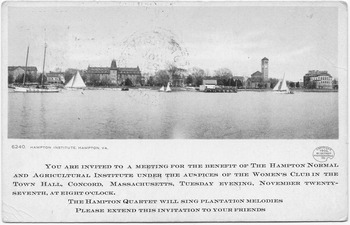
Hampton Institute, Hampton, Virginia. The Miriam and Ira D. Wallach Division of Art, Prints and Photographs: Photography Collection, The New York Public Library. New York Public Library Digital Collections, 1898–1931. Accessed Oct. 16, 2020. http://digitalcollections.nypl.org/items/510d47d9-a7d4-a3d9-e040-e00a18064a99.

While winter campaign meetings were held in public places, the summer events were more intimate, often hosted or coordinated by Hampton's northern friends, who would invite their network of associates, thus expanding Hampton's reach even more. By traveling to where the wealthy were summering, they hoped to attract more followers to the Hampton philosophy rather than visiting them during the winter when they were “much occupied with business or social cares to give time and attention to such matters.”Footnote 44 In 1906, Frissell wrote:
The social position of the hostess often draws to the meeting quite a gathering of people who otherwise would not come to such an affair if held in a church or hall. In most cases we do not expect to take a collection at the meetings, but we do get a good hearing, and results come in later.Footnote 45
As Frissell's comment indicates, White women were a critical factor, using their socially acceptable positions as hostesses to bring people together to hear Hampton's message.
Developing the Field
The “young man” who operated the stereopticon in Hartford was probably Rev. Herbert. B. Turner, who succeeded Frissell as chaplain and chief organizer of the fundraising campaigns. Turner joined Hampton in 1893 and served as both chaplain and fundraiser for over twenty-five years.Footnote 46 Frissell created a centralized Campaign Office in 1900, led by Turner, which was charged with giving tours to the approximately twenty thousand visitors Hampton received annually, as well as acknowledging donations, mailing appeals and circulars, and coordinating the northern campaigns. Turner traveled throughout the North and West, holding meetings and making new friends for Hampton.Footnote 47
Hampton was not unusual in keeping a fundraiser in the field. Most Black schools used financial agents, as the fundraisers were called, at some point, some more regularly than others.Footnote 48 Two things made Hampton distinctive, however. First, Turner was not just a hired hand; as chaplain, he was intimately connected with the work of the school. This was in keeping with Armstrong's wishes; in 1892, he insisted that a financial agent must be “a resident worker, an active part of the cause which he presents.”Footnote 49 Other schools hired agents intermittently and often on commission.Footnote 50 Paying by commission was attractive both to the schools, which were cash poor and therefore had little capital to outlay, and to the agents, who could earn more as they raised more.Footnote 51 Second, relatedly, Turner's fundraising duties were integrated into an overall marketing strategy. He understood that his job was to develop the field as well as raise funds, and that success was not measured just in immediate monetary returns.
Turner's correspondence to Frissell while on the road makes clear that he viewed his duties not only as fundraising but also as spreading awareness and building long-term relationships between Hampton and its donors. After a church meeting in Connecticut in 1894, he wrote that the collection was “small” but “from what Dr. Lawson said, the church will probably make a special donation to Hampton.”Footnote 52 From Boston in 1900, he wrote that a pastor provided Turner with a list of “rich givers of this congregation” and suggested that they be sent Hampton circulars “from time to time. It would keep Hampton before them.”Footnote 53 He also secured private meetings with friends, as when he called on a scholarship donor on the same trip. “I gave him the information [he requested about his student] . . . he seemed pleased. His scholarship boy graduated last year. . . . He wants another and said he could give me three more scholarships.”Footnote 54 Turner was not just renewing the support of an existing donor but reporting on the impact of his previous giving.
In 1904, he was working new territory and finding it difficult. “Cincinnati has been a failure and Detroit so far has shown no improvement. I spent nearly three days in calling upon various rich men.”Footnote 55 In 1908, from Wilkes-Barre, Pennsylvania, he noted that the nearby steel town of “Bethlehem is good ground to cultivate. There are several rich families who can be interested if properly approached. Our meetings did not reach any of them personally, but we got before the public and into the papers, which opened the way for our calls.”Footnote 56 In Chicago in 1910, he noted that “it is difficult to get into the presence of such people as Mr. Cyrus H. McCormick” and other wealthy Chicagoans. But he learned a valuable lesson about gatekeepers: “The only way to reach them is through their secretaries, and that their secretaries must be interested [in Hampton] also. I saw Mr. McCormick's secretary today—we had a pleasant talk together—I am confident he is interested.”Footnote 57 Sure enough, two weeks later, on his way back through Chicago from Minneapolis, he wrote, “We have succeeded in interesting Mr. Cyrus H. McCormick, who will put Hampton on his regular docket of benevolence which means an annual gift” and that his secretary “was hopeful that Mr. McCormick would increase [the amount] later.”Footnote 58 A year later, he was working on another magnate: “I saw Mr. Kelsey this afternoon . . . and said he would be glad to take up the matter . . . [to] Mr. Edison—Mrs. Kelsey is well acquainted with Mrs. Edison's most intimate friend.”Footnote 59 In 1916, he wrote that Chicago “is a great field but it takes a good deal of time to cultivate it. However we are gradually enlarging our circle of friends and that is making it less difficult to get at people.”Footnote 60
As important as Turner was as a fundraiser, his foremost service to Hampton was that of chaplain, and increasing health strains by 1910 made it difficult for Turner to maintain a grueling travel schedule and tend to his spiritual duties on campus. If Turner could not travel, that meant Frissell had to, and as Frissell was also facing health concerns, Ogden raised the alarm. Ogden pressed Frissell and his fellow board members to support the expansion of the Campaign Office. Not only did Ogden want to relieve Frissell from the “money raising strain,” Hampton was also facing increased competition, particularly from Fisk University, “which has stirred up New York a great deal of late” and from Tuskegee's Booker T. Washington's “unmatched ability.”Footnote 61 Some trustees wanted to use Frissell's health as the basis for a special appeal, recalling the effectiveness of such appeals when Armstrong was in poor health, but Frissell forbade it. “I am quite unwilling that any appeal should go out on this ground,” he wrote. Armstrong may have been more willing to be portrayed as a martyr, and Frissell indeed used Armstrong's legacy to drum up support, but Frissell was firmly against using his own personage in this way. “I shrink from being brought to the front personally in this matter of appeals.”Footnote 62
Despite Ogden's efforts, the Campaign Office did not gain an assistant until 1912, one who was intimately familiar with Hampton: the principal's son, Sydney Dodd Frissell.Footnote 63 Three years later, he was named Hampton's first field secretary, the institute's first dedicated fundraiser, more than twenty years after Hampton's founder called for one.Footnote 64 He would soon be joined by another assistant, and with Turner still helping where he could, Hampton was able to more effectively develop the field.Footnote 65
What You Are Doing for the Negro: The Donors
Hampton's professional, organized, and coordinated efforts in marketing, public relations, and fundraising made more White Northerners aware of not only the Hampton philosophy but also of the “Negro problem,” helping these well-to-do Whites see that the problems of the South were in fact national problems that required trans-sectional solutions. Frissell, Ogden, and other Hampton supporters fervently believed that the Hampton way was the best, most practical way of solving these problems, and through their efforts thousands of individuals came to financially support Hampton during the late nineteenth and early twentieth centuries. In fact, during Frissell's tenure, approximately eight thousand donors gave one or more gifts to Hampton, including 270 who gave gifts in at least fifteen of those years.
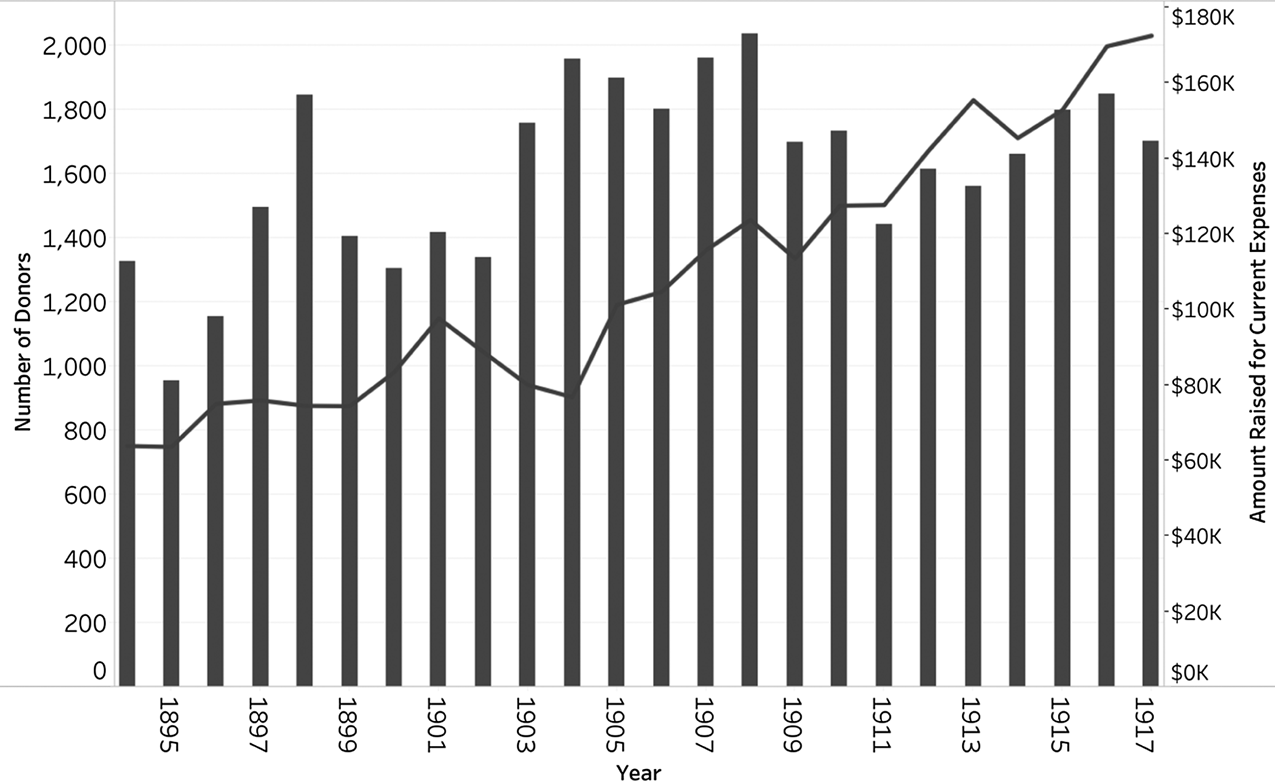
When Frissell became principal, Hampton raised approximately $80,000 annually from philanthropic sources. That figure rose to $92,000 in 1900, and $143,000 in 1917, the year of his death. The largest donations were typically from the Slater Fund or, after 1902, the GEB, but Hampton typically raised another $100,000 on top of that from scores of small donations, mostly under $100 (see Figure 2 above).Footnote 66 Despite the perception of wealth, Hampton needed these donors to meet its expenses.
The amount Hampton raised (bars) and the number of donors (line) for each year of Frissell's principalship. While the amounts peaked between 1903 and 1908, the number of donors rose by 171 percent by 1917.

Hampton had a diversified income stream, with philanthropy just one component; appropriations from state and federal sources plus interest on the endowment were the main components. In 1899, for instance, income totaled just under $160,000: the state of Virginia appropriation totaled about $18,000, federal appropriation (for the Native American students) was around $20,000, endowment interest was $33,000, another $4,800 was miscellaneous income, and the remainder, just over $82,000, was from philanthropy. Total expenses for the year were around $175,000; Hampton finished 1899 in the red. Donations of all amounts, therefore, were vital not just to Hampton's success but its very existence. With the average gift around $100, small-dollar donors meant a lot to Hampton. It is worth noting that $100 was worth much more than it is today; most American workers earned less than $500 annually.Footnote 67 For comparison's sake, one of the most expensive men's suits in the 1897 Sears, Roebuck catalog, the fashionable black Prince Albert suit, tailor-made “with 19 oz. imported all wool black English clay worsted . . . lined throughout with fine imported black Italian cloth” cost $20.Footnote 68 A Windsor organ, with a “Solid Black Walnut Case” bought from rival Montgomery Ward, cost $60.Footnote 69 Donors making gifts in this range, needless to say, had disposable income.
Hampton's fundraising efforts were primarily for current expenses, not for its endowment, but the growth of the school's endowment was an extension of its methods. The endowment's increase was almost exclusively a result of bequests. Whenever Hampton was named the beneficiary of an estate, the realized funds went into Hampton's endowment fund, meaning that the funds could not be used for current expenses. This was a decision the trustees made shortly after Armstrong's death, a policy that Frissell occasionally lamented; these unexpected and often sizable gifts would be useful in covering deficits. However, because bequests are, by their nature, unpredictable in both timing and amount, the trustees dictated that they go into the permanent fund.
Scholars have often remarked on Hampton's sizable endowment compared to other Black schools, attributing its growth to industrial philanthropists and especially to northern foundations like the GEB.Footnote 70 Indeed, Hampton's endowment grew markedly during Frissell's tenure; when Armstrong died the endowment valued approximately $370,000. By Frissell's death in 1917, the endowment exceeded $3 million. It must be noted, however, that this growth was not the result of sizable donations from foundations or other prominent philanthropists. In fact, the annual donations from the Slater Fund, the Peabody Fund, and the GEB were designated for current use, not endowment.
Hampton's endowment growth was largely due to estate gifts. Between 1894 and 1917, Hampton added over $2.5 million to its endowment from donations, three-quarters of which ($1.9 million) came from estates. The average bequest was just over $7,600, ranging in amount from $2 (from a Miss W. Harriet in 1906) to $308,000 (from the estate of Alice Byington in 1910).Footnote 71 While the annual report always mentioned the need for a larger endowment, the Hampton's fundraising emphasis was on current expenses. Hampton's board treasurer, George Foster Peabody, remarked in 1906 that permanent “endowment funds . . . help you so little now” and that current leaders “are not in a position to guarantee what the needs of the work you have in hand may be one hundred years from now much less a thousand years from now.”Footnote 72 Peabody wrote to Frissell that “I am, as you know, not sympathetic with endowments in general, but have always admitted that Hampton was an exception.”Footnote 73 In 1925, Hampton would conduct a joint endowment campaign with Tuskegee, but until then only once did the school actively solicit endowment funds, in 1899–1900, resulting in approximately $160,000.Footnote 74 Bequests came in from longtime friends as well as strangers. Benjamin R. Sheldon, an Illinois judge, left $100,000 to Hampton when he died in 1897. “We cannot at this writing give you the cause which induced him to make this bequest,” his estate's executors wrote to Hampton when alerting them of this gift.Footnote 75 For Hampton, serendipitous gifts like these reinforced their patient approach, forgoing short-term gains in the hopes of bigger payoffs later.
Hampton was able to capitalize on the new “scientific giving” taking prominence in the late nineteenth century. Philanthropists now wanted to see the results of their giving. In attracting and retaining donors, Hampton's emphasis on raising money for scholarships and connecting the student beneficiaries with the donors was a real draw, tangible “proof” of the effects of the beneficence. Hampton received about 350 to 400 donations for annual scholarships every year, raising over $30,000. While many gave precisely $70, the cost of sponsoring one student for an academic scholarship, gifts of any amount were welcome; donations as small as $1 and as much as $1,190 were contributed for annual scholarships. Alternatively, donors could sponsor an industrial scholarship for $30; these were less popular, with around fifty such gifts designated annually, totaling around $2,500. Two other regular designation choices, for the Indian Fund or the Beneficiary Fund, were less popular still, with around a dozen of each given each year.
Every scholarship donor received a letter from a student, intending to deepen the connection between the donor and Hampton. Newspaper editor R. R. Bowker received a seven-page handwritten letter in 1898 from his student, who updated his patron on life at Hampton and was “expressing to you my thoughts on what you are doing for the negro race and personally what I have gained, by being so fortunate.”Footnote 76 Institutional scholarship donors received letters from scholarship recipients too. The Sunday School of Plymouth Church (Henry Ward Beecher's former church in Brooklyn) gave a $70 scholarship annually. In October 1896, its student wrote the church, dutifully thanking the members and updating them on progress with his trade and on-campus activity. Ending on a light note, he said that he could be with them, “but I am sure you would enjoy it even as much if you were down here, because we are having so much nicer weather down here than you are having up there.”Footnote 77 For Northerners who probably had little intimate contact with African Americans, these letters gave the donors a personal connection to Hampton, reinforcing their decision to give.
Frissell was a diligent correspondent, and surviving letters between him and Hampton supporters show how he carefully cultivated relationships, making them feel like part of an extended family rather than just a source of donations. He was able to maintain relationships that Armstrong had developed, such as with Sarah Slocum, but he also recognized that he needed a younger generation of supporters too. Ethel Paine was twenty-eight in 1900 when she made her first gift to Hampton. Part of a prominent Boston family descended from a Declaration of Independence signatory, her parents also supported Hampton. Paine and Frissell exchanged several letters a year, and while only her letters exist, they show that Paine regarded Frissell with daughterly affection, greatly appreciated his correspondence, and looked forward to his visits to Boston. Her letters, frequently running five to six pages long, updated the principal on the activities of the Boston Ladies’ Hampton Committee, of which she was a part, and her efforts to connect Frissell to other influential people. The letters had a familiar tone, and Paine wrote about friends and family, religious matters, and other more mundane topics. Paine clearly felt a deep attachment to Frissell and Hampton; she gave annually to Hampton, donating a total of $3,650 during Frissell's tenure.Footnote 78
Women typically represented 60 percent of the individual donor base.Footnote 79 Although their total giving was, unsurprisingly, two-thirds of men's gifts, women played an essential role beyond their monetary contributions, as their volunteer services were vital to attracting others to the Hampton cause. Women have long been recognized for their involvement in charitable activities. Historian Kathleen McCarthy notes that while women's contributions to philanthropy have often been minimized, they have traditionally used their voluntary “activities to wield power in societies intent upon rendering them powerless” and that “women most often turned to nonprofit institutions and reform associations as their primary points of access to public roles.” In doing so, they created “parallel power structures” that produced an “array of opportunities for their sisters and themselves.”Footnote 80 Andrea Walton notes the absence of women in the literature about philanthropy for education, and “except for the stories of female luminaries . . . our knowledge of women's philanthropic action in education remains relatively limited.” She argues that this absence is “because narrow conceptions of both philanthropy and education have dominated scholarship on philanthropic action in education.”Footnote 81 Marybeth Gasman notes the importance of wealthy White women in the formative years of the United Negro College Fund (UNCF) in the 1940s and 1950s, writing “not only were they the true ‘workers’ of the organization, but they also had the closest connections to the wealthy businessmen who would be its financial mainstay.” Not only did they use their “privileged position” to attract attendees to their luncheons and meetings, but their social status lent the UNCF an air of credibility, even desirability, among other White social elites.Footnote 82 In raising money and visibility for Hampton, women played a role not unlike the next generation would play with the UNCF through locally organized committees, called Armstrong Associations. In 1893, after Armstrong became incapacitated, a group of women in Boston formed the Boston Ladies’ Hampton Committee, which aimed to create awareness and raise funds in Boston, relieving the ailing principal of the task. Similar organizations would soon be organized in New York, Philadelphia, Brooklyn, and other smaller towns around the North. With the exception of New York's Armstrong Association, all of these groups had women in leading roles.
The Most Exciting Thing I Ever Saw: Hampton Visitors
Whenever possible, Hampton welcomed its northern friends to campus so they could see the work of Hampton for themselves. Starting around 1870, Ogden chartered annual train trips to Hampton for graduation ceremonies, but beginning in 1901 these trips took on a broader significance, as part of Ogden's leadership, in the movement to expand common school education throughout the South for Whites and Blacks alike. Ogden covered the trip expenses for visitors so they could see the progress in the South for themselves.Footnote 83 Hampton, of course, was central to this trip, and it was timed to coincide with Hampton's anniversary exercises and with the annual Conference for Education in the South. Although sometimes derisively known as the “Millionaire's Special,” Ogden invited a mixture of wealthy Northerners, educational leaders, politicians, and journalists to ride a train south in order to drum up support for the southern educational crusade as well as for Hampton.Footnote 84
These trips proved to be incredibly successful in convincing people of the need for education reform in the South. His most notable convert was John D. Rockefeller Jr., son of the Standard Oil titan, who accompanied Ogden in 1901 on the ten-day trip through the South. Rockefeller was so moved by the experience that he convinced his father to create and fund the GEB, which would have an enormous influence on southern education in the years to come.Footnote 85 Oswald Garrison Villard, a grandson of abolitionist William Lloyd Garrison and later a founder of the NAACP, received his first exposure to the plight of Southern African Americans through his 1902 trip, later calling it “the most important—and most educational—event in my life.”Footnote 86 Another guest echoed the sentiment, telling Ogden, “One of the best pieces of educational work you do is educate your guests in the knowledge of the aims and progress” of the southern education movement.Footnote 87
The annual affair became a highly anticipated event for many Northerners. The son of one frequent Ogden train guest recollected years later than when he “was a boy in New York, the big events of life were the parties; Christmas party, Easter-egg party, birthday party, and every spring the Ogden party.” While he was too young to attend, his parents did, and “it must have been quite a party, I used to think, because they would be gone from home for two weeks.”Footnote 88
These visits were carefully choreographed for maximum effect. A typical itinerary would include demonstrations of agricultural and domestic work, a play or dramatic reading, student speeches, and a concert of slave spirituals. These personal visits provided guests with a glimpse of Hampton that far surpassed the best visual aids. One attendee wrote that “Hampton and the work it represents now has a vividness in my mind which it never possessed before,” while another remarked that she was “inspired with new zeal to help along, with what influence we have.”Footnote 89 Yet another wrote to her mother from Hampton during the 1903 trip that the event “was the very most exciting thing I ever saw or heard . . . I can't think of a greater privilege than to be allowed to teach there.”Footnote 90 While she never did go south to teach, she did become a lifelong donor and volunteer. While a relatively privileged few were able to attend these excursions, the hope was that they would inspire the attendees to become advocates for Hampton in their own communities, and thus to widen Hampton's reach and influence even further.
The Role of African Americans in Hampton's Success
Hampton did not systematically seek donations from its alumni as it did from its White friends. Many other educational institutions targeted alumni for donations, but because Hampton's students became teachers and tradespeople, Hampton was unlikely to graduate many alumni who would become affluent. Hampton's alumni association periodically took up collections to send to Hampton, including an impressive $1,500 gift in 1902 to endow a scholarship in memory of General Armstrong.Footnote 91 It's uncertain who contributed to the fund or how long it took to raise the funds, but that it came nine years after the late principal's death indicates the time and effort likely required to raise such a sum from the school's alumni. On the whole, however, giving back in the form of a donation to their alma mater was not what Hampton expected of its alumni; instead “giving back” meant returning to their communities and through their example serving as “object lessons.” As Frissell told the alumni association in 1893, “It is well to teach and preach, but most of all Hampton graduates should show the people how to live. Then you can help Hampton by sending us good material for the shops, to learn trades and so become useful.”Footnote 92 Giving back also meant contributing toward the building of local schools in their own communities and funding longer school terms when the local governments would not cover those expenses. As Frissell was no doubt aware, local Blacks were already contributing through their taxes, and thus additional contributions represented a kind of double taxation; the unfairness of this went unremarked.Footnote 93
Some former students did give to their alma mater when they could. One such grateful student was Mary Bosley Truxon, who attended Hampton for two years in the late 1880s and who donated fifty cents in 1914. The Southern Workman that year printed her letter, which reported that she lived
on a farm of 57 acres which we are struggling hard to pay for and call it our home. I have seven children living; the eldest one is nineteen; how I wish I could send him to Hampton. I hope to send some of my children there soon. . . . I know that it is better children and purer homes that are needed by my people, not homes free from grease and dust only, but free from filthy habits and thoughtless, wicked speech.Footnote 94
It was six years before she gave again, when she donated one dollar. Grateful as Truxon may have been to Hampton, sparing even fifty cents represented a sacrifice, a situation that was likely typical of Hampton alumni.
Of course, not all African Americans were destitute. Anna Maria Fisher was born a slave to Henry Clay; she and her husband escaped from slavery and ended up in Brooklyn, where they went into business. When she died at age ninety-three in 1911, she had an estate valued at $65,000. Her largest bequests, $10,000 each, went to the Hampton and Tuskegee Institutes, though she was not a graduate of either.Footnote 95 According to a later New York Age article, she gave because they “were doing so much for the uplift of the race that they were deserving of her support.”Footnote 96 Fisher's gift was Hampton's “only legacy and by far the largest amount, ever received from a Negro.”Footnote 97 She had apparently not been a donor to Hampton before her death, and she probably never visited the school, but hearing Frissell or Washington speak at one of the many public gatherings in Manhattan and Brooklyn over the years evidently made an impression on her.Footnote 98 Stories like Fisher's speak to the reason Frissell spent so much time campaigning. Even if the short-term returns were not always great, the long-term potential made it worthwhile.
Even as they were absent from the donor rolls, Hampton's students and alumni (Blacks and Native Americans alike) were still crucial to the school's fundraising success. As students, they accompanied Frissell on the northern campaigns as singers, wrote thank-you notes to their White benefactors, and put on a good show for Whites when they visited campus. As alumni, they were called upon to bear witness to the success of Hampton's methods. Outstanding alumni were featured in Hampton's publications and appeals and spoke at their public meetings. Booker T. Washington, as the school's most notable graduate, rarely passed up an opportunity to speak on Hampton's behalf, despite the burden of fundraising for Tuskegee. In 1907, Washington was scheduled to speak at a function in Brooklyn but had to back out at the last minute. In his place, Thomas C. Walker, class of 1883, spoke. Walker, a Virginia lawyer, might seem a curious choice for a school known for its vocational curriculum. Yet he came by his occupation honestly; he had been both a farmer and a teacher. Having thus tilled the land and taught its children, Walker was one of the people, not above them. In his speech, he attributed his success to Hampton and attributed to Hampton the improvement of race relations. “Increase your faith in the possibilities of the negro race, and in the wisdom of Dr. Frissell,” he told his audience.Footnote 99
Washington and Walker were just two of numerous Hampton alumni who promoted the school. It is easy to see African Americans as tokenized in this way, compelled by the unequal power structures to participate in a show that shed light only on the aspects of Black life that Hampton deemed appropriate. No doubt there is some truth in that. While students may have felt obligated to participate, alumni were under no such pressure, and without their willing participation, Hampton's fundraising success would not have been possible. To be sure, the words alumni spoke were couched in a way to reify the Hampton philosophy rather than challenge the prevailing order; yet their presence in front of White audiences, who evidenced their articulateness and their success, challenged the audience's biases and preconceived notions. The graduates forced the audience to see them not as the objects of charity but as men and women worthy of dignity. School officials may have used them as evidence of the Hampton method's success, but the men and women who participated used those opportunities to promote the humanity of their race.
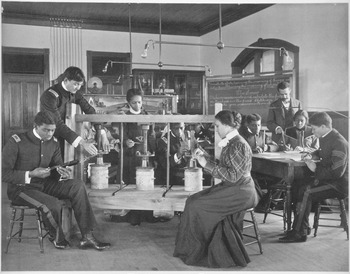
The Cheese Press Screw—Students Studying Agricultural Sciences, Hampton Institute, Hampton, Virginia, 1899 or 1900. Frances Benjamin Johnston Collection, Library of Congress Prints and Photographs Division, Washington, D.C. Accessed Oct. 16, 2020. http://hdl.loc.gov/loc.pnp/ppmsc.04892.

Hampton's apparent failure to market to its ex-students, however, represented a missed opportunity. While the school kept track of the alumni in much the way a college today might, the motivation for this was more about compiling this information for the purposes of providing “proof” of Hampton's achievements than it was about cultivating good feelings for alma mater. While they may not have seen their ex-students as lucrative a target as White Northerners, Hampton did have, by its own accounting, over seven hundred former students who were either “in business and clerical work” or “in the professions” by 1907.Footnote 100 Hampton did not see their contribution to a growing Black middle class as a source of philanthropy.Footnote 101 In fact, Hampton did not seek funds from its alumni in any organized fashion until well into the 1960s.
Conclusion: A Firm Foundation
Individuals as different as former slave Anna Maria Fisher and former jurist Benjamin R. Sheldon were just two examples of people that Hampton's outreach managed to influence, even if Frissell was not aware of it. “The amount which Hampton and Tuskegee spend in this sort of [fundraising] work is often criticized, as though the object of these campaigns was simply the raising of money,” Frissell wrote in 1902. Hampton was simply carrying on the work of Armstrong, who “felt that his Northern campaigns were as distinctly educational as his work at the school, and that the apathy and ignorance of the white race formed one of the strongest obstacles in the way of the progress of the Indian and the Negro.”Footnote 102
In Frissell's first decade as principal, he made tremendous progress in stabilizing Hampton's finances through systematic, organized fundraising. Recognizing that Armstrong had laid a strong foundation and developed a compelling philosophy that could convince Northerners to become loyal Hampton donors, he saw no reason to deviate from that foundation or philosophy. What Hampton needed was to professionalize how it raised money. The northern campaigns, a staple of the Armstrong era, continued, but they were supplemented with a rigorous marketing campaign that included pamphlets and circulars, newspaper articles, an enhanced Southern Workman, and personal letters from the principal. In modern-day parlance, he understood the value of “branding,” and he worked hard to get that brand into as many towns and households as he could. Frissell worked tirelessly, not just to attract new donors but to keep them. Much of what he did would be best practices in any modern fundraising manual. He made sure to thank each and every donor. He wrote detailed accounts of Hampton, its finances, and its accomplishments so that donors knew how their money was being used. For scholarship donors, he had students write letters to the donor to thank them. When visitors came to Hampton's campus, he made sure that personal representatives greeted them and gave them personal tours. In 1917, when Frissell died in office, he left the new principal, James E. Gregg, a school on far more stable footing than a quarter-century earlier. Gregg still had a significant and vital role to play in fundraising, and he attached as much import to the task as his predecessors, but he had inherited an organizational model in place to keep the fundraising machine running.
Instead of relying exclusively on foundation money, Hampton worked tirelessly to attract thousands of northern White supporters to its cause. Some of those supporters, like Ogden, were earnest, true believers in the Hampton philosophy and strove to spread the message to others. Many others, however, were more passive in their support, donating modest sums of money and a few hours of their time to attend a meeting once or twice a year. Whatever their motivation, they gave Hampton the relative freedom to plot its own course and stay true to its mission, to the frustration of those who saw the Hampton-Tuskegee model as detrimental to African American efforts toward equality. Hampton built an impressive and scalable infrastructure for marketing and fundraising that enabled its message to become widespread. Under Frissell, fundraising was an integral part of the machine, and the fruits of the labors of Frissell, Ogden, and other Hampton administrators and volunteers allowed Hampton to thrive.