INTRODUCTION
Traumatic brain injury (TBI) affects more than 400,000 children per year in the United States (Langlois, Rutland-Brown, & Thomas, Reference Langlois, Rutland-Brown and Thomas2006). It can result in a variety of cognitive deficits, particularly with prolonged time (e.g., >30 min) to follow commands or when there are large or diffuse intracranial lesions on neuroimaging (Catroppa, Anderson, Beauchamp, & Yeates, Reference Catroppa, Anderson, Beauchamp and Yeates2016; Roebuck-Spencer, Désiré, & Beauchamp, Reference Roebuck-Spencer, Désiré and Beauchamp2018). This study focused on the degree to which cognitive outcomes after pediatric TBI are moderated by cognitive reserve.
Cognitive reserve is a concept that reflects the fact that the clinical manifestation of an acquired injury to the brain is moderated at least in part by premorbid factors (Satz, Reference Satz1993; Stern, Reference Stern2002). Some of these factors are passive, such as the integrity of the brain before the TBI. For example, a child with prior history of hydrocephalus would likely have already diminished ability to absorb an additional injury to the brain. Some other premorbid factors are more active or fluid, such as the degree of cognitive enrichment that the child received before the TBI (e.g., parents reading to them). Pediatric TBI may result not only in reduction of brain capacity but also in compromised cognitive capacity, which can subsequently impede future development (Dennis, Yeates, Taylor, & Fletcher, Reference Dennis, Yeates, Taylor and Fletcher2006; Ris & Hiscock, Reference Ris and Hiscock2013).
Most studies of cognitive reserve have been completed with adults, often relying on educational attainment and/or tests of overlearned language-based skills. Several of these studies have reported that lower cognitive reserve is associated with worse outcomes after TBI, such as more prolonged subjective symptoms after uncomplicated mild injuries (Oldenburg, Lundin, Edman, Nygren-deBoussard, & Bartfai, Reference Oldenburg, Lundin, Edman, Nygren-deBoussard and Bartfai2016) and reduced likelihood of disability-free recovery after moderate–severe injuries (Schneider et al., Reference Schneider, Sur, Raymont, Duckworth, Kowalski, Effron and Stevens2014). Greater cognitive reserve (as measured by a combination of word recognition test performance in concert with demographic variables) has a significant protective effect with regard to the impact of TBI on cognitive test performance during the first year after injury in adults with a broad range of injury severity but does not negate the influence of prolonged time to follow commands or intracranial lesions (Donders & Stout, Reference Donders and Stout2019). Others have documented that cognitive reserve, as indexed by estimates ranging from pre-injury educational or vocational attainment to prior leisure activities, can moderate not only cognitive but also psychosocial outcomes for several years after moderate–severe TBI in adults (Leary et al., Reference Leary, Kim, Bradley, Hussain, Sacco, Bernad and Chan2018; Mathias & Wheaton, Reference Mathias and Wheaton2015; Rassovsky et al., Reference Rassovsky, Levi, Agranov, Sela-Kaufman, Sverdlik and Vakil2015). There have been only a few studies that have specifically looked at cognitive reserve in pediatric TBI.
Farmer and colleagues (Reference Farmer, Kanne, Haut, Williams, Johnstone and Kirk2002) reported that children with TBI who had premorbid learning problems did worse on tests of memory than children with TBI without such prior problems, which the authors attributed to reduced cognitive reserve in the former group. In another study that was limited to children with mild TBI, Fay and colleagues (Reference Fay, Yeates, Taylor, Bangert, Dietrich, Nuss and Wright2010) reported that ratings of post-concussive symptoms were moderated in part by cognitive reserve.
Measuring cognitive reserve in children is not as straightforward as in adults, where reliance on tests of reading of irregular words is reasonable because such a skill is fairly crystallized and robust to the influence of acquired brain injury (Green et al., Reference Green, Melo, Christensen, Ngo, Monette and Bradbury2008). In children, though, such skills are still under development. In fact, Fuentes, McKay, and Hay (Reference Fuentes, McKay and Hay2010) have suggested that reliance on word recognition measures for measuring cognitive reserve may not be valid in children with TBI. In addition, the methods used by Fay and colleagues (Reference Fay, Yeates, Taylor, Bangert, Dietrich, Nuss and Wright2010), who relied on post-injury cognitive test performance as a proxy for cognitive reserve, would likely be problematic with children with moderate to severe TBI because they included tests that are actually known to be sensitive to severity of TBI.
A more viable alternative could be to rely on parental education as a proxy for cognitive reserve in children with TBI. There is precedent for that in research with other conditions, such as acute lymphoblastic leukemia. For example, Kesler, Tanaka, and Koovakkattu (Reference Kesler, Tanaka and Koovakkattu2010) reported that parental education was a significant predictor of cerebral white matter volume in this population. In addition, parental education has been shown to be one of the predictors of 1-year outcomes after uncomplicated mild TBI in children (Babikian, McArthur, & Asarnow, Reference Babikian, McArthur and Asarnow2013). Whether this advantage also applies to cognitive test performance of children with a broader range of TBI severity has not yet been widely investigated.
The first hypothesis for this investigation was that cognitive reserve, as measured by parental education, would be a statistically significant moderator of children’s overall performance on Wechsler Intelligence Scale for Children—Fifth Edition (WISC–V; Wechsler, Reference Wechsler2014). Specifically, lower levels of parental education should be associated with lower Full Scale IQ and/or factor index scores, and this effect should be greater in children with TBI than in demographically matched controls. Such an interaction effect would support the concept of cognitive reserve as a protective factor in children with TBI.
The second hypothesis was that injury severity, as indexed by duration of time to follow commands and neuroimaging findings, would explain additional variance in performance on the WISC–V Processing Speed index, even after accounting for cognitive reserve, in the TBI group. The latter hypothesis was based on prior research with the predecessor of the WISC–V that had shown selective sensitivity of that index to severity of TBI in children (Allen, Thaler, Donohue, & Mayfield, Reference Allen, Thaler, Donohue and Mayfield2010; Donders & Janke, Reference Donders and Janke2008).
METHODS
Participants
This study included two groups of participants. One was a clinical group of pediatric patients with TBI. The other was a demographically matched control group, selected with permission from the publisher from the standardization sample of the WISC–V. Data on 60 clinical participants were retrieved from the electronic archives on referred pediatric patients with TBI who were evaluated between January 2015 and December 2017. We then matched 60 control participants to these clinical patients on age, sex, ethnicity, and parental level of education.
Selection criteria for the clinical participants were as follows: (1) ≥6 years and ≤16 years old, (2) diagnosis of TBI, defined as an acute external blow to the head with alteration of consciousness, and (3) neuropsychological assessment with inclusion of the WISC–V completed within 30 to 360 days post-injury. The WISC–V had been routinely included in outpatient neuropsychological evaluations of children with TBI during this time frame, as part of established clinical standards of care. The only exceptions were if the child had limitations that would make results of this instrument invalid (e.g., orthopedic injury to the dominant hand, not fluent in English). Data from 2 of originally 62 children who met the above inclusion criteria but who did not pass a formal performance validity test (Tombaugh, Reference Tombaugh1996) were excluded from this investigation.
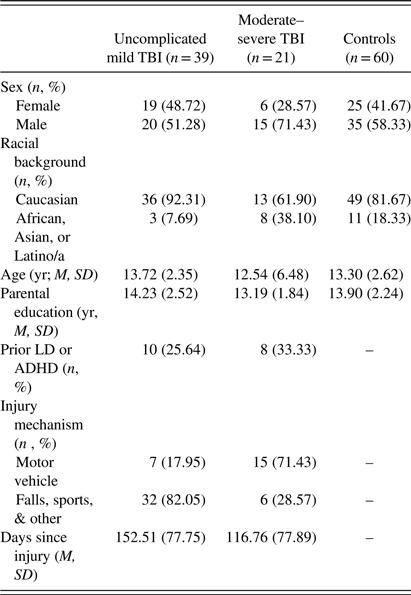
Only results from initial evaluations were considered for clinical participants who received multiple assessments. Premorbid histories were obtained through a combination of review of academic and medical records, and semi-structured interviews with parents or guardians. Parental education was based on that of the highest of both parents, which was the mother’s in the vast majority of cases (i.e., equal to or greater than father’s in 85%). Duration of time to follow commands following injury (otherwise known as coma) and findings from neuroimaging were ascertained from review of acute care medical records. Children with significant premorbid neurological (e.g., cerebral palsy), developmental (e.g., autism), or psychiatric (e.g., bipolar) disorders, as documented by appropriate health care professionals, were excluded from the sample. Table 1 presents characteristics of the final clinical sample.
Characteristics of children with TBI and control participants

Note. TBI=traumatic brain injury; LD=learning disability; ADHD=attention-deficit/hyperactivity disorder. Control group selected from the standardization sample from the Wechsler Intelligence Scale for Children—Fifth Edition (WISC–V). © 2014 Pearson. Used with permission. All rights reserved.
For purposes of the statistical analyses, two variables were dichotomized. First, in light of the fact that the distribution of time to follow verbal commands was leptokurtic and positively skewed (M=0.66; SD=1.66; Mdn=0; range 0–8), injury severity was defined on the basis of the absence or presence of any acute intracranial neuroimaging findings. The group with greater injury severity (n=21; 35%) included all children who had “positive” acute neuroimaging findings (i.e., neuroradiological evidence of a new intracranial lesion; typically established within the first 24–72 hr after injury). This group also included all 11 children who had duration of time to follow verbal commands ≥24 hr. All children in the group with lesser injury severity (n=39; 65%) had uncomplicated mild TBI (i.e., time to follow commands <30 min and no intracranial lesions on neuroimaging).
The second dichotomization pertained to parental level of education. Both the clinical group and the control group were split into high and low parental education subgroups. Children in the “low” subgroups (n=29 for the clinical participants; n=27 for the control participants) had parental education ≤12 years. Children in the “high” subgroups (n=31 for the clinical participants; n=33 for the control participants) had parents who all had ≥13 years of education.
Procedure
Neuropsychological evaluations of clinical participants were completed on an outpatient basis when they were medically stable and could recall meaningful information from day to day. All evaluations were carried out with informed parental consent and child assent by Master’s trained psychometrists or postdoctoral residents under the supervision of a board-certified clinical neuropsychologist. This research was conducted with approval from the Institutional Review Board at Mary Free Bed Rehabilitation Hospital, and in compliance with the Helsinki Declaration.
Measurements
The WISC–V is a comprehensive instrument for assessing the intelligence of children between the ages 6–16 years. It provides measures of cognition in 5 domains, including Verbal Comprehension, Visual Spatial, Fluid Reasoning, Working Memory and Processing Speed; as well as a composite Full Scale IQ that reflects global functioning across cognitive domains. All these scores are expressed as standard scores (M=100; SD=15), with higher scores reflecting better performance.
Statistical Analysis
Differences between TBI subgroups were evaluated with t tests for continuous variables and with χ2 tests for discrete variables. Predictors of WISC–V factor index scores in the TBI group were explored through linear regression analysis, including parental education as a proxy for premorbid cognitive reserve and injury severity (i.e., uncomplicated mild vs. moderate–severe) as independent variables. The resulting participant to variable ratio of 30:1 was acceptable by conventional standards. Variance inflation factors were inspected for possible collinearity, with values<3 considered desirable. The amount of variance explained by the composite models was reflected in the adjusted R 2 index, for which values<0.10 were considered small, values 0.10 – 0.25 as medium, and values >0.25 as large (Murphy & Myors, Reference Murphy and Myors2004).
RESULTS
The TBI subgroups with higher (n=31) versus lower (n=29) levels of parental education did not differ from each other in injury severity, time since injury or proportions of children with learning disability or ADHD (p>.30 for all variables). Similarly, the participants with uncomplicated mild TBI (n=39) did not differ from the group with moderate–severe TBI (n=21) in time since injury or proportions of children with learning disability or ADHD (p>.10 for all variables).
Figure 1 presents the WISC–V Full Scale IQ scores of the clinical and control groups, stratified by high (≥13 years) and low (≤12 years) levels of parental education. These data indicated that there was an interaction between group status (clinical vs. control) and cognitive reserve, as indexed by high versus low parental level of education. The difference between the clinical and control groups in average Full Scale IQ score was clearly more pronounced in those with low parental education (M diff=9.38) as compared to those with high parental education (M diff=5.28). This interaction was statistically significant, F(2,117)=5.01, p<.008, η 2=0.08.
Full Scale IQ for clinical and control participants, by high (≥13 years) and low (≤12 years) levels of parental education. Note: Error bars reflect standard error of the mean. Control group selected from the standardization sample from the Wechsler Intelligence Scale for Children—Fifth Edition (WISC–V). © 2014 Pearson. Used with permission. All rights reserved.

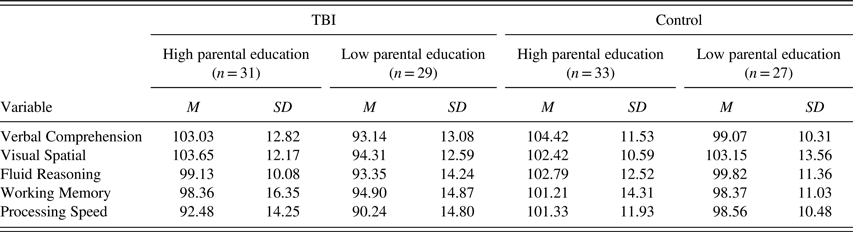
Table 2 contains the performance of the clinical and control groups, stratified by parental level of education, for all of the factor index scores. With consideration of the Benjamini-Hochberg correction for multiple comparisons, the interaction effect between group status and cognitive reserve was statistically significant for Verbal Comprehension, F(2,117)=6.56, p<.002, η 2=0.10, and for Visual Spatial, F(2,117)=4.42, p<.02, η 2=0.07, but not for the other three indices.
WISC–V factor index scores for clinical and control groups, by level of parental education

Note. TBI=traumatic brain injury. Control group selected from the standardization sample from the Wechsler Intelligence Scale for Children—Fifth Edition (WISC–V). © 2014 Pearson. Used with permission. All rights reserved.
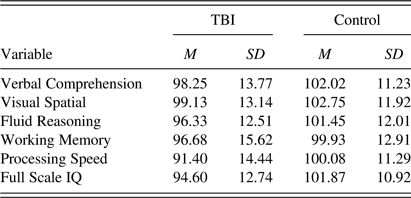
Table 3 presents the WISC–V mean results of the complete clinical and control groups. Because there were good theoretical reasons to expect that not all factor index scores would be equally sensitive to the effect of TBI, an overall multivariate analysis of variance to compare these two groups was not appropriate. Instead, we completed separate analyses of variance for each of the five factor index scores. To balance the relative risk of Type I and Type II errors, we again used the Benjamini-Hochberg correction. This revealed that the only group difference that was statistically significant was on Processing Speed, F(1,118)=13.46, p<.002, η 2=0.10.
WISC–V factor index scores of children with TBI (n=60) and demographically matched controls (n=60)

Note. TBI=traumatic brain injury. Control group selected from the standardization sample from the Wechsler Intelligence Scale for Children—Fifth Edition (WISC–V). © 2014 Pearson. Used with permission. All rights reserved.
Table 4 presents the regression models for each of the factor index scores in the TBI group. All variance inflation indices were below 1.05, suggesting no problems with collinearity.
Regression models for WISC–V factor index scores in the TBI group (n=60)

Note: TBI=traumatic brain injury; VC=Verbal Comprehension; VS=Visual Spatial; FR=Fluid Reasoning; WM=Working Memory; PS=Processing Speed; SRC=standardized regression coefficient.
The model for Verbal Comprehension was statistically significant, F(2,57)=6.62, p<.003, and explained a medium amount of variance (R 2=0.19). Higher levels of parental education were associated with better performance on this index. Injury severity did not contribute statistically significantly to the model.
The model for Visual Spatial was also statistically significant, F(2,57)=8.25, p<.0007, and explained a medium amount of variance (R 2=0.23). Higher levels of parental education were again associated with better performance on this index. In contrast, greater injury severity was associated with worse performance on this index.
Higher levels of parental education were also associated with better performance on Fluid Reasoning, with the composite model being statistically significant, F(2,27)=3.62, p<.04, and explaining a medium amount of variance (R 2=0.11). There was not a statistically contribution of injury severity to this model.
The model for Working Memory was not statistically significant, F(2,57)=2.23, p<.12, and explained only a small amount of the variance (R 2=0.07). None of the individual variables contributed statistically significantly to this model.
Finally, the model for Processing speed was statistically significant, F(2,57)=3.85, p<.03, and explained a medium amount of variance (R 2=0.12). Greater injury severity was associated with worse results on this index. Parental education did not contribute statistically significantly to this model.
DISCUSSION
The purpose of this investigation was to determine the impact of cognitive reserve on children’s performance on the WISC–V after TBI. Hypothesis 1 was confirmed: TBI resulted in a much more pronounced decrement in Full Scale IQ as well as the Verbal Comprehension and Visual Spatial indices (as compared to demographically matched controls) in the context of lower levels of parental education. This indicated that cognitive reserve, as indexed by parental education, moderated some but not all of the cognitive outcomes of pediatric TBI. Furthermore, consistent with hypothesis 2, we found that greater injury severity (as reflected in acute intracranial lesions on neuroimaging) was predictive of lower Visual Spatial and Processing Speed scores, even after accounting for cognitive reserve. The sensitivity of especially the latter index to injury severity was consistent with prior research (Allen et al., Reference Allen, Thaler, Donohue and Mayfield2010; Donders & Janke, Reference Donders and Janke2008). However, it was noteworthy that parental education did not appear to have a buffering effect with regard to the impact of TBI on performance on this index.
Visual Spatial was the only index other than Processing Speed that was meaningfully associated with injury severity. This was likely due to the fact that several of the subtests contributing to the former index (Block Design, Visual Puzzles) have time limits and/or time bonuses. This reinforces the prominence of deficits in speed and efficiency of processing in the sequelae of pediatric TBI. Processing speed may in turn mediate other outcomes such as adaptive functioning (Shultz et al., Reference Shultz, Hoskinson, Keim, Dennis, Taylor, Bigler and Yeates2016) or learning new information (Donders & Nesbit-Greene, Reference Donders and Nesbit-Greene2004).
The influence of cognitive reserve likely reflects the impact of a combination of genetic and environmental advantages on children’s cognitive development (Tong, Baghurst, Vimpani, & McMichael, Reference Tong, Baghurst, Vimpani and McMichael2007). In this context, it is important to appreciate that parental education is generally strongly associated with other indices of environmental advantage, such greater access to educational and healthcare resources and less psychosocial stress. Thus, it is most likely indicative of the combined protective effect of all these factors, as opposed to scholastic achievement alone. Additional research will be needed to determine which of these subcomponents are relatively most influential in terms of moderating cognitive outcomes after pediatric TBI.
We must also acknowledge some limitations of this investigation. We used a somewhat small and referred clinical sample of convenience and limited our time frame to 1–12 months post injury. Formal pre-injury IQ data were not available. We were also not able to include in our definition of cognitive reserve other variables that have been considered in the literature, such as premorbid brain volume (Kesler, Adams, Blasey, & Bigler, Reference Kesler, Adams, Blasey and Bigler2003). In this context, it is important to appreciate that we were limited to findings from CT scans in acute care, which were dichotomized to not violate participant-variable ratios in the statistical analyses.
The current findings do not rule out a potential role of specific location or volume of lesions in the prediction of outcomes. In addition, this investigation was limited to cognitive outcomes and did not address other areas of functioning such as social problem solving or community participation. Furthermore, we did not perform longitudinal follow-up, which is a goal for future research. Inclusion in such research of larger proportions of children with prior ADHD or learning disability would also be helpful because we did not have sufficient participants with such a history to ensure adequate power to detect unique associations with outcomes in our analyses.
With those reservations in mind, we conclude that cognitive reserve as indexed by parental education has a moderating effect with regard to some aspects of children’s cognitive functioning after TBI, especially word knowledge and visual perceptual and constructional skills. Even after accounting for cognitive reserve, however, severity of TBI still affects performance on WISC–V measures emphasizing speed and efficiency of processing that have previously been validated as being sensitive to TBI.
ACKNOWLEDGMENTS
There was no financial support for this work. The authors declare no conflicts of interest. They gratefully acknowledge the assistance from the publisher of the WISC–V for allowing us access to the standardization data. The control group for this study was selected from the standardization sample from the Wechsler Intelligence Scale for Children—Fifth Edition (WISC–V). © 2014 Pearson. Used with permission. All rights reserved.