Introduction
Biological invasions, including parasites as invaders, have occupied an important position in conservation biology due to their importance in the processes of species loss (Wilcove and Master, Reference Wilcove and Master2005; Taraschewski, Reference Taraschewski2006). The process of host switching of introduced parasites or pathogens from introduced hosts is known as parasite spillover (Grabner et al. Reference Grabner, Weigand, Leese, Winking, Hering, Tollrian and Sures2015; Morand et al. Reference Morand, Bordes, CHEN, Claude, Cosson, Galan, Czirjak, Greenwood, Latinne, Michaux and Ribas2015), and has been observed in helminths transmitted by rodents (Smith and Carpenter, Reference Smith and Carpenter2006; Romeo et al. Reference Romeo, Ferrari, Lanfranchi, Saino, Santicchia, Martinoli and Wauters2015; Loxton et al. Reference Loxton, Lawton, Stafford and Holland2017). The consequences of the spillover of parasites and pathogens have been studied not only in native hosts (Barrett et al. Reference Barrett, Carlisle and Prociv2002; Tompkins et al. Reference Tompkins, White and Boots2003), but in human populations as well (Bordes et al. Reference Bordes, Blasdell and Morand2015). Spillover can also occur in the opposite direction, from native to introduced host (Barton, Reference Barton1997). In this case, parasites can be amplified by introduced hosts and then transmitted back to native hosts, which is known as spillback (Kelly et al. Reference Kelly, Paterson, Townsend, Poulin and Tompkins2009; Mastitsky and Veres, Reference Mastitsky and Veres2010). Alternatively, native parasites may not replicate in introduced hosts, which is known as the dilution effect (Johnson and Thieltges, Reference Johnson and Thieltges2010). Thus, several studies have focused on the effect of introduced parasites and hosts on native parasites and hosts (Macneil et al. Reference Macneil, Fielding, Dick, Briffa, Prenter, Hatcher and Dunn2003; Taraschewski, Reference Taraschewski2006; Paterson et al. Reference Paterson, Townsend, Poulin and Tompkins2011; Young et al. Reference Young, Parker, Gilbert, Sofia Guerra and Nunn2017). However, few surveys have studied factors that favour host switching of parasites between native and introduced hosts (e.g. Landaeta-Aqueveque et al. Reference Landaeta-Aqueveque, Henríquez and Cattan2014). Regarding phylogenetic factors, although generalist native parasites have been found in introduced rodent species belonging to different families (Pisanu et al. Reference Pisanu, Lebailleux and Chapuis2009), some studies show that there is a decrease in the probability of transmission as an effect of increase in the taxonomic distance between hosts (Wells et al. Reference Wells, O'Hara, Morand, Lessard and Ribas2015; Young et al. Reference Young, Parker, Gilbert, Sofia Guerra and Nunn2017). However, these predictions have seldom been quantitatively studied. Therefore, in this paper, we hypothesize that introduced host species share a larger number of parasite species with native species to which they are more closely related.
Many ecological factors can also facilitate host switching of parasites between native and introduced hosts. In the context of parasitism, propagule pressure has been defined as the number of parasites that arrive with the introduced host to the new territory (MacLeod et al. Reference MacLeod, Paterson, Tompkins and Duncan2010). However, recognizing that spillover of parasites is a subsequent step in the invasion process, propagule pressure can also be understood as the parasite load in the source host population (Hatcher et al. Reference Hatcher, Dick and Dunn2012). However, the importance of this factor has not been studied. Thus, we hypothesize that the higher the prevalence and mean abundance of parasites in the source host population, the higher the probability of parasitic presence and the higher the abundance of parasites in the recipient host population.
In continental Chile, a region of a substantially isolated nature (see Landaeta-Aqueveque et al. Reference Landaeta-Aqueveque, Henríquez and Cattan2014), there is evidence of parasite transmission between native and introduced rodents (Landaeta-Aqueveque et al. Reference Landaeta-Aqueveque, Robles and Cattan2007a,Reference Landaeta-Aqueveque, Robles and Cattanb). Rodents in Central Chile belong to two suborders, Myomorpha, including the families Muridae (introduced species) and Cricetidae (native species), and Hystricomorpha (native species, hereafter non-cricetid) including the families Octodontidae and Abrocomidae (Muñoz-Pedreros, Reference Muñoz-Pedreros, Muñoz-Pedreros and Yáñez2009). We studied host switching of parasites between native and introduced rodents with two aims. The first was to compare the number of parasite species that introduced rodents (murids) shared with cricetid rodents to the number of parasite species that introduced rodents shared with non-cricetid rodents. Thus, we quantitatively analysed the importance of host relatedness. The second aim was to assess the association between the prevalence and mean abundance of parasites in source host populations and the presence and abundance of parasites in the recipient hosts. Thus, this is the first work to study the importance of these variables in the sharing of parasites between native and introduced mammal hosts.
Materials and methods
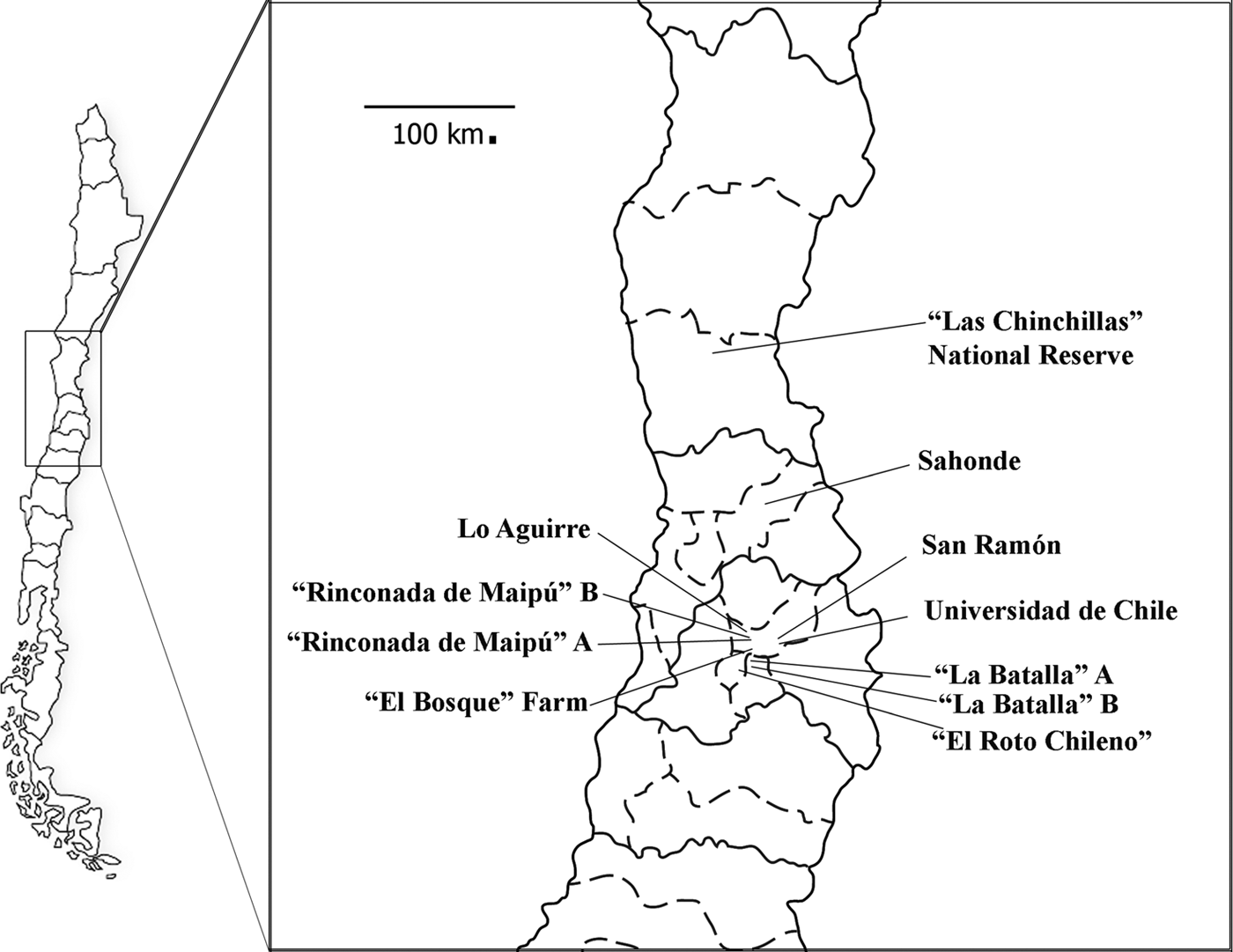
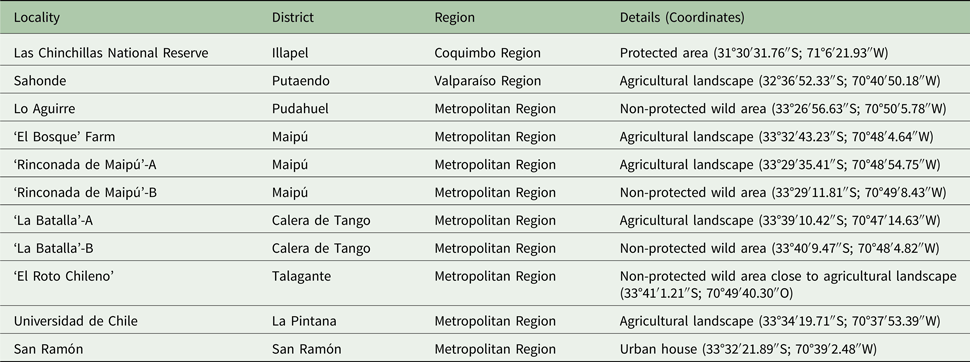
From 2002 to 2011, we sampled adult rodents in 11 localities in Chile, from 31°S to 33°S, including protected and non-protected wild areas, agricultural areas and an urban settlement, all at altitudes lower than 1100 m.a.s.l. (see details of trapping localities in Fig. 1 and Table 1). Rodents were caught with live traps and killed with an isoflurane overdose. Viscera and cavities were examined for the presence of helminths, which were examined under a light microscope. Nematodes were cleared with lactophenol or ethanol-glycerin, and cestodes were stained with carmine-HCl and were identified using Anderson et al. (Reference Anderson, Chabaud and Willmott2009) keys for nematodes and Khalil et al. (Reference Khalil, Jones and Bray1994) keys for cestodes, and published descriptions of helminths of rodents. The Comité de Ética of the Facultad de Ciencias Veterinarias y Pecuarias (Ethics Committee of the Faculty of Veterinary and Animal Sciences) at the Universidad de Chile approved and certified the study (certificate without number, 15 April 2011), and the Servicio Agrícola y Ganadero (Agricultural and Livestock Service) of Chile authorized trapping (resolution certificates 2041 and 6652 to C.L.-A.).
Map of Chile with localities where rodents were trapped. Details are given in Table 1.

Details of localities where rodents were trapped

Each set of host specimens obtained from the same locality and over a period of <31 days was considered a study unit (SU). The terminology used to describe parasitic assemblages (locality, prevalence, abundance, mean abundance) follows Bush et al. (Reference Bush, Lafferty, Lotz and Shostak1997); ‘presence’ as variable refers to the dichotomous ‘presence/absence’ variable.
Fisher's exact test was used to compare the proportion of species of parasites shared with murid (introduced) rodents between cricetid and non-cricetid native rodents. To avoid consideration of parasitic species that did not have the opportunity for host switching, we included only species of parasites found in SUs that harboured both native and introduced rodents.
Simple binomial negative regressions were performed to assess the association between the mean abundance and prevalence of a parasite species in a source host population with the abundance of this species in individuals of the recipient population in the same SU. Thus, the abundance of the parasite in the recipient host was considered to be the dependent variable, and the mean abundance and prevalence of this parasite in the source host population in the SU in which this recipient host was found were considered to be the independent variables. Similarly, we used logistic regression to assess the association between the prevalence and the mean abundance of a parasite species in the source host population with the presence of this species in individuals of the recipient population in the same SU. For simplicity, we will use the terms source and recipient population even when the sources or the recipients could be a community.
Finally, the associations of the next independent variables were assessed by means of simple logistic regressions: (i) ‘the number of localities in which a parasite species is present’, (ii) ‘the mean abundance of a parasite species in its source hosts among all of the SUs in which it was found’ and (iii) ‘the prevalence of a parasite species in its source hosts among all of the SUs in which it was found’, with ‘the odds of being or not being shared with a recipient host’ (the dependent variable). These mean abundances and prevalences were also compared between shared and not shared parasite species by means of Wilcoxon rank-sum (Mann–Whitney) test. In both cases, only parasites of myomorph rodents were considered in order to control for host relatedness. Stata/SE 11.1 software (StataCorp LP) was used to perform the statistical analyses.
Results
Overall results
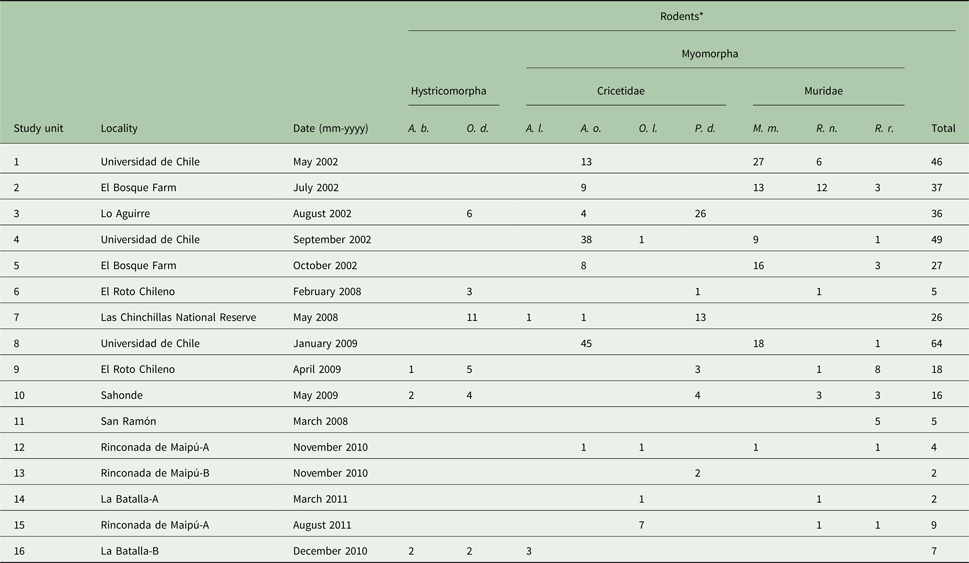
A total of 353 host individuals, belonging to nine species, were studied. The native species and their number of individuals (in parentheses) were the following: Abrocoma bennetti Waterhouse, 1837 (5) – Abrocomidae; Octodon degus Molina, 1782 (31) – Octodontidae; Abrothrix longipilis Waterhouse, 1837 (4); Abrothrix olivaceus Waterhouse, 1837 (119); Oligoryzomys longicaudatus Bennett, 1832 (10); and Phyllotis darwini Waterhouse, 1837 (49) – Cricetidae. The introduced species and the number of individuals (in parentheses) were: Mus musculus Linnaeus, 1758 (84); Rattus norvegicus Berkenhout, 1769 (25); and Rattus rattus Linnaeus, 1758 (26) – Muridae (see abundance of rodents by species, SU and locality in Table 2).
Abundance of rodents by species, study unit and locality of Central Chile

* Abbreviation of the host species names: A. b., Abrocoma bennetti; A. l., Abrothrix longipilis; A. o., Abrothrix olivaceus; M. m., Mus musculus; O. d., Octodon degus; O. l., Oligoryzomys longicaudatus; P. d., Phyllotis darwini; R. n., Rattus norvegicus; R. r., Rattus rattus.
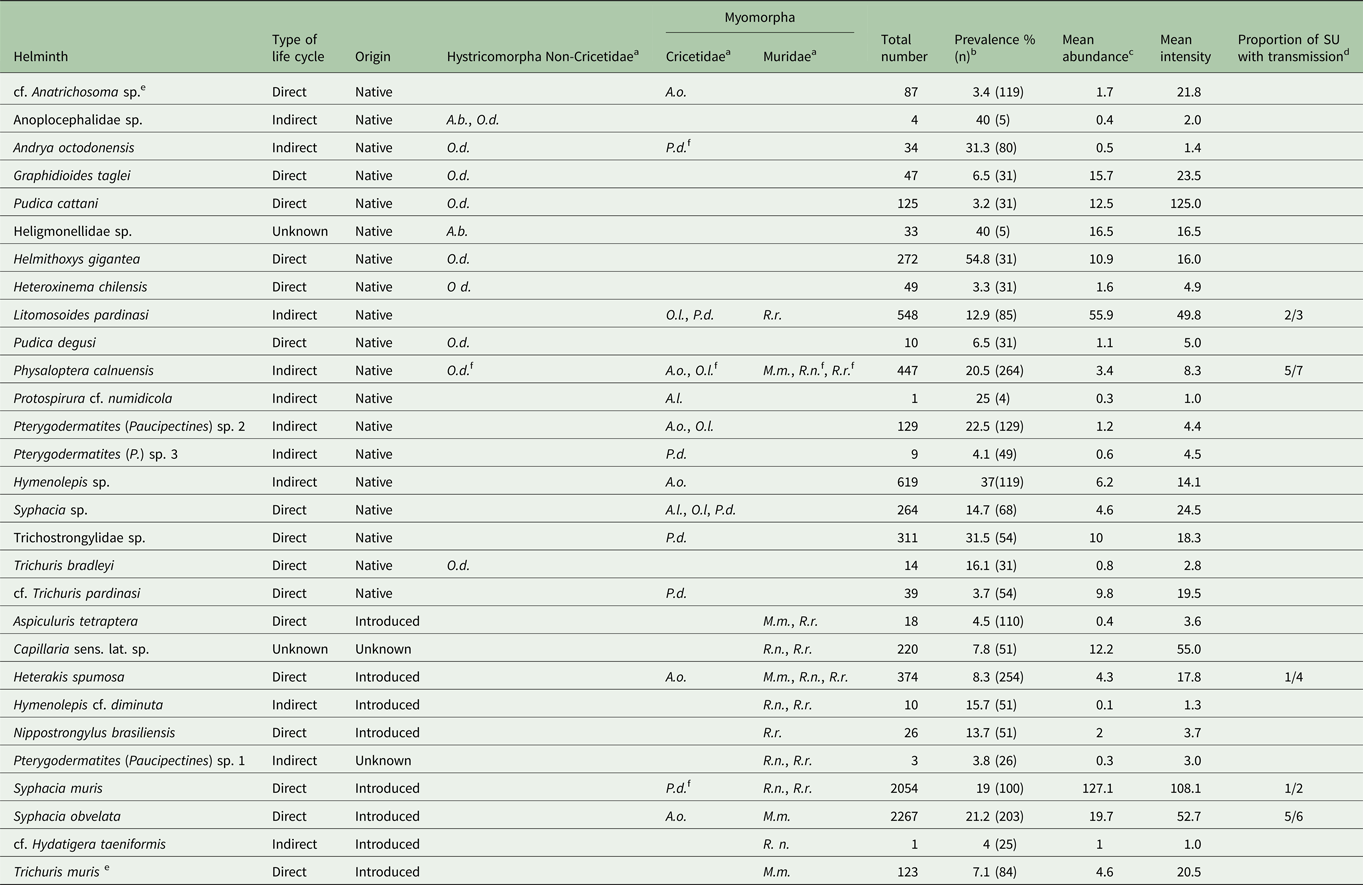
A total of 8141 specimens of parasites, belonging to 29 taxa, were found (Table 3). Eleven parasite taxa were considered to be native species because they were originally described parasitizing rodents native to the Neotropical region (Babero and Cattan, Reference Babero and Cattan1975; Babero et al. Reference Babero, Cattan and Cabello1975; Quentin, Reference Quentin1975; Sutton, Reference Sutton1989; Robles et al. Reference Robles, Navone and Notarnicola2006; Notarnicola and Navone, Reference Notarnicola and Navone2011; Digiani et al. Reference Digiani, Landaeta-Aqueveque, Serran and Notarnicola2017). In addition, we determined 10 helminth taxa to genus or family level. We considered these taxa, with the exception of Pterygodermatites (Paucipectines) sp. 1 and Capillaria sens. lat. sp., to be native species because they were found only in native rodents.
Origin (native, introduced), hosts and parasitic loads of helminths found in rodents of Central Chile

a Abbreviations of the host species names: A.b., Abrocoma bennetti; A.l., Abrothrix longipilis; A.o., Abrothrix olivaceus; M.m., Mus musculus; O.d., Octodon degus; O.l., Oligoryzomys longicaudatus; P.d., Phyllotis darwini; R.n., Rattus norvegicus; R.r., Rattus rattus.
b Prevalence % (number of susceptible hosts)
c Number of parasites among hosts (source hosts in shared parasites)/number of hosts (source hosts in shared parasites) considering SU with the presence of the parasite.
d Study units (SU) with transmission/SUs with the presence of the parasite and both groups of rodents.
e Recorded for the first time in Chile.
f Host–parasite association recorded for the first time.
On the other hand, we considered eight species as introduced species because they had been recorded mainly in one of the introduced rodent species in Chile and elsewhere (Harkema, Reference Harkema1936; Tena et al. Reference Tena, Simón, Gimeno, Pomata, Illescas, Amondarain, González, Domínguez and Bisquert1998; Pisanu et al. Reference Pisanu, Chapuis and Durette-Desset2001; Marangi et al. Reference Marangi, Zechini, Fileti, Quaranta and Aceti2003; Milazzo et al. Reference Milazzo, de Bellocq, Cagnin, Casanova, di Bella, Feliu and Santalla2003; Asakawa, Reference Asakawa2005; Kataranovski et al. Reference Kataranovski, Mirkov, Belij, Popov, Petrović, Gačić and Kataranovski2011) (Table 3). Given the lack of evidence, Pterygodermatites (Paucipectines) sp. 1 and Capillaria sens. lat. sp. were classified neither as native nor as introduced and were not included in the analyses.
The following parasite taxa were found in SUs that were inhabited by both native and introduced rodents: Anatrichosoma sp.; Andrya octodonensis Babero and Cattan, Reference Babero and Cattan1975; Anoplocephalidae sp.; Aspiculuris tetraptera Nitzsch, 1821; Capillaria sens. lat. sp.; Graphidioides taglei Babero and Cattan, Reference Babero and Cattan1975; Heligmonellidae sp. 2.; Helminthoxys gigantea Quentin, Courtin and Fontecilla, 1975; Heterakis spumosa Schneider, 1866; Heteroxinema chilensis Quentin, Reference Quentin1975; Hydatigera taeniformis Batsch, 1786; Hymenolepis cf. diminuta Rudolphi, 1819; Litomosoides pardinasi Notarnicola and Navone, Reference Notarnicola and Navone2011; Longistriata degusi Babero and Cattan, Reference Babero and Cattan1975; Nippostrongylus brasiliensis Travassos, 1914; Physaloptera calnuensis Sutton, Reference Sutton1989; Pterygodermatites (Paucipectines) sp. 1; Pterygodermatites (Paucipectines) sp. 2; Hymenolepis (syn. Rodentolepis sensu Khalil et al. Reference Khalil, Jones and Bray1994) sp.; Syphacia muris Yamaguti, 1941; Syphacia obvelata Rudolphi, 1802; Syphacia sp.; cf. Trichuris pardinasi Robles, Navone and Notarnicola, 2006; and Trichuris muris Schrank, 1788. These taxa, with the exception of Pterygodermatites (Paucipectines) sp. 1 and Capillaria sens. lat. sp., were those used to analyse the effect of the relatedness of hosts in the sharing of parasites. Native and introduced hosts shared only five parasite species (prevalences in the source host community are given in parentheses): L. pardinasi (90%), P. calnuensis (27%), H. spumosa (13%), S. muris (31%) and S. obvelata (49%). These five species were shared between cricetid and introduced rodents. Only one species was shared between non-cricetid and introduced rodents, P. calnuensis, which was also shared with cricetid rodents.
The relatedness of the hosts
In SUs that harboured both native and introduced rodents, the proportion of parasite species that introduced rodents shared with native rodents was higher when native rodents were cricetids (5/16) than when they were non-cricetids (1/17); taken as a whole, this difference was non-significant (Fisher one-tail test, P = 0.074). However, this difference was significant after excluding the most generalist species (P. calnuensis) (P = 0.043).
The parasitic loads in source hosts
We studied the native parasite species P. calnuensis and the introduced species S. obvelata to assess the association of the prevalence and mean abundance of parasites in source host populations with the presence and abundance in the recipient host populations in the same SU, because these were the species shared in the largest number of SUs: S. obvelata was shared in SUs 1, 2, 4, 5 and 8; P. calnuensis was shared in SUs 1, 2, 4, 5 and 15. The source host species of P. calnuensis was A. olivaceus and the recipient species were M. musculus, R. rattus and R. norvegicus. The source host species of S. obvelata was M. musculus and the recipient species was A. olivaceus.
Neither mean abundance nor prevalence of P. calnuensis in source host populations showed significant association with its abundance in the recipient hosts (mean abundance: coefficient = 0.09, standard error (s.e.) = 0.1, Z = 0.83, P = 0.41; prevalence: coefficient = 1.83, s.e. = 4.43, Z = 0.41, P = 0.68) nor with its presence in the recipient hosts [mean abundance: odds ratio (OR) = 1.09, s.e. = 0.07, Z = 1.38, P = 0.167; prevalence: OR = 1.86, s.e. = 4.2, Z = 0.28, P = 0.78]. Similarly, the mean abundance and the prevalence of S. obvelata in source host populations also did not show significant association with its abundance in the recipient hosts (mean abundance: coefficient = 0.02, s.e. = 0.03, Z = 0.76, P = 0.45; prevalence: coefficient = 2.58, s.e. = 2.89, Z = 0.89, P = 0.37) nor with its presence in the recipient hosts (mean abundance: OR = 1, s.e. = 0.02, Z = −0.05, P = 0.96; prevalence: OR = 1.03, s.e. = 2.22, Z = 0.01, P = 0.99).
Considering all parasite species of myomorph rodents, the mean abundance of parasites among all source host populations was not significantly associated with higher odds of being shared with a recipient host (OR = 1.19; confidence interval = 0.959, 1.494; P = 0.11). However, shared parasites had higher mean abundances in their source populations than not shared parasites (Z = 2.314, P = 0.02). The analogous analyses (logistic regression and Wilcoxon test) for the prevalence did not show significant associations with being shared (P > 0.23 in both cases). On the other hand, the number of localities in which the parasite was present was significantly associated with the odds of being shared (OR = 3.00; confidence interval = 1.207, 7.474; P = 0.018, respectively).
Discussion
The proportion of shared species between murid and cricetid rodents was higher than with non-cricetid rodents. Although this difference was not clearly significant, it shows an agreement with what was expected (Klimpel et al. Reference Klimpel, Förster and Schmahl2007; Wells et al. Reference Wells, O'Hara, Morand, Lessard and Ribas2015). The only species shared between non-cricetid and introduced rodents was a generalist nematode, P. calnuensis. In addition, P. calnuensis was also found in cricetid rodents, demonstrating low host specificity. The other less generalist species were not transmitted between suborders, and, considering only these, there is a significant association of the relatedness of the hosts with the sharing of parasites, suggesting that the relatedness of hosts, combined with the level of specialization of parasites are two forces that drive the sharing of parasites. This result complements that of MacLeod et al. (Reference MacLeod, Paterson, Tompkins and Duncan2010), who found that the host specificity of the parasite affects the persistence of the parasite after arrival. Our results are also consistent with the previous studies (Pisanu et al. Reference Pisanu, Lebailleux and Chapuis2009; Wells et al. Reference Wells, O'Hara, Morand, Lessard and Ribas2015) and reinforce quantitatively the importance of the relatedness of the hosts in the sharing of parasites between native and introduced hosts. Thus, our results enable hypotheses regarding which native species will more likely share parasites with a particular invasive species, and which parasites will more likely be shared.
Other attributes of the life history of the parasites must be studied in order to assess how they interact with the phylogenetic distance. For instance, the existence of unknown ecto-parasites as vectors (e.g. L. pardinasi) or unknown intermediate hosts present in the cycle of some parasites (e.g. P. calnuensis) can affect the likelihood of parasite transmission. In this regard, it has been reported that the diet of the host and its position in the food web can also affect parasite acquisition (Locke et al. Reference Locke, Marcogliese and Tellervo Valtonen2014).
In general terms, the parasitic loads of P. calnuensis and S. obvelata in source host populations did not show significant association with the presence and abundance in their recipient populations. Thus, the overall results suggest that the presence and the abundance of a parasite in a recipient host are not affected by the prevalence and mean abundance of this parasite in the source host population. This can be explained by the fact that parasites have been transmitted from sources to recipient host for hundreds of years – R. rattus and M. musculus from the 1600s, R. norvegicus from the 1800s (Jaksic, Reference Jaksic1998) – in such a way that the transmission dynamics, especially transmission between recipient hosts, could make the importance of the parasitic loads in the source hosts irrelevant. In other words, our results suggest that S. obvelata and P. calnuensis did not seem to require the source populations to persist in the recipient hosts. This is similar to what was observed in the California Channel Islands, where T. muris persists in Peromyscus maniculatus Wagner (1845) even on islands where R. rattus was eradicated (Smith and Carpenter, Reference Smith and Carpenter2006). Future studies must be performed to confirm this hypothesis. Our results can also be interpreted to mean that other factors not considered in this study associated to the susceptibility of the recipient hosts can also affect their infection rates. More studies are necessary to control for these factors.
On the other hand, the higher mean abundance of shared parasites among source hosts than that of not shared parasites can be considered the first evidence in support of the hypothesis that the number of parasites in the source host population within a large territory could favour the sharing of parasites between native and introduced hosts in at least one locality. Thus, our results suggest the importance of the abundance but not the prevalence of parasites in the source populations. This is consistent with the hypothesis that, given the aggregated dispersion of parasites (i.e. most parasites colonize few hosts), those few hosts with a high number of parasites, and not all infected hosts, are responsible for most parasite transmission (Woolhouse et al. Reference Woolhouse, Dye, Etard, Smith, Charlwood, Garnett, Hagan, Hii, Ndhlovu, Quinnell and Watts1997). In addition, the number of localities in which the parasites are present is also associated with being shared with a recipient host, which enhances the likelihood of contact with recipient host in at least one locality.
For free-living organisms, the propagule pressure is one of the most important factors in the success of the invasion process (Lockwood et al. Reference Lockwood, Cassey and Blackburn2005). However, in the context of parasitism, propagule pressure, understood as the number of parasites that arrived with a host, is not a major factor in the persistence of parasites in the introduced host population (MacLeod et al. Reference MacLeod, Paterson, Tompkins and Duncan2010). Hatcher et al. (Reference Hatcher, Dick and Dunn2012) mentioned that the spillover propagule pressure includes two parts, the propagule size and the number of propagules, i.e. the number of spillover events. This latter is very difficult to assess in the context of parasitism due to the possible transmission events of a parasite without successful persistence among recipient hosts, which therefore makes it difficult to prove. Thus, an acceptable equivalence for the number of propagules could be the territorial dispersion and abundance of parasites, which could be associated with the chances for a parasite to contact a recipient host and achieve a spillover event. In this context and consequent with our results, it is possible that the larger the abundance of a parasite species among its source hosts in a large territory and the larger the number of localities in which the parasite is present, the higher the probability of the parasite being shared in at least one locality. Thus, if the goal of a management is the prevention of the spillover of parasites from invasive hosts, the control of the dispersion of this invasive host is a core aim.
Concluding remarks
The foregoing allows us to suggest that the relatedness of the hosts combined with the low host specificity of parasites favour the spillover of parasites between native and introduced hosts. The prevalence of parasites found in source host populations is not as significant as a factor in parasite spillover. On the contrary, the abundance and dispersion of parasites in source hosts may affect parasite sharing between native and introduced hosts. Thus, the association of the abundance and the dispersion of parasites with host switching are proposed as factors driving the sharing of parasites between native and introduced rodent hosts.
Acknowledgments
The authors would like to thank Graciela T. Navone and Juliana Notarnicola for taxonomical collaboration and Carezza Botto-Mahan for her important suggestions that improved the quality of this manuscript. The authors also thank Eileen Smith for editorial support. Finally, the authors thank Antonella Bacigallupo, Patricio Arroyo, Juan C. Ramírez, Cristina Kretschmer and Verónica Segovia for field support.
Ethical standards
We have strictly conformed to relevant ethical standards, involving the use of the minimum number of animals necessary to produce statistically reproducible results. The Comité de Ética of the Facultad de Ciencias Veterinarias y Pecuarias (Ethics Committee of the Faculty of Veterinary and Animal Sciences) at the Universidad de Chile approved and certified the study (certificate without number, 15 April 2011), and the Servicio Agrícola y Ganadero (Agricultural and Livestock Service) of Chile authorized trapping (resolution certificates 2041 and 6652 to C.L.-A.).
Financial support
This work was supported by the Comisión Nacional de Investigación Científica y Tecnológica de Chile (scholarship numbers 24110058 and AT-24100028) and the Fondo Nacional de Desarrollo Científico y Tecnológico de Chile (grant number 1070960).
Conflict of interest
None.