INTRODUCTION
The killer whale (Orcinus orca, Linnaeus 1758) is a cosmopolitan species and the most widely distributed marine mammal. It can be found in all of the world's oceans, from the equator to polar waters (Forney & Wade, Reference Forney, Wade, Estes, DeMaster, Doak, Williams and Brownell2007), and shows seasonal movement patterns that are usually associated with increased prey abundance (López & López, Reference López and López1985; Similä et al., Reference Similä, Holst and Christensen1996; Ford et al., Reference Ford, Ellis, Barrett-Lennard, Morton, Palm and Balcomb1998; Iñiguez, Reference Iñiguez2001; Esteban et al., Reference Esteban, Verborgh, Gauffier, Esteban, Verborgh, Gauffier, Giménez, Afán, Cañadas, García, Murcia, Magalhães, Andreu and de Stephanis2013). Worldwide, its diet includes over 140 species of fish, cephalopods, sea birds, turtles and marine mammals. However, most studied killer whale populations are specialized to feed on certain specific prey items (Baird, Reference Baird1994; Ford et al., Reference Ford, Ellis, Barrett-Lennard, Morton, Palm and Balcomb1998; Pitman & Ensor, Reference Pitman and Ensor2003; Herman et al., Reference Herman, Burrows, Wade, Durban, Matkin, LeDuc, Barrett-Lennard and Krahn2005; Pitman et al., Reference Pitman, Perryman, LeRol and Eilers2007; Esteban, Reference Esteban2008).
The best studied killer whale populations in the world are found off the west coast of the US and Canada, where three different ecotypes have been described: a ‘transient’ type that specializes in feeding on marine mammals and sea birds; a ‘resident’ type that feeds on fish in nearshore waters and a piscivorous ‘offshore’ type (Bigg et al., Reference Bigg, Olesiuk, Ellis, Ford and Balcomb1990; Ford et al., Reference Ford, Ellis, Barrett-Lennard, Morton, Palm and Balcomb1998; Herman et al., Reference Herman, Burrows, Wade, Durban, Matkin, LeDuc, Barrett-Lennard and Krahn2005). These ecotypes not only differ in their diet, but also in their morphological traits, acoustic behaviour and social structure. Transient and resident ecotypes killer whales have also been documented off the Kamchatka peninsula and in the Sea of Okhotsk, in Russian waters (Burdin et al., Reference Burdin, Hoyt, Sato, Tarasyan and Filatova2004).
Using microsatellites and mtDNA, three genetically distinct populations have been identified in the North Atlantic (Foote et al., Reference Foote, Vilstrup, de Stephanis, Verborgh, Abel Nielsen, Deaville, Kleivane, Vidal, Miller, Øien, Pérez-Gil, Rasmussen, Reid, Robertson, Rogan, Similä, Tejedor, Vester, Víkingsson, Willerslev, Gilbert and Piertney2011). A piscivorous population A specialized in feeding on herring (Clupea harengus), the Norwegian, the Icelandic or the North Sea herring stocks. In turn, this population is divided into two sub-populations: the Icelandic and the Norwegian (Foote et al., Reference Foote, Vester, Víkingsson and Newton2012). Individuals from population A were all sampled at latitudes above 60°N. Killer whales from population B feed on both fish and marine mammals, and live in sympatry with population A in part of their range, as individuals were sampled between latitudes 51°N and 66°N, and from the North Sea to the West coast of Iceland (Foote et al., Reference Foote, Vilstrup, de Stephanis, Verborgh, Abel Nielsen, Deaville, Kleivane, Vidal, Miller, Øien, Pérez-Gil, Rasmussen, Reid, Robertson, Rogan, Similä, Tejedor, Vester, Víkingsson, Willerslev, Gilbert and Piertney2011). Population C includes all individuals sampled in the Strait of Gibraltar, which are specialized in feeding on bluefin tuna (Thunnus thynnus) (Esteban, Reference Esteban2008), and individuals sampled in the Canary Islands (Foote et al., Reference Foote, Vilstrup, de Stephanis, Verborgh, Abel Nielsen, Deaville, Kleivane, Vidal, Miller, Øien, Pérez-Gil, Rasmussen, Reid, Robertson, Rogan, Similä, Tejedor, Vester, Víkingsson, Willerslev, Gilbert and Piertney2011), whose feeding habits are unknown.
Although killer whales have been recorded along the entire coast of Norway, as well as in offshore waters (Foote et al., Reference Foote, Víkingsson, Øien, Bloch, Davis, Dunn, Harvey, Mandleberg, Whooley and Thompson2007), most of what is known about Norwegian killer whales comes from research studies carried out in northern Norway, especially during the winter time. These whales have been intensively studied since 1983 in the Vestfjord–Tysfjord–Ofotfjord area (Lofoten Archipelago), where they were observed to return every year to feed on the over-wintering Norwegian spring-spawning herring (NSSH) (Similä et al., Reference Similä, Holst and Christensen1996; Kuningas et al., Reference Kuningas, Similä and Hammond2007). Few killer whale observations are made during the summer months, but they have been recorded both off Andenes (Vesterålen Archipelago) and the Lofoten Islands (Similä et al., Reference Similä, Holst and Christensen1996; Similä, Reference Similä1997; Ugarte, Reference Ugarte2001; Stenersen & Similä, Reference Stenersen and Similä2004). These whales show a preference for herring, and photo-identification and satellite tags suggest that at least some groups follow the NSSH stock, year round (Similä et al., Reference Similä, Holst and Christensen1996; Stenersen & Similä, Reference Stenersen and Similä2004; Foote et al., Reference Foote, Vilstrup, de Stephanis, Verborgh, Abel Nielsen, Deaville, Kleivane, Vidal, Miller, Øien, Pérez-Gil, Rasmussen, Reid, Robertson, Rogan, Similä, Tejedor, Vester, Víkingsson, Willerslev, Gilbert and Piertney2011). In addition, they have also been observed feeding on mackerel (Scomber scombrus), cod (Gadus morhua, Linnaeus 1758), Atlantic salmon (Salmo salar, Linnaeus 1758) and saithe (Pollachius virens, Linnaeus 1758), as well as harbour seals (Phoca vitulina, Linnaeus 1758) and, on rare occasions, sea birds (Similä et al., Reference Similä, Holst and Christensen1996; Stenersen & Similä, Reference Stenersen and Similä2004; Vester & Hammerschmidt, Reference Vester and Hammerschmidt2013).
Worldwide, there have been reports of killer whale predation on more than 20 other cetacean species, ranging from small porpoises to great whales (e.g. Hoyt, Reference Hoyt1990; Jefferson et al., Reference Jefferson, Stacey and Baird1991). However, for the Norwegian population, there is only a report on a single predation event on northern bottlenose whales (Hyperoodon ampullatus, Forster 1770) (Jonsgård, Reference Jonsgård1968 in Similä et al., Reference Similä, Holst and Christensen1996). Here I report and describe the first case in which Norwegian killer whales have been observed hunting and feeding on a harbour porpoise (Phocoena phocoena, Linnaeus 1758).
MATERIALS AND METHODS
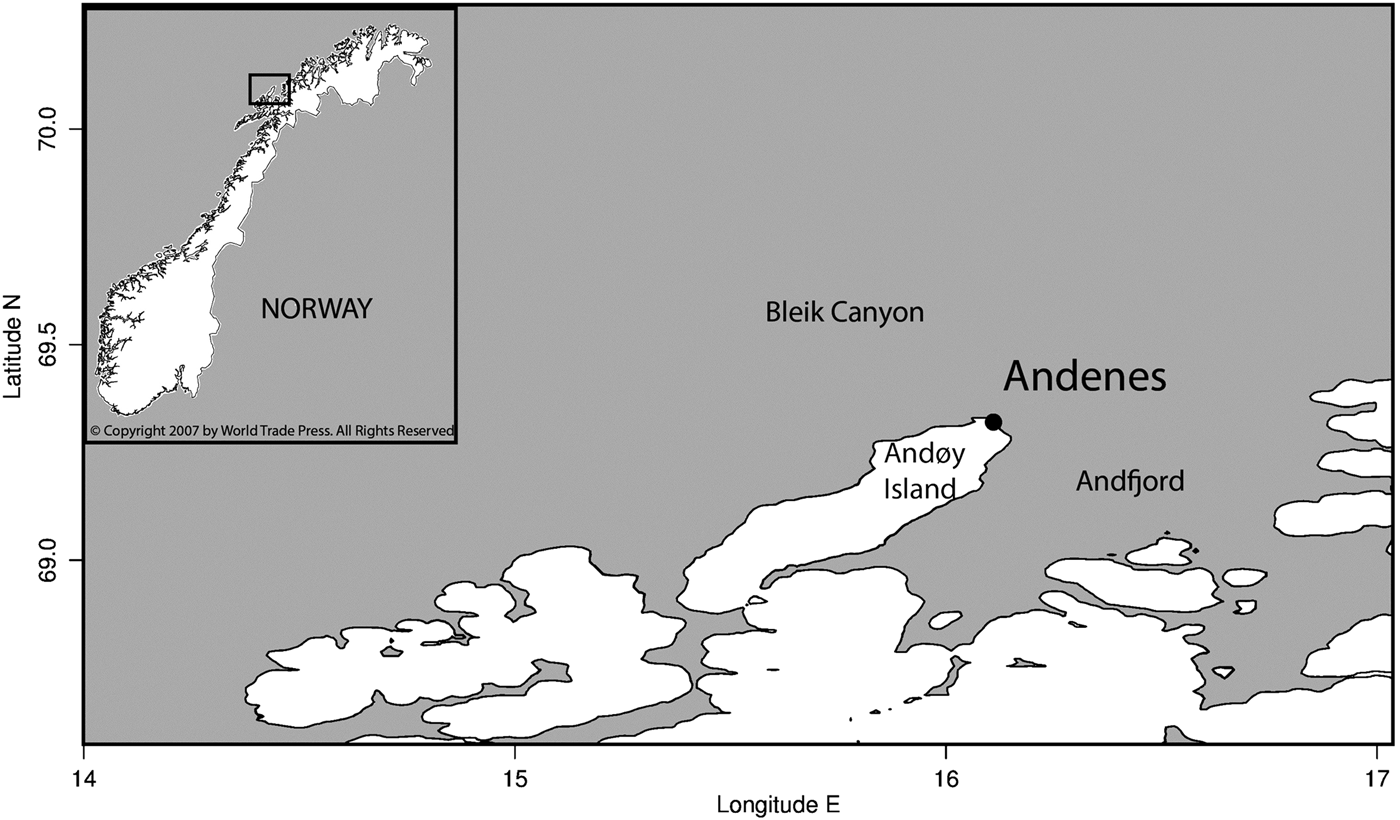
The event reported here occurred off Andenes harbour in northern Norway, at approximately 69.334°N 16.161°E. Since 2011, several land-based surveys were carried out in the area on a daily basis (depending on weather conditions), as part of a study focusing on sperm whales (Physeter macrocephalus, Linnaeus 1758). Such surveys were conducted from the Andenes lighthouse using BigEyes® binoculars (25× magnifications, 80 mm). The lighthouse is located at the northernmost point of Andøy Island (69.3240°N 16.1159°E) and the binoculars are assembled on the gallery deck at approximately 40 meters above sea level. For the above-mentioned sperm whale surveys, the study area is divided into two contiguous areas (each 120° wide): Bleik Canyon on the west side and Andfjord on the east side of the island (Figure 1). Surveys involve scanning one of the two areas for 2 out of every 5 min, for a period of 1 h (i.e. 12 scans per hour). Data are collected using an Olympus Recorder WS-750M. Location of animals at sea is approximated through the use of an internal reticule system and a graduated wheel.
Map of the study area in northern Norway.

The 24 h of daylight during the summer months in the study area makes it possible to conduct land-based surveys at any time of day.
RESULTS
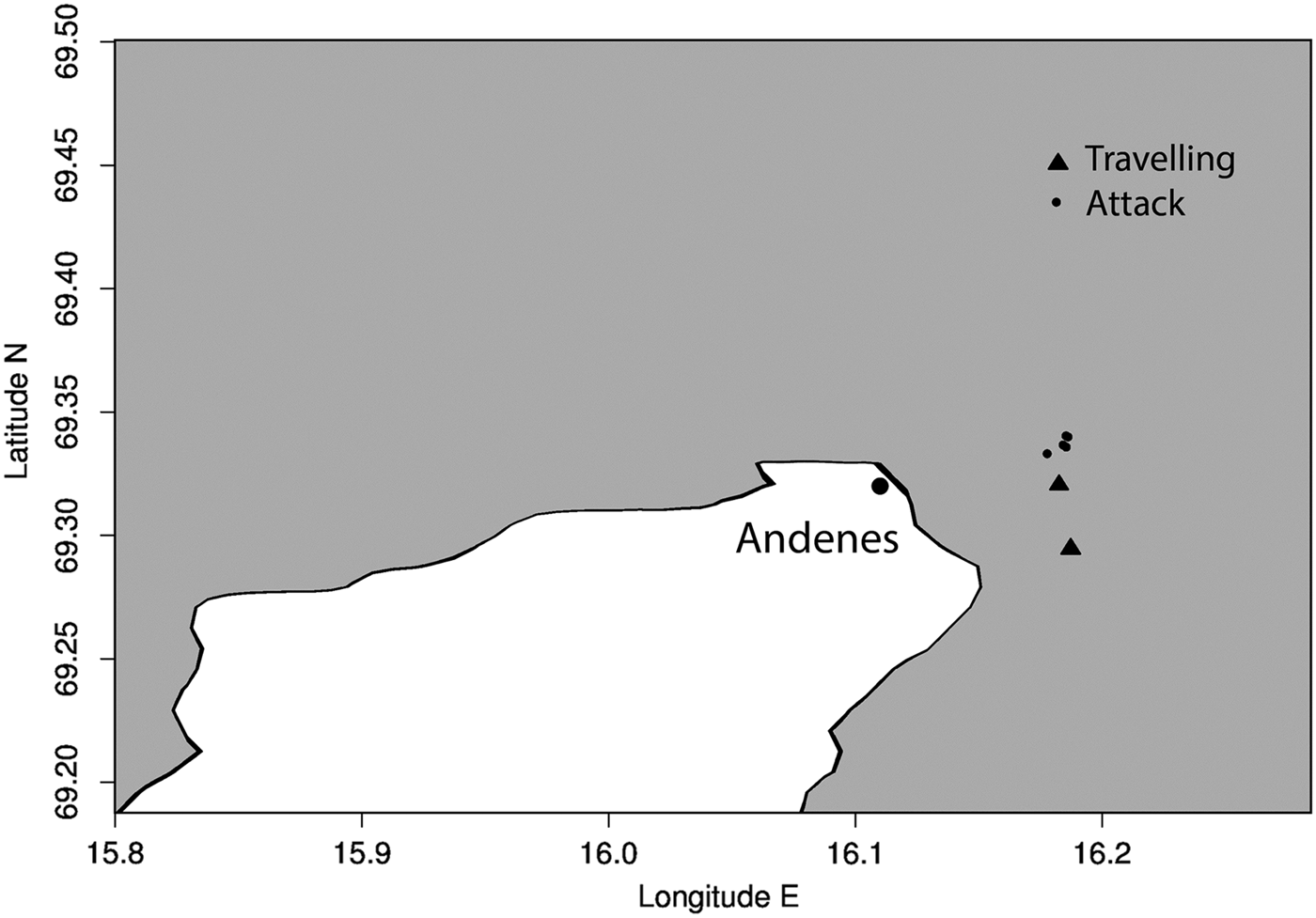
On 24 June 2012 at 03:10, an opportunistic sighting of a group of 11 killer whales was made off Andenes in Andfjord waters (69.28486°N 16.18732°E) (Figure 2). Based on body size, as well as size and shape of the dorsal fin, it was determined that the group was composed of four adult males, one calf, one juvenile and five subadult individuals/adult females. The whales were slowly travelling northwards in a loose formation, less than two body lengths from each other (sensu Barrett-Lennard et al., Reference Barrett-Lennard, Ford and Heise1996). After 36 min, during a new scan, the group was spotted again, still travelling northwards and in a loose formation. At 03:55 they were seen less than 2000 m north-east off Andenes harbour, in a 20 m deep reef area (69.32942°N 16.17670°E). The group was heading north-east when, suddenly, the entire group turned southwards and started porpoising at high speed towards the shore. It was then decided to discontinue the sperm whale survey and perform a focal follow on the killer whales instead. Within one minute, a killer whale (a subadult or an adult female) rammed a harbour porpoise from below forcing it out of the water and exposing half of its own body at an approximately 75° angle. The porpoise was lifted into the air about 5 m above the killer whale. High-speed chasing above the water is commonly observed during killer whale predation on small- and medium-sized cetaceans in other parts of the world (e.g. Baird, Reference Baird1994; Constantine et al., Reference Constantine, VIsser, Buurman, Buurman and McFadden1998; Visser et al., Reference Visser, Zaeschmar, Halliday, Abraham, Ball, Bradley, Daly, Hatwell, Johnson, Johnson, Kay, Maessen, McKay, Peters, Turner, Umuroa and Pace2010; Coscarella et al., Reference Coscarella, Bellazzi, Gaffet, Berzano and Degrati2015); however, this was not the case on this occasion, given that the porpoise was first observed when rammed in the air. The rest of the group continued porpoising for a few seconds, gathering around the spot where both the killer whale and the porpoise were last seen. After that, for less than 1 min, the entire group remained underwater. Suddenly a whale (again, a subadult or an adult female) rose out the water as previously, but this time carrying the porpoise in its mouth. Once more, the group gathered around the attacking individual and started swimming erratically in the area. Within the next few minutes, the porpoise was rammed in the air once more, though not as high as the first time. The porpoise was not seen again and the killer whales came closer to each other, moving slowly, gathering around a small area and facing towards where the porpoise was last observed, suggesting prey consumption. Reuniting around the prey during handling and after the kill suggests prey sharing (e.g. Hoelzel, Reference Hoelzel1991; Baird, Reference Baird1994). The event took place in just over 6 min. The group remained in the area and sea birds slowly gathered around, flying in circles above the killer whales, occasionally plunging around the animals.
Map showing the locations where the killer whales were observed.
Whilst the adult males were not actively involved and stayed to the side most of the time, the calf remained close to the group throughout the whole predation event. This has also been observed in North Pacific transients (Baird, Reference Baird1994). After the kill, aerial behaviour was observed, including several breaches and tail slapping, as well as other displays such as rolling on their bodies and spyhopping, which are indicative of socialization (Barrett-Lennard et al., Reference Barrett-Lennard, Ford and Heise1996).
The whales started slowly moving to the north-east 10 min after the kill, and divided into two smaller groups after another 10 min: one male, the calf and three other individuals remained together in that spot and the rest dispersed and moved further northwards. Both groups were accompanied by birds occasionally diving, suggesting the prey was shared by both subgroups. At 04:45 all five remaining killer whales started to disperse and also headed northwards. Observation was then finished due to intense glare.
Harbour porpoises are known to be part of the diet of transient killer whales’ diets off the west coast of British Columbia, Canada (Jefferson et al., Reference Jefferson, Stacey and Baird1991; Baird & Guenther, Reference Baird and Guenther1995). Despite the fact that the species have overlapping distributions in Norwegian waters (Bjørge & Øien, Reference Bjørge and Øien1995; Foote et al., Reference Foote, Víkingsson, Øien, Bloch, Davis, Dunn, Harvey, Mandleberg, Whooley and Thompson2007), no predatory interaction has been described previously in the scientific literature. In April 2012 a photograph taken by a tourist in Eikelandsfjorden in Hardanger, Southern Norway, over 1500 km from our study area, was published in an online local newspaper,Footnote 1 showing a killer whale (a subadult or an adult female) ramming a harbour porpoise. However, it is not known whether the porpoise was killed and consumed by the whales.
It was, unfortunately, impossible to take photographs using the binoculars from the land station for photo-identification. However, the short distance to the event made it possible to make reliable sketches of the dorsal fins of three individuals that had distinctive nicks: an adult male, a juvenile and a third individual, most likely to be an adult female. The sketches and group composition strongly suggest that the group was the same as one seen near Stø on 21 June 2012 (three days before), less than 30 km south-west of Andenes (69.17499°N 15.39300°E). Photographs taken on that occasion identified a total of 11 individuals, including one calf, one juvenile, and four adult males. It was impossible to attempt to photographically identify the whale in the photograph published in the online newspaper due to the low quality of the available image.
DISCUSSION
The above observations can be explained in one of three ways. First, this may indicate an expansion in the range of mammal-eating population B. Our current knowledge on their distribution range is limited and while a range increase in association with climate change (e.g. MacLeod, Reference MacLeod2009) or other factors should not be disregarded, this situation is probably unlikely given the distance between the study area and the known range of population B. The other two possible explanations are that members of population A may have learned to take new prey animals only recently due to a changing environment, or that this behaviour has simply gone unnoticed to date. Both are likely situations given the already reported opportunistic foraging behaviour of this population, and that most of what is known about the diet and feeding behaviour of Norwegian killer comes from studies carried out in the wintering grounds of the NSSH stock (Similä et al., Reference Similä, Holst and Christensen1996; Similä, Reference Similä1997; Ugarte, Reference Ugarte2001; Stenersen & Similä, Reference Stenersen and Similä2004; Kuningas et al., Reference Kuningas, Similä and Hammond2007), despite the fact that several groups have been observed in different seasons and study areas.
Recent studies suggest that the behavioural ecology of killer whales off Scotland and Iceland is more consistent with specialization in foraging behaviour at the individual or group level rather than population level (Beck et al., Reference Beck, Kuningas, Esteban and Foote2011). The possibility that the Norwegian whales also show group or individual specialization in foraging behaviour cannot be disregarded. In fact, Similä et al. (Reference Similä, Holst and Christensen1996) already noticed that at least some groups had different prey preferences (e.g. young herring instead of adults) associated with different seasonal occurrences. More recently, killer whales have been regularly observed feeding on harbour seals off Stø (northern tip of the island of Langøya) during the summer months (C. Ilmoni, personal communication) and on salmon in the Lofoten archipelago (Vester & Hammerschmidt, Reference Vester and Hammerschmidt2013), although it is not yet known if different groups are engaged in these activities.
In addition to the porpoise event, I recorded two observations of killer whales in what appeared to be foraging behaviour in search of seals on rocky islands in nearshore waters (as described in Beck et al., Reference Beck, Kuningas, Esteban and Foote2011). The first sighting occurred on 2 August 2012 off Stø, when a group of five killer whales, initially observed feeding on fish (possibly mackerel), switched to actively searching for seals around the rocky islands in the area (Beck et al., Reference Beck, Kuningas, Esteban and Foote2011). On this occasion, at least one unsuccessful attempt to catch a seal was made. Similar behaviour was observed by a group of 20 to 25 whales on the 28 November 2012, off Andenes (on the west side of Andøy Island), although no attempt to catch a seal was observed. Interestingly, one subgroup in this second sighting caught (and presumably ate) several sea birds (possibly King Eider – Somateria spectabilis Linnaeus 1758). There are also reports of killer whales harassing and probably feeding on puffins (Fratercula arctica Linnaeus 1758) in the area (G. Mann, personal communication). Together, these observations may indicate that the killer whales in northern Norway prey upon an array of fish, sea bird and marine mammal species, even though its presence in the area is highly linked to the occurrence of the NSSH (Similä et al., Reference Similä, Holst and Christensen1996; Hvalsafari unpublished data). Furthermore, observations of killer whales harassing other cetacean species (e.g. minke and sperm whales) off Andenes have been made since 2011 (Hvalsafari, unpublished data). However, it is not clear whether or not they were predatory interactions.
The ecological separation of the North Atlantic killer whales is not as clearly defined as it is in the Eastern North Pacific (de Bruyn et al., Reference de Bruyn, Tosh and Terauds2013). The NSSH has a complex life cycle that requires suitable areas for each stage (i.e. spawning, feeding, nursing and wintering). These areas and their migrations routes vary somewhat unpredictably (Dickson & Østerhus, Reference Dickson and Østerhus2007), which could explain the more generalist behaviour observed for this killer whale population.
Baird & Dill (Reference Baird and Dill1996) estimated that the optimal group size that maximizes energy intake for the North-east Pacific transients is three individuals, which coincides with the typical group size (Baird, Reference Baird1994). Other marine-mammal-eating killer whales also have small group sizes: three individuals for the Punta Norte (Patagonia) population (Hoelzel, Reference Hoelzel1991), and five for killer whales in Scottish waters (Beck et al., Reference Beck, Kuningas, Esteban and Foote2011). Group size for Norwegian killer whales, however, ranges from 6 to 30 animals, with a median of 15 (Similä, Reference Similä1997). Foraging techniques are transferred from one generation to the other through social learning, as observed in Patagonia where killer whales use an intentional stranding technique to catch seal pups on the beach (López & López, Reference López and López1985; Hoelzel, Reference Hoelzel1991).
As a population, Norwegian killer whales feed on various prey species, ranging from fish, to birds to other marine mammals, many requiring different complex hunting techniques that require a high level of coordination for a successful attack. The hunting behaviour described here greatly differs from the carrousel method used when feeding on herring (Similä & Ugarte, Reference Similä and Ugarte1993) or that used for seal hunting (Beck et al., Reference Beck, Kuningas, Esteban and Foote2011). Thus, this report increases our knowledge of killer whale diet and foraging behaviour in the area and may suggest a wider separation from the Icelandic sub-population than previously thought. Progress in the knowledge of this killer whale population is slow due to the paucity of published reports. Increased collaboration between research groups in the area will greatly benefit the understanding of their feeding ecology at an individual and group level, as well as the ecology and social structure.
ACKNOWLEDGEMENTS
I would like to thank Arctic Whale Tours for providing the killer whale photographs, and two anonymous reviewers for their comments on early versions of this manuscript.