INTRODUCTION
Maciolek (Reference Maciolek1987) defined Scolelepis as having two subgenera S. (Scolelepis) and S. (Parascolelepis) based on the morphology of their hooded hooks. Since then, Scolelepis has been widely recognized within this classification (Eibye-Jacobsen, Reference Eibye-Jacobsen1997; Eibye-Jacobsen & Soares, Reference Eibye-Jacobsen and Soares2000; Delgado-Blas, Reference Delgado-Blas2006; Williams, Reference Williams2007). Recently, Delgado-Blas (Reference Delgado-Blas2006) reinstated four species: S. (S.) goodbodyi (Jones, Reference Jones1962), S. (S.) minuta (Treadwell, Reference Treadwell1939), S. (S.) acuta (Treadwell, Reference Treadwell1914), and S. (S.) agilis (Verrill, Reference Verrill1873), removing them from synonymy with S. (S.) squamata Müller, Reference Müller1806. Delgado-Blas (Reference Delgado-Blas2006) also reported two new species: Scolelepis (S.) lighti and S. (S.) vossae. A total of five Scolelepis species have been described from the Grand Caribbean region: Scolelepis (S.) minuta from Texas, S. (S.) goodbodyi from Jamaica, S. (Parascolelepis) texana Foster, Reference Foster1971 and S. (S.) lighti from the Gulf of Mexico, and S. (S.) vossae from Florida. Research on the spionid fauna, however, has shown that there are still many undescribed spionids in this region awaiting study, particularly within the genus Scolelepis (Delgado-Blas, Reference Delgado-Blas2006). Prior to this investigation only ten species belonging to the Spionidae had been recorded from the Venezuelan coast (Bone et al., Reference Bone, Doering and Penchaszadeh1983; Liñero-Arana, Reference Liñero-Arana1993; Bone & Vieitez, Reference Bone and Viétez2002). In this study a new species of Scolelepis is described and S. lighti is recorded for the first time for Venezuela.
MATERIALS AND METHODS
Polychaetes were collected from eight localities along the north-eastern Venezuelan coast, Sucre State: El Peñón (10°27′59″N–64°06′16″W), Guacarapo (10°29′46″N–63°44′21″W), the Bocaripo lagoon (10°39′38″N–63°49′25″W), Güiria (10°33′58″N–62°44′21″W) the Marina Cumanagoto, Cumaná (10°28′37″N–64°11′11″W), Carenero (10°26′25″N–64°02′08″W), Punta Las Morochas, Mochima bay (10°210′4″W–64°21′35″N) and San Carlos Island (10°59′35.85″N–71°37′16.90″W).
All samples were collected at a depth of 1.5 m, except those from Güiria, which were collected from the intertidal zone. Sampling was carried out from soft sea bottom sediments using a PVC corer (0.018 m2), and taking 20 cm deep cores, which were then sieved in a 0.5 mm open mesh. Specimens were fixed in 10% formaldehyde and preserved in 70% ethanol. They were then examined using compound microscopes, and structures with taxonomic value were dissected. Drawings were made with a camera lucida. The material has been deposited in: the Allan Hancock Foundation at the Los Angeles County Museum of Natural History (LACMNH-AHF); the Laboratorio de Biología de Poliquetos, Universidad de Oriente, Venezuela (LBP); and the Colegio de la Frontera Sur, Unidad Chetumal, Mexico (ECOSUR). In the text the number of specimens in a sample is given in parentheses after the abbreviation for the museum.
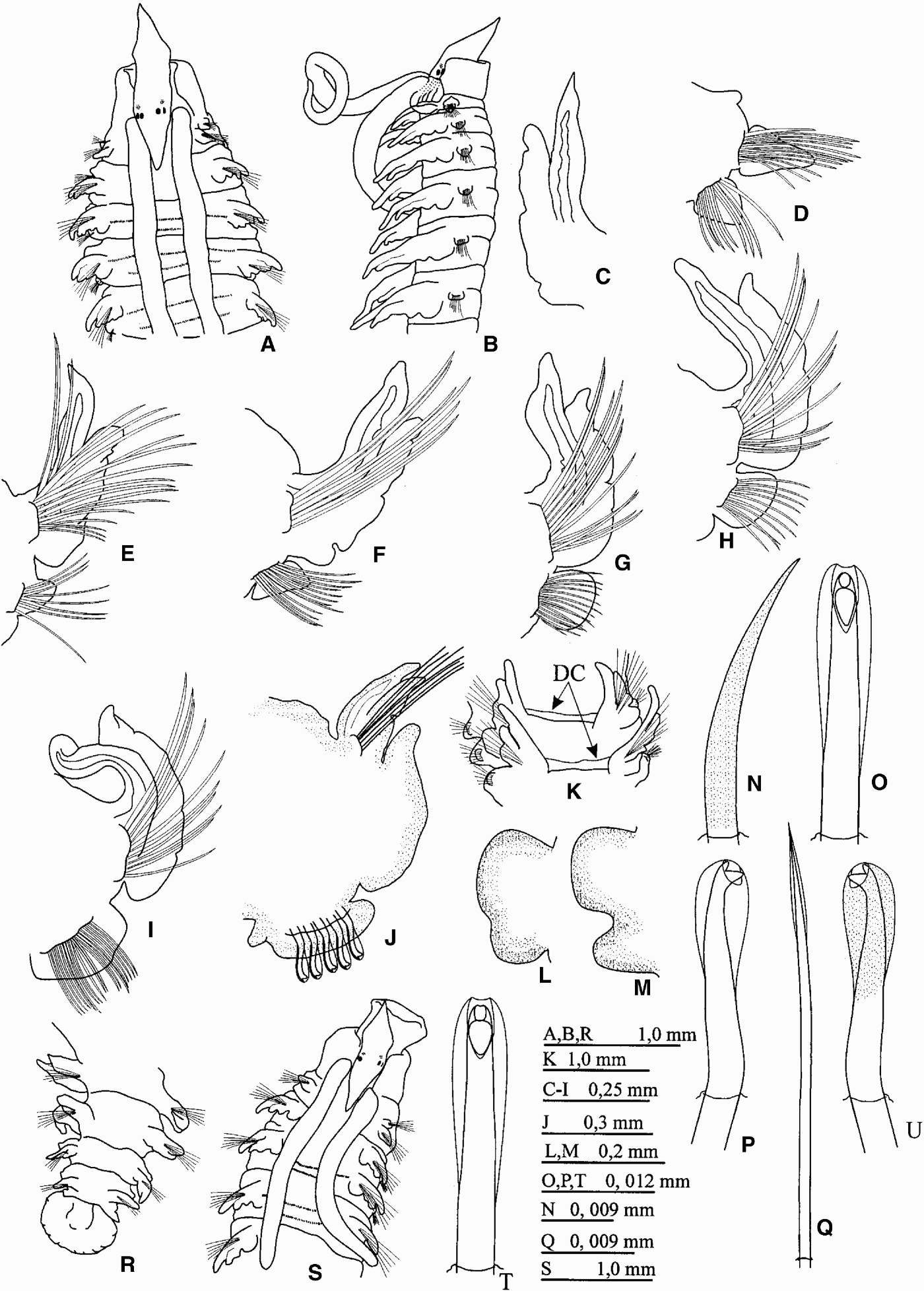
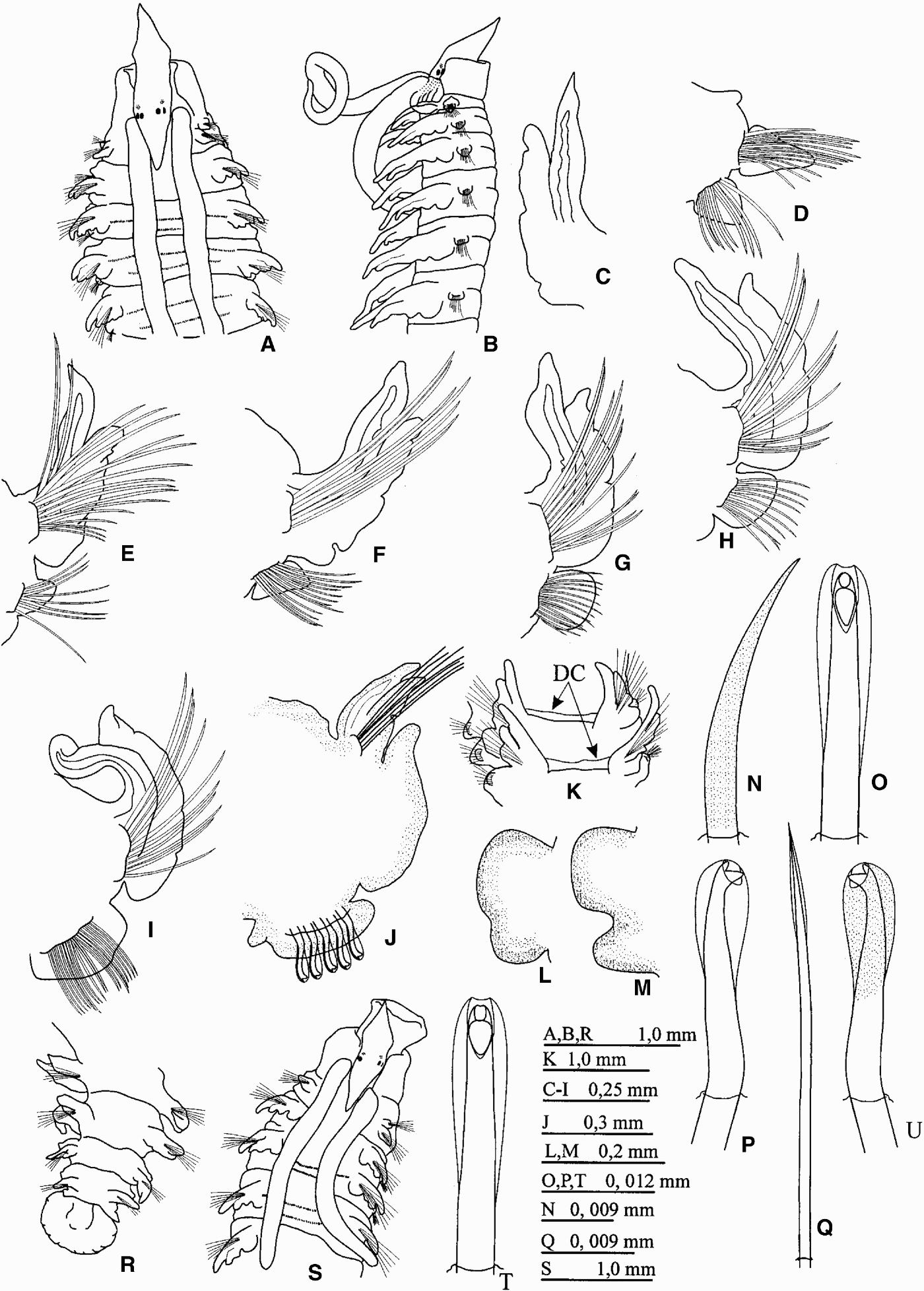
Scolelepis andradei sp. nov. (holotype: A-R,T; paratype: S). (A) Dorsal view of anterior end; (B) lateral view of same; (C) branchiae from middle setiger; (D) parapodia of setiger 1; (E) parapodia of setiger 2; (F) parapodia of setiger 3; (G) parapodia of setiger 4; (H) parapodia of setiger 5; (I) parapodia of setiger 20; (J) parapodia of setiger 57; (K) dorsal crests; (L) slight notch on neuropodial postsetal lamellae at setiger 25; (M) notch on neuropodial postsetal lamellae at setiger 27; (N) anterior neurosetae limbate, strongly granulated; (O–P) bidentate neuropodial hooded hooks; (Q) notopodial capillary setae; (R) pygidium; (S) dorsal view of anterior end with proboscis everted; (T) bidentate and strongly glanulated neuropodial hooded hooks; (U) bidentate neuropodial hooded hooks with a slight notch on the accessory tooth. DC, dorsal crest. Scale bars: A–B, K, R–S = 1.0 mm; C–I = 0.25 mm; J = 0.3 mm; L, M = 0.2 mm; N, Q = 0.009 mm; O, P, T = 0.012 mm.
TYPE MATERIAL
Holotype: Caribbean Sea: Venezuela (Güiria, coordinates: 10°33′57″N 62°17′50″, water depth: 0.50 m) (LACM-AHF POLY 2242). Eighteen paratypes (LBP-Sp0001). Five paratypes, (ECOSUR-0099) collected by O. Díaz & I. Liñero-Arana, 23 August 2005. One paratype (Mochima Bay), 26 June 1981 (LBP-Sp0002). Two paratypes: (El Peñón, coordinates: 10°33′57″N 64°05′31″W, water depth: 1.5 m on fine sand) (LBP-Sp0003), collected by I. Liñero-Arana, October 1998. Two paratypes: (Cumanagoto marina, Cumaná, coordinates: 10°28′37″N 64°11′12″W, water depth: 1.5 m on fine sand) (LBP-Sp0004), collected by O. Díaz & I. Liñero-Arana, 12 March 2003. Two paratypes: (Güiria, coordinates: 10°33′57″N 62°17′50″) (LBP-Sp0005), collected by O. Díaz & I. Liñero-Arana, 22 August 2004. Twelve paratypes: (Güiria) (LBP-Sp0006), collected by I. Liñero-Arana, 29 October 2007. Seven paratypes: (San Carlos Island) (ECOSUR-0098), collected by V. Vanegas, May 2007.
DESCRIPTION
Holotype complete, 19 mm long, 1 mm wide excluding setae, with 87 setigers. Body wide anteriorly, tapering posteriorly. Colour in alcohol: pale white.
Prostomium conical, lanceoated shape, extended anteriorly to a long, tapering point, posteriorly triangular, raised, without occipital antenna. Eyes not observed. Peristomium long, distinct from setiger 1, slightly swollen, forming well-developed lateral wings (Figure 1A–B). Palps short, extending up to setiger 11; ciliation consists of two longitudinal bands of transverse rows of cilia. Palp sheaths short, slightly rugose, fused to the base of the palps (Figure 1A).
Branchiae present from setiger 2 up to the end of the body (absent on the last four setigers of the body); branchiae tapered, elongate, longest on anterior and middle part of the body; anterior and middle branchiae narrowing abruptly at the apices (Figure 1C); partially fused to notopodial postsetal lamellae (Figure 1C); branchiae of posterior setigers fused basally to lamellae.
Parapodia of setiger 1 well developed; notopodial postsetal lamellae triangular and neuropodial postsetal lamellae subtriangular, with capillary setae in both rami (Figure 1D). Anterior and middle notopodial postsetal lamellae entire with ruffled edges (Figure 1E–I); posterior lamellae oval with elongated pointed tips (Figure 1J). Each segment with two dorsal ciliated folds between setigers 4 and 24 (Figure 1A), these developing into low crests in the following segments up to nearly the end of the body (Figure 1K).
Neuropodial postsetal lamellae on setigers 1–2 subtriangular (Figure 1D); lamellae on setiger 3 subtriangular (Figure 1F), rounded on following setigers (Figure 1G–H), developing a slight notch at setiger 25 (Figure 1L). Notch becoming deeper, dividing lamellae into two lobes at setigers 26–27 (Figure 1M); lower lobe remaining triangular on following setigers, located ventral to neurosetae; upper lobe broadly rounded with triangular tip, placed midway between neuro- and notosetae (Figure 1I).
Neurosetae arranged in two rows on anterior setiger. Neuropodia of anterior setiger with capillaries only, those of anterior row broadest, limbate, heavily granulated, shorter than those of posterior row (Figure 1N). Neuropodial hooded hooks from setiger 28, numbering 6–8 per fascicle, accompanied by 2 or 4 slender, striated capillaries above and one short striated setae below the hooks; up to 7 neuropodial hooks per neuropodium from setiger 57, accompanied by 4 granulated setae above hooks. Hooded hooks with a main fang surmounted by one accessory tooth, with long, curved shaft (Figure 1O–P). Sabre setae absent.
Notopodial capillary setae similar in morphology to those of neuropodia although more elongate, arranged in two rows, those of the posterior row longest (Figure 1Q). Notopodial hooded hooks absent.
Pygidium with ventral cushion (Figure 1R).
VARIABILITY
The above description is based on the holotype. Four complete paratypes (San Carlos Island) 19–32 mm long and 1–1.5 mm wide, with 81–92 setigers, other paratypes collected were anterior fragments 6–17 mm long, 1–1.4 mm wide, with 28–81 setigers. Some specimens were ovigerous. Palps short (Figure 1A), extending up to setigers 10–11, except one, from the Marina Cumanagoto, where the palps reached setiger 12. Ciliation consists of two longitudinal bands of transverse rows of cilia. An eversible, saclike proboscis was observed in some specimens (Figure 1S). Some specimens with two–six pairs of small brown eyes, arranged in either a transverse row or a trapezoid, with 2 or 4 ocular spots above the eyes, other specimens with eyes absent (N = 12). All paratypes with low dorsal folds starting from setiger 3 (Figure 1S), and gradually developing into low dorsal crests, which are fully formed on setigers 23–25, and from there continue up to nearly the end of the body. Only two specimens with subtriangular neuropodial lamellae on setigers 4–5; all specimens with neuropodial lamellae notched on setigers 16–24, lamellae becoming distinctly bilobed around setigers 20–26 (Figure 1L–M). Specimens from San Carlos Island with postsetal notolamellae on the first setiger were slighty longer than those of specimens from the north-western coast of mainland Venezuela. All paratypes with neuropodial hooded hooks were present from setigers 23–29 (usually setiger 27), numbering 1–8 per fascicle. Specimens from San Carlos Island with some neuropodial hooded hooks strongly granulated (Figure 1T). Hooded hooks bidentate and some hooks with a slight notch on top of accessory teeth (Figure 1U). Specimens from the Bocaripo lagoon were also anterior fragments 9–24 mm long and 1.5–2 mm wide, with 47–99 setigers. Anterior region flattened dorsoventrally, similar to the thoracic region of orbinids, becoming distinctly narrower and cylindrical from around setiger 26.
REMARKS
Scolelepis (S.) andradei sp. nov. is most similar to S. goodbodyi (Jones, Reference Jones1962): both have a long peristomium, similarly structured neuropodial hooded hooks and no notopodial hooks. Scolelepis andradei sp. nov. differ from S. goodbodyi, however, in having well developed lateral peristomial wings, short palps, the branchiae partially fused to the notopodial lamellae, and without a highly glandular cell margin, the anterior and middle notopodial postsetal lamellae entire with ruffled edges, and only uni- and bidentate neuropodial hooded hooks. Scolelepis (S.) andradei sp. is also similar to S. lighti Delgado-Blas, Reference Delgado-Blas2006, with respect to the shape of the prostomium and peristomium, and the fusion of the anterior and posterior branchiae to the notopodial lamellae; each segment having a dorsal, transverse band of cilia and dorsal crests up to the end of the body. However, S. andradei sp. nov. differs from S. lighti in that it does not have notopodial hooks, the anterior and middle branchiae narrow abruptly at the apices, and the neuropodial lamellae on setigers 1–3 are subtriangular.
HABITAT
All specimens were collected from soft substrates, in the intertidal zone (Güiria) up to a depth of 1.5 m, except those from San Carlos Island that were collected from mangroves.
DISTRIBUTION
Caribbean Sea, Venezuela.
ETYMOLOGY
The species is dedicated to Dr José Andrade-Vigo (1960–2006), friend, colleague and researcher from the Universidad de Oriente, Venezuela.
MATERIAL EXAMINED
Venezuela: 6 specimens, (Carenero, coordinates: 10°26 25″N–64°02′08″W), subtidal, in sand (LBP-Sp 0021), collected by I. Liñero-Arana, October 1998.
VARIABILITY
Specimens 10–21 mm long, 0.8–1.1 mm wide, with 34–116 setigers. Palps long, extending up to setigers 16–20, each with two longitudinal bands of transverse rows of cilia. Some specimens with one pair of small brown eyes arranged in a transverse row. Low dorsal folds starting from setiger 3, gradually developing into low dorsal crests at around setigers 26–27 and continuing up to nearly the end of the body. Neuropodial lamellae rounded anteriorly; all specimens with a notch in setigers 23–25, lamellae becoming distinctly bilobed around setigers 25–27. Neuropodial hooded hooks present from setigers 21–27 (usually setiger 26), numbering 1–8 per fascicle. Hooded hooks with two apical teeth over the main fang.
REMARKS
The Scolelepis lighti holotype designated by Delgado-Blas (Reference Delgado-Blas2006) was sent to the United States National Museum of Natural History, Smithsonian Institution (USNM), but it was lost before arrival at the Museum. The paratype ECOSUR-0063 (Delgado-Blas, Reference Delgado-Blas2006) was therefore designated as the holotype and is deposited in the Colegio de la Frontera Sur, Unidad Chetumal, Mexico under the number ECOSUR-0063.
The specimens collected from Venezuela compare well with the description of Scolelepis lighti given by Delgado-Blas (Reference Delgado-Blas2006) from the Caribbean Sea, and with the type material deposited in El Colegio de la Frontera Sur (ECOSUR). All examined specimens, however, had only one notch on the neuropodial lamellae on setiger 23, dividing it into two lobes whereas, as Delgado-Blas (Reference Delgado-Blas2006) pointed out, the specimens collected from the Gulf of Mexico have one or two notches, dividing the notopodial lamellae into two or four lobes respectively. This species has not been previously recorded from the Venezuelan coast or the south Caribbean Sea.
DISTRIBUTION
New Jersey, North Carolina to Florida, Venezuela.
ACKNOWLEDGEMENTS
This study was generously supported by the Division de Ciencias e Ingeniería of the Universidad de Quintana Roo, México and the Instituto Oceanográfico de Venezuela-Universidad de Oriente.