Introduction
Lymphatic filariasis caused by Wuchereria bancrofti is a major public health problem, contributing to about 90% of the 120 million cases of lymphatic filariasis throughout the tropics and subtropics (WHO, 2006). Although host genetic polymorphism (differences in inflammatory processes mediated by host immunity) may influence susceptibility to infection, prenatal filaria-specific immune tolerance or sensitization associated with maternal infection during gestation appears to have a dominant effect. There is increasing evidence that prenatal T-cell priming occurs via transplacental exposure to antigens, and such primary immune sensitization may affect the appropriate maturation of the postnatal immune system (Hightower et al., Reference Hightower, Lammie and Eberhard1993; Malhotra et al., Reference Malhotra, Mungai, Wamachi, Tisch, Kioko, Ouma, Muchiri, Kazura and King2006). In filarial endemic areas pregnant women are frequently infected with tissue-dwelling parasites, and the transfer of parasite-specific antibodies, the leakage of parasite-specific antigens and the migration of entire parasites across the placenta may sensitize offspring prenatally. Prenatal sensitization or in-utero exposure has been an area of concern in contemporary research in the field of infectious disease, as it is suspected to expose the neonates to infectious disease.
In-utero sensitization of infectious diseases such as malaria and filaria has been well reported. Evidence exists that prenatal sensitization to filarial antigen occurs in human filariasis, and that children born from infected mothers are at increased risk of infection relative to offspring of uninfected mothers (Malhotra et al., Reference Malhotra, Mungai, Wamachi, Tisch, Kioko, Ouma, Muchiri, Kazura and King2006; Achary et al., Reference Achary, Mandal, Mishra, Mishra, Sarangi, Satapathy, Kar and Bal2014). In-utero exposure of the developing fetus to filarial antigens may occur when its mother is infected during pregnancy, causing altered immunity of the newborn, making it more susceptible to infection during its childhood (Bal et al., Reference Bal, Sahu, Mandal, Satapathy, Ranjit and Kar2015). Several studies have been carried out to determine the effect of prenatal sensitization on neonatal immune responses. The synthesis of filaria-specific IgE in the cord blood of the unborn fetus has been documented (Terhell et al., Reference Terhell, Wahyuni, Pryce, Koot, Abadi and Yazdanbakhsh2002). Our study also demonstrated the transplacental transfer of circulating filarial antigen from maternal blood to cord. Further filaria-specific IgM and IgE antibodies were found to increase significantly in cord blood from infected mothers compared to that from non-infected mothers (Bal et al., Reference Bal, Mandal, Das, Kar, Sarangi and Beuria2010).
In general, high levels of antigen-specific antibody responses of isotypes IgG1, IgG2, IgG3 and IgE have been observed in chronic obstructive filarial disease, whereas IgG4 levels show dual behaviour – high in individuals with active infection and low in those who seem to have eliminated their worms (Lammie et al., Reference Lammie, Reiss, Dimock, Streit, Roberts and Eberhard1998). In human filariasis, microfilariae (MF) carriers characteristically produce higher anti-filarial IgG4 than other subclasses of filaria-specific IgG. In-utero sensitization to parasite antigens in children resulted in production of Th2-dependent specific IgG4, and IgE antibodies at a young age (Terhell et al., Reference Terhell, Wahyuni, Pryce, Koot, Abadi and Yazdanbakhsh2002). All these investigations on antibody responses in human filariasis used only crude extracts of different stages of parasites. However, no reports for filaria-specific IgG subclass responses to excretory/secretory antigen and detergent-soluble antigens (DSA) in cord blood samples are available, even though these antigens have been reported to have important roles for diverting the host immune response. In view of these and other reports on the study of prenatal sensitization, we have designed and attempted a study to determine the filaria-specific IgG subclass response against excretory/secretory and detergent-soluble antigens in cord blood samples of infants born from circulating filarial antigen (CFA)-positive and CFA-negative mothers.
Materials and methods
Study population
The study subjects were inhabitants of different villages in the Khurda district of Orissa, India, which is highly endemic for W. bancrofti. Paired maternal and cord blood samples (n = 145; term births = 131, post-term births = 14 and no pre-term births) were collected from the O & G Department of Khurda Hospital. The admixture of maternal and cord blood was ruled out by using an alkali denaturation test, as described previously (Scpulveda et al., Reference Scpulveda, Youlton, Gutierrez and Carstens1999). Each mother's age, parity status and level of formal education were recorded. All the mothers included in the study had no symptoms of clinical filariasis and MF at the time of admission. Complicated delivery cases were excluded from the study. Informed consent for participation was obtained before subjects were included in the study.
Antigen assay
CFA in the serum samples was detected by using an Og4C3 enzyme-linked immunosorbent assay (ELISA) test kit (JCU Tropical Biotechnology, Queensland, Australia) according to the manufacturer's instructions. Paired maternal and cord blood samples were tested. A serum sample from each individual was tested and the optical density value was used to determine the antigen concentration in units from the standard curve prepared using seven standard antigens supplied in the kit. Serum samples with an antigen unit of 128 (>titre of standard no. 3) were considered to be antigen positive.
Adults of Setaria digitata, a peritoneum-dwelling bovine filarial parasite, were collected in phosphate-buffered saline (PBS) from a local abattoir. The freshly collected worms were used for the preparation of antigens.
For preparation of excretory/secretory (ES) antigens, 10–12 motile adult worms within 2–3 h of collection were cultured in 30 ml of serum-free Dulbecco's Modified Eagle Medium (DMEM) for 72 h, with a change of medium every 24 h. After 72 h the collected media were centrifuged at 1200 g to pellet out the MF and the supernatant was concentrated 20-fold using a Labcon Centrivap Cold Trap instrument (Labcon, Kansas City, Missouri, USA), dialysed against PBS and frozen at −20°C for further use.
The worms were washed thoroughly with PBS, ground by means of a mortar and pestle with the addition of PBS and ultrasonicated (Artek Sonic Dismembrator, Model-150, Artek Systems Corp., Biologicas Inc., Manassas, Virginia, USA) for 1 min. Then the homogenate was centrifuged at 3000 g for 10 min and the supernatant was collected and stored at −20°C for further use as crude antigen. DSA was prepared from the aqueous insoluble component, collected as a pellet. The pellet was solubilized in NP-40 (0.5% NP-40 in 0.01 m Tris–HCl, pH 8.0) and incubated overnight at 4°C. Then it was centrifuged again and ammonium sulphate (50%) was added to the supernatant to precipitate the proteins. The precipitate was dissolved in 0.01 m PBS, pH 7.4.
Assessment of IgG subclass antibodies
Filaria-specific IgG1, IgG2, IgG3 and IgG4 antibodies to DSA and excretory/secretory antigens were assessed in paired maternal and cord blood sera by ELISA, as per the protocol described earlier (Bal & Das, Reference Bal and Das1999). Serum samples were tested in duplicate and the mean OD value was calculated. The OD value of a positive control serum, included on all plates, was used to calculate the antibody unit (AU). AU = (OD of test serum/OD of positive control serum) × 100.
Data analysis
Geometric means of CFA units and arithmetic means for antibody units were calculated for analysis. Two group comparisons were made by two-tailed unpaired t-test with Welch's correction (95% confidence interval). A P value <0.05 was considered as statistically significant. Data analysis was done using Graph pad prism version 4.0 (Graphpad Software Inc., Lasolla, California, USA).
Results and discussion
Characterization of the study population
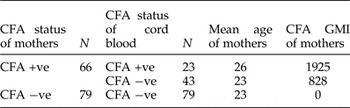
The details of the study population, CFA units and age are shown in table 1. All mothers included in the study were living in rural areas. The majority of them were housewives by occupation with a primary level of school education (77.5%). No difference was noticed in terms of age in years or multiparity status. A total of 145 pairs of mother and cord blood samples were collected and examined for CFA status using an Og4C3 ELISA. Out of 145 samples, 66 mothers were CFA positive and rest of the samples were CFA negative. Among the CFA-positive samples, 23 samples were found to be positive for both maternal blood and the corresponding cord blood, and 43 samples were found to be positive for CFA in maternal blood only, and not in cord blood. The samples were classified into three groups based on the presence/absence of CFA status of the mother and the respective cord blood: Group 1, mother and cord blood were CFA positive (M+C+); Group 2, mother was CFA positive and the respective cord blood was CFA negative (M+C−); and Group 3, mother and cord blood were CFA negative (M−C−).
The status of circulating filarial antigens (CFA) in maternal and cord blood samples of the study population; N, number of samples examined; GMI, geometric mean index.

Filaria-specific antibody responses to excretory/secretory and detergent-soluble filarial antigens
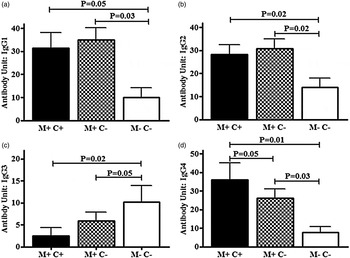
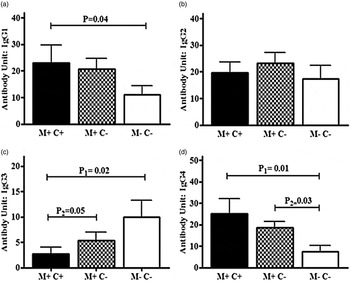
Filaria-specific IgG1, IgG2, IgG3 and IgG4 antibodies were assessed in all the samples against excretory/secretory antigen (ES) and detergent-soluble antigen (DSA), as shown in figs 1 and 2, respectively. Filaria-specific IgG1 and IgG2 responses in cord blood of M+C+ and M+C− groups were significantly higher than those of the M−C− group. No significant difference was observed in the antibody units among the mothers of all three groups (data not shown). In contrast, the filaria-specific IgG3 response was significantly higher in cord blood of children born from uninfected mothers (M−C−) compared to the cord blood of children born from infected mothers (M+C+, M+C−). Since filaria-specific IgG4 is a marker of active filarial infection, we compared the levels of IgG4 in CFA-positive and CFA-negative cord blood of children born from filaria-infected mothers. IgG4 antibody levels were found to be significantly higher in the cord blood of M+C+ and M+C− groups compared to that in the cord blood of children born from uninfected mothers (M−C−). A similar pattern of IgG1 antibody responses to DSA was found in the cord blood of all three groups. Filaria-specific IgG1 responses were significantly higher in the cord blood of M+C+ and M+C− groups than that of the M−C− group, and IgG3 was significantly higher in the M−C− group than the other two groups. IgG4 response to DSA antigen was significantly higher in the cord blood of the M+C+ group than that of the M−C− group.
Filaria-specific antibody responses to excretory/secretary filarial antigens. Antibody units of filaria-specific IgG1 (a), IgG2 (b), IgG3 (c) and IgG4 (d) response in cord blood of children born from CFA-positive mothers (M+C+ and M+C−) and CFA-negative mothers (M−C−) against excretory/secretory antigens. M+C+: mothers and children were CFA positive; M+C−: mothers CFA positive and children CFA negative; and M−C−: mothers and children were CFA negative. Bars represent geometric mean ± SEM values.

Filaria-specific antibody responses to detergent-soluble filarial antigens. Antibody units of filaria-specific IgG1 (a), IgG2 (b), IgG3 (c) and IgG4 (d) response in cord blood of children born from CFA-positive mothers (M+C+ and M+C−) and CFA-negative mothers (M−C−) against detergent-soluble antigens. M+C+: mothers and children were CFA positive; M+C−: mothers CFA positive and children CFA negative; and M−C−: mothers and children were CFA negative. Bars represent geometric mean ± SEM values.

The present study demonstrated the influence of maternal CFA status on filaria-specific IgG subclass responses in cord blood samples of offspring born from mothers living in the same endemic area of bancroftian filariasis. In this study we have used only CFA, which is a marker for active filarial infection, by quantifying circulating filarial antigens independent of microfilariae. Since all the mothers included in the study were inhabitants of communities with active transmission, it is likely that all of them were exposed equally to the infection. Interestingly, the mothers of the third group of our study population (M−C−) were exposed and appear to have developed resistance to W. bancrofti infection. Their fetuses were not exposed passively. In this study, out of the sample of 66 CFA-positive mothers, 23 samples (M+C+) were found to be positive for CFA in maternal and cord blood, which supports our earlier and other published reports that transplacental transfer of filarial antigens occurs from infected mothers to their offspring (Hitch et al., Reference Hitch, Eberhard and Lammie1997; Bal et al., Reference Bal, Mandal, Das, Kar, Sarangi and Beuria2010).
Excretory/secretory antigens and detergent-soluble antigens have been reported to play an important role in diverting the host immune response. The investigation carried out earlier on in-utero sensitization to IgG antibody responses in human filariasis used only crude extracts of different stages of parasites (Hitch et al., Reference Hitch, Eberhard and Lammie1997; Lammie, Reference Lammie, Klei and Rajan2002). They found that cord and maternal IgG levels were directly correlated, independent of maternal infection status. However, they did not evaluate the IgG subclass response to even crude filarial antigens. In our study, filaria-specific IgG1, IgG2 and IgG4 subclass responses were significantly higher in the cord blood of offspring born from infected mothers than in those born from uninfected mothers. In contrast, the filaria-specific IgG3 subclass response was significantly higher in the cord blood of neonates born from uninfected mothers than in those born from infected mothers. The observed high IgG3 and moderate IgG1 and IgG2 responses in CFA-negative samples may be due to the passage of maternal antibodies across the placenta (Hashira et al., Reference Hashira, Okitsu-Negishi and Yoshino2000). The filaria-specific IgG4 response was found to be significantly higher in cord blood samples of infected mothers compared to those of uninfected mothers. Filaria-specific IgG4 has been considered to be a marker of patent infection, and high levels of IgG4 antibody were correlated with high microfilarial loads (Adjobimey & Hoerauf, Reference Adjobimey and Hoerauf2010). Among the cord blood samples of infected mothers, the IgG4 response was higher in the M+C+ group than in the M+C− group, indicating that the IgG4 response in cord blood serum may be associated with the adult worm burden of mothers. All the above results indicate that transplacental transfer of filaria-specific IgG4 and filarial antigens was greater when the adult filarial worm burden was high in mothers. It is possible that: (1) excretory/secretory antigens can cross the placental barrier with more ease than detergent-soluble antigens; and/or (2) excretory/secretory antigens are more immunogenic and responsible for in-utero sensitization compared to detergent-soluble antigens. The results of this study provide evidence that prenatal sensitization to filarial antigen induced IgG4 antibody responses in cord blood, and that high IgG4 responses in cord blood are associated with in-utero sensitization.
Acknowledgements
We are very thankful to Dr. N Mahapatra, Director I/C of Regional Medical Research Centre, Bhubaneswar for his sustained support for this study. We are also thankful to the mothers who participated in this study. We also thank Mr K.C. Parichha for technical assistance.
Financial support
Financial support was received from the Indian Council of Medical Research, New Delhi, India.
Conflict of interest
None.
Ethical standards
The study was approved by the review boards of the Human Ethical Committee of the Regional Medical Research Centre (ICMR), Bhubaneswar.