Declared a UNESCO World Heritage site in 1988, Chichen Itza stands as a monumental landmark foreshadowing the Mesoamerican Postclassic era. Among the enigmatic aspects of Chichen Itza's architectural program counts a monumental platform decorated with reliefs of impaled heads and partially skeletonized creatures traveling through what seems to be a mythical underworld passage. The interpretation of this tzompantli platform remains shrouded in mystery now that the original idea of a unilateral “Toltec” adoption from the Mexican highlands has been discarded as simplistic and diffusionist (Kristan-Graham and Kowalski Reference Kristan-Graham, Kowalski, Kowalski and Kristan-Graham2007). Additionally, our former understanding of Mesoamerican “skull racks” has moved toward a more nuanced appreciation of these structures as “scaffolds” (Carreón Reference Carreón2006, Reference Carreón2013; Mendoza Reference Mendoza, Chacon and Dye2007; Miller Reference Miller and Kowalski1999, Reference Miller2017; Taube Reference Taube, Benson and Griffin1988, Reference Taube and Prem1994, Reference Taube2017; Tiesler Reference Tiesler2017). The tzompantli platform's precise public uses have been debated, but remain speculative without any primary contextual evidence or basic understanding of the ritual choreographies and the precise religious exigencies that may have motivated its construction and maintenance in the first place. As regards the victims themselves, whose decapitated heads we assume to have once fed Chichen's central tzompantli, interpreting them still hinges mainly on the sculpted and painted representations of their body parts (Miller Reference Miller and Kowalski1999, Reference Miller, Tiesler and Cucina2007, Reference Miller2017). We can safely say that scholarship is not yet positioned to understand the full scope of sacrificial sequences or the ideological underpinnings that once drove the intimidating volume of ritualized slaughter and corpse processing displayed at Chichen Itza. As we believe, a dearth of interdisciplinary communication can be blamed at least in part for our sustained lack of academic progress.
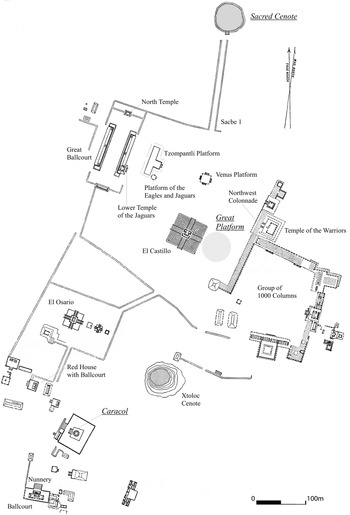
With our own “body-centered” approach, we wish to bridge the interdisciplinary gaps toward a more integrated reconstruction and discussion of ancient ritual body processing and display at Chichen Itza and other late (Terminal to Early Postclassic) Maya centers with skeletal and iconographic evidence of perimortem violence and corpse processing. To this end, we start out by addressing the skeletal remains of those who had undergone different forms of ritualized violence and post-sacrificial processing among five emblematic human skeletal series from Chichen's site-core: one human assemblage from the subsoil of the Great Platform surrounding the Castillo, one collection from the Caracol, one skull from the Osario complex, and two more from the Sacred Cenote (Figure 1). For the scrutiny of these skeletal vestiges, we apply current forensic and bioarchaeological procedures and then confront our surveys with the monumental iconography of sacrifice, corpse processing, and particularly head display at the Chichen stronghold and among its northern Maya peers.
Plan of central Chichen Itza. Architectural complexes described in this text are shown, and the three areas with human remains considered in this paper appear in grey, their names underlined. Drawing adapted from Maudslay and Maudslay (Reference Maudslay and Maudslay1899).

STUDYING THE SKELETAL RECORD OF HUMAN RITUAL DISCARD AT CHICHEN ITZA
The contextual attributes of human assemblages retrieved from Chichen's center that we presume to stem from ritualized violence, are indeed similar to those of other late Maya centers (Tiesler and Cucina Reference Tiesler and Cucina2007). They include burning, smoking, artificial fragmentation, flaying, excarnation, dismemberment, and artifactual recycling of teeth and bones. Because human body treatments by defleshing, flaying, or fire exposure have been documented as well among ancestrally motivated burials and caches (Fitzsimmons Reference Fitzsimmons2009, Reference Fitzsimmons, Fitzsimmons and Shimada2011; Scherer Reference Scherer2015), any presumed sacrificial labeling in ancient sinkholes, ceremonial dumps or middens requires careful case-by-case appraisal of taphonomic signatures (specifically marks of processing and the degree of commingling; Tiesler Reference Tiesler, Prufer and Brady2005, Reference Tiesler, Tiesler and Cucina2007). The non-funerary bone assemblages are also distinguishable by their location in publicly or religiously utilized contexts. A number of remains suggestive of such non-funerary discard are scattered about Chichen's ceremonial spaces. Such is the subsoil of the Great Platform and the Caracol structure, both of which were littered with isolated human segments. Additional bodies and body segments were thrown into the sacred waters of the city's Sacred Cenote, which functioned until recently as a major Mesoamerican portal for offerings and sacred invocation (Coggins Reference Coggins1992; Folan Reference Folan1980; Pérez Romero Reference Pérez Romero2007).
Skeletal Discard in the Subsoil Great Platform Near the Castillo
Abundant bone discard littered the subsoil in the immediate vicinity of the Castillo, trenched extensively during a recent archaeological effort led by Cobos (Braswell and Peniche May Reference Braswell and May2012; Cobos et al. Reference Cobos, German, Canto and Cobos2016). Especially in close range of the Castillo, such culturally processed human remains blended with faunal remains in the fills of Layer IV, which has been radio-carbon-dated between a.d. 886 and 981 (Ringle Reference Ringle2017:130, Figure 9; Volta and Braswell Reference Volta, Braswell and Braswell2014). Except for a partly articulated cervical spine from Test Pit 119, all documented anatomical fragments appeared isolated and highly commingled. Most of these human concentrations display indications of protracted body and bone processing in the form of slicing, fractures, and sharp force trauma in fleshed bone, scratching, sectioning, and drilling of skull segments, along with bone surface polishing and probably boiling. Although the contextual situation does not permit the reconstruction of any sequenced anthropic (human) behavior, this archaeological complex does provide a general idea of the massive amount of human body processing that went on around the Great Platform. It is also of note that the worked segments from this area appear in a much higher proportion to unworked human bone when compared to similarly classified isolated human deposits at other site cores, such as Calakmul, Becan, Kohunlich, or Xcambo (Ceballos Reference Ceballos2014:94).
An Early Functional Tzompantli at the Caracol Complex
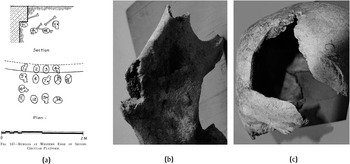
Contextually more informative are the human remains recovered from below the western edge of the second circular platform of the Caracol complex. This mortuary deposit includes 14 skulls exposed and drawn during an early field exploration organized by the Carnegie Institution of Washington (Figure 2a; Ruppert Reference Ruppert1935:119–125). These had been placed on top of a number of postcranial segments, such as iliac bones and femurs. The crania spread evenly over an area of roughly 1.2 × 1 m, forming at least four regular and distinctive rows of one to five skulls each. Skull no. 5 was described as conserving an articulated lower jaw together with the first four upper cervical vertebras, thereby implying a head deposit. In a similar fashion, the parietal bones (which form most of the cranial roof and sides of the cranial vault) of Skull no. 10 were reported to have been “broken through and rested on the mandible, which was intact” (Ruppert Reference Ruppert1935:123).
Functional tzompantli from the Caracol astronomical complex, Chichen Itza. (a) Sketch of skull alignments recorded by the Carnegie Institution of Washington beneath the central part of upper staircase and the perimeter of the circular platform (Ruppert Reference Ruppert1935:Figure 147). Drawing used by permission of the Carnegie Institution for Science. (b) Left mandibular branch from the tzompantli assemblage of the Caracol complex, Chichen Itza, displaying a sharp blow to the mandibular angle from the back in fresh bone (Dirección de Antropología Física/ Instituto Nacional de Antropología e Historia). (c) Right view of cranial vault crudely cut open on both sides by way of chopping and fracturing the sides of the cranial vault (Dirección de Antropología Física/Instituto Nacional de Antropología e Historia). Photographs by Tiesler.

Today the Department of Physical Anthropology of the Instituto Nacional de Antropología e Historia curates the human assemblage from the Caracol substructure in Mexico City. At present, the lot is made up of at least 20 fragmented and incomplete mandibles along with 15 skull vaults. Additional postcranial segments of at least 15 (mostly young) adults and of at least three more children were represented in this context. Although erosion did not allow for any systematic surface analyses for this study, there were some evident signs of unhealed damage inflicted by humans in ancient times. For example, one of the left mandibular branches displayed a blow in green (i.e., fresh) bone that had entered its rear lower edge from behind the body (Figure 2b).
A similar perimortem timing is implied by blunt and sharp force trauma that damaged at least four cranial vaults (Figure 2c). These skulls display irregular albeit large perforations from below and/or on the sides. These orifices, cut into the skulls in a fresh state, now confirm the original suspicion that some of the heads had been skewered. These perforated heads must have formed part of a perishable skull rack that collapsed and was covered over in a similar fashion to other so-called “functional” skull racks in Mesoamerica, as these archaeologically retrieved skull assemblages with signs of skewering have been named. This one either fell by accident or was intentionally buried beneath new layers of construction. Clear examples of these sorts of suspended rows of heads have been documented in different parts of Mesoamerica by at least the Late Preclassic period, as illustrated by the findings from Loma de Coyotera, Oaxaca, and Cerro del Huistle, Jalisco (Hers Reference Hers2017; Redmond and Spencer Reference Redmond and Spencer2017; see also Mendoza [Reference Mendoza, Chacon and Dye2007] and Xochipiltecatl [Reference Xochipiltecatl2004] for systematic reviews of Mesoamerican tzompantli structures).
While we can only speculate how long the functional tzompantli from the Caracol substructure was in use, the end of its use-life and interment should date to the early or middle 900s (Graña-Behrens Reference Graña-Behrens2009:232–233; Volta and Braswell Reference Volta, Braswell and Braswell2014:376). The Caracol Disc, a tenoned stone sculpture positioned right above the fill of the aligned skulls, may record epigraphically a visit of outsiders between a.d. 929 and 932 (in the Yucatecan Short Count). Although this time bracket is still disputed (Bíró and Pérez de Heredia Reference Bíró and de Heredia2016:155–156, Reference Bíró and de Heredia2018; Graña-Behrens Reference Graña-Behrens2009:233; Ringle Reference Ringle2017:120, n7; Volta and Braswell Reference Volta, Braswell and Braswell2014:375), the ceramic analysis of three vessels recovered from this same building phase ties in with this chronology (one Terminal Classic striped Piste jar and two grey slate tripod bowls; see also Ruppert Reference Ruppert1935:Figures 48 and 102; Socorro Jiménez, personal communication 2018). The functional tzompantli, now confirmed from the substructure of the Caracol, therefore must have predated the construction of Chichen's central tzompantli platform by at least half a century, as we shall discuss in section The Central Tzompantli Platform. Clearly, human head impalement and public exhibition were already in place at Chichen Itza decades before the flowering of the eclectic architectural style that characterizes the Great Platform with its Great Ballcourt and its adjacent tzompantli.
Noteworthy in all documented cases of cranial impalement from this context is the poor craftsmanship and the diversity in trepanation size and anatomical location. This lack of mastery appears to signal that the placement and maintenance of head racks was not yet standardized, despite the ability to integrate multiple rows, as indicated by the Carnegie expedition record. One other condition is striking and relates to the degree (or lack thereof) of soft-tissue processing prior to exhibition on the rack: despite the poor state of preservation, which limits any systematic survey of the cranial surfaces from the Caracol context just as it does for the long bones that accompanied them in this assemblage, the idea that no single slicing mark was encountered contrasts with the abundance of cutmarks on perforated skull vaults from the Sacred Cenote. This makes us believe that during the early stages of Chichen's heyday, decapitated heads were already exposed in public, but not in the numbers and in the state of excarnation of those displayed many years later next to Chichen's Great Ballcourt.
A Single, Bilaterally Impaled Cranium from the Osario
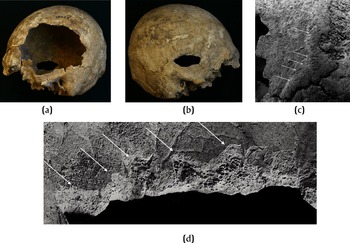
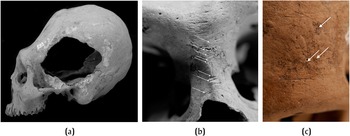
The third skeletal case study for this article forms part of a collection recovered in 1896 by Edward H. Thompson from Chichen's Osario, a temple complex between and approximately equidistant from the Castillo and the Caracol (Figure 1). Now curated at the Field Museum in Chicago, this series was labeled as part of the “High Priest's Grave.” Thompson (Reference Thompson1938) describes diverse human remains from an ossuary together with two additional tombs, seven burials, and isolated concentrations of human remains (see also Headrick Reference Headrick, Wren, Kristan-Graham, Nygard and Spencer2018). Unfortunately, no mention was made of a well-preserved (although incomplete) skull (Figure 3). Partly covered with soil and/or lime, and possibly smoked, the isolated neurocranium belonged in life to a robust middle-aged adult male. Slight flattening of the cranial vault during infancy resulted in a short and broad head silhouette, the most frequently displayed head form seen among the skeletal population from Chichen Itza (Marengo Reference Marengo2023; Tiesler Reference Tiesler2014). The skull's left parietal and temporal bones display one large lateral perforation (Figure 3a), while the upper portion of the right temporal bone displays a proportionally smaller void (Figure 3b). Some of its observable exocranial surfaces show marks of slicing and scratching, effected in antiquity in a fresh state. These cutmarks are particularly evident along the posterior border of the left perforation (Figure 3c). Additional indications from fractures and precision blows appear both on the endocranium and on the exocranium and seem to stem from bilateral penetration in a fresh state (Figure 3d). Unfortunately, the lack of contextual information precludes any precise chronological assignation, although a date of A.D. 998 on a carved column at the structure's top suggests that the Osario was built no earlier than the mid to late tenth century (Headrick Reference Headrick, Wren, Kristan-Graham, Nygard and Spencer2018:202).
The Eloquent Bones from the Sacred Cenote
For over 1,000 years, the Sacred Cenote of Chichen Itza has drawn pilgrims from all over Mesoamerica (Pérez Romero Reference Pérez Romero2007). With the centuries, abundant donations of precious materials and certainly of humans have filled its aquatic entrails. Thanks to the stable aquatic environment, most of this trove has been preserved largely unharmed by the ravages of time and decay. This includes the skeletonized vestiges of those drowned in its waters. Unfortunately for scholarship, no chronological, contextual or provenience information aids the bioarchaeological reconstruction of the isolated skeletal segments recovered one by one.
Hooton (Reference Hooton, Hay, Linton, Lothrop, Shapiro and Vaillant1940) was the first physical anthropologist entrusted with the skeletal scrutiny of the collection years after it was extracted by Thompson (Reference Thompson and Coggins1992) and integrated into Harvard's Peabody Museum in Cambridge. Although Hooton did not report on any postmortem flaying or excarnation, he readily noted the enormous amount of physical violence perpetrated on the people whose bodies sunk in the Sacred Cenote. From this he concluded nonchalantly that “altogether…the adult denizens of the Sacred Cenote of Chichen Itza may not have been generally beloved in their pre-sacrificial careers” (Hooton Reference Hooton, Hay, Linton, Lothrop, Shapiro and Vaillant1940:277).
A series of conventional studies of the human vestiges from this sinkhole have followed up on Hooton's original findings (Beck and Sievert Reference Beck, Sievert, Rakita, Buikstra, Beck and Williams2005; Tiesler Reference Tiesler2014, 2017; Tiesler and Cucina Reference Tiesler, Cucina, Martin, Harrod and Pérez2012). A second large skeletal series was recovered during the 1960s by archaeologist Piña Chan and his Mexican team and has led to additional skeletal scrutiny (de Anda Reference de Anda2006; Folan Reference Folan1968, Reference Folan1980; Piña Chan Reference Piña Chan1970). The most recent skeletal explorations point toward the late chronology of human disposals and attest to a wide range of their geographic proveniences, including the Mexican highlands and Central America (de Anda et al. Reference de Anda, García, Cobos and Cobos2016; Price et al. Reference Price, Tiesler and Freiwald2019).
The present study is founded on the systematic analysis of both skeletal collections recovered from the Sacred Cenote, using standard criteria of skeletal scrutiny as described in Buikstra and Ubelaker (Reference Buikstra and Ubelaker1994) (Table 1). The overall series is made up of at least 78 mainly male adults, and at least 151 more individuals below the age of 20 (as inferred from the right femoral counts). Over half the subadults fall in the age bracket between six and 12 years (as supported by the degree of maxilar dental maturation in skulls). The overall count further includes some 150 complete or semicomplete crania, 1/3 of which are marked by anthropic (cultural) body processing inflicted during and/or past the time of death. Every fourth head shows specific indications of flaying, disarticulation, defleshing, and/or impalement in a fresh state. Additionally, some of these body segments appear to have been exposed to the elements, given their wear due to weathering. Although no previous study has referred to impalement among these skulls from the Sacred Cenote, the literature does document a varied set of posthumously inflicted anthropogenic signatures among cranial segments as well as in bones of the trunk, legs, and arms (de Anda 2007; Beck and Sievert Reference Beck, Sievert, Rakita, Buikstra, Beck and Williams2005; Tiesler and Cucina Reference Tiesler, Cucina, Martin, Harrod and Pérez2012). These marks include thermal exposure in different forms, flaying, defleshing, dismemberment, and human bone manufacturing. Our recent scrutiny additionally found signs of eyeball extraction in at least six skulls, as indicated by levering trauma in the bony eye sockets (Tiesler Reference Tiesler2017). All of the individuals with such damage displayed additional cutmarks of soft-tissue detachment.
Total counts of selected human anatomical segments from the Sacred Cenote of Chichen Itza. These were recovered by Edward H. Thompson (and curated at the Peabody Museum, Harvard University) and by Román Piña Chan (curated at the Dirección de Antropología Física/Instituto Nacional de Antropología e Historia). Minimum number of individuals (MNI) from both collections are inferred by the highest number among paired bones. Adults (beyond 20 years) are distinguished from subadults and adolescents (first two life decades). The MNI is founded on the highest anatomical segment count in lateralized paired segments and on complete or semicomplete skulls and mandibles in the cranial skeleton. The adult ratio provides the proportion of adults of total MNI.

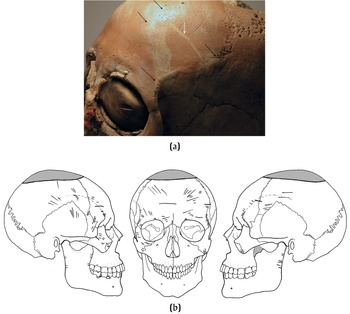
We may only speculate about the materials and objects that replaced the natural eyeballs for display after extraction or decomposition had occurred. It is quite likely, however, that such prostheses were used frequently, given that globe-shaped spheres are depicted in the eye sockets in the overwhelming majority of Maya skull renderings, including those from the great tzompantli. One such pair of artificial eye plugs, made out of perishable material, has been preserved inside the eye sockets of a human skull censer from the Sacred Cenote (Figure 4a). Note that the cranial surfaces of this skull artifact were covered with fine slicing marks from flaying and defleshing (Figure 4b). These are similarly distributed when compared to the skulls with signs of levering trauma and those with apertures from impalement, to be discussed in the following section.
Male, adult skull recorded among the isolated skeletal remains recovered from the High Priest's Grave/Osario complex (Headrick Reference Headrick, Wren, Kristan-Graham, Nygard and Spencer2018;Thompson Reference Thompson1938), displaying a large lateral perforation of (a) the left parietal and temporal bones and (b) proportionally smaller void left in the upper right temporal bone of this individual. (c) Close-up view of posterior border of left neuro cranial perforation displaying extensive cutmarks from repetitive slicing of soft tissue (white arrows). (d) Endocranial view of the upper margin of the left cranial perforation, showing a regular breakage pattern from external fracturing of fresh bone (white arrows) (courtesy of The Field Museum, Cat. No. 40452). Photographs by Tiesler.

Adult skull recovered from the Sacred Cenote of Chichen Itza, worked into an artifact. (a) The top of the cranial vault had been cut, the eye sockets and nasal bridge covered with stucco and painted red, and the eyeballs replaced with perishable organic material. Black arrows indicate ancient slicing marks from soft-tissue removal, white arrow indicates recent damage, possibly during dragging of the Cenote (Peabody Museum of Archaeology and Ethnography, Harvard Museum, President and Fellows of Harvard College). (b) Schematic representation of slicing marks on the front and sides of skull. Missing areas appear in grey. Photograph and tracings by Tiesler.

Marks of Head Impalement
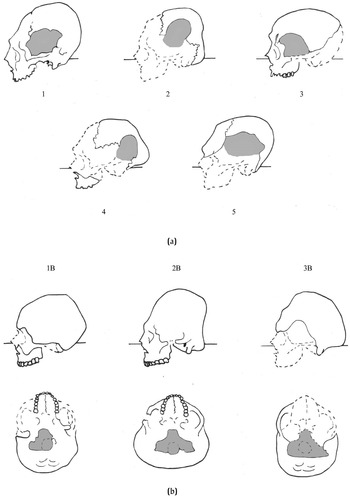
For the purposes of this study, we systematically registered skeletal indications of cranial opening in both skeletal series from the Sacred Cenote. Given the repetitive head representations on the sides of Chichen's central tzompantli platform, we expected to find the combined marks of vertical impalement in the basal and the superior portions of at least some of the skulls. Contrary to the imagery on the tzompantli, however, none of the specimens with marks of systematic vault breakage displayed any such superior opening. All documented apertures were either located on the base of the skull or on both sides (Figures 5a and 5b).
Tracings of impaled skulls with apertures shaded in grey. All profiles are oriented according to the Frankfurt plane (horizontal line) and are represented as left lateral views to facilitate comparisons. Note the diverse shapes of artificially modeled cranial vaults, suggesting different dates and/or origins of victims. (a) Profile and basal view of three skulls impaled from below, displaying diversity in artificial head shapes, which lends support to their different chronologies and/or geographic origins. (b) Profile of five skulls perforated on both sides in a fresh state (Sacred Cenote of Chichen Itza; Collection of the Peabody Museum and Dirección de Antropología Física/Instituto Nacional de Antropología e Historia). Drawings by Rocío Albarrán.

The three confirmed basal openings in complete skulls included subadult and adolescent skulls (Figure 5a). Apart from skewering, we note that the breakage from below may have occurred additionally as a way to extract brain tissue or other procedures, such as unhinging the lower jaw from the temporal-mandibular joint. Basal aperture was reached in each specimen by way of percussion around the oval occipital foramen on the base of the skull. The asymmetrical results we encountered in most cases make us think that the impalement from below did not keep the heads in a perfectly upright position unless adjusted.
Unlike the skulls opened artificially from below, the bilateral, horizontal cranial orifices are represented in the skeletal assemblages by males who died at an age that was more advanced on average than the age groups represented among the cranial vaults opened from below (Figures 5b and 6a). We confirmed at least five skulls with such bipolar breakage, all of which displayed additional marks of slicing and scratching from flaying and excarnation (Figure 6b). The bilateral breakage was reached analogously to basal openings by striking the surface with a pointed object. This procedure resembles the technique described by Chávez (Reference Chávez2017:193–194, Reference Chávez2019) for the impaled skulls from the central sanctuary of the Aztec Templo Mayor. These perforations were effected by percussion with a pointed stone instrument causing small circular depressed fractures with mostly regular beveling of the inner edges. In our case, the lower portions of the parietal bones and the upper portions of the temporal bones (i.e., the area above the ears) were the target of processing on both sides of the skull to reach bilateral aperture.
Male, adult skull recovered from the Sacred Cenote of Chichen Itza, displaying bipolar perforation of both parietal and upper temporal bones. (a) Left lateral view: the aperture is roughly rectangular on the left side and larger and polygonal on the right side of the vault; the severe tabular oblique modification stems from prolonged splinting during infancy, a common form of head shaping during the Classic period in the Maya Lowlands but abandoned during the Postclassic (Tiesler Reference Tiesler2014). (b) Close-up view of nasal portion displaying extensive cutmarks from repetitive slicing of soft tissue and cartilage. (c) Close-up view of left forehead, showing parallel marks (white arrows) of slicing from flaying along with patches of dark color (No. 07-7-20/58242, Peabody Museum of Archaeology and Ethnography, Harvard Museum, President and Fellows of Harvard College). Photographs by Tiesler.

In a few cases, the openings were completed by breakages effected from the interior side of the skull or by detaching bone from surrounding cranial sutures. In those cases that could be documented, the procedures resulted in polygonal or roughly circular orifices, sometimes damaging the adjacent portions of the frontal and/or occipital bones. Like the basal openings, the contours of the bilateral orifices appear to be asymmetrical and irregular (Figure 6a). We could not document any percussion marks around the edges of the apertures, although this does not mean they did not exist. Although more regular in craftsmanship that those described from the Osario structure and the earlier Caracol structure, the impalement holes of the skulls discarded in Chichen's Sacred Cenote are still a far cry from the seemingly much more standardized, regular openings recorded among the impaled skull deposits from later Tenochtitlan (Chávez Reference Chávez2017:205–209, Reference Chávez2019; Chávez et al. Reference Chávez, Castro, López, Tiesler, Suzuki and Pereira2021). Compared to the Aztec series, the segments from the Sacred Cenote still exhibit quite a diversity in breakage patterns. Here, the opening procedures still hinge importantly on the forced separation along cranial sutures, often leading to uneven breakages and therefore irregular morphological results.
Head Exposure, Decomposition, and Paint
A further question relates to the state of decomposition (and the amount of time) that the skull segments that display marks of impalement were left in the open before being buried, possibly being displayed on top of a tzompantli platform. Indeed, half of the eight perforated skulls (Figures 5a and 5b) show a surface color and texture that is visibly lighter than most other human remains from the Cenote, which are characterized by their dark tone and shiny surface quality resulting from decomposing within a subaquatic environment. These heterogeneous bone surface qualities appear to indicate that in half of these individuals, the decomposition and skeletonization process occurred in a nonaquatic environment, lending support to the possibility of their prolonged exposure to the elements during display.
This idea is further confirmed in five of the suspended cranial specimens, which had been artificially blackened at some point, as the appositions of dark color on the cranial surfaces seem to indicate (Figure 6c). Another four skulls had been spotted reddish or yellow. Although most of the paint is external, it is not exclusively limited to the outer surfaces of the cranial vaults. No systematic material scrutiny has yet allowed for deepened insights into the timing, type or distribution of such paint. The mere presence of color on bone, however, makes a case for the protracted nature of head and skull manipulation, which we assume was related to prolonged public display in all or some of the impaled skulls documented here.
Death and the Mortuary Paths of Lower Jaws
A last word regards the lower jaws from both skeletal collections from the Sacred Cenote. At the Peabody Museum, the curators had hinged each mandible into the corresponding temporal fossae of the skull whenever they encountered any anatomical match. Successful or probably successful matches between individual crania and their mandibles were confirmed for this study by aligning the teeth of the upper and lower dentitions, by verifying overall facial morphology and similarities in surface color. Our results indicate that all the perforated skulls with matching or probably matching mandibles had been penetrated from below, while none of the bilaterally perforated skulls possessed a matching mandible. This may indicate either a distinctive form of processing and maintenance, a different timing of discard, or simply the inability to fit segments from the incompletely recovered underwater deposit. This said, both the individualized and isolated mandibles from the two skeletal series showed a recurrent pattern of disarticulation and defleshing in green bone. This taphonomic pattern signals that the lower jaws were detached from the face still in a fleshed state. This could have been achieved by cutting through the chewing muscles below the cygomatic arch (cheek bone) and cleaning the lower part of the face from its soft tissue. This form of processing is further hinted at by the rendering of horizontal cuts among the partly defleshed faces on Chichen's tzompantli walls and shall be discussed in section Reliefs from the Great Ballcourt Complex.
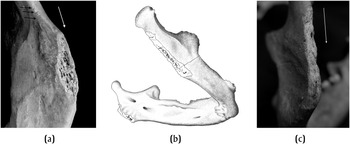
A different sort of cut replicates the morphological result already described for one mandible from the Caracol deposit (Figure 5b). The edges of at least 10 mandibles show sharp blows that entered the neck horizontally from behind when still in a fleshed state (Figure 7a). Edges cut in a similar fashion have also been documented in a number of mandibles from highly processed ritual deposits outside Chichen Itza. We cite recently studied skeletal research of a massive Postclassic human depository from the Acropolis of Tonina (Ruiz Reference Ruiz, Tiesler, Suzuki and Pereira2021) and of the site of Tezontle (at Tula), conducted by the first author (Figures 7b and 7c). Much earlier, dated to the Early Classic period, around a.d. 350, is a further specimen from of the Pyramid of the Moon at Teotihuacan. The assemblage in question (Deposit 4) consists of 17 skulls that were still articulated with their vertebrae and mandibles. Pereira and colleagues (Reference Pereira, Sugiyama, Spence, Castex, Coutaud, Duday, Mort and Tillier2006:251–252, 268–271) document a fractured edge in one of the mandibles, which they attribute to a sharp blow inflicted from behind around the time of death. As regards the cases from Chichen Itza, we cannot distinguish with this forensic evidence alone whether these blows were the side-product of posthumous beheading (or any other ulterior stage of soft and hard tissue processing) or whether they stem from decapitation of a still living victim, as the programmatic scenes on the lower panels of Chichen Itza's main ballcourt imply (Figure 8a).
Mandibles with sharp force trauma in mandibular angles. (a) View from the back of severed edge of right mandible from Sacred Cenote, Chichen Itza. White arrow shows the oblique direction of impact from behind. Black arrows show marks of posthumous slicing for soft-tissue detachment (Peabody Museum of Archaeology and Ethnography, Harvard Museum, President and Fellows of Harvard College). (b) Severed edges of both mandibular angles from sharp blow(s) from behind towards the front of the head. This segment is part of a highly processed mass burial from Postclassic-period Structure 15, Tonina, Chiapas (Proyecto Arqueológico Toniná, Instituto Nacional de Antropología e Historia). Redrawn by Hemmamuthé Goudiaby after Ruiz (Reference Ruiz, Tiesler, Suzuki and Pereira2021). (c) Back view of severed left mandibular angle after receiving a blow from behind. Late Postclassic Tezontle, Tula. White arrow shows the oblique direction of impact from behind (courtesy of The Field Museum, Cat. No. 42800). Photographs by Tiesler.

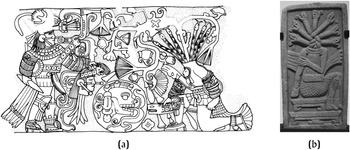
Scenes of decapitation with the victim in a kneeling or seated position, with blood flow or metaphorically entwined serpents coming out of the neck stump: (a) Central scene, east central panel from Great Ballcourt, Chichen Itza. Drawing SD-5058 by Linda Schele ©David Schele, photograph courtesy Ancient Americas at Los Angeles County Museum of Art. (b) Ballcourt panel from Aparicio, Vega de Alatorre, central Veracruz (Museo de Antropología de Xalapa, Universidad Veracruzana). Photograph by Tiesler.

DEATH AND RITUAL BODY PROCESSING IN “NEW” CHICHEN'S SCULPTURAL PROGRAM
Unfortunately, neither the earlier functional skull rack from the Caracol nor the remains from the Sacred Cenote hold any direct contextual or spatial relationship to the iconographic program of ritualized violence that drapes the Great Ballcourt and the adjacent tzompantli platform. Here, only two isolated skulls were recovered from the platform fill, together with two monumental chacmool sculptures, a large stone ring, and the scorched remains of a mosaic disk (Acosta Reference Acosta1954:33–34; Miller Reference Miller, Tiesler and Cucina2007; Taube Reference Taube2017). None of these bone segments have been preserved or made available for further academic scrutiny. In the following section on the reliefs found in the Great Ballcourt complex, we shall therefore relate the represented forms of ritualized body processing to the taphonomic signatures we have documented in the skeletal record, starting with those surrounding and possibly causing death by decapitation.
Reliefs from the Great Ballcourt Complex
Turning to the representations of decapitation from the Great Ballcourt, can we relate them to the actual skulls and jaws with sharp-force trauma deposited at the Caracol and in the Cenote? As regards the mandibles cut from behind, which we have described for both of these human assemblages, we are tempted to connect them to these scenes. On the Great Ballcourt panels, blood serpents spurt out metaphorically from the severed necks of dying victims, seemingly pumped up by a still functioning heart (Figure 8a). From the detached head itself, streams of blood flow down. Coeval imagery from the Veracruz sites of Aparicio, Las Higueras, and El Tajin show similar blood spurts from what we presume are three arteries on each side of the neck stump (Figure 8b; Koontz Reference Koontz2009:18–19, Figures 2.3; Sánchez Bonilla Reference Sánchez Bonilla, Brüggemann, de Guevara and Bonilla1992:149). The theme may be even older and more widespread: looted mold-impressed tripod vessels displaying the seated decapitated figure, an executioner, and a ball containing a human head have been found in the Escuintla region of Guatemala, dating between the fifth and seventh centuries (Hellmuth Reference Hellmuth1975:Plates 8 and 9). Taken together, this imagery suggests that this specific form of decapitation was carried out in association with ballgames, with the victim still alive and taking a sitting or kneeling position, which would have been impossible to sustain if he were already dead.
The blood gush would certainly not be in line with posthumous decapitation after heart extraction, which strengthens the idea that such a form of decapitation could have caused the unhealed blows on the back sides of several of the mandibles documented from the Sacred Cenote and the Caracol. If this was the case, we are left to speculate on the form of decapitation of a robust male neck, which a number of authors contend requires a sturdy cutting block and cannot be achieved vis-à-vis a victim suspended solely by his hair, especially when effected with a lithic implement. Any collateral damage to the mandibular edges (Figures 7a–7c), such as those documented for this study, would likely not have occurred had the practitioners severed the head on any cutting surfaces in the form of flat or convex stone blocks, because the face (and therefore the lower jaw) would be pressed against the plane and be out of the way of the severing knife. A more plausible support to have incurred such cutting damage is a sharp-edged conical or triangular object, over which the throat of the victim would be pressed right before their neck was hit from above and behind. Elongated implements made out of hard wood or stone—such as the palma-like objects emerging out of the belts of processional figures represented on Chichen's Great Ballcourt panels—might make suitable supports for this decapitation procedure (Figure 8a). As of now, there is no consensus regarding the practical uses of palmas or other ballcourt gear in ritual killings (Annick Daneels, personal communication, 2020). As this question still awaits systematic academic scrutiny, we simply draw attention to similarly positioned palma-like accoutrements in other decapitation scenes featuring blood (or transforming serpents) spurting out of severed neck stumps, as illustrated at Chichen Itza itself and other Mesoamerican sites (Figure 8b). An additional issue regarding stone palmas is, of course, their rarity in the Maya archaeological record, although many lithic examples are known from Veracruz.
Ball playing and decapitation were closely linked throughout Mesoamerica, as we know from a range of visual and written sources. There are even a few reported examples of heads cached beneath ballcourt floors, such as the decapitated female skull found in a Late Classic context at the Maya site of Santa Rosa, Chiapas (Martínez and Carreón Reference Martínez, Carreón, Boxt and Dillon2012). Nevertheless, the relationship between ballcourts and tzompantlis is still not well understood. First of all, there are many more examples of the former in the archaeological record, approaching 2000, and perhaps only 30 of the latter (Carreón Reference Carreón2013:3). Second, while ballcourts are easily recognizable, skull racks are more elusive: structures decorated with sculpted skulls, for example, are not necessarily places on which heads were displayed, while it is also clear that heads were hung on wooden scaffolds and even trees, which are difficult to document archaeologically (Mendoza Reference Mendoza, Chacon and Dye2007). We do know, however, that the two structures were closely linked: for the Mexica, for example, a traditional act of settlement foundation was to build a ballcourt and skull rack (for a systematic review of the literature, see Carreón [Reference Carreón2006:15–17, Reference Carreón2013]).
According to Mexica creation stories, the “place of the skull,” in the center of the ball playing field, was likened to a refreshing spring (Taube Reference Taube2017:29). The seventeenth-century K'iche’ creation myth, the Popol Vuh, likens ballplaying, decapitation, and head display as complemental practices for engendering humanity. Ballcourts may have been perceived as crevices in the earth, providing human access to the world of gods and ancestors (Schele and Mathews Reference Schele and Mathews1998:207). The tzompantli, on the other hand, was sometimes represented as a flowering tree, and as mentioned above, decapitated heads were apparently hung on real trees (Carreón Reference Carreón2013:48; Mendoza Reference Mendoza, Chacon and Dye2007; Miller Reference Miller and Kowalski1999:345–346; Taube Reference Taube2017:29). According to the Popol Vuh, Hun Hunahpu, the maize god and father of the Hero Twins, lost his head in a ballgame with the lords of the underworld. Subsequently, the head was placed in a calabash tree, causing it to bear fruit and eventually impregnating the mother of the Hero Twins. In the Borgia Codex, two episodes of mythical underworld narrative take place on top of tzompantlis that are depicted in the form of verdant tree scaffolds where impaled skulls are placed. In each one of the two scenes (Borgia, pp. 19 and 45), the Lord of the Morning Star (Tlahuizcalpantecuhtli in Nahuatl) or his avatar Mixcoatl-Camaxtli (the Morning Star as a hunter) kneels on top of such a skull rack (Milbrath Reference Milbrath2019; Seler Reference Seler1980:vol. 2, p. 59; Xochipiltecatl Reference Xochipiltecatl2004:50–52, 156).
On a more prosaic level, it has been suggested that the Mesoamerican ballgame was a surrogate for warfare, serving as a way to resolve political and territorial rivalries (Carreón Reference Carreón2013; Declercq Reference Declercq2018; Fash and Fash Reference Fash, Fash and Uriarte2015:42–43). It has even been proposed that defeated warriors were forced to play a gladiatorial form of the ballgame, which they would lose (Miller and Houston Reference Miller and Houston1987:47). Their heads were subsequently cut off, prepared, and displayed on a nearby platform. The choreography of this ritual sequence brings us back to the reliefs of the Great Ballcourt at Chichen Itza, which depict scenes of kneeling, headless ballplayers whose severed arteries turn into serpents and flowering vines (Figure 8a). Opposite the victims are the victors, clasping knives in one hand and the victims' heads in the other. Between each pair of figures lies a large ball encasing a skull, highly ornamented and further animated with a speech scroll.
The complex multifigured reliefs within the North Temple of the Great Ballcourt, which may represent a series of acts related to the inauguration of a ruler, feature related activities (Wren Reference Wren, Robertson and Fields1994:25). One panel on the west wall depicts what seems to be a person kneeling between two executioners who are about to take his head, while another, on the east wall, repeats the central image of the ballcourt reliefs, namely, a decapitated figure whose blood spurts transform into serpents (Wren Reference Wren, Robertson and Fields1994:Figures 5 and 6). Similar iconography occurs elsewhere at the site, including on relief panels from two other ballcourts, neither in good condition when found: the Red House ballcourt (Structure 3C10; Ruppert Reference Ruppert1952:49, Figures 124b and 124c) and the Nunnery ballcourt (Bolles Reference Bolles1977:226–228).
Additional information comes from the Great Ballcourt Stone, a large carved sphere apparently found in the vicinity of the Great Ballcourt, although its original setting is unknown (Wren Reference Wren, Robertson and Fields1991:Figure 6). It bears a date of 10.1.15.3.6 (a.d. 864; for alternate readings of its date, see Braswell and Peniche [Reference Braswell and May2012:235]). The scene carved on its top surface varies from the other depictions in that the headless victim remains standing rather than kneeling. The prevalence of this theme—warriors/ballplayers witnessing a decapitation—suggests that it was a central political and religious act at Chichen Itza. Whether beheadings took place on the playing field itself is unknown although feasible, given the possibility of mobile cutting supports, as discussed above. Given the images of the heads or defleshed skulls and their locations, it is likely that the severed capita were subsequently impaled on perishable racks erected on top of the nearby tzompantli. The victims’ cut-up bodies, like their impaled heads, once dispatched from display, may have ended up in the Sacred Cenote.
A further question relates to the stages and degrees of head processing of the severed heads of the victims before being skewered. Potentially illustrative are the reliefs in the North Temple of the Great Ballcourt, where one vignette on the north vault shows a full-bodied, possibly wrapped figure, being cut open with knives (Wren Reference Wren, Robertson and Fields1994:Figure 4). This scene may represent an episode of a larger program of ritualized body fragmentation, at the end of which such processed body segments could serve for further display and as a relic.
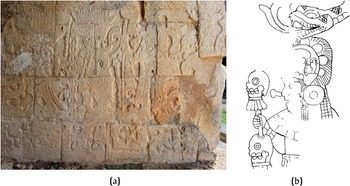
Such reliquary use is evoked in a detail from the processional scene that drapes the walls and vault of the Lower Temple of the Jaguars (Figure 9a). Here, a warrior grasps a spear or staff loaded with two vertically impaled human skulls, resembling the skewered skulls of the great tzompantli right next to it (Figures 1 and 9b). Skewered one on top of the other, each skull is mounted on a support decorated with feathers. If this were meant to represent a real event, the eye sockets would have been replaced with suitably shaped objects by the crafters. The lower skull quite clearly displays a notch in the superior portion of the cranial vault, indicating its aperture in preparation to being stuck on the pole. Armed with this cranial staff, the warrior moves into the room as the last of a series of marching warriors, all elaborately attired and carrying weapons, with no two costumes or accoutrements alike (Figure 9a). The remaining portion of this figure shows ear spools, a nose ornament, a bracelet, and a thick collar (Figure 9b). In line with the cranial attributes of his staff is the warrior's headdress. The facial segment of a jawless skull shows an eye socket and exposed upper teeth. It is framed by an ear with an ornament in its lobe and a hair crest with circular elements that resembles the crest of hair and large eyeballs seen on the skeletal head contained within the large ball represented at the center of the Great Ballcourt reliefs (Figure 8a). In proximity to the tzompantli, this warrior with his skeletal headdress and his two vertically impaled skulls provides an important proxy for recreating the roles of skulls in Chichen's religious processions and possibly the ritual uses of the similarly arranged vertical skull poles of the tzompantli platform right next to this scene.
Processional scene of warriors from the lower part of the north wall of the Lower Temple of the Jaguars. (a) Detail of procession displaying four warriors walking towards the left (west). The Lower Temple of the Jaguars faces the southwest corner of the tzompantli platform, located just 30 meters to the east. Photograph by Tiesler. (b) Close-up of warrior with skeletal headdress, holding spear shaft with two impaled skulls. Drawing SD-5017 by Linda Schele © David Schele, photograph courtesy of Ancient Americas at the Los Angeles County Museum of Art.

The Great Ballcourt and the nearby tzompantli are not only linked by their date of construction, the shared iconography of their processional reliefs, and the speared skulls of the Lower Temple of the Jaguars warrior, but also by a circular stone, shaped as a ballcourt ring and deposited in the fill of tzompantli. This large stone disk with a central perforation at first glance appears to be a mate to the rings in place at the ballcourt, like them carved with entwined feathered serpents (Acosta Reference Acosta1954:39, Lámina xi; Salazar O. Reference Salazar O.1952:39–41). Unlike those markers, however, this disk is also ringed with small fish on its inner and outer rims. More significantly, the circular stone lacks the tenon needed to attach it to a ballcourt wall. It must therefore have been used in some other way, perhaps as an altar.
The Central Tzompantli Platform
Like most of the adjacent Great Ballcourt complex, the central tzompantli at Chichen was probably built rather late in the Great Platform's constructional sequence, during the early or middle eleventh century (Braswell and Peniche Reference Braswell and May2012:255; Canto Reference Canto and Cobos2016). Ringle (Reference Ringle2017:134), however, argues that no major construction occurred at the site after a.d. 1000. This structure, a monumental T-shaped platform, is situated directly east of the Great Ballcourt. The head of the T measures 55 × 12 m, while the body, measuring nearly 13 × 16 × 2 m, is slightly higher than the head. At the east side, a central staircase, 6.5 m wide, leads to the top of the platform. No evidence of a superstructure was reported by Acosta (Reference Acosta1954) during initial restoration. A similar T-shaped platform, also adjacent to one of the site's ballcourts, is found at Tula and is probably contemporaneous with Chichen Itza. No relief sculptures, however, are associated with the tzompantli at Tula (Matos Reference Matos1972).
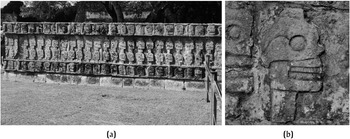
The walls of the head of the platform are draped with four rows of sculptured profile heads, with the upper and lower rows contained within simple moldings that are visibly set apart from the central skulls in “tablero” fashion (Figure 10a). The walls, or at least the background, were originally painted red, as the remnants of reddish pigment preserved on some of the surfaces suggest (García Moll and Cobos Reference García Moll and Cobos2009:169). The anatomical features of at least some of the profile heads had been delineated in black (Claudia García Solís, personal communication 2022). The heads of the two middle rows are depicted strung vertically on poles, in contrast to the Mexica custom of piercing heads horizontally (Figure 10b; Mendoza Reference Mendoza, Chacon and Dye2007:406, 411). Collectively, these two middle rows display apparently continuous poles loaded with pairs of heads impaled one on top of the other, recalling the skulls pierced by the spear represented in the adjacent Lower Temple of the Jaguars (Figure 9b). This presentation also echoes de las Casas's (Reference de las Casas1967:221) account of the highland Maya practice of displaying the heads of sacrificial victims for some time on vertical poles atop structures dedicated solely to this function, before being interred.
Chichen Itza's major tzompantli platform. (a) The southeast frieze displays four rows of impaled heads in profile in a progression towards the eastern annex. (b) Defleshed head with no ear and visible nasal stump, exposed mandible, suggesting it was unhinged and cleaned of soft tissue prior to placement (including the masseter muscle for mastication). A horizontal line crosses the area of the cheek, visibly dividing the upper from the lower face. The eyeball (or substitute eye plug) is delineated within the eye socket. A thick pole seems to impale the head vertically through the base and the superior part of the vault. Photographs by Tiesler.

Recent restoration, conducted on the tzompantli walls by INAH's Conservation Department in 2007, integrated a number of isolated head blocks that had laid on top of the platform. These efforts were guided by the relatively intact lower molding (Claudia García Solís Reference García Solís2017, personal communication 2022). All profiles are oriented in such a way that the heads appear to “look” toward the eastern staircase, surrounding the head of the T. From a divide in orientation, located in the middle of the west wall, the heads “progress” on its northern and southern perimeter. Left head profiles drape the northern, right head profiles the southern loop. Frontal views of such heads only appear at the platform's corners (Figure 11a). Provided the archaeological reconstruction of the platform and our on-site count is correct, some 232 head columns (totaling 928 heads in four rows; Figure 9a) progress around the southern half of the platform while the northern half of the T head features another 230 head columns, making a total of 920 head in four rows and a grand total of 1,848 around the whole platform.
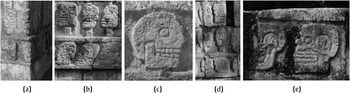
Details of Chichen Itza's tzompantli. (a) Front views of partially defleshed heads displaying an upper, fleshed, and a lower, defleshed facial segment. Note highlighted muscle insertion line on their parietal bones, represented as a sickle shape beyond eye sockets, as in (b). (b) Visibly elongated head (middle, lower row), suggesting that it had been artificially splinted and wrapped during infancy. At upper left, squat head, indicating a severe tabular erect cranial vault modification which predominates among the skulls of Chichen Itza. (c) Unmodified or top-flattened head silhouette. (d) Area of “crowding” of skull columns. (e) Two horizontal grooves framing the lower and upper dentition appear to signal that the lips were cut off. Note the sickle shape behind the ear, which mirrors the line of insertion of the fan-shaped temporal muscle. Photographs by Tiesler.

The number of head pairs on the northern (N = 230) and southern (N = 232) perimeter each comes close to the canonical day interval of Venus when visible as a Morning Star, as quantified in the Dresden Venus Table (N = 236; Faulseit Reference Faulseit2006:110–112; Milbrath Reference Milbrath2019). Milbrath (Reference Milbrath, Aldana, Villalobos and Barnhart2014:128, Figure 6.15, Reference Milbrath2019) suggests that a similar day count is recorded in the Northwest Colonnade, across the plaza and facing the tzompantli from the east (Figure 1). Here, 59 piers are carved on four sides, each with humans or deity impersonators framed above and below by small supernatural figures. Each upper register depicts the Venus God hurling darts below, for a total of 236. This “Lord of the Dawn,” feared in Postclassic Mesoamerica and even the Southwest as a fierce deity, was represented with either a vertically striped or sometimes fleshless body (Mathiowetz et al. Reference Mathiowetz, Schaafsma, Coltman and Taube2015:54, 57–60). Like the intimidating Aztec tzitzimime, “star demons,” the Morning Star could be rendered as a party defleshed head or skull (Taube Reference Taube1993:6). Further Venus attributes are stars, flint dart points, and a close association with the feathered serpent (Mathiowetz et al. Reference Mathiowetz, Schaafsma, Coltman and Taube2015:5). The art of Chichen Itza is replete with Venus symbolism and Venus-related figures, some holding darts, some entwined with serpents (feathered and not), and further examples with skull faces or masks (Miller Reference Miller, Hanks and Rice1989). The latter appear on several piers from the Temple of the Warriors complex (Morris et al. Reference Morris, Charlot and Morris1931:vol. 2, Plates 32, 88, 106, 110, 111). One such figure wears the cut conch pendant that is characteristic of Ehecatl-Quetzalcoatl in central highland Mexico, but is rarely seen depicted at Chichen Itza itself (Morris et al. Reference Morris, Charlot and Morris1931:vol. 2, Plate 105; Taube Reference Taube and Prem1994:223;).
From an artistic point of view, the renderings of the heads that cover the walls of the tzompantli platform are remarkably varied. In part this may be due to multiple sculptors of divergent skills, in part to the portrayal of real individuals. Most of the heads appear to be crudely carved, although some defects may have disappeared under plaster and paint. In some examples, notably the three-dimensional corner heads, the proportions are anatomically correct, the features are more carefully delineated, and the skull and fleshed cheek areas are sensitively modeled (Figure 11a). A few of the profile heads are visibly elongated and suggest they had been artificially splinted and wrapped during infancy, while most others are squat, indicating a tabular erect cranial vault modification which predominates among the skulls of Chichen Itza (Figure 11b; Price et al. Reference Price, Tiesler and Freiwald2019:110–111). Further head profiles appear to be either unmodified, which is not typical of contemporary Maya practices, or top-flattened, denoting a frequent variation of squat head shapes at the site (Figure 11c; Tiesler Reference Tiesler2014:233–234). Just like the rendering of head form, the treatment of the dentitions also varies in form and number (cf. Figures 10c and 10d, top center). While there is no way of knowing if this sculptural program was carved in one episode or over time, it is interesting to note that the artists seemed to struggle to maintain heads uniformly sized and equidistant. In some places, the columns of skulls are quite narrow, as if the sculptors were trying to squeeze the heads in, perhaps to meet a set number, as we have suggested above for the Venus cycle (Figure 10d).
Apart from diversity, there are also a number of commonalities in rendering that point to ancient patterns in head processing. Quite likely, different states of soft-tissue decomposition are represented, as can be seen in the more fleshed corner pieces (Figure 11a). The common denominator is a completely defleshed mandible, which is hinged back on a partly defleshed head with the eyeball (or substitute) still in place (Figures 10b and 11a). In a number of examples, the insertion line of the temporal muscles can be distinguished (Figures 11a and 11e). Paired horizontal grooves appear to show the horizontal cut where the upper and the lower lips were severed and where the flesh of the lower face was cut off below the cheek bone (Figure 11e). Neither hair nor ears are evident in any example, indicating a degree of excarnation that surpasses the amount of head processing depicted on the earlier Puuc tzompantli scaffolds (to be discussed under section Early Tzompantli Platforms in the Maya Area).
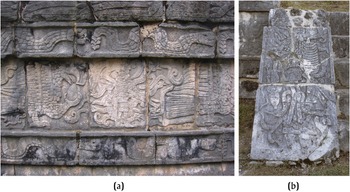
On the northern and the southern hemisphere of the eastern part of Chichen's tzompantli platform, the rows of heads give way to a progression of 10 armed and partially defleshed warriors each. Both strings of figures advance eastward and toward the balustrades of the eastern staircase. The marching warriors alternate on each side with eight reliefs of large-scale eagles clutching human hearts in their claws (Figure 12a). These panels are framed above and below by moldings containing undulating rattlesnakes, directed like the rest of the creatures toward the eastern balustrades. Feathered snakes appear above the wandering warriors and segmented ones slither below them, perhaps a reference to the sky and the earth. The upper edge of this part of the platform is completed by a cornice of large feathered serpents, whose projecting heads mark the structure's upper corners.
Details of Chichen Itza tzompantli reliefs, with (a) one of the 20 partly defleshed warriors walking between raptorial birds, with serpent moldings above and below and the feathered serpent cornice at top. Just like the figure, all other creatures appear to progress from the “T” part of the platform towards the eastern staircase. (b) Partly defleshed warrior with shielded arm on the southern balustrade of the eastern staircase, standing on two large darts. Photographs by Miller.

The warriors’ costumes and accoutrements are quite common at Chichen Itza and are sometimes described as “Toltec” because they blend elements of central Mexican and Maya dress (Taube Reference Taube and Prem1994:272). These include a headdress consisting of a mosaic “pillbox” hat or headband, the so-called butterfly ornament above that, and a headdress with short feathers on top and longer flowing ones at the back. The warriors wear large disk ear ornaments displaying frontal faces (perhaps flayed), ornaments at the sides of their noses, heavy beaded necklaces or collars, a loincloth, and a thick belt to which a round shield is attached at the back. One arm is heavily padded with what appears to be protective shielding. An atlatl is gripped in one hand, while the other holds spears and grasps the long hair of a human head, whose eyes are closed.
What distinguishes the tzompantli figures from other warriors at the site, however, are their partly defleshed legs and arms (the one with the atlatl). What might appear to be arm and knee bands are in fact remnants of flesh marking the division between upper and lower limbs. A second unusual feature is the segmented snakes emerging from their heads and bodies, with smaller ones wrapping around their ankles. Flame-like volutes emanate from and swirl around the warriors, manifesting their transformative powers and, perhaps, their anthropophagus feeding action in a mythical underworld scenario (Karl Taube, personal communication 2015). It is of note that similar scrolls or flames can also be seen around important figures represented in the reliefs and murals of the nearby Lower and Upper Temple of the Jaguars.
The two rows of 10 skeletonized warriors culminate in a pair of larger, standing figures on the balustrades that frame the tzompantli's east-oriented staircase. Unfortunately, only one of these remains mostly intact (Figure 12b). While in most other respects he resembles the smaller figures in procession on the walls of the tzompantli, including skeletonized limbs, this warrior has a large speech scroll—a central Mexican trait— in front of his mouth. His feet are oddly poised on two pointed blades, which look like large darts. This prominent dart motif, set below a skeletonized warrior surrounded by plumed serpent motifs and flames, links the figure to Venus, a connection proposed 60 years ago by Acosta (Reference Acosta1954:39).
Placed on balustrades that face the Venus Platform across the plaza and which were lit each dawn by the rising sun, these warriors are charged with Venus symbolism and possibly identify protagonists of Venus-related myths. Such is the battle between the Morning Star and the Sun, which is the key theme in the closing narrative of the Era of the Fourth Sun, as still recounted centuries later by the Aztecs (Graulich Reference Graulich1997:205). According to this myth, Quetzalcoatl descends to the underworld as Venus and loses his flesh, only to reemerge after eight days of transiting the inferior conjunction of the planet. Hereafter, Quetzalcoatl remains exiled in a dark version of paradise, just like his Venus avatar, Tlahuizcalpantecuhtli, who combats the rising sun by throwing darts at it. We wonder if this astronomical battle could be indeed the scene rendered on the tzompantli balustrades, representing the progressive phases of Venus, first visible, then invisible during eight days in its inferior conjunction before its reappearance, if we follow the Dresden Codex (Faulseit Reference Faulseit2006:110). The partly skeletonized tzompantli warriors number 10, and the pairs of heart-clutching eagles, eight on each side, result in a total that indeed comes close to this day count. Jointly with the number of skull pairs oriented to the east, these supernatural warriors and raptorial birds bring to mind such embodied Venus and Sun periodicities. In the ceremonial calendar of Chichen Itza, these astronomical cycles could well have served as proxies for public display of multiple heads of sacrificed victims during relevant calendar dates, evoking the processions of heroic warrior souls on their paths to the eastern solar paradise (Taube et al. Reference Taube, Stanton, Osorio León, Ruiz, González de la Mata and Coltman2020:32, 38–39, 80). If so, then the central tzompantli platform embodies a centrally conceived, sculpted space-and-time cosmogram, which would come alive during celebrations, possibly including massive displays of tribute, prisoners, and sacrifice (Cobos and Fernández Reference Cobos and Fernández2015; Kristan-Graham Reference Kristan-Graham, Koontz, Reese-Taylor and Headrick2001).
During the tzompantli platform's use during the eleventh century, its east-oriented mythical narrative would probably have guided the processions from the Great Ballcourt area along its two half-perimeters toward the east. As we believe, this ritual path inscribed only one part of a broader architectural cosmogram that must have embraced the extent of the Great Platform. Such ceremonial paths emanating from the Ballcourt would surely have intersected with the Platform of the Eagles and the Jaguars, adjacent to the tzompantli platform (Figure 1). This small, four-sided structure shows human hearts in the claws and jaws of raptorial animals, including eagles similar to those on the nearby tzompantli (García Moll and Cobos Reference García Moll and Cobos2009:170–171). Further east, between the Castillo and the beginning of the sacbe leading to the Sacred Cenote, lies the larger Platform of Venus, whose iconography combines Mexican year signs, frontal composite creatures, and feathered serpents (García Moll and Cobos Reference García Moll and Cobos2009:172–173). We may ask ourselves how these platforms were being used—independently or more likely in tandem—during religious processions and those ceremonial sequences demanding the sacrifices of multiple human victims that we have documented. We hope that future, systematic research may test or warrant this correlation and its wider implications for understanding the ritual uses of late Mesoamerican architectural programs.
EARLY TZOMPANTLI PLATFORMS IN THE MAYA AREA
Both an architectural masterpiece and a central space for performance and public display, Chichen's tzompantli platform does not stand isolated in time or cultural context. Instead, it conceptually transformed earlier Maya public platforms with death imagery, which deserve exploration on a regional scale. In the Maya area, the earliest appearance of the sculpted skull and cross bone motif occurs at least 1,000 years before the construction of Chichen's major skull rack. Skeletal elements grace the facade of a Late Preclassic building at Holmul, Guatemala, as well as numerous Late Classic buildings elsewhere (Coltman Reference Coltman, Gonlin and Nowell2018:207; Miller Reference Miller and Kowalski1999:349). During the Classic period, long bones were especially potent relics when taken from war captives and were accordingly dominant in public representation. Classic Maya prisoners themselves are identified with the hieroglyph b'ak or bone (Burdick Reference Burdick2016; Montgomery Reference Montgomery2002:41; Stuart Reference Stuart and Fields1985). To follow is an updated survey of public Terminal Classic platforms decorated with skulls, heads, eyeballs, and crossed-bone motifs from Yucatan and beyond. Their identification as tzompantli platforms, however, is still conjectural as none of them has yet been excavated.
Early Tzompantli Platforms in Northern Yucatan
At Chichen Itza itself, archaeologist Lincoln (Reference Lincoln1990:404–405) discovered another possible tzompantli platform while mapping areas beyond the site's core 30 years ago. It is an unexplored structure (5D26) next to a ballcourt (5D5) on a platform to the northeast of the Initial Series Group, to which the complex is connected by a sacbe. Lincoln suggests that two other small platforms nearby (5D22 and 5D23) might be equivalents of the Platform of the Eagles and the Jaguars and the Platform of Venus, located east of the Great Ballcourt and the tzompantli on the Great Terrace. Further afield, a mound located to the west of the ballcourt at Yaxkukul, a site between Chichen and Ek’ Balam, has been identified as a possible skull rack. According to Smith (Reference Smith2001:33), while the site is closer to Ek’ Balam (17 km) than to Chichen (36 km), the I-shape plan of its ballcourt more closely resembles the Great Ballcourt at Chichen than the two at the former site. The structure has not been excavated, however, nor are there reports of any associated carved reliefs.
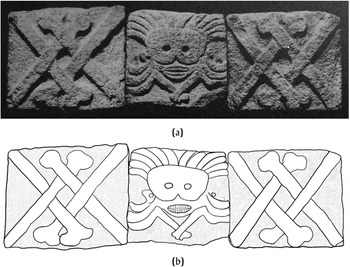
To the west of Chichen Itza lies the site of Dzibilchaltun, Yucatan, where a platform decorated with skulls and crossed bones was described by Andrews and Andrews (Reference Andrews and Andrews1980:231, 290) after excavations carried out by the Middle American Research Institute at Tulane University. Here, the carved facade stones are part of the basal molding from a Late Classic structure. The panels display a series of three-part head-and-crossed-bone motifs (Figure 13a). In this early case of head exhibition, hair is represented, and the lower jaw is depicted in a defleshed fashion, framed with soft-tissue wrap on both sides. Crossed long bones, possibly in the form of a small scaffold, appear to sustain the head in the central frame, while the entwined rendering of the femoral segments to both sides may indicate they were part of a standing scaffold made out of long bones (Figure 13b). Although unexcavated, the platform may be similar to the ones at Uxmal, to be discussed below (Rubén Maldonado, personal communication 2020).
Carved facade stones from Structure 99, Dzibilchaltun, displaying one of a series of three-part head-and-crossed-bone motifs on its north side. (a) Photograph of panels, now lost, courtesy of Middle American Research Institute, Tulane University. (b) The long bones on the lateral slabs appear interwoven and the crossed bones on the central slab are possibly supporting the head. A lateral wrap emerges out of the ear lobes. Hair is represented in strands on the top of the head. Redrawn by Mirna Sánchez from Andrews and Andrews (Reference Andrews and Andrews1980:Figure 228).

Early Tzompantlis in the Puuc Area
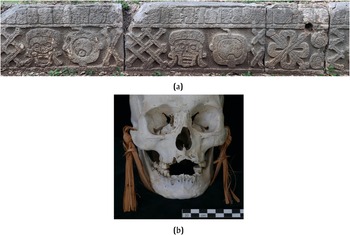
Among the possible tzompantli structures of the Puuc area, the largest known such complex comes from Uxmal, where four low platforms are part of the so-called Cemetery Group. Epigraphic Long Count dates provided on Platform 3 (a.d. 831, 844, and 849) and Platform 1 (a.d. 869) indicate their use during the ninth century and lend support to the idea that the platforms were not built at the same time (Graña-Behrens Reference Graña-Behrens2009:193). Here, representations of flayed heads, some of which appear suspended upside down, alternate with crossed bones and the disembodied “death eye” motif (Figure 14a). These heads are not as excarnated as the ones that cover Chichen's tzompantli; they still possess their ears and hair, shown as a crest running from the forehead to the neck when the head is shown in profile, but from ear to ear when frontal. The hair is reminiscent of the Aztec practice of displaying the heads of certain sacrificial victims defleshed but retaining their hair (Mendoza Reference Mendoza, Chacon and Dye2007:413, 414). More like Chichen's large eponymous platform, however, are the depictions of completely defleshed mandibles. In this case they are framed by pieces of cloth or bark at either side. These may be replacements for more precious ornaments or paper, as such earpieces were sometimes worn by captives or those who had let blood from the ears (Baudez and Mathews Reference Baudez, Mathews, Robertson and Jeffers1979:33). Alternatively, they might represent sturdy fabric or bark bindings (rather than perishable paper), which were used to keep the loose lower jaws attached to the skull during its weather-exposed display in open spaces (Figure 14b).
Detached mandibles and public display of human corpse segments. (a) Panel from Uxmal's Cemetery Group, east side of Monument 3. Crossed-bones and “big-eye” motif alternate with a partly excarnated head with defleshed jawbone that appears to be tied to the ears with lateral wraps. Hair still clings to the forehead. Photograph by Miller. (b) Hypothetical reconstruction of a lateral jaw wrap, made of sturdy, yet flexible majagua tree bark (Hampea trilobata or jool k'an jool in Yutatecan Maya), prepared by Wilberth Canul. Photograph by Tiesler.

While the text is mostly eroded, two of the glyphs have been read as a “star war” event at an unknown toponym, possibly a place in northern Campeche (Grube Reference Grube and Prem2003:Figure 26). Both the text and the imagery explicitly evoke the connection between warfare and beheading in a way that is not as obvious at Chichen Itza, where neither the identity of victors or victims, nor their places of origin, are stated in the many images of warfare, captivity, and sacrifice at the site. Unlike the more dynamic display of heads on the tzompantli at Chichen Itza, at Uxmal's earlier Cemetery Group, the heads appear to “look” motionlessly out of the platform's side. Notably, the one platform lacking a text along its upper edge has nine niches cut into the carved stones where poles for skull and long-bone display may have been erected. Subsequently, perhaps, the other platforms were constructed with poles placed on top of the platforms rather than its sides (Taube Reference Taube2017:30). The whole complex consists of a courtyard with high buildings on three sides and a tall pyramid-temple on the fourth. Access to the plaza appears to have been through a portal vault (Graham Reference Graham1992:Figure 4.77). The enclosed area with its four low sculpted platforms may have served as a performance space for rituals associated with sacrifice and the display of body parts. Significantly, perhaps, Uxmal's main ballcourt is located east of the group, while Ballcourt 2 is immediately to the south, across a plaza.
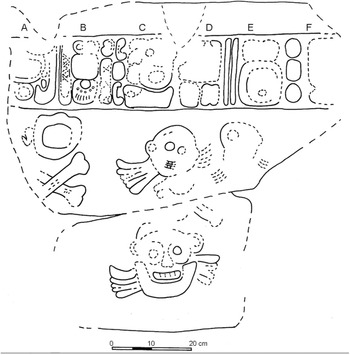
A sacbe links Uxmal to the site of Nohpat, approximately 15 kilometers southeast of Uxmal. Here, a platform displays hieroglyphs and reliefs of heads, long bones, and eyeballs in a fashion quite similar to those at Uxmal, noticeably the form of partial flaying and suspension of the heads (Mayer Reference Mayer2010; Stephens Reference Stephens1963:Figure 21). This structure, unfortunately much deteriorated and looted since it was first recorded by nineteenth-century explorers, is also located near a ballcourt. A recently documented cylindrical altar at the site bearing similar iconography has a date of a.d. 912, placing it within the recorded dates of nearby Uxmal at its height (Figure 15; Dunning Reference Dunning2011:6).
Nohpat, Altar 9, photo-corrected field drawing. Crossed-bones and “big-eye” motifs alternate with at least two partly excarnated heads with defleshed jaw bones. Earlobes and hair are displayed. Drawing courtesy of Nicholas Dunning.

At this point, we may speculate if the interwoven pattern of crossed bones (displayed on all the described platforms) is purely symbolic of dark places, death, and the underworld or, alternatively, if the Maya used real human long bones and other excarnated body segments in ritual scaffold constructions (Tiesler and Folan Reference Tiesler and Folan2020). In addition to skulls, these piles of bones may have been placed on top of platforms or attached to temporary scaffolds, as Carreón (Reference Carreón2006, Reference Carreón2013) argues convincingly. If this were the case, such representation may have mirrored the display of the noticeably complete long bones that accompanied the four lines of skulls documented by the Carnegie Institution in the fill of the Caracol complex (and discussed in section An Early Functional Tzompantli at the Caracol Complex).
While no tzompantli has been documented for Kabah (also connected to Uxmal by a sacbe), a recent discovery there demonstrates that the three sites share similar macabre imagery. The basal molding on the exterior of Room 14, at the southern end of the Codz Pop, consists of three rows of carved stones, the upper representing frontal skulls similar to those at Nohpat and Uxmal, with the addition of a decorative guilloche above the skulls. The middle row depicts full-bodied skeletal figures in a hocker, or squatting, position with extruded eyeballs that are grasped in each figure's outstretched hands. Below are reliefs of crossed bones (Rubenstein Reference Rubenstein2015:Figure 141). The chamber in question is not very accessible, being located on the least public facade of the building and contained within another room, suggesting it had a specialized function (Rubenstein Reference Rubenstein2015:172). Is it conceivable that this modest, hidden chamber was reserved for body processing?
Door jambs from both the Codz Pop and Manos Rojas buildings feature lively scenes of captive-taking, with captors grasping their victims by the hair (Rubenstein Reference Rubenstein2015:Figures 79–82, 137–138). Recently discovered reliefs from the former include the display of prisoners, participants holding femurs, and a scaffold sacrifice (Rubenstein Reference Rubenstein2015:176–185, Figures 152–155, 161–163, and 165). Readings of Calendar Round dates on two of the Codz Pop jambs have been proposed, one of which, 10.1.10.0.11 2 Chuen 3 Muan (a.d. October 14, 859), appears to mark the death of the vanquished warrior represented in the image on the jamb (Stuart and Rubenstein Reference Stuart and Rubenstein2014). The other date, on one of the northern jambs, is 10.2.3.11.6 9 Cimi 8 Zotz (a.d. March 9, 873) and refers to an unknown event. These dates place the Codz Pop squarely within the Terminal Classic period. Finally, it should be noted that as at Uxmal and a number of other Maya sites, Kabah's facades were once adorned with carved three-dimensional stone heads and skulls: some 12 such tenoned examples were recovered in excavations at Manos Rojas in the early 1990s (de la Garza Reference de la Garza2015:Catalog 88, 89; Rubenstein Reference Rubenstein2015:104, Figure 66, 68; Schmidt et al. Reference Schmidt, de la Garza and Nalda1998:Catalogue 372).
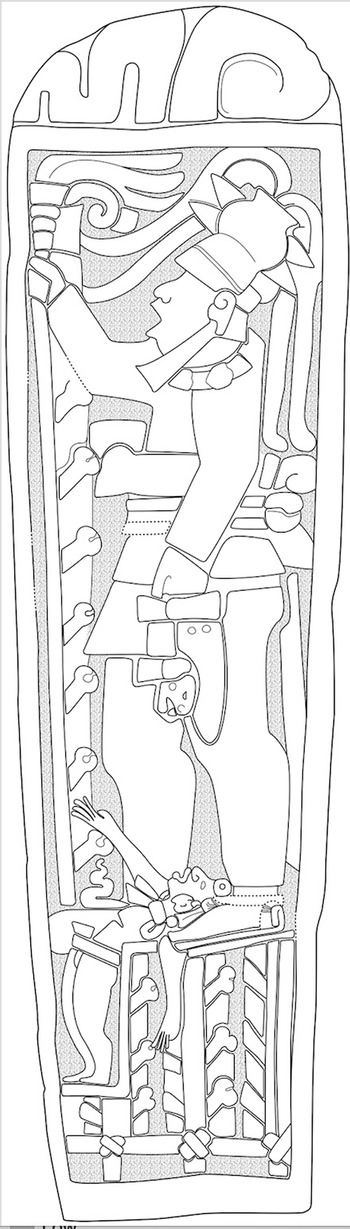
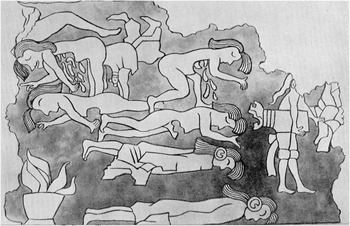
As this overview of early tzompantlis in Yucatan shows, the display of body parts was not limited to heads and was quite diverse. Contrary to the long-standing emphasis in the literature on the exhibition of skulls, long-bone display may well have been more dominant than head display. This idea becomes more obvious further afield. A recently discovered Late Classic stela from Lagartero in Chiapas depicts a standing figure, possibly a ballplayer, who appears to grasp a staff or touch a wall studded with seven long bones, possibly femurs (Figure 16). Below him, a small, lifeless figure with his chest cut open reclines against a wooden scaffold also replete with long bones. While images of scaffold sacrifice can be found in other examples of Classic Maya art, most notably on painted ceramics, this stela is unusual in showing platform and bones integrated as one (cf. Taube Reference Taube, Benson and Griffin1988). In this case, no skulls but only long-bone segments make up the human scaffold.
Late Classic stela from Lagartero, Chiapas, showing warrior/ballplayer as he stands on a scaffold filled with heaps of human long bones. His victim leans back lifeless against the staircase with an open chest from heart extraction. Tracing by Hemmamuthé Goudiaby after de la Garza (Reference de la Garza2015:Catalog No. 258).

We close this regional survey by concluding that the manipulation and reuse of human bones, whether of ancestors or sacrificial victims, was already well-established by the Classic period in Mesoamerica, including the Maya area (Burdick Reference Burdick2016; Fitzsimmons Reference Fitzsimmons2009, Reference Fitzsimmons, Fitzsimmons and Shimada2011). Approaching and after the collapse of the lowland Maya hegemonies, a sharp increase in public display of not only heads but body parts is evident both in the skeletal record and the sculpted imagery. Nowhere is this more patent than on the Pacific rim of Guatemala, where during the Late and Terminal Classic period the sculptural program of Cotzumalguapa brims with anatomically rendered death images in the form of artificially excarnated corpses and chopped up body segments (Chinchilla Reference Chinchilla2014). These appear to anticipate the increase in massified body processing and display of human victims in late power hubs like Chichen Itza where corpse segments and full-bodied skeletonized creatures became an integrated part of a full-fledged program of mythical and as we argue, historically enacted processions (see also Cobos and Fernández Reference Cobos and Fernández2015; Kristan-Graham Reference Kristan-Graham, Koontz, Reese-Taylor and Headrick2001; Miller Reference Miller2017; Taube Reference Taube2017).
CONCLUSIONS
From our body-centered study of human corpse processing and display at Chichen Itza and beyond it is clear that, between the ninth and the eleventh centuries, Yucatan witnessed a general surge in the decorated tzompantli platforms that was part of a broader increase in ritualized body processing and exhibition. At the beginning of this process, individual victims or small groups of victims would have been the target of ritual action, as reflected by the platform sizes and the small numbers of heads and/or bodies represented per scaffold at Nohpat, Kabah, Dzibilchaltun, and Uxmal, among others. In the case of the displayed heads, these tend to be still left largely intact after facial flaying and after separating the lower jaws. More limited in size and still representing predominantly long bones, these stone constructions appear to branch out of long-standing local Maya practices of scaffold sacrifice (Taube Reference Taube, Benson and Griffin1988, Reference Taube2017). Our revisited early functional tzompantli under the western staircase of the Caracol structure, with its long bones and only a few minimally processed skulls occupying less than 2 meters, still seems to fit in with this early tradition and is in accordance with the time frames noted for the Puuc structures we have discussed.
Given the prominence of long bones both in Puuc iconography and in skeletal arrangements that indicate public display, we have asked ourselves if the exhibition loci of dead anatomical parts were properly conceived as “tzompantli-skull racks” in the eyes of the Classic-period Maya. Taken one step further, the alleged exhibition of those human body segments not identified with the head renders the term “skull rack” limited and biased when used as a label for early Maya post-sacrificial platforms and exhibition spaces. Not limited to skulls, these displays would have included a diverse set of full-bodied corpses, torsos and extremities, eyeballs, and long bones.
At Chichen Itza itself, the reliefs, murals, and gold disks from the Sacred Cenote illustrate diversity in body processing that goes beyond the head. Not only decapitation but also scenes of heart excision are illustrated. Scenes of multiple, sprawled naked bodies (some graphically displaying their open chests) were depicted in now-lost murals from the Temple of the Warriors and an upper chamber of the Nunnery (Figure 17; Bolles Reference Bolles1977:207; Morris et al. Reference Morris, Charlot and Morris1931:vol. II, plate 144). It stands to reason that victims would have been put to death not one by one and on rare occasions, but rather collectively, their bodies massacred publicly and put on exhibition at times, perhaps after a particularly brutal or hard-fought battle. Additional historic reality to the public display of bony extremities and trunks is supported by the ongoing forensic scrutiny in the Maya area and beyond, which has already documented, extensive excarnation in long-bone segments and trunks, as argued elsewhere (Ruiz Reference Ruiz, Tiesler, Suzuki and Pereira2021; Tiesler and Folan Reference Tiesler and Folan2020; Tiesler et al. Reference Tiesler, Suzuki and Pereira2021). We agree with Carreón (Reference Carreón2006, Reference Carreón2013:44), who demands a more diversified and culturally nuanced interpretation of a phenomenon that has so far been treated among Mesoamericanists in a biased and simplistic fashion under the rubric of “skull exhibitions.”
Copy of lost mural from the Nunnery at Chichen Itza, showing at least nine agonizing and/or lifeless human bodies, some with wide-open, bleeding chest wounds (Willard Reference Willard1933:123).

One further conclusion emphasizes the dynamic quality of human body display in “New” Chichen Itza, as we have argued by confronting the skeletal evidence of body processing with the iconography of its display. Nowhere is this dynamic quality better illustrated than in the case of the great tzompantli platform itself, a focal point for ritual programs and, as we argue, immense, visually charged public spectacles. Not long after the construction and presumably use of the Puuc-style platforms, the building of the huge, elaborate tzompantli in Chichen Itza's central plaza departs radically from this regional practice. In its process, a shift is evident from individual or small groups of sacrifices toward what looks like state-sponsored mass executions (if we believe in the numbers of represented heads). A clearly totalitarian rhetoric responded to new political agendas, war, and religious demands, and still permeates the spaces used for such deadly performance at “New” Chichen. Its huge central ballcourt is lined with decapitation scenes, surrounding temples are adorned with reliefs with eagles and jaguars devouring human hearts, and its enigmatic tzompantli-type platform features severed human heads in the hundreds together with their presumed macabre executioners. During such public events, these spaces must have come to life and filled with crowds in massive processions. Curtains of smoke, music, and commotion would have enveloped the consecration of military triumphs and new terrestrial and cosmic alliances. In this context, the decomposing heads that once crowned the skull rack must have appeared terrifying to participants and onlookers alike, reifying the status quo and the absolute supremacy of the ruling authorities, and promising a dismal fate for any transgressor or aggressor and, of course, the captives brought in and presented at the city's sacred slaughterhouse.
Our final conclusion relates to the quantities and forms of body processing that are evident in the skeletal record of Chichen Itza, which grant a historic reality to mythic enactment beyond what is currently imagined. Instead of gradually evolving Classic-period Maya traditions, we believe that earlier, autochthonous forms of sacrificial body processing were adapted by Chichen's ruling elites in a new scheme of religious cults and rituals, some not previously cultivated in this area. As part of a broader trend that initiated during the Epiclassic period in Mesoamerica and most probably beyond, this new (cosmic) era was ostensibly upheld by massive ritualized violence. While the discussion of “ritualized violence” and its political instrumentation in Chichen Itza goes beyond the scope of this study, we hope to have fostered with our body-centered interdisciplinary approach new points of departure toward a more comprehensive perspective on sacrificial rituals and their performance at Chichen Itza and beyond. As part of larger liturgies and ritual programs, these events heralded late religious cults that satisfied new sets of deities and new foci of veneration promoted by cadences of war—namely Venus and solar cycles—and the perpetual movement of the Feathered Serpent.
RESUMEN
Chichén Itzá proyecta los complejos religiosos tardíos, algunos específicamente mayas y otros mesoamericanos en general. Entre los aspectos emblemáticos de las innovaciones ceremoniales en Chichén Itzá cuentan altares permanentes de cráneos (conocidos como tzompantli en Náhuatl), donde las cabezas empaladas de las víctimas se exhibirían. Aquí exploramos conjuntamente la iconografía de la muerte y el registro esquelético, recuperados de los dominios centrales de la “Nueva” Chichén, El Osario y El Caracol. Eso incluye cráneos con perforación bilateral o basal y mandíbulas con signos de decapitación perimortem. Nuestros resultados conjuntos confirman un incremento en la importancia de los procesamientos póstumos y la exhibición pública en Chichén Itzá en comparación con centros mayas propiamente clásicos. Estos tratamientos no eran introducciones foráneas, como se ha postulado con anterioridad, sino seguían prácticas locales, llevadas a cabo muchos años antes en los centros urbanos yucatecos de Nohpat, Kabah, Uxmal y Dzibilchaltun. Ahí, la exhibición de despojos humanos era diversificada y no limitada a calaveras, volviendo el término tzompantli problemático. En el contexto totalitario de los espacios centrales de Chichén, la masificada violencia y exhibición de los despojos habrán acompañado advocaciones religiosas tardías al ritmo de batallas, ciclos astronómicos y el perpetuo movimiento de la Serpiente Emplumada.
ACKNOWLEDGMENTS
Our thanks go Rafael Cobos Palma for inviting us to contribute to this timely dossier along with his valued feedback and ongoing discussion. Tiesler's research for this paper was in part conducted at the Dumbarton Oaks Research Library and Collection (Trustees for Harvard University) in Washington, DC. The skeletal series are part of the project work conducted with the permission or in collaboration with the following projects and institutions: Peabody Museum, Harvard University (human remains from the Thompson collection from Chichen Itza), Dirección de Antropología Física, INAH (human remains from the Carnegie expedition and Román Piña Chan's collection from Chichen Itza's Sacred Cenote), the Field Museum (human remains from the Osario complex/High Priest's Grave, reported by Edward H. Thompson), and Rafael Cobos Palma (Proyecto Gran Nivelación, Universidad Autónoma de Yucatán). This and relevant related research has been kindly aided or enriched by Bill Ringle, Claudia Brittenham, Oswaldo Chinchilla, Rex Koontz, Annick Daneels, Henri Duday, María Teresa Uriarte, Emilie Carreón, Ximena Chávez Balders, Ruben Mendoza, Jorge Gómez Valdés, John Verano, Mary Miller, Wilberth Canul, Judith Ruiz, Karl Herbert Mayer, Cynthia Kristan-Graham, Susan Milbrath, Guilhem Olivier, Socorro Jiménez, Stephan Merk, Guido Krempel, Nelda Marengos, Igor Sarmientos, Beatriz Repetto,* Rubén Maldonado, Arturo Romano Pacheco,** and Karl Taube. Claudia García Solís of the INAH Conservation Department generously shared her insights regarding the recent restoration efforts of Chichen's central Tzompantli platform that she supervised during 2007. Likewise, we extend our sincere thanks and appreciation to the anonymous reviewers who generously offered information and thoughtful comments.