

APPROACHES TO UNDERSTANDING WEALTH IN NINETEENTH-CENTURY BRITAIN
Studies of wealth-holding in Britain have generally followed two broad approaches: the first explores aggregate patterns of ownership based largely on probate evidence whilst the second relies more on detailed case studies of the assets of particular individuals. Aggregate studies, including W. D. Rubinstein's influential and controversial work on the very rich which has dominated the field, have used probate data to assess wealth at the end of life.Footnote 1 As Rubinstein himself observes, probate data ‘are highly age specific to the elderly, since they record only the wealth of recently deceased persons’ (emphasis original).Footnote 2 Such analyses offer few insights into the ways that the ownership of wealth varied according to age or life-course stage and they provide little sense of the types of strategies that might have influenced the accumulation of assets that took place over a person's life. The fact also that most work on nineteenth-century wealth-holding is focused on the very rich means that we know little about the strategies of those who accumulated more modest fortunes – the vast majority of the population. Additionally, because most of those who were very wealthy were men rather than women, the role of gender has been largely ignored in most analyses to date.
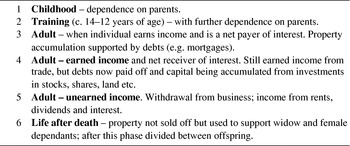
By contrast, studies that focus on sets of personal papers, such as Michie's work on the fabulously wealthy Lord Overstone and Morris' research on members of the Leeds bourgeoisie, allow us to explore longitudinal changes in wealth-holding for specific individuals.Footnote 3 Presenting several such case studies, Morris has proposed the idea of a male ‘middle-class property cycle’, which can be linked to different phases of the bourgeois life course (see Figure 1).Footnote 4 Drawing upon evidence from very full sets of personal papers, account books, ledgers and other personal financial records of a small number of individuals who were active in the early to mid years of the nineteenth century, his cycle attempts to summarize the way that wealth-generating and asset-holding strategies altered over the years of a successful middle-class man's life. Whilst his model is plausible, it remains speculative and rooted in the industrial middle class of northern cities. Moreover, there are questions about its validity in the period after 1870 (when his study finishes and this one starts) and in different economic contexts from the ‘urban-industrial’ one studied by Morris. As a greater range of financial opportunities opened up towards the end of the century, notably the availability of lower-denomination shares, did the balance between different types of assets shift at an earlier phase of the life course?
The middle-class male property cycle in nineteenth-century England and Wales. (Source: Based upon R. J. Morris, Men, women and property in England, 1780–1870 (Cambridge, 2005), 148–9.)

The problem with both approaches, however, is that whilst the first has relatively little to say about the composition of wealth and how that changed over the life course, the second lacks a systematic and comparative framework that would allow the individuals concerned to be situated in a broader context that takes into account differences in age and gender. In seeking to understand the composition of wealth, there are good reasons why we need to consider both these factors. Different kinds of assets and investments, for example, may have been important at different stages of the life course.Footnote 5 In particular, as long as individuals remained at work, their income stream could have been derived from both earned and unearned income. But once they ceased to earn a wage, unearned income from interest, dividends or rents became relatively more important. At that stage there is likely to have been a need to translate assets into income, which in turn may have influenced the kind of wealth individuals might have owned at the latter end of their life. The fact that individuals may have died with a particular set of assets does not mean that the balance of their holdings would necessarily have remained the same throughout their life. Since almost all studies of wealth-holding in Britain have focused on sources that are heavily biased towards the end of life, any discussion of the composition of assets must therefore take account of this life-course effect.
Gender, too, is an important aspect of understanding the kinds and amounts of assets that individuals owned. Morris' schematic model of the middle-class property cycle suggests a process whereby males sought to eliminate debt and move from active to passive forms of income as they aged. However, since he identifies this middle-class property cycle as an explicitly male phenomenon, it prompts further questions about the extent to which it can be applied to females. Traditionally, it has been argued that women had fewer opportunities than men to work outside the home, although more recent scholarship has claimed that women's economic agency has frequently been overlooked or underestimated.Footnote 6 Were middle-class women capable of accumulating assets and, if so, of what kind? To what extent did the differential capacity to earn a living have an impact on the composition of assets and the pattern of inheritance? How significant was gender in relation to debt?
In this article we attempt to answer the questions that age and gender pose for our understanding of the composition of wealth in late-nineteenth-century Britain. Using a range of evidence based on taxation of personal property and real estate at death, we provide an analysis of the relationships between age, gender and the composition of wealth. As a proportion of the population, only about 13 or 14 per cent of those who died in a given year had sufficient property to have made probate (a tax on personal property at death) necessary.Footnote 7 The estates left by this group were submitted to the relevant department in the Inland Revenue for valuation and assessment for death duties. By definition, these individuals, from whom our sample of estates is drawn, were part of the British middle class in the sense that they owned some personal wealth, real estate or both. Although definitions of the middle class need to extend beyond just the possession of property, nevertheless the active accumulation, investment and management of financial assets was an important shared experience of middling social groups.Footnote 8 Based on income-tax returns and occupational information from the census, R. D. Baxter estimated that in the 1860s about 20 per cent of the British population could be categorized as middle-class whilst towards the end of the century Charles Booth suggested that nearly 18 per cent of London's population belonged to what he termed the lower and upper middle class.Footnote 9
The people whose estates are analysed in this article cover a wide spectrum of the wealth-holding population, from those who owned modest amounts to others who were exceptionally rich, and they represent different segments of the middle class, from shopkeepers and petty-industrialists to merchants, manufacturers and professionals. Their ability to accumulate assets varied according to the financial resources that they had available and the opportunities that were open to them. Some would have had sufficient wealth to withdraw from business later in life and live off their investments whilst others would have had to continue to work in order to maintain their standard of living. For these reasons the composition of an estate of a wealthy London-based financier would be rather different to that of a small provincial shopkeeper. Whilst it is important to be mindful of the fundamental ways in which inequalities in access to financial resources and opportunities shaped middle-class wealth portfolios, it is not our main concern here. In this article our principal focus is on the significance of age and gender in understanding patterns of wealth-holding.
James Mott was a solid member of the Birmingham bourgeoisie – a man of wealth, but not spectacularly rich. His account of investments covers the years from 1880 to 1927 and our study starts with his balance sheet as a way of raising questions about how assets and wealth may have shifted as individuals aged. We then present significant new evidence on the composition of individual wealth portfolios for the period 1870 to 1902 for a sample of people who represent a wide spectrum of the wealth-holding population. The findings outlined below, based upon the analysis of 1,274 wealth portfolios, provide a means of assessing how typical the examples of James Mott and other individuals were, as well as offering some detailed empirical evidence to assess the validity of models such as Morris' property cycle. Finally, we draw attention to the implications of our findings for understanding wealth-holding more generally.
A LIFE IN THE BALANCE: JAMES MOTT (1844–1927)
James Mott was born in 1844 into a relatively wealthy Birmingham family. His father, Isaac, was a brassfounder with a business at Brook Street and a residence in the up-and-coming suburb of King's Heath, four miles south of the city.Footnote 10 Isaac owned shares in the Birmingham Banking Company and in 1861 the family was wealthy enough to have employed two resident female domestic servants.Footnote 11 He took an active part in the promotion of Liberal candidates in the 1868 parliamentary election and was of sufficient social status to have been recorded in the court section of Kelly's Post Office Directory.Footnote 12 Isaac died in 1879 aged 68, a notice to that effect appearing in the Birmingham Daily Post on 13 September. On his death he left an estate worth £40,000 to his four children: James, Fanny, Eleanor and Anna. Each received a freehold house and a sum of money. James, in addition, inherited the business in partnership with his father's clerk and relative by marriage, John Harcourt.Footnote 13 It was at that point that James, now aged 35, started to record his investments.
James remained a bachelor all his life. He was recorded as a brassfounder in the 1881 census, living as a single boarder in 3 Valentine Street, King's Heath. The head of the household at that time was his father's accountant, Herbert Brown. Footnote 14 In the 1901 census he was listed as a retired brassfounder living as a visitor at the same house and he was still at that address in 1913.Footnote 15 From the time of his father's death to his own in 1927 aged 83, a period of 47 years, he kept a detailed record of the value of his investments and assets that provides a glimpse into his financial dealings and an insight into how his portfolio changed with age.Footnote 16
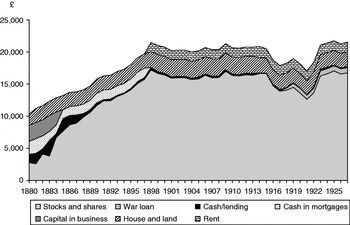
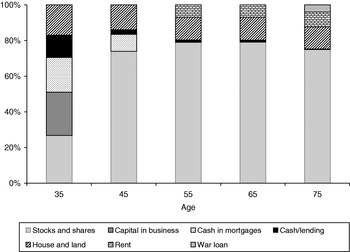
As a bachelor James had different opportunities to amass wealth than did married men with families. Upon receiving his inheritance, he chose to diversify his sources of income and invest in shares rather than continue as a brassfounder. In 1884 the partnership in the family firm which had been set up with John Harcourt, according to the terms of his father's will, was dissolved.Footnote 17 At that stage his net worth was about £13,000, which reflected the approximate amount he had inherited from his father's estate a few years earlier. His investment book for that year shows that there was about £2,500 sunk into the business and once that had been realized he began to invest in earnest. His portfolio of assets, sketched out in Figures 2 and 3, expanded considerably after that date, though shares remained his main form of investment. In the next few years he bought a variety of new shares and actively increased his holdings, as shown in Figure 3 and 4. In 1883–1884 he bought shares in W. Perry and Company and in the Birmingham Canal Company and also a Birmingham Water Corporation Annuity. Two years later he added the Isle of Man Railway Company and in the following year the Cambrian Railway Company and the Patent Nut and Bolt Company (which became Guest, Keen and Nettlefolds in 1902). Throughout this period of acquisition, in his middle-aged years between about 35 and 55, his assets grew. His net worth around 1900 was just over £20,000, at least double the amount that was recorded in the first year's entry in his investment book for 1880.Footnote 18 At that point he began to diversify his portfolio, buying land to rent out, investing in safe corporation stocks in Eastbourne and lending some money to the firm of Harcourt and Son, which was owned by a close relative. He was actively involved in overseeing his investments, speaking at shareholders' meetings and conducting a correspondence about his financial affairs with Brown's, his family's long-term firm of accountants.Footnote 19 The value of his portfolio dipped during the war years, and he added war bonds in 1916, but otherwise his investments remained essentially unchanged, with only the addition of Brighton Corporation stocks and the sale of unprofitable Cambrian Railway shares later on. When he died in 1927 shares accounted for nearly three-quarters of his wealth. At that point his gross personal estate was valued at £19,280, a figure that accords closely with the final entry in his investment book. However, inflation during the First World War had reduced the real value of his portfolio and, although prices fell after 1921, when he died his investments were worth approximately half the amount they had been nearly thirty years earlier.Footnote 20
James Mott's assets 1880–1927. (Note: The value of assets was calculated as of 1 January each year.) (Source: Birmingham City Archives, Lee Crowder Papers, H/864/42: James Mott's account book of assets and share dealings.)

James Mott's investments over the life course (% of total value of assets). (Source: See Figure 2.)

Shares and stocks held by James Mott, 1880–1927. (Source: See Figure 2.)

But how typical was James Mott? The value of his assets and the active role he played in maintaining a portfolio of investments would suggest that he enjoyed a comfortable bourgeois life style. Within a broad and diverse middle class the size of Mott's fortune placed him nowhere near the millionaire financiers and industrialists studied by Rubinstein, yet his ability to invest in and manipulate a range of assets over different periods of his life suggests that his socio-economic status was more secure than those petit-bourgeois men and women who died leaving less wealth. How can we place Mott's investment activity in a broader framework that allows us to explore the relationship between age, life course and investment behaviour, from early adulthood to the end of life? How did the composition of personal assets and liabilities shift according to age, as individuals moved through different life-course phases? What difference did gender make in this process of accumulation? In the remainder of this article we address these issues and seek to develop a framework that allows us to set individual experiences in a broader context that explores the relationships between age, gender and the composition of wealth.
SOURCES AND METHODS
In this article we use death duty records to examine the ownership of assets over the life course. Our evidence is drawn from several interrelated sources that concern the imposition of different kinds of inheritance tax that were levied on individuals' estates – Probate, Legacy, Succession and Estate Duty – and which variously yield information on the composition and value of their real and personal property.Footnote 21 Firstly, a series of papers known as the ‘Residuary Accounts’ (which are preserved within the Inland Revenue ‘IR19’ class at the National Archives at Kew in London) provide a complete breakdown of the personal property for a sample of 1,444 individuals who died between 1870 and 1902.Footnote 22 This sample comprises virtually all surviving Residuary Accounts for persons who died in these years; the remainder have unfortunately been destroyed.Footnote 23 Usually submitted by solicitors acting on behalf of the executors or administrators of the deceased, these forms list all of the decedent's personal assets and debts, from household furniture, money in the bank and stock in trade to stocks, shares, securities and leasehold property, as well as simple debts, mortgage debts, bonds and funeral and probate expenses. The valuation of assets reflected market prices and was usually performed by a professional assessor.Footnote 24 In essence, the Residuary Accounts provide a balance sheet of an individual's personal worth at the time of his or her death.
These accounts form part of the process of the assessment of estates for the payment of Legacy Duty (specifically, that which was payable by the ‘residuary legatee’). Legacy Duty was only payable on personal or moveable property; real estate, including freehold land and buildings, was not liable. Therefore, in order to find out what real estate an individual owned, it is necessary to turn to a related set of records known as the ‘Death Duty Registers’ (preserved within the ‘IR26’ class at Kew).Footnote 25 These comprise the Legacy, Succession and Estate Duty Registers from which it is normally possible to obtain a description and valuation of an individual's real property. Succession Duty was introduced by William Gladstone in 1853 in order to extend the scope of inheritance tax to cover real and settled property.Footnote 26 In 1894 William Harcourt simplified the inheritance-tax system by bringing the different forms of death duty (Probate, Legacy, Account and Succession Duty) under the overall umbrella of Estate Duty.Footnote 27 The registers that dealt with the imposition of Succession Duty – and (from 1894) Estate Duty – provide information on succession to real estate. This information includes valuations of that estate.
Linking the Residuary Accounts (which yield information on the composition of personal assets) with these various registers (which yield information on the composition of real assets) is no easy task. As well as the confusion and difficulty caused by a complex and shifting inheritance-tax regime, the registers themselves are notoriously difficult to work with. Most historians have been put off by the sheer volume of the Death Duty Registers (there are thousands for the period dealt with here) and their complex and seemingly ambiguous nature. According to Rubinstein, the death duty records are ‘extremely confusing … illegible and incomprehensible’, which led him ‘to lack sufficient confidence to proceed’.Footnote 28 Even contemporaries were confused by the complexities of nineteenth-century inheritance tax. In their Handbook to the death duties, published in 1890, Sydney Buxton and George Barnes astutely observed that ‘The history of the Death Duties has been one long tale of tinkering and tacking … [involving] … subdivisions, eccentricities and anomalies without end, and which together form a maze which no one who has not devoted much time and patient study to the subject can hope to unravel.’ As they later put it, ‘on every side, and from every point of view, the Death Duties are full of anomalies and complications’.Footnote 29 However, given the potential significance of real estate as a form of wealth, it is vitally important to include it in the calculation of wealth-holding and with some perseverance it is possible to do so, and thereby to supplement the evidence on personal property contained within the Residuary Accounts.Footnote 30
For the majority of the period covered by our study, the information on the value of real estates that appears in the Death Duty Registers requires further arithmetical manipulation in order to convert the ‘net annual yields’ (upon which Succession Duty was levied) into capital or market values.Footnote 31 This is a complex and contentious matter, but we believe that a multiplier of around 30 provides a reasonable estimate of the capital value of the real estate, translating what is essentially a measure of income into an asset valuation (and thus making the data on real estate comparable with those for personal estate).Footnote 32 From 1894 the Registers contain the capital values of all real estates, since the newly introduced Estate Duty was levied on that figure rather than the annual yield.
There are, of course, several problems associated with using death duty records. At one level, the desire to avoid tax was always present and this may have encouraged the under-reporting of estates liable for duty. However, there were penalties for executors who failed to declare the correct amount of wealth that was liable for duty, and the correspondence attached to the Residuary Accounts, or contained within the margins of the Death Duty Registers, between the executors and the clerks at the Death Duty Offices in Somerset House suggest that figures were often queried and where necessary amended. The Inland Revenue's willingness to exempt estates worth less than £100 (later raised to £150) from Legacy Duty also meant that even executors responsible for relatively small estates had nothing to lose by submitting correct estimates. In general, deliberate avoidance of death duties was considered at the time to be relatively rare since, as Sydney Buxton and George Barnes pointed out in A handbook to the death duties, ‘They are, on the whole, less disliked than almost any other form of taxation.’Footnote 33
A second issue arises in relation to the valuation of settled property and property held in trust which, strictly speaking, was not owned but merely held by an individual for the duration of his or her lifetime or by a set of trustees for the benefit of others.Footnote 34 The aristocracy and landed gentry had begun to make extensive use of settlements and trusts from the eighteenth century.Footnote 35 According to legal historian Chantal Stebbings, there was a ‘widespread adoption’ of trusts by the emerging middle class of Victorian England.Footnote 36 Evidence certainly suggests that earlier in the century trusts and settlements were relatively common. Owens found that in Stockport between 1800 and 1857 62 per cent of wills contained evidence of the existence of trusts, and in Leeds for the period 1830 to 1834 trusts were set up for widows in 82 per cent of married men's wills.Footnote 37 In some places, however, trusts appear to have been less common. Less than a third of men's wills in London for 1830 recorded the creation of a trust, although this proportion rose to 41 per cent when real estate was involved.Footnote 38 Trusts were often formed in relation to women, for whom such arrangements provided protection against the possible actions of a future husband or his creditors. After the Married Women's Property Act of 1882, which gave married women rights over any property they possessed in their own name, such arrangements might have become less necessary, since women no longer needed the same degree of protection.Footnote 39
Settled property (usually in the form of land, but occasionally personal estate) was liable for Succession Duty at each succession and its ‘net annual yield’ was therefore valued in the Death Duty Registers. In other words, a person who had inherited settled property and who would therefore have enjoyed its benefits during their own lifetime, was required to pay Succession Duty and hence the property had to be valued. However, in the case of settled real property, Harcourt's reforms of 1894 legislated that the estate only became liable for duty once in the period of settlement rather than upon each succession.Footnote 40 But since the same reforms also made settled property liable for a 1 per cent Estate Duty tax, the principal value of settled estates is recorded in the Death Duty Registers after this date.Footnote 41 It is therefore unlikely that settled property has been missed or undercounted in our study.
The question was more complex in relation to trusts and it depended on when and how the arrangements had initially been made. Where a trust was established by the terms of a will to take effect after the person had died, the property so used was liable for duty in the same way as any other part of the estate and was therefore included in the overall valuation of the deceased. However, a trust set up by the deceased more than three years before his or her death – effectively an inter vivos gift – was generally not liable for any kind of duty and would therefore not appear in the death duty accounts. The situation was more complex when the person who died was him- or herself the beneficiary of a trust. If that individual had no rights of disposal over the property, it would not be liable for duty and would not be valued as part of the estate. However, if the deceased had ‘general power of appointment’ over the property (that is if he or she had the power to dispose of it by deed or will), it was liable for duty and would therefore be recorded in the death duty records. Finally, if the individual was a trustee him or herself (in other words if he or she held property for the benefit of another person), the property in question was not liable for duty and would not appear in the records, since the deceased had no beneficial interest in it.Footnote 42
In spite of these variations and complexities in the accounting of different kinds of assets, the data on real estate and personal property derived by combining evidence from the Residuary Accounts and the Death Duty Registers represent a unique resource. Although some previous use has been made of the Death Duty Registers to investigate asset-holding and bequest motives, no study of wealth-holding in nineteenth-century Britain has been able to work with such an informative and comprehensive assessment of individual wealth.Footnote 43 Linking these data with the life course ideally requires establishing a range of additional information about the wealth-holders, such as the age at which they died, their family and their household characteristics. This is possible for micro-studies of a relatively small number of individuals but without significant additional research it is impractical for the number of individuals contained in our sample. On pragmatic grounds, therefore, we use age at death, which was obtained from the Civil Registration Indexes to Births, Marriages and Deaths, as a proxy for an individual's life-course position.Footnote 44 In this fashion it was possible to trace age at death for 1,274 out of our total sample of 1,444 individuals.
Although the use of cross sectional evidence to infer longitudinal change over time – in this case using age at death to infer change over the life course – is not uncommon in historical research, it raises some problems. The first is that using evidence gathered over several decades might introduce changes in behaviour associated more with the period in question than with the age of the individuals concerned. In other words, there is a possibility that people who died at the same age or stage of the life course but at different periods might have behaved in different ways. Although the thirty or so years covered in this study is a relatively short time for such behavioural changes to become manifest, the possibility exists that the period rather than age might be important in explaining the different compositions of wealth-holding.Footnote 45 The second problem is that using cross-sectional data to infer change over the life course assumes that the change occurred at discrete points in an individual's life when in fact it could have taken place gradually over a longer time period. To some extent this problem can be minimized by using broad age groupings that are assumed to reflect different positions in the life course. However, there will always be some variability both within these age groupings and between them. Despite these reservations, the advantages of cross-sectional data outweigh the drawbacks. Case studies such as that of James Mott, which provide micro-level data of longitudinal change, are exceptionally rare and even when they do exist they need to be interpreted in the context of wider patterns of wealth-holding. Furthermore, wealth data is usually only collected infrequently and it is therefore difficult to gather evidence of longitudinal patterns for sufficiently large numbers of individuals to allow such a context to be established.
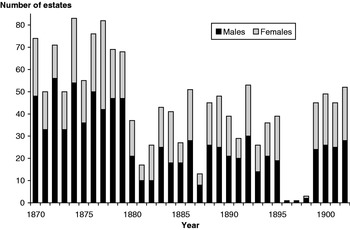
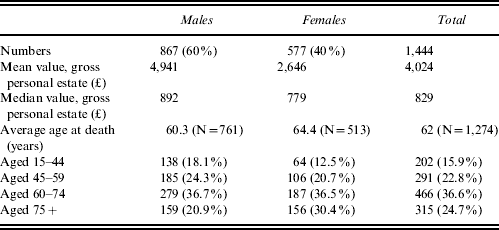
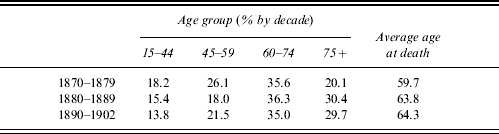
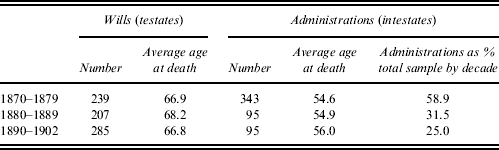
Despite these problems, the sample obtained using these sources and methods raises some intriguing issues. Derived from the various death duty records, the sample is inevitably biased towards older age groups. However, Table 1 reveals that the distribution of ages also covers a significant number of younger people. There is an uneven distribution of the estates across the period dealt with by the study. Greater numbers of Residuary Account papers survive for the earlier years (see Figure 5).Footnote 46 Table 2 shows that the age structure of our data varies for the three decades under consideration. The average age of those dying in 1870–1879 is around 5 years lower than for those in the period 1890–1902. It is unlikely that this is due to demographic factors, such as an increase in life expectancy (there is no evidence for such), but rather, as Table 3 suggests, it is an artefact of the data: a greater proportion of the estates in the earlier decade related to those individuals who failed to make a will, a state of affairs termed being intestate (administrations), who on average tended to die at a younger age than those who made a will.
Number of estates in the death duty records sample by year of death (N=1,444). (Sources: National Archives, Kew, Death Duty Residuary Accounts, 1870–1902 (IR19), and Death Duty Registers, 1870–1902 (IR26); Civil Registration Indexes to Births, Marriages and Deaths, 1870–1902.)

The death duty records sample

Sources: National Archives, Kew, Death Duty Residuary Accounts, 1870–1902 (IR19) and Death Duty Registers, 1870–1902 (IR26); Civil Registration Indexes to Births, Marriages and Deaths, 1870–1902.

Wills and administrations of the death duty records sample by decade (N=1,274)Footnote a

a Ten residuary accounts could not be clearly identified as deriving from either a will or an administration and have been omitted.
Sources: See Table 1.
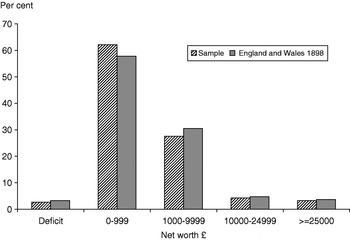
Last but by no means least, in terms of wealth the average and median net worth of estates suggest that our sample differs little from the aggregate figures for all probated estates gathered by the Inland Revenue. Figure 6 confirms that the bulk of our decedents came from towards the lower ends of the wealth spectrum, in parallel with the situation in England and Wales for 1898. Our sample might be a little less wealthy, but the difference is slight. This in particular is further evidence that our sample is representative of broader patterns, and by implication it also suggests that our cross sectional data can be used to draw inferences for the period as a whole.
Net wealth bandings of the death duty records sample estates and all estates in England and Wales (% of total). (Sources: National Archives, Kew, Death Duty Residuary Accounts, 1870–1902 (IR19), and Death Duty Registers, 1870–1902 (IR26); Commissioners of the Inland Revenue, Forty-first report for the year ended 31 March 1898, Tables xcvi, xcvii.)

ASSETS, AGE AND GENDER: AGGREGATE VALUES
Accounts of the relationships between age and wealth, particularly those that focus on the significance of the life-cycle motive for wealth accumulation, emphasize the importance of savings to prepare for retirement.Footnote 47 In this situation, wealth increases with ‘income and age, but tends to decrease in the highest age group, as capital accumulated during the working years is run down’.Footnote 48 In this context, we would expect to see the classic hump-shaped distribution of wealth by age.Footnote 49 As Kotlikoff has pointed out, however, without lengthy periods of retirement, or at least significantly reduced earnings towards the end of life, there is no life-cycle motive for saving.Footnote 50 In this situation, individuals would seek to increase their assets throughout their lives and as such there would not necessarily have been a downturn in the amounts of wealth held in the final years of life.
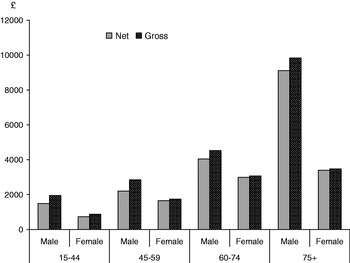
Such accounts, however, fail to recognize that investments and savings may have varied by gender as well as age and therefore it is important to consider these two variables in conjunction. In our sample, both gender and age had a role to play in determining the overall amount of personal wealth. Typically, men tended to have larger estates than women at all ages, though the differential widened with age. Figure 7 shows that both gross and net wealth increased with age, though much faster for men than for women. Given that retirement from business was still relatively rare for most people, this pattern accords with Kotlikoff's views noted above. However, gender was an important factor in this overall pattern. On average, women who died relatively young tended to have only half the wealth of their male counterparts. This proportion increased to around three-quarters for those who died between the ages of 45 and 74 but fell to around a third in the oldest age group. This does not necessarily mean that there were no wealthy women. For example, Elizabeth Snaith, who died in 1890 aged 85, had an estate worth over £66,000, including more than £13,000 in government securities (consols) and £10,000 in railway shares. Only two of the top twenty wealth-holders, however, were women and as a group they were disproportionately represented in the lower wealth bands.
Average gross and net wealth of the death duty records sample by age and gender (N=1,274). (Sources: See Figure 5.)

To a large extent these contrasts reflected the differential earnings capacities over the life course for men and women. In middle age, these differences were less marked, tempered by additional wealth inherited from elderly parents. Since men and women often inherited equal amounts, the differentials in overall wealth during this period in the life course would have been comparatively small. Widening differentials in subsequent years reflected two factors: the continued ability of men to add to their overall wealth through earned income and the fact that since women tended to outlive men, it was more likely that they would have been compelled to eat into their capital assets rather than just rely on income. This was particularly true if they relied, as did Elizabeth Snaith and many other women, on the relatively safe but unspectacular returns from consols and railway shares.Footnote 51 Railway finance, especially debenture stock (which was in some ways comparable to consols), rarely returned more than 3 per cent.Footnote 52 Therefore, unless these were held in sufficiently large quantities it would be likely that anyone owning these investments as the major items in their portfolio would have had to sell some as a way of balancing income with expenditure. By contrast, riskier investments in other forms of certain shares and stocks that paid higher dividends could have provided a larger income and, partly for that reason, as they aged, men tended to see relatively large increases in their total wealth. In turn, deriving an adequate dividend income from investments – and, in some cases, as a consequence of retaining a hand in the family business – meant that their need to sell off capital assets was less pressing than for women.
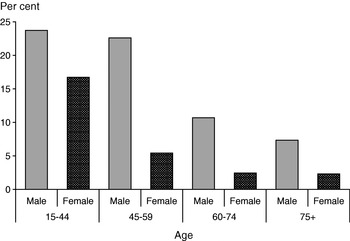
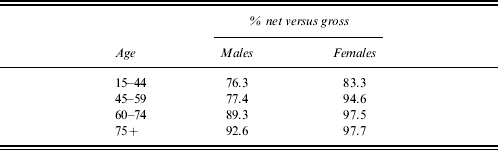
Differences between the gross and net values of estates also signal another important element in understanding the relationships between gender and the life course of asset ownership: lending and debt. Such differences largely reflect the level of debt that was outstanding at the time of death, and here both gender and age were important. Table 4 (and Figure 8), which compare the differences between the net and gross value of estates, show that for men aged between 15 and 44, the net value of their estate after deductions for debt have been made was just over 76 per cent of the gross sum reported in the death duty accounts. The percentage increased with age as the proportion of debt fell in relation to assets. Young women similarly accrued larger proportions of debt early in the life course, though the difference diminished more rapidly than was the case with men.
Debt as percentage of the gross value of the death duty records sample estates by age and gender (N=1,274). (Sources: See Figure 5.)

Age breakdown in the death duty records sample by percentage of net versus gross value of estate (N=1,274)

Sources: See Table 1.
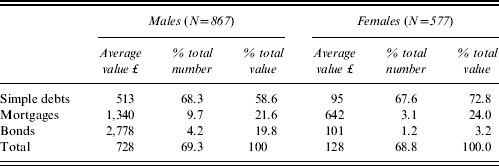
Almost everyone died with some debts and adjustments for these were made when calculating the net value of an estate. Table 5 shows that about 69 per cent of men's and women's estates included some adjustments for debts owed by the deceased. In setting up households or new businesses, men and women contracted debts, and at certain stages of the life course these comprised relatively large amounts of their total worth – and in a few cases they consumed their entire estate, as demonstrated by those in deficit shown above in Figure 6. For both men and women, borrowing was primarily undertaken early in the life course: in the age group 15–44, borrowing accounted for some 23 per cent of the value of men's and 17 per cent of women's total gross wealth. The importance of simple debts, which were usually unpaid tradesmen's bills, emphasizes how important credit was for middle-class households. For men, however, the burden of debt continued in the middle phases of adulthood, hinting at the ongoing significance of borrowing throughout a man's economically active years and reflecting the importance of credit not just for supplying the needs of the middle-class individual and household but also for running day-to-day business activities.Footnote 53 Other debts, including mortgages and bonds (some of which would no doubt have been used to finance business ventures), though relatively infrequent, were much larger, particularly for men. Similarly, nearly 10 per cent of men had unpaid mortgages when they died compared to just over 3 per cent of women, again reflecting not just the likelihood that real or leasehold property would have been held in the man's name but also the likelihood that some of these properties were to do with conducting business. Additionally, a greater number of men had personal borrowing in the form of bonds. Although this was a relatively rare practice, nevertheless when such bonds were assessed as part of an estate they typically accounted for comparatively large amounts, hinting that men were likely to have included their business assets and liabilities as well as any personal borrowing in their Residuary Accounts. The differences outlined above demonstrate that there is a clear life-course pattern of accumulation and indebtedness, which mirrors Morris' ‘property cycle’ earlier in the century, but that the trend needs to be understood in the context of gendered differences in earnings capacity.Footnote 54
Types and value of debts in death duty records sample by gender (N=1,444)Footnote a

a The types of debt are derived from the categories used in the Residuary Accounts. No distinction was made between personal/household and trade-related debts. Consequently, either or both of these types of debts could appear in any of the above categories.
Sources: See Table 1.
THE CHANGING COMPOSITION OF WEALTH BY AGE AND GENDER
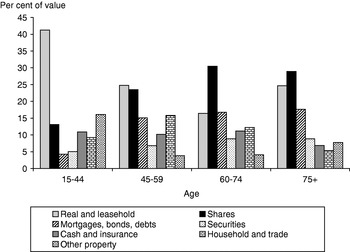
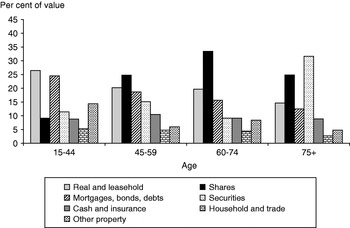
Just as gender and age influenced the aggregate levels of wealth and debt, so too did they influence the kinds of assets that were held. Studies elsewhere have suggested that as individuals age they turn to more liquid forms of investment that can be realized relatively quickly.Footnote 55 The evidence presented in Figures 9 and 10 is an attempt to assess the extent to which this holds true for men and women in different age categories. One of the key trends for both males and females is that the importance of shares – and, to a lesser extent, securities – tended to increase with age, suggesting, perhaps, a switch towards greater reliance on investments and dividend income in older age. This is what happened in James Mott's case, where his shares were built up in the years prior to his retirement as a brassfounder and where his subsequent income was derived not from work but from the returns to his investments. Important differences occur, however, in relation to other types of assets, with the men tending to favour real estate in later years whilst the women tended to favour securities (both favoured shares). When James Mott added land for rental purposes to his portfolio at around the age of 55, he therefore appeared to be following a well-trodden path for men, though perhaps several years earlier compared to most of his contemporaries. For older women, many of whom would have inherited assets (or an equitable income derived from assets) from their husbands, securities – notably consols – became much more important. As has been argued elsewhere for an earlier period in the century, these investments often reflected the terms of a husband's will, which stipulated that income for his widow was to be provided through investments in government consols, otherwise known as ‘the funds’. Single women as well frequently favoured money in the funds as a way of ensuring a steady and virtually risk-free income.Footnote 56 This perhaps confirms Morris' view that over their life course those in the middle class ‘sought to eliminate debt and move from active to passive forms of income’.Footnote 57 The yield from shares and the dividends of securities, alongside the continued income from personal lending (which seems to have been important at all ages) might be described, again in Morris' terms, as the ‘capital of old age’.Footnote 58 The same phenomenon appears to be as true for women as it is for men; indeed the similarities between men and women are probably stronger in these figures than the differences.
Male assets in the death duty records sample by age (N=761). (Sources: See Figure 5.)

Female assets in the death duty records sample by age (N=513). (Sources: See Figure 5.)

CONCLUSION
From the evidence presented here, it seems that James Mott was both exceptional and unexceptional. There may have been personal reasons why James Mott chose not to follow his father and make his money in brass, but instead to build up his portfolio and live as a rentier. However, in doing so he mirrored broader shifts that were taking place in the British economy that encouraged greater involvement with stocks and shares. Although not amongst the ranks of the very rich who comprised those who could be described as ‘gentlemanly capitalists’, he was nevertheless representative of a much larger group of people who amassed comparatively small personal estates but who formed the bulk of wealth-holders in the country. He started building up a portfolio of assets relatively early, helped by his inheritance and the fact that he had no family of his own and, for those reasons, he appears to have had no debts. As such, he was able to expand his portfolio sooner than others for whom debt in early middle age was a more significant barrier to building up a range of assets. The composition of his portfolio, though perhaps weighted more heavily towards shares than other forms of assets, reflected common experiences of other wealth-holders who died in the late nineteenth century.
In this article we have focused on age and gender as ‘demand-side’ factors that drove the decision to invest in particular types of assets. Supply-side arguments might point to changes in legislation that made property ownership more likely: to shifts in corporate governance that resulted in the issue of lower share denominations; and to a widening set of investment opportunities that included not just an expansion in the geographical scope of business ventures but also a change in the types of shares and securities on offer. Nevertheless an understanding of wealth-holding more generally must also take into account wider social and demographic factors that influenced the decision to invest in particular forms of wealth.Footnote 59
Foremost amongst these, we argue, were age – used here as a surrogate for the life course – and gender, both of which can be used to shed light on the kinds of assets that individuals owned. It is very clear that, as a group, individuals who died leaving wealth that was liable for death duties were heavily engaged in a variety of financial investments throughout their adult lives. Clearly, the availability of various kinds of financial opportunities was important, but as individuals aged and their position in the life course changed, they were more likely to shift investment to shares and securities relative to other kinds of wealth. These differences were tempered by gender. For men, shares became relatively more important whilst for older women securities were almost of equal significance as far as overall portfolio values were concerned. The fact that both gender and age were significant influences on the accumulation of wealth suggests that we need to extend our models of wealth-holding beyond the male property cycle to take both these factors into account.
In this article we have not dealt with regional, cultural or economic differences, though arguably these were also important factors that influenced an individual's choice of the types of wealth in which to invest. James Mott's portfolio, for example, included highly local as well as national firms, and the land he bought late in life was very close to where he lived. Regional economic opportunities may have played a part in influencing the precise balance of assets and choice of firms made by any given individual. So too may considerations of profitability, and here the ebb and flow of the broader economy may have played a part in directing individuals into specific forms of investment at particular points in time. The impacts of changing rates of profitability and of the proliferation of different types, denominations and issues of shares have been demonstrated as key reasons why, over the course of the later nineteenth century, Britain became ‘a nation of shareholders’.Footnote 60 At the same time, analyses have suggested a shift away from other forms of wealth, such as land which became relatively less profitable, notably after the depression in agriculture that began around the middle of the 1870s. There were other significant changes during the later Victorian years that are pertinent to an understanding of gender. The Married Women's Property Acts of 1870 and 1882 had the potential to dramatically alter married middle-class women's engagements with the financial markets and their accumulation of assets.Footnote 61 These are issues that require further analysis that is beyond the scope of this article.
What we have demonstrated, however, is that age and the life course, tempered by gender, are crucial elements in understanding both the aggregate amounts and composition of wealth. The explanation for this lies in the way that individuals had to provide for themselves as they aged: there is little evidence to suggest that middle-class parents relied on their children for support later in life.Footnote 62 Nor, for most people, were pensions a significant addition to middle-class incomes late in life. Hannah estimates that only 10 per cent of the British working population had a pension in 1900.Footnote 63 Instead, the middle class had to rely primarily on their own efforts to see them through old age. In doing so, and as the cost of gentility increased, engagement with the financial markets became even more essential. The emergence of ‘a nation of shareholders’ stands out as the single most important way in which that engagement was expressed, though other forms of wealth-holding were also important.Footnote 64 To understand this phenomenon requires more than just an excursion into the operation of the markets or the issue of shares. It also demands a deeper grasp of demand-side factors that would refer to the demographic structure of wealth-holders and in this respect age and gender had important roles to play. Balancing income, assets and age was, in this respect, as much a preoccupation of the Victorian period as it is of our own – for women no less than for men.
ACKNOWLEDGEMENTS
This research was made possible by an Economic and Social Research Council Grant ‘Women investors in England and Wales, 1870–1930’, Award Number: RES-000-23-1435. We thank Steven Ainscough, Carien van Mourik, Carry van Lieshout and Claire Swan for their first-rate research assistance and Marian Nicolson for her help with building, maintaining and querying the project's database. Earlier versions of this article were presented at the European Social Science History Conference, Lisbon, Portugal in February 2008 and at an Economic and Social Research Council (ESRC) workshop on ‘Wealth, Investment and Gender in the Nineteenth and Twentieth Centuries’ held at the Open University, Milton Keynes, UK in June 2008. We are grateful to the participants at these events for their comments and suggestions. We would also like to thank Paul Thane and Bernard Harris for their invaluable comments on earlier versions of this article as well as the two anonymous referees who helped significantly to clarify the argument.