Introduction
The present contribution discusses a previously unidentified unique tallying system practiced by clerks of Eanna, the temple of Ištar in the southern Babylonian city of Uruk.Footnote 1 The peculiar notation was first observed and “deciphered” in YOS 24, 202 and affirmed by YOS 24, 213. Further exploration revealed similar cases in GC 2, 364, GC 2, 187, UCP 9/1 I, 13, UCP 9/1 II, 10, and the previously unpublished tablet NBC 4783. All tablets stem from the Eanna archive during the reign of Nebuchadnezzar II.Footnote 2
I first present the basic terminology and the principles of the tally system. This is followed by short discussions of the individual cases. Apart from the two YOS 24 texts, in the forthcoming editions of which I address the issue at hand, editions of the remaining five texts are included below (three with accompanying hand-copies). This is followed by a discussion and conclusions.
The notation-related terminology used in this paper is based on the following definitions, presented in Chrisomalis Reference Chrisomalis2010:
• “Tallying: The practice of making a series of relatively permanent marks to indicate an ongoing total of some objects” (Chrisomalis Reference Chrisomalis2010: 437).Footnote 3
• “One-to-one correspondence: The association of a collection of discrete sets of identical marks with a set of objects of the same quantity (e.g., IIIIIII = 7)” (Chrisomalis Reference Chrisomalis2010: 436).Footnote 4
• “Chunking: The structuring of long strings of information in groups, usually of three to five elements, to aid in comprehension” (Chrisomalis Reference Chrisomalis2010: 435, emphasis mine).Footnote 5
Graphically, the basic principle in all the cases presented here is the sequence of three triplets of vertical wedges followed by a Winkelhaken. To illustrate, figure 1 presents the first two lines of GC 2, 364 as copied by Dougherty,Footnote 6 and an image of the tablet itself:Footnote 7
GC 2, 364, hand-copy and photo

Since, as will be seen below, the vertical wedges ( ) and the Winkelhaken (
 ) do not necessarily represent the expected numerical values of 1 and 10 (respectively), it is better to transliterate the above sequence as follows:
||| ||| |||<
||| ||| |||<
First to be discussed are the two YOS 24 tablets, in both of which the numerical values of | and < correspond to the 1 and 10 (respectively).Footnote 8 This will establish the basic principle behind the system and allow us to further examine additional cases and variants of this practice.
Texts
1. YOS 24, 202 (NCBT 948)
This administrative tablet is an undated accounting inventory,Footnote 9 recording sums of outgoing silver. The tablet can be roughly dated to the first half of the reign of Nebuchadnezzar based on prosopography.Footnote 10 At the top of the tablet, we find the following underlined heading:
1. kù.babbar šá a-na su-uˀ-ut-˹ti˺
2. a-na lúgal 10meš šá a-na [×]
3. šá urué-Ida-ku-ru il-l[i-ku]
Silver for the support (money given) to the decurions, who went to Bīt-Dakūri:
The main part of the text, lines 4–30, lists each of the 27 decurions with their respective quantities of silver: 10 gín (shekels) PN.Footnote 11 This is followed by a common napḫaru note:
31. ˹pap 27˺ lúgal 10meš
Total of 27 decurions
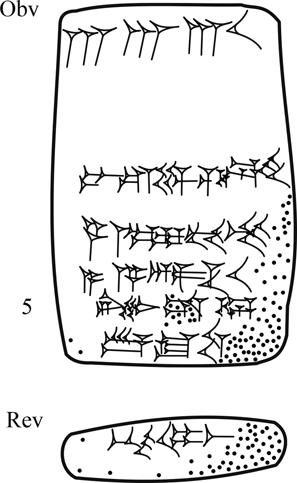
In the final line (32, figure 2) of the tablet we find the following sequence:Footnote 12
YOS 24, 202: 32

As noted above, we can transliterate line 32 as follows: ||| ||| ||| < ||| ||| ||| < ||| ||| |. If we read vertical wedges as 1's and Winkelhakens as 10's, adding it all up comes out as 45. This is clearly nonsensical since only 27 decurions are totalled in the tablet. It also does not correspond to the 270 shekels of silver distributed to these men. In order to get 27 from this sequence of wedges and Winkelhakens, we should read this notation as a base-10 tally. The vertical wedges are chunked in triplets in a one-to-one correspondence. Then, a Winkelhaken “closes” each such sequence marking 10. Importantly, this is not followed by 11, 12, etc., but rather by another such series (full or partial), all of which add up to the final sum. The rationale behind this method is the same as the well-known and often used base-5 clustering: | = 1, || = 2, ||| = 3, |||| = 4, |||| = 5. Read this way, we count: ten (111 111 111 10), plus ten (111 111 111 10), plus seven (111 111 1) = 27. Note that the scribe continues chunking in threes for the last seven wedges even though this last series does not reach ten. While this reading works for YOS 24, 202, the tablet presents us with just one such summary line, and the correspondence may be argued to be coincidental. The additional cases discussed below, however, confirm the reading of a base-10 tallying system.
2. YOS 24, 213 (NCBT 529)
The second tablet to be discussed, YOS 24, 213, is another accounting inventory, listing multiple transactions in silver, gold, and wool. Prosopography points to a chronological horizon similar to that of YOS 24, 202, early–mid Nebuchadnezzar.Footnote 13 Several transactions concerning quantities of wool are summarised with the help of our tallying method. Here are the relevant lines:
3’. ˹|||˺ ||| ||| < ||| ||| ||| <
4’. ˹|||˺ ||| ||| < pap 30 gun sík.ḫi.a
111 111 111 10, 111 111 111 10, 111 111 111 10; total of 30 talents of wool
15’. ||| ||| |½ pap 7 ½ gun
111 111 1½, total of 7½ talents
21’. ||| | pap 4 gun …
111 1; total of 4 talents …
23’. ||| || pap 5 gun …
111 11; total of 5 talents …
25’. ||| || pap 5 gun …
111 11; total of 5 talents …
In the first case, lines 3’–4’, we find three series, each made out of three triplets plus a Winkelhaken; and indeed, the total which follows counts 30 talents (of wool). None of the other tallies reach ten, so no Winkelhakens are used, but there is still clear chunking in triplets in all cases. In the case of line 15', we see seven wedges arranged in two triplets plus one single, and then a ½ is added to count a total of 7½. In line 21' we have one triplet plus one for a total of four, and lines 23’ and 25’ each have a triplet plus a pair to mark five.
3. GC 2, 187 ([x].VII.15, no RN)
The text is a memorandum, as is clear from the use of the first person plural nindašaḫ ‘we have measured’ in line 5. It is dated to year 15 of an unnamed king. If Nabû-zēru-iddin/Ša-Nabû-šū is to be identified as the farmer (ikkaru) listed in YBC 4000 (edited in Janković Reference Janković, Baker and Jursa2005: 169–170), dated to 34 Nbk, then it would be reasonable to date the present text to the reign of Nebuchadnezzar as well. An individual by that name is also attested in FLP 623 (unpublished), which is dated to late Npl–early Nbk, based on prosopography.Footnote 14 Although Dougherty's copy is accurate regarding the signs themselves, it does not properly present the layout of the text on the tablet, especially as regards the gap between lines 1 and 2, the significance of which is discussed below. A new copy of the obverse and the lower edge is therefore presented below (figure 3); the uninscribed reverse is omitted.Footnote 15
Obv ||| ||| ||| <
(gap)
3sic gur še.bar maš-šiḫ-ḫi
šá Id+ag-numun-mu
a Išá- dpa-šú-u
5. ni-in-da-šaḫ
itidu6 ud.[x.kam]
Lo.E mu.15.[kam]
(1) ||| ||| ||| <
(2–7) We have measured 3 kors in the mašīḫu-measure of Nabû-zēru-iddin/Ša-Nabû-šū. [x].VII.15.
GC 2, 187

The tally system at the head of the tablet clearly parallels the above cases. The problem, however, is its relation to the rest of the text, which is clearly dealing with only 3 kors of barley. It seems that the way to address the problem must be to disassociate line 1 from the rest of the text. This can be supported by two arguments. First, the clear gap between lines 1 and 2 should probably be taken as the scribe's way of disassociating the tally from the measured barley. Second, and perhaps of greater weight, is the fact that, unlike all other cases discussed in this paper, the three kors which follow the tally are not presented as the total (pap, napḫaru) of anything else. As an ephemeral and brief “note-to-self”, the existence of two unrelated entries, or at least not co-dependent ones, is neither uncommon nor problematic in the administrative context of the tablet.
4. GC 2, 364 (27.III.09 no RN)
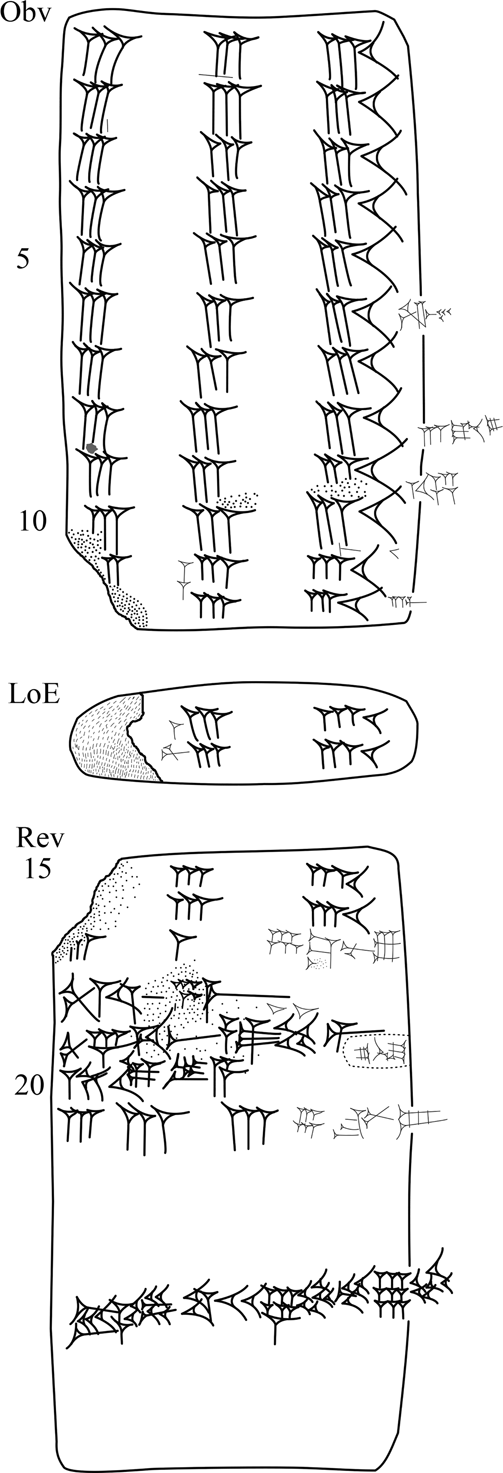
The next tablet presents us with a variation to the tally system seen so far: each series adds up to 100 (rather than to 10). A quick glance at Dougherty's copy in GC 2 makes it clear that the same tally system was used on this tablet; it is easy to identify the rows of three triplets followed by a Winkelhaken. On further inspection of Dougherty's copy, however, several unexpected figures and signs are detected. This is especially true for the obverse, where our familiar tally system is immediately recognisable, but is accompanied by several “additions”, signs which seem to make little sense. Collation of the tablet proves unequivocally that all of these cases are in fact erasures, some of which were half-heartedly executed.Footnote 16 This is especially true for those on the edges, where the scribe barely tried to erase the previous text. Even in these less successful erasure attempts, however, it is clear that the signs that raised our suspicion in Dougherty's copy are smaller, and do not properly align with the rest of the text. Given that collation of the text has resulted in several crucial corrections to the Dougherty's copy, a new hand-copy is presented below in order to make the new readings as clear as possible (figure 4).Footnote 17 While collation did resolve some textual matters, it should be noted that there are still problems with the text.
Obv. ||| ||| ||| <
||| ||| ||| <
||| ||| ||| <
||| ||| ||| <
5. ||| ||| ||| <
||| ||| ||| < {pap 1 me 40}
||| ||| ||| <
||| ||| ||| < {3 ma-nu-ú}
||| ||| ||| < {75}
10. ||| ||| ||| <
[|]|| {x} ||| {x x} ||| <
[|||] {x} ||| ||| < {3 me}
LoE [|||] {pap} ||| ||| <
14. [|||] ||| ||| <
Rev [|||] ||| ||| <
[|||] ||| ||| <
˹|||˺ | {6 ma-nu-ú}
pap 1 lim ˹6*˺ me {2}
pap 4 me 11 (gur) 2 (pi) 3 (bán) še.bar
20. Iḫaš-di-ia
||| ||| ||| {6 ma-nu-˹ú˺}
itisig4 ud.27.kam mu.9.kam
(1–16) (tallies) 100 (x16)
(17) (tally) 400 ?
(18) Total of 1600.
(19) Total of 411;2.3 (kors) of barley.
(20) Ḫašdia.
(21) (tally) 90(0)?
(22) 27.III.09
GC 2, 364

Commentary
17. This tally is separated from the preceding 16 lines based on the two summaries which follow. The figure 1600, line 18, clearly relates to lines 1–16. The four wedges of line 17, then, might be referred to in the sum given in line 19, just over four-hundred kors of barley; see below. This somewhat unclear notation should probably be seen in the context of the ephemeral and pragmatic nature of the text; it was meant for the scribe, and probably only the scribe, to make sense of it.
18. The sum of 1600 must refer to the sixteen series tallied above at lines 1–16.
19. The reason for the separation into two sums is unclear. Given that this second total is just above 400, it may be speculated that it correlates with the four wedges tallied in line 17. If this is indeed the case, however, it would mean that each wedge stands for 100, rather than 10 as in the previous lines of this tablet. While not impossible, this solution admittedly feels forced.
21. The nine wedges are not followed by a Winkelhaken. The chunking of the wedges in triplets suggests that this is tallying as well, though it does not seem to correspond to any other notation on the tablet.
5. NBC 4783 (20.I.[x] Nbk)
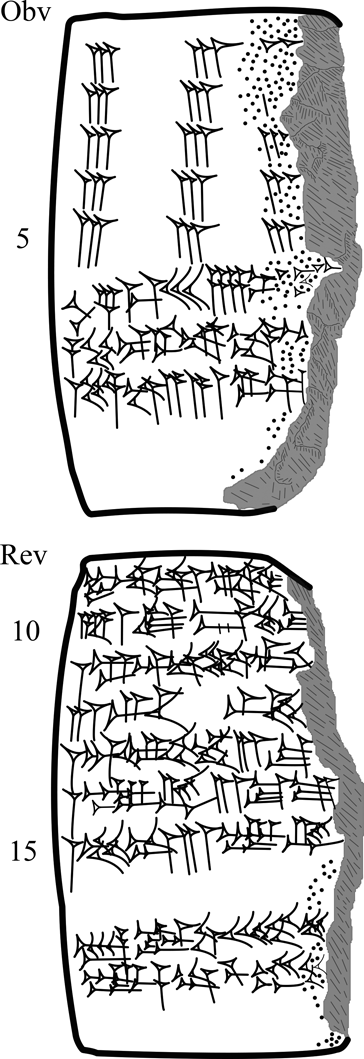
This previously unpublished tablet is a witnessed record of either the withdrawal or the delivery of dates (the verb in line 8 is broken) in lieu of barley; see figure 5 below. While the entire left side of the tablet is missing, the rows of triplets leave little doubt that we are dealing with the same tally system, and that each of the first five lines ended with a Winkelhaken.
NBC 4783

As in the case of GC 2, 364 (no. 4 above), each of the five series add up to 100. This is established by the total of 498 (line 6), summarising the five lines of tallies above it; the minor difference between 500 (lines 1–5) and the total of 498 was presumably insignificant for the scribe (and for the witnesses for that matter).
Obv. ||| ||| ˹||˺[| <]
||| ||| ˹|˺[|| <]
||| ||| ||˹|˺ [<]
||| ||| |˹||˺ [<]
5. ||| ||| ||| [(<)]
pap 4 me 98 ˹gur ˹zú˺.[lum.ma]
šá še.giš.ì ina šà-bi šá ˹x˺ […]
Isum-na-a a Ine-˹e˺-[šú giš/igi-ir]
Rev. i-na gub Ita-qi[š- dgu-la]
10. a-šú šá Iki-˹rib˺-t[u]
Ie-an-na-li-pi-pap
a Iri-mut
Idu.gur-tin-iṭ ! a Iba-[šá-a]
Id+ag-gi a Išu-zu-[bu]
15. Imu-du a Id+ag-gi
itibár ud.20.kam mu.[x.kam]
d+ag-níg.du-pap lugal ˹tin˺.[tirki]
(1–5) ||| ||| ||| < (×5, tallies)
(6–8) Total of 498 kors of dates for sesame, of which …; Iddināya/Nēšu [withdrew/received].
(9–17) (Written) in the presence of: Taqī[š-Gula]/Kiribtu, Eanna-līpu-uṣur/Rīmūt, Nergal-uballiṭ/Iqīšā[ya], Nabû-ušallim/Šūzu[bu], Šumu-ukīn/Nabû-ušallim. 20.I.[x] Nebuchadnezzar, king of Babylon.
Commentary
8. For Iddināya/Nēšu see e.g., YOS 24, 55 (NCBT 147, 17 Nbk), VS 2, 37 (39 Nbk).
9–10. Taqīš-Gula/Kiribtu is further attested in e.g., UCP 9/1, 15 (2 Nbk), NCBT 93 (2 (Nbk?))
11–12. Eanna-līpu-uṣur/Rīmūt is further attested in e.g., YOS 17, 122 (3 Nbk), YBC 3525 (7 Nbk), YOS 17, 350 (12 Nbk), PTS 2491 (14 Nbk), PTS 2283 (21 Nbk).
13. Nergal-uballiṭ/Iqīšā[ya] is further attested in e.g., YOS 17, 306 (3 Nbk), NBC 4932 (6 (Nbk?)).
6. UCP 9/1 II, 10 (14.VIII.7 Nbk)
This is another tablet in which we find the same tally in a series of 100. For the problem of the sum listed in line 8 see commentary below.
Obv ||| ||| ||| <
||| ||| ||| <
||| ||| ||| <
||| ||| ||| <
5. ||| ||| ||| <
||| ||| ||| <
||| ||| ||| <
pap 7?* me gišma-ši-ḫu
[…] Id+ag-[…]
10. [ igi?-ir ?]
Rev (upper part of the reverse was left blank)
itikinII.kam ud.14.kam
mu.7.kam d+ag-níg.du-pap
lugal eki
(1–7) (tallies)
(8–10) Total of 700! measures, [received from] Nabû-[…].
(11–13) 14.VIII.7 Nebuchadnezzar, king of Babylon.
Commentary
l. 8 Lutz's copy reads: pap 6 me. The tallies above, however, add up to 700 (rather than 600). Collation of the tablet's photo in the CDLI (P248210) suggests that some additional damage to the tablet has occurred since Lutz's copy was made. The signs in question were at the edge of the damaged part, and it is reasonable to assume that some further clay has crumbled with time. As such, although the reading 7 is possible, it is difficult to offer a solid reading. If Lutz's copy was indeed accurate, then it should probably be seen as scribal error. Given that the relationship between the tallies and the sum in line 8 was not clear at the time, however, a copyist mistake is slightly more probable.
7. UCP 9/1 I, 13 (27.V.01 Nbk)
The last tablet to be discussed undoubtedly contains the by now familiar tally system, though there are several textual difficulties which could not be resolved even after collation; see commentary below.Footnote 18 Despite these problems, this is another example of our tally system in which each series adds up to 100.
Obv. ||| ||| ||| <
|||*? ||| ||| <
||| ||| ||| <
|| ||| ||| <
5. ||| ||| ||| <
|| pap 5 me 25
dugma-šiḫ šá še.bar
Rev. Id+ag-mu-dù
a-šú šá Id+en-dù-uš
10. igi-ir
itine
ud.27.kam
mu.1.kam
d+ag-níg.du-pab
15. lugal eki
(1–6a) (tallies)
(6b–10) Total of 525 measures of barley were received from Nabû-šumu-ibni/Bēl-īpuš.
(11–15) 27.V.01 Nebuchadnezzar, king of Babylon.
Commentary
l. 2, 4. Lutz's copy has two wedges (rather than three) in the first batch of each line. Collation shows that while in line 2 the reading ||| (rather than ||) is possible, line 4 does seem to have two vertical wedges and not the expected three. However, collation also shows that each of these first batches is aligned to the right rather than to the left (as represented in the transliteration above). This is not to argue for a positional value, rather whatever the reason for the omission of the wedge, the tally in this line was still concluded and calculated in the same way as were the preceding and following tallies.
l. 6 Assuming that the two vertical wedges, like the ones above, stand for 10 each, then the total of the tallying comes out 520; only five less than the actual recorded total of 525. Note that unlike the two verticals at the beginning of line 4, and possibly line 2, the two verticals in line 6 are clearly aligned to the left (as represented in the transliteration above).
8*. SMUI 1913.14.1650
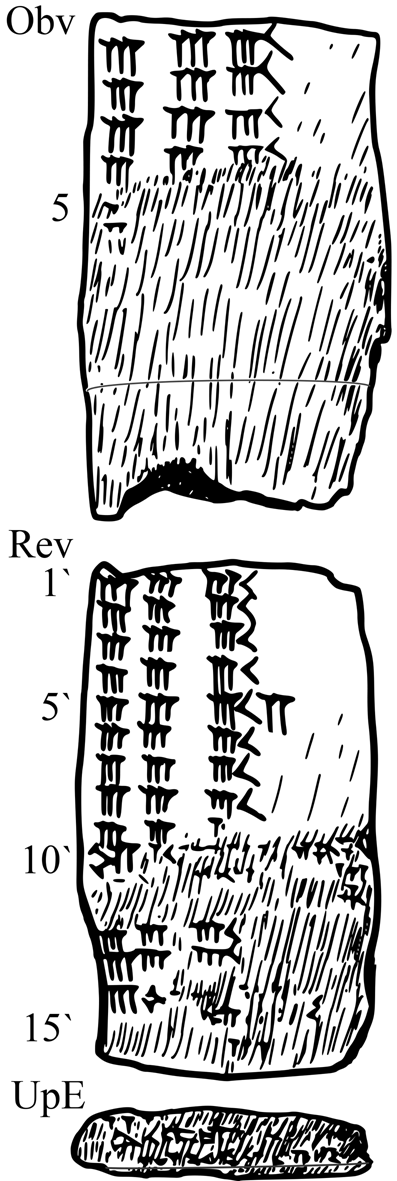
As in all of the above cases, the tablet is written in a portrait format; see figure 6 below. Its bottom is broken and about 1–3 lines are missing. The obverse of the tablet is heavily eroded but it seems that it was filled with about 15 rows of our tally system. It is unknown whether the (now broken) bottom edge was inscribed. The tally rows, at any rate, continue on to the reverse. After nine tally rows on the reverse, a total is given followed by three more or less illegible lines of text. Then another two rows of tallies plus three verticals, and again a total is given. Due to the poor preservation of crucial parts of the text and the limited available image, the following copy is meant merely to present the overall layout of the tablet.
SMUI 1913.14.1650

Discussion
The notation system identified in the cases above clearly differs from the well-known practices of first millennium Babylonia. While the cases are not identical to one another, all were written in portrait format, and there are several shared characteristics that clearly tie these tablets together in regard to content and context. In terms of context, all known cases stem from the Eanna archive, and all of the dateable tablets, whether dated directly or based on prosopography, point to the first half of Nebuchadnezzar's reign. Thus, while we cannot identify specific scribes, all of these tablets come from a relatively narrow bureaucratic context, whether they were produced by a single hand or multiple hands.
Summary of data in the texts discussed.

As for the tallied items, these are typical and commonly recorded items in the Eanna administrative apparatus: men (YOS 24, 202), wool (YOS 24, 213), dates (No. 5), and barley (GC 2, 187, GC 2, 364, UCP 9/1 II, 10(?),Footnote 19 UCP 9/1 I, 13). While some of the quantities of these items are certainly high (e.g., 30 talents of wool in YOS 24, 213 and 1600 (kors?) of barley in GC 2, 364), they are not unheard of in the Eanna archive. The tally system was thus neither meant (specifically) to deal with large quantities, nor was it used for a particular item. Overall, apart from the tally system itself, there is no clear exceptional administrative aspect connecting these tablets to one another. In fact, from an accounting perspective, these notations are redundant. They not only duplicate information that is registered on the tablet,Footnote 20 they also lack any specific data (names, dates, location, etc.).Footnote 21 In this respect, the tally has practically no value for future accounting. Added to this, the fact that, when compared to the given totals, some cases appear to be rough assessments rather than accurate figures raises the question of the added value and practicality of the system.
Yet it is precisely practicality which is the added value of the tally system. It allows the scribe to record multiple large figures quickly, which could then be easily calculated and summed up if necessary. The use of tallies of 10's or 100's allowed the scribe to evaluate totals quickly, while within each tally, the repeated use of chunking in triplets had a similar function. The triplets were used even in cases of lower totals, where the recorded items did not require several series; see YOS 24, 213: 15’, 21’, 23’, 25’.Footnote 22
This chunking in triplets clearly differs from the standard Babylonian notation system of the first millennium, in which groups of either three or four wedges are normally stacked vertically (in one, two, or three rows) to express the numbers 1–9.Footnote 23 In fact, given this standard notation system, it is surprising that such groupings of 3×3 “cubes”, i.e. the notation for 9, are not used instead of the series of  triplets.Footnote 24 Significant in this respect is that, notwithstanding writing apparatus and medium, a basically identical series of chunked triplets can be found in the Aramaic numeral notation system. Aramaic scribes used a series of vertical strokes, paralleling the Akkadian wedges, for the notation of 1–9; see Chrisomalis Reference Chrisomalis2010: 70. It seems most likely, therefore, that the unique notation practice found in our tallies was the result of Aramaic influence.Footnote 25 Although not necessary for the argument, Aramaic chunking in triplets can even be found on clay tablets containing Aramaic dockets; e.g., YOS 6, 164 (6 Nbn, Lasūtu),Footnote 26 TCL 13, 139 (6 Cyr, Bīt-alpi), IMT 65 (27 Art I, Nippur), and BE 9, 47 (36 Art I, Nippur).Footnote 27 Given that chunking in triplets seems to be an Aramaic characteristic, it may be argued that the tallied figures were extracted from an Aramaic original, and the chunking is in fact the result of this copying. The practice of extracting data from Aramaic parchments to clay tablets is recorded, for example, in YBC 3504, ul-tu kušna-a-a-ru šá lúse-pir šu-bal-kut “copied from the parchment of the alphabet scribe” (lower edge, see Pirngruber Reference Pirngruber2017). While this scenario cannot be disproved, I find it less likely. First, none of the cases hint at an Aramaic document or an alphabet scribe. Second, while the above seven cases were not necessarily written by the same scribe, if the chunking in triplets was indeed the result of copying, we would expect to find these cases scattered chronologically and geographically wherever Aramaic was in use in first millennium Babylonia; i.e., more or less all over. Third, the practice of chunking cannot be disassociated from the tally system as a whole, as both the chunking and the tallying are unique.
Two interesting text groups in which we find “Aramaic tallying” should be mentioned here: the (earlier) Arameo-Assyrian lion-weights from Nineveh and the (later) Bactrian tally sticks.Footnote 28 Fourteen bilingual Arameo-Assyrian inscriptions are found on a group of lion-weights from 8th–7th century BCE Nineveh.Footnote 29 Note, for example, BM 91220 (Fales Reference Fales, van Lerberghe and Schoors1995 no. 1), in which we find the Aramaic numerical notation for 15 on its right flank clearly using chunking in triplets. Interestingly, no chunking is used in the corresponding 15 vertical strokes found on the left side of the same object.Footnote 30 A group of eighteen wooden tally sticks, some with accompanying Aramaic notes on them, were first published by Naveh and Shaked (Reference Naveh and Shaked2012) and extensively discussed by Henkelman and Folmer (Reference Henkelman, Folmer, Kleber and Pirngruber2016). The tally marks are made of a series of notches which were incised into the wood (Henkelman and Folmer Reference Henkelman, Folmer, Kleber and Pirngruber2016: 161). As in the case of the Assyrian lion-weights, while the accompanying Aramaic notations kept the expected chunking in threes, no such grouping was used for the tally marks.
As interesting as these two cases are, it must be stressed that they are fundamentally different from the tallies used in the Eanna tablets discussed above. To the best of our understanding, both the lion-weights and the Bactrian tally sticks form a much more coherent group with a uniform format and purpose. That is, even if the lion-weights were not considered to be a single set, they certainly had the same function as one another, and this would be obvious to the clerks who used them. Similarly, Bactrian tally sticks, while certainly used for different counting events, would be identified as tally sticks (notwithstanding the obvious anachronism) by their contemporary bureaucrats. The cuneiform tablets discussed above, on the other hand, certainly share the general administrative context, but were never meant, or seen by their scribe(s), as a specific and coherent administrative dossier.
Conclusions
This paper identified and discussed a unique tally system, composed of a base series of nine vertical wedges, grouped in triplets, followed by a Winkelhaken: ||| ||| ||| <. The vertical wedges can stand for either 1 or 10, and the Winkelhaken concludes the series as either 10 or 100, respectively. The series is then repeated according to need, without change or indication of the running total. The distinctive chunking in triplets is a key aspect of our tally system, and it is kept even in tallies lower than ten. This feature should probably be seen as the result of influence from the Aramaic notation system, which uses parallel triplets of strokes (instead of the Akkadian wedges). This system is so far attested only in administrative tablets from the Eanna from the first two decades of the reign of Nebuchadnezzar. It cannot be said whether all texts were written by a single scribe, but it is clear that all known examples come from the same administrative milieu. The attested cases concern a variety of mundane day-to-day temple dealings, and there is no specific/unique administrative context that can be assigned to our tally system. It seems that it did not serve a specific function in the Eanna archive, but was rather the ad hoc solution of a creative scribe.
Administrative texts are often thought of as merely a source of quantifiable data. More often than not we cannot pinpoint their context and a solid comprehension of the tablets seem to be floating always slightly out of our reach. They lack the lively narrative aspect that may be easier to associate with legal texts and letters, but beyond the data, administrative texts reveal how the scribes organised their world. They illustrate how they dealt with and resolved abstract problems from a very practical perspective. The tally system discussed above was helpful in various scenarios a scribe could face. It is a flexible system which was useful for large estimations (1600, GC 2, 364) but could also be adopted for smaller accurate figures (7½, YOS 24, 213), all simple to mark and quickly recognisable. While further examples are very likely to be recognised in the future, it seems that this clever practical trick did not catch on, and was only a local and short-lived episode.
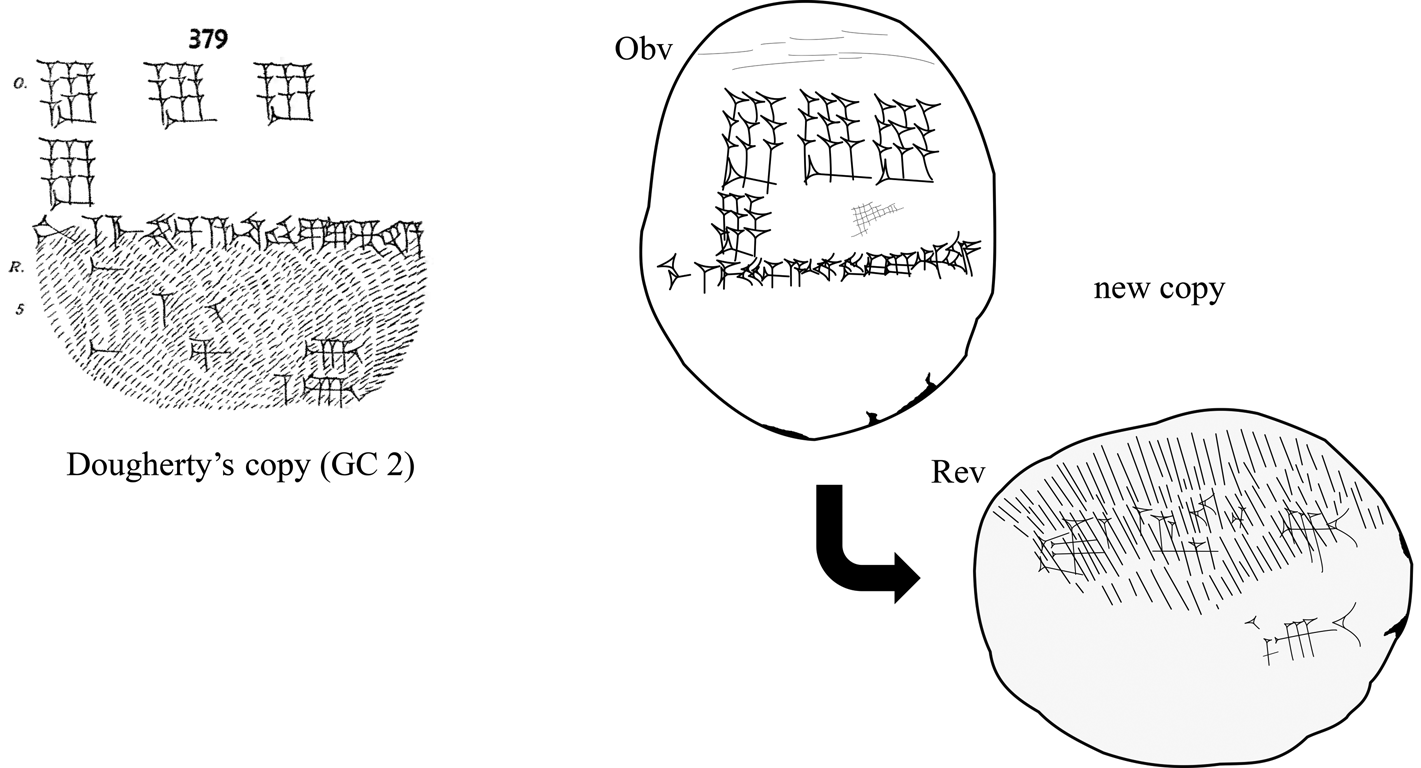
Appendix A: GC 2, 379
This undated Eanna tablet first drew the present writer's attention due to its unique, and still unclear, notation marks. It quickly became clear, however, that it is not part of the small dossier discussed in this paper. Whatever notation or tallying is used in GC 2, 379, it differs from the cases above. Nonetheless, due to its uniqueness, and the hope that it may spark further discussion, the tablet is presented below with a few added notes.
Dougherty's copy is not too inaccurate concerning the signs on the obverse, which is where we find the peculiar notation, but the overall layout of the tablet is misrepresented. A new copy is thus presented below (alongside the original); figure 7. Despite first impressions, both the obverse and the reverse of the tablet are copied by Dougherty in GC 2, though only half of each is represented. Additionally, the copy fails to indicate that the tablet is not flipped vertically as is the standard, but the reverse is written at a 90° angle to the obverse. On the obverse, above and below the text, there are faint scratches that were caused after the clay was dry. The edges of the tablet appear slightly flattened, as if the tablet was rolled like a wheel along a hard surface. The reverse appears to have been erased, and is in any case not related to the obverse. A comparison of Dougherty's copy with the new, collated, copy below will show this most clearly.Footnote 31
GC 2, 379

As noted, this tablet clearly differs from the ones discussed above. Here we have three rows of three verticals stacked upon each other, a 3×3 “cube”, with a closing horizontal at the bottom (rather than a row of three triplets followed by a Winkelhaken). I suggest a tentative transliteration of the obverse as:
Obv. ⁝⁝⁝ ⁝⁝⁝ ⁝⁝⁝
⁝⁝⁝
pap 1 me še.bar a-na lúsipa mušenḫi.a
Translation:
(1–2) tallies
(3) Total of 100 (kors?) for the bird-herder.
The understanding of the four clusters in lines 1–2 as tallies is, at least partially, intuitive, as I am not aware of a similar contemporary parallel.Footnote 32 Additionally, it is difficult to see how these four clusters could be reconciled with the sum of 100 in line 3. I would argue, we are indeed dealing here with tallying, even though it may not correspond to the following total of 100.Footnote 33
SMUI 1913.14.1727

First, regardless of whether these are tallies, it is clear that the four clusters do not conform to any contemporary notation practice. Whatever, and however, the scribe was counting on this tablet, he was not following standard notation. Surprisingly, striking parallels, at least graphically speaking, are found in a group of Middle-Assyrian texts recording daily offerings;Footnote 34 Postgate (Reference Postgate2013: 101, notes 32 and 33) lists MARV 7.46, MARV 5.57, 7.22, 7.61, 8.13, 8.27, 8.30, 9.16, 10.86, 10.88.Footnote 35 Given the hundreds of years separating these texts from GC 2, 379, as well as the fact that these are Assyrian rather than Babylonian tablets, no direct connection can be made between the cases. Nonetheless, this Middle Assyrian tally system does demonstrate that such systems were a repeatedly developed innovation in cuneiform, thereby lending support to our interpretation of the Late Babylonian Uruk text as such a development. As in the case of the main tally system discussed in this paper, the identification of additional exemplars will potentially widen the currently narrow chronological horizon and allow us a better understanding of these practices and their administrative context.
Appendix B: SMUI 1913.14.1727
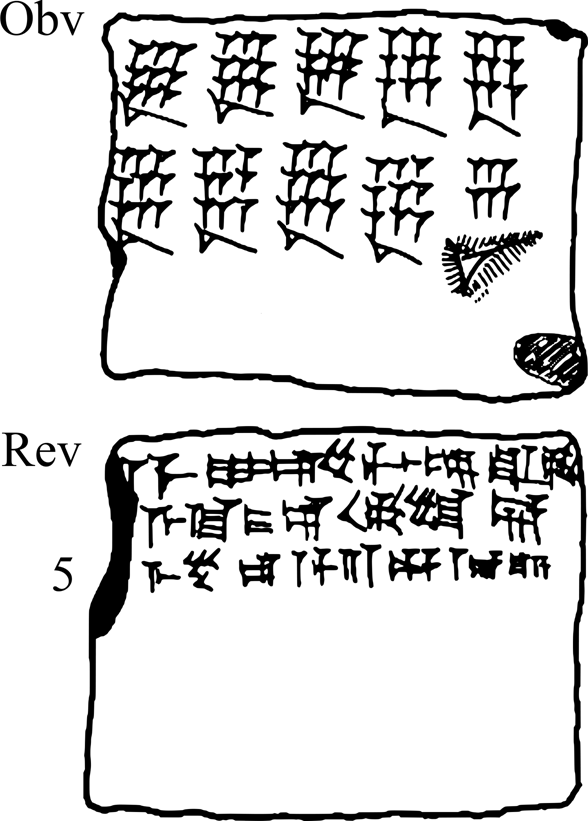
As noted above, after submission of the manuscript, a similar notation practice was identified on another tablet, SMUI 1913.14.1727 (P421578) from the Spurlock Museum. A preliminary copy and the basic notes below are not to be taken as a proper edition.
Obv. ⁝⁝⁝ ⁝⁝⁝ ⁝⁝⁝ ⁝⁝⁝ ⁝⁝⁝
⁝⁝⁝ ⁝⁝⁝ ⁝⁝⁝ ⁝⁝⁝ ˸˸˸
{10 3 1 2}
Rev. [(x)] ˹1˺ me 8 gur še.bar ina 2 gur RA AM
[x] me 60-šu 3 gur ul-tu é
[x] me 50 gur 1 ban 3 qa Ikal-ba-a
Commentary
2. Note that the last group has only six verticals.
2a. The small wedges below line 2 are smaller than the rest of the signs, but there is no sign of erasure.
3–4. The text deals with quantities of barley probably taken from the temple.
5. The only personal name attested on the tablet is Kalbāya.