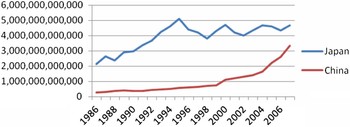
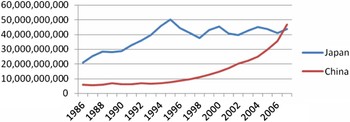
When visiting Japan in May 1980, Wu Xiuquan吴修权, Deputy Chief of Staff of the People's Liberation Army (PLA) said to Japanese politicians: “I am all for Japan's increasing its self-defence capabilities … Generally speaking, Japan is one of the economic powers and it is entitled to become a big military power, too ….”Footnote 1 In contrast to this, however, China's 2006 national defence White Paper was highly cautious about Japan's defence policy. It states: “There are growing complexities in the Asia-Pacific security environment … The United States and Japan are strengthening their military alliance in pursuit of operational integration. Japan seeks to revise its constitution and exercise collective self-defence. Its military posture is becoming more external-oriented.” Japan and the United States are the only two countries that the White Paper describes negatively.Footnote 2 These contrasting quotations imply that China's threat perception of Japan has hardened over the past two decades. This is puzzling considering that China's power has risen over this period. The gap between Japan and China in terms of GDP and defence budget has narrowed, and in 2007 China's defence budget surpassed that of Japan for the first time (see Figures 1 and 2).
Comparison of GDP between Japan and China since 1986 (US$)

Comparison of Defence Budget between Japan and China since 1986 (US$)

This article examines changes in China's perception of the Japanese threat from 1981 to 2006, as evidenced in journals published by two sectors of the Chinese government – the PLA and the Ministry of Foreign Affairs (MFA) – and economic institutes. It seeks to answer two important questions. First, has there been a change in perception of the Japanese threat by these sectors over time? Second, if so, what can we deduce about the causes of this change?
In this study, I find two changes in China's threat perception of Japan, one in the late 1980s, and the other in the mid-1990s. I consider four different hypotheses for these changes: the demise of the Soviet Union; Japan's military build-up; the enhancement of the US–Japan alliance; and the rise (and fall) of historical tensions between China and Japan.Footnote 3 My content analysis suggests that the second and third hypotheses can best account for each of these shifts.
These are important questions for several reasons. One is that scholars often assume there has been a change without conducting any serious testing. We need, first, to examine whether there has been change and second, to determine when the change occurred. The second reason is that there has been no systematic analysis of the attitudes of different sectors of the Chinese government using their own sources. This article seeks to fill these gaps by conducting a comprehensive analysis of the attitudes expressed in journals published by the PLA, MFA and economic institutes. It then explores changes in threat perception over time. Scholars have suggested numerous reasons for why China's perception of the Japanese threat might be changing. It has been argued that the decline of the Soviet threat may have created room for a rise in perception of the Japanese threatFootnote 4; that the Chinese view Japan's defence policy through a historical lensFootnote 5; and also that changes in United States–Japan relations are the determining factor.Footnote 6 This article will seek to examine the validity of each of these arguments.
Has there been a Change in China's Threat Perception of Japan?
This article represents the first attempt to examine the Chinese elite's threat perception of Japan using statistics. It also attempts to analyse what, if any, differences exist among the sectors in China concerning this threat perception. A common problem that pervades the existing literature is that many scholars assume that China's threat perception of Japan is uniform, without considering the possibility that it may vary across sectors as well as across time. Some scholars rely extensively on sources which represent only the PLA's view, and others do not even specify whose views they analyse. However, because of the professionalization, pluralization and decentralization of the bureaucracy after the Mao era, more and more players are involved in the decision-making process in China.Footnote 7 We cannot assume that the perception of one sector (such as the PLA) is all-encompassing.
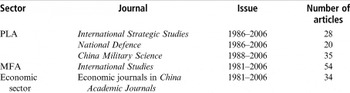
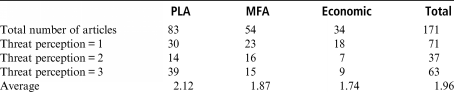
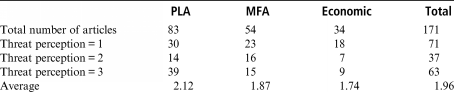
In this article I use Chinese articles published by the think tanks described below as primary sources. The growing pluralism in China's policy-making process means that these think tanks have an increasingly large impact on the attitudes of the Chinese government, and it is possible to assume that they reflect the Chinese government's stance.Footnote 8 I examine all the articles that discuss Japan's defence policy in the journals specified below. In total I examined 171 articles (see Table 1).Footnote 9
Chinese Sources

Notes: National Defence (from 1994), International Studies and economic journals are available in China Academic Journals. First, through the key word search, I examined all the articles which include the word “Ziweidui,” the JSDF. Then, among them, I chose articles which analyse Japan's defence policy. For the economic journals, I examined all those whose subject is “Jingji,” economy. International Strategic Studies, China Military Science and National Defence (before 1994) are available only as hard copies. First, I examined all the articles whose subject is Japan or security environment. Then, I picked up articles which analyse Japan's defence policy.
The PLA and the MFA have their own think tanks which publish journals that reflect their views. In order to examine the PLA's threat perception, I use International Strategic Studies (Guoji zhanlue yanjiu 中国战略研究), National Defence (Guofang 国防) and China Military Science (Zhongguo junshi kexue 中国军事科学). The first is published by the China Institute of International Strategic Studies (CIISS) and reflects the view of the General Staff's Second Department which is in charge of defence intelligence. The other two are published by the Academy of Military Sciences, which performs analysis for the Central Military Commission and the General Staff Department.Footnote 10 For the MFA, I use International Studies (Guoji wenti yanjiu 国际问题研究) which is published by the China Institute of International Studies (CIIS). The CIIS is under the control of the MFA and reflects its views.Footnote 11 For the economic sector, I rely on articles written by Chinese economists from a collection of economic journals available in China Academic Journals.
I have developed a typology to classify the level of China's threat perception of Japan. Given that a “threat” could potentially include anything economic or political, from a current, pressing threat to a latent threat, I have limited the scope of the term to that of a military threat only, either potential or immediate. For example, I have thus excluded statements about the possibility of Japan intervening politically in Taiwan. The typology is as follows:
1. Neutral: descriptive of Japan's defence policy; giving comments that have no strong argument.
2. Suspicious: expressing concern regarding Japan's defence policy, but not specifying China as a target.
3. Critical: characterizing Japan as a threat, including arguments that Japan's defence policy is targeted at China.
I classified each article as a whole into one of these three categories. I then converted each of these categories into numerical values (neutral = 1, suspicious = 2 and critical = 3).
Articles classified as “neutral” seek only to describe Japan's defence policy and give no particular emotive comments about it. For instance, one PLA analyst describes Japan's military build-up in the 1980s as follows:
Japan has been increasing its military expenditures since the mid-1980s … Japan has become the third largest country in terms of military expenditures and is second only to the United States and the Soviet Union … Japan possesses powerful economic strength and advanced science and technology, so the objective foundation of developing modern arms is available.Footnote 12
This author gives no strong comments on Japan's defence budget, the most controversial issue in the late 1980s, and does not show concern about it or criticize it. I classify the threat perception in this article as low.
In articles I classify as “suspicious,” Chinese analysts typically express their concerns about Japan's defence policy by using the words such as danxin (担心, worried), youlü (忧虑, concerned) and guanzhu (关注, pay close attention to). They fear the possibility that Japan will revive itself as a great military power and argue that the current trends in its defence policy suggest that it may be heading down this path. However, they do not understand Japan's defence policy as being specifically targeted at China. They regard Japan as a latent threat at best, not as a present threat. For example, one MFA analyst analyses Japan's decision to send its self defence forces (JSDF) to Cambodia as follows:
Asian countries are still worried about whether or not Japan will become a great military power and show anxiety about the fact that Japan is willing to send its military to foreign countries. Chinese leaders hope that regarding this sensitive issue of sending its troops to a foreign country, Japan will act carefully.Footnote 13
The author displays some nervousness about the JSDF's overseas operations, as he believes that it is indicative of the future direction of Japan's defence policy. However, he does not argue that Japan is posing a direct threat to China.
Articles classified as “critical” regard Japan as a threat to China. Some directly say that Japan is “a threat” (weixie 威胁) and others argue that Japan intends to “contain” (ezhi 遏制) China or to “intervene” (ganshe 干涉) militarily in what the Chinese believe to be “domestic affairs” (such as the Taiwan issue). What distinguishes this from the second category is whether or not the analysts argue that Japan's defence policy has a negative and direct impact on China's security. As one MFA analyst argues:
The new guidelines for the US–Japan defence co-operation enlarged and enhanced the alliance system and put China's Taiwan into the scope of defence co-operation through the form of contingency in the area surrounding Japan … It is very obvious that the US–Japan military alliance has already changed from one against the Soviet Union to one against China. This also promotes Japan to go on the road to a great military power. Clearly, this is dangerous.Footnote 14
Although this author does not use the word “threat,” he interprets Japan's defence policy as being directed at China. It is obvious that he regards Japan as a threat to China.
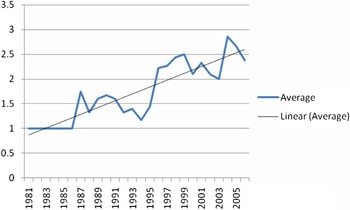
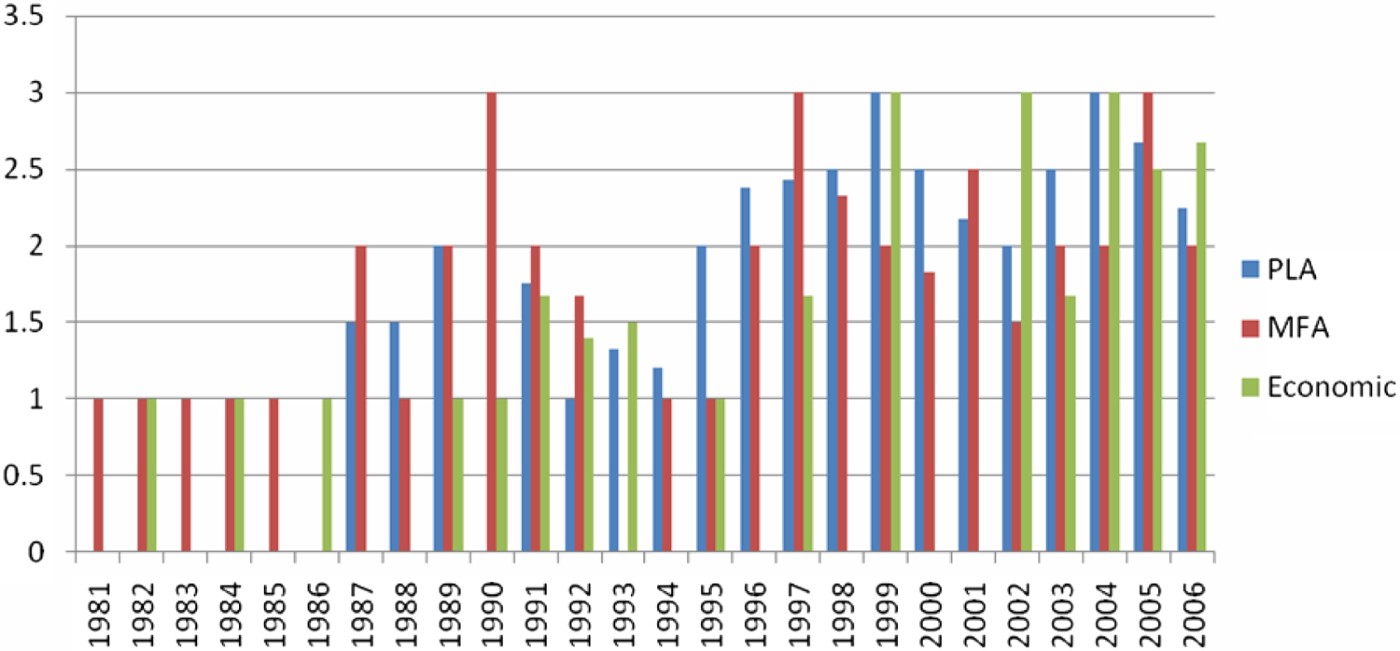
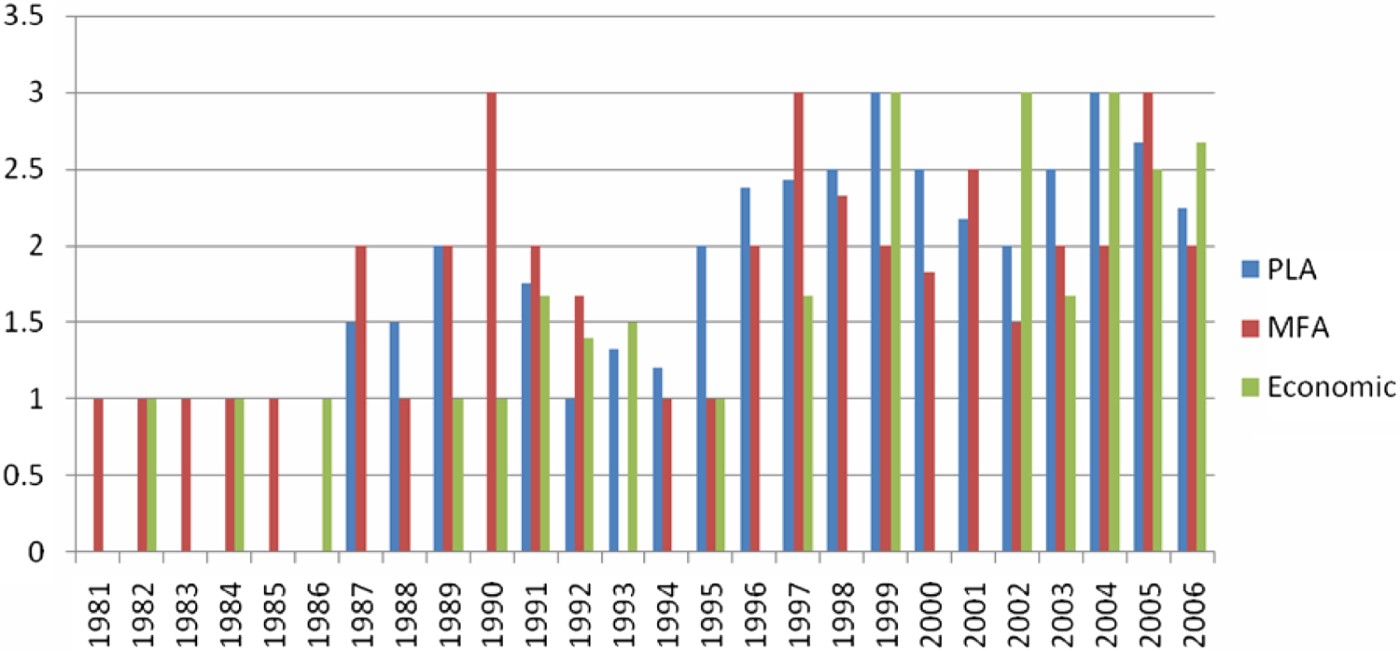
The results are displayed in Figure 3. Prior to 1987 there was not a single article that was suspicious or critical of Japan's defence policy. After 1987, however, the level of threat perception increased notably and remained comparatively high. A second turning point came in 1996: the level of threat perception soared in this year, and has remained at an extremely high level since.
Average Level of China's Threat Perception from 1981 to 2006

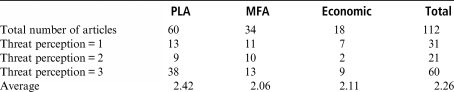
These two changes – the rise in threat perception that occurred around 1987 and the even larger change that occurred around 1996 – require further explanation. With regard to differences between the three sectors, Table 2 indicates that overall, the PLA displays a more hard line position against Japan than the other two sectors. However, Figure 4 indicates that there are no major differences within the three sectors in terms of the way in which levels of threat perception shift. In each of the three sectors, the levels increased temporarily after 1987 and soared after 1996.
Average Levels of Threat Perception by Sector
China's Threat Perception of Japan from 1981 to 2006
In sum, these results provide striking confirmation of the argument that China now regards Japan as a threat and that China's threat perception of Japan is hardening. In addition, it illustrates that there are two major changes in China's threat perception of Japan: a temporary increase of the level of threat perception after 1987, and a radical increase after 1996. Although the PLA tends to adopt a slightly more hard line view of Japan's defence policy than the other two sectors, there is no major difference within the three sectors in terms of the way the levels of threat perception shift.
Alternative Explanations for this Change
How can these two changes in China's threat perception of Japan be explained? Scholars have offered a variety of reasons. Some argue that the presence and absence of the Soviet threat determined China's propensity to regard Japan as a threat. In the early 1980s China was extremely worried about the Soviet Union and may have calculated that it “needed” Japan's military build-up to counterbalance the Soviet threat. The détente between the Soviet Union and China in the late 1980s allowed China to express its concern regarding Japan's military build-up for the first time.Footnote 15 The problem with this argument, however, is that it does not consider how the collapse of the Soviet Union in 1991 should have affected China's threat perception of Japan. Had the presence of a Soviet threat been a crucial factor in determining the degree to which China viewed Japan as a threat, its collapse should have had a major impact. As noted above, however, there were no significant changes in the early 1990s. Chinese threat perception did not change until 1996. This argument is clearly inadequate.
Other scholars contend that changes in China's threat perception of Japan can be explained by the presence of a security dilemma between China and Japan, fuelled by the US–Japan alliance. Christensen, for example, argues for the presence of a security dilemma by suggesting that China has been concerned about Japan's military build-up since the late 1970s.Footnote 16
Others point to the redefinition of the US–Japan alliance in 1996 as having a huge impact. Wang and Wu, for example, contend that it was only after this redefinition that the Chinese government realized that the strengthened alliance was targeted at them.Footnote 17 China has since become deeply concerned about the possibility of Japan, with the United States, militarily intervening in a contingency over Taiwan. China does regard any possible declarations of Taiwanese independence as the biggest threat. This suggests that even though Chinese military power has been improving over the last few decades, China still feels insecure because of the growing assertiveness of Japan's defence policy and the enhancement of the US–Japan alliance. Thus, the logic of a security dilemma offers a compelling explanation for why China continues to regard Japan as a threat in spite of its own rising power status.
Another explanation is offered by scholars taking a historical perspective. Several scholars have argued that the memory of Japanese aggression has had a substantial impact on China's threat perception of Japan.Footnote 18 China tends to observe Japan's military through a historical lens, and is highly sensitive to any small changes in Japan's defence policy. Even if the gap between Japan and China narrows in terms of military power, the Chinese perception of the Japanese threat will continue, as it is hard for the Chinese to forget Japan's history of aggression. Thus, the problem of history between the two nations also may account for why China still regards Japan as a threat despite its rising-power status.
In sum, I offer four hypotheses for explaining the shifts in China's threat perception of Japan:
1. China's détente with the Soviet Union in the late 1980s and the subsequent demise of the Soviet threat created space for China to pay attention to a Japanese threat.
2. The logic of the security dilemma suggests that as Japan augments its military capabilities, China's threat perception of Japan will rise.
3. The logic of the security dilemma suggests that as Japan assumes more roles within the US–Japan alliance, China's threat perception of Japan will rise.
4. The logic of the historical argument is that when Japan's policies invoke Chinese memories about Japan's aggression, China's threat perception will rise.
These explanations are not mutually exclusive and sometimes overlap. For instance, Japan's decision to acquire ballistic missile defence technology constitutes a determination to augment its capabilities and thus can be classified under Hypothesis 2. But it also amounts to an enhancement of the US–Japan alliance, because it is a joint project, and therefore could also be classified under Hypothesis 3. And even though Japan's deployment of forces abroad technically falls under Hypothesis 2, it could also fall under Hypothesis 3, as the aim of most of the operations has been to assist in American wars. In the next sections, I derive hypotheses from the above explanations which might explain the two major shifts in China's threat perception of Japan. I then examine which hypothesis or combination of hypotheses can answer these questions most effectively. In order to test the hypotheses, I use the same Chinese materials as before.
Explaining the First Increase in Threat Perception (1987)
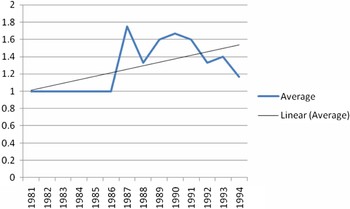
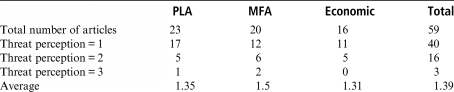
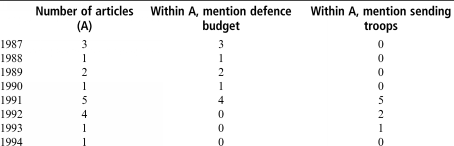
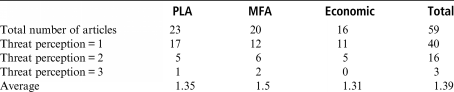
This section examines the causes of the change in China's threat perception of Japan from the late 1980s to the early 1990s. According to Table 3, the level of threat perception was quite low during this period. As Figure 5 indicates, however, it changed notably in 1987. Although there were no articles that conceived of a Japanese threat until 1987, Chinese analysts suddenly began to show concern about it that year. The level of China's threat perception of Japan remained comparatively high until 1991 and then gradually decreased.
Change in China's Threat Perception of Japan from 1981 to 1994

China's Threat Perception of Japan from 1981 to 1994
Methodology
In order to examine possible causes of this shift, I evaluate the following hypotheses derived from the alternative explanations presented above.
H1-1: China's détente with the Soviet Union in the late 1980s and the subsequent demise of the Soviet threat created space for China to pay attention to a Japanese threat.
H2-1: Japan augmented its military capabilities at this time, shown by the increase in its defence budget, which led to a hardening of Chinese perception of the Japanese threat.
H3-1: Japan enhanced its alliance with the United States, leading to an increase in the Chinese threat perception of Japan.
H4-1: The visits by Japan's Prime Minister Nakasone Yasuhiro to Yasukuni Shrine, and/or the dispute over Japan's portrayal of its history in its school textbooks or/and changes in Japan's defence policy per se were enough to evoke Chinese memories about Japan's history of aggression, which resulted in a hardening of the Chinese threat perception of Japan.
In order to evaluate the above hypotheses, I conducted a comprehensive analysis of the content of the articles I collected. In order to test H1-1, I examined how and when China's threat perception of Japan changed. If H1-1 is correct, the level should have increased in the late 1980s because of détente between China and the Soviet Union. As mentioned above, however, I also need to consider China's threat perception of Japan after the demise of the Soviet Union in 1991.
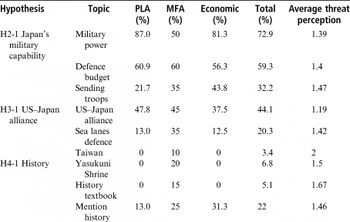
For H2-1, H3-1 and H4-1, I first analyse what Chinese analysts mentioned when discussing Japan's defence policy. If they mention a particular topic (such as Taiwan) frequently, I assumed that this topic was a causal factor in the change in China's threat perception. In order to test H2-1, I examined how frequently the following three topics appeared in the journals: Japan's military power, Japan's defence budget and the overseas deployment of the JSDF. Regarding H3-1, I chose the US–Japan alliance, sea lanes defence and Taiwan.Footnote 19 For H4-1, I chose to see if Japan's defence policies were discussed in relation to Yasukuni Shrine or the history textbook issue, since China labelled Japan's policies towards these issues as signs of a revival of Japanese militarism.Footnote 20 I also examine how frequently Chinese analysts mentioned Japan's past aggressions in order to assess how history affected China's threat perception of Japan. If memory is to have an impact on people's perception, historical events should be evoked repeatedly.Footnote 21
Alongside this content analysis, I employed an additional strategy to try and evaluate my hypotheses. I calculated the average level of threat perception per article. If articles containing a particular topic show a particularly high level of threat perception, I assume that this topic may have been a causal factor in increasing the level of China's threat perception. I then examine the content of the articles containing the topics that I regard as the most plausible cause of the change and assess which hypothesis can explain the change most effectively.
Results
The results are quite startling. Table 4 indicates that Chinese analysts mentioned H2-1- related topics most frequently, and it was these topics that showed the highest levels of threat perception. In other words, the augmentation of Japan's defence capabilities had the biggest impact on China's threat perception of Japan. Although nearly half the articles mentioned the US–Japan alliance, the levels of threat perception in these articles were extremely low. This implies that China did not (yet) regard the alliance as a threat. Finally, the articles made almost no mention of historical issues. Thus, it is safe to say that both H3-1 (strengthening of the US–Japan alliance) and H4-1 (the Japanese government's assertive policies regarding textbooks and Yasukuni Shrine) cannot explain the change in China's threat perception during this period.
Frequency and Threat Perception of a Particular Topic from 1981 to 1994

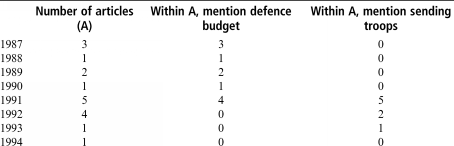
Chinese materials may appear to support H1-1 (détente with the Soviet Union creating space for a Japanese threat), because the level of threat perception began to increase in the late 1980s. However, my examination of the topics covered by articles whose levels of threat perception were 2 or above suggests that it is possible to explain the change in China's threat perception without the Soviet factor. As Table 5 shows, an astonishing 91.7 per cent of the articles from 1987 to 1991 mentioned Japan's defence budget and 72.7 per cent of the articles from 1991 to 1994 mentioned Japan's decision to send the JSDF to the Persian Gulf and Cambodia. Increasing its defence budget above 1 per cent of GNP and sending its troops abroad were key decisions for Japan, which actually went against a 1976 Cabinet resolution and a 1954 Upper House resolution, respectively.Footnote 22 Chinese analysts depicted these decisions as crucial changes to Japan's defence policy. Thus, I contend that these decisions can explain the changes in China's threat perception without the Soviet factor.
Topics which Articles with Threat Perception of 2 or above Cover
As further evidence, had the Soviet Union been a key factor, its collapse in 1991 would have had an even bigger impact on China's threat perception of Japan. If H1-1 is correct, we could assume that the level of China's threat perception of Japan would increase dramatically after 1991, since the demise of the Soviet Union would have allowed China to pay more attention to Japan's defence policy. As Figure 5 shows, however, after the Soviet Union collapse the level of China's threat perception of Japan actually started to decrease. This provides strong evidence that the structure of the international system has a surprisingly small impact on China's view. In fact, in the early 1990s Sino-Japanese relations improved as a result of Japan's more forgiving attitude in the wake of the Tiananmen incident.Footnote 23 Some analysts even argued that Japan would not pose a threat to China in the future. Two PLA analysts claimed: “It is expected that at the turn of the century, Japan will not become a military power posing a threat to other countries and will not possess nuclear weapons either.”Footnote 24 Thus there is simply no evidence to support the argument that the détente with the Soviet Union was a crucial factor in creating a shift in Chinese attitudes towards the Japanese threat.
In sum, it was Japan's military build-up, symbolized by the increase in its defence budget, and its deployment of the JSDF abroad that worried Chinese analysts during this period. Japan's defence budget surpassed 1 per cent of GNP in 1987 and 1988, and Chinese analysts understood this as a dangerous sign of the revival of the Japanese military. As one analyst argued, “recently Japan's defence budget surpassed 1 per cent of Japan's GNP and Japan declared that it will defend 1,000 nautical miles surrounding its territory called sea lanes. This reflects the fact that in Japan there exist a group of people who dream of the revival of militarism, which worries our country and others around Japan.”Footnote 25 Moreover, many Chinese analysts showed anxiety over the JSDF operations in the Persian Gulf and Cambodia. More than 50 per cent of the articles from 1991 to 1993 mentioned the JSDF's foreign operations and they showed high levels of threat perception. Chinese analysts were worried about the future direction of Japan's defence policy.Footnote 26
Finally, it should be noted that the change in China's threat perception from the late 1980s to the early 1990s was quite temporary, as Figure 5 shows. Few Chinese analysts criticized Japan's defence budget after it returned to less than 1 per cent of GNP in 1989. Although many Chinese voiced concerns about the JSDF's overseas operations, they were not necessarily entirely against them. They were anxious about the direction of Japan's defence policy, but did not yet advance the argument that Japan was a threat to China. The criticisms were still highly ideological and symbolic.Footnote 27 Otake has argued that the reason why Japan's defence budget attracted China's attention was that those who advocated the military build-up were those who worshipped at the Yasukuni Shrine and supported the conservative history textbook which the Japanese government adopted.Footnote 28 At that time China was criticizing the increasing influence of the rightists and the signs of the revival of militarism in Japan, rather than Japan's military power per se. In this sense, China did not yet regard Japan as a threat.
In sum, my second hypothesis, which focuses on Japan's build-up of its military capabilities, can explain the first change most effectively. The increase in Japan's defence budget and Japan's deployment of the JSDF abroad worried Chinese analysts. They interpreted these actions as signs of a revival of militarism in Japan. As a result, China's threat perception of Japan worsened, although temporarily.
Explaining the Second Increase in Threat Perception (1996)
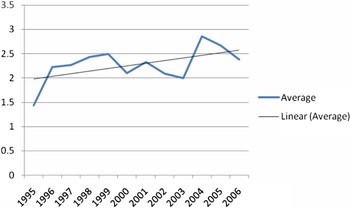
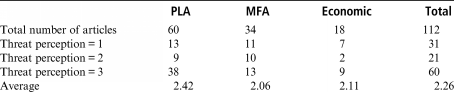
China's threat perception of Japan changed dramatically again in 1996. As Table 6 indicates, 53.6 per cent of articles (60 out of 112) showed threat perception at level 3, the highest. The average jumped from 1.39 in the first period (1981–94) to 2.26 during this period. As Figure 6 shows, the level of threat perception soared between 1995 and 1996 and has remained significantly high since then.Footnote 29
Change in China's Threat Perception of Japan from 1995 to 2006

China's Threat Perception of Japan from 1995 to 2006
Methodology
In order to examine causes of this second change, I evaluate the following three hypotheses derived from the alternative explanations presented above.
H2-2: Japan's qualitative and quantitative augmentation of its military capabilities during this time caused a hardening of the Chinese threat perception.
H3-2: The US–Japan Joint Declaration on Security in 1996 signalled Japan's willingness to assume more roles and responsibilities within the US–Japan alliance, which caused a hardening of the Chinese threat perception.
H4-2: The visits by Japan's Prime Minister Koizumi Junichiro to Yasukuni Shrine, and/or the dispute over Japan's portrayal of its history in its school textbooks or/and changes in Japan's defence policy per se were enough to evoke Chinese memories about Japan's history of aggression, which resulted in a hardening of the Chinese threat perception of Japan as a consequence.
In order to evaluate these hypotheses, I used the same method as above to evaluate the first change, and I chose the same key words for the analysis of H4-2 as I did for H4-1 (Yasukuni Shrine and the history textbook controversy). To the topics for H2-2, I add missile defence, since it symbolizes the qualitative improvement of Japan's military power and has been one of the most controversial issues in Sino-Japanese relations.
Results
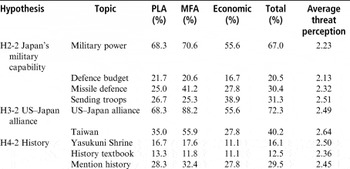
According to Table 7, the US–Japan alliance attracted the most attention from Chinese analysts during this period. As many as 72.3 per cent of the articles mentioned it, while only 44.1 per cent did during the first period. Furthermore, these articles showed significantly high levels of threat perception (2.49 on average), compared to only 1.19 during the first period. This suggests that Chinese perception of the US–Japan alliance changed drastically after 1996.
Frequency and Threat Perception of a Particular Topic from 1995 to 2006

This change in threat perception reflected what is known as the “redefinition” of the US–Japan alliance, epitomized in a joint statement issued in 1996. In April that year, President Clinton and Prime Minister Hashimoto issued the US–Japan Joint Declaration on Security. In the Joint Declaration, the United States and Japan formally agreed that Japan would co-operate with the United States not only in the defence of the Japanese homeland itself, but also of “areas surrounding Japan.” The following year the two governments revised the US–Japan Defence Guidelines, which were implemented by legislation passed by the Japanese government in 1999. Although the two countries took pains to explain that “areas surrounding Japan” were situational and not geographical, Chinese analysts argued that they were proof that the US–Japan alliance and Japan's military build-up was directed at China. For the first time since the 1980s, Chinese analysts named Japan as a clear threat (weixie). As one analyst remarked: “After the end of the Cold War, the target of the Japan–US security alliance changed. While in the past its enemy was the Soviet Union, it was now paying closer attention to regional threats, mainly North Korea and China.”Footnote 30
An important reason why China feared the strengthening of the alliance was the possibility that Japan might co-operate with the United States in support of Taiwanese independence. Although only 3.4 per cent of the articles had mentioned Taiwan from 1981 to 1994, 40.2 per cent of them did during this period. The articles also showed extremely high levels of threat perception of Japan, even higher than those of the US–Japan alliance themselves. This suggests that the redefinition of the alliance meant that the Taiwan issue emerged as a grave security concern between China and Japan.
Chinese analysts contended that the revised defence guidelines would enable the Japanese military to intervene in a conflict in the Taiwan Strait in the future. They suspected that “the areas surrounding Japan” covered by the guidelines included Taiwan. At a press conference in September 1997, the Japanese Cabinet Secretary General Kajiyama Seiroku said that Taiwan was naturally covered by the new defence guidelines.Footnote 31 Chinese President Jiang Zemin visited Japan in November 1998 and demanded that Japan acknowledge that the guidelines did not include Taiwan, and also that Japan follow the Clinton administration's “Three Nos” policy. However, Japanese Prime Minister Obuchi Keizo rejected these demands.Footnote 32 For the Chinese elite, these attitudes were confirmation of their concerns.
The further enhancement of the alliance in the Bush–Koizumi era kept the level of China's threat perception of Japan high. A particularly important incident was the “common strategic objectives” confirmed by the Japan–US Security Consultative Committee (“2 + 2”) in 2005. According to this, “in the region, common strategic objectives include: … encourage the peaceful resolution of issues concerning the Taiwan Strait through dialogue.”Footnote 33 One PLA analyst wrote: “In February this year, the US and Japanese governments issued a joint declaration, overtly including the Taiwan question in their ‘common strategic objective.’ This indicates that Japan is deliberately challenging China's sovereignty interests by making its ‘implicit’ strategy of intervention on the Taiwan issue ‘explicit’.”Footnote 34
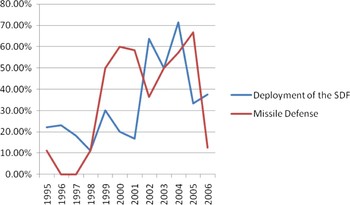
We also have to consider ballistic missile defence (MD) and the deployment of the JSDF abroad in the context of the enhancement of the alliance, although I classified them above as being part of H2-2. While both these changes are indications of an enhanced military capability, they also show the strengthening of the US–Japan alliance. Japan decided to join the joint research project on MD in 1998 and finally decided to develop it together with the United States in 2005. Japan sent units of the JSDF to the Indian Ocean in 2001 and Iraq in 2003 in order to assist two American-initiated wars. Although only about 30 per cent of the articles overall mentioned these topics, they were discussed more and more over time, as Figure 7 indicates. Table 7 shows that the articles in which these topics were discussed also showed high levels of threat perception.
Probability that the JSDF's Foreign Operations and Missile Defence were Mentioned

There are three reasons why the Chinese criticize the MD project. First, Chinese analysts are afraid of the possibility that the United States and Japan might use missile defence to defend Taiwan. That was why China opposed Japan's initial decision to take part in the joint research project in 1998.Footnote 35 Chinese analysts' concerns about the impact of the MD system on Taiwan became more serious over time as the research proceeded. As one analyst noted, “it is becoming more and more obvious that Japan has a plot to interfere in the Taiwan issue and the situation in Taiwan. From now on, Japan will continue to regard China as a potential threat and use China as an excuse to expand its military power, develop the BMD with the US and even allow Taiwan to join the BMD system.”Footnote 36
Second, they were afraid that the deployment of MD would have a negative impact on China's own ability to wield power in East Asia. In short, the deployment of MD would make China's ballistic missiles less useful, requiring it to develop new missiles which could break through the MD system. One analyst argued that Japan's decision to join the MD project would “cause a new series of arms race in East Asia.”Footnote 37 The third reason is simply because China perceived MD to enhance Japan's military power. In the words of one analyst:
First, Japan will have the second-to-none anti-ballistic missile system in East Asia by procuring and deploying the US “Patriot Ⅲ” missiles and the “Aegis” destroyer; secondly, Japan can glean a great deal of secret information of the anti-ballistic missile technologies from the US anti-ballistic missiles, which is an “active defense system,” as well as the ability to develop its offensive missiles; thirdly, the anti-ballistic missile system will enable Japan to make breakthroughs in its military information gathering, early warning and operational responses, thereby improving its overall military strength.Footnote 38
It is necessary to examine the nature of China's criticism of Japan's decision to send its troops to the Indian Ocean and Iraq. Japan carried out these operations to support the American military operations. Chinese analysts were afraid that against the backdrop of this strengthened alliance, Japan would take a hard line towards China. In the words of one PLA analyst:
An enhanced Japan–US alliance will embolden Japan to take a tougher stand in dealing with contradictions and disputes with its neighboring countries … the recent provocative acts taken consecutively by Japan over territorial problems such as the issues about Diaoyu Islands with China … occurred synchronously with the new round of adjustment of the Japan–US alliance and the process of reinforcement of their military cooperations.Footnote 39
Chinese analysts contended that the enhanced alliance would allow Japan's security policy to be more intervention-oriented and assertive, and regarded the operations in the Indian Ocean and Iraq as evidence of this. They described Japan's decisions as “borrowing ships and going to sea” (jiechuan chuhai 借船出海), which meant that Japan took advantage of the American wars in Afghanistan and Iraq to expand the scope of its military operations.Footnote 40
Japan's military power per se also attracted the attention of Chinese analysts during this period, and 67 per cent of the articles mentioned this (Table 7). Japan was acquiring intelligence satellites, aerial refuelling aircraft, F-2 jet fighters and advanced battleships.Footnote 41 Some analysts expressed concern about the possibility that Japan might develop its own nuclear weapons.Footnote 42 Major changes in defence-related legislation in Japan also worried Chinese analysts. Some examined the emergency legislation, which specified what Japan would do in the event of an armed attack, in detail and concluded that Japan was seriously considering ordering military mobilization.Footnote 43
However, it should be noted that Chinese analysts paid more attention to the US–Japan alliance than Japan's military power per se, and articles mentioning the alliance showed much higher levels of threat perception than ones mentioning Japan's military power (Table 7). This implies that the enhancement of the alliance had a more significant impact on China's threat perception than Japan's military build-up on its own. In fact, Japan's defence budget did not increase notably in the 1990s and only 20.5 per cent of articles mentioned it during this period. Chinese analysts were nervous about Japan's military power, but their concerns were inseparable from their fears about the US–Japan alliance. They were extremely worried about the argument for collective self-defence in Japan, because if realized, it would allow Japan to assume more roles in the alliance. One analyst criticized this trend, writing “Japan's eagerness to exercise the ‘Right of Collective Self Defence’ will only arouse the doubts of the surrounding countries. In addition to the historical reasons, it is also because Japan's real intention is to play a part in unilateralist military intervening actions by the United States.”Footnote 44 In effect, what worried Chinese analysts was the fact that Japan was assuming more roles within an alliance that had been redefined as targeting China, rather than the possibility that Japan's augmented military power itself would pose a direct threat to China's security. Thus, the utility of H2-2 is limited here.
With regard to H4-2, hardly any of these articles mentioned any topics related to history. As Table 7 indicates, less than 20 per cent of the articles referred to the issues of the Yasukuni Shrine and the history textbook, and only 29.5 per cent mentioned Japan's past aggressions in their analysis of Japan's defence policy. This implies that the historical issues between China and Japan had little impact on China's threat perception of Japan. This result confirms some scholars' argument that Chinese foreign policy has been quite rational, despite the rising tide of nationalism, and that the fears that Chinese nationalism will distort China's foreign policy tend to be overstated.Footnote 45
We should not overlook the fact that issues related to the history of Sino-Japanese relations have appeared with more and more frequency in the Chinese journals. This is perhaps a reflection of the worsening of bilateral relations over the period, especially while Prime Minister Junichiro Koizumi was in office. Moreover, the levels of threat perception in these articles were extremely high (Table 7). The patriotic education campaign launched by the Chinese government in order to bolster its popular support and Japan's provocative China policies can together explain the increasing influence of historical issues in forming China's threat perception of Japan.Footnote 46
In sum, my third hypothesis, the enhancement of the US–Japan alliance, explains the change in China's threat perception of Japan most effectively. Clearly, the most important causal factor in this change was the enhancement of this alliance in and after 1996. Chinese analysts interpreted this redefinition as being pointed at them, and began to regard Japan as a threat. Japan's decisions to join the MD project and send the JSDF to the Indian Ocean and Iraq were similarly understood as evidence of the strengthened alliance. My second and fourth hypotheses, Japan's military build-up on its own and historical memory, were not useful in explaining this shift in threat perception. While Chinese analysts did worry about Japan's military power, they viewed this in the context of a much-strengthened alliance relationship, which was their primary concern. The articles mentioning topics related to my fourth hypothesis were few, though their number has been increasing. This suggests that they have the potential to affect Chinese threat perception in the future.
Conclusion
This study has four main findings. First, I found that there have been two major shifts in China's threat perception of Japan since the 1980s. The first occurred in the late 1980s. Although the level of China's threat perception of Japan remained low compared to changes that were to occur later, it increased temporarily from 1987 to 1991. The second shift came in the mid-1990s. The level of threat perception soared in and around 1996 and remained high until 2006.Footnote 47
Second, I found that my second hypothesis, Japan's build-up of military capabilities, most effectively explained the temporal change in China's threat perception in the late 1980s. Japan's increasing defence budget and its decisions to send the JSDF to the Persian Gulf and Cambodia elevated China's threat perception of Japan. Although Chinese analysts did not regard Japan as a threat at that time, they were worried about the future direction of Japan's defence policy.
Third, I found that my third hypothesis, Japan's assumption of new roles within the US–Japan alliance, accounts for the drastic change in China's threat perception since the mid-1990s. Chinese analysts understood the enhancement of the US–Japan alliance as being pointed at China, and they were particularly concerned about the possibility of Japan's military intervention with the United States in Taiwan affairs. They regarded the JSDF's operations in the Indian Ocean and Iraq and the missile defence project as the embodiment of a much-strengthened alliance.
My fourth finding was that there has been a consensus regarding the threat perception of Japan within the three sectors in China: the PLA, the MFA and economic institutes. This is a surprising finding, and suggests that one cannot dismiss the changes in threat perception to be the product of publicity by a single organ of the Chinese government. All sectors reacted the same way. The levels of threat perception changed in exactly the same way in the late 1980s and the mid-1990s in all three sectors. In terms of the degree of threat perception, the PLA had a tendency to adopt a slightly more hardliner view than the other two sectors.
A policy implication of this study is that China's threat perception of Japan in the future will be significantly affected by the US–Japan alliance. Almost all the security co-operation between Japan and the United States will be perceived as being targeted at China, and will therefore trigger increases in China's threat perception of Japan. The strengthening of the alliance cannot be the only option for Japan to deal with the military rise of China, and Japan will try to diversify its security policy towards China, considering my finding that the strengthening of the alliance has strategic implications for the entire region. The alliance will remain important for Japan, but at the same time Japan will seek other policy options such as developing its own military capabilities and enhancing confidence-building measures with China.