1. INTRODUCTION
In this work we support design exploration using multiple external representations (MERs) of knowledge triggers, so as to help designers improve the chances of developing designs with greater creative quality. Because a trigger is always given using a particular representation, both its content and form (or representation) could potentially influence the effect created by the trigger. Although the effect of the content of the triggers is generally well studied (see more in Section 2), the influence of representation of the triggers, especially in the context of engineering design, does not seem to have been studied much.
The specific objective of this work is to understand the influence of representation of knowledge triggers (called “triggers” in the rest of the paper) on the representation and quality of the designs generated by designers.
Many research studies have been reported where the effect of representation is investigated on various tasks such as learning or collaboration. For instance, Potelle and Rouet (Reference Potelle and Rouet2003) investigated the effects of different content representations in hypermedia and whether variations in the presentation of the information in either a hierarchical, network map, or alphabetical list aids learners with low prior knowledge and high prior knowledge of the subject. Suthers and Hundhausen (Reference Suthers and Hundhausen2002) similarly reported the effects of representations on collaborative processes and learning, where pairs of participants worked on one of three representations (matrix, graph, or text) while investigating a complex public health problem. The results showed significant impact of the representation types on the students' elaboration of their emerging knowledge, in particular, how they stored this knowledge and whether they would revisit this knowledge later. However, the effect of representations of knowledge triggers on ideation tasks does not seem to have been studied before.
Earlier work published by us (Chakrabarti et al., Reference Chakrabarti, Sarkar, Leelavathamma and Nataraju2005) demonstrated that, in general, use of triggers represented with MERs from an inspiration provider tool called Idea-Inspire (Indian Institute of Science, 2004) has the potential of supporting a generation of a wider variety of ideas in designers. However, the work showed that the overall impact of using triggers, rather than how the representations were used, influenced the process of exploration and its outcome, that is, the kind of search processes that were triggered and the designs that were produced as a result.
MERs have long been recognized as a powerful way of facilitating understanding and learning (Ainsworth & Labeke, Reference Ainsworth and Van Labeke2002). Early research into understanding learning concentrated on using pictures with text to improve understanding (Mayer, Reference Mayer and Glaser1993). Further work focused on understanding the impact of including animations, sound, video, and simulations (Ainsworth & Labeke, Reference Ainsworth and Van Labeke2002). Many research works focused on how specific representations influence learning and problem solving. For instance, Larkin and Simon (1983) proposed that diagrams exploit perceptual processes by grouping together information that makes search and recognition easier. In addition, because descriptive representations are symbolic in nature, they were seen as better at describing general information, whereas depictive representations, the more iconic, were seen as better at providing specific information about instantiations of concrete objects (Schnoltz, 2002).
Use of multimodal knowledge for supporting some tasks in design has also been reported. For instance, Zabel et al. (Reference Zabel, Deisinger, Weller and Hamisch1999) have developed a multimodal environment to support all stages of the industrial design process. The system is meant to support a designer starting at the very early stages of the design process up to the production and reengineering of physical models. This switching between the virtual and the physical world is what they call multimodal. To deal with all those stages, the system's architecture comprises commercially available tools as well as completely new developed components. Another example is the system developed by Adler and Davis (Reference Adler and Davis2004) that, based on the understanding that some information is better conveyed verbally rather than spatially, captures and aligns speech and sketching inputs to create a multimodal system where the user can have a natural conversation with the computer, of the sort a user might have with another person. Yet another instance is the Digital Design Recorder Project (Gross et al., Reference Gross, Johnson and Do2001), which aims to make design transcription easier, by helping to capture the spoken and drawn events of a design session, and constructing a machine-searchable transcription that serves as a pointer into the source data captured during the design session. The three components—drawing, audio, and text transcript—are arrayed in a multimedia document for review and annotation. However, no specific instances have been found in which multimodal representation has been used specifically for aiding ideation.
The importance of using multimodal representations, particularly for generation of design proposals, has been stressed by Chandrasekaran (Reference Chandrasekaran1999). Chandrasekaran argues that providing perceptual cues and supporting extraction of perceptual predicates are the two most important roles of perceptual representations, and argues that the first is particularly important in propose, critique, and modify subtasks, whereas the second is particularly useful in verify subtasks. Therefore, multimodal representations should be good at triggering ideation processes. Particularly important for the context of this paper is his proposition that cues to memory during the propose subtask can be multimodal, enhancing the possibility of retrieving design possibilities from design memory related to all perceptual categories and their associations. Linking this to the work of Goel (Reference Goel1995) on sketching and the importance of its vagueness and ambiguity in allowing multiple interpretations, he argues that ambiguous representations could potentially lead to multiple alternative proposals.
Study of existing literature on MERs and multimodal environments seems to indicate that, although some general and much discipline-specific literature exists for understanding the effect representation on various tasks, and some design support environments have began to emerge, little has been researched in the general understanding of the impact of representations on designing, and in particular that of triggers on creative quality of ideation. Our focus is specifically on the impact of representations used in triggers on the process of exploration, leading to creation of new designs generated by experienced engineering designers.
1.1. Triggers and designing
The presence of a stimulus can lead to more ideas being generated during problem solving (Young, Reference Young1987; Kletke et al., Reference Kletke, Mackay, Barr and Jones2001). Watson (Reference Watson1989) demonstrates empirically that individuals being stimulated with association lists demonstrate more creative productivity than do those without such stimuli.
A trigger is a stimulus for something: a stimulus that sets off an action, process, or series of events (Microsoft, 2007). It is a cause to function or to make something happen (Oxford University Press, 2007).
Stimulus has been defined as an agent (or something) that provokes or promotes interest, enthusiasm, or excitement (Microsoft, 2007; Oxford University Press, 2007). This agent encourages an activity or a process to begin, increase, or develop (Cambridge University Press, 2007; Microsoft, 2007). Freemantle (Reference Freemantle2001) defined stimulus as a small packet of energy that triggers the expenditure of a much larger amount of energy. The meaning of trigger is similar in meaning to that of a number of other terms: stimulus, metaphor, and inspiration. Generally, these provide association or analogy between different objects that are related in some aspects, which is the main reason for their activation. A metaphor is an association between two concepts, through properties that are common to both concepts (Nakakoji et al., 2000).
In engineering design, the presence of triggers helps designers to search for problems, generate solutions, and identify evaluating criteria for evaluating and selecting the generated solutions. The presence of triggers also helps in the search of design spaces (Sarkar & Chakrabarti, Reference Sarkar and Chakrabarti2007); use of suitable triggers can help activation of “exploration,” which can help designers identify crucial design spaces to direct their “search” (see Section 1.2). Thus, we consider a trigger as “an agent that encourages exploration and search of design spaces to begin or increase.” In summary, we take the view that a “trigger is an agent that activates exploration and search in design.”
1.2. Understanding search and exploration
Exploration is a process by which ill-structured knowledge is converted into well-structured knowledge through browsing large design spaces after determining the space within which to search, whereas Search is a process of finding improved designs in a given design space (Sarkar & Chakrabarti, Reference Sarkar and Chakrabarti2007). A “design space” consists of a set of data (which can be problems, solutions, or evaluation criteria) that are similar to each other in some respect. Depending upon the relationship and the level of abstraction used, a design space can overlap with, or subsume other design spaces. Design space generally means “solution design space” for exploring alternatives (Woodbury & Burrow, Reference Woodbury and Burrow2006). A design space may consist of many problems and their respective solutions. A “problem design space” (or simply problem space) contains many similar problems, as a “solution space” contains many similar solutions, or an “evaluation space” contains many similar evaluation criteria.
Jansson and Smith (Reference Jansson and Smith1991) argued that showing designers a picture of a potential design solution to a problem prior to a design session should result in fixation. In some sense we are trying to find what kind of fixation of the outcome takes place because of the administration of different kinds of representation of the same trigger as content.
Through design experiments Sarkar and Chakrabarti (Reference Sarkar and Chakrabarti2007) found that in designing the number of occurrences of the type “exploration” is negligible. Next, it has been observed that searches in the idea generation phase can be further classified into other subcategories according to the link of an utterance with the previous utterances, namely, “unknown solution search,” “global solution search,” “local solution search,” and “detail solution search.” It was also observed that similar kinds of searches are present not only in solution generation but also in problem understanding and solution evaluation stages (see Appendix C for ways of finding different kinds of searches during solution generation).
An “unknown” or “global search” represents search in a global solution space that is less specific than that of the local and detailed spaces (see Appendix C). In addition, the designers search first unknown or global, then local, and ultimately detailed spaces, leading to the solutions becoming more and more detailed. Global, local, and detailed search spaces are visited by designers (while solving other similar problems) whereas unknown spaces are not. Search at the higher level in the hierarchy (such as unknown and global) include and influences searches that are in the lower level of hierarchy (e.g., local or detailed; Sarkar & Chakrabarti, Reference Sarkar and Chakrabarti2007).
1.3. Content and representation of a trigger
Effective triggering depends on both the content (which trigger is shown) and the representation (how it is shown) of the trigger used.
Research reported earlier demonstrated the positive influence that triggers have in enhancing creativity or solving engineering problems. Kletke et al. (Reference Kletke, Mackay, Barr and Jones2001) argued that stimulus can lead to more ideas during the idea generation phase of design. MacCrimmon and Wagner (Reference MacCrimmon and Wagner1994) noted that stimulus-rich creativity techniques positively impact creativity, especially when the initial ideas have been exhausted. Liberman (Reference Liberman1977) noted that playful stimuli foster creativity. While researching many creative problem-solving techniques, Young (Reference Young1987) showed that providing appropriate stimuli helps to enhance creativity. Boden (Reference Boden and Boden1994) expressed that a creative idea is a novel and valuable combination of familiar ideas. Boden (Reference Boden and Boden1994) also argued that an agent could help by suggesting, identifying, and evaluating differences between familiar ideas and novel ones.
Several authors focus on obtaining a detailed understanding of representations of design. For example, Goel and Chandrasekaran (Reference Goel and Chandrasekaran1989) found that knowledge specific to the design of a device is required to solve redesign problems effectively and efficiently. Chandrasekaran (Reference Chandrasekaran, Brown and Chandrasekaran1988) argued that knowledge available to the designer and computational efficiency of finding a solution affects selection of effective methods for solving tasks and subtasks.
A number of methods for creation and selection of triggers for enhancing creativity or problem solving have been proposed in the past. Trigger word technique, trigger sessions, pin cards, or pictures as idea triggers (Mycoted, 2007) are some of the creativity techniques that employ suitable triggers for helping designers generate ideas. Chakrabarti et al. (Reference Chakrabarti, Sarkar, Leelavathamma and Nataraju2005) have developed the State-Action-Part-Phenomenon-Input-oRgan-Effect (SAPPhIRE) model of causality and used this for selecting suitable entries as triggers from a database of entries of natural and artificial systems.
Literature on analogy mainly focuses on how the content of the analogical material is related to the design outcome created. In contrast, in our work, the main focus is on the form of the triggers, and understanding how this influences both the form and the content of the final design outcomes (i.e., the analogical material).
2. OBJECTIVES AND METHODOLOGY
This work focuses on the specific objectives of how design representation of triggers influence the representation and creative quality of outcomes of the designs inspired by these triggers. We asked the following research questions:
1. What are the most effective representations?
2. What kinds of search spaces are found using what kinds of representation of triggers?
3. How does the representation of triggers influence the creative quality of solutions?
4. How flexibility is influenced by the representations?
5. How does the representation of triggers used influence the representation of solutions created using these triggers?
6. What representations does a creative designer prefer?
7. How does the order of a given set of triggers influence the representation of the solutions generated?
8. What is the best likely order of representation?
To answer the above research questions, we first identified and categorized different kinds (modalities) of representation of triggers. Then, we created a suitable database that contained similar contents of triggers represented in different ways. Next, as a pilot study, we asked an experienced designer to solve an engineering problem using suitable triggers from this database. Those triggers that were found effective by this designer were selected for use in the main design experiment. Different representations of these selected triggers were then placed in separate slides in a presentation form. The sequence of representations for each trigger was randomized. Later, each slide was shown to six volunteer design engineers who solved the same given problem, using each slide as a trigger. These design engineers (all with a graduate degree in engineering and with at least 1 year (average 2 years) of mechanical engineering design experience and 2 years of research experience) were asked to capture each solution they generated in white sheets, along with the number of the slide that triggered the solution. Both the experiments were conducted in laboratory setting. Even though there was no strict time constraint, each slide was shown in the main experiment for about 5 min. In case any designer generates an idea because of the effect of the content of a previous slide late during the experiment, the designers are requested to capture the idea in the same place where other ideas from the previous slide is captured.
3. REPRESENTATION OF TRIGGERS
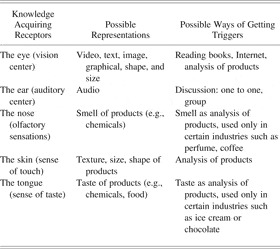
There are many possible modalities for representation of a trigger. Because a “trigger is an agent that activates exploration and search in design,” theoretically a designer can be triggered by any information that activated one or more senses (see Table 1).
Possible representations

We argue that in the earlier stages of engineering design, designers are triggered mostly through their eyes and ears. Thus, we concentrated on those representations that are more widely used in engineering design. Initially, we tried to identify suitable triggers that can be represented in all possible representations that engineering designers might use. The triggers were chosen from Idea-Inspire (Indian Institute of Science, 2004). Each entry in the databases of Idea-Inspire has video, audio, textual, and image as representations. What was missing was a representation using graphical means, which was added.
4. DIFFERENT KINDS OF REPRESENTATION OF TRIGGERS
Six different representations were used (see Appendix A for details):
1. only a video as representation of the selected trigger (visual and auditory)
2. only an image as representation of the selected trigger (visual)
3. only a function–behavior–structure (FBS) model as representation (verbal)
4. only data of SAPPhIRE model as representation (verbal)
5. only a simplified SAPPhIRE model (explicit) in the form of verbs, nouns, and adjectives (link VNA, verbal)
6. only a linked SAPPhIRE model (explicit) in the form of paragraphs (linked para, verbal)
5. PILOT STUDY AND SELECTION OF TRIGGERS
First a design problem is selected, such that the generation of solutions does not require any special knowledge of a particular domain. The selected problem is shown in Appendix B. The experienced designer (with 7 years of design experience), who took part in the pilot study, solved the problem using triggers from Idea-Inspire. The designer used various search strategies to find suitable entries from the Idea-Inspire database. Next, the designer had selected five entriesFootnote 1 that were very effective for him in solving the problem given. It was assumed that these would also be effective on others in solving this problem. These five entries are then broken down into their corresponding basic representations (6 for each case, 30 in total) as mentioned above and placed in separate slides in a presentation.
6. CONDUCTING THE MAIN DESIGN EXPERIMENT
In a laboratory setting, the six design engineers (described earlier) were asked to generate concepts to solve the same problem (Appendix B) individually, using each slide of the presentation above as a trigger. The slides are projected using a projector to all the designers who have worked individually and no interaction among them was allowed. Blank sheets were provided to capture the solution generated after each slide was shown to them one at a time.
7. REPRESENTATIONS USED BY THE ENGINEERING DESIGNERS
The representations used by the designers fall into three categories:
1. Sketches only (shown as s in the tables): This is when a designer has only sketched the solution.
2. Explanation only (e): This is a verbal expression of a solution without the help of any sketching.
3. Both sketching and explanation (s + e): This representation is a combination of sketching and explanation of the idea in words. In general, a sketched solution is followed by some verbal expression.
8. RESULTS AND ANALYSIS
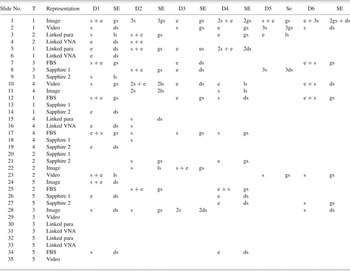
The results of the experiment are being shown in Table 2. The first column of Table 2 shows the trigger number in the same sequence as provided to the designers shown in Table 2, the second column its representation, the third representation used by a designer (D) to express the solution generated, followed by the type of search space found (column 4). Data for all the designers are shown. The representation used for each trigger in each slide is also shown as it was shown to all the participant designers.
Results of the experiment with six design engineers (D1–D6)

T, trigger (no.); D, response of an engineering designer; s, solution has been sketched; e, solution has been explained; sapphire 1 and sapphire 2, SAPPhIRE constructs shown in two different slides (because one slide was not enough for all seven constructs); SE, search types (us, unknown solution search; gs, global solution search; ls, local solution search; ds, detailed solution search; see Appendix C). The empty cells show that the designer did not generate any solution for that particular representation.
Data from the experiments (Table 2) are further analyzed with the following analyses.
8.1. Finding the most effective representation (quantity)
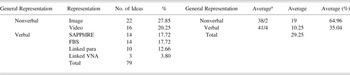
Data from Table 2 were summarized and sorted according to the representation to evaluate the effectiveness of each kind of representation on engineering designers, and Table 3 was constructed. Note that the effectiveness of the representations is assessed in terms of both the number of solutions generated in response to the use of each representation, described as quantity (Table 3), and the evaluation of the number and kind of search spaces generated, described as quality (Table 4), which are further explained in Section 8.2.
The effect of representations on the number of ideas generated

aTotal number of ideas/kinds.
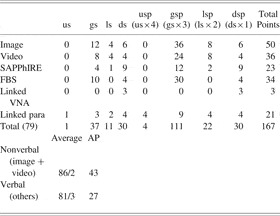
Effect of representation on the quality of the generated ideas

us, unknown solution search; gs, global solution search; ls, local solution search; ds, detailed solution search (see Appendix C); usp, unknown search point calculated as the value of us multiplied by 4; gsp, global search point (gs × 3); lasp, local search point (ls × 2); dsp, detail search point (ds × 1); AP, average point.
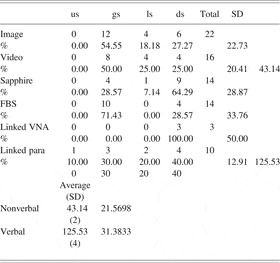
Among the six kinds of representation used, representation by image and video are of a nonverbal type and the other four can be categorized as verbal. Table 3 shows the number of ideas generated by the six design engineers when a different kind of representation is shown to them. Because the total number of generated ideas is higher when nonverbal representation is used, it can be concluded that nonverbal representation is more effective on designers. Thus, fluency increases with the use of nonverbal representation. Because there are two kinds of nonverbal and four kinds of verbal representation used, the number of ideas generated per kind of verbal and nonverbal representation are also calculated in Table 3, which also shows that nonverbal triggers are more effective.
8.2. Finding the most effective representation (quality)
The quality of the ideas is judged by both the number and kind of search spaces found during the problem-solving session using each kind of representation. Table 4 shows the cumulative effect of each kind of representation on all the engineering designers. Because generation of higher levels of searches improves the solutions more (refer to Section 1.2), we ascribe each generation of unknown search (us) 4 points, each global search (gs) 3 points, each local search (ls) 2 points, and each detailed search (ds) 1 point. The total number of points awarded to each instance of search triggered by a representation as taken here is its cumulative effect on quality (Table 4).
Table 4 shows the total number of different kinds of search spaces found for each type of representation. Because different amounts of different kinds of search spaces are generated for each type of representation, and because occurrence of higher level of searches (such as us or gs) are regarded as more effective than the occurrence of a lower level of searches (such as ls and ds; Sarkar & Chakrabarti, Reference Sarkar and Chakrabarti2007), it was essential to assign points to compare the efficacy of each kind of representation. A higher level of searches was given more points compared to a lower level of searches. Table 4 shows that the quality of the solutions that are generated is best when image is used as the representation followed by video, FBS, and others. Next, all verbal mode of representation and nonverbal mode of representation are combined and an average point is found. Table 4 indicates that the quality of the ideas generated is likely to be better using triggers that are represented using nonverbal ways.
8.3. Flexibility (variety of solutions) and representation of triggers
Table 5 was constructed from Tables 2 and 4. According to Torrance (Reference Torrance and Passow1979), flexibility is the ability to produce a large variety of ideas. We consider the variety in solutions generated in terms of the generation of very different ideas (us and gs) and in terms of the generation of less different ideas (ls and ds). This one could be considered flexible if we can generate both very different and very similar solutions—the number of different search spaces generated uniformly. This is because as a designer searches different search spaces the designers generates different kinds of solutions, and when the same design spaces are searched, the designer would generate solutions that are relatively similar. A designer could be considered flexible if one can search various kinds of search spaces that are both different and same uniformly. Table 5 has been derived from Table 4. In Table 5 the percentage of different kinds of search spaces found is calculated and standard deviation (SD) is also calculated. Next, the average standard deviations for nonverbal and verbal representation are calculated. A smaller SD value means that the data are more uniform. Table 5 shows that for nonverbal representation the outcome is more uniform. This shows that the variety of ideas gets increased when the triggers are represented nonverbally.
Flexibility

8.4. Mapping triggers representation with the solutions representation
The representation of the solutions are mapped with that of the triggers and shown in Table 6.
Mapping trigger representations with the representations of the generated ideas
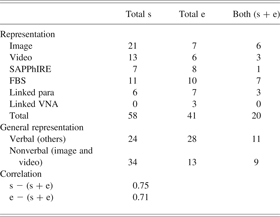
A Pearson correlation was used; p < 0.02 for both values.
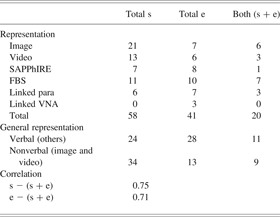
As explained in Section 7, representations that the designers have used to express their solutions are either a sketch (s) or verbal explanation (e) or both (s + e). Although calculating, for each s + e generated we have increased the total number of s by 1 and total number of e by 1 (to calculate total s or e) and also separately represented them under s + e.
Table 6 shows that total number of s (see column 2) is high compared to e (see column 3), for nonverbal representations such as image and video; one can say that when the nonverbal mode of representation is used for triggering designers, they tend to represent their outcome by nonverbal means. Similarly, verbal modes of triggering designers are more included to represent those using verbal ways.
Table 6 also shows that the total number of s generated during the entire experiment is higher than that of e, leading us to believe that that designers generally prefer to represent their solutions nonverbally. One possible reason can be physiological; when a designer generated a very different (new) solution the designer may feel the necessity of explaining it using a sketch, or else others may not understand. For trivial or simple solutions, the designer might assume that only verbal explanation would be enough.
The correlation between the values of s (21, 13, 7, 11, 6, 0) of all six types of representations and corresponding values of s + e (6, 3, 1, 7, 3, 0) and that between e (7, 6, 8, 10, 7, 3) and s + e are similar. Thus, we can state that designers equally prefer to represent a solution by first sketching it and then explaining the sketching or first explaining the idea and then sketching it.
8.5. Mapping designers performance with their solution representation
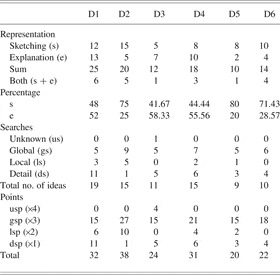
We have tried to identify here the most creative designers among the six involved in the experiment. Because search at the higher levels of search hierarchy (Section 1.2) increases the chances of the resultant solutions to be more creative, we gave points to each kind of search (as before) carried by each designer, aggregated the total number of points for each designer,Footnote 2 and compared them to find the highest scoring ones as the most creative designers (Table 7).
Finding the most creative designers

While calculating, for each s + e generated we increased the total number of s by 1 and total number of e by 1 (to calculate total s or e) and separately represented them under s + e. us, unknown solution search; gs, global solution search; ls, local solution search; ds, detailed solution search (see Appendix C); usp, unknown search point calculated as the value of us multiplied by 4; gsp, global search point (gs × 3); lasp, local search point (ls × 2); dsp, detail search point (ds × 1).
Table 7 demonstrates that designers D1 and D2 are the most creative. The table shows that most creative designers on average prefer to represent their ideas using nonverbal representations (for some others this would also be applicable).
8.6. Effect of the order of representation on idea generation
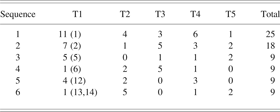
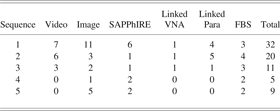
Each sequence in Table 8 denotes a total of five slides shown serially to the designers. Each cell shows the number of ideas generated by all the designers taken together in response to the specific trigger shown in a specific representation in that step of the sequence. Note from Table 2 that the various representations that are used in expressing the triggers are administered to the designers randomly. Table 8 shows that, irrespective of the representation of triggers that is administered first, the representations that appear first have more effect (i.e., lead to generation of a larger number of ideas) on the designers than those administered progressively later. Table 2 also shows that designers tend to generate more ideas in the beginning of the experiment; this is possibly because they would have more patience, concentration, and enthusiasm (motivation) in the beginning of the experiment. Another possible reason is that those shown later still have the same content, and only the representation is different; therefore, what was possible to be triggered from them is derived from their earlier representations, and little is left to be triggered later.
The effect of the order of any representation on idea generation
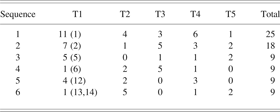
T1–T5 represent different triggers. Sequence shows the sequence of different representations that were shown to the designers irrespective of the type of representation (verbal or nonverbal). The slide number is shown in parentheses only for the first trigger (refer to Table 2).
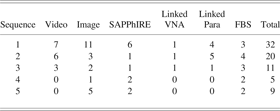
Table 9 shows the entire series of 30 slides shown as five sequences, in which each sequence denotes 6 slides, and each slide has a different representation. The table shows that when a trigger is given to a set of designers the nonverbal representations have more effect on them than verbal ones.
The effect of the order of representation
9. DISCUSSION
Some of the findings were predictable. It was anticipated that sketching would be a more common way of representing solutions for designers than other ways. Another was the likelihood that, regardless of in what order the triggers are presented, the earlier ones would get more attention than the later ones. It was also anticipated that images would be more interesting and therefore more attention catching than the verbal triggers. However, whether this greater attention would turn into a greater number or quality of solutions was not clear.
More results turned out to be different from anticipated. The first was the strong influence that the kind of representation that triggers had on the kind of representation of the solutions generated. Because the kind of representation of triggers also had a strong influence on the number and quality of solutions, this was an important finding in this work.
We had anticipated that video would draw the most attention; it might be the most influential of the triggers. Unexpectedly, images turned out to be the most influential. Similarly, among the verbal representations, as used in this paper, we had felt the graphical ones would be the most influential as they would provide clearer and a more detailed account of the functionality of the triggers. It turned out that the more textual representations yielded greater results. This is also in contrast to what was predicted by Larkin and Simon (Reference Larkin and Simon1987).
We also thought images would generate more detailed searches, whereas textual ones would generate more general searches. In reality, the findings indicate a relatively uniform array of searches triggered by the images, whereas textual ones do not show any specific pattern.
The empirical findings do not point to a clear explanation, although the degree of attention drawn by the triggers seems to be an important (but not the only) factor. The motivation of the designers could be another factor that might be relevant, and needs to be investigated in greater detail.
There are some inherent limitations of this work detailed here. Even though we have taken considerable care to keep the depth of explanation or the detail of the information provided in each kind of representation the same, we believe that the contents are not exactly the same across representations. This is because each representation has different advantages and disadvantages in terms of expressing the content of a trigger. For example, a video is inherently better in showing the dynamic aspects of the content, whereas the verbal mode is better in terms of explaining the behavior of a trigger, and an image could be used both for explaining the internal and the external structure of a trigger.
One observation during the analysis was that the designers predominantly expressed their outcome in nonverbal ways. One possible reason could be that designers are predisposed to nonverbal modes of expression and when they are triggered using nonverbal means the outcome tends even more toward nonverbal mode of expression (discussed in Section 8.4).
10. SUGGESTIONS FOR USE OF TRIGGERS
Suggestions can be drawn from the above analysis that when triggers are to be applied by designers, the following point should be noted: for a given content of a trigger representation nonverbal representations could be followed by verbal representations to make a trigger more effective. Thus, it is better to represent the content first using videos and images followed by explanatory texts and linked texts.
11. CONCLUSIONS
Using design experiments we observed how the representation of a trigger influenced the efficacy of the trigger on inspiring solutions in engineering designers. Analyses of the effects of both nonverbal (image and video) and verbal (FBS, SAPPhIRE model, and two kinds of linked representations) representations have shown that nonverbal expressions were more effective as triggers than verbal expressions. In addition, designers were found to represent ideas predominantly nonverbally when triggered nonverbally, and verbally when triggered verbally. It has also been found that a nonverbal expression of triggering seemed to enhance the quality of the solutions generated. It was also noticed that representations earlier in the order, though with the same content of a trigger, were more effective. Again, nonverbal representations when preferred over verbal representations in a sequence (when the same content of a trigger is applied) is more effective.
Many of the findings remain unanticipated and unexplained. A more comprehensive theoretical development must follow to explain the findings. This notwithstanding, some suggestions have been made from these to make application of triggering more effective.
ACKNOWLEDGMENTS
We express our thanks to all of the participant designers.
Prabir Sarkar is a PhD student at the Centre for Product Design and Manufacturing, Indian Institute of Science, Bangalore, India. He received his MDes degree from Indian Institute of Science and worked in the industry for 3 years before seeking his PhD. His research interests are design creativity and biomimicry.
Amaresh Chakrabarti is an Associate Professor at the Centre for Product Design and Manufacturing, Indian Institute of Science, Bangalore, India. He obtained his PhD from the University of Cambridge. Dr. Chakrabarti's research interests are creativity and synthesis, ecodesign, collaborative design, and design research methodology.
APPENDIX A: REPRESENTATION OF TRIGGERS
A.1. Only video as representation of the selected trigger
Each selected entry (trigger) has a corresponding video. This was placed in a separate slide in the presentation that was made (see Fig. A.1).
Video or animation. [A color version of this figure can be viewed online at www.journals.cambridge.org]

A.2. Only image as representation of the selected trigger (visual)
Each selected entry (trigger) has a corresponding image. This was placed in a separate slide in the presentation that was made (see Fig. A.2).
Image. [A color version of this figure can be viewed online at www.journals.cambridge.org]
A.3. Only the FBS model as representation (verbal)
The definitions of function, behavior, and structure used here are from Chakrabarti et al. (Reference Chakrabarti, Sarkar, Leelavathamma and Nataraju2005):
• function: descriptions of what a system does: it is intentional and at a higher level of abstraction than behavior
• behavior: descriptions of how a system does its function: this is generally nonintentional and at a lower level of abstraction than function
• structure: structure is described by the elements and interfaces of which the system and its immediate interacting environment are made
For an example, see Figure A.3.
The function–structure–behavior of an entry.
A.4. Only data of SAPPhIRE model as representation (verbal)
A more detailed model for describing the FBS of products is used. In a recent study (Chakrabarti et al., Reference Chakrabarti, Sarkar, Leelavathamma and Nataraju2005) the product characteristics in an FBS model has been subdivided into seven elementary constructs. We use this model to assess the relative degree of novelty of products. The seven elementary constructs of this model are the following:
1. action: an abstract description or high level interpretation of a change of state, a changed state, or creation of an input.
2. state: the attributes and values of attributes that define the properties of a given system at a given instant of time during its operation
3. physical phenomenon (PP): a set of potential changes associated with a given physical effect for a given organ and inputs
4. physical effect (PE): the laws of nature governing change
5. organ: the structural context necessary for a physical effect to be activated
6. input: the energy, information, or material requirements for a physical effect to be activated; interpretation of energy/material parameters of a change of state in the context of an organ
7. parts: a set of physical components and interfaces constituting the system and its environment of interaction
These constructs and links are taken together to form a model of causality known as the SAPPhIRE model (see Fig. A.4).
The relationships between these constructs are as follows: parts are necessary for creating organs. Organs and inputs are necessary for activation of physical effects. Activation of physical effects is necessary for creating physical phenomena and changes of state, and changes of state are interpreted as actions or inputs, and create or activate parts. Essentially, there are three relationships: activation, creation, and interpretation (Fig. A.5.)
The SAPPhIRE model.
SAPPhIRE model constructs.
A.5. Only simplified SAPPhIRE model (explicit) in the form of linked VNA as a trigger (visual and verbal)
Actions are described using a list of verbs, nouns, and adjectives/adverbs. For instance, the action of feeding is described using “feed” as a verb and with no specific noun or adjective as qualifiers:

A state change is also described using a phrase. In this case, one such state change is “from rest to reciprocating motion”:

Physical phenomena are also expressed in terms of verbs, nouns, and adjectives. For instance, the physical phenomenon of “production of a chemical” is described using the verb “produce” and the noun “chemical” with no specific adjectives:

Physical effects are described using the name of the effect, for example, “stimulus–response effect”:

An input is represented using a verb, noun, and/or an adjective. For instance, an input “electrical signal” is described using no verb, the noun “signal,” and the adjective “electrical”:

An organ is currently described with the help of a phrase that describes the organ. In the example case, one such organ is “the ability of the scent gland of the Venus flytrap to produce appropriate chemicals for scent emission”:

Parts are defined described with the help of a phrase that describes the part. In the example case, one such parts is “belt pair”:

The links between these individual fragments of knowledge are represented using ordered lists. For instance, the above knowledge fragments are linked together by linking the action with physical phenomenon with the physical effect with the input with the state change with the organ with the part. It is represented as the following link:
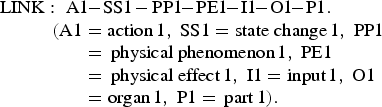
This representations are linked explicitly in a template showing exactly how the constructs are related to each other (see Fig. A.6).
The SAPPhIRE model explicitly linked in a simplified manner. [A color version of this figure can be viewed online at www.journals.cambridge.org]
A.6. Only linked SAPPhIRE model (explicit) in the form of paragraphs (linked para) as a trigger (visual and verbal)
As explained in the previous subsection, the representation is also done in linked para form. The contents of this representation are similar to “Only data of the SAPPhIRE model as representation (verbal),” but these data are linked to each other showing the relationship among them (see Fig. A.7).
The linked SAPPhIRE model (explicit) in the form of paragraphs as a trigger (visual and verbal). [A color version of this figure can be viewed online at www.journals.cambridge.org]
APPENDIX B: THE PROBLEM
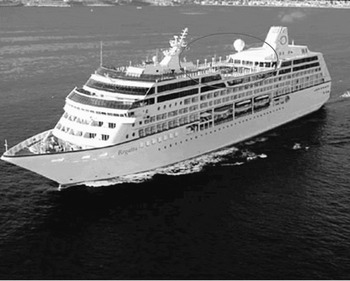
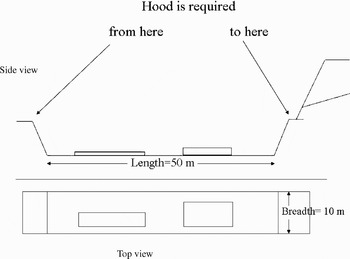
Design conceptual solutions for a foldable roof for a cruise. A small restaurant runs on the open space of the cruise and the roof is generally open. The roof needs to be used during midday to avoid scorching sunshine and during rain. The rough dimension of the open space is about 50 (length) × 10 (breadth) × 10 (height) m (see Figs. B.1 and B.2).
Problem 1 details, part 1. The circled area is the place where the solution is supposed to fit. [A color version of this figure can be viewed online at www.journals.cambridge.org]

Problem 1 details, part 2.

APPENDIX C: TERMS RELATED TO SEARCHES OF SOLUTION SPACES
The characteristics of different kinds of searches are provided below. For the purpose of illustrating let us assume the following given design problem: design a system that can drill a hole in a material in any direction and whose direction can change while the drilling is in progress.
C.1. Solution generation
C.1.1. Unknown solution search
• This occurs when a designer find a new solution while searching an unknown solution space.
• It is not presearched, that is, the designer did not have any idea about any possible solution of any problem that lies in that space.
• It is characterized by identification of a “new function”/action.
• If the function of the product is compared with that of other products, and this function does not exist in any other product, this is an unknown idea space search.
• Example: “Use of 3-D laser cutting for soft material” (that such a technology could be used was “unknown” to the designer).
C.1.2. Global solution search
• This occurs when a solution is generated through the search of a global solution space. The designer might have modified the solution after retrieving it from that space. This solution belongs to a new global solution space, that is, it does not belong to any previously visited global solution spaces.
• New ideas are found through a search of the global search spaces.
• These searches are recognized by a new solution belonging to a new domain or a change in perspective.
• The new solution is dissimilar from other previous solutions in terms of “state change,” “input,” “physical effect,” “physical phenomenon,” “organ,” and “parts.”
• Example: “Use microrobots.” Robots have been used in the manufacturing industry in many countries, but it was a global search for the designer, as such an idea, that was used for the first time in solving this particular problem. The solution as such is not novel, but its use is. The solution is also different from the previous idea in terms of “state change,” “input,” and others.
C.1.3. Local solution search
• New ideas are found through searching of the local search space.
• A local search space is within a global search space; the ideas are similar in terms of input and action, but different in the “physical effect,” “physical phenomenon,” “organ,” and “parts” used.
• Example: “use of remote controlled drilling system.” Here the designer uses a new physical effect for this solution, the existing system being a standard drilling system.
C.1.4. Detail solution search
• New ideas (or modification of the local idea) are found through detailed searching of the detail search space.
• Solutions in the detail search are similar to those in a local search in terms of the same state change/action and PP and PE. However, they are more detailed, and it looks as if one has zoomed into the space to have better clarity on a small set of ideas. The difference is only in terms of “organ” and “parts.”
• This is identified when there is a change in partial structure, addition of another structure, or modification of the same structure to do other subfunctions.
• Example: “… use microrobots that are fitted with a crawler, have a laser for cutting, and have three stepper motors for three axis movement” (the designer is detailing a solution that has already been generated earlier).